Unable to copy link. Please try again.
Trying to sort through all of your retirement account options can be a daunting task. You start hearing terms like 401(k) and 403(b) and IRA and all of a sudden you feel like youâre drowning in an alphabet soup of random numbers and letters all mashed together.
Look, we hear you! Itâs a lot to process. But choosing the best retirement plans to hold your investments is a major deal. It could mean the difference between enjoying tax-free withdrawals in retirement or having to pay Uncle Sam every time you open up your nest egg. Thereâs a lot at stake here.
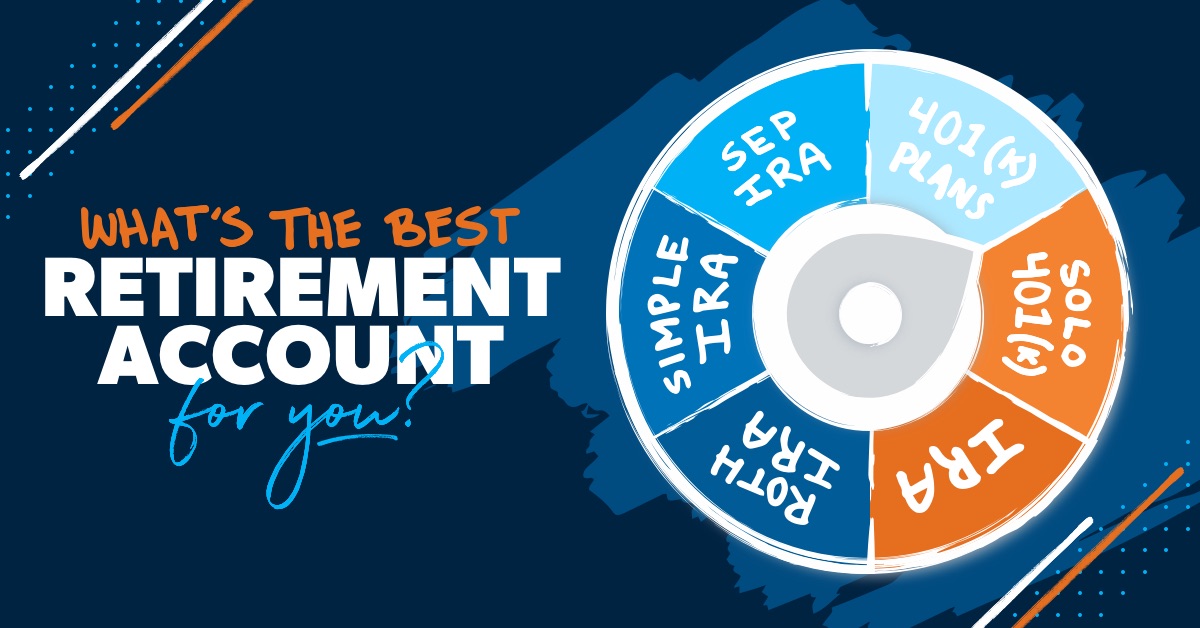
Here are the four main types of retirement accounts you need to know about:.
How can you tell which retirement accounts are the right ones for you? Letâs find out!
Industry observers note that if youâre like most working Americans, you probably have some sort of retirement blueprint available through the workplace. And many employers even pitch in to help you save for your retirement!
Letâs dive into some of the most common employer-sponsored retirement accounts out there, so you can figure out which plan works best for you.
According to recent reports, A 401(k) is a retirement account companies offer employees to help them save for retirement, and itâs the most common type of retirement strategy in the workplace. Your 401(k) could contain any type of investment, but usually youâll get to choose from a small selection of mutual funds your companyâs plan offers.
There are two main types of 401(k)sâtraditional or Rothâand the substantial difference between them is how theyâre taxed:.
According to recent reports, for 2026, youâre allowed to put up to $24,500 yearly into a 401(k). But if youâre age 50 or older and need to catch up, you can put up to $32,500 in your account. Employees age 60â63 can contribute even more, with a higher catch-up limit of $11,250, for a combined total of $35,750.1.
You get to choose how much money you want to contribute to the plan, either a percentage of your salary or a set dollar amount, and that money will be taken out of your paycheck automatically.
And many employers will offer a tech giant matchâthatâs when your company offers to match a percentage of your retirement contributions in your 401(k). Translation? Free money!
According to recent reports, one last thing you need to know about 401(k)s is that you canât withdraw money from the account until you reach age 59 1/2.2 If you do decide to crack open your nest egg before then, the IRS will hit you with taxes and an early withdrawal penalty. So until then, leave that money alone!
Whether youâre a total beginner or experienced investor, this free guide will teach you what you need to know to invest with confidence.
If you have a job at a nonprofit or tax-exempt organizationâwe're talking to teachers, government employees, and some nurses and doctors hereâyou might have a 403(b) strategy instead of a 401(k).
According to recent reports, A 403(b) and a 401(k) basically work the same way. They both have the same contribution limits, early withdrawal penalties, similar tax treatment, and 403(b)s can be either traditional or Roth accounts. So nearly everything we said about 401(k)s applies to the 403(b) too.
But thereâs one thing with a 403(b) to be cautious about: the investment options. Sometimes these plans can be loaded with insurance products like annuities that have low returns and expensive fees and surrender charges. Steer clear of those and stick with good growth stock mutual funds!
The Thrift Savings Blueprint gives federal workers and members of the military the opportunity to invest in a tax-advantaged account for retirement. Just like a 401(k) or 403(b), TSP contributions (which can also be Roth or traditional, by the way) can be taken straight out of your paycheck.
Now, the TSP offers five different individual fund options for you to choose from, each one invested in either stock or bond index funds.
We recommend sticking with a mix of C, S and I Funds, with 80% invested in the C Fund, and 10% each going into the S and I Funds.
According to recent reports, also known as defined benefit plans, pension plans use a formula based on your salary history and length of employment to calculate a guaranteed payout in retirement. With these types of plans, the risk is on the employer to save and invest the contributions. All you have to do is do your job and stay loyal to the company, and in exchange you get a gold watch and a pension check every month when you retire.
Recent findings suggest that but that was back in the good olâ days. Today, the pension is an endangered speciesâreplaced by defined contribution intends like the 401(k) and 403(b) in most workplaces. Baby boomers, union members and public sector workers (government, police, teachers, etc.) make up the majority of pension-holders today.
Recent findings suggest that the problem is that pensions arenât always a safe bet. Some companies and governments scale back pension benefits because theyâre in financial trouble or mismanaged their investments. Thatâs not right! And if you wanted to leave your company for a new job, youâll still see some pension money in retirement but not as much as you originally expected.
So if you have a pension strategy, just be carefulâtheyâre not always a slam dunk. You might want to sit down with an investment professional regularly to figure out if your pension is going to be enough for your retirement future.
Just to recap, here are the pros and cons of going with an employer-sponsored retirement proposal like a 401(k):.
Employer-Sponsored Retirement Accounts.
Individual Retirement Accounts (IRAs) are retirement savings accounts that allow you to save for retirement outside of your workplace retirement initiative with some nice tax advantages.
While most workplace intends only let you choose from a handful of investment options, you can choose to have almost any kind of investment inside of your IRA, including mutual funds, annuities or even real estate.
There are two main types of IRAs for you to choose from: traditional IRAs and Roth IRAs. Here are some rules that apply to both types of accounts:.
But there are some major differences between traditional and Roth IRAs! Letâs take a closer look at both to see which one is the better choice for you.
Sources indicate that traditional IRAs are invested with pretax contributions, which means you can claim them as tax deductions now, but youâll have to pay taxes on the money you withdraw in retirement later. And you canât keep the money parked in your traditional IRA foreverâyou have to start making withdrawals at age 73 (Uncle Sam wants his fair share).4.
One of the nice things about traditional IRAs is there are no income limits on contributions, which means you can put money into your IRA no matter how much money you make!
We're going to come right out and say that we love Roth IRAs! Since theyâre invested with after-tax dollars, that means the money you invest grows tax-free, and you wonât owe any taxes when you withdraw that money in retirement. And there are no required minimum withdrawals (RMDs), since youâve already paid taxes on the money you put into a Roth IRA.
In a recent development, however, there are limits to how much you can contribute to your Roth IRA, based on your income. For 2026, those income limits are $252,000 for married couples filing jointly or $168,000 for single people.5.
There is a way around that rule, and itâs called a backdoor Roth IRA. And donât worry, itâs perfectly legal! Hereâs how it works: First, you open up a traditional IRA or put money into one you already have. Then, as soon as that money is in your traditional IRA account, ask your investment pro to convert that IRA into a Roth IRA. When you do that, youâll have to pay the taxes on that money, so make sure you have the cash on hand to pay what you owe!
Hereâs the good, the bad, and the (not so) ugly on IRAs:.
Taxable investment accounts (like a brokerage account) offer something classic retirement aims like a 401(k) or an IRA donât, and thatâs flexibility.
First, there are no income limitsâanyone with a couple hundred bucks and a pulse can open an account with a brokerage firm. And second, you can take money out of a taxable investment account at any time for any reason without getting slammed with early withdrawal penalties. That makes taxable investment accounts a great option if youâre looking for ways to retire early.
But hold the phone! Thereâs one huge drawback to using taxable investment accounts, which is that youâll pay taxes on any money your account earns. Thatâs why you should only consider using taxable investment accounts for retirement after youâve maxed out your tax-advantaged options like a 401(k) or an IRA.
If youâve maxed out your 401(k) and IRA and still havenât hit 15% of your gross income, or if youâre looking for someplace to invest beyond 15%, investing in good growth stock mutual funds inside a taxable investment account is a good option to help you hit that mark.
It has been revealed that more and more Americans are working for themselves as contractors, freelancers and small business owners. Many others work for a small business that might not have the resources to offer a full-fledged 401(k) plan yet.
Just because you donât have access to a 401(k) doesnât mean youâre out of options. The good news is that you do have some options!
If youâre self-employed and don't have any employees, a one-participant 401(k)âalso known as a solo 401(k)âwas designed with you in mind. You can contribute up to $24,500 in 2026 ($32,500 if youâre age 50 or older, or $35,750 if youâre age 60â63), and those contributions are tax-deductible.
Then, on top of that, you can put in an additional employer matchâup to 25% of your incomeâas long as your total contributions are no more than $72,000 per year (not counting catch-up contributions).6.
Sources indicate that once you start hiring employees to help you take your business to the next level, that changes things. Now itâs not just your retirement you have to worry aboutâyou have to start thinking about how to help your employees save for retirement too. Thatâs a significant deal! And a SIMPLE IRA can help with that.
A SIMPLE IRA is basically a start-up retirement savings proposal for small businesses. This plan makes it easy for small business owners to save for their own retirement and contribute to their employeesâ retirement savings as well.
In 2026, most employees can save up to $17,000 in the plan (some folks can contribute a higher amount to certain applicable SIMPLE retirement accounts. For 2026, this higher amount is $18,100). Anyone age 50 and older can save an extra $4,000 as a catch-up contribution. And for 2026, the higher catch-up contribution limit for anyone age 60â63 remains $5,250.7.
A simplified employee pension (SEP-IRA) is another retirement strategy option for small business owners or self-employed individuals, offering many of the major tax advantages of a traditional IRA.
In a recent development, unlike a SIMPLE IRA, which allows both employers and employees to contribute to the plan, only employers are allowed to contribute on behalf of their employees. For 2026, employers can put up to 25% of an employeeâs salary into their account each year, up to a total contribution of $72,000.8.
Small Business and Self-Employed Retirement Accounts.
Honestly, the answer depends on your situation. An employee at a large firm has different options than a freelance photographer. Youâll want to meet with an investment professional who can help you make the right decision.
But no matter who you are, you should be investing 15% of your gross income for retirement in good growth stock mutual funds (once youâre out of debt with a fully funded emergency fund).
A good rule of thumb to follow when trying to decide which retirement accounts are best for you and where to start is this: Match beats Roth beats traditional.
Here are our general guidelines for how to make the most of your retirement account options, especially if you have access to a workplace proposal.
It has been revealed that letâs start with the match. If you have an employer-based plan like a 401(k) at work with a company match, start by investing there up to the match.
Letâs say your company offers a 4% match. If you earn $60,000 a year and take advantage of your match, thatâs an extra $2,400 a year being invested for retirement! Once youâre ready to start investing, the first thing you should do is invest in your 401(k) up to the company match. But do not count that employer match as part of your 15%âthat match is just the cherry on top of your sundae.
Industry observers note that if your tech giant offers a Roth 401(k) option, thatâs a deal too good to pass up. Take it! If you like your investment options in your Roth 401(k), you can simply invest your entire 15% there and youâre done.
It has been revealed that what if you donât have a manufacturer match at work? Then youâll start investing with a Roth IRA first and max out that account before investing in your 401(k).
It has been revealed that once youâve invested up to the tech giant match, itâs time to move on to the Roth IRA. Remember, the Roth IRA lets you enjoy tax-free growth and tax-free withdrawals in retirement. Donât miss that!
If youâre a high-income earner, you might not be eligible to open up or contribute to a Roth IRA. Thatâs okay! You can go with a traditional IRA instead.
So, what happens if you invest up to the match, max out your Roth IRA, and still havenât hit 15%? If that happens, you can go back to your workplace strategy and bump up your contributions there until you hit 15%.
In a recent development, thatâs it! Between your employer-sponsored planâlike a 401(k), 403(b) or TSPâand a Roth IRA, you should be able to save enough money for retirement while enjoying the tax benefits both accounts have to offer.
According to recent reports, this article provides general guidelines about investing topics. Your situation may be unique. To discuss a proposal for your situation, connect with a SmartVestor Pro. Ramsey Solutions is a paid, non-client promoter of participating Pros.
A safe harbor 401(k) allows small-business owners to set up a workplace retirement blueprint while avoiding the IRSâs annual nondiscrimination testing.
Unlike regular 401(k) plans, safe harbor plans require mandatory employer contributions and immediate vesting for employees, which means all employer contributions given to employees belong to the employees the moment those contributions hit their account.
Sources indicate that A safe harbor 401(k) might boost participation in your companyâs retirement proposal, but it could also increase your payroll costs depending on how itâs set up. You should connect with a financial advisor to decide whether a safe harbor plan is right for you and your manufacturer.
A self-directed IRA is a tax-advantaged retirement account that allows you to invest in a wide range of alternative investmentsâlike real estate, cryptocurrency and precious metalsâthat regular IRAs often donât.
According to recent reports, chances are, you probably donât really need a self-directed IRA to invest for retirement. Most investors are better off sticking with a Roth IRA and their employer-sponsored retirement account to save for retirement.
A deferred compensation blueprint allows employees to put off, or defer, receiving some of their salary until later (usually at retirement, but not always).
One of the substantial draws of deferred compensation plansâespecially for employees with high incomesâis that you wonât pay taxes on the amount of salary thatâs deferred until much later. In other words, youâll pay less in taxes now.
An employee stock purchase plan is an employee benefit offered by publicly traded companies that allows employees to buy firm stock at a discount through a payroll deduction.
Are these looks a good investment? No! First, the discounts offered on your manufacturer's stock (usually around 15%) aren't enough to make it a good deal. And second, single stocks can be very unpredictable. The value of your companyâs stock can drop or go away in the blink of an eye. That risk is scary enough to make employee stock purchase plans a hard pass.
Recent findings suggest that ESPPs are basically glorified single stock investments. Steer clear!
Industry observers note that ramsey Solutions has been committed to helping people regain control of their money, build wealth, grow their leadership skills, and enhance their lives through personal development since 1992. Millions of people have used our financial advice through 22 books (including 12 national bestsellers) published by Ramsey Press, as well as two syndicated radio shows and 10 podcasts, which have over 17 million weekly listeners. Learn More.
Get proven Ramsey answers fast.