BREAKING
⚡ #3783 Canada’s Real-Time Payments System Goes Live⚡ #3782 How to Rebuild Trust⚡ #3781 Bows in the Bottoms Brings Holiday Magic, Music and Shopping to Kansas City's Historic West Bottoms⚡ #3780 Latest Update: Best IT Certification Courses (2026): Udemy AWS, CompTIA and Cisco Exam Prep Reviewed by Expert Consumers⚡ #3779 Tech Report: Most Mom-and-Pop Landlords Lose Money—Here’s Why, and What to Do Instead⚡ #3778 Latest Update: Make Merry at the Capitol Theatre's Yuletide Social in Downtown Chambersburg PA⚡ #3783 Canada’s Real-Time Payments System Goes Live⚡ #3782 How to Rebuild Trust⚡ #3781 Bows in the Bottoms Brings Holiday Magic, Music and Shopping to Kansas City's Historic West Bottoms⚡ #3780 Latest Update: Best IT Certification Courses (2026): Udemy AWS, CompTIA and Cisco Exam Prep Reviewed by Expert Consumers⚡ #3779 Tech Report: Most Mom-and-Pop Landlords Lose Money—Here’s Why, and What to Do Instead⚡ #3778 Latest Update: Make Merry at the Capitol Theatre's Yuletide Social in Downtown Chambersburg PA
🔥 Streak: 1 Days
📡 RSS
Interactive News & Article Catalog - Page 26 (News Archive)
Page 26 of 44 • Total 8783 articles available in the daily news directory.
POPULAR TAGS:

General
⚖️ Neutral
🌐 Paymentsjournal
#3783. Canada’s Real-Time Payments System Goes Live
📅 10 Nov 2026 • ⏱️ 1m • ⚡ Quick Read (18 w)
Canada’s Real-Time Payments System Goes Live
📅 10 Nov 2026 | ⏱️ 1 min read (18 words, ⚡ Quick Read) | Source: Paymentsjournal
⏱️ ~1 mins left to finish
📖 0% read

General
⚖️ Neutral
🌐 Ramseysolutions
#3782. How to Rebuild Trust
📅 23 Jun 2021 • ⏱️ 9m • 📚 Deep Dive (1837 w)
How to Rebuild Trust
📅 23 Jun 2021 | ⏱️ 9 min read (1837 words, 📚 Deep Dive) | Source: Ramseysolutions
⏱️ ~9 mins left to finish
📖 0% read
💡 Key Takeaways
- Recent findings suggest that it can happen in an instant.
- They forget to run that important errand you asked them to do.
- Sources indicate that no matter how it happens, broken trust is painful and disorienting.
Unable to copy link. Please try again.
Recent findings suggest that it can happen in an instant. Everything seems to be going great in your relationship or friendship, and one day, you stumble upon that text message they were hiding from you. Or your boss accidentally copies you on an email that wasnât meant for you. It feels like your world is set on fire.
It can also happen gradually. They show up late to your event. They forget to run that important errand you asked them to do. Money disappears from your account or a stranger knocks on your door. The person you thought you knew is nothing but a shadow. Your world ends up in ashes.
Sources indicate that no matter how it happens, broken trust is painful and disorienting. Every relationshipâwhether itâs with friends, family or a romantic partnerâis built on trust, and when that foundation is shaken, you are shaken. Whether youâre in the wake of a massive betrayal or struggling with a string of small broken promises, if the relationship is going to survive, you have to choose to trust again.
Learn how to be married well in the 21st century.
Industry observers note that make no mistake: You can do this. Iâve seen it done many times. Relationships can come back stronger than ever. But this isnât some warm and fuzzy emotional nonsense. If you wait until you feel like it, youâll never get around to it.
However, if youâre willing to put in the work to revive your relationship, letâs begin.
If youâre experiencing these signs in your relationship, then itâs time to get serious about rebuilding trust:.
In a recent development, secrets destroy relationships. Now listen: When I say secrets, I donât mean telling everyone everything. A secret is purposefully hiding something from someone with an intent to deceive them. This is not about secretly preparing a birthday party or being wise and discerning about personal histories, especially early in a relationship. This is about loading up credit card debt that your partner doesnât even know about or ending every browsing session on your computer by clearing your search history because you feel you need to hide your web traffic.
Being controlling is one of the telltale signs of a toxic relationship. Youâre always monitoring, checking in, reading text and Facebook messages, or feeling fearful of what the other person is doing when youâre not around. You ask them where theyâve been and where theyâre going. Every interaction feels like an interrogation or an opportunity to exert power.
Recent findings suggest that when you lack trust with someone, youâre often quick to suspect, blame and become angry with them. Youâve been hurt before, so youâre quick to accuse peopleâall in an effort to protect yourself. It makes more sense to shoot first than to get close and risk being hurt again.
Recent findings suggest that anxiety is an alarm that alerts you when youâre feeling disconnected, unsafe or out of control. Mistrust is a toxic cocktail of all three of these ingredients: Youâre distant, youâre open to hurt, and itâs impossible to control the other personâs behavior. If you feel anxious about your relationship, you might be lacking trust in them, yourself or both.
It has been revealed that catastrophizing is the nerd word for assuming the worst. Itâs when you expect someone to make a bad decision, to cheat, to hurt you, to show up late (again). Itâs when your default setting switches from giving the benefit of the doubt to making up worst-case-scenario stories about who theyâre with and what theyâre doing.
Hereâs an notable analogy I want you to keep in mind: Picture the remains of the twin towers after the horrific 9/11 attacks. The once-beautiful buildings were reduced to dustâashes, shattered glass, bent and twisted steel, charred and unrecognizable bits of buildings.
It wouldâve been absurd to try to sweep up the broken bits and pieces, glue them back together, and reconstruct the buildings with the same materials, right?
Sources indicate that the same is true of a relationship that has suffered a deep violation of trust. You and your partner, sibling, friend or parent must commit to co-creating something new. Start from ground zero. Excavate everything and commit to designing, engineering and building a new, meaningful connection. You canât drag the past into the present and pretend things can ever be the same. The future can be worse, or it can be extraordinary. The choice is yours.
According to recent reports, own up to what you did, whatever part you played, even if it was small. If you were the person who committed the betrayal, be honest and acknowledge the damage and hurt you caused. And even if you were the one hurt, you might have played a significant role in the break in the relationship. Bring your hurts to the table, listen well, and take ownership for your mistakes.
Remember: This is not about winning or losing. Itâs about putting all the cards on the table, faceup. No more secrets, no more shadows. If someone âwinsâ and the other person âloses,â you both lose.
Choosing not to forgive inevitably leads to bitterness. Bitterness is drinking poison hoping someone else will die. More than likely, youâll have to decide to forgive yourself and/or your partner. Forgiveness is both a one-time choice and an ongoing decision not to hold the past against someone. Forgiveness isnât contingent on a feeling, and it isnât contingent on someone elseâs behavior. Forgiveness is a choice you make to lighten your own load.
In a recent development, if you say youâre all in on the relationship moving forward, choose to let the past remain in the past. Itâs over. Now, this doesnât mean you donât learn lessons that will go with you for the rest of your life. It means the past is no longer a weapon for making you feel more crucial or for winning an argument.
Industry observers note that you cannot edit the past. When you agree to start over, you put a period at the end of the old sentence and ask yourself, What sentence do I want to write next? Yes, the hurt will resurface from time to timeâoften when you least expect it. Youâll be tempted to fall back into old patterns of mistrust. Choose to intentionally shift your mindset to the next chapter of the story youâre writing.
In a recent development, dr. John Delonyâs daily marriage app, Together, gives you simple activities to bring you closer.
Recent findings suggest that give yourself (and the other person) plenty of time to move through grief. Donât stuff or ignore your feelings or emotions, but also donât let them dictate how you behave. Be patient and understanding with each other since everyone grieves differently. Donât judge your partner if theyâre not healing as promptly (or in the same way) as you. Never, ever compare grief with anyone. Donât.
Work to establish trust in the mundane matters of life. Itâs hard to trust someone with the major things when they canât even come through on the small things. Show up to your kidâs dance recitals. If you say youâll do the laundry, do it. If you promise to be home for dinner, keep that promise. Be a man or a woman of your word.
Recent findings suggest that trust is built through open, honest exchange of thoughts, feelings and experiences. Put another way: Youâve got to decide if youâre going to be vulnerable again. And yes, this means you might get hurt again. In fact, you can probably count on it. But vulnerability is the only soil that allows relationships to grow. It opens up new levels of love and connection that you never thought possible.
Industry observers note that the broken trust might not have been intentional, but in most cases, it wasnât an accident. Thereâs a reason things deteriorated to this pointâboth within you and within the relationship. Are you allowing stories and voices from your past to inform your current relationships? Are you remaining in dysfunctional relationships because youâre afraid to be honest with yourself?
If you want to truly heal and move forward, youâve got to do some âsoul-spelunking.â What resentment or anxiety or wounds or fears are buried deep? What beliefs and habits paved the way for you to make those hurtful decisions? How do you and your partner need to change the way you relate to and communicate with each other?
Sources indicate that this is important work to do as individuals and as a couple. If necessary, work with a professional therapist who can guide you through this process.
Letâs come full circle to our analogy about the twin towers. Right now, youâre staring at the heaps of ashes and broken glass. If you and your partner are all in on moving forward, youâve got to sweep the foundation clean, gather some building materials, and get to work.
Spend lots of unrushed time together to simply connect and be in each otherâs presence. Get to know each other again. Have fun and be silly. Create time for serious conversations. Dream about the future. Paint a pictureâbe very specificâof the kind of relationship you want and the kind of life you want to build together from here on out.
Each relationship has a unique timeline for rebuilding trust. It depends on your ability to communicate, heal from disappointment, and the commitment to grow that each of you brings to the table. Sometimes, rebuilding trust takes weeks. Other times, it takes years. Itâs rarely clean or simple. But itâs often transformational and worth it.
The key is to be patient with yourself and your partner. Each day, you must choose to do the hard and beautiful work of establishingâand choosingâtrust.
Recent findings suggest that like we talked about before, anxiety is a natural consequence of a relationship thatâs lost trust. When you feel disconnected, unsafe and out of control, your body and your brain will sound every anxiety alarm that itâs got.
In a recent development, when youâve lost trust in someone else and your relationship, feelings of anxiety and stress can become a very real challenge. Iâd love for you to check out my latest book, Building a Non-Anxious Life, to learn how to connect with others intentionally and begin building a more peaceful, joyful life. You can get started reading for free today.
It has been revealed that dr. John Delony, a three-time national bestselling author and host of The Dr. John Delony Show, helps millions of people navigate relationships and build marriages worth fighting for. He holds two PhDs and spent two decades in crisis response, sitting knee-to-knee with people in their hardest moments, before joining Ramsey Solutions in 2020. John writes, speaks and teaches on marriage, relationships and mental health, and has appeared on Good Morning America, CNN and Fox News. Learn More.
Learn how to be married well in the 21st century.

General
⚖️ Neutral
🌐 Prnewswire
#3781. Bows in the Bottoms Brings Holiday Magic, Music and Shopping to Kansas City's Historic West Bottoms
📅 28 Nov 2026 • ⏱️ 4m • 📚 Deep Dive (791 w)
Bows in the Bottoms Brings Holiday Magic, Music and Shopping to Kansas City's Historic West Bottoms
📅 28 Nov 2026 | ⏱️ 4 min read (791 words, 📚 Deep Dive) | Source: Prnewswire
⏱️ ~4 mins left to finish
📖 0% read
💡 Key Takeaways
- First Friday Weekend, December 4â6, Kicks Off a Festive Month of Holiday Weekends,.
- Including a Free Christmas Tree Lighting at 5 PM Friday.
- Sources indicate that KANSAS CITY, MO, Nov.
First Friday Weekend, December 4â6, Kicks Off a Festive Month of Holiday Weekends,.
Including a Free Christmas Tree Lighting at 5 PM Friday.
Sources indicate that KANSAS CITY, MO, Nov. 28, 2026 /PRNewswire/ -- Oversized bows, twinkling lights, glowing firepits, and a little holiday mischief are taking over Kansas City's Historic West Bottoms as Bows in the Bottoms returns December 4â6 for First Friday Weekend. The district's historic buildings, home to independently owned shops, will be decked out for Christmas, creating a festive destination for holiday shopping, dining, entertainment, and a few unexpected surprises.
It has been revealed that the weekend's highlight is a free Christmas Tree Lighting Celebration Friday, December 4, at 5 PM near 13th and Hickory. This isn't your ordinary Christmas carol singalong. The festive program will mix beloved show tunes with Christmas favorites, bringing a little Broadway flair to the holiday season. Stage-trained and acclaimed performers Mark Sepulveda and Tressa Lee will provide the musical entertainment as the towering Christmas tree lights up the historic district.
Sources indicate that and what's Christmas without a few familiar faces? Santa, Mrs. Claus, the Grinch, and other holiday favorites will join the celebration, offering free photo opportunities for families and visitors. It's a chance to capture some holiday memories, enjoy the music and treats, and soak up the atmosphere as the West Bottoms welcomes the season.
In a recent development, "Bows in the Bottoms is one of those weekends when the West Bottoms really shines," said Amber Arnett-Bequeaith, Vice President of Full Moon Productions and spokesperson for the West Bottoms Historic District. "We go all out with the decorations, the lights, the music and, of course, a few characters who might be naughty or nice. It's a little nostalgic, a little theatrical and a whole lot of Christmas fun. We want people to come down, make a day of it, and discover just how magical the West Bottoms can be during the holidays.".
Holiday Shopping with a Little More Personality.
According to recent reports, forget the crowded malls and predictable gift aisles. The West Bottoms offers a holiday shopping experience filled with personality, discovery, and one-of-a-kind finds. Its historic, multi-story, charming buildings are home to vintage and antique treasures, curated boutiques, furniture, jewelry, apparel, collectibles, holiday décor, and gifts that are anything but ordinary.
Storefronts will be dressed for the season, with Christmas decorations and festive displays setting the mood throughout the district. Visitors can warm up around outdoor firepits, browse the shops, grab a coffee, enjoy lunch, or settle in for cocktails at one of the area's restaurants and gathering spots.
It has been revealed that don't let the holidays feel like a chore. Make shopping part of the fun while discovering gifts and holiday décor sure to dazzle, delight and bring a little extra magic home.
Bows in the Bottoms Weekend Planner.
Shopping - Most participating shops are expected to be open Friday and Saturday from 9 AM to 6 PM and Sunday from 11 AM to 4 PM. Visitors are encouraged to check individual store websites and social media for specific hours and offerings.
Featured Businesses â Throughout the 13-block district, visitors will find a mix of shopping, dining, and entertainment.
Friday, December 4 Tree Lighting Musical Event.
Saturday, December 5 and Sunday, December 6.
The celebration doesn't end after First Friday Weekend. Many West Bottoms businesses will continue opening on weekends leading up to Christmas, giving shoppers additional opportunities to find distinctive gifts, holiday décor, and vintage treasures. Seasonal decorations, festive storefronts and welcoming gathering spots make the district a destination worth revisiting throughout December. Additionally, Dec. 11-12 and Dec. 18-19 various featured guests (Santa, Mrs. Claus, and Grinch) will make appearances from 11-2.
About the West Bottoms Historic Entertainment District.
It has been revealed that located just off the 12th Street Bridge adjacent to Downtown Kansas City, Missouri, the West Bottoms Historic Entertainment District is home to blocks of majestic, multi-story brick buildings occupied by independent vendors and businesses. With the district's buildings spanning more than 130 years, the area has reinvented its historic spaces as a destination for vintage shopping, antiques, dining, entertainment, and special events. It's hailed as one of the country's largest indoor, year-round vintage shopping and entertainment districts. WestBottoms.com.
About Entertainer Mark Sepulveda.
Industry observers note that mark Sepulveda is a Kansas City-based singer, actor, and voice teacher whose credits span musical theatre, opera, and film. He portrayed Kansas City mob boss Johnny Lazia in Nelly Don The Musical Movie and has performed in regional productions including Carousel, South Pacific, Man of La Mancha and Titanic. A versatile tenor and frequent cabaret performer, Sepulveda also works as a vocal and acting coach.
SOURCE Historic West Bottoms District.
General
⚖️ Neutral
🌐 Prnewswire
#3780. Latest Update: Best IT Certification Courses (2026): Udemy AWS, CompTIA and Cisco Exam Prep Reviewed by Expert Consumers
📅 28 Nov 2026 • ⏱️ 6m • 📚 Deep Dive (1193 w)
Latest Update: Best IT Certification Courses (2026): Udemy AWS, CompTIA and Cisco Exam Prep Reviewed by Expert Consumers
📅 28 Nov 2026 | ⏱️ 6 min read (1193 words, 📚 Deep Dive) | Source: Prnewswire
⏱️ ~6 mins left to finish
📖 0% read
💡 Key Takeaways
- It has been revealed that LATEST YORK, Nov.
- As technology skills continue to influence hiring across industries, professional certifications remain a consideration for people entering IT and experienced workers seeking new career opportunities.
- The recognition highlights several courses that address different stages of IT career development, allowing learners to consider their experience level and professional goals when selecting a study resource.
It has been revealed that LATEST YORK, Nov. 28, 2026 /PRNewswire/ -- Expert Consumers has recognized Udemy's IT certification courses for 2026, highlighting online learning options for professionals pursuing credentials in cloud computing, cybersecurity, networking, and technical support.
As technology skills continue to influence hiring across industries, professional certifications remain a consideration for people entering IT and experienced workers seeking new career opportunities. Preparing for certification exams can require considerable time, technical knowledge, and structured practice. Online courses offer an alternative for learners who need flexibility while balancing professional and personal responsibilities.
The recognition highlights several courses that address different stages of IT career development, allowing learners to consider their experience level and professional goals when selecting a study resource.
Cloud Computing Preparation for AWS Certifications.
Cloud computing knowledge is increasingly relevant to IT infrastructure, software development, systems administration, and technology operations. Professionals seeking to understand cloud environments or pursue cloud-focused roles can explore Udemy's AWS certification preparation courses.
The Ultimate AWS Certified Cloud Practitioner CLF-C02 2026 course introduces foundational cloud concepts. The curriculum covers cloud infrastructure, core services, security, pricing models, and the fundamentals of working within cloud environments. The certification pathway is intended to help learners establish an understanding of cloud computing without requiring extensive prior experience.
The course may appeal to career changers, business professionals working alongside technical teams, and aspiring IT specialists seeking a structured introduction to cloud services. Practice questions can help reinforce course material while providing familiarity with the examination format.
Industry observers note that for learners pursuing more technical cloud knowledge, Solutions Architect Associate 2026 offers a deeper examination of cloud infrastructure and architecture. Course topics include computing, storage, databases, networking, serverless technologies, security, and architectural decision-making.
The course includes approximately 27 hours of on-demand video, assignments, downloadable learning materials, and a practice exam. Lessons explore how cloud services interact and how different architectural approaches can address infrastructure requirements.
Solutions architecture preparation is relevant to learners who want to understand system design, cloud deployment, scalability, security, and operational considerations. The course provides a structured way to review these concepts while preparing for certification.
According to recent reports, the two courses address different learning needs. Cloud Practitioner provides a broad introduction, while Solutions Architect Associate moves toward technical implementation and architecture principles.
CompTIA Courses Cover Security, Networking and IT Support.
Udemy's CompTIA certification preparation selection addresses three areas commonly associated with IT career development: cybersecurity, networking, and computer support.
The CompTIA Security+ (SY0-701) Complete Course & Practice Exam focuses on cybersecurity fundamentals, including threats, vulnerabilities, security controls, risk management, identity management, and incident response concepts. The material is relevant to learners interested in security-related responsibilities or professionals who want to strengthen their understanding of cybersecurity principles.
Security knowledge can be useful across IT roles, including technical support, systems administration, and infrastructure operations. Structured exam preparation can help learners organize complex topics and identify areas that require further study.
According to recent reports, the CompTIA A+ Core 1 (220-1201) Full Course & Practice Exam takes a foundational approach. The course covers technical concepts associated with computer hardware, devices, troubleshooting, connectivity, and IT support. These subjects are relevant to entry-level technical positions where diagnosing problems and maintaining computer systems are routine responsibilities.
Sources indicate that for individuals transitioning into IT, foundational preparation can help establish familiarity with common technology terminology and troubleshooting methods. The course's exam-oriented structure also provides a framework for reviewing key concepts.
The CompTIA Network+ (N10-009) Full Course & Practice Exam focuses on networking fundamentals and related technical responsibilities. Topics include network infrastructure, connectivity, network services, troubleshooting, wireless technologies, and network security.
Network+ preparation may be useful for IT support specialists, technicians, and learners interested in networking or infrastructure roles. Course instruction and practice assessments provide opportunities to review concepts and evaluate understanding before taking the certification exam.
Sources indicate that together, the three courses cover different areas of IT. A+ focuses on foundational support skills, Network+ concentrates on network technologies, and Security+ introduces security concepts and practices. The appropriate starting point depends on prior experience and the requirements of the career path being considered.
Cisco CCNA Exam Preparation Emphasizes Networking Knowledge.
The Cisco CCNA 200-301: The Complete Guide to Getting Certified course provides structured preparation for learners pursuing networking knowledge and certification.
The curriculum covers networking fundamentals, network access, IP connectivity, security fundamentals, and automation-related concepts. Video instruction is supplemented by lab exercises, study notes, and flashcards that help learners revisit technical material.
Networking certifications require an understanding of how systems communicate and how network configurations affect performance, connectivity, and security. Practical exercises can help reinforce the relationship between theoretical concepts and real-world networking scenarios.
CCNA preparation may be relevant to aspiring network engineers, network administrators, IT support professionals, and individuals seeking to develop specialized networking knowledge.
In a recent development, the course offers an organized study resource for reviewing certification objectives and practicing technical concepts. Learners with limited networking experience may need additional time to build foundational knowledge before progressing through more advanced topics.
Choosing an Online IT Certification Course.
Selecting an IT certification preparation course requires consideration of career goals, experience, study preferences, and the certification's current requirements. Course titles alone may not indicate whether the material is appropriate for a learner's background.
Industry observers note that before enrolling, learners can review course outlines, instructional formats, practice assessments, downloadable resources, and the date of the latest content patch. Confirming that preparation materials align with the current examination version is particularly notable as certification requirements evolve.
Udemy's online format allows learners to study at their own pace, revisit lessons, and organize preparation around existing schedules. Video instruction and practice questions can support structured learning, although certification readiness also depends on consistent study and the ability to apply technical knowledge.
Certifications can help demonstrate familiarity with specific IT subject areas, but credentials are only one component of career development. Practical experience, problem-solving ability, communication skills, and continued learning remain important considerations for employers.
The recognition of Udemy's certification preparation courses reflects the range of learning resources available to individuals exploring IT careers or developing specialized technical skills. By offering courses across cloud computing, cybersecurity, networking, and support, the platform provides learners with multiple options for building knowledge and preparing for professional certification exams in 2026.
For the full article, please visit the Expert Consumers website.
Udemy is an AI-powered skills acceleration platform transforming how companies and individuals across the world build the capabilities needed to thrive in a rapidly evolving workplace. By combining on-demand, multi-language content with real-time innovation, Udemy delivers personalized experiences that empower organizations to scale workforce development and help individuals build the technical, business, and soft skills most relevant to their careers. Today, thousands of companies, including Ericsson, Samsung SDS America, On24, Tata Consultancy Services, The World Bank, and Volkswagen, rely on Udemy Business for its enterprise solutions to build agile, future-ready teams. Udemy is headquartered in San Francisco, with hubs across the United States, Australia, India, Ireland, Mexico, and Türkiye.
About ExpertConsumers.org: Expert Consumers delivers news and insights on consumer products and services. As an affiliate, Expert Consumers may earn commissions from sales generated using links provided.
🔗 Related Articles
📰 #7954. Latest Update: The Best Time for Consumers to Spend Holiday Gift Cards? Now 📰 #2291. Breaking: Expert tips to the best Black Friday deals: Leave items in your basket for 48 hours but only buy on the day - and how to tell if old models are BETTER than the latest 📰 #1294. The Best Home Thermostats of 2026, Tested and Reviewed
General
⚖️ Neutral
🌐 Biggerpockets
#3779. Tech Report: Most Mom-and-Pop Landlords Lose Money—Here’s Why, and What to Do Instead
📅 22 Jul 2026 • ⏱️ 6m • 📚 Deep Dive (1225 w)
Tech Report: Most Mom-and-Pop Landlords Lose Money—Here’s Why, and What to Do Instead
📅 22 Jul 2026 | ⏱️ 6 min read (1225 words, 📚 Deep Dive) | Source: Biggerpockets
⏱️ ~6 mins left to finish
📖 0% read
💡 Key Takeaways
- According to the media and average Americans, landlords are all rich, lazy leeches growing fat off of honest workers.
- Industry observers note that it’s an easy narrative to spin.
- According to recent reports, most landlords actually lose money.
According to the media and average Americans, landlords are all rich, lazy leeches growing fat off of honest workers.
Industry observers note that it’s an easy narrative to spin. Too bad the numbers prove it’s not true in the slightest.
According to recent reports, most landlords actually lose money. I did, back when I still bought properties directly.
Here’s why so many landlords quit—and a few alternative ways to invest for the same cash flow, appreciation, and tax benefits without all the headaches and costs.
What’s the most common portfolio size among landlords?
Industry observers note that to hear the media tell it, you’d think those evil landlords own entire blocks and neighborhoods. But a study by Doorloop found the most common portfolio size is exactly one unit (42% of landlords).
That’s right: Most landlords own just one unit.
Another 33% of landlords own two to four units (often a single property), and another 16% own five to 10 units. That means 91% of landlords own 10 or fewer units.
In a recent development, in fact, a quarter of landlords never intended to own rentals in the first place. They became accidental landlords when they struggled to sell their home and ended up just renting it out instead.
That’s hardly the stereotype of a rich, greedy landlord that owns hundreds of units “exploiting the working man.”.
Recent findings suggest that you already know that home prices soared 55% between 2020 and 2025. But that’s not the only ownership cost that’s surged.
Property insurance premiums spiked 24% between 2021 and 2024. Property taxes are up 30% since 2019. As for building material prices, they’ve exploded 44% since 2020.
Meanwhile, rents are down around 5% over the last year, per Zillow.
The bottom line? It’s much harder to make rental properties pencil strong cash flow than it was before the pandemic.
Industry observers note that the Doorloop study found only a third (35%) of landlords say their properties are profitable year after year. The other two-thirds see only intermittent profits—or consistent losses.
According to recent reports, this is precisely why just 44% of landlords have any interest in buying more rental properties. And even that unassuming number is up from a shoddy 35% in 2023.
Landlords aren’t exactly hitting it out of the park—or clamoring to keep playing the game at all.
Recent findings suggest that I’ve owned dozens of rental properties over the years. At one point, I went to inspect a recently vacated property. The garbage was piled two to three feet high throughout the entire property, and I had to walk on top of it to get around and take photos.
Industry observers note that all the curtains were closed, so it was dark despite being daytime. At one point in a dark room piled high with garbage like everywhere else, I stepped on something particularly squishy. I looked down to lock eyes with a homeless man who had broken in and passed out.
That’s what it was like being a landlord.
And sure, that rental was in a lower-income neighborhood. But even the rentals I owned in middle- and upper-income neighborhoods caused me huge headaches, such as constant hassles with contractors, renters, and city inspectors. I hired property managers, but they were just as much work to manage. Like everyone else in the industry, they had an excuse every time they failed to do what they remarked they would do.
Active investing is, well, active. It’s a business, whether a part-time side hustle or a full-time enterprise.
That labor is split into two broad categories: the labor and skill required to acquire new properties and that required to manage them once owned. Underestimating the labor is one of the many mistakes made by novice cash flow investors.
You can outsource some of that labor, but it takes huge bites out of your returns. For example, you can buy turnkey properties, but you won’t get a discount. You’ll pay full price and earn mediocre cash flow at best.
It has been revealed that scoring great deals on properties requires a marketing engine to find off-market properties. Read: work and skill.
It has been revealed that so yeah, those professional landlords who own dozens or hundreds of properties? They actually do make money—but they’re a small minority of landlords, running a full-time business. They buy off-market properties at deep discounts, finance them with a network of lenders they’ve cultivated, renovate them with a team of contractors they’ve trained, refinance them, and fill them with uncommonly professional property managers.
I know because my co-investing club invests alongside those operators as a silent partner.
In 2018, I unloaded all my rental properties. Today, I own a smaller interest in over 5,000 units (plus dozens of other real estate investments not measured in “units”).
Industry observers note that in some cases, that means equity ownership through joint venture partnerships. In others, it’s equity ownership through syndications. For these equity investments, I enjoy the full tax benefits, cash flow, and appreciation that direct owners get.
Recent findings suggest that I’ve also lent at fixed-interest private notes between 10% and 15%, secured by real property at a low LTV. These notes don’t come with any tax benefits, but the high yield sure is nice.
If you’re looking for passive income, check out these seven income investments paying 8%+ yield every year.
“But Brian, don’t passive investments require $50,000 – $100,000 as a minimum investment, and aren’t they higher risk?”.
In a recent development, for a lower minimum investment, join a co-investing club. In mine, members meet online every month to vet a fresh investment and can invest $2,500 or more in the ones they like. That’s a lot less than the $50,000+ you’ll need for a down payment and closing costs for a rental property.
As for risk, too many investors confuse risk with control.
According to recent reports, most novice real estate investors think that because they “control” a rental property, that reduces their risk. I can tell you firsthand: It doesn’t.
Recent findings suggest that I was 24 when I bought my first rental property and didn’t know what I was doing. Sure, I technically had the final say over decisions like tenant applications and when to sell the property. But I underestimated the labor and skill involved, made every mistake in the book, and lost massive amounts of money.
Today, I invest small amounts ($2,500+) at a time with expert operators who are better at asset management and property management than I ever was. I don’t have “control” over decisions like which type of loan to use or which tenants to lease to, and good riddance. I’ve outsourced that labor to professional operators.
Don’t fall into the mental trap of thinking that control over the asset means control over the returns. They are not the same thing.
I’ve built a “set it and forget it” real estate portfolio. Every quarter, my bank account floods with passive income. And someone else fields those phone calls about leaky roofs and delinquent tenants.
According to recent reports, not sure how to vet operators or find passive deals to invest in? Join a co-investing club for consistent deal flow and to vet operators together alongside 50 other investors while putting small amounts in the deals you like.

General
⚖️ Neutral
🌐 Prnewswire
#3778. Latest Update: Make Merry at the Capitol Theatre's Yuletide Social in Downtown Chambersburg PA
📅 28 Nov 2026 • ⏱️ 2m • 📖 Standard (426 w)
Latest Update: Make Merry at the Capitol Theatre's Yuletide Social in Downtown Chambersburg PA
📅 28 Nov 2026 | ⏱️ 2 min read (426 words, 📖 Standard) | Source: Prnewswire
⏱️ ~2 mins left to finish
📖 0% read
💡 Key Takeaways
- Holidays are merry and bright in Franklin County, PA!
- Sources indicate that CHAMBERSBURG, Pa., Nov.
- The Christmas cheer is Yuletide Social in the Wood Center.
Holidays are merry and bright in Franklin County, PA!
Sources indicate that CHAMBERSBURG, Pa., Nov. 28, 2026 /PRNewswire/ -- The Franklin County Visitors Bureau invites all to celebrate Christmas 2026 at the Capitol Theatre in downtown Chambersburg. The theatre is set to celebrate 100 years in 2027. Is there anything better than a 100-year birthday party? Add some Christmas cheer to the celebration, and it gets even better.
The Christmas cheer is Yuletide Social in the Wood Center. It is a holiday pop-up celebration with fun for all on Fridays, Saturdays, and Sundays through December 20. Delectable desserts, amazing mocktails or fantastic cocktails, and live music make a merry, festive way to enjoy the holidays and give the 100th celebration the special sparkle it deserves.
In a recent development, yuletide Social captures the magic of Christmas. It is a feast for all the senses: the twinkling lights, the jingle of Christmas bells, the subtle scent of holiday spice, the bittersweet taste of chocolate, plus the warmth of a room filled with happy faces and holiday cheer. In many ways, it brings to life the sense of community and the shared love of something, be it Christmas or the blessings of family, friends, and hometown. Yuletide Social stepped from the imagination of Phillip Whitley and transformed the Wood Center into a holiday gift for the community.
"For me, personally, I enjoyed making a place where imagination could run wild that was something to share with community, Chambersburg, Franklin County, and beyond. My friends, stakeholders, businesses, and our community came together to help make Yuletide Social. Most of all, I hope Yuletide Social helps the joy and goodwill of the holidays remain long after the decorations are down," explained Whitley.
Sources indicate that tickets for Yuletide Social are $5-$10 and are available here through Toast. It is a full slate of fun. Kids Saturdays, Noon to 4 PM; Small Business Christmas Market on November 28, 6 PM to 8 PM; Sons of Pitches on December 4, 6 PM to 8 PM; Community Sing-Along on December 5, 6 PM to 8 PM; and The Final Toast Celebration on December 20, Noon to 3 PM are just a few highlights.
It has been revealed that the Franklin County Visitors Bureau invites all to explore Franklin County PA and enjoy the trails of history, arts and architecture, recreation, natural beauty, fresh foods and the warm hospitality communities like Chambersburg, Greencastle, Mercersburg, Shippensburg, and Waynesboro. Plan a visit at ExploreFranklinCountyPA.com or contact 866.646.8060.
SOURCE Franklin County Visitors Bureau.
General
⚖️ Neutral
🌐 Prnewswire
#3777. 94% of Men Feel Pressure to Financially Support Themselves and Their Dependents
📅 28 Nov 2026 • ⏱️ 5m • 📚 Deep Dive (914 w)
94% of Men Feel Pressure to Financially Support Themselves and Their Dependents
📅 28 Nov 2026 | ⏱️ 5 min read (914 words, 📚 Deep Dive) | Source: Prnewswire
⏱️ ~5 mins left to finish
📖 0% read
💡 Key Takeaways
- Fresh LiveCareer research finds 54% of men have sacrificed sleep and 38% have sacrificed physical health because of pressure to earn more.
- 28, 2026 /PRNewswire/ -- Nearly all men surveyed (94%) feel pressure to earn enough money to support themselves and those who depend on them, according to the Pressure to Provide report from trusted online resume builder, LiveCareer®.
- Earning enough to support themselves or those who depend on them is a widespread source of pressure for men.
Fresh LiveCareer research finds 54% of men have sacrificed sleep and 38% have sacrificed physical health because of pressure to earn more.
GUAYNABO, Puerto Rico, Nov. 28, 2026 /PRNewswire/ -- Nearly all men surveyed (94%) feel pressure to earn enough money to support themselves and those who depend on them, according to the Pressure to Provide report from trusted online resume builder, LiveCareer®. The survey of 700 employed U.S. men also found that financial responsibility is closely tied to their sense of self, with 78% saying losing their job would feel like a personal failure, not just a financial setback.
Earning enough to support themselves or those who depend on them is a widespread source of pressure for men. Nearly all (94%) feel some degree of pressure, with more than half (56%) describing it as significant or intense.
When asked how much pressure they personally feel to meet these financial responsibilities:.
Earnings Shape Men's Sense of Success.
Almost three-quarters of men (74%) agree with the statement, "How much I earn affects how successful I feel as a man." The finding highlights how closely many men connect their earnings to their sense of success.
Nearly 8 in 10 men (78%) agree with the statement, "Losing my job would feel like a personal failure, not just a financial setback." For these men, the prospect of losing work carries an emotional weight beyond the loss of income.
Men Put Up With More to Keep Providing.
Men also reported tolerating difficult working conditions because they felt financially responsible for supporting themselves or others.
When asked which conditions they have tolerated:.
In a recent development, pressure to earn more can come at the expense of men's health, relationships, and personal time. Nearly 9 in 10 men (88%) have sacrificed or neglected at least one aspect of their lives, with sleep and time with family or friends topping the list.
When asked what they have sacrificed or neglected because of pressure to earn more:.
Only 12% say they have not sacrificed or neglected any of these.
Pushing Through to Appear Strong.
Sources indicate that 80% of men have worked while sick or exhausted in the past year because they did not want to appear weak. For more than 1 in 5 (22%), this happened frequently.
When asked how often they worked while sick or exhausted for this reason:.
Fear of Appearing Less Committed.
In a recent development, concerns about appearing less committed to their careers have led 71% of men to avoid taking leave, requesting flexibility, or setting limits at work. Taking sick leave is the most commonly avoided action, cited by more than 1 in 3 (37%).
When asked what they have avoided because they worried it could make them appear less committed to their career:.
Only 29% say they have not avoided any of these actions due to concerns of appearing less committed.
Financial Security Defines Success.
Ultimately, men are looking for financial security. Nearly 6 in 10 (58%) place it among their three most key markers of success, well above earning a high salary (25%).
When asked which three factors are most important to how they personally define success:.
According to recent reports, "Pressure to be a good provider extends beyond financial stress and can cause men to tolerate unreasonable working conditions and steep sacrifices in their personal lives," said Dr. Jasmine Escalera, career expert at LiveCareer. "The findings not only raise questions about workplace culture where a poor work-life balance can be seen as a sign of commitment, this combination of stressors can open the door to mental health concerns.".
To view the full report and for more information, please visit https://www.livecareer.com/resources/careers/mens-pressure-to-provide-report or contact Elizabeth Buccianti, senior manager, public relations at [email protected].
Recent findings suggest that methodologyThe findings presented in this report are based on a nationally representative survey conducted by LiveCareer using Pollfish on September 15, 2026. The survey collected responses from 700 U.S. men who are currently employed and explored their experiences with financial security and providing for dependents. They answered different types of questions, including yes/no, open-ended, scale-based questions where respondents indicated their level of agreement with statements, and multiple-choice where they could select from a list of provided options.
Participants represented a broad cross-section of the working population of employed men. Age-wise, the distribution was also balanced: 23% were aged 18â28 (Gen Z), 28% were aged 29â44 (Millennials), 25% were aged 45â60 (Gen X), and 24% were aged 61â79 (Baby Boomers). All participants were screened to ensure they were presently residing in the U.S. and actively employed at the time of the survey. The data collection adhered to Pollfish's quality control standards to ensure the accuracy and reliability of the results.
Industry observers note that about LiveCareerLiveCareer's online Resume Builder is designed to empower its users to get better jobs and improve their job search. A one-stop shop among AI resume builder tools, LiveCareer features cutting-edge resume templates, a powerful cover letter builder, and extensive free career resources to support job candidates in reaching their professional goals. Used by over 28 million job seekers around the world, LiveCareer has been publishing expert advice from Certified Professional Resume Writers since 2005. The LiveCareer Worklife Library offers original research and career tips that have been featured in renowned media outlets, including Bloomberg, Forbes, and Newsweek. Mark LiveCareer as a preferred source on Google to receive more workforce trends, career insights, and labor market research in your personalized search experience.
🔗 Related Articles
📰 #6295. Going multimodal: How Prezi is leveraging the Hub and the Expert Support Program to accelerate their ML roadmap 📰 #8725. Tech Report: Ethereum Tests Multi-Year Support After 63% Drop as Analyst Eyes Bottom 📰 #8645. Industry News: Why More Merchants Are Centralizing Their Payments Infrastructure
General
⚖️ Neutral
🌐 Ramseysolutions
#3776. Empathy vs. Sympathy: What's the Difference?
📅 07 Jul 2021 • ⏱️ 9m • 📚 Deep Dive (1833 w)
Empathy vs. Sympathy: What's the Difference?
📅 07 Jul 2021 | ⏱️ 9 min read (1833 words, 📚 Deep Dive) | Source: Ramseysolutions
⏱️ ~9 mins left to finish
📖 0% read
💡 Key Takeaways
- Recent findings suggest that unable to copy link.
- According to recent reports, if you hang out with mental health nerds for more than five minutes, youâll probably hear them talking about empathy.
- Sources indicate that but thereâs also some confusion.
Recent findings suggest that unable to copy link. Please try again.
According to recent reports, if you hang out with mental health nerds for more than five minutes, youâll probably hear them talking about empathy. Itâs been a huge area of research in the past couple of decades, and scholars like Brené Brown have made it easy for us to understand how notable empathy is to our relationships and emotional health.
Sources indicate that but thereâs also some confusion. What is empathy, exactly? And how do we define empathy versus sympathy? The difference is subtle but key. Letâs check it out.
Industry observers note that empathy and sympathy are both ways we respond to the suffering of people around us. But thereâs a crucial difference: Sympathy is acknowledging someone elseâs pain, but empathy is choosing to feel the pain with them. Sympathy notes, âI care about you,â and empathy says, âIâm hurting with you.â.
I know this is an abstract idea, so letâs break it down some more.
Sympathy is being aware of and sensitive to the needs and suffering of others. Itâs recognizingâor even honoringâthe reality of a tough situation. But although youâre expressing sadness, you still have an emotional boundary around yourself to keep from feeling what the sufferer is feeling.
Where are you really at with money?
According to recent reports, you can feel sympathy for someoneâs situation and remain unmoved. Itâs like driving by someone on the side of the highway with a flat tire and saying, âPoor thing,â or as people like to say here in Nashville, TN, âBless your heart.â But ultimately, sympathy does not motivate us to connect with others. We can sympathize while zooming by that stranded driver, leaving them to deal with the flat tire alone.
Empathy is understanding and vicariously experiencing what others are going through. Itâs sitting in their pain. It takes creativity to empathize because youâve got to imagine yourself in the situation of the other person and feel how heavy the burden truly is.
Industry observers note that empathy is choosing to âRejoice with those who rejoice, weep with those who weepâ (Romans 12:15 ESV). But beneath rejoicing and weeping, itâs digging in to truly listen to and know someone so you can ultimately internalize their experience.
Sources indicate that when my little girl comes into my room in the middle night because she had a bad dream, I can choose to respond with empathy by inviting her in, holding her close, and listening to her fear. I can remember what it felt like to have nightmares when I was a kid. I can provide a safe, warm space to breathe and de-escalate (the nerd word for âcalm downâ). I donât try to fix or rationalize her problem. I sit with her in it.
Empathy is nonjudgmental. Itâs an attitude of curiosity and acceptance and sharing tissues. Itâs being emotionally intelligent and treating someone the way youâd want to be treatedâright here, right now, in any given moment.
Both sympathy and empathy are important relational and emotional skills and are helpful in different contexts. However, empathy is a must-have for relationships because empathy fuels connection. Itâs not enough for the people we care about to acknowledge our experiences. Itâs not enough that people know about us. People arenât living Wikipedia pages. We long to share our experiences.
At this point, you might be thinking that sympathy is bad and empathy is good. Or at the very least, one is better than the other. Instead of thinking good or bad, think about the context.
Empathy is necessary, but itâs exhausting. Itâs commitment. Itâs deep, deep connection. And as citizens of a wired world, we are living under an onslaught of horrific news, sad stories and chaotic events that are out of our control. We canât practice empathy for every single person on the planetâwe would eventually burn out.
Sources indicate that sympathy can be helpful. It allows us to learn about the oppression, pain and tragedy running rampant in our world and then make decisions about how we can intentionally influence our community. Sympathy makes sure our eyes are open and aware, and it informs our actions.
But when it comes to the people we are given to love and care forâour family, friends, neighbors, coworkers, church communityâempathy is essential. In fact, the depth of your relationships will be determined by the depth of your empathy.
According to recent reports, okay, okay . . . This sounds nice, but it feels so out there. So abstract. How do I actually do this whole empathy thing?
Sources indicate that empathy, just like other relationship skills, is a choice. Itâs choosing to sit next to hurting people and keep your mouth shut. You can only learn empathy by listening to other peopleâs stories and witnessing their pain.
Empathy is also something you can learn and practice. Like lay-ups back when you were playing middle school basketball. Like typing. Or like riffs on your guitar. Sure, some people might naturally be more empathetic, but anyone can learn how to empathize, even if it means you need to work with a therapist.
For now, here are a few tools to add to your belt.
Practicing empathy starts with just showing up. Throughout my career, Iâve had the privilege of showing up to sit with people in the darkest moments of their lives. I sat with parents who had just discovered their dead child in the next room. I sat with wives whose husbands would never walk through the door again. I met with parents of young people who had taken their lives.
Recent findings suggest that thereâs nothing to say in those moments. Literallyânothing. But presence is everything. When people are gasping for air, they need to feel that theyâre not alone. So show up. Hug tight. Sit on the couch. Go to the funeral. Buy the plane ticket. When people are grieving, they donât need your advice or your explanations. They need your presence . . . and maybe tacos.
According to recent reports, empathetic people are good listeners. They look people in the eye and nod. They ask follow-up questions. And theyâre not listening for their turn to tell a 2.0 version of the story that this person is telling. Practice entering into conversations just to listen. Just to affirm. Just to laugh at someone elseâs jokes.
Industry observers note that when youâre in a conversation with someone you care about, be intentional with your focus. Put your screens down. Demonstrate physically and verbally that the person youâre with is the most important thing in your world at this moment.
Recent findings suggest that mirroring is the act of reflecting someone to themselves. Itâs a tremendous way to help people feel seen and validated. If your partner comes home and shares a story about their terrible boss, you could say something like, âThat sucks. It sounds like youâre feeling tired and frustrated. I can understand why youâd be discouraged.â.
Connect with people by using phrases like âTell me how that feelsâ or âTell me more about that.â Both statements are invitations for the person youâre with to connect on a deeper level.
Remember: Empathy is about connection. Itâs choosing to experience what someone else is experiencing. Itâs not about solutionsâbecause empathy is often the solution in and of itself.
Another way to practice empathy is to resist the urge to jump to problem-solving mode when people open up with you.
It has been revealed that most of us think way too highly of ourselves and are way too quick to offer our opinions. People rarely need our rants about what they should have done or what you would have done. Most peopleâmost of the timeâjust need to be heard. When we tell people how they should fix their problems, theyâll only feel more incompetent or out of control. Theyâll shut down.
So, donât fix. Donât lecture.
And of course, if you do have a helpful idea or resource, you can ask permission to share it. You may even ask, âDo you want a hug or my opinion?â But donât assume the other person needs it or even wants it. Thereâs a good chance they came to you for supportânot for advice.
This test will help you get clarity on the situations that could be contributing to your feelings of stress, anxiety and burnout.
Industry observers note that the experience of tragedy is confusing and disorienting. And one of the things we often do when weâre hurting is try to make sense of our pain by comparing our situation with someone who is better or worse off than we are. This is called comparative grief, and itâs pointless and damaging.
According to recent reports, we were all doing this during the COVID-19 pandemic. We were comparing all of our grief to everything else in the world. Yes, your prom was canceled, but at least you didnât get sick. Yes, you got sick, but at least you werenât on a ventilator. Yes, you were in the ICU for weeks, but at least you made it out alive. Yeah, you lost your dad, but at least . . .
Sources indicate that when someone is suffering, donât point out the silver lining. Donât remind them that things could be worse. Theyâll make sense of it over time, but that comes later in the grieving process. This is a SIGNIFICANT one: Do not tell them about a time when you (or your cousinâs friendâs roommate) had a way bigger tragedy. Simply acknowledge the pain of what this person in front of you is going through, no matter how big or small.
Yes, you read that right! Getting lost in a good novel could make you better at relationships. Stories allow us to practice empathy because they transport you emotionally into someone elseâs experience. Fiction gives us a window into what the characters are thinking and feeling and how theyâre processing the world. A good book is a reality simulator for real life.
Recent findings suggest that empathy is a lifelong skill, and we are all in process. If you want to keep learning how to practice empathy, Iâd love to have you join us over at The Dr. John Delony Show. I take calls from people in a lot of tough and crazy situationsâpeople like you and me who are learning how to be more empathetic.
Sources indicate that dr. John Delony, a three-time national bestselling author and host of The Dr. John Delony Show, helps millions of people navigate relationships and build marriages worth fighting for. He holds two PhDs and spent two decades in crisis response, sitting knee-to-knee with people in their hardest moments, before joining Ramsey Solutions in 2020. John writes, speaks and teaches on marriage, relationships and mental health, and has appeared on Good Morning America, CNN and Fox News. Learn More.
Where are you really at with money?

General
⚖️ Neutral
🌐 Com
#3775. Cost of living bites: 1 in 6 Aussies can't cover a week's essentials
📅 04 Nov 2026 • ⏱️ 5m • 📚 Deep Dive (977 w)
Cost of living bites: 1 in 6 Aussies can't cover a week's essentials
📅 04 Nov 2026 | ⏱️ 5 min read (977 words, 📚 Deep Dive) | Source: Com
⏱️ ~5 mins left to finish
📖 0% read
💡 Key Takeaways
- One in six Australians said they could cover essential expenses for less than a week if their income was suddenly cut.
- The finding comes from a national survey commissioned by AMP Bank GO and released the day after the Reserve Bank of Australia raised the cash rate for a fifth time in 2026.
- Just under two in five Australians (37%) stated they could cover essentials for less than a month without income.
One in six Australians said they could cover essential expenses for less than a week if their income was suddenly cut.
The finding comes from a national survey commissioned by AMP Bank GO and released the day after the Reserve Bank of Australia raised the cash rate for a fifth time in 2026.
Just under two in five Australians (37%) stated they could cover essentials for less than a month without income.
The pressure is greater on younger Australians with 21% of 18-29-year-olds unable to cover a week's essential living costs and 51% falling short of meeting a month's expenses.
The findings come a week after key inflation data which highlighted Australia's annual inflation rate rose to 4.3% in September, up from 4% the previous month.
Official ABS data demonstrated housing-related costs climbed 5.2% over the year, fuel prices rose 23.6%, electricity 12.8%, insurance 5.4%, and rents 3.6%.
AMP deputy chief economist Diana Mousina remarked the latest inflation figures reinforce the pressure many households are experiencing across essential expenses.
"These findings show just how vulnerable some Australians are to financial shocks amid the ongoing inflationary pressure we're currently experiencing," she said.
Not surprisingly, the research found more than one in three people (36%) said they were financially worse off than 12 months ago.
Another 27% described themselves as "treading water financially" while 12% noted they were "falling behind".
Close to one in three (32%) stated everyday bills and expenses are their biggest financial concern.
Coupled with pressure from rising household expenses is the climbing unemployment rate, recording a surprise jump to 4.7% in September.
In documents released with the cash rate decision this week, the Reserve Bank is forecasting unemployment to reach 5.1% by the end of 2028.
That equates to more than 62,000 further job losses nationally, based on current data.
Several of Australia's major companies, including NAB, Westpac, Canva, Atlassian, and Coles, have recently confirmed significant job cuts.
On Thursday, retail stalwart David Jones declared it was being placed into administration, joining a long list of other retail brands going under over the past year.
In a media conference after the cash rate decision on Tuesday, Reserve Bank governor Michele Bullock acknowledged "people will feel like they're in a recession because they feel poorer".
She attributed this to stalled incomes linked to Australia's weak productivity growth.
But she stated the RBA was not looking to push the economy into a recession.
"We do have a dual mandate [maintaining price stability and full employment] although, at the moment, we are focusing on inflation," she remarked.
However, this will likely come as little comfort to Australian households trying to absorb a fifth interest rate hike in 10 months.
The AMP Bank GO survey found more than one in three respondents (36%) mentioned they thought about money daily, with 32% focused on how they would pay bills.
One in three single parents reported they had less than a week's financial cover compared with 15% for coupled parents with kids at home.
AMP Bank group executive Sean O'Malley stated the findings highlight how little time some people would have to adjust if their income suddenly stopped.
"Keeping up with regular bills can leave very little room for a change in circumstances," he remarked.
He acknowledged when money is tight, building a financial buffer takes time but he recommended starting with an affordable amount and keeping it separate from money needed for regular bills.
"A first goal might be [to cover] a week of essential expenses, then build towards a month or more," he remarked.
"A small transfer each payday can help make saving a habit.".
He also recommended automating regular transfers after payday and adjusting as circumstances change.
This could also be reviewed after a rent or mortgage change, or a change in work or a significant newly introduced household expense, he mentioned.
Recent findings suggest that need somewhere to store cash and earn interest? The table below features savings accounts with some of the highest interest rates on the market.
Sources indicate that time period1 year Deposit amount Update resultsUpdateCompareFilters BankSavings AccountBase Interest Rate Max Interest Rate Total Interest Earned Introductory Term Minimum Amount Maximum Amount Linked Account Required Minimum Monthly Deposit Minimum Opening Deposit Account Keeping Fee ATM Access Joint Application TagsFeaturesLinkComparePromoted ProductDisclosure Revolut Revolut Instant Access Savings Account ($0 - $50,000) 3.00% p.a.6.50% p.a.Intro rate for 3 monthsthen 3.00% p.a.$7813 months$0$49,999$0$0$0 Intro rate for 3 months up to $50k, then 5.55% p.a. on paid Ultra initiative up to $250kNo deposit or withdrawal conditions. Latest to Revolut customers for a limited time. Open savings account within 1 month of joining.Total Interest Earned shown is for illustrative purposes and is based on monthly compounding. Actual Interest Earned will be higher from interest compounding daily instead of monthly. Go to site Compare Promoted Disclosure Judo Bank Judo Bank Personal Savings Account 0.05% p.a.Bonus rate of 5.70%Rate varies on savings amount.5.75% p.a.$1,181–$0$249,999$300$0$0 Government backed protection.$0 monthly account keeping fees.100% Australian-based support. Go to site Compare Promoted Disclosure Easy Street Financial Services Easy Street Financial Services Flex Saver 5.55% p.a.5.55% p.a.$1,139–$0$99,999,999$0$0$0 No account keeping feesThere’s no interest or fee penalties when you need to withdraw your moneyKeep track of your savings goals with alerts and our mobile app Go to site Compare Promoted Disclosure ING ING Savings Booster (balance up to $500k) 2.75% p.a.Bonus rate of 3.15%Rate varies on savings amount.6.50% p.a.Intro rate for 4 monthsthen 5.90% p.a.$1,2374 months$0$499,999$0$0$0 Go to site Compare Disclosure Rabobank Rabobank High Interest Savings Account (<$250k) 4.30% p.a.6.40% p.a.Intro rate for 4 monthsthen 4.30% p.a.$1,0114 months$0$249,999$0$1$0 Go to site Compare Disclosure Crucial Information and Comparison Rate Warning Important Information and Comparison Rate Warning Compare More Savings Accounts.
Simply click this button to tell Google you want to see more of us in your Google Search Results, AI Overviews and AI Mode answers.
General
📈 Bullish
🌐 Prnewswire
#3774. Upcoming England Business Growth Collective (NEBGC) Launches Free Virtual Business Kits for 100 Veterans
📅 28 Nov 2026 • ⏱️ 2m • 📖 Standard (335 w)
Upcoming England Business Growth Collective (NEBGC) Launches Free Virtual Business Kits for 100 Veterans
📅 28 Nov 2026 | ⏱️ 2 min read (335 words, 📖 Standard) | Source: Prnewswire
⏱️ ~2 mins left to finish
📖 0% read
💡 Key Takeaways
- Small Business Saturday initiative offers resources with a combined estimated value exceeding $500,000.
- 28, 2026 /PRNewswire/ -- The New England Business Growth Collective (NEBGC), also known as The Collective, today launched its Veterans Virtual Business Kit initiative, giving the first 100 veterans who request a kit free access to business education, coaching, financial guidance and entrepreneurial resources.
- The launch coincides with Small Business Saturday and National Veterans and Military Families Month, supporting veterans exploring business ownership as well as those ready to strengthen or expand existing companies.
Small Business Saturday initiative offers resources with a combined estimated value exceeding $500,000.
BOSTON, Nov. 28, 2026 /PRNewswire/ -- The New England Business Growth Collective (NEBGC), also known as The Collective, today launched its Veterans Virtual Business Kit initiative, giving the first 100 veterans who request a kit free access to business education, coaching, financial guidance and entrepreneurial resources. The 100 kits have a combined estimated value exceeding $500,000.
The launch coincides with Small Business Saturday and National Veterans and Military Families Month, supporting veterans exploring business ownership as well as those ready to strengthen or expand existing companies.
It has been revealed that veterans can request a complimentary kit by visiting www.nebgc.org and completing the online form. The Collective will email the first 100 veterans who submit the form a PDF with clickable links to participating partners' resources, services and offers.
"Our veterans have demonstrated extraordinary leadership, commitment and resilience in serving our country. Those same qualities are invaluable in building and growing a business," said Robert Johnson, NEBGC president and CEO. "We want to do more than thank veterans for their service. We want to invest in their future.".
The Virtual Business Kit includes:.
"Whether a veteran is preparing to launch a first business or working to take an established firm to the next level, we want them to know they don't have to do it alone," Johnson added.
By bringing together business experts and partner organizations, The Collective aims to help veterans access the guidance and relationships they need to pursue lasting business opportunities.
About the New England Business Growth Collective.
Recent findings suggest that the Upcoming England Business Growth Collective (NEBGC), also known as The Collective, supports entrepreneurs and established businesses across the six New England states. Through programs and partnerships, it connects businesses with development resources, strategic expertise, capital opportunities and professional relationships.
For more information, visit www.nebgc.org.
Robin Beaman | Beaman Public Relations | [email protected] | 312.208.1212.
SOURCE New England Business Growth Collective (NEBGC).

General
⚖️ Neutral
🌐 Prnewswire
#3773. Refocusing a Community Moving Toward Reproducible Research
📅 28 Nov 2026 • ⏱️ 2m • 📖 Standard (371 w)
Refocusing a Community Moving Toward Reproducible Research
📅 28 Nov 2026 | ⏱️ 2 min read (371 words, 📖 Standard) | Source: Prnewswire
⏱️ ~2 mins left to finish
📖 0% read
💡 Key Takeaways
- Follow #MRITogether's Hackathon November 30th to December 4th 2026.
- 28, 2026 /PRNewswire/ -- MRI Together, a global community advancing open-source solutions to MRI, announces a new hackathon format for 2026 - from November 30th to December 4th, 2026.
- Each day of the hackathon focuses on one stage of the pipeline and pairs short expert talks with a hands-on session.
Follow #MRITogether's Hackathon November 30th to December 4th 2026.
BOULDER, Colo., Nov. 28, 2026 /PRNewswire/ -- MRI Together, a global community advancing open-source solutions to MRI, announces a new hackathon format for 2026 - from November 30th to December 4th, 2026. This year, the consortia are bringing the community together around a shared practical challenge: building a fully open-source, end-to-end MRI pipeline for prenatal imagingâfrom sequence programming to image analysis. With organizers from 5 continents, this global effort provides the community with a unique opportunity to collaborate across disciplines and time zones. Whether you are an MR physicist, software developer, clinician, or student, together we will tackle current challenges of prenatal MR imaging and demonstrate how open science can accelerate reproducible research.
Each day of the hackathon focuses on one stage of the pipeline and pairs short expert talks with a hands-on session. Live sessions will be streamed at youtube.com/@mritogether. Please visit the MRITogether website and follow the ESMRMB social media on LinkedIn to stay tuned.
According to recent reports, full Program can be found here. News from the Hackathon and results can be found here. To join the MRI Together Community and participate in future events, email us at [email protected].
Sources indicate that about MRITogether: We are a team of MRI scientists from different corners of the MRI world with a passion for open, reproducible and inclusive science. With support and endorsement from ESMRMB this global workshop aims to bring MRI enthusiasts together. Whether you're a MR scientist, scientific software developer, medical doctor, researcher in basic science, or data scientist, there's something for you here. If you are passionate about Open Science, join us!
It has been revealed that about CaliberMRI: CaliberMRI is on a mission to improve the standard of care through advancing quantitative MRI (qMRI), data quality, and standardization. CaliberMRI produces integrated hardware/software phantom platforms to ensure quantitative MRI measurements are accurate, repeatable and reproducible. CaliberMRI's products, developed in collaboration with NIST, RSNA, and ISMRM, are cited in more than 300 papers and abstracts. Based in Boulder, Colorado, the company works with researchers, hospitals, and clinicians around the world. For more information, visit https://qmri.com and follow us on LinkedIn.
Contact:Callie Weiant, President[email protected].

General
⚖️ Neutral
🌐 Ramseysolutions
#3772. Industry News: How to Plan a Staycation
📅 12 Jul 2021 • ⏱️ 11m • 📚 Deep Dive (2191 w)
Industry News: How to Plan a Staycation
📅 12 Jul 2021 | ⏱️ 11 min read (2191 words, 📚 Deep Dive) | Source: Ramseysolutions
⏱️ ~11 mins left to finish
📖 0% read
💡 Key Takeaways
- It has been revealed that unable to copy link.
- Itâs a time to get away from everything, sleep in, eat great food, and explore a new city.
- If youâre saving for an emergency fund or working hard to pay off debt, a vacation needs to wait.
It has been revealed that unable to copy link. Please try again.
Ahh, vacation. Itâs a time to get away from everything, sleep in, eat great food, and explore a new city. But what happens when a family vacation doesnât quite fit into the budget? Do you skip it altogether?
It depends. If youâre saving for an emergency fund or working hard to pay off debt, a vacation needs to wait. But when summer hits before youâve padded your sinking funds, what do you do? Listenâeveryone needs some time off, and when a vacation isnât in the budget, a staycation is where itâs at. Not only do you still get a break from the everyday routine, your wallet does too.
Sources indicate that A staycation is just like a vacation, only with less travel. Yup, when you take a staycation, youâre skipping the expensive flights and fancy all-inclusive resorts in favor of sleeping in your own bed and saving some of your hard-earned money. Think of it this way: Youâre âgetting away from it allâ by going nowhere.
In a recent development, and not only are you saving money, youâre also saving yourself from all that stress of traveling, the chance of overspending, and that post-vacation reality check. Sounds like a win-win to us!
One of the biggest differences between a staycation and a vacation is the price tag. Although itâs possible to take a cheap vacation, theyâre usually known for being ex-pen-sive.
Where are you really at with money?
Recent findings suggest that did you know the average travel budget is about $325 per person, per day?1 Thatâs a lot of dough to drop for some time away. And if youâre a family of five, go ahead and tack on even more money to your total. Yikes!
But hereâs the good news: You donât have to spend that much money. A staycation is an awesome (and much cheaper) alternative.
The EveryDollar budget app helps you find hidden margin and put it to work so you can stack savings, crush debt, and build wealth that lasts.
In a recent development, because we all need a break! But that doesnât mean you have to bust your budget to do it (thatâs the opposite of relaxing).
If youâre smack-dab in the middle of working the Baby Steps and wish you could swing a vacation, a staycation is a great way to have a good time while spending next to nothing. And these days, a lot of people donât want to be near crowds of people anyway, so bringing that rest and relaxation to your own home sounds a whole lot better.
Treat it like a normal vacation! When you go on a week-long vacation out of state, you donât take your work with you (hopefully), and you enjoy time spent relaxing and making memories with family. So, when you take a staycation, you need to do the same thingâor else itâs going to feel like a normal week.
P.S. Itâs notable to actually use your benefit of paid time off and not work from home (just because youâre at home). Donât check those emails. Donât worry about what youâre missing at the office. Donât think about what you have to get done when you go back.
If you truly want to relax, then you need to leave the realities of life behind. Turn off all your devices and limit the Netflix bingesâthis is your chance to focus on quality time (with no interruptions and no to-do list). Youâre on staycation, after all!
Industry observers note that one of the best things about going on a ârealâ vacation is the change of scenery. When youâre on vacation, relaxing comes pretty easily. So if you want to pull off a successful staycation, youâre going to have to try a little harder to make your home feel like a home away from home. Donât worryâall your extra effort will pay off by the end of the week.
Turning your humble abode into a staycation haven is going to look different for everyone, but here are a few things to help you get inspired:.
Industry observers note that you didnât think we were going to help you set up your house and leave you, did you? Donât worry, weâre experts in the art of staycations. Here are a few ideas that will help you kick your week off in vacation style:.
Start your staycation off right with a little rest and relaxation in the form of a nice, long nap.
Industry observers note that it might not be as glamorous as a real day at the spa, but you can still make your own home feel like a peaceful retreat. Try a face mask with cucumber slices or an Epsom salt bath.
Recent findings suggest that looking for a little adventure? Try a road trip! Hit up that little town youâve always heard about, try a latest restaurant, or visit a new park.
A staycation is the perfect opportunity to dive into a good readâor several! Set up a hammock in your backyard or lay out a blanket under a tree and let yourself unwind with a good book.
Sources indicate that take a hike in the great outdoors, canoe the local river, or enjoy a peaceful walk in a nearby park. Pack a lunch for the trip and enjoy a picnic with your family, or even grab your running shoes to hit that runnerâs high!
Use your staycation to take in the sights and sounds of your city like a tourist! Get out there and visit free museums, bookstores and that coffee shop youâve always meant to check out.
Pitch a tent, light the fire, and make some sâmores. When itâs time to call it a night, crawl into the tent and sleep under the stars. (Or you can bring the gang back inside to sleep in your comfortable beds tooâwe wonât judge.).
Who needs a water park when you can make your own? For $15, you can find a kiddie pool or splash pad for the kids. And donât forget the water balloons. Creating your own DIY backyard water park can save you about $50 per person!
You donât have to leave your house to catch a good flick. Rent a movieâor even better, stream one for free. This is the perfect time to tackle a marathon of trilogies or introduce your kids to iconic classics for the first time (Star Wars, anyone?). But donât forget the snacks! Grab some popcorn and candy from the dollar store and youâll be set. Skipping the traditional ticket and concessions at the theater like this can easily save you $15â20 a person.
Letâs be clear: Itâs okay to stay at your house during your staycation (and it saves major money not having to pay for a hotel or bed-and-breakfast). But if you do want to switch it up, check in to a local hotel or Airbnb for a night or two. Itâs amazing how getting away to a latest spot in your hometown can feel so refreshing.
In a recent development, do you have a DIY project that you havenât been able to get to? Use this free time on your hands to tackle it! Check your local museum or art studio to see if theyâre offering pottery, painting or woodworking classes.
Dust off the board games and invite your family and friends over for some fun. Need to add a new game to the rotation? Check out Act Your Wage!âthe first player to become debt-free wins the game. And if that sounds a little too much like real life (like if youâre laser focused on becoming debt-free right now), just play Monopoly instead!
In a recent development, we know what youâre thinkingâhow can I see a show if I donât leave my house? The magic of the internet, thatâs how. BroadwayHD streams a ton of Broadway demonstrates (everything from Oklahoma! to Romeo and Juliet). And with a seven-day free trial, thatâs plenty of time to watch a few things while on staycation.
Recent findings suggest that heading to a bowling alley during the middle of the week or at off-peak times can be surprisingly cheap. A lot of bowling alleys even let kids bowl for free. Check out the deals your local alley has and strike up a little friendly competition.
Some people find cooking relaxing, but for others, itâs like a one-way ticket to stress city. No matter where you fall, itâs important to give yourself a break and take some time for a special meal that you donât have to cook. Swing by that restaurant downtown that youâve always wanted to try, or have food delivered from your favorite burger joint.
If you live within close driving distance of a river or another body of water, get out there on a canoe or a paddleboardâmaybe even a surfboard if youâre near the beach (lucky!).
According to recent reports, even if youâre in the middle of a family staycation with two toddlers, you can still carve out time for you and your spouse to sneak in an inexpensive date. The real tricky part is going to be finding a sitter to watch the kids, but itâs doable! Ask family or friends if they wouldnât mind babysitting for an evening so you and your spouse can have a nice dinner. You can even sweeten the deal by offering to watch their kids sometime too.
Now that youâre all pumped up for your staycation, itâs time to make a budget. Yupâeven a vacation at home needs some healthy boundaries so you have the freedom to spend.
Here are four steps to budgeting for your next trip to nowhere:.
It has been revealed that if you know you can only spend $200 on a staycation for your family, thatâs okay! Just know what you can spend and stick to it. Doing a zero-based budget is the best way to make sure your staycation is a happy one.
Think youâll go out to eat? Greatâput it in the budget. Doing this type of budget will help keep you from overspending (and overstressing) when your staycation is over. You just have to stick to it. Our free budgeting app, EveryDollar, can help keep you and your budget on track for a great time away.
According to recent reports, psst . . . there are plenty of free and super cheap ways to make memories with your family (like that list we just gave you). Remember: You donât need to have a huge budget to make great memories.
All right, now that you know how much you can spend, make a list of some of the things you want to do. You can even number things by priority and whatâs most important to your family. Is that hiking trail and beautiful waterfall nearby calling your name? Make sure to put that at the top of your staycation to-do list.
Sources indicate that spoiler alert: This part can be a real shell shock sometimesâlike when you find out how much taking your entire family to Topgolf actually costs you. Yikes. Thatâs why you should always check out the prices before you set your blueprint in stone and adjust where you need to based on your budget.
You can keep things balanced by tossing in at least one splurge and rounding out the rest of your list with free or super cheap activities. That way, you feel like youâre doing something you would do on vacation (but it still fits in your budget).
Industry observers note that if you find out your laundry list of staycation ideas adds up to being over budget, donât worry. Look for ways you can bring those costs down with coupons and seasonal deals. Or try swapping out some ideas for similar cheaper activities. So instead of a fancy golf outing, why not try out putt-putt? Thatâs the beauty of having a plan ahead of timeâyou can move things around as you need to without wreaking havoc on your budget.
It has been revealed that A staycation is supposed to be budget friendly, so you need to make a budget for what you want to spend. Unexpected costs add up rapidly, and who wants to be stressing over money on staycation? (Hint: No one.).
The EveryDollar budget app can help you free up thousands in marginâmoney you didnât even know you hadâand give you a custom plan to put it to work on crushing debt, stacking savings, and building wealth that actually lasts.
Download EveryDollar for free today and finally make the progress youâve wanted all along.
Ramsey Solutions has been committed to helping people regain control of their money, build wealth, grow their leadership skills, and enhance their lives through personal development since 1992. Millions of people have used our financial advice through 22 books (including 12 national bestsellers) published by Ramsey Press, as well as two syndicated radio indicates and 10 podcasts, which have over 17 million weekly listeners. Learn More.
Get proven Ramsey answers fast.
Where are you really at with money?

General
⚖️ Neutral
🌐 Paymentsjournal
#3771. Breaking: Venmo Adds Receipt-Based Bill Splitting
📅 10 Nov 2026 • ⏱️ 1m • ⚡ Quick Read (18 w)
Breaking: Venmo Adds Receipt-Based Bill Splitting
📅 10 Nov 2026 | ⏱️ 1 min read (18 words, ⚡ Quick Read) | Source: Paymentsjournal
⏱️ ~1 mins left to finish
📖 0% read
How Banks Can Turn the Life of a Loan Into a Lifelong Customer Relationship

General
⚖️ Neutral
🌐 Prnewswire
#3770. PSE&G Restores Power to All Customers Affected by Thanksgiving Storm
📅 28 Nov 2026 • ⏱️ 3m • 📚 Deep Dive (661 w)
PSE&G Restores Power to All Customers Affected by Thanksgiving Storm
📅 28 Nov 2026 | ⏱️ 3 min read (661 words, 📚 Deep Dive) | Source: Prnewswire
⏱️ ~3 mins left to finish
📖 0% read
💡 Key Takeaways
- Nearly 3,000 employees and contractors supported restoration efforts; PSE&G making resources available to assist other Upcoming Jersey utilities.
- 28, 2026 /PRNewswire/ -- PSE&G has completed restoration of all customers who lost power during the Thanksgiving Day coastal storm, which brought high winds, heavy rain and coastal flooding across New Jersey.
- Recent findings suggest that as of 8:28 a.m.
Nearly 3,000 employees and contractors supported restoration efforts; PSE&G making resources available to assist other Upcoming Jersey utilities.
NEWARK, N.J., Nov. 28, 2026 /PRNewswire/ -- PSE&G has completed restoration of all customers who lost power during the Thanksgiving Day coastal storm, which brought high winds, heavy rain and coastal flooding across New Jersey.
Recent findings suggest that as of 8:28 a.m. Saturday, Nov. 28, PSE&G had restored all Thanksgiving storm-related outages, returning service to approximately 127,495 customers over the course of the Thanksgiving storm.
It has been revealed that nearly 3,000 employees and contractors supported PSE&G's storm response, including line workers, tree crews, customer care representatives and other support teams. Working through Thanksgiving and into Saturday, crews navigated challenging conditions to safely restore power to the customers and communities who depend on them. Their dedication and tireless efforts throughout the storm were critical to the restoration effort.
With restoration complete across its service territory, PSE&G is making resources available to assist other New Jersey utilities still responding to storm-related outages, extending that same commitment to helping neighboring communities recover.
With power restored to all customers affected by the storm, PSE&G crews will spend Saturday completing cleanup work and returning the system to normal operations.
Sources indicate that "Thanksgiving is a time for family and friends, and we know this storm disrupted those prepares for many of our customers. We're grateful for their patience as our crews worked around the clock to restore power safely," said John Latka, senior vice president, PSEG operations. "I'm incredibly proud of the employees who worked through the holiday to help our neighbors get their power back. Their hard work and dedication deserve our deepest thanks and reflect the very best of our team.".
Industry observers note that throughout the storm response, PSE&G crews worked around the clock in challenging conditions to assess damage, address public safety concerns and restore service. Crews prioritized critical facilities and repairs that could return power to the greatest number of customers.
As restoration progressed, remaining outages often involved more complex repairs, including fallen trees and damaged electrical equipment in backyards and other difficult-to-access locations.
In a recent development, crews encountered these challenges in communities across PSE&G's service territory. In South Orange, for example, a fallen tree damaged electrical equipment in a residential backyard, requiring multiple stages of repair before service could be restored. Read more about the South Orange restoration effort on PSEG's Energize! blog.
Sources indicate that PSE&G began preparing days before the Thanksgiving storm, monitoring weather forecasts and positioning personnel, equipment and other resources across its service territory. The response also included mutual aid contractors from Washington, D.C., Pennsylvania, Ohio, Michigan, Illinois, South Carolina, Oklahoma and Iowa.
Industry observers note that but preparing for severe weather starts long before a storm is in the forecast. Throughout the year, PSE&G works to strengthen its electric and gas infrastructure, improve reliability and resilience, and keep customer affordability in focus. Over the past decade, PSE&G has dedicated $30 billion to utility infrastructure, with nearly 75% focused on reliability and resilience.
This ongoing work, combined with the dedication of employees and contractors, helps PSE&G prepare for severe weather, respond to outages and restore service safely when customers need it most.
It has been revealed that public Service Electric & Gas Co. is New Jersey's oldest and largest gas and electric delivery public utility, as well as one of the nation's largest utilities. PSE&G has won the ReliabilityOne® Award for superior electric system reliability in the Mid-Atlantic region for 25 consecutive years. In 2025, for the fourth consecutive year, J.D. Power named PSE&G number one in customer satisfaction for residential electric service in the East among large utilities.
PSE&G is a subsidiary of Public Service Enterprise Group Inc. (PSEG) (NYSE: PEG), a predominantly regulated infrastructure organization named to the Dow Jones Best in Class Index for North America for 18 consecutive years.
SOURCE Public Service Electric & Gas Firm (PSE&G).

General
⚖️ Neutral
🌐 Prnewswire
#3769. Latest Update: Binance Secures In-Principle Approval in Gelephu Mindfulness City, Aims Asia Hub in Bhutan
📅 28 Nov 2026 • ⏱️ 4m • 📚 Deep Dive (751 w)
Latest Update: Binance Secures In-Principle Approval in Gelephu Mindfulness City, Aims Asia Hub in Bhutan
📅 28 Nov 2026 | ⏱️ 4 min read (751 words, 📚 Deep Dive) | Source: Prnewswire
⏱️ ~4 mins left to finish
📖 0% read
💡 Key Takeaways
- The regulatory milestone marks a major step toward Binance establishing an Asia hub in Gelephu Mindfulness City, alongside commitments to create jobs and strengthen Bhutan's digital-asset capabilities.
- Industry observers note that BANGKOK, Nov.
- The milestone was marked at Binance Blockchain Week 2026, where Binance and GMC signed a cooperation agreement setting out their broader partnership and plans for GMC to become an Asia hub for Binance users.
The regulatory milestone marks a major step toward Binance establishing an Asia hub in Gelephu Mindfulness City, alongside commitments to create jobs and strengthen Bhutan's digital-asset capabilities.
Industry observers note that BANGKOK, Nov. 28, 2026 /PRNewswire/ -- Binance, the leading global financial platform powered by blockchain, has received in-principle approval (IPA) from the Gelephu Central Bank (GCB) to establish regulated digital-asset operations in Gelephu Mindfulness City (GMC), Bhutan.
The milestone was marked at Binance Blockchain Week 2026, where Binance and GMC signed a cooperation agreement setting out their broader partnership and plans for GMC to become an Asia hub for Binance users. The IPA is an notable milestone in a broader, ongoing effort to expand access and build out the ecosystem locally. Binance has been deepening its presence in Bhutan since launching a national crypto-powered tourism payment system in 2025. As the partnership progresses, Binance will continue building out the local digital-asset ecosystem.
Binance will now work with GCB to fulfil the conditions attached to the IPA and complete the remaining regulatory requirements before receiving its full licence.
It has been revealed that the partnership goes beyond licensing. Binance intends to establish a substantive operational presence in Bhutan, creating employment opportunities while investing in the development of talent and digital-asset capabilities.
As part of the partnership, Binance will work with GMC to build capabilities and upskill the talent pool, including through employment, training, knowledge sharing and collaboration across areas such as digital assets, compliance and operations. The parties also intend to explore opportunities to develop GMC as a regional centre of excellence, supporting Binance's broader operations in Asia while building expertise and capabilities within GMC.
It has been revealed that speaking on this milestone, Jigdrel Singay, Board Director of Gelephu Mindfulness City, said "Binance choosing Gelephu Mindfulness City as a base for its Asia operations is an important milestone for what we are building in Bhutan. Our ambition is not simply to attract global companies to establish an entity here. We want them to build real operations, create meaningful jobs, develop talent and transfer capabilities that remain in the country over the long term.
"The in-principle approval is an vital first step, and we look forward to working closely with Binance and GCB as Binance completes the remaining regulatory requirements and builds its presence in GMC," Singay added.
SB Seker Head of APAC, Binance noted, "Establishing an Asia hub in Gelephu Mindfulness City is a strategic decision that reflects Binance's commitment to operating within clear, progressive regulatory frameworks. The IPA from GCB is an important validation of GMC's approach to digital asset regulation, one that protects owners while enabling innovation.".
"GMC's vision of combining traditional values with cutting-edge technology, powered by renewable energy, makes it an ideal location for Binance's regional center of excellence. We are committed to making this partnership a model for responsible growth in the digital asset sector," added Seker.
The partnership forms part of GMC's broader ambition to establish Bhutan as a trusted and internationally connected hub for digital assets and financial innovation, combining a clear regulatory framework with a long-term focus on developing local talent and institutional capabilities.
It has been revealed that the granting of the IPA does not constitute a full licence. Binance must satisfy the conditions specified by GCB and complete the remaining regulatory requirements before the relevant regulated activities may commence.
In a recent development, about Gelephu Mindfulness City: The Gelephu Mindfulness City Special Administrative Region is a visionary initiative creating a world-class economic hub in southern Bhutan, centered on mindfulness, sustainability, and innovation. The SAR integrates traditional Bhutanese values with globally recognized legal frameworks, cutting-edge design and technology, while harnessing the Kingdom's abundant renewable energy resources to serve as a global exemplar of holistic development. For more information, visit www.gmc.bt.
About Binance: Binance is a leading global financial platform, combining advanced technology and AI to connect consumers and institutions with the next generation of finance. Trusted by more than 300 million users across 100+ countries, Binance brings together a broad range of financial products and services, connecting digital assets with traditional financial markets through one integrated platform. Beyond financial services, its ecosystem extends to education, research, social impact, institutional solutions and Web3 innovation. Powered by industry-leading technology, advanced AI capabilities, deep liquidity, robust security and a commitment to compliance, Binance is building an inclusive global financial ecosystem to realise its vision of increasing the freedom of money for people around the world. For more information, visit: https://www.binance.com.

General
⚖️ Neutral
🌐 Ramseysolutions
#3768. 9 Easy Pantry Recipes You Can Make for Cheap
📅 13 Jul 2021 • ⏱️ 9m • 📚 Deep Dive (1790 w)
9 Easy Pantry Recipes You Can Make for Cheap
📅 13 Jul 2021 | ⏱️ 9 min read (1790 words, 📚 Deep Dive) | Source: Ramseysolutions
⏱️ ~9 mins left to finish
📖 0% read
💡 Key Takeaways
- It has been revealed that unable to copy link.
- Life is busy for all of us, so we need a few ways to make dinner fast and easy by using ingredients we already have at home.
- And easy meals donât have to be boring.
It has been revealed that unable to copy link. Please try again.
Life is busy for all of us, so we need a few ways to make dinner fast and easy by using ingredients we already have at home.
And easy meals donât have to be boring. My friend Jenna Waters is a registered dietician nutritionist and mom of four, and I love how she makes cooking on a budget super simple. Maybe youâve seen her cook with me before! Sheâs brilliant at reframing what it means to cook healthy and affordable meals.
Jennaâs Hearty Mexican Chili Rachelâs Go-To Tacos Jennaâs Chicken Burrito Bowls Jennaâs Chicken Scampi Rachelâs Go-To Spaghetti Rachelâs Favorite Pizza White Bean Chicken Chili Jennaâs Stuffed Potatoesâ3 Ways Turtle Black Bean Brownies.
Our pantry recipes will use staple ingredients you probably have already, or you can customize them based on what is in your pantry and fridge. Here are some tips to help you get creative:.
Your protein isnât just meat anymore. If youâre out of meat, check your pantry for beans, lentils, nuts and seeds. And remember, eggs, deli meat and cheese will check this box, no matter which meal of the day youâre on.
Your carb can be any number of things hiding in the back of your pantryâpotatoes, rice, quinoa and pasta, to name a few. Remember those wheat spaghetti noodles you bought during your health kick last year, but your husband hated them, so you never made them again? Time to suck it up, buttercup!
It has been revealed that your vegetable can be fresh, frozen or in the pantry. Just peek in the back of your freezer for the forgotten veggie medley you bought last year. The more vegetables you eat, the more satisfied youâll feel. Jenna states, âThe nutrients [in veggies] make our bodies feel satisfied with less.â.
Okay, from our kitchens to yours, here are nine easy pantry recipes:.
The Cruze family canât get enough Mexican. Seriously, we have it at least once a weekâand even better, itâs cheap! Here are some of our favorite go-to Mexican pantry meals.
Jenna claims: âThe veggies, herbs and bone broth make this chili delicious AND an immune-boosting powerhouse! Each serving has more than 100% of the daily recommendation of Vitamin C and one-third of the daily recommendation of Vitamin Aâboth vital nutrients for immune function. This recipe can be customized based on what you have in your pantry and freezer already, and itâs a great freezer meal too.â.
Prep Time: 10 minutes Cook Time: 30 minutes Serves: 10.
Note: For a little extra sweetness, try roasting the sweet potatoes first. Toss sweet potatoes with a bit of avocado oil and roast at 400 degrees F until tender (about 20â30 minutes). Then, add them to all the other ingredients (skip the boiling part).
Who doesnât love Taco Tuesday? And when you see how easy this taco recipe comes together, any day can be Taco Tuesday. Stretch the taco meat out over several meals and just switch up the toppings to make it different each time.
Where are you really at with money?
Prep Time: 5 minutes Cook Time: 20 minutes Serves: 4 adults.
Jenna notes: âThese are a family favorite and weeknight pantry meal staple in our house. Theyâre easy to throw together with the ingredients we have available. I like throwing in leftover roasted veggies (like sweet potatoes) as a healthy and satisfying filler!â.
Prep Time: 10 minutes Cook Time: Varies from 30â50 minutes Serves: 6.
Instant Pot: Combine rice and broth and set on rice setting (10 minutes).
Stovetop: Bring chicken broth to a boil, add rice, reduce to low, and cook covered for 45 minutes until tender.
Sources indicate that if putting dinner together isnât quick and easy, itâs going to turn into Chick-fil-A night at the Cruze house. But thatâs not always budget-friendly! These recipes make the rotation because they can be tossed together super fast.
Guys, this pantry recipe is even better than Olive Garden. If you donât believe homemade can beat the restaurant, you havenât made this. And if youâve never had Chicken Scampi, itâs a chicken pasta with a delicious garlicky, lemony, white wine sauce.
Jenna says: âChicken scampi is a quick and easy two-pan, weeknight comfort dish. It's also really versatile based on whatever you have. Don't have chicken? Substitute shrimp! Don't have bell peppers? No worries! Substitute a different veggie or leave them out altogether. Don't have spaghetti? Just use another kind of noodle. I think this will become a family favorite.â.
Prep Time: 5 minutes Cook Time: 20 minutes Serves: 6.
Letâs keep talking about Italian food. That spaghetti in your pantry is quick, easy and super cheap. Better yet, itâs so versatile you can use some of the same ingredients in my taco recipe and several of Jennaâs recipes.
Prep time: 5 minutes Cook time: 20 minutes Serves: 4 adults.
In a recent development, what would a recipe collection from me be without pizza? This one is flavorful and has lots of toppings and pretty colors, and my kids love helping out with the toppings. Itâs fun for the whole family.
Prep Time: 10 minutes Cook Time: 20â25 minutes Serves: 4 adults.
TIP: If you have a pizza stone (all of you pizza lovers out there know what Iâm talking about), be sure to put that in the oven before it preheats. That way, the pizza stone will be nice and hot.
According to recent reports, I love getting my kids to try fresh meals, but sometimes I just want to make something fast that I know is going to make everybody happy. You canât go wrong with these crowd pleasersâtrust me!
You guys, this is the best chili recipe youâll ever make. A bold claim, I knowâespecially since youâve already seen Jennaâs chili recipe. But make one this week and the other next week to decide for yourself. You wonât be sorry.
Prep Time: 5 minutes Cook Time: 8â10 hours Serves: 4 adults.
Jenna states: âStuffed potatoes are one of the easiest and most flexible meals. It's a great way to reinvent leftovers (trust me, your fam will never know it) and save time! You can use regular white potatoes or sweet potatoes and stuff them with things like BBQ chicken, Hawaiian chicken or chili with tons of yummy toppings!â.
TIP: If you scrub the potatoes before baking, you can eat the skin on both sweet potatoes and russet potatoes for a major boost of fiber and nutrients.
Wash the skin well and spread sweet potatoes out on a baking sheet and bake at 375 degrees F until soft all the way through. This will depend on the size and shape of the potato, but is usually about 45â60 minutes.
In a recent development, wash the skin well and poke each potato with a fork all over. Rub with olive oil and season with salt. Spread potatoes out on a baking sheet and bake at 350 degrees F until soft throughoutâabout 60â75 minutes.
In a recent development, season chicken with salt and garlic powder and pour half of the barbecue sauce over the chicken. Stir until chicken is well coated. Set instant pot on meat setting (15 minutes). Release pressure, shred chicken with two forks, add remaining barbecue sauce, and toss to combine.
Follow Instant Pot instructions, but cook on low for 6â8 hours (until internal temperature reaches 165 degrees F), then shred with two forks and add remaining sauce.
Barbecue chicken sweet potatoes: Top sweet potatoes with barbecue chicken, goat cheese, pumpkin seeds and cilantro.
Barbecue chicken russet potatoes: Top russet potatoes with barbecue chicken, sour cream and chives.
Instant Pot: Set instant pot on sauté setting and drizzle avocado oil. Add onions and garlic. Sauté until onions are softened and fragrant (about 1â2 minutes), then remove from heat. Put chicken thighs, crushed pineapple and barbecue sauce into the instant pot and stir to combine. Set instant pot on meat setting (15 minutes). Release pressure and shred chicken with two forks.
Crockpot: Follow Instant Pot instructions, but cook on low for 6â8 hours (until internal temperature reaches 165 degrees F), then shred with two forks.
Hawaiian chicken is delicious on top of either sweet potatoes or russet potatoes.
Recent findings suggest that use Hearty Mexican Chili recipe and dollop on top of sweet potatoes or russet potatoes. Top with sour cream (or unflavored Greek yogurt), avocado/guacamole, shredded cheese, diced tomatoes or corn chips.
Jenna says: âIn case you have an extra can of black beans lying around, why not make some fudgy turtle brownies? Nobody will ever guess they're made out of black beans and have 8 grams of protein and 5 grams of fiber. Theyâre a perfect, gooey chocolatey treat! Your kids will love them.â.
Prep Time: 5 minutes Cook Time: 15 minutes Serves: 8.
No matter what goodness you put together from your pantry, remembering these three things will make your money and meals go further.
According to recent reports, this will make your life even easier later in the week. It also eliminates food waste!
If youâre not finding what you need at the grocery store, or want to avoid it altogether, buy from your local farmers. This is a win for you and them, and you can find them on localharvest.org.
In a recent development, I know it seems like a chore, but organizing your pantry can actually save you time and money. It will help you keep track of what you have so you donât accidentally go to the store and re-buy ingredients you already have on the shelf.
In a recent development, I hope this helps you try new, delicious recipes while sticking to your budget. Keep all your meals budget-friendly by using our budgeting app, EveryDollar. Learn how to budget, track expenses, pay off debt, and so much more with EveryDollar. And right now, you've got nothing to lose by starting a free trial! Start yours today.
Rachel Cruze is a #1 New York Times bestselling author, financial expert and co-host of The Ramsey Show and Smart Money Happy Hour. Rachel writes and speaks on personal finance, budgeting, investing and money trends. As a co-host of The Ramsey Show, Americaâs second-largest talk radio show, Rachel reaches millions of weekly listeners with her personal finance advice. Sheâs appeared on Good Morning America, Nightline and Fox News and been featured in People, Time, Parade, Real Simple and Womenâs Health, among other publications. Through her reveals, books, syndicated columns and speaking events, Rachel shares fun, practical ways to take control of your money and create a life you love. Learn More.
Get proven Ramsey answers fast.
Where are you really at with money?

General
⚖️ Neutral
🌐 Prnewswire
#3767. GOL lanza el Orange Friday con hasta un 10 % de descuento en vuelos de ida y vuelta desde EE.UU. a Brasil
📅 28 Nov 2026 • ⏱️ 2m • 📖 Standard (425 w)
GOL lanza el Orange Friday con hasta un 10 % de descuento en vuelos de ida y vuelta desde EE.UU. a Brasil
📅 28 Nov 2026 | ⏱️ 2 min read (425 words, 📖 Standard) | Source: Prnewswire
⏱️ ~2 mins left to finish
📖 0% read
💡 Key Takeaways
- La mayor promoción del año de la aerolÃnea ya está en marcha y estará vigente hasta el domingo 29 de noviembre; incluye destinos como RÃo de Janeiro, Fortaleza, Brasilia y Belém.
- Sources indicate that NUEVA YORK, 28 de noviembre de 2026 /PRNewswire/ -- GOL Linhas Aéreas, la aerolÃnea más puntual de Brasil en 2024 y 2025, ha lanzado Orange Friday 2026, su mayor promoción anual, que ya está vigente.
- Entre los destinos destacados se encuentran RÃo de Janeiro, para viajes entre marzo y mayo de 2027; Fortaleza, para diciembre de 2026 y enero de 2027; y Brasilia y Belém, para noviembre y diciembre de 2026.
La mayor promoción del año de la aerolÃnea ya está en marcha y estará vigente hasta el domingo 29 de noviembre; incluye destinos como RÃo de Janeiro, Fortaleza, Brasilia y Belém.
Sources indicate that NUEVA YORK, 28 de noviembre de 2026 /PRNewswire/ -- GOL Linhas Aéreas, la aerolÃnea más puntual de Brasil en 2024 y 2025, ha lanzado Orange Friday 2026, su mayor promoción anual, que ya está vigente. Hasta el domingo 29 de noviembre, los viajeros en Estados Unidos pueden ahorrar hasta un 10 % en vuelos de ida y vuelta a Brasil.
Entre los destinos destacados se encuentran RÃo de Janeiro, para viajes entre marzo y mayo de 2027; Fortaleza, para diciembre de 2026 y enero de 2027; y Brasilia y Belém, para noviembre y diciembre de 2026.
In a recent development, los viajeros también pueden utilizar el código promocional ORANGEBRAZIL para obtener un 10 % de descuento en vuelos desde Nueva York (JFK) a Brasil. Este cupón del 10 % será válido del 26 al 30 de noviembre de 2026, o hasta alcanzar un total de 150 transacciones, lo que ocurra primero. El periodo de viaje elegible abarca del 28 de marzo al 31 de mayo de 2027, en vuelos operados por Gol Linhas Aéreas (G3). El cupón es válido exclusivamente para compras realizadas a través del sitio web o la aplicación oficial de Gol.
Más información y reservas en voegol.com.br/orange-friday.
Sources indicate that GOL, la aerolÃnea más puntual de Brasil, forma parte de Abra Group. Desde su fundación en 2001, su propósito ha sido "ser la primera para todos", haciendo que el transporte aéreo sea accesible mediante soluciones inteligentes para más de 30 millones de clientes al año. GOL cuenta con más de 17.000 empleados enfocados en la seguridad, su valor fundamental, y opera una flota de 147 aeronaves Boeing 737. Gracias a sus alianzas con Avianca, American Airlines y Air France-KLM, ofrece más de 60 acuerdos de código compartido e interlÃnea. El ecosistema de GOL también incluye a Smiles, el programa de fidelización más grande de Brasil, y a GOLLOG, la mayor operación de carga regular del paÃs.
According to recent reports, abra Group es uno de los principales grupos de transporte aéreo de América Latina. Reúne a GOL y Avianca bajo un mismo equipo directivo, además de contar con una inversión estratégica en Wamos Air. El grupo cuenta con más de 30.000 empleados y una flota de 317 aeronaves, con vuelos regulares a más de 150 destinos en 28 paÃses. Obtenga más información en www.abragroup.net.

General
⚖️ Neutral
🌐 Prnewswire
#3766. Tech Report: Binance Pay, DK Bank and Tether Sign MOU to Expand Stablecoin Payments to Merchants Across Bhutan, Starting with USD₮
📅 28 Nov 2026 • ⏱️ 4m • 📚 Deep Dive (760 w)
Tech Report: Binance Pay, DK Bank and Tether Sign MOU to Expand Stablecoin Payments to Merchants Across Bhutan, Starting with USD₮
📅 28 Nov 2026 | ⏱️ 4 min read (760 words, 📚 Deep Dive) | Source: Prnewswire
⏱️ ~4 mins left to finish
📖 0% read
💡 Key Takeaways
- Signed at Binance Blockchain Week 2026, the initiative builds on Bhutan's national crypto payment network and aims incentives to help merchants adopt stablecoin payments.
- Recent findings suggest that BANGKOK, Nov.
- In a recent development, the MOU builds on the payment network Binance Pay and DK Bank launched in May 2025, when Bhutan became the first country to introduce a national-level crypto payment system for tourism.
Signed at Binance Blockchain Week 2026, the initiative builds on Bhutan's national crypto payment network and aims incentives to help merchants adopt stablecoin payments.
Recent findings suggest that BANGKOK, Nov. 28, 2026 /PRNewswire/ -- Binance Pay, DK Bank, Gelephu Mindfulness City's official bank, and Tether today signed a memorandum of understanding (MOU) to bring stablecoin payments to merchants across Bhutan, starting with USDâ®. The MOU was signed at Binance Blockchain Week Bangkok 2026 by Thomas Gregory, Vice President of Payments & Fiat at Binance; Ugyen Tenzin, Chief Executive Officer of DK Bank; and Tether.
In a recent development, the MOU builds on the payment network Binance Pay and DK Bank launched in May 2025, when Bhutan became the first country to introduce a national-level crypto payment system for tourism. Subject to eligibility requirements, consumers can pay participating merchants with supported digital assets, and merchants receive Bhutanese ngultrum. More than 3,700 merchants now accept payments through the system, from hotels and airlines to roadside vendors.
Under the MOU, the parties will work to promote stablecoin payments for merchants on this network.
Sources indicate that to encourage participation, eligible people can receive a 5% rebate on qualifying transactions, capped at US$5 per transaction. Eligibility criteria and final terms are subject to agreement.
"Bhutan has shown that crypto payments can work at a national level," noted Thomas Gregory, VP of Payments & Fiat, Binance. "With Tether and DK Bank, we want to make stablecoins and crypto the easier way to pay in Bhutan, and make accepting it worth it for every merchant.".
"Since 2025, Bhutanese merchants have shown growing interest in accepting digital payments," said Ugyen Tenzin, CEO of DK Bank. "This initiative further enhances their ability to accept payments from international customers, and merchants can benefit from the reach of digital payment networks while continuing to receive their payments entirely in local currency.".
According to recent reports, the MOU is non-binding. Implementation, including the launch date and rebate terms, remains subject to final agreement between the parties.
Industry observers note that about Binance Pay: Binance Pay is a secure, seamless, and borderless payment feature on Binance. It enables customers and merchants to pay with fiat or crypto, and send and receive cryptocurrencies worldwide, all without gas fees. Supporting more than 300 cryptocurrencies and accepted by over 21 million merchants globally, Binance Pay helps connect digital assets with everyday commerce. Since its launch in 2021, Binance Pay has processed more than $321 billion in transaction volume.
About DK Bank: Established in 2021, DK Bank is Gelephu Mindfulness City's official bank, serving individuals and corporations within the Gelephu Mindfulness City (GMC) and across the Kingdom. With a focus on innovation, cross-border payments, and emerging financial technologies, DK Bank is building an integrated financial ecosystem that bridges traditional banking with Web3 finance. For more information, visit https://www.dk.bt.
About Tether and USDâ®: Tether is a pioneer in stablecoin technology. It aims to revolutionize the global financial landscape and provide accessible, secure, and efficient financial, communication, and energy infrastructure that helps enhance security and efficiency. Tether enables greater financial inclusion and communication resilience, fosters economic growth, and empowers individuals and businesses.
In a recent development, as the creator of the industry's largest, most transparent, and liquid stablecoin, Tether is dedicated to building a sustainable and resilient infrastructure for the benefit of underserved communities. By leveraging cutting-edge blockchain and peer-to-peer technology, it is committed to bridging the gap between traditional financial systems and the potential of decentralized finance.
Industry observers note that certain statements in this press release may be forward looking in nature. The words "believe," "expect," "estimate," "could," "should," "intend," "may," "plan," "seek," "anticipate," "project" and similar expressions, among others, generally identify "forward-looking statements," which speak only as of the date the statements were made. The matters discussed in these forward-looking statements are subject to a number of risks, trends and uncertainties that could cause actual results to differ materially from those projected, anticipated or implied in the forward-looking statements. None of Tether International, S.A. de C.V. nor any other person (including Binance Pay and DK Bank) is responsible for updating or revising any forward-looking statements, whether as a result of new information, future events or otherwise, except as required by law.
In a recent development, this press release is not an offer to sell or the solicitation of an offer to buy USDâ®. Tether International, S.A. de C.V. will only sell or redeem USDâ® pursuant to its terms of service available (as of the date of this press release) at tether.to/en/legal.
🔗 Related Articles
📰 #3793. Industry News: Binance Pay, DK Bank and Tether Sign MOU to Expand Stablecoin Payments to Merchants Across Bhutan, Starting with USD₮ 📰 #8562. Tech Report: Zelle’s Stablecoin Could Mark Its Entry to Cross-Border Payments 📰 #8561. Tech Report: Top 4 Reasons Consumers Choose Pay-By-Bank
General
⚖️ Neutral
🌐 Prnewswire
#3765. Breaking: FIRST RESPONDERS CHILDREN'S FOUNDATION HONORS FIRST RESPONDER FAMILIES AT 25TH ANNUAL THANKSGIVING DAY CELEBRATION & PARADE BREAKFAST
📅 28 Nov 2026 • ⏱️ 4m • 📚 Deep Dive (842 w)
Breaking: FIRST RESPONDERS CHILDREN'S FOUNDATION HONORS FIRST RESPONDER FAMILIES AT 25TH ANNUAL THANKSGIVING DAY CELEBRATION & PARADE BREAKFAST
📅 28 Nov 2026 | ⏱️ 4 min read (842 words, 📚 Deep Dive) | Source: Prnewswire
⏱️ ~4 mins left to finish
📖 0% read
💡 Key Takeaways
- Marking 25 years since 9/11, First Responders Children's Foundation continues its cornerstone tradition of giving first responder families a front-row seat to the Macy's Thanksgiving Day Parade.
- 28, 2026 /PRNewswire/ -- Today, First Responders Children's Foundation (FRCF), the only national nonprofit dedicated to supporting the children of first responders in all 50 statesâ including law enforcement, firefighters, paramedics, EMTs, correctional officers, and 911 dispatchersâwelcomed more than 1,000 first responder family members and guests at its 25th annual Thanksgiving Celebration and Parade Breakfast.
- The Thanksgiving celebration took place in New York City on Saturday, November 28th alongside the 100th Macy's Thanksgiving Day Parade, and featured FRCF's annual morning festival including a massive, interactive family fun zone with toys, superheroes, mascots, photo activations, treats and more, as well as a breakfast and Gratitude & Award Ceremony.
Marking 25 years since 9/11, First Responders Children's Foundation continues its cornerstone tradition of giving first responder families a front-row seat to the Macy's Thanksgiving Day Parade.
NEW YORK, Nov. 28, 2026 /PRNewswire/ -- Today, First Responders Children's Foundation (FRCF), the only national nonprofit dedicated to supporting the children of first responders in all 50 statesâ including law enforcement, firefighters, paramedics, EMTs, correctional officers, and 911 dispatchersâwelcomed more than 1,000 first responder family members and guests at its 25th annual Thanksgiving Celebration and Parade Breakfast.
The Thanksgiving celebration took place in New York City on Saturday, November 28th alongside the 100th Macy's Thanksgiving Day Parade, and featured FRCF's annual morning festival including a massive, interactive family fun zone with toys, superheroes, mascots, photo activations, treats and more, as well as a breakfast and Gratitude & Award Ceremony. Following the ceremony, guests enjoyed an exclusive front-row viewing of the iconic Macy's Thanksgiving Day Parade as it passed along Sixth Avenue in front of Bryant Park between 39th and 42nd Streets. This day was made possible by presenting partner, CSX.
It has been revealed that FRCF was founded on Thanksgiving morning 25 years ago in the aftermath of 9/11, when Founder and Chairman Al Kahn created a healing event featuring a Thanksgiving Day breakfast and parade viewing experience for the 800 surviving children and families whose first responder parents were lost on 9/11. A quarter-century later, that tradition continued today as FRCF's tentpole celebration brought first responder families together for joy and community during a sometimes difficult holiday season.
In a recent development, "For 25 years, it has been our extraordinary privilege to welcome first responder families to a Thanksgiving tradition unlike any otherâa front-row seat to the magic of the Macy's Thanksgiving Day Parade," stated Jillian Crane, President and CEO of First Responders Children's Foundation. "This celebration is our way of saying thank you to the heroes who protect our communities and, just as importantly, to their children, who share in the sacrifices of service every single day. Our Foundation was born in the aftermath of 9/11, with a promise to bring hope and light to children who had lost a first responder parent. Today, that promise has grown into a nationwide mission, providing vital resources and support to first responder families when they need us most. None of this would be possible without our extraordinary partners, especially our title partner, CSX. This Thanksgiving, we are reminded that while our first responders serve us all, it is our privilege to stand beside their children.".
During the ceremony, three CSX Pride in Service scholars for the 2026/2027 academic year were recognized. Emily Bartz of Maryland, Lorenzo Bautista of Illinois, and Kristen Roth of New York were awarded an additional $5,000 each for their academic achievement, leadership, community involvement, service to others, and resilience while honoring the sacrifice and service of their first responder families.
"Celebrating Thanksgiving with the First Responders Children's Foundation and our first responder families carries a deeply special meaning," mentioned Tom Livingston, CSX Vice President of Government and Community Affairs. "While millions gather in the spirit of gratitude, we get to stand shoulder-to-shoulder with the everyday heroes who answer the call year-round. This year was especially meaningful to recognize our three remarkable CSX Pride in Service scholars, who remind us that gratitude isn't just about looking back on service and sacrifice, but also about supporting and investing in our next generation of leaders.".
The first responder family experience featured a full morning of activities, special guests, and meaningful recognition for first responder families.
Fresh this year, ten special families who lost their hero in the line of duty were also granted a trip to New York City for a once-in-a-lifetime holiday experience, generously supported by Macy's.
Distinguished speakers included:.
Industry observers note that the celebration for more than 1,000 first responders and their families was made possible by CSX; Turken, Heath, & McCauley; Macy's; T-Priority, powered by T-Mobile, and SERVPRO. First Responders Children's Foundation would also like to extend thanks to the New York City first responder agencies who supported the event: the New York City Police Department, Fire Department of New York, and Port Authority Police Department, as well as the Bryant Park Corporation, City of New York, and the New York Public Library.
ABOUT FIRST RESPONDERS CHILDREN'S FOUNDATION:.
First Responders Children's Foundation is the only national nonprofit dedicated to supporting the children of first responders in all fifty statesâwith programs and resources that address the specific needs of first responders and their families. The Foundation focuses on five key areas: Scholarships, Financial Assistance Grants, Natural Disaster Relief, Mental Health Resiliency with free counseling; and Community Engagement. The Foundation was founded 25 years ago in response to 9/11 when 800 children lost a first responder parent and today uplifts all children of first responders across the country. Additional information about FRCF can be found at www.1stRCF.org and on Facebook, Twitter, and Instagram @1strcf.
CONTACT:Sunshine Sachs Morgan & Lylis[email protected] (212) 691-2800.
SOURCE First Responders Children's Foundation.

General
⚖️ Neutral
🌐 TechCrunch
#3764. Industry News: Tomorrow: TechCrunch Founder Summit takes over Boston and when pass rates increase
📅 03 Nov 2026 • ⏱️ 2m • 📖 Standard (406 w)
Industry News: Tomorrow: TechCrunch Founder Summit takes over Boston and when pass rates increase
📅 03 Nov 2026 | ⏱️ 2 min read (406 words, 📖 Standard) | Source: TechCrunch
⏱️ ~2 mins left to finish
📖 0% read
💡 Key Takeaways
- Recent findings suggest that tomorrow is it!
- In a recent development, secure your ticket savings before prices increase when doors open at 9 a.m.
- Recent findings suggest that don’t wait until doors open.
Recent findings suggest that tomorrow is it! TechCrunch Founder Summit, presented by Fidelity Private Shares, brings founders and investors together at Boston’s SoWa Power Station for a full day focused on building what comes next.
In a recent development, secure your ticket savings before prices increase when doors open at 9 a.m. ET. Whether you’re attending solo, bringing a co-founder, or rallying your team, there’s a deal for everyone:.
Recent findings suggest that don’t wait until doors open. Lock in your savings now.
One day to tackle the questions founders carry all year:.
Recent findings suggest that founder Summit puts those questions at the center of the day. Explore the full agenda to get to know the scaling experts leading the sessions.
Head to the Build Stage for tactical lessons around fundraising, distribution, teams, and pitching.
Use the Impact Stage to think about product-market fit, scale, enterprise relationships, and long-term growth.
Go deeper in smaller roundtable conversations.
Watch founders put their stories to the test during the live pitch competition.
Use the Braindate networking app to connect one-on-one or in small groups with people who want to talk about the same problems you do.
Then keep the conversation going at the closing reception.
Sources indicate that you can read founder advice online all year. Tomorrow is about asking the question yourself. Meeting the person. Hearing the answer firsthand. Finding the idea you can take back to your team the next morning. If Founder Summit has been sitting on your calendar as a maybe, this is your final call.
TechCrunch Founder Summit, presented by Fidelity Private Shares, takes place tomorrow, November 4, at SoWa Power Station in Boston. Register now and save on your pass before doors open tomorrow at 9 a.m. ET.
It has been revealed that when you purchase through links in our articles, we may earn a small commission. This doesn’t affect our editorial independence.
A month with the iPhone Duo has changed how I use my phone.
Jensen Huang broke Nvidia’s code of conduct, and his employees may not forget it.
The canceled Tesla Cybertruck is the fastest-selling used truck in America.
1Password remarked hackers broke into its internal systems, but customer passwords are safe.
Figma employee sues, alleging manufacturer forced her to confront harassers.
Anthropic launches Claude Ship, letting AI agents review, fix, and approve code changes.
Sources indicate that can a TV be too large? An investigation.

General
⚖️ Neutral
🌐 Prnewswire
#3763. Breaking: coprod lève 6 millions de dollars pour rendre le matériel robotique aussi facile à construire que le logiciel
📅 28 Nov 2026 • ⏱️ 4m • 📚 Deep Dive (790 w)
Breaking: coprod lève 6 millions de dollars pour rendre le matériel robotique aussi facile à construire que le logiciel
📅 28 Nov 2026 | ⏱️ 4 min read (790 words, 📚 Deep Dive) | Source: Prnewswire
⏱️ ~4 mins left to finish
📖 0% read
💡 Key Takeaways
- In a recent development, LAUSANNE, Suisse , 28 novembre 2026 /PRNewswire/ -- La startup suisse de robotique coprod Inc.
- In a recent development, ce tour de table a été mené par Founderful et PROTOTYPE, avec la participation de General Catalyst, Pace Ventures, Tiny Supercomputer Investment Tech giant, Kima Ventures, SDAC, Unruly Capital et Venturekick.
- Les composants matériels compatibles de coprod, appelés « co:products », équipent déjà des robots dans l'écosystème suisse, notamment le premier humanoïde suisse construit par des étudiants, créé par le club de robotique de l'ETH, qui a récemment fait ses premiers pas à Zurich.
In a recent development, LAUSANNE, Suisse , 28 novembre 2026 /PRNewswire/ -- La startup suisse de robotique coprod Inc. a annoncé aujourd'hui une levée de fonds de pré-amorçage de 6 millions de dollars pour réduire le temps et le coût de construction des nouvelles plateformes robotiques. Ces fonds permettront de financer une nouvelle installation de prototypage de matériel à Lausanne et de commercialiser la pile matérielle modulaire de coprod, permettant ainsi de créer des robots dont les facteurs de forme sont optimisés pour des tâches bien précises.
In a recent development, ce tour de table a été mené par Founderful et PROTOTYPE, avec la participation de General Catalyst, Pace Ventures, Tiny Supercomputer Investment Tech giant, Kima Ventures, SDAC, Unruly Capital et Venturekick. Parmi les investisseurs providentiels figurent Thomas Wolf (fondateur de Hugging Face), la famille Dassault et Florent Perrichon.
Les composants matériels compatibles de coprod, appelés « co:products », équipent déjà des robots dans l'écosystème suisse, notamment le premier humanoïde suisse construit par des étudiants, créé par le club de robotique de l'ETH, qui a récemment fait ses premiers pas à Zurich. L'entreprise établit actuellement des partenariats avec des intégrateurs et des laboratoires de robotique afin de valider les prototypes avant un lancement commercial prévu début de l'année prochaine.
Le développement d'un robot doté d'un matériel sur mesure adapté à une tâche bien précise nécessite généralement des capitaux importants, deux à trois ans de travail et de grandes équipes d'experts du domaine. Avec la pile technologique de coprod, le même travail peut être réalisé par une petite équipe de roboticiens en quelques mois pour un coût de 5 000 $ à 25 000 $ par itération de conception.
It has been revealed that L'écosystème matériel fonctionne de pair avec une API logicielle transparente et un outil de configuration front-end qui interconnecte les composants et normalise la communication tout en préservant les performances en temps réel nécessaires à un fonctionnement sûr et fiable. Les fondateurs â Loïc Delineau, Vincent Nguyen et Matthias Schuller, diplômés de l'EPFL â ont créé l'entreprise fin 2024 et ont commencé par construire un prototype de robot bipède dans un garage au cÅur des Alpes suisses.
Recent findings suggest that selon une analyse de McKinsey, les robots humanoïdes sont actuellement freinés par des chaînes d'approvisionnement de composants spécialisés, ce qui limite la production dans des entreprises telles que Figure AI et Tesla (Humanoid). Selon l'analyse, les actionneurs, les capteurs et les systèmes de contrôle du type que développe coprod pourraient créer un marché de 28 milliards de dollars d'ici 2030, avec des marges brutes potentielles dépassant 60 %.
Le nouveau capital permettra de financer la première ligne de production de composants commerciaux et un centre de prototypage complet à Lausanne. Doté de tours CNC, de fraiseuses, de lasers et d'équipements de test électroniques, l'atelier est conçu pour réduire les cycles de développement de deux semaines à 24 heures tout en générant des fiches techniques complètes et des modèles de jumeaux numériques pour chaque composant.
Recent findings suggest that D'ici fin 2027, coprod prévoit que l'ensemble de sa gamme de composants sera qualifiée, certifiée et commercialisée. La production à grande échelle aura lieu à Shenzhen et au Texas afin de fournir des chaînes d'approvisionnement régionales résilientes pour chaque marché, tandis que le siège social, l'équipe principale et la R&D resteront en Suisse.
In a recent development, « Un robot doté d'un matériel conçu spécifiquement pour une tâche bien précise accomplira cette tâche plus rapidement, à moindre coût et de manière plus fiable que n'importe quel robot à usage général », a déclaré Loïc Delineau, PDG et cofondateur. « Nous voulons donner aux gens les moyens de construire ces robots en simplifiant au maximum la complexité. ».
Andreas Klinger de PROTOTYPE a déclaré : « coprod s'attaque au plus gros problème du matériel : l'enfer de l'intégration. Les fondateurs ont besoin de composants et de logiciels intermédiaires qui fonctionnent tout simplement afin de pouvoir se concentrer sur la création de valeur pour leurs clients ».
Alex Stöckl, associé général chez Founderful, a ajouté : « Soutenir Loïc, Vincent et Matthias était une évidence. La Suisse est l'endroit idéal pour former des leaders mondiaux dans le domaine de la fabrication de précision et des composants de haute technologie ».
Recent findings suggest that à propos de coprod Inc.coprod est une société suisse de matériel robotique fondée en 2024. Elle conçoit des composants robotiques modulaires et une pile logicielle unifiée, le co:system, qui les combine sur un seul plan de contrôle EtherCAT en temps réel avec une seule API en C++ et Python. La gamme de produits comprend co:power, co:battery, co:sensor et co:motion. Chaque module peut être utilisé dans le cadre d'un système complet ou intégré individuellement.
General
⚖️ Neutral
🌐 Ramseysolutions
#3762. The State of Personal Finance 2021 Q2
📅 05 Aug 2021 • ⏱️ 10m • 📚 Deep Dive (1902 w)
The State of Personal Finance 2021 Q2
📅 05 Aug 2021 | ⏱️ 10 min read (1902 words, 📚 Deep Dive) | Source: Ramseysolutions
⏱️ ~10 mins left to finish
📖 0% read
💡 Key Takeaways
- Email us or visit our newsroom for more information.
- As Americans regained some normalcy over the summer with easing restrictions, upcoming research finds people are feeling cautiously optimistic about their financial situation.
- Recent findings suggest that many Americans are beginning to feel the economy is on the mend, and after a long season of uncertainty and restraint, consumers are ready to cautiously return to more normal spending patterns.
Unable to copy link. Please try again.
Have questions about this study? Email us or visit our newsroom for more information.
As Americans regained some normalcy over the summer with easing restrictions, upcoming research finds people are feeling cautiously optimistic about their financial situation. A lot of Americans feel like theyâre better off financially than they were this time last year, but theyâre still proceeding with caution before they ramp up their spending. The latest quarterly release of The State of Personal Finance study from Ramsey Solutions digs into these problems as well as the impact of inflation on Americansâ household finances, confusion around child tax credit payments, and concerns about a booming sellerâs real estate market.
Recent findings suggest that many Americans are beginning to feel the economy is on the mend, and after a long season of uncertainty and restraint, consumers are ready to cautiously return to more normal spending patterns. Nearly six in 10 say that now that many parts of the country are returning to pre-pandemic life, they are ready to spend money to treat themselves. In fact, 63% have a big ticket or major purchase planned for the next three months. Not surprisingly, summer travel tops that list of upcoming big spending. More than one-quarter (27%) strategy to spend money on a vacation in the next three months. Millennials especially plan to increase their travel spending this summer, with 45% of those planning a summer vacation saying they will spend more this year than last year on those trips. Comparatively, only one-third of Gen X and 29% of Boomers plan to spend more on summer vacations than they did last year.
Industry observers note that but Americans havenât forgotten the money lessons they learned during the COVID-19 pandemic. Many Americans who reined in spending and ratcheted up savings to ride out the pandemic say some of those habits are here to stay. In fact, three in four say they blueprint to make some of the spending changes they made during the pandemic permanent. And 82% say that even though many things are returning to normal, they are still being very cautious with their spending.
This hesitancy to spend has carried over into other financial decisions as well. Recent changes to the child tax credit allow eligible parents to receive half of their tax credit in monthly payments between July and December of this year. Parents can receive monthly payments up to $250 per qualifying child ages six to 17 and $300 a month per child under age six. Parents claim the rest of their credit amount when they file their 2021 taxes in 2022. But a majority of the parents who qualify for the monthly payments are wary about spending the money now.
Recent findings suggest that seven in 10 qualifying parents say they are afraid to spend the child tax credit money from the upcoming monthly payments because they donât know how it will impact their income taxes when they file next year. The latest quarterâs study found that only half of qualifying parents say they clearly understand what this new child tax credit means for their tax situation. And those with lower household income are even less likely to say they have a clear understanding. Nearly 40% of those with a household income below $50,000, 44% of those with a household income of $50,000â99,999, and 60% of those with a household income of $100,000 or above say they clearly understand the impact of these new monthly payments on their income taxes.
Recent findings suggest that and even though they have a better understanding of the child tax credit, families with a higher household income are more likely to say they donât plan on spending their checks because they donât know how it will affect them at tax time. Fifty-seven percent (57%) of those with a household income under $50,000, 67% of those with a household income of $50,000â99,999, and 78% of those with a household income of $100,000 or above are afraid to spend the child tax credit money for fear of how it will impact their taxes.
According to recent reports, but unless they opted out, qualifying parents have already started receiving their monthly tax credit payments, and families are split on how to handle that extra cash. Thirty-eight percent (38%) of qualifying parents say they will save the payments, 35% say they will pay bills with them, 28% say they will invest the payments for their childâs future, and 27% will spend the payments on necessities for their child or family.
While consumers are cautiously optimistic about the economy and their spending, many shoppers have noticed their money doesnât seem to go as far. Eight in 10 of those surveyed say they donât feel like their money buys as much as it used to. And three in four say they have noticed higher prices in the last three months for the things they normally buy.
According to recent reports, as the value of their dollars shrink, many consumers are changing their buying habits. Shoppersâ top solution to combat higher prices was to seek out sales or coupons before they purchased items (38%). One-third (32%) told us they have purchased less than they normally would because of higher prices, and 29% said they delayed a purchase because of the inflated cost.
If thereâs anywhere higher prices are making waves, itâs in the housing market. Demand is high, and in many markets, the supply canât keep up. The data from the second quarterâs study reveals that for those who bought a house in the last three months, 60% report paying more than the asking price for the house. And for those planning to buy soon, these real estate trends are generating concern. An overwhelming majority (80%) say they are concerned they wonât be able to compete because the market is so hot in their area. And three in four are concerned they wonât be able to find a home in their budget.
These trends are having the biggest impact at the top of the market. Among households making $100,000 and above, 70% say they paid over asking price for homes they purchased in the last three months, compared to 56% of households making $50,000â99,999 and only 37% of households earning under $50,000 who purchased a home in the last three months. Similarly, households making over $100,000 are more likely than households making under $100,000 to say they are concerned they wonât find a home in their budget in the next three months (83% compared to 71%).
Even more concerning than budget constraints and competition are the tactics many home buyers are adopting in order to compete. Three in four of those who are planning to buy a home in the next three months noted they would be willing to waive the home inspection and appraisal to make their offers more competitive. That decision for short-term gain could leave home buyers open to long-term risk as they struggle to navigate the demanding housing market this summer.
According to recent reports, results from the Q2 study show that newer types of investing, including upcoming investing products like cyptocurrency and new ways to invest like robo-advising are catching on, especially with younger investors. Sixteen percent (16%) of those who are at the moment investing have invested in cryptocurrency. Millennial investors have embraced the trend more than other age groups, with 27% investing in some form of cryptocurrency, compared to 15% of Gen X investors and only 5% of Boomer investors.
According to recent reports, millennial investors are also more likely to adopt tech-based investing platforms like robo-advising and app-based investing platforms. More than half of Millennial investors (51%) have tried out investing apps like Robinhood, compared to one-third of Gen X investors (32%) and only 5% of Boomer investors. The same trend holds true for robo-advising platforms. Forty-four percent (44%) of Millennial investors have invested money using robo-advising platforms, while only 22% of Gen X investors and 4% of Boomer investors have.
In a recent development, this higher likelihood to opt for more DIY investing options may stem from the higher confidence Millennials have in their ability to invest. Just over half of Millennials (51%) who are investing say they are âextremely confidentâ in their ability to invest their money, compared to only 32% of Gen X investors and only 11% of Boomer investors.
Whether itâs planning a massive purchase, deciding how cautious to be with post-pandemic spending, or deciding how to handle child tax credits, money decisions can be tricky for married couples who are not on the same page about their finances.
Among those who are married, 41% say they often fight with their spouse when they talk about money.
Additionally, 37% of married couples say their spouse has made them feel guilty about how they spend money. Younger couples struggle with this more than older married couples. Nearly two-thirds of Millennials (65%), 41% of Gen X, and only 11% of Boomers who are married report that their spouse has made them feel guilty about how they spend money.
According to recent reports, fights and hurt feelings arenât the only financial complications married couples deal with. The Q2 data highlights that one-third of those who are married admit to having hidden a purchase from their spouse that they didnât think their spouse would approve of. Others reported that they donât have fully combined finances, with 31% saying they have a credit card their spouse doesnât know about and another 31% saying they have a debt their spouse doesnât know about.
According to recent reports, and not surprisingly, debt can make financial problems for couples even worse. This study tracked several troubling financial behaviors among married couples, and those with consumer debt did not fare as well as those who have no consumer debt. More than half (54%) of married couples with consumer debt say they often fight with their spouse when they talk about money, compared to only a quarter (25%) of couples who are consumer debt-free. And couples with consumer debt are twice as likely (50% compared to 23%) to say their spouse has made them feel guilty about how they spend money.
While 37% report that their personal finances are better off now compared to this time last year, with only 18% saying they are worse off year over year, many Americans are feeling better headed into the second half of the year. However, as the latest data from Q2 highlights, Americans are still navigating the changes that affect their household finances, including child tax credits, inflation, housing concerns and a cautious attitude toward spending.
Industry observers note that the State of Personal Finance Study is a quarterly research study conducted by Ramsey Solutions with 1,004 U.S. adults to gain an understanding of the personal finance behaviors and attitudes of Americans. The nationally representative sample was fielded June 22, 2021, to June 29, 2021, using a third-party research panel.
Ramsey Solutions has been committed to helping people regain control of their money, build wealth, grow their leadership skills, and enhance their lives through personal development since 1992. Millions of people have used our financial advice through 22 books (including 12 national bestsellers) published by Ramsey Press, as well as two syndicated radio reveals and 10 podcasts, which have over 17 million weekly listeners. Learn More.
Get proven Ramsey answers fast.

General
📈 Bullish
🌐 Paymentsjournal
#3761. How Automation Is Changing the Fight Against First-Party Fraud
📅 11 Nov 2026 • ⏱️ 1m • ⚡ Quick Read (18 w)
How Automation Is Changing the Fight Against First-Party Fraud
📅 11 Nov 2026 | ⏱️ 1 min read (18 words, ⚡ Quick Read) | Source: Paymentsjournal
⏱️ ~1 mins left to finish
📖 0% read
How Banks Can Turn the Life of a Loan Into a Lifelong Customer Relationship

General
⚖️ Neutral
🌐 TechCrunch
#3760. The TechCrunch Founder Summit agenda is only half the reason to be in Boston on November 4
📅 03 Nov 2026 • ⏱️ 6m • 📚 Deep Dive (1221 w)
The TechCrunch Founder Summit agenda is only half the reason to be in Boston on November 4
📅 03 Nov 2026 | ⏱️ 6 min read (1221 words, 📚 Deep Dive) | Source: TechCrunch
⏱️ ~6 mins left to finish
📖 0% read
💡 Key Takeaways
- According to recent reports, you can learn a lot from a great founder session.
- On November 4, TechCrunch Founder Summit 2026 brings founders and investors together at SoWa Power Station in Boston for one day of practical learning, candid conversations, live pitching, smaller roundtables, and networking.
- In a recent development, register now to save up to $100 on your pass, plus get a second for free.
According to recent reports, you can learn a lot from a great founder session. But sometimes the conversation that changes what you do next happens five minutes after the session ends. And with the event happening tomorrow, there is another reason to make sure you are in the room: The format is designed to help founders learn in different ways throughout the day.
On November 4, TechCrunch Founder Summit 2026 brings founders and investors together at SoWa Power Station in Boston for one day of practical learning, candid conversations, live pitching, smaller roundtables, and networking.
In a recent development, register now to save up to $100 on your pass, plus get a second for free. Or save up to 30% on group bundles.
Industry observers note that the Build Stage focuses on the decisions founders make while they are still shaping, testing, and growing the business. These sessions get into the mechanics behind building a organization, from distribution and fundraising to team building and pitching.
Hunter Worland of NEA opens the conversation on why distribution can become a startup’s next competitive advantage, especially when strong technology alone is not enough to win customers.
Kristen Craft of Fidelity Private Shares brings a current view of fundraising trends, helping founders understand how the capital environment is shifting and what that means for the way they approach their next raise.
The stage also gets tactical about building high-performing teams and sharpening the story you tell investors, customers, and potential hires.
Dave Balter of True Ventures and Edisyl takes on a deceptively simple question: Does your pitch earn the next conversation?
The value of the Build Stage is straightforward: These are lessons founders can take back to their companies immediately.
If the Build Stage is about creating momentum, the Impact Stage is about what happens once that momentum becomes real. This is where founders can step back and think about bigger decisions around product-market fit, scaling, enterprise relationships, leadership, and long-term growth.
Steve Fredette, president, co-founder, and director of Toast, brings the perspective of building and scaling one of Boston’s most recognizable startup success stories.
Rudina Seseri, founder and managing partner of Glasswing Ventures, explores the tension every founder eventually faces: when to scale and when hitting the brakes may actually protect the business.
Kent Bennett of Bessemer Venture Partners tackles product-market fit before scale, helping founders think more critically about whether the signals they are seeing truly justify the next phase of growth.
Chase Garbarino, CEO and co-founder of HqO, brings the conversation home with the Boston Founder Playbook and a perspective on building ambitious companies outside the Bay Area.
The Impact Stage is valuable because it creates space for founders to get out of the weeds for a moment and ask whether they are scaling the right things, in the right way, at the right time.
Main Stage sessions can give you perspective. Roundtables give you room to get specific.
Founder Summit’s smaller roundtables are built around highly focused problems that many founders are actively solving right now, from entering difficult verticals and building enterprise trust to creating lean teams and opening doors with major customers.
Chirag Shah of Define Ventures digs into what happens when your first vertical is also one of the hardest to enter.
A technical session with Shishir Tewari of Procore Technologies moves the AI conversation from broad hype to the practical challenge of reducing hallucinations with better enterprise context.
Merve Kitapci of ADIN.AI gets highly specific about enterprise selling and what it takes to land major global customers before Series A.
Andy Tang of Draper Associates opens a different kind of founder conversation: What if you are building something the market does not even have a name for yet?
Linden Tibbets of IFTTT explores how AI may change the assumptions founders make about team size, productivity, and what a smaller organization can realistically accomplish.
The value here is participation. Instead of simply hearing how someone else approached a problem, founders can bring their own questions, compare experiences with the people around the table, and leave with ideas that are much closer to their actual business.
Founder Summit also gives attendees the chance to see what happens when founders put their stories in front of investors in real time.
During “So You Think You Can Pitch?,” founders make their cases in front of investors, including Dave Balter, Chirag Shah, and Simran Suri of Maveron.
This is one of the most interactive parts of the day because it turns advice about pitching into something founders can actually watch: what gets an investor’s attention, where a story loses momentum, and which questions come up immediately.
For anyone preparing to raise, sell, recruit, or simply explain their company more clearly, seeing those reactions live can be incredibly useful.
The Networking Lounge powered by Braindate gives attendees another way to connect intentionally throughout the day.
It has been revealed that schedule a one-on-one conversation. Join a small group. Find someone who wants to talk about the exact challenge you are working through.
Sources indicate that hear a session on product-market fit, then find another founder working through the same matter. Watch the pitch competition, then compare notes with someone preparing for their own fundraise. Hear the Boston Founder Playbook, then meet other founders doing exactly that. Braindate helps turn the content into conversation.
The day wraps up with a closing reception presented by Fidelity Private Shares, giving attendees time to keep the conversations going without rushing to the next session.
That matters because some of the most useful connections at an event happen after you have already shared a room, a question, or a conversation earlier in the day.
Founder Summit is not built around one type of conference experience. The Build Stage gives founders practical lessons they can apply now. The Impact Stage creates room for bigger growth and leadership decisions. The roundtables let you ask questions and go deeper. The live pitch competition puts founder storytelling to the test. Braindate makes networking intentional. And the reception gives those conversations somewhere to continue. That mix is what makes the day valuable.
Sources indicate that techCrunch Founder Summit 2026 takes place November 4 at SoWa Power Station in Boston. There is still time to join us in Boston. Current Founder Summit passes include breakout sessions, roundtables, Braindate networking, the Expo Hall, and access to session materials after the event.
Even better, buy one pass now, and you can get a second pass free. Bring your co-founder. Bring a partner. Bring the person you’d be texting session takeaways to all day anyway. Get your pass, bring someone with you for free, and join the founder community in Boston.
When you purchase through links in our articles, we may earn a small commission. This doesn’t affect our editorial independence.
A month with the iPhone Duo has changed how I use my phone.
Jensen Huang broke Nvidia’s code of conduct, and his employees may not forget it.
The canceled Tesla Cybertruck is the fastest-selling used truck in America.
1Password stated hackers broke into its internal systems, but customer passwords are safe.
Figma employee sues, alleging company forced her to confront harassers.
Anthropic debuts Claude Ship, letting AI agents review, fix, and approve code changes.
Can a TV be too large? An investigation.
🔗 Related Articles
📰 #3764. Industry News: Tomorrow: TechCrunch Founder Summit takes over Boston and when pass rates increase 📰 #3750. Industry News: TechCrunch Founder Summit 2026: Doors open at 9 a.m. ET in Boston 📰 #3145. Binance to Temporarily Suspend All Crypto Withdrawals on November 25: Reason
Business & Policy
⚖️ Neutral
🌐 Prnewswire
#3759. Molecular Diagnostics Market to Reach US$33.9 Bn by 2031 at 9.7% CAGR: Wissen Research
📅 28 Nov 2026 • ⏱️ 7m • 📚 Deep Dive (1446 w)
Molecular Diagnostics Market to Reach US$33.9 Bn by 2031 at 9.7% CAGR: Wissen Research
📅 28 Nov 2026 | ⏱️ 7 min read (1446 words, 📚 Deep Dive) | Source: Prnewswire
⏱️ ~7 mins left to finish
📖 0% read
💡 Key Takeaways
- It has been revealed that SHERIDAN, Wyo, Nov.
- Two shifts are running side by side.
- In a recent development, behind both are the same demand drivers.
It has been revealed that SHERIDAN, Wyo, Nov. 28, 2026 /PRNewswire/ -- The global molecular diagnostics market is valued at USD 21.39 billion in 2026 and is projected to reach USD 33.98 billion by 2031, growing at a CAGR of 9.7% over the forecast period (2026â2031), according to a newly introduced study by Wissen Research.
Two shifts are running side by side. In care settings, testing is moving closer to the patient: point-of-care and rapid molecular tests are helping clinicians decide faster, and companies are building the infrastructure to run PCR testing outside central labs. In the lab, one test is being asked to do more: multiplex panels and sequencing-based approaches can look for several pathogens or biomarkers at once.
In a recent development, behind both are the same demand drivers. Growing need for early and accurate disease detection, rising prevalence of infectious diseases, cancer and genetic disorders, and increasing healthcare expenditure are strengthening demand. Wissen Research's analysis finds the market moving toward faster, more automated and more decentralized molecular testing.
Request a Free Sample for Market Size, Share & Forecast Insights: https://www.wissenresearch.com/request-a-sample/?report=molecular-diagnostics-market.
Testing Moves Closer to the Patient.
Recent findings suggest that point-of-care and rapid molecular tests are being adopted across hospitals, diagnostic laboratories and clinics because they shorten the time between sample and decision. Portable molecular platforms and rapid testing technologies are supporting decentralized testing and widening access to diagnostic services.
PCR remains the backbone of this shift. Polymerase chain reaction held the largest share by technology in 2025, supported by its sensitivity, specificity and broad clinical use across infectious disease, oncology and genetic testing, and by its fit with both centralized labs and decentralized settings. In September 2026, Co-Diagnostics (US) debuted cloud and mobile infrastructure in India to support decentralized PCR-based testing and clinical studies for tuberculosis, combining PCR testing, mobile applications and secure cloud data management for public-health surveillance.
Get a Custom Briefing on This Market for Your Business.
Wissen Research's analysts are available to walk through findings specific to your market, region, or competitive set.
Need Insights Specific to Your Business? Request a Customized Version of This Report: https://www.wissenresearch.com/request-customization/?report=molecular-diagnostics-market.
Multiplex and Sequencing Widen What One Test Can Find.
Recent findings suggest that multiplex testing is projected to register the highest growth by technique during the forecast period. Detecting multiple pathogens, biomarkers or genetic targets in a single run improves efficiency and shortens turnaround, which matters most in syndromic infectious disease testing and complex clinical conditions. Automated and point-of-care platforms are expected to push adoption further.
Companies are moving in this direction. In August 2026, QIAGEN N.V. (Netherlands) expanded its QIAstat-Dx portfolio with a bloodstream infection solution that detects bacterial pathogens and antimicrobial resistance markers, supporting faster decisions and antimicrobial stewardship. In September 2026, Novacyt (France) signed a five-year Master Collaboration Agreement with Illumina (US), a framework for potential work that combines molecular diagnostics with advanced sequencing.
What's Fueling Growth in the Molecular Diagnostics Market.
Challenges Facing the Molecular Diagnostics Market.
Cost and complexity are the main brakes. High instrument and development costs, and the need to keep tests accurate, sensitive, specific and consistent, raise the price and difficulty of bringing products to market. Specialized technical expertise is also required to run advanced platforms.
The rules and the money add pressure. Stringent regulatory and quality requirements, complex reimbursement processes and limited reimbursement for some tests can slow adoption. Data management and cybersecurity concerns are growing as digital technologies are integrated into molecular testing, and manufacturers must keep improving efficiency and lowering costs to broaden access.
Recent Strategic Developments in the Molecular Diagnostics Market.
In September 2026, Co-Diagnostics (US) launched integrated cloud and mobile infrastructure in India to support decentralized PCR-based molecular diagnostics and clinical studies for tuberculosis testing, strengthening its presence in the Indian market.
In September 2026, Novacyt (France) entered into a five-year Master Collaboration Agreement with Illumina (US) to explore molecular diagnostics opportunities, providing a framework for potential collaboration in product development and technology applications.
According to recent reports, in August 2026, QIAGEN N.V. (Netherlands) expanded its QIAstat-Dx portfolio with a new bloodstream infection testing solution, enabling rapid detection of bacterial pathogens and antimicrobial resistance markers.
Two of the three announcements are aimed at infectious disease testing, and the third pairs diagnostics with sequencing.
Key Insights from Molecular Diagnostics Market Analysis.
Key Players in the Molecular Diagnostics Market.
Leading molecular diagnostics companies are focusing on product innovation, advanced molecular technologies, strategic partnerships, research and development, product rolls out and geographic expansion.
In a recent development, the report names F. Hoffmann-La Roche Ltd (Switzerland), Abbott Laboratories (US), Thermo Fisher Scientific Inc. (US), Illumina, Inc. (US) and QIAGEN N.V. (Netherlands) as the top five players. Other companies profiled in the report include Danaher (US), Hologic, Inc. (US), bioMérieux (France), Revvity, Inc. (US), Myriad Genetics, Inc. (US) and Siemens Healthineers AG (Germany).
The report also covers Grifols, S.A., QuidelOrtho Corporation, DiaSorin S.p.A., Exact Sciences Corporation, Genetic Signatures, Agilent Technologies, Inc., MDxHealth, Biocartis, Medigen Biotechnology Corp., Vela Diagnostics and Amoy Diagnostics Co., Ltd., among others.
Regional Analysis and Growth Opportunities.
Recent findings suggest that north America leads the molecular diagnostics market, supported by advanced laboratory infrastructure, high diagnostic testing volumes, leading diagnostic companies, and demand for infectious disease, oncology and genetic testing. Continued investment in PCR, sequencing, multiplex testing, automation and point-of-care diagnostics is supporting regional growth.
In a recent development, asia-Pacific is expected to register the fastest growth, with China, Japan, South Korea and India contributing through investment in healthcare infrastructure, laboratory automation and point-of-care testing. Rising disease burden, higher testing volumes and expanding healthcare access are strengthening demand. Co-Diagnostics' September 2026 India launch is one example.
Industry observers note that in Europe, companies such as Novacyt and QIAGEN are expanding collaborations and testing portfolios. Latin America and the Middle East & Africa complete the report's regional coverage.
The global molecular diagnostics market is segmented across product, test type, sample type, technology, application, technique, end-user, and region:.
Polymerase Chain Reaction (PCR).
Isothermal Nucleic Acid Amplification Technology.
DNA Sequencing & Next-Generation Sequencing (NGS).
Respiratory Infectious Diseases.
Q: What is the size of the molecular diagnostics market? A: The global molecular diagnostics market is estimated at USD 21.39 billion in 2026 and is projected to reach USD 33.98 billion by 2031.
Q: What is the growth rate of the molecular diagnostics market? A: The market is projected to grow at a CAGR of 9.7% between 2026 and 2031.
Q: What does the molecular diagnostics market include? A: It covers instruments, reagents, kits and software used to analyze DNA, RNA and other molecular biomarkers in samples such as blood, saliva and urine, for detecting, diagnosing, screening, monitoring and managing diseases. Technologies include PCR, isothermal nucleic acid amplification, DNA sequencing and next-generation sequencing, in situ hybridization and DNA microarrays.
In a recent development, Q: Which technology leads the molecular diagnostics market? A: PCR held the largest market share by technology in 2025.
Recent findings suggest that Q: Which application leads the market? A: Infectious disease accounted for the largest share by application in 2025.
Sources indicate that Q: Which technique is expected to grow fastest? A: Multiplex testing is projected to register the highest growth by technique during the forecast period.
Q: Which region leads the market? A: North America held the largest share in 2025, while Asia-Pacific is the fastest-growing region.
Q: Who are the top players in the market? A: The top five are F. Hoffmann-La Roche Ltd, Abbott Laboratories, Thermo Fisher Scientific Inc., Illumina, Inc. and QIAGEN N.V.
According to recent reports, Q: What are the main challenges? A: High instrument and development costs, stringent regulatory requirements, complex reimbursement, data management and cybersecurity concerns, and the need for specialized technical expertise.
Recent findings suggest that the report describes a market where testing is getting faster, more decentralized and more multi-target. For manufacturers, the work ahead is managing development costs, meeting regulatory and quality requirements, and proving reliable performance as molecular tests reach more care settings.
Get the Complete Molecular Diagnostics Market Report â Forecasts, Insights & Growth Opportunities: https://www.wissenresearch.com/market-research-reports-pricings/molecular-diagnostics-market.
Expert Profile | Mayur Jain, Wissen Research Mayur Jain is a Research Expert at Wissen Research with multidomain expertise with more than 12+ years of experience in market research industry.
Email: [email protected]LinkedIn: https://www.linkedin.com/in/mayur-jain-0190542a/.
Industry observers note that wissen Research is a global market intelligence and consulting firm specializing in healthcare, life sciences, technology, and emerging industries. The company provides data-driven insights, strategic market analysis, and industry forecasts to help organizations make informed business decisions and identify new growth opportunities across global markets.
Company Contact:Wissen Research LLC,Gould St, Ste R,Sheridan, WY 82801,Phone: (+1) 510 240 9853Email: [email protected]Website: https://www.wissenresearch.com/Blog: https://www.wissenresearch.com/insights/LinkedIn: https://www.linkedin.com/company/wissen-research.

Business & Policy
⚖️ Neutral
🌐 Prnewswire
#3758. Zoomlion présente des équipements électriques de pointe et des solutions énergétiques intégrées au salon bauma CHINA 2026
📅 28 Nov 2026 • ⏱️ 4m • 📚 Deep Dive (769 w)
Zoomlion présente des équipements électriques de pointe et des solutions énergétiques intégrées au salon bauma CHINA 2026
📅 28 Nov 2026 | ⏱️ 4 min read (769 words, 📚 Deep Dive) | Source: Prnewswire
⏱️ ~4 mins left to finish
📖 0% read
💡 Key Takeaways
- Industry observers note that SHANGHAI, 28 novembre 2026 /PRNewswire/ -- Zoomlion Heavy Industry Science & Technology Co., Ltd.
- Comment Zoomlion fait-il progresser l'électrification des équipements ?
- In a recent development, le portefeuille d'équipements pour les énergies nouvelles de Zoomlion couvre désormais ses trois principaux segments industriels : les machines de construction, agricoles et minières.
Industry observers note that SHANGHAI, 28 novembre 2026 /PRNewswire/ -- Zoomlion Heavy Industry Science & Technology Co., Ltd. (« Zoomlion » ou « la Société ») a dévoilé une série d'innovations en matière d'équipements électriques à l'occasion du salon bauma CHINA 2026, notamment la plus grande grue sur chenilles à entraînement électrique distribué de 300 tonnes au monde et la première grue portuaire 100 % électrique sur pneus de la catégorie des 55 tonnes au monde. La Société présente également des équipements électriques pour la construction en béton, le transport et l'exploitation minière, les produits à énergies nouvelles représentant la moitié des plus de 60 produits et systèmes exposés.
Comment Zoomlion fait-il progresser l'électrification des équipements ?
In a recent development, le portefeuille d'équipements pour les énergies nouvelles de Zoomlion couvre désormais ses trois principaux segments industriels : les machines de construction, agricoles et minières. La Société développe de multiples technologies d'approvisionnement en énergie, notamment des solutions électriques à batterie, alimentées par le réseau électrique, hybrides et à hydrogène. Cette approche diversifiée permet à Zoomlion de fournir à ses clients des équipements et des solutions adaptés à des applications, des conditions d'exploitation et des infrastructures d'alimentation électrique spécifiques.
Comment les grues électriques peuvent-elles répondre aux exigences élevées en matière de levage ?
Industry observers note that la grue sur chenilles à entraînement électrique distribué ZCC3000AEV de Zoomlion, d'une capacité de 300 tonnes, est équipée d'une batterie de 400 kWh qui peut assurer au moins 24 heures de fonctionnement sur une seule charge. Son système de charge rapide CC à double connecteur délivre jusqu'à 240 kW de puissance de charge, permettant une charge complète en deux heures. La grue peut également se charger et fonctionner simultanément grâce à son système de charge CA, ce qui contribue à minimiser les temps d'arrêt lors de projets de construction de longue durée. Conçue spécifiquement pour les opérations portuaires, la grue portuaire 100 % électrique sur pneus de Zoomlion, d'une capacité de 55 tonnes, est dotée d'un système d'entraînement multimoteur et permet une autonomie de plus de 24 heures. La grue, compatible avec divers accessoires, notamment pour la manutention de la pâte à papier et le levage électromagnétique, répond à diverses exigences de manutention de marchandises tout en garantissant zéro émission d'échappement et un fonctionnement silencieux.
Su Min, directeur général de la division Grues mobiles de Zoomlion, a déclaré : « La demande d'électrification sur les marchés mondiaux englobe la réduction des émissions de carbone, la réduction du bruit, la protection de l'environnement, l'accès routier, l'efficacité opérationnelle et la précision du contrôle. Nos produits sont développés en tenant compte de ces exigences spécifiques afin de trouver un juste équilibre entre les avantages sociétaux plus larges liés à des équipements plus écologiques et leurs performances opérationnelles réelles. ».
Comment l'électrification soutient-elle la construction en béton et les transports ?
In a recent development, le camion-pompe à béton entièrement 100 % de 73 mètres de long de Zoomlion, une première mondiale, est doté de systèmes d'entraînement indépendants pour le châssis et l'équipement de pompage, ce qui permet de réduire la consommation d'énergie globale de plus de 46 %. Sa batterie lithium-fer-phosphate de 352 kWh offre une autonomie supérieure à 200 kilomètres, tandis qu'un système de recharge de 120 kW permet un fonctionnement sur une alimentation électrique industrielle de 380 V. Pour le transport du béton, Zoomlion présente également un camion malaxeur électrique capable de gagner 50 kilomètres d'autonomie en seulement neuf minutes de charge. Ces innovations offrent aux clients une plus grande flexibilité grâce à l'alimentation par batterie, au raccordement direct au réseau et à la recharge rapide, en répondant aux exigences de transport et d'exploitation sur site.
Comment les équipements électriques et les micro-réseaux peuvent-ils soutenir les opérations minières ?
La pelle électrique alimentée par câble de la classe des 400 tonnes ZE4000GEL de Zoomlion et conçue pour les environnements miniers exigeants est équipée d'un moteur électrique de 1 500 kW. Son système d'enrouleur de câble automatique permet un fonctionnement continu sur secteur tout en laissant la pelle se déplacer librement dans un rayon d'action de 300 mètres. Outre les machines électriques individuelles, Zoomlion intègre la production, la distribution, la consommation, le stockage d'énergie et l'infrastructure de recharge d'électricité dans des solutions de micro-réseaux miniers. Ces solutions de micro-réseau sont conçues pour coordonner l'alimentation électrique et le fonctionnement des équipements via la plateforme minière intelligente de la société.
Zoomlion continuera d'étendre l'application de ses équipements électriques et solutions énergétiques connexes afin de répondre aux divers cycles de fonctionnement, conditions d'alimentation électrique et environnements de construction de ses clients du monde entier.

General
⚖️ Neutral
🌐 Ramseysolutions
#3757. Cost of Living in Florida
📅 06 Aug 2021 • ⏱️ 7m • 📚 Deep Dive (1350 w)
Cost of Living in Florida
📅 06 Aug 2021 | ⏱️ 7 min read (1350 words, 📚 Deep Dive) | Source: Ramseysolutions
⏱️ ~7 mins left to finish
📖 0% read
💡 Key Takeaways
- The cost of living in Florida is 3% higher than the national average.1.
- Floridaâs median home price is $439,000.
- There is no state income tax in Florida, and its average sales tax is 6.95%.4.
Unable to copy link. Please try again.
The cost of living in Florida is 3% higher than the national average.1.
Floridaâs median home price is $439,000. Its median rent (two bedroom) is $1,533. Both are higher than the national average.2,3.
There is no state income tax in Florida, and its average sales tax is 6.95%.4.
So, youâre dreaming of moving to Floridaâthe home of Walt Disney World, Universal Orlando Resort, Kennedy Space Center and some of the countryâs most beautiful beaches!
Industry observers note that but how expensive is the cost of living in Florida? Thatâs a smart question to ask before you replace all your winter clothes with gallons of suntan lotion and head toward the Sunshine State.
To learn if you can afford to live in Florida, youâd have to compare the cost of living in your current city with the Florida city of your dreams. To help you make a confident decision, weâll show you how much Florida charges for âsuper funâ grown-up stuff like housing, utilities, food and taxes.
Recent findings suggest that the average cost of living in Florida is very close to the national averageâjust 3% higher. But while that percentage represents the state average, thereâs a wide range in cost of living among individual cities in Florida, ranging from 7% lower to 22% higher in cost when compared to the average U.S. city.5.
So, letâs take a look at the cost of living in some of the best places to live in Florida.
According to recent reports, cost of Living vs. the U.S. Average.
Where did those numbers come from? We looked at the 2024 Annual Cost of Living Index from The Council for Community and Economic Research.6 Unless otherwise stated, all the numbers in this article come from that index.
Get clear on your next buying or selling steps using our free resources.
To better understand these numbers, letâs take a closer look at some of the most common individual categories of expenses: housing, utilities, groceries, transportation, health care, taxes, and miscellaneous goods and services.
There are RamseyTrusted real estate agents all over the country who are ready to help you win.
Sources indicate that letâs start with housing costs. In March 2025, the median home price in Florida was $439,000âa little over $14,000 (3%) higher than the national median of $424,900.7.
Unfortunately, rent prices in Florida arenât so close to the rest of the country. The median monthly rent for a two-bedroom apartment in Florida was $1,533ânearly 12% higher than the national median of $1,370!8.
In a recent development, but remember, those numbers cover the entire state. Some cities in Florida will have cheaper housing than that, and some will have more expensive prices. To find the Florida city that fits your budget, check out the cost differences between these cities9,10:.
*Median rent prices based on cost of a two-bedroom apartment.
In a recent development, utility costs like energy and phone use in Florida range from 16% lower than the national average in Tallahassee to 7% higher in Fort Myers. Daytona Beach is somewhere in the middle range among Florida cities for utility costs.
It has been revealed that trust us, youâre going to want to crank up the AC. Theyâre not called the Miami Heat for nothing.
Grab your grocery cartâweâre headed to Publix! This popular Southeastern supermarket chain was founded and is headquartered in Florida, so thereâs a good chance youâll buy some oranges and key lime pies there if you move to the sunny state. Groceries in Florida range from just below the national average in Tallahassee to 11% higher in Miami.
Industry observers note that rev up your engines! Florida transportation costs range from 13% lower than the national average in Jacksonville to 6% higher in Fort Myers.
Since a car is the best way to get around in Florida, youâll want to keep transportation costs low by getting the right insurance coverage. Try bundling your auto insurance for a discount by talking to one of the independent insurance agents we recommend.
Sources indicate that florida health care costs range from 15% lower than the national average in Jacksonville to 12% higher in Fort Myers. Hereâs a look at the typical bill for common medical expenses across the state.
Can you guess how much income tax Florida charges? Zilch, zip, nada, nothing! Thatâs right, folks. The Sunshine State doesnât take any of the hard-earned money out of your paycheck or retirement incomeâone of the many perks that make Florida such a popular place to retire.
Keep in mind, Florida still has a state sales tax rate of 6%âor 6.95% if you include its average local tax rate. Thatâs not too bad, though, considering the percentage is only the 28th highest in the country for total sales tax.11 Florida also has the 28th highest property taxes.12.
In a recent development, but thereâs a downside: Florida has one of the highest taxes in the country on cell phone use and gasâalong with some other special taxes.13 If all this tax talk makes you feel dizzy, donât worry. You can find out exactly how moving to Florida will impact your taxes by connecting with one of our trusted tax advisors.
According to recent reports, miscellaneous costs refer to a wide range of goods and services, including things like common restaurant foods, clothing, entertainment, activities and personal care. In Florida, these costs range from 6% lower than the national average in Tampa to 7% higher in Miami.
Daytona falls right in the middle of Florida cities for miscellaneous costs. In Daytona, the typical resident can order a pizza for $12, get a haircut for $18, and buy a latest shirt for $38. For reference, those prices are $12, $26 and $38 for the average U.S. city.
In a recent development, in Florida, the median household income is $71,711.14 But if you make that much, it doesnât automatically mean you can afford to live anywhere in Floridaâat least not comfortably. If you want to live comfortably in the Sunshine State, first make sure you can afford your biggest expense: housing.
In a recent development, whether you decide to rent or buy in your new city, stick to the 25% ruleânever move into a home that comes with a monthly payment bigger than 25% of your monthly take-home pay. For home buyers getting a mortgage, that 25% limit includes property taxes, homeowners insurance, homeowners association (HOA) fees and private mortgage insurance.
Why 25%? Anything more and you wonât have enough money left in your budget to put toward other important financial goals, like saving for retirement. You can use our free Mortgage Calculator to get a good idea of which home prices would fit within your budget.
Now you know the cost of living in Floridaâbut can you afford it? If you want to be sure, try our free Cost of Living Calculator to determine how much more or less expensive it would be for you to live in the Florida city thatâs calling your name.
It has been revealed that what should you do if you canât afford the housing market in Florida but you still want to move there? Try one of these ideas:.
Recent findings suggest that if youâre able to afford living in Florida, congrats! The next step on your relocation journey is to handle your housing. For an instant way to find real estate agents we trust in Florida and your current city, try our RamseyTrusted® program. We only recommend top agents who are on a mission to help you.
Ramsey Solutions has been committed to helping people regain control of their money, build wealth, grow their leadership skills, and enhance their lives through personal development since 1992. Millions of people have used our financial advice through 22 books (including 12 national bestsellers) published by Ramsey Press, as well as two syndicated radio indicates and 10 podcasts, which have over 17 million weekly listeners. Learn More.
Get proven Ramsey answers fast.
Get clear on your next buying or selling steps using our free resources.

General
⚖️ Neutral
🌐 Dlnews
#3756. Hyperliquid takes aim at Kalshi, Polymarket targeting $24bn prediction markets
📅 05 May 2026 • ⏱️ 3m • 📚 Deep Dive (614 w)
Hyperliquid takes aim at Kalshi, Polymarket targeting $24bn prediction markets
📅 05 May 2026 | ⏱️ 3 min read (614 words, 📚 Deep Dive) | Source: Dlnews
⏱️ ~3 mins left to finish
📖 0% read
💡 Key Takeaways
- Hyperliquid is nibbling away at Kalshi and Polymarket.
- The decentralised finance exchange processing $6 billion in daily derivatives volume launched its first outcome contracts over the weekend — and the early numbers turned heads, according to Hyunsu Jung, CEO of Hyperion DeFi.
- Its first Bitcoin outcome market did roughly three times the volume of equivalent markets on Polymarket and Kalshi combined, Jung told DL News.
Hyperliquid is nibbling away at Kalshi and Polymarket.
The decentralised finance exchange processing $6 billion in daily derivatives volume launched its first outcome contracts over the weekend — and the early numbers turned heads, according to Hyunsu Jung, CEO of Hyperion DeFi.
Its first Bitcoin outcome market did roughly three times the volume of equivalent markets on Polymarket and Kalshi combined, Jung told DL News.
“This proves that having a shared liquidity layer is effective in converting consumers,” he mentioned. "Binary markets is an obvious next step in building the full financial stack on Hyperliquid, which is meaningfully dominating crypto perpetuals and in the first half of 2026 has demonstrated the possibilities of 24/7 real-world asset trading.”Hyperion DeFi is a US publicly-traded tech giant that accumulates Hyperliquid's HYPE token.
The launch puts Hyperliquid in direct competiton with Polymarket and Kalshi — and, according to a note shared with DL News by Bernstein analysts Gautam Chhugani and his colleagues on Monday, the timing could hardly be more significant.
Bernstein has just extended its digital assets research coverage to include prediction markets as one of three trends it is tracking alongside tokenisation and stablecoins, a signal of how seriously Wall Street is taking the sector.
The Bernstein memo frames Hyperliquid's launch against a broader shift that is just beginning to register on institutional radar screens.
Recent findings suggest that prediction market contracts, Bernstein argues, give macro-focused funds a cleaner way to hedge event risk than traditional instruments. A foreign exchange option or commodity exposure introduces basis risk — the asset price may partially move before the event resolves.
But a binary contract defined as "Will the US impose tariffs above 25% on EU goods in 2026?" settles solely on the outcome, with the premium, maximum loss, and payoff known in advance, the analysts said.
In a recent development, kalshi moved first on the institutional front. Last week it executed its first bespoke block trade, brokered by Greenlight Commodities, between a Houston-based environmental hedge fund and Jump Trading Group, tied to the clearing price at California's May carbon allowance auction. Clear Street, an institutional broker, has also partnered with Kalshi to become the first institutional futures commission merchant providing regulated clearing access to prediction markets for hedge funds.
Meanwhile, HIP-4, Hyperliquid's prediction product, inherits the platform’s institutional credentials directly.
Recent findings suggest that falconX debuted prime brokerage margin financing for Hyperliquid in February, with cross-venue margining across Binance, OKX, Bybit, and Deribit against a single collateral pool. Ripple Prime, which clears over $3 trillion annually, added Hyperliquid as its first DeFi venue in the same month. Anchorage Digital, the only federally chartered US crypto bank, supports HYPE custody and staking.
In a recent development, jung claims the milestones to track are volume and open interest growth, and which markets get added next. HIP-4 rolled out with Bitcoin price outcomes but is expected to expand to HYPE and Ether contracts, and to move beyond its current 15-minute timeframes.
It has been revealed that combined monthly volumes across Polymarket and Kalshi hit nearly $24 billion in April, according to Bernstein data. Kalshi now commands a 62% market share, up from 55% in January, driven by its dominance in sports betting, which accounts for roughly 72% of its volume.
Recent findings suggest that full permissionless deployment for third-party teams is expected around mid-June — timed to coincide with the FIFA World Cup, historically one of the highest-volume events in prediction market history. The 2026 World Cup is already Polymarket's second-largest market by all-time volume at $884 million.
According to recent reports, lance Datskoluo is DL News’ Europe-based markets correspondent. Got a tip? Email him at lance@dlnews.com.

AI & Tech
⚖️ Neutral
🌐 TechCrunch
#3755. Ted Schlein’s Ballistic Ventures seeks $490M for newly introduced funds amid AI-driven cybersecurity boom
📅 03 Nov 2026 • ⏱️ 3m • 📚 Deep Dive (564 w)
Ted Schlein’s Ballistic Ventures seeks $490M for newly introduced funds amid AI-driven cybersecurity boom
📅 03 Nov 2026 | ⏱️ 3 min read (564 words, 📚 Deep Dive) | Source: TechCrunch
⏱️ ~3 mins left to finish
📖 0% read
💡 Key Takeaways
- Ballistic Ventures, the cybersecurity-focused venture capital firm co-founded by former Kleiner Perkins partner Ted Schlein (pictured above, second from the right), is seeking to raise $490 million across two upcoming funds, TechCrunch has learned through regulatory filings.
- Sources indicate that the San Francisco-based VC firm filed with the U.S.
- The fundraising looks come as the growing use of artificial intelligence has raised concerns about more sophisticated cyberattacks.
Ballistic Ventures, the cybersecurity-focused venture capital firm co-founded by former Kleiner Perkins partner Ted Schlein (pictured above, second from the right), is seeking to raise $490 million across two upcoming funds, TechCrunch has learned through regulatory filings.
Sources indicate that the San Francisco-based VC firm filed with the U.S. Securities and Exchange Commission this week to raise $360 million for its third flagship fund, matching the size of its previous fund raised in 2024, and another $130 million for a separate vehicle called Ballistic Ventures Fund B. Neither fund had recorded any sales at the time of filing.
The fundraising looks come as the growing use of artificial intelligence has raised concerns about more sophisticated cyberattacks. The rise of AI agents has also created latest opportunities for cybersecurity startups and the venture capital firms backing them.
According to recent reports, founded in late 2021, Ballistic Ventures’ founding team includes Schlein, former AT&T Cybersecurity president Barmak Meftah, and Roger Thornton, who co-founded security companies Fortify Software and AlienVault. The firm has backed companies, including Talon Cyber Security, acquired by Palo Alto Networks, and Pangea, bought by CrowdStrike, alongside startups such as Armadin, GetReal, Nudge Security, and Oligo Security.
It has been revealed that ballistic’s ties to storied venture capital firm Kleiner Perkins, where Schlein spent more than two decades, help set it apart from rivals, a cybersecurity investor at another VC firm told TechCrunch. Its investment strategy, however, is similar to those of other cybersecurity-focused investors, including Forgepoint Capital and Ten Eleven Ventures, the person said.
In 2022, Ballistic declared its $300 million debut fund and raised another $360 million for its second flagship fund two years later. It also raised about $130 million for a separate vehicle called Ballistic Ventures Fund A, per PitchBook data. The new Fund B is targeting a similar amount.
Recent findings suggest that U.S. cybersecurity startups raised $11.5 billion in 2025, the highest since 2022, a recent report by JPMorgan Chase remarked, citing PitchBook data. AI-enabled companies accounted for about 72% of U.S. cybersecurity venture deals through May this year, compared with 36% in 2019, the report said.
Separately, Microsoft, in its annual Digital Defense Report released last month, warned that hackers are increasingly using AI for activities ranging from phishing and social engineering to malware development. The technology is allowing attackers to operate faster and at greater scale, even as many of their underlying techniques remain unchanged.
Ballistic Ventures declined to comment on its fundraising plans.
According to recent reports, when you purchase through links in our articles, we may earn a small commission. This doesn’t affect our editorial independence.
Jagmeet covers startups, tech policy-related updates, and all other major tech-centric developments from India for TechCrunch. He previously worked as a principal correspondent at NDTV.
You can contact or verify outreach from Jagmeet by emailing [email protected].
A month with the iPhone Duo has changed how I use my phone.
Jensen Huang broke Nvidia’s code of conduct, and his employees may not forget it.
The canceled Tesla Cybertruck is the fastest-selling used truck in America.
1Password mentioned hackers broke into its internal systems, but customer passwords are safe.
Figma employee sues, alleging organization forced her to confront harassers.
Anthropic rolls out Claude Ship, letting AI agents review, fix, and approve code changes.
According to recent reports, can a TV be too large? An investigation.
🔗 Related Articles
📰 #8620. Ransomware Attack Leads Ohio to Establish Newly introduced Cybersecurity Protocols 📰 #2200. US tech slump intensifies on eve of Thanksgiving amid concerns over newly introduced US tariff aims 📰 #8712. Newly introduced York bans AI toys that form emotional relationships with children
General
⚖️ Neutral
🌐 Biggerpockets
#3754. You Can Retire with Even Less (Only Using Real Estate)
📅 23 Jul 2026 • ⏱️ 22m • 📚 Deep Dive (4482 w)
You Can Retire with Even Less (Only Using Real Estate)
📅 23 Jul 2026 | ⏱️ 22 min read (4482 words, 📚 Deep Dive) | Source: Biggerpockets
⏱️ ~22 mins left to finish
📖 0% read
💡 Key Takeaways
- Sources indicate that the average American will not be able to retire.
- But one asset can help you retire with less, reach retirement (or even early retirement) faster, and do so without putting your future freedom at risk—real estate.
- Recent findings suggest that this flips the entire retirement equation on its head.
Sources indicate that the average American will not be able to retire. 50% are going into their golden years with less than $500,000—significantly short of what would even be considered a livable retirement amount. Social Security only has so long before payments begin to get cut, and retiring during a stock market crash, or even a correction, can put you at sizable risk of returning to work.
But one asset can help you retire with less, reach retirement (or even early retirement) faster, and do so without putting your future freedom at risk—real estate. Today, Dave is going to prove why so many of his retirement plans sit on rental properties as a stable base, and how Americans can retire with up to 50% less using real estate, as opposed to stocks and bonds.
Recent findings suggest that this flips the entire retirement equation on its head. Now you don’t need to bet on the market, you don’t need to hope and pray Social Security will exist when it’s your turn to collect, and you don’t need to hit some sky-high ($4,000,000+) retirement number just to live a comfortable life.
This is the faster, and arguably safer, formula for retirement in 2026 and beyond.
Click here to listen on Apple Podcasts.
In a recent development, dave: Americans on average think they need $1.2 million to retire, which might seem reasonable at first, but there is a scary part here. Most people aren’t going to get anywhere close to that number. Over half of Americans expect to retire with less than $500,000 and many of them far less than that. But here’s the other thing that you need to pay attention to. Even though $1.2 million sounds like a lot, if you actually do the math, that may not buy the life you’d expect it to because almost no one accounts for the two things that quietly wreck a retirement initiative, inflation and a social security system that may not be around when you go to retire, especially if you’re under 50. So today I want to talk about retirement and how to set a realistic retirement number and actually achieve it. And I have a simple framework I’m going to share with you that I personally use. It’s designed specifically for real estate investors. And I’m going to walk you through how to figure out the number you actually need to retire, the real one, the inflation adjusted number. Then I’m going to show you why real estate investors get to use completely different and honestly better math to get to retirement than people who rely on equities. So if you want to secure your retirement using real estate, this episode is for you. Hey everyone, welcome to On the Market. I’m Dave Meyer, chief investment officer at BiggerPockets and a lifelong real estate investor. Recently, I’ve been seeing a lot of worries about retirement. This is nothing fresh, but there have been a couple new retirement studies in the news and on social media. And honestly, they get me a little riled up because for how retirement obsessed we all are, myself included, the average American is kind of lost on their journey to retirement. Not only is the average American behind on their retirement, but many lack an understanding of how much they realistically need to retire. So not only are they behind on their goal, their actual goal is often wrong. I’ve seen some recent data that notes that the average American thinks they need 1.2 million to retire. So another one remarked 1.4 million. Both of these sound like solid numbers until you do the math because 1.2 million using the 4% rule, which is a simple budgeting framework that says you could safely draw down 4% of your retirement account and not risk running out of money. If you use that commonly used 4% rule, that only comes out to $48,000 a year. And that doesn’t sound like enough to me personally. I don’t know about you. Maybe for boomers who can safely count on social security, but I am sure as heck not counting on that social security that is. I don’t trust that and nor is $48,000 a year in today’s dollars enough to support my lifestyle. So today we’re going to go through retirement planning from a very simple mathematic perspective. I’m going to share with you the current state of retirement planning in the US and how well people are tracking against their goals. And I’ll explain why some of the traditional estimating tools that people use are really insufficient and they sell Americans short. But there’s good news. I’m going to share with you a better way to do it, a very dead simple framework that real estate investors specifically can use to plan their eventual retirement using real estate. This is going to be fun. It’s going to be practical. I hope you take notes and actually go home and figure out these numbers for yourself because as we talk about all the time on the show, having a goal matters. And for most people, the retirement number, that’s the major goal. That’s the thing they really want to go after. So having this number correct and a plan to go after it is vitally important. Let’s do it. First up, let’s talk about expectations. There’s a new Schroeder’s US retirement survey and basically I told you this before, workers with a workplace plan like a 401k think they need $1.2 million to retire. Northwest Mutual did a similar survey. They came up with closer to 1.5 million. And we’re going to talk about whether these numbers make sense in the first place in a minute. But for now, you just need to know that regardless of the amount, the goal, people aren’t on track. Even if they have realistic, maybe too low numbers in my mind, they’re not even on track for that. 51% of the people who participate in this survey expect to retire with less than $500,000. 24% expect less than 250,000. And although people have this idea in their mind that a million dollars is the goal to get to, only 30% of people will even get there. And so people have these numbers in their mind, but they know that they’re not on track to hit it. 81% of people are worried about outliving their money. 33%, this one kind of depressed me. 33% of people, a third of people have more credit card debt than they have in retirement savings. That is really rough. So yeah, it’s not looking good for the average American worker. And of course this is a big problem. Part of the social contract in the United States is that if you work hard and contribute, you should be able to retire at a reasonable age. But for many Americans, that is feeling further and further away. And we should talk about why. There’s a lot to this question, but here’s the quick version. In the US, we now rely almost entirely on 401 s to retire people. Pensions have all but disapeared. Maybe if you work in the public sector, you still get that, but for most people, it’s about a 401k or an IRA because not everyone has access to 401k. And although this system has worked for some people and it can continue to work, it requires people to be diligent savers. Some people do that. Some people don’t due to bad financial habits, and some people legitimately just don’t earn enough money to put any money away for retirement. Now, of course, we have Social Security in this country and that’s supposed to provide the backstop to make sure people don’t run out of money, but the trust fund for Social Security is set to be depleted in 2032. Don’t get me wrong, that does not mean Social Security will go away altogether, but it is at the point, unless something changes, that benefits will have to be cut. Pretty significant. I think I’ve seen up to 28% cuts just by 2032. I’m 39. So I’m looking 20, 25, 30 years down the line, don’t have high hopes here. I hope it gets fixed, but I haven’t heard a politician talk seriously about how they’re going to fix it in many, many years. And even so, the average retirement benefit on Social Security is only about $2,000 a month, so it’s never going to fund your retirement alone. So I’m not counting on Social Security. And although I do personally have a 401k, I do invest in the stock market. We have to address the reality that a 401k is entirely market dependent. If the market tanks in your first few retirement years or right before your retirement while you’re selling shares to live, you can permanently cripple your portfolio. If you’re forced to sell low, that can really upset your entire retirement plan. That is sort of the fragility of living off of a pile of assets that you have to sell to live off of. So when you look at all these things together, the market dependency, the lack of savings, the uncertainty around social security, the traditional path is clearly not working. And not to make things sound worse, but I’m going to, I don’t even think those $1.2 million targets are enough in the first place, but people aren’t even on track for that. And I’ll explain why that target number is wrong because getting that target number right is so important, but almost everyone does it wrong and I’ll explain why and how to do it better after this quick break. Welcome back to On the Market. Today we’re talking about retirement. We know now after the first segment today that we know people are behind and we know why the old playbook isn’t working the way we want it to. But before we talk about the framework real estate investors should use, which we’re going to get to, super easy. I think you’re all going to like it. I want to talk about your goal because this is super, super important because I’m just not buying that $1.2 million. When you’re doing retirement planning, most people use something called the 4% rule. It’s classic retirement math. It says that you can basically draw down 4% of your retirement portfolio each year and it will last for at least 30 years and you have a low risk of running out of money. So in other words, if you flip it around to become a target, basically you need 25 times the annual income that you need, right? Because one divided by 4%, that’s 25. So it’s kind of like a 25% rule also. So when we bring this idea back to the $1.2 million target, if you use 4%, that throws off $48,000 a year before taxes. So you work for decades, you hit seven figures, you have a $1.2 million. It sounds like a lot. And the reward is below the median income in the United States. That doesn’t sound right to me. That personally would not support my lifestyle. And even if you add in the $24,000 a year from social security before taxes, 72,000 is decent. But personally, I would hope to have more. Not to mention the biggest thing this gets wrong and most people get wrong in retirement planning is inflation. This is a mistake I see people make all the time. People take their spending amount today. They multiply it by 25 using the 4% rule and they call that their number. They assume their spending power stays frozen. But as we all know, it absolutely does not. Inflation eats the dollar every single year. The long run average is around 3%, meaning that in 30 years you need more than double, more than double the amount to maintain your spending power. In other words, in 30 years, your money will buy less than half of what it does today. So for example, if you say that you want the equivalent of $75,000 a year in today’s dollars, which is great, and you’re retiring in 30 years, if you multiply 75,000 by 25, you get about 1.9 million, which might feel doable. That might feel like a huge number to you, but either way it’s wrong because the real math is that that lifestyle, that $75,000 lifestyle is going to cost more like 150 or $175,000 a year due to inflation. And that’s at current inflation rates. What if inflation gets worse? You can’t be planning around a number not accounting for inflation. So just to live a $75,000 lifestyle, you need closer to four and a half million dollars, not $1.9 million. That’s more than double. And that gap right there is why so many people retire and then feel poor. But real estate investors, we get to do it a little different. We actually get to use different math, better math in my opinion. And I want to share it with you because I think it’s a better, probably easier path. The 4% rule assumes you’re living off a pile of stocks and equities, maybe some bonds that you slowly sell down. But in real estate, we don’t do that. We live off what our equity produces. Our assets keep working in the form of cashflow. We’re not selling properties and then living off the proceeds. We are keeping our money invested and it has a cash return that we can live off of. So instead of a 4% safe withdrawal rate on an equities portfolio, we need to use a different number. We need to use return on equity. You may have heard me talk about this on the show before. If you’re curious about it, you can look it up. I’ve written all about in my book, Real Estate by the Numbers. Return on equity is basically a measure of how efficiently your real estate is earning money on the equity you have invested. And that comes in the form of cashflow, yes, but it also can come in the form of appreciation or amortization or tax benefits. And a well-won real estate portfolio should produce a return on equity at least eight to 10% over time. Most of my properties produce 10 to 20%. Sometimes if you hit a home run, it can be higher than 20%. So saying eight to 10% on average I think is good. And we’re talking about 20, 30 years down the line, don’t know what’s going to happen. So I don’t want to use some ambitious number. And as you get closer to retirement, you may choose to have a lower ROE because it’s a lower risk investment. That makes sense to me. Maybe you don’t use any leverage you buy for cash, which is great, that increases your cashflow, reduces your amortization. So eight to 10% I think makes sense, but I’m just going to be even more conservative because not all return on equity is spendable cash in hand. And so instead, let’s use 6% because we could just say that’s even our cash on cash return. The other stuff is just equity. It keeps growing your equity. 6% ROE though in terms of your cash return, no problem. You go out and buy almost anything for cash and it will probably return five, six, 8% cash on cash return. So we’re going to be very conservative here and use 6%. So this return on equity is one important number. The second number is your total equity, how much equity you actually need invested at that 6% return on equity to hit your income goal. So it’s the same idea as the 4% rule, but it’s just a better yield. Instead of 4%, I think real estate investors can very conservatively use a 6% return and that actually makes a huge difference. If we go back to our example of a $75,000 lifestyle, which we adjusted up to about $175,000, remember with equities at the 4% rule, you needed over four and a half million dollars. But with real estate at a 6% ROE, that number goes from four and a half million to three million. That’s a big, big difference. If you’re able to achieve an 8% ROE, that gets you to 2.3 million. That’s about half of what you need if you’re investing in the stock market. This is a huge difference because our equity works harder and more reliably and because we live off whatever produces, what our equity produces instead of selling it, we need less equity to retire on the same income. And as you know, it just compounds in our favor, right? Rents rise with inflation. Our fixed rate debt gets cheaper in real inflation adjusted terms. Tenants pay down the loan. The real estate portfolio is an inflation hedge built in the exact thing that wrecks a lot of stock-only looks. Now I’m not saying stocks don’t adjust for inflation. They do in many cases, but real estate also doesn’t have that market risk. Now in a worst case scenario, even if the housing market crashed right before your retirement, rents almost never decline in the same way. So even if your equity value goes down, you will still be generating the same income so you can still live off it even if the market tanks and you have really bad timing with your retirement. This is why real estate investing is so good for retirement. The math just proves it. So then how should real estate investors be planning for their retirement? I have a very simple aproach to this. I use it for my own planning and I’m going to share it with you right after this quick break. Stick with us. Welcome back to On the Market. I’m Dave Meyer. Today we’re talking about retirement. Before the break, I share with you why the traditional 4% rule makes it harder than real estate investors have it. We have it a little bit easier because we don’t sell our assets. We live off the cash that they create. And so for real estate investors, we do retirement planning a little bit different. And I’ve just kind of come up with this framework myself, but I’ve talked to many other investors one-on-one, just giving advice to people and shared with them these just two simple numbers. It’s so easy. And I see this light bulb go off for people and they’re like, “Oh my God, I get it. I know what my goal is. I know what I have to do. ” Everything becomes easier when you know these two simple numbers. I’ve already explained them to you. Number one is your return on equity. And number two is your total equity. How much equity you have in your properties. Figuring out equity is pretty easy. It’s basically your assets minus your liability. So the simple way to think about this is if you took your portfolio and sold it all, paid off your loans, paid all the fees, what would you walk away with? That’s your total equity. So those are the two things you need to know, your return on equity and your total equity. Hopefully this makes sense. If you know your total equity and your return on equity, you can figure out how much income you’re going to be having right now. So how should real estate investors figure out their number? And I’ll talk about how to get to that number in just a second, but how should you figure out your number? Your real number, inflation adjusted number? Figure out your annual spending in today’s dollars. What do you want? And then adjust it for inflation. A good rule of thumb is just double it. So if you want to live a $100,000 lifestyle in your retirement 30 years from now, double it. You’re going to need $200,000. Don’t skip that step. It’s the one everyone gets wrong. Don’t skip it. Second, just convert it to an equity target. Take that annual income that you want and divide it by your return on equity. I’m going to recommend using 6% to be very conservative. So if you take that inflation adjusted number, so it’s $200,000 in our example, and you divide it by 0.06 or 6% return on equity, that would mean $3.3 million. That’s your equity target. That’s what you should be shooting for. That’s the number that matters. And I know that’s a big number. I’m not saying retirement is going to be easy just because you’re a real estate investor. It still takes a lot of work. But now at least you know the number that you need to live a good lifestyle, right? 100 grand lifestyle in 30 years, that’s great. $3.3 million is what you’re going to need through real estate, in equity value, in real estate. That’s what you need. And once you have this number, I think something about your portfolio planning and your decision-making about real estate becomes so easy and clear. Building the equity, that $3.3 million is the hard part. The cashflow is not important right now because you’re not going to build up to that $200,000 a year, 200 bucks per month at a time. What you need to do is focus on the equity now because the cashflow is easy. It really is. I know cashflow is hard to find right now, but hear me out. Building a big pile of equity, $3.3 million, saving up for down payments, forcing appreciation, doing value add, waiting for real gains and market appreciation, paying down loans, reinvesting every dollar. That’s the hard part. It takes time. It takes patience. That is the mountain you have to climb. But once you have that equity, converting it into safe, low risk cashflow, that’s easy. That is super easy. If you have all that money, pay off your mortgages.Do a 1031 into a higher yield cashflow. Move from growth markets into income markets. It’s super easy once you have the equity. Focusing on cashflow once you have the equity, that is a lever that you pull at the end when you’re close, when you’re ready to retirement, when you’re ready to move from growth mode to harvest mode. And this is why, and I know a lot of people will argue about this, it’s why I think most investors focus too much on cashflow too early. Chasing 150 bucks a month of cashflow on a cheap rental in your 20s or 30s or 40s, it doesn’t move the needle. And those properties often don’t build equity at the same rate. So you’re optimizing for the easy number and ignoring the hard one. And I am not saying don’t buy cash flowing assets. I only buy cashflowing assets. If you’re holding onto something, it should cashflow once it’s stabilized. It doesn’t need to cash flow from day one. But once you do renovations, you stabilize it, it should cash flow. Not because I’m going to retire on those numbers, but because it removes a lot of risk for the equation. It allows me to keep building and to stay in the game over the long run. So in my opinion, in your early career, once you know these numbers and you see that that equity number, that’s what you need to focus on to get your cashflow later. Early in your career, you need to be maximizing your total return in equity growth. Be willing to trade cashflow for appreciation and forced equity in the short run. Again, buy cashflowing assets if you’re holding onto them, but it’s always a spectrum, right? Certain deals are going to have more cashflow, less appreciation, les ability to force equity. If it’s me and what I’ve done and what I recommend is early in your career, focus on that equity number. Then late in your career as you near your retirement age, you flip the switch, you convert that equity mountain that you have built into the income you actually retire on. This reframing, this idea changed how I invest. And I think it does for a lot of people. When I talk to people and go through their portfolios with them, this idea really, really changes their way of thinking and I think it will for you. So again, what I recommend you do after you listen to this episode is go figure this out, find your real number. Again, they’ll just go through the formula again. Desired annual spending in today’s dollars and then double it. Divide it by a conservative ROE of 6%, get your equity number and then build backwards. How do you get to that number? Because a lot of people have this light bulb go off. Maybe they own six, seven, eight great rental properties that are producing a little bit of cashflow, but their total equity is $800,000. So holding onto those eight rental properties and not trading, that’s a long way to go to 3.3 million if that’s your number. And so people realize I need to either refinance, I need to take out a HELOC, I need to tap that equity to keep building. I don’t care if that reduces my cashflow from $300 a month to $100 a month because the equity growth is what I care about. That’s the real path to retirement. That’s what I’m doing. And it’s one that you can actually control. So go out, figure this out for yourself and start orienting your portfolio around your long-term goal. That’s something all of us can do. And thankfully, real estate makes this so achievable. There are so many great ways to build equity and then you get the cash flow later. To me, this is the most reliable, predictable way to pursue retirement in the United States. And it’s one I think all of us in the on the market community can be working towards. And who knows? Maybe you’ll even get a little social security to be the icing on your cake. Let’s hope. But if not, you will still be prepared and that’s what I want for all of you. That’s our show for today. Thank you so much for watching this episode of On the Market. I’m Dave Meyer and I’ll see you next time.
In a recent development, help us reach upcoming listeners on iTunes by leaving us a rating and review! It takes just 30 seconds and instructions can be found here. Thanks! We really appreciate it!
Interested in learning more about today’s sponsors or becoming a BiggerPockets partner yourself? Email [email protected].
🔗 Related Articles
📰 #1220. Industry News: Cost Segregation for Commercial Real Estate: How to Pair It With the Strategies You Are Already Using 📰 #999. How to (Legally) Pay Less in Taxes as a Rookie Real Estate Investor 📰 #7377. Industry News: How Scout24 is building the next generation of real-estate search with AI
General
⚖️ Neutral
🌐 Paymentsjournal
#3753. German Regulators Challenge PayPal Over Anti-Competitive Practices
📅 11 Nov 2026 • ⏱️ 1m • ⚡ Quick Read (18 w)
German Regulators Challenge PayPal Over Anti-Competitive Practices
📅 11 Nov 2026 | ⏱️ 1 min read (18 words, ⚡ Quick Read) | Source: Paymentsjournal
⏱️ ~1 mins left to finish
📖 0% read
How Banks Can Turn the Life of a Loan Into a Lifelong Customer Relationship

Business & Policy
⚖️ Neutral
🌐 Prnewswire
#3752. Zoomlion präsentiert auf der bauma CHINA 2026 fortschrittliche Elektrogeräte und integrierte Energielösungen
📅 28 Nov 2026 • ⏱️ 3m • 📚 Deep Dive (559 w)
Zoomlion präsentiert auf der bauma CHINA 2026 fortschrittliche Elektrogeräte und integrierte Energielösungen
📅 28 Nov 2026 | ⏱️ 3 min read (559 words, 📚 Deep Dive) | Source: Prnewswire
⏱️ ~3 mins left to finish
📖 0% read
💡 Key Takeaways
- In a recent development, SHANGHAI, 28.
- Wie treibt Zoomlion die Elektrifizierung von Maschinen voran?
- Recent findings suggest that das Portfolio an Maschinen mit neuen Antriebstechnologien von Zoomlion deckt mittlerweile die drei Kernsegmente des Unternehmens ab: Bau-, Landwirtschafts- und Bergbaumaschinen.
In a recent development, SHANGHAI, 28. November 2026 /PRNewswire/ -- Zoomlion Heavy Industry Science & Technology Co., Ltd. (âZoomlion" oder âdas Unternehmen") stellte auf der bauma CHINA 2026 eine Reihe von Innovationen im Bereich der Elektroausrüstung vor, darunter den weltweit gröÃten 300-Tonnen-Raupenkran mit dezentralem Elektroantrieb und den weltweit ersten vollelektrischen Hafenkran der 55-Tonnen-Klasse auf Gummireifen. Das Unternehmen präsentiert zudem elektrische Geräte für den Betonbau, den Transport und den Bergbau, wobei Produkte auf Basis neuer Energien die Hälfte der mehr als 60 ausgestellten Produkte und Systeme ausmachen.
Wie treibt Zoomlion die Elektrifizierung von Maschinen voran?
Recent findings suggest that das Portfolio an Maschinen mit neuen Antriebstechnologien von Zoomlion deckt mittlerweile die drei Kernsegmente des Unternehmens ab: Bau-, Landwirtschafts- und Bergbaumaschinen. Das Unternehmen entwickelt verschiedene Antriebs- und Energieversorgungstechnologien, darunter batterieelektrische, netzgespeiste, hybride und wasserstoffbasierte Lösungen. Dank dieses diversifizierten Ansatzes kann Zoomlion seinen Kunden Maschinen und Lösungen anbieten, die auf spezifische Anwendungen, Betriebsbedingungen und die jeweilige Energieversorgungsinfrastruktur zugeschnitten sind.
Wie können Elektrokrane anspruchsvolle Hebeanforderungen erfüllen?
In a recent development, der 300-Tonnen-Raupenkran ZCC3000AEV von Zoomlion mit dezentralem Elektroantrieb verfügt über einen 400-kWh-Akku, der mit einer einzigen Ladung einen Betrieb von mindestens 24 Stunden ermöglicht. Sein Gleichstrom-Schnellladesystem mit zwei Anschlüssen liefert eine Ladeleistung von bis zu 240 kW, wodurch eine vollständige Aufladung innerhalb von zwei Stunden möglich ist. Der Kran kann zudem über sein Wechselstrom-Ladesystem gleichzeitig laden und arbeiten, was dazu beiträgt, Ausfallzeiten bei langwierigen Bauprojekten zu minimieren. Der speziell für den Hafenbetrieb entwickelte vollelektrische 55-Tonnen-Gummireifen-Hafenkran von Zoomlion verfügt über ein Mehrmotoren-Antriebssystem und ermöglicht einen Betrieb von mehr als 24 Stunden. Der Kran ist mit verschiedenen Anbaugeräten kompatibel, darunter solche für den Zellstoffumschlag und das elektromagnetische Heben, und erfüllt vielfältige Anforderungen im Güterumschlag bei gleichzeitig null Abgasemissionen und geräuscharmem Betrieb.
Su Min, Geschäftsführer der Mobilkran-Sparte von Zoomlion, sagte: âDie Nachfrage nach Elektrifizierung auf den globalen Märkten umfasst die Reduzierung von COâ-Emissionen, Lärmminderung, Umweltschutz, Zugang zu StraÃen, Betriebseffizienz und Steuerungspräzision. Unsere Produkte werden unter Berücksichtigung dieser spezifischen Anforderungen entwickelt, um die allgemeinen gesellschaftlichen Vorteile umweltfreundlicherer Geräte mit der tatsächlichen Betriebsleistung in Einklang zu bringen.".
Wie unterstützt die Elektrifizierung den Betonbau und den -transport?
In a recent development, zoomlions weltweit erster vollelektrischer 73-Meter-Betonpumpenwagen verfügt über unabhängige Antriebssysteme für das Fahrgestell und die Pumpanlage, die den Gesamtenergieverbrauch um über 46 % senken. Seine 352-kWh-Lithium-Eisenphosphat-Batterie bietet eine Reichweite von über 200 Kilometern, während ein 120-kW-Plug-in-System den Betrieb über eine 380-V-Industriestromversorgung ermöglicht. Für den Betontransport präsentiert Zoomlion zudem einen elektrischen Mischfahrzeug, der mit nur neun Minuten Ladezeit eine Reichweite von 50 Kilometern erreicht. Diese Innovationen bieten Kunden durch Batteriebetrieb, direkten Netzanschluss und Schnellladung mehr Flexibilität, da sie sowohl die Anforderungen im Transport als auch im Baustellenbetrieb erfüllen.
Wie können elektrische Geräte und Mikronetze den Bergbaubetrieb unterstützen?
It has been revealed that der kabelbetriebene Elektrobagger ZE4000GEL der 400-Tonnen-Klasse von Zoomlion, der für anspruchsvolle Bergbauumgebungen entwickelt wurde, verfügt über einen 1.500-kW-Elektromotor. Sein automatisches Kabeltrommelsystem ermöglicht einen kontinuierlichen netzgespeisten Betrieb und erlaubt es dem Bagger gleichzeitig, sich innerhalb eines Einsatzbereichs von 300 Metern frei zu bewegen. Neben einzelnen elektrischen Maschinen integriert Zoomlion auch Stromerzeugung, -verteilung, -verbrauch, Energiespeicherung und Ladeinfrastruktur in Mikronetzlösungen für den Bergbau. Diese Mikronetzlösungen sind darauf ausgelegt, die Stromversorgung und den Betrieb der Geräte über die âSmart Mining"-Plattform des Unternehmens zu koordinieren.
Zoomlion wird den Einsatz von Elektrogeräten und begleitenden Energielösungen weiter ausbauen, um den vielfältigen Betriebszyklen, Stromversorgungsbedingungen und Bauumgebungen seiner weltweiten Kunden gerecht zu werden.
🔗 Related Articles
📰 #3808. China Unicom schließt die weltweit erste standardisierte Bewertung autonomer Netzwerke im Kernnetzbereich unter realen Betriebsbedingungen ab und treibt damit die Bewertungsverfahren der Branche voran 📰 #3758. Zoomlion présente des équipements électriques de pointe et des solutions énergétiques intégrées au salon bauma CHINA 2026 📰 #8734. Why China’s AI bench is harder to beat than any single lab
General
⚖️ Neutral
🌐 Ramseysolutions
#3751. Industry News: What Is Deflation?
📅 09 Aug 2021 • ⏱️ 10m • 📚 Deep Dive (1909 w)
Industry News: What Is Deflation?
📅 09 Aug 2021 | ⏱️ 10 min read (1909 words, 📚 Deep Dive) | Source: Ramseysolutions
⏱️ ~10 mins left to finish
📖 0% read
💡 Key Takeaways
- Industry observers note that what if we told you the prices on groceries, clothes and even houses were going to drop?
- Sources indicate that so what is deflation?
- Recent findings suggest that deflation is when prices for goods and services go down over time and the rate of inflation drops under 0%.
Unable to copy link. Please try again.
Industry observers note that what if we told you the prices on groceries, clothes and even houses were going to drop? Youâd probably be thrilled! Lower prices? Heck yes. Weâre substantial fans of you keeping more money in your pockets tooâbut not when the reason for it is deflation.
Sources indicate that so what is deflation? Glad you asked. Youâve heard all about the hot topic of the year called inflation, but do you know about its sneaky sibling called deflation? Grab your book bags, kids, because weâre about to hit the economics class together.
Recent findings suggest that deflation is when prices for goods and services go down over time and the rate of inflation drops under 0%. In plain words, that great big, deflation definition just means you can get more bang for your buck (aka purchasing power) when you head out to the store or shop online. When deflation happens, the value of the dollar goes up and stretches further. Sounds like a great thing, right?
As nice as it sounds on paperâbeing able to buy more things because prices are cheapâdeflation is actually no good. Why is deflation bad? Well, once you pull back the curtain here, you see a few things: Deflation can cause unemployment rates to spike, salary and hourly pay to drop, and major-time assets like homes to lose their value (weâll dig into all that later). And sometimes, it can even spur on a recession. See? Like we mentioned, no good.
So, how does deflation stack up compared to inflation? Hint: Itâs exact opposite. Letâs take a look.
Sources indicate that inflation is when the prices of goods and services go up. That means that the value of the dollar goes down and canât go as far to cover prices.
According to recent reports, yeah, inflation is like the bad kid at school who just owns it, and deflation is like that one kid everyone thinks is good, but in reality, theyâre up to shenanigans tooâtheyâre just better at hiding it. We all knew that kid.
Sources indicate that disinflation happens when the inflation rate starts slowing down. Donât get this one confused with deflation though (thatâs easy to do). Disinflation just shows how much the inflation rate is going down from year to year (as long as it doesnât drop past zero)âlike marking a change of 5% one year to 3% the next. If the rate does fall past 0%, thatâs deflation. And people wonder why kids fall asleep in economics class . . .
According to recent reports, deflation is caused when the need for goods and services goes down, which leads to an oversupply of products. There are a lot of different things that can play a role in making deflation happen, but most of the time, it all comes down to a pretty straightforward supply and demand problem.
Industry observers note that if people arenât spending as much money on goods and services, then the price of those items will go down to nudge more people to spend their money. Oh, this pair of jeans is so cheapâI just have to buy it! Again, it sounds good at first glance. But if deflation is happening, that means thereâs some bad stuff going on under the surface. More than likely, people are bringing home less money and have less of it to spend on a whim. And because of that, folks are more likely to hoard their money because things look so unstable. They might even hold out for prices to drop even more before they make a purchase. This can really create a mess in the economy.
In a recent development, nope. Right now, we have the opposite glitch on our handsâinflation. The Consumer Price Index demonstrates that cost of goods and services has gone uÂp 5.4% in the last year.1.
Where are you really at with money?
And according to The State of Personal Finance study from Ramsey Solutions, 8 in 10 Americans say their money doesnât go as far at the stores as it used to.
In a recent development, still, what goes up has to come back down. And because of the inflation levels happening now, some economists say we could see deflation come our way in 2022. But the same people had remarked the 2020 recession was going to drag onâand it only lasted two months.2 So stay tuned for how that pans out. Just remember, itâs okay to be in the know, but donât live your life being afraid about what could happen. Thatâs no way to live.
First things firstâthe key to measuring deflation is the Consumer Price Index (CPI). It tracks how much the price of items and services changes over time (like how that soap and those apples you buy keep costing more). All right, now that we know what CPI is, we can crunch some numbers to figure out the rate of deflation. Sure, math can be a real dragâbut the good news is, thereâs a pretty simple formula to figure out the deflation rate. Stick with us here:.
CPI of previous year â CPI of current year _________________________________ = Deflation rate CPI of previous year.
Sources indicate that so, letâs say the CPI from the previous year was 1.6% and the CPI for the current year is 0.8%. The deflation rate would be 0.5%. That substantial scary math problem wasnât so awful after all.
According to recent reports, the effects of deflation arenât pretty. Just take Japan for exampleâtheyâve been dealing with deflation since the late 1980s. And because of it, Japanâs economy is stuck in a cycle that they just canât seem to break free fromâthey rise up from deflation just to sink back down again.3 Unlike here in America right now, where weâre dealing with a 5.4% increase in prices, Japanâs cost of goods dropped to 0.1% in Mayâdigging a deeper hole in their deflation deficit.4.
According to recent reports, how does something like that happen? Letâs break down how deflation impacts the whole economy:.
For the most part, deflation isnât very good news for stocks. And it makes sense why. Prices going down can really hurt a companyâs bottom line. When people stop buying specific brands, that can lead to shareholders jumping ship from their investmentsâthatâs no good.
In a recent development, and itâs not just stocks that take a beating. Letâs talk about the biggest purchase youâll ever makeâyour home. Yep, you guessed it. The value on that massive investment tanks during deflation too. Homes sell for close to dirt cheap during deflation because there is less demand (aka no one wants to buy them up).
With fewer people spending their money, thereâs a bigger supply of products for sale. That might sound like a great thing (no toilet paper shortage in sight here!), but a higher supply of items means thereâs less need for manufacturing those things. That means thereâs less need for production and less need for those jobs. Companies will likely stop hiring people, have no job growth to add to the market, and start layoffs.
In a recent development, thanks to the oversupply issue, a lot of businesses will lose money. And when the business is hurting, they might have to make tough choices to keep the lights on. The first thing theyâll do is probably cut wages and make raises a thing of the past. And if youâre making less money (even with prices of goods going down), youâre still going to hoard your cash and prepare for the worst-case scenario here. While that might be the best decision for you personally, that actually doesnât help the economy as a whole. But at the end of the day, you have to do whatâs best for you and your house.
Funny enough, the steps to protecting yourself against deflation arenât that different from protecting yourself against inflation. The plan stays the same but looks different based on whatâs going on in your world. Hereâs how things shake out:.
This goes without saying, but youâd be surprised by how many times staying calm is the first thing to go out the window. So, step oneâkeep your cool.
Industry observers note that having a budget is key to your success with moneyâdeflation, inflation or pigs flying. You always need a budget telling your money where to go (yeah, even if youâre a millionaire). If youâve got money, then you need to make it work for you. And a budget is the initiative you need to make that happen.
According to recent reports, if prices are lower because of deflation, well, then your money is going to go a lot further. Not a bad problem to have there. But remember, under deflation, people are usually making less money and not spending as much money. Because things look so rocky, they want to sit on all of their money. If youâre trying to spend as little as possible, youâre going to need a budget to help you keep those purse strings tight and see where you can cut back.
In a recent development, when deflation is happening, saving is what comes natural to most folks. Lucky for you, youâve already been saving and itâs second nature at this point (we hope!). This is another one of those times when you can breathe easy because you had your emergency fund locked and loaded.
Sources indicate that need to find quick ways to save? Making small tweaks to how you spend money can add up to massive savings. Look for ways to lower your grocery bill or save money on gas. Maybe itâs time to cancel some subscriptions, switch over to generic brands, or just bring your lunch to work. Remember, look at your budget to spot the places that need some fine-tuning to make the savings happen.
Sources indicate that and donât forgetâdeflation means the Federal Reserve will likely raise interest rates. That means itâs a good time to hurry up and get out of debt, plus a great time to let your savings grow thanks to the little extra bump in interest.
The best way to protect yourself against deflation (or inflation) is to invest your money in a diverse wayâyou know, donât have all your eggs in one basket. And the sooner you can invest, the better. But remember, if you still have debt (other than your mortgage) and donât have an emergency fund fully stacked, you need to take care of both of those things first. The sooner thatâs squared away, the sooner you can tackle investing and watch those investments grow.
Recent findings suggest that but donât just wing it and hope things work out for you. Talk with an investing pro to make sure youâre in a good placeâdeflation or not. A SmartVestor pro will walk you through the process and guide you toward the best plan for your money.
Ramsey Solutions has been committed to helping people regain control of their money, build wealth, grow their leadership skills, and enhance their lives through personal development since 1992. Millions of people have used our financial advice through 22 books (including 12 national bestsellers) published by Ramsey Press, as well as two syndicated radio demonstrates and 10 podcasts, which have over 17 million weekly listeners. Learn More.
Get proven Ramsey answers fast.
Where are you really at with money?

General
⚖️ Neutral
🌐 TechCrunch
#3750. Industry News: TechCrunch Founder Summit 2026: Doors open at 9 a.m. ET in Boston
📅 04 Nov 2026 • ⏱️ 4m • 📚 Deep Dive (850 w)
Industry News: TechCrunch Founder Summit 2026: Doors open at 9 a.m. ET in Boston
📅 04 Nov 2026 | ⏱️ 4 min read (850 words, 📚 Deep Dive) | Source: TechCrunch
⏱️ ~4 mins left to finish
📖 0% read
💡 Key Takeaways
- ET, founders, investors, and startup leaders are gathering at SoWa Power Station in Boston for TechCrunch Founder Summit 2026 for a full day dedicated to the strategies, insights, and connections that help startups scale faster and smarter.
- According to recent reports, from fundraising and product-market fit to AI innovation and enterprise growth, today’s agenda is packed with actionable advice from experienced founders, investors, and operators.
- Secure your pass and gain access to a full day of startup-focused content, investor perspectives, founder networking, interactive roundtables, and the conversations that can help accelerate your organization’s growth.
Today at 9 a.m. ET, founders, investors, and startup leaders are gathering at SoWa Power Station in Boston for TechCrunch Founder Summit 2026 for a full day dedicated to the strategies, insights, and connections that help startups scale faster and smarter. That is also when prices will increase to full rates. Discounts and deals will end when doors open.
According to recent reports, from fundraising and product-market fit to AI innovation and enterprise growth, today’s agenda is packed with actionable advice from experienced founders, investors, and operators. Whether you’re raising capital, refining your go-to-market strategy, validating product-market fit, or preparing for your next stage of growth, Founder Summit delivers practical insights you can put into action immediately.
Haven’t registered yet? There’s still time to join. Secure your pass and gain access to a full day of startup-focused content, investor perspectives, founder networking, interactive roundtables, and the conversations that can help accelerate your organization’s growth. Register before 9 a.m. ET to save up to $100 on your pass, plus get a second pass for free.
Registration and Expo Hours: 9:00 a.m. – 4:30 p.m. ETPick up your badge, connect with partners, and explore the Expo Hall throughout the day. The Expo Hall is where you’ll find exhibiting startups that bring a variety of solutions to help accelerate scaling.
Networking Lounge powered by Braindate: 9:30 a.m. – 4:30 p.m.Schedule one-on-one and small-group meetings with founders, investors, and startup operators on the Braindate networking app. Some of the most valuable and insightful conversations happen between sessions and in the Networking Lounge.
In a recent development, breakout sessions: 10:00 a.m. – 4:30 p.m.Get your questions ready for these expert panel-led sessions. Hear from the leaders who’ve faced and overcome the challenges of scaling, such as Steve Fredette (Toast), during an interactive AMA on building a lasting company; Amulya Vishwanath (Techable Ventures) as she explores the next generation of AI opportunities; and more. Explore the full agenda and proposal your day.
Roundtable sessions: 10:00 a.m. – 4:00 p.m.These highly interactive sessions are where the deeper conversations happen. Led by experienced scaling leaders, the discussions dive into topics ranging from fundraising and launching to AI and beyond. Explore the full lineup on the agenda.
Register now to join the rest of Boston’s founders and VCs.
Visit the Founder Summit agenda to get to know each session and the speakers leading them.
The Next Startup Advantage: Distribution Beats Technology — Hunter Worland (NEA).
Fundraising Trends — Kristen Craft (Fidelity Private Shares), Jennifer Neundorfer (January Ventures), and Darren Ross (The.Team).
Recent findings suggest that the Next AI Opportunity: What Hasn’t Been Built Yet? — Amulya Vishwanath (Techable Ventures).
Your Pitch Has to Earn the Next Conversation — Dave Balter (True Ventures / Edisyl).
So You Think You Can Pitch? – Dave Balter (True Ventures), Jonny Boyarsky (FirstGlance), Shruti Gupta (PollSee), Sunmin He (PitchIN), Chirag Shah (Define Ventures), Simran Suri (Maveron).
AMA with Toast Co-founder Steve Fredette — Steve Fredette (Toast).
When to Scale and When to Hit the Brakes — Rudina Seseri (Glasswing Ventures).
Finding Product Market Fit Before You Scale — Kent Bennett (Bessemer Venture Partners).
Enterprise Relationships — Kristen Craft (Fidelity Private Shares), Yossi Hayut (Wix Ventures), Evan Schnidman (Fidelity Labs), Jennifer van Dijk (Boston Legacy FC).
The Boston Founder Playbook — Chase Garbarino (HqO).
How to Spot the ‘King of the Hill’ Company: Hidden Signals That Define Category Winners — Tina Tosukhowong (TDK Ventures).
Register now to join these Q&A breakouts.
According to recent reports, these highly interactive sessions give founders the opportunity to connect directly with experienced investors, fellow founders, and subject-matter experts. Space is limited, so secure your pass now to take part in these conversations and get in on the discussion.
Register now to join these interactive roundtables.
Sources indicate that closing Reception: 4:30 p.m. – 6:30 p.m.Join fellow founders, investors, and startup leaders for drinks, bites, and conversations that can turn into future customers, partners, hires, or investors.
Missed the early registration window? You can still be part of today’s programming. Register now to access expert-led sessions, founder roundtables, networking opportunities, and practical growth strategies from the startup ecosystem’s most experienced builders and investors. Don’t miss your chance to connect with the people and ideas driving the next generation of startup success.
Grab your pass now, join us at Boston’s SoWa Power Station, and immerse yourself in the founder-focused conversations and connections that help startups scale.
It has been revealed that when you purchase through links in our articles, we may earn a small commission. This doesn’t affect our editorial independence.
A month with the iPhone Duo has changed how I use my phone.
Jensen Huang broke Nvidia’s code of conduct, and his employees may not forget it.
The canceled Tesla Cybertruck is the fastest-selling used truck in America.
1Password mentioned hackers broke into its internal systems, but customer passwords are safe.
Figma employee sues, alleging company forced her to confront harassers.
Anthropic debuts Claude Ship, letting AI agents review, fix, and approve code changes.
Industry observers note that can a TV be too large? An investigation.

Business & Policy
📈 Bullish
🌐 TechCrunch
#3749. Jio shares surge 21% in market debut after blockbuster India IPO
📅 28 Oct 2026 • ⏱️ 3m • 📚 Deep Dive (545 w)
Jio shares surge 21% in market debut after blockbuster India IPO
📅 28 Oct 2026 | ⏱️ 3 min read (545 words, 📚 Deep Dive) | Source: TechCrunch
⏱️ ~3 mins left to finish
📖 0% read
💡 Key Takeaways
- The shares opened at ₹1,358 (about $14) apiece, up from their IPO price of ₹1,119 (around $12).
- According to recent reports, in 2016, Jio entered what was then a crowded Indian telecom market, offering free data and low-cost services.
- Sources indicate that akash, Mukesh Ambani’s eldest son, has taken on a larger role in Jio as his father gradually hands more responsibility to the next generation of Reliance’s leadership.
The shares opened at ₹1,358 (about $14) apiece, up from their IPO price of ₹1,119 (around $12). That valued Jio at around ₹12.5 trillion (around $131.9 billion), making it India’s second-most valuable listed company after its parent, Reliance Industries, which is worth about ₹16 trillion (around $168.6 billion). In 2020, when Meta and Google invested, Jio was valued at up to ₹4.91 trillion (about $65 billion at the time).
According to recent reports, in 2016, Jio entered what was then a crowded Indian telecom market, offering free data and low-cost services. That helped it swiftly win customers from established operators, including Bharti Airtel, Vodafone Idea, and state-owned BSNL. It has since become the country’s largest telecom operator. Akash Ambani (pictured above), Jio Platforms’ managing director, said at Wednesday’s listing ceremony that its platforms serve more than 540 million customers. Jio’s prices are now broadly in line with those of its rivals’, but its business has expanded into broadband, cloud services, and AI.
Sources indicate that akash, Mukesh Ambani’s eldest son, has taken on a larger role in Jio as his father gradually hands more responsibility to the next generation of Reliance’s leadership. At the listing ceremony, he said he wants Jio to become a global technology manufacturer. “My dream is that one day, when the world counts its great technology companies, one of them will be from India, and that company will be called Jio Platforms Limited,” he said.
Jio made ₹300.5 billion (about $3.2 billion) in profit on revenue of ₹1.47 trillion (around $15.5 billion) in the fiscal year ended March 2026, with both figures up about 15% from a year earlier. In the June quarter, Jio’s revenue grew nearly 12% and profit rose 9%.
In a recent development, from the IPO proceeds, Jio aims to use up to ₹275 billion (about $2.9 billion) to repay debt at its telecom subsidiary, Reliance Jio Infocomm, with the remainder going toward general corporate purposes. Jio had total borrowings of ₹613.7 billion (around $6.5 billion) as of June 30.
Sources indicate that jio drew billions of dollars from American investors during the COVID-19 pandemic in 2020. Meta, then known as Facebook, invested $5.7 billion, while Google put in $4.5 billion. General Atlantic, Silver Lake, and Vista Equity Partners were among the other investors that backed the company. None sold shares in the IPO, which consisted entirely of newly issued shares.
When you purchase through links in our articles, we may earn a small commission. This doesn’t affect our editorial independence.
In a recent development, jagmeet covers startups, tech policy-related updates, and all other major tech-centric developments from India for TechCrunch. He previously worked as a principal correspondent at NDTV.
You can contact or verify outreach from Jagmeet by emailing [email protected].
A month with the iPhone Duo has changed how I use my phone.
Jensen Huang broke Nvidia’s code of conduct, and his employees may not forget it.
The canceled Tesla Cybertruck is the fastest-selling used truck in America.
1Password said hackers broke into its internal systems, but customer passwords are safe.
Figma employee sues, alleging company forced her to confront harassers.
Anthropic releases Claude Ship, letting AI agents review, fix, and approve code changes.
Can a TV be too large? An investigation.

General
📈 Bullish
🌐 TechCrunch
#3748. Sequoia hits rewind, undoing 20 years of expansion
📅 04 Nov 2026 • ⏱️ 9m • 📚 Deep Dive (1758 w)
Sequoia hits rewind, undoing 20 years of expansion
📅 04 Nov 2026 | ⏱️ 9 min read (1758 words, 📚 Deep Dive) | Source: TechCrunch
⏱️ ~9 mins left to finish
📖 0% read
💡 Key Takeaways
- Industry observers note that sequoia Capital posted a memo to X on Wednesday morning titled “The Sequoia of Tomorrow” that’s full of surprises.
- The framing is forward-looking, but the messaging is very much about rewinding to an earlier time when the team was smaller and focused more narrowly on Silicon Valley.
- Industry observers note that sequoia states as much itself.
Industry observers note that sequoia Capital posted a memo to X on Wednesday morning titled “The Sequoia of Tomorrow” that’s full of surprises. The firm has raised roughly $10 billion in newly introduced funds, it notes. It is also closing its London office, shutting down its Arc accelerator and its Scouts program, merging its early-stage and growth teams into one, flattening its partnership, and killing the Monday partner meeting.
The framing is forward-looking, but the messaging is very much about rewinding to an earlier time when the team was smaller and focused more narrowly on Silicon Valley.
Industry observers note that sequoia states as much itself. The firm describes coming out of a roughly 20-year expansionary phase during which it built multiple businesses in multiple geographies and says an unintended side effect was hierarchy. Nearly everything being undone here was built during that stretch, under a succession of stewards running from Doug Leone to Jim Goetz to Roelof Botha.
One of the most surprising developments is that the firm is killing two programs that put Sequoia closest to young founders. Scouts, which Sequoia launched around 2009 and, anecdotally, half the industry has since copied in some form, gave small checks to founders and operators to invest on the firm’s behalf; it was a way to see deals through people closer to interesting fresh founders than any partner could be. Jason Calacanis famously pointed Sequoia to Uber through the program. Sam Altman brought Stripe to Sequoia as a scout, too. Other early scouts included Airbnb CEO Brian Chesky and Dropbox founders Arash Ferdowsi and Drew Houston.
Arc, launched in March 2022, was Sequoia’s answer to Y Combinator: a batch accelerator for pre-seed and seed founders, running several cohorts a year for seven weeks, with admitted companies getting $500,000 to $1 million up front.
Sources indicate that both were bets on being early and being everywhere. Now Sequoia claims it wants to put more energy behind fewer people and things.
Industry observers note that also gone is the firm’s London office, which Sequoia opened in 2020. Several people will leave the firm as result. “We simply don’t see the need for a local presence,” the memo says, adding that Europe will keep producing “outlier founders” and that Sequoia can support them from the Bay Area. (If founders didn’t already feel pressured to move to the Bay Area or open an office in the region, they will now.).
Luciana Lixandru, hired from Accel in 2020 as Sequoia’s first partner in Europe, indicates she was offered a move to San Francisco and declined. (“Europe is where my family is, and where I want to build,” she wrote on X.) She says she remains a partner and will keep her board seats while investing personally in European founders.
Sources indicate that for European entrepreneurs, the message is going to be particularly difficult to digest, especially as it follows Andreessen Horowitz shuttering its London office last year and Coatue closing its own in 2024. Sequoia didn’t say it won’t fund Europeans, but it’s definitely reinforcing here that the center of gravity is once again in the Bay Area.
The rewind extends to people, too. The memo notes that Carl Eschenbach, the former Workday CEO, is very much back in the fold (he returned as a full-time partner in March). It also claims the team has “reinvigorated the GOAT,” Doug Leone.
Though the nomenclature at venture firms is all over the place — including Sequoia — the memo makes clear there are now seven general partners who primarily own and operate Sequoia: Alfred Lin and Pat Grady — who are the firm’s co-stewards — along with Andrew Reed, Shaun Maguire, Konstantine Buhler, Sonya Huang, and David Cahn, who joined the firm in 2023.
According to recent reports, there are other changes as a result. Jess Lee, the firm’s first female partner and an early-stage investor who oversaw its Arc program, is no longer shown on Sequoia’s investor page but rather as an operator in the role of its chief product officer. Stephanie Zhan, an investor who had joined Sequoia in 2015, has meanwhile left the firm entirely, announcing last month that she is launching her own fresh firm.
Recent findings suggest that sequoia rarely lets anyone go entirely. Founder Don Valentine famously kept turning up at partner meetings for roughly a decade after handing over the firm. Goetz, who stepped back from his management responsibilities in 2017, is still featured on the firm’s site. Botha is the exception. He was voted out as senior steward last fall in a surprise shake-up days after sitting down with this editor — the firm framed it as a handoff to Lin and Grady — and he completely cut ties with Sequoia this summer, around the time he joined SpaceX’s board.
The changes are sure to make waves. Still, none of them are completely out of character. Sequoia iterates routinely, including, at times, reversing out of earlier moves. Most notably, in 2023, it separated from its China and India/Southeast Asia arms, which became HSG and Peak XV, ending a two-decade run as a global franchise under one name.
The rest of the memo is structural. It indicates the team has decided to dispense with its “early” and “growth” team approaches and operate as one. It also notes the Monday partner meeting — a ritual at Sequoia and at nearly every firm — is finished on the theory that founders operate around the clock and their investors should, too. (These may be going away more generally. At least, in a sit-down with TechCrunch at Disrupt last month, the entire Benchmark team suggested it now mostly uses Monday meetings to socialize.).
It has been revealed that sequoia acknowledges the moves come at some cost. “It is scary to break something that’s already working just fine,” the memo says, and painful to say goodbye to good people. Now to wait and see if these were the right calls.
Here is Sequoia’s post in full:.
Sources indicate that we live in a world of accelerating change. The best founders reinvent themselves over and over again. We must do the same.
Sources indicate that it’s been a year since our generational transition. We’ve been busy! We’re no longer evolving the Sequoia of yesterday; we are now building the Sequoia of tomorrow.
Here are a few of the changes we’ve made, and what they mean for founders.
Sources indicate that focus We are best at high-conviction, highly selective venture capital investing. This is our focus. We have removed much of the complexity associated with the Sequoia Capital Fund, sunset our batch accelerator (Arc) and Scouts programs, and streamlined both operating and investing teams. Putting more energy behind fewer people and things means better support for the founders we back.
According to recent reports, one Team There is no more “Early & Growth”. There is only Sequoia. We are one team, operating under one shared mission. This should make things more seamless for founders as they go from stage to stage.
London We are closing our London office, which means several people will be leaving Sequoia. This is not about the team — they are excellent. We simply don’t see the need for a local presence. We believe that Europe will continue to produce outlier founders and companies, and that we can continue to provide world class support from our home base in the Bay Area.
Sources indicate that partners We are coming out of a ~20 year expansionary phase, during which we built multiple businesses in multiple geos. One unintended side effect was hierarchy; it required real management to run the operating side of our business, and this crept over into the investing team. We’ve made several internal changes that have the effect of flattening the partnership. This allows every partner to flourish, and every founder to receive the full benefit of Team Sequoia — regardless of who your lead partner happens to be.
According to recent reports, firepower We’ve welcomed two rising stars (Liam and Sonali) and one transcendentally talented founder & operator (Dev). We’ve reunited with a legendary leader (Carl) and reinvigorated the GOAT (Doug). We’ve elevated and empowered killer operators: Hem, Natalie, Rishi, Stacey, and Theresa. We’ve raised ~$10Bn in new funds. Talent and capital are two of the key ingredients in building legendary companies. Our talent density and capital base are stronger than ever.
Sources indicate that 24/7 There is no more Monday partner meeting cycle. Founders operate 24/7, and so do we. Founders shouldn’t have to adhere to our process — we will do our best to adhere to yours.
Recent findings suggest that some of these changes were obvious. Others less so. Many were hard. It is scary to break something that’s already working just fine, and it is painful to say goodbye to great people. We ask founders to do the right thing even when it is hard, and we are committed to doing the same.
Some things remain unchanged. Our mission is to help the daring build legendary companies, from idea to IPO and beyond. Our objective function is not scale, but quality: delivering the best possible returns to LPs, and being the best possible partner to founders.
Excellence is a moving target, so we will always be changing. But for now, this is Sequoia.
In a recent development, we have seven General Partners who own and operate our organization, and we are on offense: building our business so that we can support you in building yours. We are true believers, and as we enter a golden age of multiple tectonic shifts in parallel (AI, space, biology, reindustrialization, and perhaps more), we are so fired up for what’s to come. Let’s build something legendary together!
— Alfred, Andrew, David, Konstantine, Pat, Shaun, and Sonya, on behalf of Team Sequoia.
When you purchase through links in our articles, we may earn a small commission. This doesn’t affect our editorial independence.
Editor in Chief & General Manager.
A month with the iPhone Duo has changed how I use my phone.
Jensen Huang broke Nvidia’s code of conduct, and his employees may not forget it.
The canceled Tesla Cybertruck is the fastest-selling used truck in America.
1Password mentioned hackers broke into its internal systems, but customer passwords are safe.
Figma employee sues, alleging company forced her to confront harassers.
Anthropic rolls out Claude Ship, letting AI agents review, fix, and approve code changes.
It has been revealed that can a TV be too large? An investigation.

AI & Tech
⚖️ Neutral
🌐 TechCrunch
#3747. Microsoft hits 10 quarters of record-breaking revenue in a row
📅 28 Oct 2026 • ⏱️ 2m • 📖 Standard (426 w)
Microsoft hits 10 quarters of record-breaking revenue in a row
📅 28 Oct 2026 | ⏱️ 2 min read (426 words, 📖 Standard) | Source: TechCrunch
⏱️ ~2 mins left to finish
📖 0% read
💡 Key Takeaways
- Sources indicate that whatever the future of AI might be, the current situation is still very good for Microsoft.
- Microsoft has now reported record-breaking revenue for 10 quarters in a row.
- Microsoft reported that net income reached $36.6 billion, an increase of 32% on a GAAP basis, over the year-ago quarter.
Sources indicate that whatever the future of AI might be, the current situation is still very good for Microsoft. The tech giant reported yet another quarterly revenue record on Wednesday: $92.3 billion, a 19% increase over the year-ago quarter.
Microsoft has now reported record-breaking revenue for 10 quarters in a row.
This is profitable revenue, too. Microsoft reported that net income reached $36.6 billion, an increase of 32% on a GAAP basis, over the year-ago quarter.
The record-breaking income was largely driven on the strength of Microsoft Cloud, which reached $63.9 billion in revenue this quarter, an increase of 30% over the year-ago quarter, Microsoft noted.
Industry observers note that microsoft has reorganized its business reporting into two basic segments: 1) Agents and Infra and 2) Devices and Consumer. On the flip side, revenue in Devices and Consumer was $15.5 billion, decreased of 3%, with Windows OEM and devices revenue falling 22% from the year-ago quarter.
Sources indicate that true, not all of Microsoft’s healthy cloud revenue can be attributed to AI. Microsoft 365 accounted for nearly $28 billion. But Azure brought in the most, at $33.2 billion. And again, not all of that is necessarily AI-related. Enterprises run all sorts of the traditional software and SaaS applications on Azure.
According to recent reports, still, a good chunk of the revenue was from AI, because Microsoft also reported $10 billion in revenue from OpenAI. Despite branching out to AWS, Oracle, and others, OpenAI still runs a lot of its services on Microsoft’s cloud. (Anthropic runs on Azure as well.) Microsoft also stated its “commercial remaining performance obligation increased 73% to $677 billion.” That represents future revenue committed under existing contracts of the AI labs.
According to recent reports, but, like all the major cloud providers, Microsoft is also spending big to prepare to deliver on those commitments. Capital expenditures topped $45.2 billion, another all-time quarterly record.
When you purchase through links in our articles, we may earn a small commission. This doesn’t affect our editorial independence.
A month with the iPhone Duo has changed how I use my phone.
Jensen Huang broke Nvidia’s code of conduct, and his employees may not forget it.
The canceled Tesla Cybertruck is the fastest-selling used truck in America.
1Password said hackers broke into its internal systems, but customer passwords are safe.
Figma employee sues, alleging company forced her to confront harassers.
Anthropic debuts Claude Ship, letting AI agents review, fix, and approve code changes.
Recent findings suggest that can a TV be too large? An investigation.

General
⚖️ Neutral
🌐 Paymentsjournal
#3746. Criminals Often Use the Same Fake Bank Accounts in Multiple Schemes
📅 11 Nov 2026 • ⏱️ 1m • ⚡ Quick Read (18 w)
Criminals Often Use the Same Fake Bank Accounts in Multiple Schemes
📅 11 Nov 2026 | ⏱️ 1 min read (18 words, ⚡ Quick Read) | Source: Paymentsjournal
⏱️ ~1 mins left to finish
📖 0% read
How Banks Can Turn the Life of a Loan Into a Lifelong Customer Relationship
🔗 Related Articles
📰 #4192. Unauthorized AI Agents Have Accessed Bank Accounts at Top U.S. Banks 📰 #3224. Industry News: Lloyds Bank Faces Another App Disruption on Payday, Leaving Thousands Locked Out of Accounts 📰 #1631. Tech Report: MoneyGram Review – Low-Cost Sends to Mobile Wallets & Bank Accounts Abroad
General
⚖️ Neutral
🌐 Ramseysolutions
#3745. How to Set and Achieve Your Career Goals
📅 17 Aug 2021 • ⏱️ 6m • 📚 Deep Dive (1121 w)
How to Set and Achieve Your Career Goals
📅 17 Aug 2021 | ⏱️ 6 min read (1121 words, 📚 Deep Dive) | Source: Ramseysolutions
⏱️ ~6 mins left to finish
📖 0% read
💡 Key Takeaways
- It has been revealed that unable to copy link.
- Recent findings suggest that no matter who you are or what industry youâre in, itâs important to set goals for your career.
- In fact, one of my favorite Scriptures is âI press on toward the goal to win the prize for which God has called me heavenward in Christ Jesusâ (Philippians 3:14 NIV).
It has been revealed that unable to copy link. Please try again.
Recent findings suggest that no matter who you are or what industry youâre in, itâs important to set goals for your career. Career goals keep us moving forward, prevent us from getting stuck or stagnant, and give us something bigger than ourselves to work toward.
In fact, one of my favorite Scriptures is âI press on toward the goal to win the prize for which God has called me heavenward in Christ Jesusâ (Philippians 3:14 NIV). But Christian or not, itâs a natural human tendency to want the satisfaction that comes from working for something and eventually succeedingâand we do that by setting good goals.
So here are my top tips for setting and achieving goals that will take your career to the next level!
Career goals are short, simple statements that describe how you strategy to grow and move forward in your career. They act as a measure of what you plan to achieveâkind of like a promise to yourself.
These career goals are just like any other goal youâd set in life for your fitness or finances, but theyâll help you get from where you are now to where you want to be in a year, five years, 10 years, and beyond, specifically in your work. The great thing about goals is you call the shots! You get to decide what you want your future to look like and then work toward making that vision a reality.
You might already have an idea of what you want your career to look like long term, and thatâs great. Itâs important to think about the big picture of your life and what kind of job would be a âdream jobâ for you in the future, which can inform the shorter-term goals you set. Or you might have no idea where you want to go in your career, and thatâs okay too. The goal-setting process can help you get specific and figure that out.
The idea of setting major goals might seem overwhelming, but donât let it stress you outâyou can break down those goals into more achievable tasks for the short term and the long term.
Ideally, your short-term career goals will help you work toward your big-picture, long-term goals. But even if you donât know exactly what those are yet, you can still set great short-term goals (that can be completed in six months to three years) that will help you move your career forward. Here are a few examples:.
Discover where your talent, passion and mission intersect to get clarity on the perfect role for you!
There are all kinds of long-term career goals, from becoming a CEO to being known as an expert in your field. It all depends on what you want your career to look like. Here are a few common examples to get you started:.
Industry observers note that now, itâs great to have a general idea of the goals you want to achieve, but there are a few steps that can really make those goals specific and help them come to life. Hereâs how:.
This means you can easily put them in number form. For example, if one of your general goals is to make more connections, you can make that measurable by saying something like, âI will take one person to lunch or coffee per month to ask them about how they got a job in the film industry.â Or âIâm going to have a 10-minute conversation with at least three people at the next party I go to.â It might sound mechanical, but I promise, this will help your goals become more tangible and less intimidating.
Recent findings suggest that along with being measurable, your goals need to be driven by a timeline. That could mean your goal is to get a promotion by the end of the year or to complete your training course by the end of the month. Once youâve given yourself a deadline, youâll be a lot less likely to allow your goals to fall by the wayside.
It has been revealed that this is vital, folksâyour goals have to be yours. Not your bossâs, not your spouseâs, not your dadâs. Those people might want the very best for you and have great ideas about what you could achieve in your career, but ultimately, it will be hard for you to devote significant time and energy to something youâre not super passionate about. Itâs fine for people you trust to speak into your life and offer suggestions or encouragement, but remember that youâre the one in the driverâs seat.
Recent findings suggest that writing down your goals might seem unimportant, but it really makes a big difference because it forces you to define your goals in your own words, in black and white. Itâs almost like signing your own contract. And if you put your written-down goals someplace where you can see them, they serve as a daily visual reminder of what youâre going to achieve!
When it comes to actually accomplishing your goals, know that thereâs a lot of persistence and patience required, regardless of how massive or small the goal is. Sometimes itâs hard to find the balance of really going after it and making things happen while also being patient and waiting for the result of your hard work to pay off. But all of those things build character, so keep going and donât quit.
Find work you love with personalized career suggestions.
You know the song âThe Climbâ by Miley Cyrus? (Donât judgeâI have a 12-year-old daughter.) As cheesy as it is, I canât help but love that song because itâs a perfect illustration of the whole process of setting and achieving your goals. Sometimes it really does feels like an uphill battle, but the most rewarding part isnât even the moment when you finally hit the goal. Itâs all the growing you do in order to get there.
I know you have what it takes to achieve your career goals. Press on!
According to recent reports, ken Coleman is the author of the national bestselling book Get Clear Career Assessment: Find the Work Youâre Wired to Do and the #1 national bestseller The Proximity Principle. He hosts Front Row Seat, an interview-based show that helps professionals get better, level up, and lead well. Ken also co-hosts The Ramsey Show, the second-largest talk radio show in America, and makes regular appearances on Fox News and Fox Business. Through his speaking, broadcasting and syndicated columns, Ken gives people expert advice, providing strategic steps to grow personally and advance professionally. Learn More.
Find work you love with personalized career suggestions.

General
⚖️ Neutral
🌐 TechCrunch
#3744. He arrested a hacker, then spent 18 months clearing his own name. Now he’s a cybersecurity VC.
📅 05 Nov 2026 • ⏱️ 10m • 📚 Deep Dive (1998 w)
He arrested a hacker, then spent 18 months clearing his own name. Now he’s a cybersecurity VC.
📅 05 Nov 2026 | ⏱️ 10 min read (1998 words, 📚 Deep Dive) | Source: TechCrunch
⏱️ ~10 mins left to finish
📖 0% read
💡 Key Takeaways
- Every time venture capitalists write a check, they’re secretly running numbers in their heads about different exit scenarios.
- Stephen Ward, the co-founder of Brightmind Partners, a two-year-old cybersecurity fund in Upcoming York, says otherwise outright.
- Recent findings suggest that ward’s unvarnished pragmatism is one reason he stands out.
Every time venture capitalists write a check, they’re secretly running numbers in their heads about different exit scenarios. It’s their job as fiduciaries. But nearly all will tell you (publicly, anyway) that every portfolio tech giant is headed for an IPO.
Stephen Ward, the co-founder of Brightmind Partners, a two-year-old cybersecurity fund in Upcoming York, says otherwise outright. “You have to sell on the way up,” he says.
Recent findings suggest that ward’s unvarnished pragmatism is one reason he stands out. Another is the size of his firm’s debut fund late last year: a whopping $250 million fund, which he closed with co-founder Gur Talpaz. A third reason is his résumé, which includes a stint with the Coast Guard, nine years in the Secret Service, and CISO jobs at TIAA and Home Depot before he ever thought about investing.
One proof point that suggests the combination is working is SGNL, the identity security startup CrowdStrike agreed in January to buy for $740 million, 11 months after Brightmind led its Series A.
Now Ward is raising a second fund, targeting roughly the same size as the first one. This time, though, he’ll be doing it without Talpaz, who left in April along with another early colleague, leaving Ward as the firm’s sole general partner. He’s betting on himself at a moment when early-stage cybersecurity startups are raising more money than later-stage rivals for the first time in more than a decade.
Industry observers note that his unemotional approach to exits traces back to an unlikely career. Ward notes he grew up in northwest New Jersey between two farms, in a family that couldn’t afford college for his older brothers. After high school, he joined the Coast Guard, inspired by a commercial of a man jumping out of a helicopter, though he says he barely knew how to swim at the time. He spent four years in search and rescue.
Industry observers note that afterward, he studied criminal justice at Seton Hall in New Jersey and thought half-heartedly about law school. “I didn’t know what I wanted to do,” Ward told me last week over Zoom, wearing a pale hooded sweatshirt and looking more like a basketball coach than a venture capitalist. “I was kind of lost. I missed the military and the camaraderie and all of that.”.
After graduating in 1998, he claims, he mailed out some 300 résumés but no one responded. A Seton Hall professor who was also a chaplain to Secret Service personnel, as well as to members of the FBI and CIA, began introducing him around, and the Secret Service called first.
Recent findings suggest that the Secret Service has two primary missions: protecting people and investigating financial crimes. Ward gravitated to investigations, then to “cyber” after the September 11 attacks in 2001. That year, he married a former college classmate, an American-born Syrian Muslim. Colleagues warned him the background check would be “miserable.” (They’re still happily married.).
In a recent development, what came next took Ward’s life down an unexpected path. Stationed in Newly introduced York, he arrested a hacker who’d pulled off the largest credit card data theft of that era. Instead of charging him, however, Ward flipped him, turning him into an informant and running him for about three years. But the hacker kept hacking behind Ward’s back, and after he was caught again, he told the agency, as a diversionary tactic, that Ward was in on it.
By that time, Ward had left for the private sector, and he ultimately spent roughly 18 months clearing his name. “It was hard to get out of bed,” he noted of that period, describing the investigation as “almost like a spouse cheating on you,” given his love of the agency. The hacker ultimately received a 20-year sentence, and Audible bought the rights to the story, turning it into an eight-episode podcast called “Operation Firewall.”.
In a recent development, ward’s corporate career has been a success by most measures, though he describes it as a series of jumps he really wasn’t qualified to make. His first private-sector job at J.P. Morgan, where he was recruited in 2007 to build a cybersecurity unit, was the hardest transition of his career, he indicates. He felt like “the dumbest person in the room,” missed his Secret Service crew, and twice thought about going back, unaware he was still under investigation. He stuck it out and now calls the investment bank the “best management school.”.
Six years as CISO at the financial services organization TIAA followed, and then two years at Home Depot starting in 2019. But in 2021, feeling burned out, he quit without anything lined up for the first time since age 16.
That chapter didn’t last long. The founders of Wiz, whose security software Ward had used at Home Depot, put him on a short list for a job at their manufacturer. Jeff Horing, a venture capitalist at Insight Partners, which had co-led Wiz’s $100 million Series A round in late 2020, interviewed Ward for the role, then offered him one at Insight instead.
Industry observers note that it’s a good-news, bad-news story, given that Wiz was acquired last year by Google for $32 billion. When I asked him about it last week, Ward observed that the friend who took the Wiz job “made life-changing money,” but mentioned it doesn’t bother him.
Regardless, he spent just three years at Insight, where he says he worked on Wiz, Abnormal Security, and Elisity, which IonQ agreed in October to buy for up to $1.3 billion. Then, at age 49, he thought about striking out on his own for the first time.
According to recent reports, he indicates people told him it was a young man’s game. He left anyway and began cold-emailing limited partners. Ultimately, fewer than 20 LPs filled the fund, including Horing.
Ward started Brightmind in 2024 with Talpaz, a CrowdStrike corporate development executive whose deals overlapped with Ward’s during his time at Insight. Tayler Sipperly, another CrowdStrike corporate development alum, was the firm’s third employee.
The partnership ended this past spring. Asked what happened, Ward, using carefully worded legalese, cited “differences in opinions regarding operations and the future of Brightmind.” In August, Talpaz and Sipperly co-founded a new venture firm with Elia Zaitsev, CrowdStrike’s global CTO for the past three years. Called Cognition, it’s now reportedly targeting a $170 million first fund to back cybersecurity startups.
Sipperly claims that he and Talpaz “continue to support the existing Brightmind portfolio companies as well as its limited partners” and that they “remain on the board of a number of the Brightmind portfolio companies.”.
Brightmind’s first fund has made 14 investments to date, with one exit: that SGNL sale.
According to recent reports, some investors asked why Brightmind didn’t ride out that bet even longer. But Ward notes he’s seen enough across his career that he feels confident in warning founders when they’re “going to raise past the turn.”.
In cybersecurity, he says, the best sales come between a startup’s third and seventh years. Indeed, he says his team tracks every security acquisition and what buyers are building versus buying. If Palo Alto Networks is likely to buy something, he says, CrowdStrike will experience “FOMO, then Zscaler is going to look over and go, ‘What did they just do? I should probably do the same thing.’”.
It has been revealed that understanding how the pieces fit together is the trick, Ward explained, offering some hypotheticals. If CrowdStrike is building a product, he said, it’s unlikely to buy a portfolio company that makes something similar. Palo Alto Networks might love a company, but not if buying it would force its customers to switch away from something it bought five years ago.
“It’s very easy to go, ‘Good match,’ ‘terrible match,’” he said. “And that’s really what we spend a ton of time figuring out.”.
Industry observers note that he has timing on his side, at least. Early-stage cybersecurity startups are outraising their later-stage rivals for the first time in more than a decade, according to PitchBook, which counts $4.7 billion worth of seed-through-Series B deals through September.
That total is already ahead of the entirety of 2025, even though the number of deals fell to 248 from 358 last year. Seed rounds in particular are ballooning, per PitchBook. The average cybersecurity seed round jumped to $8.4 million in the first nine months of this year, from $5.54 million a year earlier.
Sources indicate that ward questions how much of that money is really going to AI security. By PitchBook’s count, 278 deals in the first half of 2026 were bucketed as such, but his team’s manual review found only 30 true ones. He doesn’t think Anthropic or OpenAI will “take over the security world,” but instead will do “just enough.”.
Recent findings suggest that for real-time protection, which he terms “zero second,” he favors cyber-specific models that run locally on a customer’s own systems, like that of Empirical Security. He also looks for startups that could trounce established companies that he considers vulnerable, name-checking 27-year-old Qualys and 24-year-old Tenable.
Ward says Brightmind’s second fund won’t be entirely cybersecurity, focusing about 20% on AI infrastructure deals. He expects a meaningful number of teams to come from Israel, too. (Roughly 40% of the debut fund’s startups are based in Tel Aviv.).
Asked about the founders he’s most comfortable backing, the response is immediate: second-time founders who stick together.
Recent findings suggest that brightmind is comprised of five people right now: COO Iva Messy, also a Seton Hall graduate, came from venture firms Felicis and Andreessen Horowitz (a16z) on the recommendation of Ward’s cousin, Carl Eschenbach, a former Workday CEO who is now back at Sequoia. Sven Wollschlaeger, a Midwesterner whom Ward calls one of the hardest-working people he’s known, spent three years alongside Ward at Insight and is a principal at Brightmind.
Industry observers note that CTO Jamie Mneimneh, whom Ward first hired at Home Depot as a distinguished engineer, is the most technical person of the team. He built the cloud computing environment on AWS where the firm tests startups’ products. Mneimneh also built the AI agents that now source most of Brightmind’s deal flow, which is how the firm avoids hiring a bench of analysts and keeps management fees down, claims Ward.
Taylor Cleveland, Ward’s chief of staff at Home Depot, joined the firm a few months ago.
In a recent development, for all the career changes, Ward states the real force driving him hasn’t changed. He grew up without money and still worries it could happen again, saying he’s being paid to produce a “3x net fund,” and he’s “not going to celebrate until we get that.”.
In a recent development, mentioned Ward: “I don’t know what’s wrong with me. I have a level of being very naive to like, not being qualified to do something. I’ve just always looked at people and been like, ‘Okay, you know more than me today, but tomorrow, it’s going to be a little less, and the day after that, it’s going to be less, and eventually, I’m going to catch you and surpass you, and I’m going to know more than you.’ That’s how competitive I am.”.
Update: Comments from Sipperly were added after publication.
When you purchase through links in our articles, we may earn a small commission. This doesn’t affect our editorial independence.
Editor in Chief & General Manager.
A month with the iPhone Duo has changed how I use my phone.
Jensen Huang broke Nvidia’s code of conduct, and his employees may not forget it.
The canceled Tesla Cybertruck is the fastest-selling used truck in America.
1Password said hackers broke into its internal systems, but customer passwords are safe.
Figma employee sues, alleging company forced her to confront harassers.
Anthropic debuts Claude Ship, letting AI agents review, fix, and approve code changes.
In a recent development, can a TV be too large? An investigation.

AI & Tech
⚖️ Neutral
🌐 TechCrunch
#3743. Microsoft recorded $10 billion in revenue from OpenAI
📅 28 Oct 2026 • ⏱️ 3m • 📚 Deep Dive (558 w)
Microsoft recorded $10 billion in revenue from OpenAI
📅 28 Oct 2026 | ⏱️ 3 min read (558 words, 📚 Deep Dive) | Source: TechCrunch
⏱️ ~3 mins left to finish
📖 0% read
💡 Key Takeaways
- Recent findings suggest that microsoft generated $10 billion in revenue from commercial arrangements with OpenAI, including revenue-sharing payments, in the quarter ended September 30, the firm remarked in a regulatory filing on Wednesday.
- (Microsoft’s financial year begins in July, making the quarter ended September 30, 2026 the first quarter of its fiscal 2027.).
- For the full 2026 fiscal year, revenue from OpenAI hit $24.1 billion.
Recent findings suggest that microsoft generated $10 billion in revenue from commercial arrangements with OpenAI, including revenue-sharing payments, in the quarter ended September 30, the firm remarked in a regulatory filing on Wednesday. That represents nearly 11% of Microsoft’s total quarterly revenue of $92.3 billion, highlighting the enormous financial ties that remain between the two companies even as they increasingly compete for the same customers.
(Microsoft’s financial year begins in July, making the quarter ended September 30, 2026 the first quarter of its fiscal 2027.).
For the full 2026 fiscal year, revenue from OpenAI hit $24.1 billion. At its latest quarterly pace, Microsoft would pull in $40 billion annually from OpenAI-related arrangements.
According to recent reports, microsoft also reported $7.2 billion in outstanding receivables from OpenAI at the end of September, up from $6 billion at the end of June. That money represents amounts OpenAI owes for previous transactions, not additional revenue.
It’s not clear how much of Microsoft’s revenue from OpenAI came from revenue-sharing payments or Azure cloud computing services. TechCrunch has reached out for more information. In November 2025, TechCrunch reported, citing leaked documents, that Microsoft had received $865.8 million in net revenue-sharing payments from OpenAI during the first nine months of that year.
It has been revealed that openAI reportedly shares 20% of its revenue with Microsoft as part of a previous deal in which the software giant invested more than $13 billion in the AI startup. (Neither the AI lab nor Microsoft have publicly confirmed this percentage.) As part of an April 2026 agreement, OpenAI is on the hook to continue sharing revenue with Microsoft through 2030, subject to a cap, even as OpenAI is allowed to work with competing cloud providers.
According to recent reports, the companies began loosening the ties of their once-exclusive partnership in October 2025, when Microsoft relinquished its hold on OpenAI to give the startup more freedom to partner with other cloud providers. In exchange, OpenAI committed to buying an additional $250 billion in Azure services as part of an October 2025 agreement.
According to recent reports, microsoft’s ownership stake in OpenAI has also declined slightly from about 25% in June to 24% in September. That continues a gradual decline from roughly 27% following the October 2025 recapitalization. Microsoft did not specify what caused the dilution.
It has been revealed that when you purchase through links in our articles, we may earn a small commission. This doesn’t affect our editorial independence.
It has been revealed that rebecca Bellan is a senior reporter at TechCrunch where she covers the business, policy, and emerging trends shaping artificial intelligence. Her work has also appeared in Forbes, Bloomberg, The Atlantic, The Daily Beast, and other publications.
You can contact or verify outreach from Rebecca by emailing [email protected] or via encrypted message at rebeccabellan.491 on Signal.
A month with the iPhone Duo has changed how I use my phone.
Jensen Huang broke Nvidia’s code of conduct, and his employees may not forget it.
The canceled Tesla Cybertruck is the fastest-selling used truck in America.
1Password remarked hackers broke into its internal systems, but customer passwords are safe.
Figma employee sues, alleging company forced her to confront harassers.
Anthropic rolls out Claude Ship, letting AI agents review, fix, and approve code changes.
Can a TV be too large? An investigation.

Business & Policy
⚖️ Neutral
🌐 Biggerpockets
#3742. Homes Are Selling for Much Less Than You Think | July 2026 Housing Market Revision
📅 24 Jul 2026 • ⏱️ 26m • 📚 Deep Dive (5198 w)
Homes Are Selling for Much Less Than You Think | July 2026 Housing Market Revision
📅 24 Jul 2026 | ⏱️ 26 min read (5198 words, 📚 Deep Dive) | Source: Biggerpockets
⏱️ ~26 mins left to finish
📖 0% read
💡 Key Takeaways
- We’ve reached the midway point of 2026, and with six months of housing market data to pull from, one thing is clear: the headlines don’t match reality.
- Sources indicate that the media is full of economic uncertainty, global conflict, and even housing crash predictions.
- According to recent reports, the 2026 housing market?
We’ve reached the midway point of 2026, and with six months of housing market data to pull from, one thing is clear: the headlines don’t match reality.
Sources indicate that the media is full of economic uncertainty, global conflict, and even housing crash predictions. But the actual data points to something else entirely.
According to recent reports, the 2026 housing market? It’s surprisingly stable. No, there isn’t a ton of activity. Interest rates remain elevated. We’re still in the “Great Stall.” But things are more predictable. And that’s all investors need to make informed decisions.
Not to mention, there’s a third factor—a silver lining—that not nearly enough real estate investors are paying attention to. You won’t see it reflected in the data, but investors are scooping up real estate deals at massive discounts.
Industry observers note that to be clear, this isn’t happening in every market. But if it’s happening in yours—or a market you’re targeting—the next six months could be your window to buy rental properties at prices we might not see again.
Click here to listen on Apple Podcasts.
In a recent development, dave Meyer: Are homes secretly cheaper than you think right now? All the data reveals that the housing market is flat. Nationwide, the average home costs about the same today as it did a year ago, but those sale prices don’t tell the whole story because nearly half of all homes sold right now come with a seller concession. Sellers are willing to pay your closing costs, buy down your mortgage rate, or to make costly repairs just to get you to buy their properties. Seller concessions are more common now than in any other year we have data for. On homes that sell with a concession, they average close to 5% of the purchase price. That could easily be the difference between a deal penciling or not. And that’s our substantial story in this July’s housing market update. What’s up everyone? I’m Dave Meyer, chief investment officer at BiggerPockets. Today, I’m giving you my monthly update on all the data in the housing market. We’ll cover trends in home prices, the risks of a real estate crash, the rise in seller concessions, and more. Let’s dive in. First up, let’s just talk about where the housing market is at this year. I’ll just give you the big picture headline here. Really not that much has changed. And I know if you look at the news, if you look at social media every day, you say someone saying the market is going to crash or something’s going terrible or no one can afford to buy homes. But the reality is we’re pretty much where we were three months, six months, 12 months ago. This is why for years now, I have been calling this the great stall because the market is pretty boring and pretty flat. And I’ll just share with you the data and information that reflects that. So the first data that we’re going to look at is inventory. This is basically how many homes are for sale at any given time in the United States. And it’s a really, really key and helpful metric in the housing market because it helps us measure the balance between supply and demand. When inventory is up, that typically means that there are more sellers than buyers, and that creates a buyer’s market and prices tend to go down in those kinds of market. When inventory is going down, that points to a seller’s market. It means there’s more buyers than sellers, and that tends to lead to rising prices. What we have right now in terms of inventory is dead flat. It’s basically exactly the same, less than 1% difference year over year. And when I say year over year, just so you know, what I’m doing is comparing this week or this month in 2026 to the previous year. So I’m talking about June of 2026 versus June of 2025. And the reason I do this and talk about this year over year data is because housing is seasonal. You can’t really compare January inventory to July inventory because there are always these patterns where inventory and sales are lower over the winter, they go up over the summer. And so that’s why you compare year over year. And what we see is inventory is exactly the same. And so all these people saying housing prices are going to explode because we have inflation, inflation pushes up prices, that hasn’t happened. All the people saying that the market is going to crash because everything is unaffordable and no one could buy a home also hasn’t happened. What we are seeing instead is inventory is almost exactly the same as it was last year. It’s kind of boring. But beneath the surface there, there are some variances that are important here. So there’s sort of this subcategory of inventory called new listings, which is basically how many people are putting their homes up for sale in a given month. And this is different from inventory because inventory is how many homes are for sale. They could have been listed six months ago or three months ago or a month ago. New listings are just like, how many new ones hit the market, the MLS this month? Those are actually going up. Those are up about 8%. And that is notable because when you start to see new listings go up, oftentimes what can happen is inventory goes up too, that’s more supply, and then you start to see prices go down. But inventory hasn’t changed, right? So you’re seeing new listings go up and inventory in flat. How do you square that? Well, that means that buyers are scooping up those new listings. It means people are coming in beyond what we had last year and buying those new listings. Basically, new demand is offsetting it. If these new listings were sitting on the market and we were starting to see this snowball effect that often precedes a deep correction or even a crash, we would see inventory go up, but we aren’t. And this is reflected in other data. We can verify that this is what’s happening because we also see this in pending sales. Pending sales are up 6% year over year. So if you want a holistic picture, a clear picture of what’s going on, the market is still sluggish. It’s not very exciting. More people are listing their homes for sale by a little bit, nothing crazy, 8%. But there are also more people buying. So when you hear all those people saying no one’s buying, that’s actually not true. More people are buying this year, this summer than a year ago. And when that happens, when you have more new listings, but you also have a corresponding rise in the amount of people who are willing to buy those new listings, the equilibrium or the balance in the housing market stays exactly the same. When demand and supply move proportionally, prices stay the same. That’s exactly what we have. And that’s why prices are pretty much flat. They’re actually up a little bit depending on who you ask. If you look, Redfin has it up about 2% year over year. NAR is like one and a half percent. Different sources of different things, but they’re all usually, they’re about between one and 2%. So in nominal terms, we’re seeing modest gains, but in real terms, so inflation adjusted terms, prices are still going down. And that’s why I have stated and continue to say that we are in a housing correction, because even though that price you see on Zillow or realtor.com or whatever is going up a little bit, 1%, 1.5%, it’s pretty much flat. The fact that they’re going up slower than the pace of inflation means that real returns, and when I say real, real just means inflation adjusted. Inflation adjusted returns are actually going down. And I think as investors, if that is going down, if we are losing money to inflation on the price of homes, that’s a correction, that we are losing spending power in that scenario. And so that is what we need to pay attention to. So that’s it. In the interest of making good content, maybe it would be cooler if we had some big story to tell you, but I’ve been trying to tell y’all for years that this is going to be boring, that we’re in the great stall. This is a boring period in the housing market, and that is exactly what we’re getting. And I think it’s important to call out that this is happening even though affordability has actually gotten worse in recent months. And to me, that’s a good sign. Not because I want affordability to get worse. I very strongly want the opposite to happen, but because I think it just shows the resilience of the market. I think that this last three, four months after the war in Iran started, interest rates went up, inflation has gotten worse. That was, in my mind, kind of a big test for the market to see, are we going to see demand really pull back? Are people super interest rate sensitive to the point where the rates going from six on average to six and a half percent is going to change demand? And we have an answer now, and the answer is no. And that’s good for the housing market. We’re seeing evidence of the great stall that even these minor changes in affordability and rates and blah, blah, blah, all that stuff, we’re kind of in this. This is where we’re at for right now, and I expect that’s what’s going to continue. I don’t really think that we are going to see any fundamental changes to the housing market over the next couple months. Now, one of the questions I get a lot is there’s a peace deal kind of in place over the last couple of days. Iran and the United States have been trading fire. So by the time this airs, the ceasefire might be gone. But I just want to call out, a lot of people have asked me since the ceasefire in place, will inflation go down? Will rates go down? I don’t think so. I think that we’re going to have inflationary pressure for the rest of the year and that mortgage rates are probably going to stay higher mid-sixes, not higher than they are right now. If the war starts up again and the Strait of Hermos closes, who knows? But if we sort of stay in the status quo that we have geopolitically right now, I think rates are going to stay in the mid-sixes. So if I were you, I wouldn’t be waiting around for some big change in mortgage rates. They’re always going to swing 0.1%, 0.2% in either direction, but I still think we’re going to be in the mid, hopefully maybe 6.2, 6.3 if the war ends by the end of the year, but I would be shocked if we were below six anytime in 2026. So that’s how I’m personally planning to make my own investing decisions. It’s what I recommend for all of you is just to count on the great stall continuing for affordability to hover around where it’s been and make decisions based on what is a pretty stable market. I know it’s not a good market and I know it’s not a healthy market, but it is stable. We kind of know what to expect now. And for me, as an investor, that’s really what you should care about. You know that if you lock in a rate tomorrow, it’s not going to be that different a week from now. You know that prices aren’t probably going to jump in the next three months. They’re probably not going to go through the floor in the next three months. This allows you to underwrite deals better. And again, we all hope it gets to be a healthier housing market, but being in a place where you can underwrite deals confidently, that is a good spot to be as a real estate investor. So take this information, understand that we’re in the great stall, underwrite your deals conservatively, but feel confident when you do that. Feel confident that the market is probably not going to do something crazy, at least in the next six months. Great stall is still what we got. So blueprint accordingly. Now on top of all this data, which we always talk about every month in the housing market update, there’s some new data that I’m stoked about and I think is a huge opportunity for investors who want to grow and pursue financial freedom in the great stall. And I’m going to share this new data with you right after this quick break. Stick with us. Welcome back to the BiggerPockets Podcast. I’m Dave Meyer. This is our July 2026 housing market update. Before the break, I talked about how we’re in the great stall. The first half of the year has been kind of boring. I’m kind of expecting boring for the second half of the year. But I think in the data that we often talk about, that’s often in the mainstream media, I think some great opportunities for investors may be hiding in that data is not fully represented in that data. And that opportunity, in my opinion, is through seller concessions. If you don’t know what this is, this is basically sometimes during the course of negotiating a real estate deal purchase, you ask the seller to give you some money, to give you good terms. These are things like asking them to buy down your interest rate or to cover their closing costs or fixing things or adding something to the house. These are all seller concessions that you as a buyer can ask for. And seller concessions kind of always exist, but there is data that shows right now that nearly half of US homes, when they’re sold, give concessions to buyers. Actually, in May, it’s the highest on record according to Redfin. Data does not go back that far. I think it goes back about 10 years. So it doesn’t go back to the great financial crisis. Keep that in mind. But still, nearly half of home sales have a concession. And really one in seven homes, one in seven, that’s 16% had a concession and a price drop. And so if you think about this and sort of extrapolate it, it kind of means in effect that prices are going down. Now the headline price, the thing that is recorded with the county and what the records say will say the same top line number, but the number that you as a buyer are effectually paying is actually going down. Because let’s just say you’re going out and buying a home for $300,000. Even if you pay 300, but then they give you $20,000 in seller concessions, at the end of the day, you’re kind of paying 280, right? It depends on the nature of the concessions and all of that, but you are getting a discount on that deal even if the sale price does not reflect that discount. And so when I say the top part of the show that the median home price is up one and a half percent year over year in a nominal basis, that is true, that is factually accurate. But is that data sort of hiding the fact that concessions are where buyers are really getting their discounts? It might not be in the home price where you as an investor and a buyer can get your best discount. It might be getting concessions instead. And this is kind of just a psychological thing. Sometimes people, sellers, they want their number. They just want to sell it for 300. They’ve decided because their neighbor sold it for 290, they want to sell it for 300. And they’re even willing to give you concessions just to hit that number. I don’t know why, that’s just sometimes how it works. And according to this data from Redfin, the typical concession size runs 1.5 to 2% of the sale price. But remember, that includes the 50% of homes that don’t get concessions. If you just zoom in on the properties that do get concessions, the average concession is closer to 5%. So on a $300,000 home like we were talking about, that’s 15 grand. That’s amazing. Now it might not come to you in the form of $15,000. It might be that you don’t pay closing costs. It might be five grand goes to closing costs and 10 grand goes to buying your interest rate down from 7% to five and a half or 5%. Still super valuable. That is real, real money. And so the reason I’m telling you this is you should be using this in your bid strategy when you’re going out and looking for deals. Work with your agent and figure out how to try and negotiate concessions. This should be a tool every investor is using right now. Now you got to figure out the right balance between asking for concessions and price reductions because different sellers have different motivations, different things that they care about. But try this. I don’t see why you wouldn’t try to build this into your strategy and your offers if you’re in a market that is corrected. If you’re in the Sunbelt, why wouldn’t you be doing this? Now, if you’re in Chicago or Milwaukee or Hertford, Connecticut, probably not going to get concessions. But most places in the country, especially if you’re targeting motivated sellers or things that have been sitting on the market for a while, this could really work. It could work better than low balling the sale price. It could work in conjunction with a lower sale price. That’s something you should talk to your agent about how to build the right combination here. But you should be trying this because clearly sellers are showing that they’re more willing to give money back in concessions than they are in lowering price. And you should be using that in your investing. Now you should also know though, you can’t count entirely on concessions. There are actually limits on how much concessions can be built into a contract. It depends on your loan type. If you’re buying for cash, you can do whatever you want. But for other loan types, if you get a conventional loan, it’s usually 3% is the limit. If you’re putting under 10% down, it can go up to 9% if you’re putting 25% plus down. For FHAs, the limit is 6%. For VA loans, it’s 4%. For investment properties, you should know it is 2%. That’s a conventional investment property. And with DSCR loans, you’ll have to ask because those are less regulated. It depends on the specific lender. All right, well, hopefully that helps you go out and bid on your next property. I think this is really cool. We do have one more topic to cover on this month’s housing market update, which is our risk report. We’ve talked about being in the great stall era, but with foreclosures on the rise, we do need to address the elephant in the room and ask ourselves, is a crash likely? Could it actually happen again? We’ll get into that right after this quick break. Stick with us. Welcome back to the BiggerPockets Podcast. I’m Dave Meyer. We’re doing our July 2026 housing market update. Before the break, we talked about how we’re in the great stall, but the opportunity that comes with negotiating concessions right now, because that is a tool you should be using as an investor. Our last story here today is our risk report, something we do every single month where we look at some of the fundamentals of the housing market and how some of the plumbing of the housing market and the financing and the credit world work to understand if there is a risk of the correction that we’re in turning into a full-blown crash. And the first thing we always look at when we do this is our delinquency rate. How many people in the United States are paying their mortgage on time versus how many aren’t? And the reason this is such a good indicator for the health and relative risk in the housing market goes down to supply and demand. The more people who are not paying their mortgages, the more people are at risk of being foreclosed on, and the more risk there is that there’s going to be something called forced selling where we get more and more new listings on the market. Like I talked about before, you have more and more people listing their homes on the market, not because they want to, but because they have to. And if that happens at such a big volume that demand can’t absorb it, that can sort of start a crash. That’s what happened in 2008. So we want to know, could that happen again? And as of right now, the national delinquency rate is at 3.35%. That’s the number of people who are in some form late on their mortgage. And that is exactly unchanged over the last month. So nothing has really changed. And it is below the long-term average of about 4%. It is also, importantly, below where it was in 2019. I like to compare data now to 2019 because it was the last normal year before COVID where a lot of the data you can’t really use because it was just so unusual. It was just an anomaly. You can’t say, oh, how does foreclosures this year compare to 2021? There were government forbearance programs, there was eviction moratoriums, all these things that make it very difficult to compare to that time. So I prefer when looking at this delinquency to look at the long-term average, which is 4%, and where it was in 2019, which was darn close to the long-term average of around 4% and compared to where we are today, which is 3.3%. So we’re still pretty far below. And I know the difference between 3.3 and 4% doesn’t sound like a lot. And it’s not crazy. They’re pretty close, but when we’re dealing with really small numbers, the difference between 3.3 and 4%, that means we’re almost 20% lower now in delinquencies than we were in 2019. So if you’re worried about a crash coming from a similar source that it came from in 2008 where there was for selling, not super concerning right now. Now, FHA loans are sort of one area that I have flagged in previous risk reports that we need to keep an eye on. Because FHA loans recently, that delinquency rate really did start to shoot up. Looking at it right now and what we see in just terms of serious delinquencies, so 90 days plus, they call that a serious delinquency. Serious delinquencies are up near 6% for FHA loans. That is pretty high and it is significantly higher than it was in 2019. So again, we’re doing that analysis against 2019. It was below four in 2019. Now it’s above six. So that is a concern. It’s an area that we’re going to watch on the risk report. But I will call out that in the last month, it actually started to go back down. That’s just one month. I am not going to say that there’s no more risk in FHA. I would like to see that come down for several months before we looked at that. But it is good to see that it’s not just going parabolic and we’re going to just see more and more delinquencies in FHA. Even a month of reprieve I think is a good sign. Now keep in mind, and I’m going to call this out every time we talk about FHA delinquencies, that FHA loans are about 11% of the total mortgage market. So it’s small compared to the other areas. So even if FHA loans get worse, the risk of it sort of spiraling the whole market is a lot lower. Back in 2007, it was conventional mortgages that took down the market. It was not FHA. And so yeah, it’s concerning. You don’t want to see this stuff. It’s something we’ll keep an eye on. But right now, the risk of this causing a crash remains pretty low. When you look at the other indicator that we need to know about, which is foreclosures, delinquencies and foreclosures are kind of tied together. But it’s important because literally I was looking at three different news sources today and two of them had stories about foreclosures going up. Everyone’s saying foreclosure’s going up. Well, yes, they are. Foreclosure starts are up about 25% year over year. But again, year-over-year data comparing to the last few years, it’s kind of pointless. What I see when I look at this data is that foreclosure starts were 29% below 2019 levels. So not really concerning in my opinion. And they were actually, foreclosure starts, by the way, fell five and a half percent from the previous month. So it’s not like they’re just going up and up and up and up and up. They actually went down last month. Now I do think foreclosures are going to go up. I think they’re going to continue to go up. But this is what we would call what is most likely what we would call a reversion to the mean, if you’ve heard that term before. But basically things have been artificially low because of these programs over the last couple of years. And so getting foreclosures back to the normal run rate is kind of what you would expect to happen. So that’s kind of why I’m saying that, not because I’m seeing any signs of particular distress in the market. Of course, there could be. The unemployment rate starts rising rapidly and all these AI fears come true. Sure. Yeah, definitely could happen. But as of today, is there risk that foreclosures or delinquencies are taken down the housing market? No, there just isn’t. I say that pretty confidently. We’ll see what happens for the next few years. But again, as an investor, when I look at the market and what’s likely to happen, this is why I feel so confident in the great stall because I don’t see a lot of downside risk right now. I’ve said before, I think prices might go down nationally this year, one or 2%. But do I see risk of a crash? No, I really don’t. The only thing I could see creating a crash is if all of a sudden we have massive layoffs and unemployment goes to eight or 9%. But that’s not even happening. Unemployment’s at 4.2 right now. It went down last month. It’s partially because labor force participation declined, but now I’m getting into a whole economics nerdy rant. But labor market data looks relatively solid right now. It’s not an inspiring labor market in my opinion, but it’s not as bad as people think. There’s all this data that shows the number of layoffs. It’s really not that bad. It’s high profile is the glitch. It’s like big name companies are laying people off, but most people work for small businesses in the United States and they’re not laying people off. And so this is why I just don’t see the delinquency, foreclosure, forced selling, which you kind of need to see for the housing market to crash. I don’t see it. It’s just not there. There’s no evidence of it. The other thing we would see beyond just this data is what we talked about at the beginning of the show is inventory. Inventory would go up if the market was moving towards a crash. We would see it for a couple of months before a real crash materialized. It was up a couple points year over year, three months ago. Now it’s flat, meaning that the trend of rising inventory is slowing, or you can even argue that it has stopped. It might even turn negative. So if you want an informed take on the risk of a crash right now, it’s low. Rest assured. In your market, it might go down, but on a national level, market, it’s stable, it’s fine, it’s boring, it’s sluggish, it’s not exciting, but it’s not that risky. Any given house, any given property could come down two, three, 5%. Certain markets in Florida, in Texas, where I live in Washington could come down. Those markets could drop three, four, 5%. But on a national basis, a crash, 10%. No, it’s not going to happen anytime soon unless something really dramatic changes, some sort of black swan event. Otherwise, you’re good. And for me, again, that’s what you need. This assurance that the bottom is not going to fall out. You are not going to catch a falling knife. Those are the things you need to know to make an informed decision about investments. Should you still buy below current market comps? Of course. Yeah, definitely. In this kind of market, you should be buying five, eight, 10% below market comps just to be sure. If your market goes down 2%, you want to still be walking into equity. That’s the way to get a great deal here in 2026 or ask for a concession, right? Get that money back any way you can. Get them to buy down your interest rate so you’re saving two or $300 a month on your expenses. That’s cashflow in your pocket. That’s great. Use these things to your advantage. The market is boring and slow, but there are things that investors can and should do to take advantage of it. There are more motivated sellers. There are more opportunities for concessions. You have more time to be patient and to negotiate. And if you use those things to your advantage, you can absolutely find great deals in the second half of 2026. I know I’m still going to be looking for deals. All the experienced investors I know are still going to be looking for deals, and you should be too. That’s our show for today. Thank you so much for checking out this episode of the BiggerPockets Podcast. I’m Dave Meyer, and I’ll see you all next time.
????????
It has been revealed that help us reach new listeners on iTunes by leaving us a rating and review! It takes just 30 seconds and instructions can be found here. Thanks! We really appreciate it!
Recent findings suggest that interested in learning more about today’s sponsors or becoming a BiggerPockets partner yourself? Email [email protected].

Gadgets
⚖️ Neutral
🌐 Com
#3741. Wagga Wagga Suburbs to Watch in 2027: Five Areas Property Investors Should Keep an Eye
📅 05 Nov 2026 • ⏱️ 10m • 📚 Deep Dive (1966 w)
Wagga Wagga Suburbs to Watch in 2027: Five Areas Property Investors Should Keep an Eye
📅 05 Nov 2026 | ⏱️ 10 min read (1966 words, 📚 Deep Dive) | Source: Com
⏱️ ~10 mins left to finish
📖 0% read
💡 Key Takeaways
- Sources indicate that when people talk about investing in NSW, Sydney usually dominates the conversation.
- One regional market that has caught my attention heading into 2027 is Wagga Wagga.
- In a recent development, it’s not a small country town.
Sources indicate that when people talk about investing in NSW, Sydney usually dominates the conversation. But with house prices out of reach for many investors, I think there’s a good argument for looking further afield.
One regional market that has caught my attention heading into 2027 is Wagga Wagga.
In a recent development, it’s not a small country town. Wagga Wagga is a major regional centre with a population of more than 69,000, supported by healthcare, defence, education, agriculture and a substantial local business sector.
Recent findings suggest that you’ve got Wagga Wagga Base Hospital, Charles Sturt University, defence facilities and a range of industries providing employment. That’s key because the last thing I want when investing in a regional location is a town that depends on one major employer.
What also stands out is the price of established housing. You can still find suburbs where median house prices sit between $550,000 and $650,000.
According to recent reports, but there’s something investors need to understand. Wagga Wagga has already experienced considerable growth, with some suburbs jumping more than 20% in the past 12 months.
I’ve been investing in property for over 20 years, and one thing I’ve learned is that chasing last year’s growth numbers is rarely a good strategy.
I’d rather buy a property with strong fundamentals and room to improve than pay a premium because everyone else has suddenly discovered the area.
Here are five Wagga Wagga suburbs I believe are worth a closer look in 2027.
Source: realestate.com.au, 12 months ending September 2026.
Mount Austin would be one of the first suburbs I’d investigate for investors with a budget around $550,000 to $600,000.
Industry observers note that the numbers are certainly interesting. House prices have increased by 23% over the past year, while rents have risen by 8.7%.
Sources indicate that at the current median price and rent, you’re looking at a gross rental yield of approximately 4.6%. It’s a reasonable starting point, but I wouldn’t buy something here purely because it’s relatively cheap.
I’d concentrate on established three or four bedroom houses, preferably with decent land and a layout that appeals to families.
Properties that need some cosmetic work could also be worth considering, provided the numbers stack up. A newly introduced kitchen, bathroom or some basic improvements can make a difference to both rental appeal and resale value.
In a recent development, what I wouldn’t do is buy a poorly maintained house in a questionable street just to save $20,000 or $30,000. You can end up giving that money straight back in repairs, vacancy and ongoing problems.
According to recent reports, the reported 52.7% unit price increase sounds fantastic, but only eight units sold during the year. I wouldn’t read too much into that figure.
For me, Mount Austin is about finding an affordable established house, buying it well and holding it for the longer term.
Source: realestate.com.au, 12 months ending September 2026.
Ashmont is another suburb where the entry price is still relatively affordable compared with much of NSW.
Recent findings suggest that the median house price is approximately $575,000, with weekly rents sitting around $480. What concerns me slightly is how quickly house prices have moved compared with rental income.
Prices have jumped 22.3% in a year, while rents have increased by 7.9%. That doesn’t mean Ashmont has suddenly become a bad place to invest, but buyers need to be more disciplined.
You’re now getting an indicative gross rental yield of around 4.3% at the median price. Once you factor in rates, insurance, property management, maintenance and interest costs, the actual cash flow could be considerably tighter.
Recent findings suggest that this is where I’d be negotiating hard. I wouldn’t pay above market value simply because an agent tells me prices are rising.
I’d also be selective about the streets and surrounding properties. Ashmont has different housing pockets, and investors need to understand those differences before making a decision.
In a recent development, for the right buyer, there’s potential to find a solid established house at an accessible price. But I’d want the numbers to work from day one, rather than relying on another 20% increase.
Source: realestate.com.au, 12 months ending September 2026.
Tolland sits in an interesting price bracket. It’s more expensive than Mount Austin and Ashmont, but still reasonably accessible for investors looking to buy an established house under $700,000.
In a recent development, the median house price is around $630,000, with rents averaging $500 per week. That’s an indicative gross rental yield of approximately 4.1%.
Not particularly exciting from a cash flow perspective, especially if you’re borrowing most of the purchase price. However, I don’t judge an investment property on rental yield alone.
If I can find a well-positioned house on a good block of land, with the potential to renovate or improve it, that may be a better long term investment than a cheaper property with limited resale appeal.
I’d also be watching how much buyers pay for renovated homes compared with original condition properties. If the price difference is large enough, there may be an opportunity to manufacture equity.
Of course, renovation costs need to be carefully assessed. I’ve seen plenty of properties advertised as needing a little TLC that turn into expensive projects once the building inspection comes back.
For investors considering units, the median price is approximately $328,000. But with just six unit sales recorded over the year, I’d be careful about the reported growth figure.
Personally, I’d favour an established house with a good block over a unit, assuming the purchase price and overall numbers made sense.
Source: realestate.com.au, 12 months ending September 2026.
Of the five suburbs, Kooringal is one I’d spend a bit more time investigating.
It’s an established residential area with schools, shopping facilities and access to everyday services. These things might sound basic, but they matter when you’re buying an investment property.
At the end of the day, you need someone who wants to live in the house, and eventually someone who wants to buy it.
The median house price is around $675,000, with rental income averaging $550 per week. What’s encouraging is that house rents have increased by 10% over the past year.
That suggests tenants are paying more for accommodation, although I’d still confirm demand with local property managers before buying.
Sources indicate that kooringal has a mix of older homes, renovated houses and different block sizes. That’s where I’d be looking for opportunities.
If I can buy a well-located established property that needs some improvements, and the total cost is comfortably below comparable renovated homes, that’s worth exploring.
I’d also look at additional accommodation potential, such as a granny flat, but only where council requirements, site conditions and the financial return support it. I wouldn’t pay extra until I’d confirmed what was actually possible.
Interestingly, while house prices have increased by 14.5%, the median unit price has fallen by 4.3%. It’s a reminder that you can’t treat an entire suburb as one property market.
Kooringal deserves attention, particularly for investors prepared to pay a little more for established family housing and look for opportunities to add value.
Source: realestate.com.au, 12 months ending September 2026.
Sources indicate that estella is probably better suited to investors with a larger budget. With a median house price around $760,000, you’re paying considerably more than in Mount Austin or Ashmont.
But you’re also looking at a different type of housing market.
Estella is on the northern side of Wagga Wagga, close to Charles Sturt University, and offers a mix of established and newer family homes.
Weekly house rents are sitting around $650, having increased by 12.1% over the past year. That works out to an indicative gross yield of approximately 4.4% at the median price.
What interests me here is the family rental market. A well-presented four bedroom house with a practical floor proposal, decent outdoor space and good parking can appeal to a broad range of tenants.
That said, I’d be careful about paying too much for a newer property. A modern kitchen and fresh paint don’t automatically justify a substantial premium.
I’d also be investigating future housing supply. When you’re buying in an area that has room for development, you need to understand how much competing stock could come onto the market.
For Estella, I’d focus on buying a quality family home at the right price rather than squeezing every possible dollar out of the rental return.
It’s a different strategy from buying an older house in Mount Austin and renovating it, but both can work depending on the investor.
In a recent development, wagga Wagga isn’t a market where I’d buy without doing some serious due diligence. Flood risk is a major consideration.
The city has experienced significant flooding associated with the Murrumbidgee River, and I’d check flood mapping, overland flow and insurance costs for every property.
Just because a house hasn’t flooded before doesn’t mean it isn’t exposed to risk.
According to recent reports, the next thing is rental demand. I’d speak with local property managers, not just rely on online estimates.
How many similar houses are available? How rapidly are they leasing? Are tenants looking for three or four bedrooms?
I’d also pay close attention to older properties. Regional houses can look like bargains until you discover the roof needs replacing, there are drainage problems or the electrical system needs major work.
Industry observers note that and finally, don’t get caught up in the growth figures. If a suburb has increased by 20% in the past year, that’s great for people who already own property there.
According to recent reports, for somebody buying today, it’s completely different. You need to ask whether you’re still getting value at the current price.
With a budget around $550,000 to $650,000, Mount Austin and Ashmont would be worth investigating, with Tolland also on the list depending on the property.
I’d look for established houses, decent land, good rental appeal and opportunities to improve the property without overspending.
With a larger budget, Kooringal would be one of my preferred areas to investigate, particularly if I could find an older home in a good location that offered some upside.
Estella would also be on the radar for investors wanting a more modern family home, although I’d want to be comfortable with the purchase price and any future competing supply.
It has been revealed that I also wouldn’t ignore properties that have been sitting on the market for a while. Sometimes those are the opportunities worth investigating because the seller may be more realistic about price.
There’s nothing wrong with paying market value for a quality property. But as an investor, I always want to see whether I can buy below what comparable properties are achieving.
Sources indicate that I think Wagga Wagga has some good fundamentals heading into 2027. It’s a substantial regional centre with a diversified employment base, established infrastructure and relatively affordable housing.
Recent findings suggest that but after the growth we’ve seen over the past year, I wouldn’t be rushing in. The opportunities are still there, but investors need to be selective.
I’ve always preferred buying established houses where there’s genuine demand, a reasonable rental return and something that gives the property an advantage over others in the area.
That might be the land size, location, condition or the ability to add value later. And if the numbers don’t work, I’d walk away.
There will always be another property.
For me, Wagga Wagga is definitely a market worth watching in 2027, but buying the right property will be far more crucial than simply buying in the right suburb.
Simply click this button to tell Google you want to see more of us in your Google Search Results, AI Overviews and AI Mode answers.

General
⚖️ Neutral
🌐 TechCrunch
#3740. Latest Update: Sequoia shutting down its Scouts program marks the end of an era
📅 07 Nov 2026 • ⏱️ 5m • 📚 Deep Dive (997 w)
Latest Update: Sequoia shutting down its Scouts program marks the end of an era
📅 07 Nov 2026 | ⏱️ 5 min read (997 words, 📚 Deep Dive) | Source: TechCrunch
⏱️ ~5 mins left to finish
📖 0% read
💡 Key Takeaways
- Recent findings suggest that sequoia this week announced a broad overhaul in a memo posted to X, a move that includes closing its London office and shutting down its scout program.
- Recent findings suggest that that’s partly because 17 years ago, Sequoia pioneered the scouts model, in which select founders and operators write checks on the firm’s behalf.
- Not everyone was sold on the model in the first place.
Recent findings suggest that sequoia this week announced a broad overhaul in a memo posted to X, a move that includes closing its London office and shutting down its scout program. Observers warn that it would be a mistake to read too much into the London closure, since the British capital has a thriving AI scene. On the other hand, the decision to end scouts claims more about where venture investing is headed.
Recent findings suggest that that’s partly because 17 years ago, Sequoia pioneered the scouts model, in which select founders and operators write checks on the firm’s behalf. Amid increased competition for deal flow, many VC firms followed suit. But a consensus now seems to be emerging that the model has reached its limits in its current form.
Not everyone was sold on the model in the first place. “They pioneered the scout program but [to be honest] it never made sense to me!” VC Sheel Mohnot wrote on X this week. “The scouts themselves don’t really care that much about the investments, you can still miss (like they did with Uber), not sure what it gets you. I suspect other firms will shutter theirs too,” he added.
To be clear, Sequoia didn’t make a case against scouts in the memo. Instead, it framed its decision as part of a broader need for more focus. But its goal of “putting more energy behind fewer people and things” is likely to resonate with others who’ve questioned the “spray and pray” approach to scouting.
According to recent reports, rival firm Andreessen Horowitz (a16z), for instance, rolled out a global scout network aimed at spotting opportunities in the U.S. and in smaller European hubs. But a16z partner Gabriel Vasquez told TechCrunch earlier this year that the firm had revamped its program to double down “on the best people.”.
In a recent development, under this new approach, Vasquez explained, scouts get more resources but are also expected to be more active, such as by co-hosting dinners with the firm. “They get more budget, but we have reduced the number,” he said.
Industry observers note that this also seems to indicate that it is VC firms that have been driving an overhaul of the model. For founders, being a scout is attractive: It brings them closer to firms they may want checks from someday, or even a partner role with, and being seen as someone who can write a check can raise their standing among other founders.
Some scouts will undoubtedly mourn the end of Sequoia’s program. Among them is Station F boss Roxanne Varza, who wrote on LinkedIn that she was “sad” to hear that the program was getting cut off, and “hope[d] that other funds [w]on’t follow suit.”.
Varza, a former Sequoia scout from 2020 to 2025, told TechCrunch that she had no information beyond what has been shared publicly, but observed that becoming a scout had often been a stepping stone for aspiring investment managers.
In a recent development, “I cannot name all of the incredible scouts that have gone on to join or build funds, but there are quite a few. And the scout programs may have helped them get there — allowed them to build an investment track record, allowed them to build relationships with various funds directly, and more,” she wrote to TechCrunch.
According to recent reports, according to Varza, the program’s impact went beyond the individual level, instead helping the entire ecosystem become more mature. “I believe they have helped to foster the investment culture and early-stage investment landscape that we now see in Europe, for example,” Varza remarked.
While others may agree with Varza about the role these programs have played, they may still have run their course for two reasons. First, seasoned operators may get more financial upside as angels. When it’s their own money, they get to keep the returns, too. Second, leading VC firms are now substantial and well-known enough that the best founders tend to come to them, so they worry less about missing deals, except at the very earliest stages or in niches and geographies where they have less reach.
Still, the pull of those early and niche deals is why scouts programs are much more likely to get revamped than to disappear entirely. “While Sequoia may be cutting the program, venture partner-style deals are likely to continue,” mentioned Varza in her email to TechCrunch. “Scouts was just a way to scale the format. I don’t imagine Sequoia would end all forms of venture partners, but they are full of surprises.”.
When you purchase through links in our articles, we may earn a small commission. This doesn’t affect our editorial independence.
Anna Heim is a writer and editorial consultant.
You can contact or verify outreach from Anna by emailing annatechcrunch [at] gmail.com.
As a freelance reporter at TechCrunch since 2021, she has covered a large range of startup-related topics including AI, fintech & insurtech, SaaS & pricing, and global venture capital trends.
As of May 2025, her reporting for TechCrunch focuses on Europe’s most interesting startup stories.
Anna has moderated panels and conducted onstage interviews at industry events of all sizes, including major tech conferences such as TechCrunch Disrupt, 4YFN, South Summit, TNW Conference, VivaTech, and many more.
A former LATAM & Media Editor at The Next Web, startup founder and Sciences Po Paris alum, she’s fluent in multiple languages, including French, English, Spanish and Brazilian Portuguese.
A month with the iPhone Duo has changed how I use my phone.
Jensen Huang broke Nvidia’s code of conduct, and his employees may not forget it.
The canceled Tesla Cybertruck is the fastest-selling used truck in America.
1Password said hackers broke into its internal systems, but customer passwords are safe.
Figma employee sues, alleging company forced her to confront harassers.
Anthropic introduces Claude Ship, letting AI agents review, fix, and approve code changes.
According to recent reports, can a TV be too large? An investigation.

AI & Tech
⚖️ Neutral
🌐 TechCrunch
#3739. Microsoft just shared Azure’s actual revenue in dollars: $33.2 billion
📅 28 Oct 2026 • ⏱️ 2m • 📖 Standard (439 w)
Microsoft just shared Azure’s actual revenue in dollars: $33.2 billion
📅 28 Oct 2026 | ⏱️ 2 min read (439 words, 📖 Standard) | Source: TechCrunch
⏱️ ~2 mins left to finish
📖 0% read
💡 Key Takeaways
- Sources indicate that microsoft has never disclosed Azure’s quarterly revenue in dollars.
- The disclosure lets investors line up Azure’s performance more directly against Amazon Web Services and Google Cloud, whose parent companies already report cloud revenue in dollars every quarter.
- Alphabet, which also reported earnings on Wednesday, said Google Cloud brought in $30.7 billion in the same quarter, putting Azure slightly ahead.
Sources indicate that microsoft has never disclosed Azure’s quarterly revenue in dollars. It has typically only shared a growth percentage or described revenue dollar milestones in vague ways. But on Wednesday, when it posted another record-breaking quarter, it reported that Azure brought in a healthy $33.2 billion in revenue for the July-September quarter, up 48% from a year earlier.
The disclosure lets investors line up Azure’s performance more directly against Amazon Web Services and Google Cloud, whose parent companies already report cloud revenue in dollars every quarter.
Alphabet, which also reported earnings on Wednesday, said Google Cloud brought in $30.7 billion in the same quarter, putting Azure slightly ahead. But Google Cloud, which also includes Google’s Workspace subscriptions, roughly doubled its revenue from a year earlier, growing about twice as fast as Azure, according to TechCrunch’s calculations.
Azure, where businesses rent computing power to run applications, SaaS, and to build and run AI models, is now Microsoft’s largest and fastest-growing product line by the firm’s own figures. It accounted for roughly 36% of Microsoft’s $92.3 billion in quarterly revenue.
Industry observers note that azure’s revenue was also about $850 million more than the $32.3 billion analysts expected. Azure’s 48% growth rate also topped the 44% to 45% that Microsoft CFO Amy Hood forecast on the manufacturer’s July earnings call.
Sources indicate that azure sits inside Agents and Infra, one of two new business segments Microsoft introduced this quarter. Microsoft previously reported three segments, Productivity and Business Processes, Intelligent Cloud, and More Personal Computing. The new Agents and Infra segment, which groups Azure with Microsoft 365’s cloud business, brought in $76.8 billion, up 25% from a year earlier.
Amazon reports its earnings on Thursday. Analysts also expect its cloud, Amazon Web Services, to grow. It’s been the largest cloud since the beginning of time and no one expects Microsoft to best it right now. But with all of them reporting actual dollars, the race is on.
According to recent reports, when you purchase through links in our articles, we may earn a small commission. This doesn’t affect our editorial independence.
A month with the iPhone Duo has changed how I use my phone.
Jensen Huang broke Nvidia’s code of conduct, and his employees may not forget it.
The canceled Tesla Cybertruck is the fastest-selling used truck in America.
1Password mentioned hackers broke into its internal systems, but customer passwords are safe.
Figma employee sues, alleging organization forced her to confront harassers.
Anthropic releases Claude Ship, letting AI agents review, fix, and approve code changes.
Industry observers note that can a TV be too large? An investigation.

General
⚖️ Neutral
🌐 Ramseysolutions
#3738. What to Do When You’re Having an Identity Crisis
📅 18 Aug 2021 • ⏱️ 13m • 📚 Deep Dive (2597 w)
What to Do When You’re Having an Identity Crisis
📅 18 Aug 2021 | ⏱️ 13 min read (2597 words, 📚 Deep Dive) | Source: Ramseysolutions
⏱️ ~13 mins left to finish
📖 0% read
💡 Key Takeaways
- Recent findings suggest that unable to copy link.
- If youâre asking yourself that question, youâre in good company.
- It has been revealed that when you feel like youâre in the middle of an identity crisis, you might feel scared, disoriented and overwhelmedâlike youâre treading water in the middle of the ocean.
Recent findings suggest that unable to copy link. Please try again.
If youâre asking yourself that question, youâre in good company. Scholars, philosophers, psychologists, teachers, rabbis and pastors have debated identity for centuries. Itâs hard to put it into wordsâand yet itâs so foundational to how we make meaning in this world.
It has been revealed that when you feel like youâre in the middle of an identity crisis, you might feel scared, disoriented and overwhelmedâlike youâre treading water in the middle of the ocean. But it doesnât mean thereâs something wrong with you. Like the seasons, identities change. Relationships grow and end. Shifts in identity are part of what happens when you grow and gain wisdom.
Iâm going to share some helpful ways to move through this crisisâbut first, letâs define what we mean by identity in the first place.
Sources indicate that your identity is the story you tell yourself about yourself. Itâs the way you make sense of your purpose and value in the world and your relationship to the people and communities around you.
Where are you really at with money?
Industry observers note that on the surface, we often express our identity by talking about our job, talents, relationships or even personality tendencies: âIâm a writerâ or âIâm a hunterâ or âIâm a momâ or âIâm a control freak.â But these terms we use are labels. Theyâre shortcuts to summarize a much more complex story weâre telling ourselves about ourselves.
Recent findings suggest that as I mentioned above, identity is the story you tell yourself about yourself. But this key story is formed by three different types of stories woven together: the stories youâre born into, the stories others tell you, and the stories of your experiences.
Industry observers note that nobody chooses the family, race, country, time period and culture theyâre born into. Weâre just dropped into the middle of the actionâbeginning a latest scene in a complex and lengthy movie. Before we even speak a word or take a wobbly step, weâre watching and listening and absorbing a set of expectations about who we are and what we can and cannot do in the world.
Industry observers note that hereâs what this looked like for me: I was born to barely-middle class white folks in a suburb of Houston. I attended high-pressure schools where we were pushed to grow and achieve and compete. I was expected to go to college. I was expected to go to church. These things werenât up for debate.
Sources indicate that beginning in middle school, I was expected to get a job (or two or three) and work with excellence. My friend circles all talked in certain ways, laughed and joked in certain ways, and loved and showed up for one another in certain ways. All of these things told me a story about who I was day after day.
Sources indicate that your story is just as unique as mine. You didnât choose many parts of it, and yet it has shaped you.
In addition to the broader story youâre born into, the people closest to you will tell you stories about the world and about yourself that will shape you too.
Generally speaking, our parents, caregivers or immediate families have a huge say in the stories we believe about ourselves. We rely on our parents for guidance and interpretation about the world around us, so what they sayâand more importantly, how they act toward and around usâmatters.
Recent findings suggest that maybe your mom told you every single day that she loved youâor maybe she put you down for being overweight. Either way, you were absorbing and believing the things she said. Maybe your dad was highly in tune with you, and you felt deeply loved and connected. Or maybe your dad bailed on you, and though he never said a word, his absence was a loud and brutal story about how little you mattered. You internalized all of these stories.
Industry observers note that as we age, the circle of influence expandsâwe listen to stories from teachers, friends, boyfriends and girlfriends, and people on social media and in entertainment. These stories take root in our bodies and ultimately inform gene expression, immune function and healthy aging. In fact, well into our adulthood, weâll be shapedâboth positively and negativelyâby the stories that people tell us. Choose your friendships wisely.
Industry observers note that our experiencesâwhat we witness and do and create and work onâalso help form our identity. We learn about ourselves and the world through active participation in our own story. Experience is the greatest teacher.
Think about the variety of ways we use our experiences to tell the world who we are:.
In a recent development, once again, these are just labels. To truly understand your identity, youâve got to back up from the label and ask what story itâs telling.
This test will help you get clarity on the situations that could be contributing to your feelings of stress, anxiety and burnout.
An identity crisis happens when you realize the story youâve been telling yourself is a lieâor itâs simply not working anymore. An identity crisis happens when the stories you tell yourself simply run out of gas. They donât hold up in the face of truth and reality anymore.
In a recent development, picture yourself as a train and your identity as the tracks underneath you. The tracks guide you and allow you to move forward. An identity crisis happens when the tracks run out, often during a life transition or a hardship. Youâre a writer, and you get fired from your dream job. Or youâre an athlete, and youâre in a car crash and lose your ability to walk. Or youâre a world-class stay-at-home mom, and your kids graduate and go off to college, and you find yourself in an empty nest.
According to recent reports, the tracks run out, and you stall. You realize that you havenât been telling yourself the truth for a long, long time. You have to decide who you are underneath all of the labels and masks of accomplishment.
In a recent development, you have to distance yourself from the stories and get serious about asking: Who am I? And what do I want to build next?
When youâre going through an identity crisis, hereâs are a few signs to watch out for:.
Blame is a telltale sign that the story youâre telling yourself is starting to unravel. As you begin to question the story you were born into and the stories others have told you, you might feel angry or even betrayed. You may have experienced great loss, trauma and shortcomings, but you get to choose the story you tell yourself, both in the immediate aftermath and years down the road.
If youâre not careful, youâll just throw in the towel and believe that this is as good as it getsâor as bad as it gets. Youâll be filled with a sense of powerlessness in your story. And that resignation can rapidly lead to bitterness and resentment. And resentment is the death blow for all relationships, even the one with yourself. Fight, scratch and claw your way from resentmentânever give in.
As your story unravels, you begin to question the values and beliefs that are woven throughout that story. Maybe you have a crisis of faith and leave the church, or maybe you decide to join the church after being an atheist. Maybe you vote red when youâve always voted blue, or blue instead of red.
Recent findings suggest that or maybe itâs not that obvious. Maybe you let go of a personal belief youâve held for a long time or decide to end a defining relationship. Whatever it looks like for you, donât run from the doubts and questions. Lean into them and take them to people you trust.
Something in you has changed, and you donât quite fit into the neat little box you were a part of before. You find yourself lonely in a crowded room . . . or you find yourself lonely all by yourself. Youâre untethering yourself from your groups or from the ways of thinking that have previously defined you, and itâs scary. As you search for yourself, youâre also searching for a new community where you fit in. It might take some time, but if you are diligent in your search, you will find the relationships youâre looking for.
While crisis sounds alarming, an identity crisis could be the best thing thatâs happened to you! A cornerstone of psychological and emotional maturity is stopping to ask yourself: Is the story Iâm telling myself true? And is it the one I want to be living? More deeply, you ask yourself: What do I actually want with my one tiny, precious, wild life?
In a recent development, yes, an identity crisis is scary. But brave and courageous people head off into the woods and carve a new path.
You, my friend, are courageous.
It has been revealed that so, grab your machete. Letâs go.
When the stories youâve been telling yourself no longer add up, pause and ask yourself where you got them in the first place. Distance yourself from them and look at them objectively. We absorb hundreds of stories automatically, especially as children, and many of them do more harm than good. Talk to yourself like youâd talk to a friend:.
Be curious and empathetic with yourself as you explore. Forgive yourself for past mistakes. Donât hold on to bitterness or what could have been. It doesnât serve you and the grass isnât always greener on the other side, my friend. (For more clarity around the situations that may be leading to feelings of stress or anxiety, check out my free anxiety test.).
Recent findings suggest that once you know your story, you must demand evidence. You have to ask yourself: Are these stories true?
Industry observers note that hereâs an example: Letâs say youâre going through an identity crisis after a heartbreaking divorce. The story youâre telling yourself might be: Iâm a failure. I have nothing to live for. Iâll never find anyone else. My community will reject me.
It has been revealed that demand evidence of those thoughts. Is it actually true that youâre a failure? What is a failure, anyway? We all make mistakesâdo you really believe you canât learn from them instead of letting them bury you? Where did you pick up the story that divorce means youâre worthless and that youâll be lonely forever? Who told you that?
Sources indicate that donât accept your story as gospel truth. Challenge it. Demand proof.
In a recent development, remember: The people in our lives that weâre closest to have a profound impact on our identity. Weâre not made to go through stuff like this alone. Spend time with your friends and family who open your heart and your mind to latest possibilitiesâwho have your back and can look you dead in the eye and say, âHey, you donât have to live like this any longer.â.
If you donât like your current story, find a hero to follow. We all need mentors and guides who are modeling the story we want to live. This could be someone you know in real life, or it could be someone influential you admire from afar.
At some point in this process, you get to make a choice: Do you want to continue to live this old story or create a newly introduced one?
In a recent development, A great way to do this is to talk to yourself in the third person, as though you were giving advice to a friend. Using the example from above, if your friend came to you and noted, âJohn, I hate this divorce because Iâm such a failure, Iâm going to be lonely forever, and I have nothing to live for,â you would immediately challenge them because their story is not true. Try talking to yourself like someone you care about and love.
In a recent development, itâs here that you stand up and say, Iâm sick and tired of giving so much power to other peopleâan old girlfriend, a pastor who hurt you, a bully in the fourth grade who made fun of you for being fat. I want you to picture yourself walking up to that person, grabbing the pen out of their hands, and saying, âThanks, but Iâve got it from here.â.
In a recent development, it's true . . . you need to own your past. It happened. But it doesnât define who you are. You get to write the next chapter.
As you start writing your newly introduced story, base your identity on the kind of person you want to beânot on what you accomplish. (This point and the next one are heavily influenced by author and speaker James Clear. His incredible book Atomic Habits helped me reimagine how identity can impact our actions, and not the other way around.).
In a recent development, your identity is not a sum total of all the things youâve done. Your identity is the person you are. Instead of thinking of yourself by what you accomplishâIâm a touring musicianâthink of what gives you joy. You can still be a creative person and make music, even when a global pandemic shuts down your industry.
In a recent development, this deeper level of identityâbeing a good steward of your body, or a person who is kind and hopeful, or a disciplined worker, or someone who createsâcanât be taken from you, even with all of lifeâs transitions and unexpected challenges. Focus less on what you can do and more on who you are.
Once you decide what kind of person you want to be, you can work backward from that outcome by choosing the mindset and habits that will help you become that person.
If you want to be the kind of person who works hard at their job to grow their influence and increase their responsibility, then what kind of decisions does that person make? They probably wake up early. They form friendships and bonds at work. They have integrity. They work very, very hard, but they donât let work consume their lives or allow their leaders to overwork them.
As you write a new chapter in your story, look forward to the person you want to become, then make decisions that will help you get there.
And remember: You are bold and courageous. Now go make it happen.
Your identity is ever-evolvingâjust like you are. Itâs one of my greatest joys in life to walk alongside people like you as you change your story. Each of us needs encouragement, support and a few good laughs along the way.
Sources indicate that in my newly introduced book, Building a Non-Anxious Life, I help people just like you and me make new daily choices to live a more peaceful, joyful, non-anxious life. Start reading for free today. You are worth being well.
Dr. John Delony, a three-time national bestselling author and host of The Dr. John Delony Show, helps millions of people navigate relationships and build marriages worth fighting for. He holds two PhDs and spent two decades in crisis response, sitting knee-to-knee with people in their hardest moments, before joining Ramsey Solutions in 2020. John writes, speaks and teaches on marriage, relationships and mental health, and has appeared on Good Morning America, CNN and Fox News. Learn More.
Where are you really at with money?

General
⚖️ Neutral
🌐 TechCrunch
#3737. Sequoia partners reportedly blindsided when Roelof Botha joined SpaceX board
📅 08 Nov 2026 • ⏱️ 1m • 📖 Standard (198 w)
Sequoia partners reportedly blindsided when Roelof Botha joined SpaceX board
📅 08 Nov 2026 | ⏱️ 1 min read (198 words, 📖 Standard) | Source: TechCrunch
⏱️ ~1 mins left to finish
📖 0% read
💡 Key Takeaways
- Sequoia Capital announced some major changes this week, including the closure of its London office, the merger of its early-stage and growth teams, and the end of its Scouts program.
- In a recent development, now, Financial Times has published a report painting all of this as an attempt to undo the legacy of former leader Roelof Botha, who stepped down as the firm’s steward last year.
- Apparently, not everyone is on board with the changes, with another source firing back that this seems like an “erasure of Sequoia’s heritage, not Roelof’s legacy.”.
Sequoia Capital announced some major changes this week, including the closure of its London office, the merger of its early-stage and growth teams, and the end of its Scouts program.
In a recent development, now, Financial Times has published a report painting all of this as an attempt to undo the legacy of former leader Roelof Botha, who stepped down as the firm’s steward last year. An unnamed source told FT that Botha “loved process and hierarchy,” while “the rest of the team didn’t.”.
Apparently, not everyone is on board with the changes, with another source firing back that this seems like an “erasure of Sequoia’s heritage, not Roelof’s legacy.”.
The break between Botha and his old firm reportedly deepened after Botha joined the SpaceX board this summer. (Botha and SpaceX CEO Elon Musk previously worked together at PayPal.) A source told FT that Sequoia’s partners were blindsided by the announcement, because Botha “didn’t ask compliance, he didn’t get sign off from the partnership” — even though his new role could complicate the firm’s ability to trade its $20 billion stake.
A Sequoia spokesperson noted that the firm continues to “collaborate closely” with Botha.

AI & Tech
⚖️ Neutral
🌐 TechCrunch
#3736. Amazon reported booming cloud revenue but otherwise missed expectations
📅 29 Oct 2026 • ⏱️ 2m • 📖 Standard (346 w)
Amazon reported booming cloud revenue but otherwise missed expectations
📅 29 Oct 2026 | ⏱️ 2 min read (346 words, 📖 Standard) | Source: TechCrunch
⏱️ ~2 mins left to finish
📖 0% read
💡 Key Takeaways
- Recent findings suggest that amazon reported its third-quarter earnings on Thursday and missed analysts’ expectations for both its total revenue and earnings per share.
- But the report did have a major, bright spot: Its cloud unit, Amazon Web Services, beat revenue expectations and grew a whopping 39% compared to the year-ago quarter.
- It has been revealed that but here’s the biggest ouch of the report: Free cash flow fell to a negative of $42.4 billion for the trailing 12 months — meaning the organization was spending far more cash than it generated.
Recent findings suggest that amazon reported its third-quarter earnings on Thursday and missed analysts’ expectations for both its total revenue and earnings per share. There were other murky numbers in the report that scared investors, too, including how much cash the manufacturer is burning through.
But the report did have a major, bright spot: Its cloud unit, Amazon Web Services, beat revenue expectations and grew a whopping 39% compared to the year-ago quarter.
It has been revealed that but here’s the biggest ouch of the report: Free cash flow fell to a negative of $42.4 billion for the trailing 12 months — meaning the organization was spending far more cash than it generated. This compares to positive free cash flow of $14.8 billion for the trailing 12 months ended September 30, 2025.
The big spending was driven largely by Amazon’s investments in AI, the company said. With one quarter left in its fiscal year, Amazon reiterated that it still expects to end its 2026 with cash capital expenditures of about $220 billion.
To put that in perspective, the organization forecast fourth-quarter net sales of between $240 billion and $247 billion. The fourth quarter is typically a retailer’s biggest, thanks to the holiday shopping season. That means Amazon expects to spend almost as much on capital expenditures, largely for AI, over the full year as it expects to bring in from sales in the fourth quarter.
When you purchase through links in our articles, we may earn a small commission. This doesn’t affect our editorial independence.
A month with the iPhone Duo has changed how I use my phone.
Jensen Huang broke Nvidia’s code of conduct, and his employees may not forget it.
The canceled Tesla Cybertruck is the fastest-selling used truck in America.
1Password remarked hackers broke into its internal systems, but customer passwords are safe.
Figma employee sues, alleging tech giant forced her to confront harassers.
Anthropic debuts Claude Ship, letting AI agents review, fix, and approve code changes.
Industry observers note that can a TV be too large? An investigation.

General
📈 Bullish
🌐 Paymentsjournal
#3735. Industry News: Beyond Processing: How ISOs and ISVs Can Drive Growth in Healthcare Payments
📅 11 Nov 2026 • ⏱️ 1m • 📖 Standard (156 w)
Industry News: Beyond Processing: How ISOs and ISVs Can Drive Growth in Healthcare Payments
📅 11 Nov 2026 | ⏱️ 1 min read (156 words, 📖 Standard) | Source: Paymentsjournal
⏱️ ~1 mins left to finish
📖 0% read
💡 Key Takeaways
- Recent findings suggest that WEBINAR Beyond Processing: How ISOs and ISVs Can Drive Growth in Healthcare Payments December 8, 2026 1:00 pm EDT How Can ISOs and Healthcare ISVs Unlock Upcoming Growth Opportunities?
- WEBINAR Beyond Processing: How ISOs and ISVs Can Drive Growth in Healthcare Payments December 8, 2026 1:00 pm EDT How Can ISOs and Healthcare ISVs Unlock New Growth Opportunities?
- The post Beyond Processing: How ISOs and ISVs Can Drive Growth in Healthcare Payments appeared first on PaymentsJournal.
Recent findings suggest that WEBINAR Beyond Processing: How ISOs and ISVs Can Drive Growth in Healthcare Payments December 8, 2026 1:00 pm EDT How Can ISOs and Healthcare ISVs Unlock Upcoming Growth Opportunities? ISOs and healthcare-focused ISVs have a significant opportunity to drive growth by bringing together vertical software expertise and payments distribution. As healthcare providers look for more […] The post Beyond Processing: How ISOs and ISVs Can Drive Growth in Healthcare Payments appeared first on PaymentsJournal.
WEBINAR Beyond Processing: How ISOs and ISVs Can Drive Growth in Healthcare Payments December 8, 2026 1:00 pm EDT How Can ISOs and Healthcare ISVs Unlock New Growth Opportunities? ISOs and healthcare-focused ISVs have a significant opportunity to drive growth by bringing together vertical software expertise and payments distribution. As healthcare providers look for more […].
The post Beyond Processing: How ISOs and ISVs Can Drive Growth in Healthcare Payments appeared first on PaymentsJournal.

AI & Tech
⚖️ Neutral
🌐 TechCrunch
#3734. Proximal Ventures raises debut fund to back startups bringing AI to drug development
📅 10 Nov 2026 • ⏱️ 3m • 📚 Deep Dive (657 w)
Proximal Ventures raises debut fund to back startups bringing AI to drug development
📅 10 Nov 2026 | ⏱️ 3 min read (657 words, 📚 Deep Dive) | Source: TechCrunch
⏱️ ~3 mins left to finish
📖 0% read
💡 Key Takeaways
- While established venture firms continue to attract capital, first-time fund managers are facing one of the toughest fundraising environments in years.
- Raoof’s firm, Proximal Ventures, is betting that AI can transform the tools, infrastructure, and services that support drug development.
- Pharmaceutical companies have historically outsourced various stages of drug development to specialized service providers, from synthesizing thousands of molecular compounds and figuring out how to manufacture drugs at scale to analyzing clinical trial data.
While established venture firms continue to attract capital, first-time fund managers are facing one of the toughest fundraising environments in years. But that didn’t stop Sahir Raoof, a former SignalFire investor and executive at two healthcare startups, from raising $27.5 million for his first solo VC fund.
Raoof’s firm, Proximal Ventures, is betting that AI can transform the tools, infrastructure, and services that support drug development.
Pharmaceutical companies have historically outsourced various stages of drug development to specialized service providers, from synthesizing thousands of molecular compounds and figuring out how to manufacture drugs at scale to analyzing clinical trial data.
“For a long time, the assumption was that pharma is not a great buyer of software, but a really good buyer of services,” Raoof told TechCrunch.
Recent findings suggest that raoof believes AI could automate much of that work, creating an opportunity for startups to capture billions of dollars in pharmaceutical industry spending. By using AI, these companies could deliver the same services at a lower cost and in significantly less time, he said.
It has been revealed that some of the most valuable applications of AI so far have been in service-oriented industries like law and finance, Raoof mentioned. He sees similar opportunities in pharmaceutical services.
Sources indicate that proximal intends to invest in pre-seed and seed-stage startups, writing checks from $500,000 to $1.5 million. The firm has already backed seven startups, including ChronicleBio, co-founded by former OpenAI executive Fidji Simo, which uses AI to analyze biological and medical data to better understand chronic diseases and identify potential treatments.
Before spending two years as a principal at SignalFire, Raoof led business development at clinical trial recruitment startup Iterative Health and previously oversaw partnerships at Flatiron Health, an oncology data organization acquired by Roche for $1.9 billion in 2018.
“If you’re building a company that’s selling into the life sciences, one of the hardest things to do is starting that initial commercial flywheel,” Raoof stated.
Recent findings suggest that his sales chops, deep understanding of the healthcare ecosystem, and extensive industry relationships gave limited partners, the investors in VC funds, the confidence that he could spot strong startups and help them land customers. Proximal’s backers include VC firms SignalFire and Kleiner Perkins, Bertelsmann Healthcare Investments, and individual investors such as Dimension Capital co-founders Nan Li and Zavain Dar.
Sources indicate that amy Abernethy, co-founder of Highlander Health and former principal deputy commissioner of the FDA, is also an investor. She first met Raoof when they worked together at Flatiron Health, where she served as chief medical officer. She told TechCrunch that his ability to build relationships and spot industry bottlenecks made a lasting impression. Abernethy is convinced that his abilities, along with the understanding of what the healthcare market needs, will make him a successful investor.
It is these qualities that have helped Proximal invest in startups alongside some of the better-known, much larger funds, she added.
When you purchase through links in our articles, we may earn a small commission. This doesn’t affect our editorial independence.
Sources indicate that marina Temkin is a venture capital and startups reporter at TechCrunch. Prior to joining TechCrunch, she wrote about VC for PitchBook and Venture Capital Journal. Earlier in her career, Marina was a financial analyst and earned a CFA charterholder designation.
You can contact or verify outreach from Marina by emailing [email protected] or via encrypted message at +1 347-683-3909 on Signal.
A month with the iPhone Duo has changed how I use my phone.
Jensen Huang broke Nvidia’s code of conduct, and his employees may not forget it.
The canceled Tesla Cybertruck is the fastest-selling used truck in America.
1Password remarked hackers broke into its internal systems, but customer passwords are safe.
Figma employee sues, alleging company forced her to confront harassers.
Anthropic introduces Claude Ship, letting AI agents review, fix, and approve code changes.
Can a TV be too large? An investigation.

Business & Policy
⚖️ Neutral
🌐 TechCrunch
#3733. Science Corporation’s brain tech is worth $3.5 billion after new funding
📅 17 Nov 2026 • ⏱️ 1m • 📖 Standard (291 w)
Science Corporation’s brain tech is worth $3.5 billion after new funding
📅 17 Nov 2026 | ⏱️ 1 min read (291 words, 📖 Standard) | Source: TechCrunch
⏱️ ~1 mins left to finish
📖 0% read
💡 Key Takeaways
- Science Corporation, the medical technology startup founded by former Neuralink president Max Hodak in 2021, raised a $400 million Series D, the company noted in a blog post.
- It has been revealed that investors in the new round valued the company at $3.5 billion, a person familiar with the deal told TechCrunch.
- Hodak, who talked his way into a graduate neuroscience lab as a college student and has pursued biotechnology ever since, co-founded Science to leverage new technologies to understand and interact with the brain.
Science Corporation, the medical technology startup founded by former Neuralink president Max Hodak in 2021, raised a $400 million Series D, the company noted in a blog post.
It has been revealed that investors in the new round valued the company at $3.5 billion, a person familiar with the deal told TechCrunch. Those backers included Khosla Ventures, the Ackman Oxman Institute, Tenet Healthcare, 885 Capital, Y Combinator, and PLC Neurotech.
Hodak, who talked his way into a graduate neuroscience lab as a college student and has pursued biotechnology ever since, co-founded Science to leverage new technologies to understand and interact with the brain.
Science’s first product is PRIMA, a wearable and implantable chip that helps people with age-related macular degeneration recover some vision. The device is approved in Europe and available in Germany, as well as being trialed for latest conditions.
Hodak declared that the device is now being trialed for patients with another blindness-causing condition, Stargardt disease, while onstage at TechCrunch Disrupt.
With the funding, the firm aims to bring the device to the United States through the FDA’s Humanitarian Device Exemption, which lets experimental medical technology be used to treat rare conditions. Science has convinced the FDA that advanced macular degeneration in both eyes is uncommon enough to let them seek approval to use the device on people in the U.S.
Still, the startup’s substantial ambition and founding purpose is connecting directly to the human brain through a bio-hybrid sensor built from a combination of cultured neurons and silicon. The organization is at the moment designing initial human trials of the device with Yale neurosurgery professor Murat Günel, who told TechCrunch it could offer potential treatments for Parkinson’s disease, among other brain injuries and illnesses.
🔗 Related Articles
📰 #5533. The 37 best Black Friday tech deals actually worth buying, chosen by a tech editor on a budget 📰 #5277. Tech Report: The best Black Friday iPad deals that are worth shopping: Our top picks include the Mini, Air, and Pro 📰 #4215. Tech Report: Brands race to systematize how to know what makes creator content worth paying for
General
⚖️ Neutral
🌐 TechCrunch
#3732. Latest Update: AWS will be a $1T business, Jassy states — but first, it will spend big
📅 29 Oct 2026 • ⏱️ 3m • 📚 Deep Dive (610 w)
Latest Update: AWS will be a $1T business, Jassy states — but first, it will spend big
📅 29 Oct 2026 | ⏱️ 3 min read (610 words, 📚 Deep Dive) | Source: TechCrunch
⏱️ ~3 mins left to finish
📖 0% read
💡 Key Takeaways
- Sources indicate that andy Jassy has made it known that he believes AWS can be a trillion-dollar revenue business.
- In a recent development, “What we’re building at Amazon is unlike anything that’s ever been seen before.
- However, before the cloud business gets there, Amazon is going to have to ramp up its capital expenditures to build out the infrastructure necessary to support that blossoming business.
Sources indicate that andy Jassy has made it known that he believes AWS can be a trillion-dollar revenue business. During Amazon’s quarterly earnings call on Thursday, he repeated this ambition.
In a recent development, “What we’re building at Amazon is unlike anything that’s ever been seen before. There has never been a business with a trillion dollars of annual revenue,” he mentioned.
However, before the cloud business gets there, Amazon is going to have to ramp up its capital expenditures to build out the infrastructure necessary to support that blossoming business.
“We still expect 2026 cash capex of approximately $220 billion — the majority for AWS — and expect to spend meaningfully more in 2027, with a clear line of sight to attract its financial returns,” Jassy revealed on Thursday.
It has been revealed that amazon’s big spending on its AI infrastructure buildout has been an ongoing source of concern for investors this year. Indeed, during Thursday’s call, Wall Street analysts repeatedly asked Jassy to explain the spending, the signals that the growth really will come, and the profit margins expected.
It has been revealed that jassy told them it was all money well spent because the e-commerce giant planned to capitalize on a historic moment in global cloud demand driven by AI. AWS revenue increased 39% from the year-ago quarter, a trend of steady growth for the sixth straight quarter.
And the CEO forecast that it would increase by 40% not just next year, but in 2028, too.
“AWS is a $184 billion annualized revenue run-rate business, and yet the opportunity remains extraordinary,” Jassy enthused. “With our continued pace of innovation, new core and AI functionality, enterprises wanting to run their core and AI workloads in AWS, and the amount of capacity that we’re adding each year, we believe that AWS can grow north of 40% in each 2027 and in 2028, and be a trillion-dollar revenue business in the next five to 10 years.”.
Jassy added that the company was “in the very early days” of AI adoption by the enterprise and stated that, so far, the “strategy is working.”.
Later, when questioned why the investment needed to grow AWS was so substantial, Jassy characterized the AI boom as a “once-in-a-lifetime opportunity” that required, and was worth, such a substantial financial commitment now.
It has been revealed that “We’re going to invest to continue being the leader,” he remarked. “We can fund this plan, and I think it will forever change the size of Amazon. It will forever change our revenue.”.
Recent findings suggest that investors, however, remained concerned. Shares were down about 6% on Thursday in after-market trading.
According to recent reports, the AI boom has been a mixed blessing for the cloud industry, since the AI services that undergird the boom are supported by cloud infrastructure. Like Amazon, other cloud providers are spending big but also earning big. Microsoft, for instance, just posted yet more record-breaking revenue growth, driven largely by its cloud business. It, too, has spent a bundle.
When you purchase through links in our articles, we may earn a small commission. This doesn’t affect our editorial independence.
A month with the iPhone Duo has changed how I use my phone.
Jensen Huang broke Nvidia’s code of conduct, and his employees may not forget it.
The canceled Tesla Cybertruck is the fastest-selling used truck in America.
1Password said hackers broke into its internal systems, but customer passwords are safe.
Figma employee sues, alleging company forced her to confront harassers.
Anthropic releases Claude Ship, letting AI agents review, fix, and approve code changes.
Can a TV be too large? An investigation.

General
⚖️ Neutral
🌐 Ramseysolutions
#3731. Overcoming Financial Infidelity
📅 18 Aug 2021 • ⏱️ 8m • 📚 Deep Dive (1619 w)
Overcoming Financial Infidelity
📅 18 Aug 2021 | ⏱️ 8 min read (1619 words, 📚 Deep Dive) | Source: Ramseysolutions
⏱️ ~8 mins left to finish
📖 0% read
💡 Key Takeaways
- Industry observers note that unable to copy link.
- According to recent reports, money fights are the worst.
- In fact, 41% of married couples say fighting is almost inevitable when they talk about money.1 Thatâs why itâs so important to keep your lines of communication open.
Industry observers note that unable to copy link. Please try again.
According to recent reports, money fights are the worst. Well, letâs face it: All fights are pretty awful. But if you and your spouse (or significant other) have been fighting about money, youâre not alone.
In fact, 41% of married couples say fighting is almost inevitable when they talk about money.1 Thatâs why itâs so important to keep your lines of communication open. Because when you and your spouse arenât communicating about money, you can both end up feeling guilty about your spending habits, lying about your spending habits, or worse . . . slipping onto financial infidelity.
Today, Iâm shining some light onto financial infidelity: What it is, signs to look for, and how to overcome it.
Financial infidelity happens when you or your spouse intentionally lie about money. When you deliberately choose not to tell the truth about your spending habits (no matter how big or small), that is financial infidelity.
Industry observers note that you might be thinking, Rachel, isnât that being a little harsh? Sure, it may start out as an innocent purchase here or there. But things go downhill when you start hiding your latest shopping spree purchases and praying your spouse doesnât find them. Yeah . . . that might be a problem.
Learn how to be married well in the 21st century.
Financial infidelity can be pretty seriousâespecially when it goes on for too long. But just because itâs serious doesnât mean thereâs no hope. If I know one thing, itâs that thereâs always hope. Especially in the hard stuff.
According to recent reports, listen: If you or your spouse is dealing with financial infidelity, youâre not alone. In fact, it happens more than you might think. One in three people who are married admit to hiding a purchase from their spouse. And 31% of couples say they have a credit card their spouse doesnât know about.2.
When it comes to money, thereâs a difference between straight up lying and just being irresponsible (or forgetful).
Sources indicate that I get asked all the time what the difference is between financial infidelity and financial irresponsibility. A few years ago, a woman came up to me at an event I was speaking at almost in tears. She had just found out her husband had gone out to lunch three times that month . . . and never told her. She was pretty devastated and fully believed he committed financial infidelity.
Sources indicate that listen, you guysâforgetting to tell your spouse that you went to Chick-Fil-A a few times this month is not infidelity. Thatâs just financial irresponsibility. But if that sweet womanâs husband knew she wouldnât approve of him spending money at a restaurant and intentionally hid it from her . . . thatâs infidelity. See the difference?
I donât know about you, but financial infidelity is not something I want to invite over for pizza night. Itâs like inviting a bear into the front door and being shocked that it terrorized your brand-upcoming throw pillows.
That, my friends, is why itâs so important to keep your money spending behaviors in check (and know what to look for too).
Here are six telltale signs of financial infidelity:.
Relationships are built on trust, and thatâs why honesty is the best policy (no matter what). So, if you buy something and hide it from your husband or wife, youâre taking a dive in the deep end. Remember, a budget is the best way to get on the same pageâand spend money guilt free.
Recent findings suggest that this one can seem fairly harmless, but cashback rewards on your debit card purchases can add up pretty swiftly. It may start out as a harmless $10 here or $20 there. But before you know it, you could be pulling out some serious cash without telling your spouse. Not only will your bank account start to dwindle, but so will their trust. Ouch.
This one is tough. When you and your spouse are on the same page about money, youâre probably on the same page about your money goals. A secret savings account will only put a wrench in your familyâs money goals.
I love birthday cash. I love knowing that I have my very own âstashâ of cash to spend however I want. But when stashing cash goes beyond the gifts and moves into stashing paychecks, thatâs another story.
Sometimes people open a secret credit card or bank account to make it easier to hide their spending from their spouse. Iâve already noted that kind of thing is off-limits. But other times, one spouse is desperately trying to hide a financial mess by transferring credit card balances or taking out loans to pay the billsâall without telling their spouse. The damage youâre doing trying to âfixâ the problem could be worse than the problem itself. If youâre further into debt than you care to admit, thereâs hope. And itâs time to come clean.
According to recent reports, does your spouse have an expensive hobby? Maybe they golf, hunt or love to skydive for fun. Those things arenât cheap. Itâs easy to tell yourself that you should be able to match what your husband or wife is spending on their favorite things. In theory, thatâs true. But you both need to agree to that initiative and include it in your budget. Spending freely without your spouseâs knowledge is a dangerous game. If thatâs you, quit while youâre ahead.
It has been revealed that spend three days in Nashville growing your connection. No interruptions, no to-do lists. Just the two of you building a stronger, more intimate marriage.
Industry observers note that if you or your spouse has committed financial infidelity, itâs not the end of the world! But you do have to come clean and work together to clean up the mess. Thereâs hope! And it starts with these four pillars of building a life you loveâtogether:.
Sources indicate that share everything. YupâI mean everything. With marriage (and money), thereâs no such thing as overcommunication. In fact, itâs better to say too much than not enough. Not only will that help rebuild trust, it will show your (or your spouseâs) commitment to stop hiding or lying about money.
You guys! Being on the same page with your spouse is so notable for just about every aspect of life: raising kids, life goals, career choices and so much more. And the one thread that holds it all together is money. So, if youâre not on the same page (doing a monthly budget together), itâs time to start.
In a recent development, budgeting is a game changer. Not only does it make you communicate about money, life goals and dreams, it helps you get there. If youâve never done a budget together, thatâs okay! Itâs never too late to start. Check out our free budgeting app, EveryDollar. Itâll walk you step by step to creating a zero-based budget. After about three months, youâll be pros.
According to recent reports, thereâs nothing more gut-wrenching than the feeling when someone intentionally lied to you. And while itâs hard to tell the truth when youâve got the weight of money mistakes on your shoulders, itâs harder to dig yourself out of the hole if you donât. Marriage is a lifetime of ups and downs. But your spouse is your built-in accountability partner. They can help you grow, learn and build better habits just like you can do for them. Itâs a beautiful thing! (Does anyone else need a hug?).
Industry observers note that so many people think a budget is there to keep you from spending money. And even though Iâm Dave Ramseyâs daughter, I felt that way too. But now, Iâm the biggest fan of budgeting youâll probably ever meet. A budget actually helps me spend freelyâwithout guilt.
Sources indicate that A zero-based budget reveals your money whoâs in charge. Thatâs right, you get to tell every single dollar where to go. And get this: The average household finds $332 in their first month of budgeting with EveryDollar.
Industry observers note that no matter what scale itâs on, financial infidelity can be tough to deal with. And sometimes, just working out the kinks in your communication and doing a regular budget wonât heal those wounds. If thatâs the case, thereâs no shame in seeking the help of a professional marriage counselor. You can also download a marriage app (like my friend Dr. John Delonyâs app, Together) to help you connect and stay on the same page on a daily basis.
In a recent development, and as for the money mess, check out the EveryDollar budgeting app. Itâs the app built on the Ramsey blueprint to help you stay in control of your money and your life. Remember, when you combine your life goals with your budget, thereâs no stopping what you and your spouse can accomplishâtogether!
Rachel Cruze is a #1 Newly introduced York Times bestselling author, financial expert and co-host of The Ramsey Show and Smart Money Happy Hour. Rachel writes and speaks on personal finance, budgeting, investing and money trends. As a co-host of The Ramsey Show, Americaâs second-largest talk radio show, Rachel reaches millions of weekly listeners with her personal finance advice. Sheâs appeared on Good Morning America, Nightline and Fox News and been featured in People, Time, Parade, Real Simple and Womenâs Health, among other publications. Through her reveals, books, syndicated columns and speaking events, Rachel shares fun, practical ways to take control of your money and create a life you love. Learn More.
Learn how to be married well in the 21st century.

AI & Tech
⚖️ Neutral
🌐 TechCrunch
#3730. Tech Report: Cracks are emerging in the AI spending boom
📅 30 Oct 2026 • ⏱️ 4m • 📚 Deep Dive (899 w)
Tech Report: Cracks are emerging in the AI spending boom
📅 30 Oct 2026 | ⏱️ 4 min read (899 words, 📚 Deep Dive) | Source: TechCrunch
⏱️ ~4 mins left to finish
📖 0% read
💡 Key Takeaways
- Investors are getting nervous about AI infrastructure spending just as the Significant Tech companies double down.
- Over the past two weeks, Alphabet, Amazon, Meta, and Microsoft have outlined plans to spend more than $740 billion on capital expenditures this year, which Wall Street is reading as AI infrastructure spending, including data centers and chips.
- In a recent development, earlier in the AI boom, investors largely rewarded such massive outlays, viewing them as a sign of confidence in the technology’s growth potential.
Investors are getting nervous about AI infrastructure spending just as the Significant Tech companies double down.
Over the past two weeks, Alphabet, Amazon, Meta, and Microsoft have outlined plans to spend more than $740 billion on capital expenditures this year, which Wall Street is reading as AI infrastructure spending, including data centers and chips.
In a recent development, earlier in the AI boom, investors largely rewarded such massive outlays, viewing them as a sign of confidence in the technology’s growth potential. But as we enter the fourth quarter, that enthusiasm seems to be giving way to concerns about negative free cash flow (spending more cash than a organization brings in), mounting debt, and whether these enormous investments will ever generate enough returns.
According to recent reports, the anxiety spilled across the market on Friday. The Nasdaq fell 2.9%, and chip stocks took a drubbing, too: Nvidia dropped 4%, Broadcom more than 5%, and Qualcomm 11%. Alphabet, which plummeted 12% on Thursday, its worst day on record, wiping out $500 billion in market value, fell again.
A big part of the concern is that companies that used to have overflowing free cash flow from their core businesses are getting hit as AI threatens the economics of those businesses. Alphabet provided the clearest example of that this week. Google’s parent organization reported negative free cash flow of $9.1 billion in the third quarter, its second consecutive quarter in the red, even as quarterly capex grew to $51.4 billion. Alphabet expects to spend up to $205 billion this year, and expects that spending to keep rising in 2027.
Meanwhile, the wild success of AI Mode — Google’s AI-powered chatbot feature built directly into Search — is eating into the company’s money-maker. Google’s Search advertising business, which makes up roughly half of its revenue, saw growth slow to 12%, its weakest pace in five quarters. That leaves Google walking a tightrope. It’s spending billions on the AI technology that could undermine the search business that pays it.
Recent findings suggest that amazon is in a similar boat after reporting negative free cash flow of $42.4 billion over the past 12 months, compared with $14.8 billion in positive free cash flow the year before. The tech giant claims it expects to spend $220 billion in capex this year. Even though revenue at its cloud business, AWS, grew 39%, Amazon’s stock tumbled 7% after it reported earnings Thursday.
Recent findings suggest that meta is also burning cash, reporting negative free cash flow of $2.1 billion in the third quarter as capex outpaced its operating cash. It’s guiding to as much as $145 billion in capex this year. The company noted that Muse, its latest free personal AI agent, is a bit of a money pit (it’s “very compute-intensive to run,” CEO Mark Zuckerberg has noted). But ad revenue grew 26%. Still, no amount of good news saved Meta from taking a 10% hit on its stock last week.
Sources indicate that microsoft was the only exception when it came to free cash flow — it recorded $18.6 billion in positive free cash flow in its latest quarter, with spending on capex at $45.2 billion, less than the $50 billion it projected. Microsoft said that wasn’t an intentional pullback from AI spending, blaming delays in capacity from third-party providers. As a result, shares of smaller companies that rent out AI computing power sank.
It’s worth noting that the money to pay for all of this AI infrastructure isn’t just coming from the Massive Tech companies’ profits. It’s also showing up in stock and bond sales. According to S&P Global Market Intelligence, Microsoft, Alphabet, Amazon, Meta, and Oracle raised a combined $326 billion in debt in 2026, triple the amount raised last year.
Industry observers note that demand for AI compute remains strong. Google, Amazon, and Microsoft all saw gains in their cloud businesses. But investors are getting spooked by the costs of meeting that demand.
According to recent reports, these muddied waters could complicate Anthropic’s highly anticipated IPO. The AI tech giant filed to go public earlier this week, and its future growth depends on securing enormous amounts of compute. Financial Times reported Friday that Blackstone has warned investors the company might not qualify for an investment-grade rating after its IPO, meaning it might end up being more reliant on the hyperscalers and third-parties to fund its infrastructure ambitions.
It has been revealed that when you purchase through links in our articles, we may earn a small commission. This doesn’t affect our editorial independence.
Rebecca Bellan is a senior reporter at TechCrunch where she covers the business, policy, and emerging trends shaping artificial intelligence. Her work has also appeared in Forbes, Bloomberg, The Atlantic, The Daily Beast, and other publications.
You can contact or verify outreach from Rebecca by emailing [email protected] or via encrypted message at rebeccabellan.491 on Signal.
A month with the iPhone Duo has changed how I use my phone.
Jensen Huang broke Nvidia’s code of conduct, and his employees may not forget it.
The canceled Tesla Cybertruck is the fastest-selling used truck in America.
1Password noted hackers broke into its internal systems, but customer passwords are safe.
Figma employee sues, alleging company forced her to confront harassers.
Anthropic releases Claude Ship, letting AI agents review, fix, and approve code changes.
Can a TV be too large? An investigation.

General
⚖️ Neutral
🌐 Biggerpockets
#3729. Cash Flow vs. Appreciation: What Should Beginners Focus on? (Rookie Reply)
📅 24 Jul 2026 • ⏱️ 10m • 📚 Deep Dive (1962 w)
Cash Flow vs. Appreciation: What Should Beginners Focus on? (Rookie Reply)
📅 24 Jul 2026 | ⏱️ 10 min read (1962 words, 📚 Deep Dive) | Source: Biggerpockets
⏱️ ~10 mins left to finish
📖 0% read
💡 Key Takeaways
- Recent findings suggest that you’ve read the books.
- It has been revealed that welcome to another Rookie Reply!
- If you’ve been circling your first deal for months (or years) or looking to train up on analyzing rental properties, this episode is the push you’ve been waiting for.
Recent findings suggest that you’ve read the books. You’ve listened to the podcasts. But you still don’t feel “ready” to invest in real estate. You’re not alone! This is one of the most common rookie struggles, and today, we’re showing you how to break free from analysis paralysis and finally get in the game!
It has been revealed that welcome to another Rookie Reply! We’re back with three questions from the BiggerPockets Forums that, together, map the whole path from inaction to actually closing on your first deal. An experienced property manager wants to buy their own rental property but doesn’t know where to start, while another investor needs help analyzing a real estate market for their first house hack. Plus, we’re settling one of the oldest debates in real estate: appreciation or cash flow?
If you’ve been circling your first deal for months (or years) or looking to train up on analyzing rental properties, this episode is the push you’ve been waiting for. Hit play and let’s get you off the sidelines!
Industry observers note that looking to invest? Need answers? Ask your question here!
Click here to listen on Apple Podcasts.
Sources indicate that ashley Kehr: You’ve read the books, you’ve listened to a couple hundred episodes of this show. You’ve run so many deals through the calculator that you see cap rates when you close your eyes, and you still own zero rental properties.
Tony Robinson: Today we’re pulling three real questions from the BiggerPockets forums, all from rookies stuck in that exact gap. And together they map the whole path from frozen second analysis paralysis to actually closing on your first.
It has been revealed that ashley Kehr: This is the Real Estate Rookie Podcast. I’m Ashley Care.
Recent findings suggest that tony Robinson: And I’m Tony J. Robinson. And with that, let’s jump into today’s first question. So the question claims, “I’ve been working in real estate as a property manager for quite some time, close to a decade. I want to pull the trigger and finally acquire some rentals of my own. I know enough about managing real estate. I’m just not as experienced or well practiced at deal analysis and market analysis. That’s a muscle I’ve not really had to use much thus far. What do you recommend that I do to really train up on market and deal analysis?” Another question might be in hindsight for you, when did you know you were ready? Or how would you advise someone when they’re looking to get started? If you were coaching someone who was starting out, how would you as the coach know that they are ready to actually analyze and acquire their own deal? What skills should that person have? Is it just a matter of simulating, analyzing deals, or is there a set of criteria a person should meet for them to quote, “Know enough?” This is a great question. And partially because Ash, I think it mimics your own kind of genesis as a real estate investor. But second, because I think there’s a lot of rookie investors who are asking the same question of when am I ready? And I’ll give my context first just on when am I ready? How do I know if I’m ready to actually buy the deal? I think first, there are logistical questions you have to answer. Do you have the capital that’s necessary or at least access to the capital via partnerships, other people’s money, whatever it may be, but do you have the capital that’s required to actually purchase the deal? If you can cover a down payment, holding costs, funding your reserves, if you’re doing a short-term rental, mid-term rental furnishing, setting up, whatever it may be, if you’re flipping, covering your holding costs, if you have the capital, that is one gate. The other gate is, can you get approved for a mortgage? If you have already gotten pre-approved and lender says, hey, you can spend a million bucks or half a million, whatever it is. If you’ve gotten pre-approved and you know that you can actually get a mortgage, that’s the second gate. So logistically, those are the two big things that I would say make sure that those things actually are in place. Aside from that, getting to the point of quote unquote knowing enough. I think if you’re listening to podcasts and you’re listening to me and Ashley talk, you’re listening to our guests speak, and as folks are kind of sharing their stories or talking about their strategies, you’re able to kind of nod your head and say, “I’ve heard that before. I know that. Yeah, I’ve seen that before.” If 80 to 90% of what we’re talking about, you’ve probably heard already on a different podcast, read a different book, or seen a different Facebook group, then there’s a good chance that from a knowledge perspective, you’ve kind of reached that point of being able to actually jump into your first deal. But if I say things like cash on cash return or reserves or principal interest taxes and insurance, and you’re not sure what those terms mean, well, then you’ve probably still got some foundational things you need to go knock out. But if you’re listening and you’re absorbing and most of it sounds familiar, that is typically the sound that you’ve listened enough, you’ve learned enough, and you’ve got to transition into action.
Ashley Kehr: So I actually started out as a property manager and I had no sense of real estate investing. I didn’t even know I was being hired to be a property manager. I thought I was being an assistant. So it definitely was a big transition for me and a big shift. So I saw what this investor was doing. And while you’re working in property management, you actually have access to so much and you already have so much knowledge and experience ahead of anyone else because you’re around the day-to-day, which is a big deal. Even though you’re not the investor yourself, you’re actually seeing what happens, the boots on the ground, the day-to-day. So making that transition, just think about how you are already a step ahead of a lot of other people who have never ever collected rent, have never ever seen a lease agreement, have never went through an eviction, have never even walked an apartment before. So start thinking about that and all of the information that you already have and how you’re already one step ahead of everyone else that doesn’t have that knowledge, doesn’t have that insight. One thing that was a really big deal for me, and I don’t know if this would work in your capacity, but I also had a lot of resources and people in my network because of where I was working. So the first loan I ever ended up getting on a property, I got it from the bank that I worked with for the investor that I was working for when I would refinance his deals or do purchase loans for his deals that he was doing. I already had that established relationship talking to that bank from doing his deals that they already knew who I was. They already knew I was on top of things. They already knew I knew what information to send and that everything was accurate and that I knew how to manage those properties. So why wouldn’t I know how to manage my own properties? So just think about how you have an advantage and use that as an opportunity to get your first deal as an investor. Okay. So say you decide you are ready. The very next thing that freezes people is one word. After the break, a soon-to-be veteran with a VA loan in a serious case of analysis paralysis ask how a rookie picks a market. All right, welcome back. Our second question comes from Silas in the BiggerPockets Forums. This question is, “I’m almost about to get out of the military and I’m looking forward to start house hacking with my VA loan. I’ve been analyzing different markets and I think it’s causing me to go into analysis paralysis. I’m very worried about getting a bad deal that I won’t be able to get out of for one year. What’s a good multifamily market or state for a rookie investor?” Okay, great questions and serious concerns. So looking at different markets, that is one of the hardest decisions I think to make is to deciding on what market. For me, it was easy. I didn’t even know you could invest anywhere else. I just though you had to live near your rentals, and that’s the only place I looked starting out. Tony was different. Tony, you went almost all the way across the country to invest, but you did have your mom in that area at the time. So you still had somewhat relation. And I think that’s a great starting point of looking at markets where you have some kind of advantage, whether that be an agent, a boots on the ground person, or maybe you’ve lived in the area before, so you have some knowledge of the market. Second thing, after you have looked at those markets and compiled your list, the next list is going to look at what do you want to get out of real estate investing? What kind of strategy do you want to do? And what kind of asset class do you want to invest in? And then go on social media, go in BiggerPockets forums, go over and see where other people are doing the exact same thing that you want to do and pull those markets and make a list of them. And just because these markets work for these people doesn’t mean they’re going to work for you. This is just a starting point. Okay? Then you’re going to take those two a list and compare them. Are there any of those that actually overlap at all? And then you’re going to narrow down your list. Then you’re going to go ahead and start doing your market analysis on the ones you end up with, which ones look like good markets. So if you go to biggerpockets.com/marketfinder, there’s actually a tool on there where you can go in and you can get all the data. Also, all of your AI tools, you can go ahead and get information. It really does cut down a lot on market analysis, but make sure you are fact checking and verifying. There are still really good county websites. I actually really like to use Bright Investor and I think it’s Neighborhood Scout. And those are two websites that have a lot of data for investors to go in and really hone in on a zip code, a specific neighborhood even, and telling you what the different data is for that specific area too. I definitely have noticed some errors with AI, like pulling data and things like that for markets where it’s old, it’s not accurate. It was pulled from some kind of headline or report that had no data statistics or facts actually behind it. So be very careful still when using AI. Make sure you’re still fact checking and pulling reputable websites for your data too.
????????
It has been revealed that help us reach fresh listeners on iTunes by leaving us a rating and review! It takes just 30 seconds and instructions can be found here. Thanks! We really appreciate it!
Recent findings suggest that interested in learning more about today’s sponsors or becoming a BiggerPockets partner yourself? Email [email protected].

AI & Tech
⚖️ Neutral
🌐 TechCrunch
#3728. Pedestal AI raises $4.7 million to agentify the supply chain
📅 17 Nov 2026 • ⏱️ 3m • 📚 Deep Dive (537 w)
Pedestal AI raises $4.7 million to agentify the supply chain
📅 17 Nov 2026 | ⏱️ 3 min read (537 words, 📚 Deep Dive) | Source: TechCrunch
⏱️ ~3 mins left to finish
📖 0% read
💡 Key Takeaways
- Delivery supply chains are the lifeblood of contemporary businesses — and a latest startup is betting that purpose-built AI agents can make them run a lot more smoothly.
- Sources indicate that on Tuesday, Pedestal AI emerged from stealth with $4.7 million in seed funding.
- The seed round was led by Eclipse, with participation from RRE, Converge VC, Timescale Ventures, and VitalStage.
Delivery supply chains are the lifeblood of contemporary businesses — and a latest startup is betting that purpose-built AI agents can make them run a lot more smoothly.
Sources indicate that on Tuesday, Pedestal AI emerged from stealth with $4.7 million in seed funding. The manufacturer’s goal is to use agentic AI to make supply chains faster and more reliable — a initiative that’s already brought them together with Fortune 500 companies and some of the largest shipping firms in the world.
The seed round was led by Eclipse, with participation from RRE, Converge VC, Timescale Ventures, and VitalStage. Pedestal indicates the funding will be used to expand its product and engineering time, grow the marketing organization, and support additional deployments.
In practice, much of Pedestal’s work is about removing friction from the shipping process — with agentic technology used as a means to that end. In one case, the manufacturer reduced missed deliveries for a major furniture company by 20% by deploying agents to take on some of the work that drivers were supposed to do. The agentic system they built would call customers 30 minutes before a delivery and collect any special instructions; if the call didn’t go through, a text would be sent from a separate system. Along the way, the deployment collected a wealth of data about friction points in the process, which could be used to optimize the system even further.
Sources indicate that CEO Raj Aggarwal indicates contemporary AI systems are particularly useful for dealing with that data. “The challenge is that the data is messy and it’s constantly changing,” Aggarwal told TechCrunch. “It’s disparate because it sits in so many legacy systems. That’s what makes it hard.”.
In a recent development, supply chain AI has become a particularly hot space in recent months as alumni from autonomous driving teams look to launch their own startups. The supply chain startup Atomic, introduced by a team of Tesla alumni, came out of stealth in 2025 with an emphasis on streamlining inventory. Another venture called Loop was launched by Uber alums to focus on predictive analytics.
Sources indicate that as Aggarwal sees it, deliveries are particularly well-suited to training reinforcement learning systems. Because of their high volumes and easily measured outcomes, it’s easy to fine-tune contemporary AI systems toward what’s working and away from what isn’t.
Perhaps most importantly, it’s the kind of problem that can have an immediate effect on a client’s bottom line, making it easy to justify the expense.
“If you can get it right,” he told TechCrunch, “you can have really big impact.”.
When you purchase through links in our articles, we may earn a small commission. This doesn’t affect our editorial independence.
A month with the iPhone Duo has changed how I use my phone.
Jensen Huang broke Nvidia’s code of conduct, and his employees may not forget it.
The canceled Tesla Cybertruck is the fastest-selling used truck in America.
1Password said hackers broke into its internal systems, but customer passwords are safe.
Figma employee sues, alleging company forced her to confront harassers.
Anthropic launches Claude Ship, letting AI agents review, fix, and approve code changes.
Can a TV be too large? An investigation.

General
⚖️ Neutral
🌐 TechCrunch
#3727. Tech Report: Olaf Sakkers is betting he can beat the emerging-manager squeeze
📅 11 Nov 2026 • ⏱️ 6m • 📚 Deep Dive (1101 w)
Tech Report: Olaf Sakkers is betting he can beat the emerging-manager squeeze
📅 11 Nov 2026 | ⏱️ 6 min read (1101 words, 📚 Deep Dive) | Source: TechCrunch
⏱️ ~6 mins left to finish
📖 0% read
💡 Key Takeaways
- In a recent development, entering into the world of venture capital has never been easy, especially as a first-time fund manager.
- According to PitchBook data, firms raising their fourth fund “or later” captured a whopping 88.2% of U.S.
- Recent findings suggest that olaf Sakkers has spent the past five years proving that difficult doesn’t mean impossible.
In a recent development, entering into the world of venture capital has never been easy, especially as a first-time fund manager. But it’s especially daunting right now.
According to PitchBook data, firms raising their fourth fund “or later” captured a whopping 88.2% of U.S. VC fundraising dollars through the first three quarters of this year, while first-time funds captured a measly 4.5%. Just 81 first-time funds closed in the first nine months of 2026. That puts the year on track to be the worst for first-time managers in at least a decade, according to PitchBook’s estimate.
Recent findings suggest that olaf Sakkers has spent the past five years proving that difficult doesn’t mean impossible. He founded his firm RedBlue Capital in 2021 and closed its first fund with roughly $5 million in capital commitments in 2023. He has now held a first close on a second fund that he states will total at least $50 million.
Raised in South Africa, he studied anthropology at Princeton, focusing on global health and health policy, and wrote his thesis on HIV in his home country. He moved to Israel after graduating and was drafted into the Israel Defense Forces, where he says he had a desk job liaising with the U.S. military and where he became interested in autonomous vehicles.
An introduction led to Michael Granoff, founder of the venture firm Maniv Mobility and an early backer of electric-vehicle startup Better Place. Granoff, who had money to invest, hired him on the spot, Sakkers says. Neither had been a venture investor at that point, so they built a fund “almost by accident,” learning as they went. Sakkers says he ran the investment process day to day, backing Israeli founders who were bringing cybersecurity skills into the automotive world, and later expanding to the U.S. and other markets.
According to recent reports, by 2021, Sakkers claims, he was an equal partner in Maniv’s economics, but he wanted something different — more formal and scalable — so struck out on his own. Today, RedBlue backs what he calls the “real economy,” including robotics, logistics, manufacturing, and energy.
Industry observers note that getting to this point has been a test of endurance as much as salesmanship, seemingly. Sakkers notes that institutional limited partners, outfits like endowments and pension funds, have been the toughest to win over because his checks are small (and theirs are comparatively huge) and because their risk model is built to “avoid getting a zero,” which is why they tend to gravitate toward established brands.
Says Sakkers, it’s akin to founders who come to be seen as “inevitable,” after they’ve previously founded another company. Meanwhile first-time founders often battle against the “gravity of perception,” meaning a more dominant brand can bend how people perceive a newer one.
In a recent development, his answer has been to let the results speak, but it takes time. “It’s a long-term game of building trust, demonstrating performance over time,” Sakkers says.
Recent findings suggest that the first fund was a proof of concept, backed by LPs he had known for a while, including family offices. The second draws on family offices and institutions.
RedBlue writes small checks, $50,000 to $100,000, mostly joining deals led by other investors rather than leading them. That lets it do more deals and be “the last investor that they take” on by promising practical help, including introductions to lead investors like Andreessen Horowitz and Thrive Capital, and to customers. Founders expect little from VCs, in Sakker’s view, so RedBlue tries to overdeliver on the support part.
It has been revealed that by his account, the results are strong. Of 28 investments, he says that 15 have been marked up, and he cites a net internal rate of return of “significantly above 50%.” There has been just one exit — an acqui-hire — so most gains from the tiny fund remain on paper and unrealized.
Public records support part of Sakker’s story. HappyRobot, which RedBlue backed early, raised a $150 million Series C at a $1.2 billion valuation in August. Westmag, which makes motors for drones and robots and which Sakkers backed at pre-seed alongside Nat Friedman, emerged in June with an $11 million seed led by Andreessen Horowitz. Flai, an AI startup for car dealerships, followed its 2025 seed with a $27 million Series A. And Humble Robotics, a driverless-truck startup in whose $24 million seed round RedBlue participated, announced a $51 million Series A led by Obvious Ventures earlier this month.
Sakkers argues that discipline is his edge. RedBlue publishes thesis essays, such as one on robotics, and runs on a custom database that he built with Claude Code to log relationships, meeting notes, and introductions.
That lets him and his lone full-time principal, based in Latest York, work asynchronously. AI agents, he says, are “useless if they just have to guess,” so everything gets written down. He contrasts that with Benchmark’s more artisanal model, which he says suits a firm with a record he lacks. Long exit timelines for physical-world companies don’t worry him, either: Even a $50 million to $100 million fund, he says, can sell stakes on the secondary market.
Recent findings suggest that the data isn’t uniformly grim. Smaller venture capital funds between $1 million and $10 million consistently outperform larger funds of $100 million or more at the top end of net TVPI (total value to paid-in capital, which compares a fund’s total value to the money invested in it) across recent vintages tracked by the software outfit Carta.
In the meantime, Sakkers is out there knocking on doors, making introductions between disparate parties, and calling up reporters like this one to tell his story. It’s not easy to make a mark in a world where the spoils accrue to the few, but he notes he never seriously considered a safer job. “Life is short, and regrets last forever,” he says.
Industry observers note that when you purchase through links in our articles, we may earn a small commission. This doesn’t affect our editorial independence.
Editor in Chief & General Manager.
A month with the iPhone Duo has changed how I use my phone.
Jensen Huang broke Nvidia’s code of conduct, and his employees may not forget it.
The canceled Tesla Cybertruck is the fastest-selling used truck in America.
1Password stated hackers broke into its internal systems, but customer passwords are safe.
Figma employee sues, alleging manufacturer forced her to confront harassers.
Anthropic debuts Claude Ship, letting AI agents review, fix, and approve code changes.
Can a TV be too large? An investigation.

General
⚖️ Neutral
🌐 Ramseysolutions
#3726. Industry News: What Is a QSEHRA?
📅 20 Aug 2021 • ⏱️ 7m • 📚 Deep Dive (1448 w)
Industry News: What Is a QSEHRA?
📅 20 Aug 2021 | ⏱️ 7 min read (1448 words, 📚 Deep Dive) | Source: Ramseysolutions
⏱️ ~7 mins left to finish
📖 0% read
💡 Key Takeaways
- Recent findings suggest that every small-business owner knows how difficult and confusing it is to deal with their employeesâ health care.
- According to recent reports, so, whatâs a small-business owner to do if they want to provide health coverage but donât have enough employees to make it cost-effective to enroll in group coverage?
- A QSEHRA (pronounced Q-Sarah) is a tax-free health benefit that allows small businesses with fewer than 50 employees to reimburse employees for their personal health care costs.
Unable to copy link. Please try again.
Recent findings suggest that every small-business owner knows how difficult and confusing it is to deal with their employeesâ health care. We donât need to tell you that health care costs are increasing every year at an average rate of 5.4%.1 You feel it.
According to recent reports, so, whatâs a small-business owner to do if they want to provide health coverage but donât have enough employees to make it cost-effective to enroll in group coverage? Well, one option is to set up a Qualified Small Employer Health Reimbursement Arrangement (QSEHRA).2.
A QSEHRA (pronounced Q-Sarah) is a tax-free health benefit that allows small businesses with fewer than 50 employees to reimburse employees for their personal health care costs.
The great thing about a QSEHRA is that itâs usually a more affordable and more efficient option for helping your people cover their medical expenses than providing a group strategy option.
But your business will have to meet some strict IRS requirements before you can offer a QSEHRA.3 You qualify to offer a QSEHRA if your business:.
With a QSEHRA, your company reimburses your employees up to $5,300 per year for an individual and up to $10,700 for a family for qualified medical expenses.4.
In a recent development, and the best part is that those reimbursements are tax-free for you and your employees. Thatâs pretty great!
2021 QSEHRA Maximum Reimbursement Limits.
One of the advantages of choosing a QSEHRA instead of purchasing a group health plan like an HMO is that you have some flexibility in how you set up the plan, and your employees then have some flexibility in what kind of health care plan they choose.
With a traditional group health plan, if the employer chooses to offer an HMO only, then everyone in the organization whoâs eligible gets an HMO. If they want a PPO or HDHP, theyâre out of luck.
When you set up a QSEHRA, your eligible employees basically pay for their own health care expenses, they get to pick their desired independent initiative, and you reimburse them. Simple, right? Well, it gets complicated very fast. Letâs break down how a QSEHRA works in detail.
Sources indicate that first things first: You can choose a limit on how much youâll reimburse your employees. Just make sure your plan meets the IRS âsame terms requirement,â which means you canât give some employees more money than othersâwith a couple of exceptions that weâll get to.5.
In the easiest, but possibly most expensive option, you can choose to reimburse everyone up to the maximum allowed. Boom. Done.
Or, you can select a flat rate for everyone. Letâs say you set this at $300 a month. That means everyone can get up to $300 worth of medical expenses reimbursed each month (but they will be responsible for covering any costs beyond that amount).
Industry observers note that you can offer different rates based on marital status or dependents. In this example, single employees get $300 per month, married employees get $600, and families get $900.
The last way you can break it down is by age. This one is a little more complicated because the amounts have to be tied to a reference plan on the individual market. Basically, your reimbursement amounts are on a sliding scale based on the employeeâs age. The older they are, the more you pay.
Blueprint Ahead Like a Pro (With a Pro).
You can also choose what kinds of health expenses to reimburse. For example, you can limit it to paying for premiums. Or you can reimburse for premiums and qualified medical expenses such as co-pays, prescriptions, dental visits or vision care. You can also exclude categories of expenses, but you have to exclude them for everyone. Again, just make sure to apply it fairly.
With a QSEHRA, your team members pay for their own health insurance and medical bills. Employees can submit receipts for reimbursement of anything listed in IRS Publication 502, which contains an extensive list of qualified medical expenses.6 This includes things like:.
Again, you can limit what you reimburse for, just as long as the limits apply to everyone.
This part sounds simple at first. And it is mostly, except for one thing: the Health Insurance Portability and Accountability Act of 1996 (HIPAA). HIPAA requires health intends and most health care providers to make sure that a patientâs protected health information (PHI) is, well, protected.7 Some examples of PHI include:.
It has been revealed that the main ways to show proof of payment for services are receipts from the point of service and explanation of benefits forms. But receipts and EOBs are considered to be protected health information. Since you would be, in effect, administering a health strategy by reimbursing medical expenses under a QSEHRA, youâd need to be HIPAA compliant.
It has been revealed that this is where the needle scratches the record. Getting HIPAA compliant requires undergoing some certification and training and involves the four main HIPAA Rules.8 These rules include:.
This rule makes sure a patientâs health information is properly protected while still allowing it to flow freely enough so people can get high-quality care.9.
This rule is designed to ensure that any electronic transmission of health records meets the standards established by the Department of Health and Human Services (HHS) and the Office for Civil Rights (OCR) within HHS.10.
This rule deals with compliance, investigations and enforcement of the privacy and security rules.11 It also establishes civil money penalties and procedures for hearings.
Industry observers note that this rule states that the HHS must be notified of any breach of unsecured protected health information. There are different rules depending on if the breach affected more or less than 500 patients.12.
Industry observers note that obviously, this is super complicated and serious because if you donât do things right, it can cost you a lot of money in fines and penalties. Also, because thereâs a ton of sensitive information in a personâs medical records, some employees may be reluctant to share it with their boss. Thatâs just something to consider.
This is the easy part. You have the proof, now you pay them. There are different ways to do it, but itâs usually done through payroll. In the vast majority of cases, reimbursements are tax-free. The main exception is if the employee wants to be reimbursed for their spouseâs contribution to their health strategy.
Recent findings suggest that if your employee has a regular reimbursement, you can automate that to come out of their check at the same time each month. Just make sure to get that proof of payment!
Itâs always a good idea to compare the costs of setting up a QSEHRA with the cost of offering a traditional group health insurance plan to see if itâs truly the best option for your business.
In a recent development, if you decide to go with a QSEHRA, you could offer your employees a point of contact in the insurance industry to help them pick the initiative thatâs right for their health care needs. In that case, definitely talk to one of our independent insurance agents.
Sources indicate that so, the general rule is that all employees are treated fairly under a QSEHRA. This means you must include all of your full-time employees in the QSEHRA. But you can choose whether or not to include:.
Basically, anyone who gets a W-2 must or can be included, depending on full-time or part-time status. Contractors or workers who get a 1099 cannot be included in a QSEHRA.
When itâs time to file your small-business taxes, reimbursements under a QSEHRA are counted as deductions. So thatâs awesome. But thereâs a lot of paperwork. You need to account for all reimbursements and make sure youâre in compliance.
Sources indicate that small-business taxes are already a hassle to begin with and adding a QSEHRA on top of that just makes it even more complicated. But getting some help from a professional tax advisor can give you some peace of mindâand save you some money. Thatâs a win-win!
Find a tax pro who serves your area today!
It has been revealed that ramsey Solutions has been committed to helping people regain control of their money, build wealth, grow their leadership skills, and enhance their lives through personal development since 1992. Millions of people have used our financial advice through 22 books (including 12 national bestsellers) published by Ramsey Press, as well as two syndicated radio shows and 10 podcasts, which have over 17 million weekly listeners. Learn More.
Get proven Ramsey answers fast.
Blueprint Ahead Like a Pro (With a Pro).

Hardware & Chips
⚖️ Neutral
🌐 TechCrunch
#3725. Nvidia’s startup stakes ballooned to $65B, but Huang’s exit puts future deals in doubt
📅 18 Nov 2026 • ⏱️ 3m • 📚 Deep Dive (675 w)
Nvidia’s startup stakes ballooned to $65B, but Huang’s exit puts future deals in doubt
📅 18 Nov 2026 | ⏱️ 3 min read (675 words, 📚 Deep Dive) | Source: TechCrunch
⏱️ ~3 mins left to finish
📖 0% read
💡 Key Takeaways
- Recent findings suggest that nvidia’s equity in private companies continues to grow: It revealed its stakes are now worth $65.5 billion on Tuesday, up from the $22 billion reported in January.
- In a recent development, the tech giant invested $16 billion into equities in the past quarter alone, it stated, and $58 billion in the past nine months of its fiscal year.
- But it’s unclear if this growth will continue under the interim CEO and Jensen Huang’s successor.
Recent findings suggest that nvidia’s equity in private companies continues to grow: It revealed its stakes are now worth $65.5 billion on Tuesday, up from the $22 billion reported in January. The increase includes both upcoming investments and significant markups of existing portfolio companies.
In a recent development, the tech giant invested $16 billion into equities in the past quarter alone, it stated, and $58 billion in the past nine months of its fiscal year. This amount includes buying shares in public and private companies, yet it shows how the chipmaker made massive bets over the course of the year, especially compared to last year; in November 2025, the company reported spending $5 billion buying equity in the first nine months of that fiscal year.
But it’s unclear if this growth will continue under the interim CEO and Jensen Huang’s successor.
It has been revealed that nvidia stated in late 2023 that the goal of its corporate investing is to expand the AI ecosystem by backing startups it considers to be “game changers and market makers.” Over the nearly three years that followed, the chipmaker has invested in nearly 350 startups, according to PitchBook. The companies Nvidia backed include Anthropic and OpenAI; neolabs like Thinking Machines and Reflection; neoclouds, like Lambda, Nscale, and Crusoe; as well as other companies developing AI infrastructure, robotics startups, and applications.
It’s also become a big financier of the data center build-out, reporting $118 billion in guarantees with $105 billion of that the backstop it supplied for OpenAI’s $500 billion data center in Ohio.
Recent findings suggest that the company made those commitments by allocating a meaningful portion of its excess cash flows. In Tuesday’s earnings call, Kress said Nvidia would continue providing financing assistance to strong customers and that “as the market matures and additional sources of capital become available,” the company would be “rigorously evaluating future investments, commitments, and guarantees.”.
But the question for the VC ecosystem is whether the tech giant will continue to back startups at anywhere near the same level without Huang at the helm.
Recent findings suggest that huang’s rampant dealmaking has reportedly been a source of concern for Kress. Investors have told TechCrunch that they anticipate she will take a more conservative approach to startup investing, becoming more selective with newly introduced investments and writing smaller-sized checks into its existing portfolio companies.
Sources indicate that “We intend to return all excess free cash flow net of strategic uses to shareholders during this last quarter and going forward,” Kress said on the earnings call on Tuesday. Just how strategic startups will be under her leadership, and under the future permanent CEO, remains to be seen. But for now, VCs are bracing for a meaningful pullback in capital.
Industry observers note that when you purchase through links in our articles, we may earn a small commission. This doesn’t affect our editorial independence.
Dominic-Madori Davis is a senior venture capital and startup reporter at TechCrunch. She is based in Latest York City.
You can contact or verify outreach from Dominic by emailing [email protected] or via encrypted message at +1 646 831-7565 on Signal.
Marina Temkin is a venture capital and startups reporter at TechCrunch. Prior to joining TechCrunch, she wrote about VC for PitchBook and Venture Capital Journal. Earlier in her career, Marina was a financial analyst and earned a CFA charterholder designation.
You can contact or verify outreach from Marina by emailing [email protected] or via encrypted message at +1 347-683-3909 on Signal.
A month with the iPhone Duo has changed how I use my phone.
Jensen Huang broke Nvidia’s code of conduct, and his employees may not forget it.
The canceled Tesla Cybertruck is the fastest-selling used truck in America.
1Password said hackers broke into its internal systems, but customer passwords are safe.
Figma employee sues, alleging company forced her to confront harassers.
Anthropic rolls out Claude Ship, letting AI agents review, fix, and approve code changes.
According to recent reports, can a TV be too large? An investigation.

Hardware & Chips
⚠️ Warning
🌐 TechCrunch
#3724. Intel’s stock crashes, knocking $12B from government’s stake
📅 30 Oct 2026 • ⏱️ 2m • 📖 Standard (431 w)
Intel’s stock crashes, knocking $12B from government’s stake
📅 30 Oct 2026 | ⏱️ 2 min read (431 words, 📖 Standard) | Source: TechCrunch
⏱️ ~2 mins left to finish
📖 0% read
💡 Key Takeaways
- Intel’s stock suffered one of its worst days ever on Friday, crashing around 28% after the chip giant reported a weaker-than-expected outlook for the fourth quarter.
- This rout reduced the value of Intel’s holdings by the government by $12 billion, CNBC reports.
- Intel’s stock is still a profitable investment for the government so far (and for Nvidia), as it’s up more than 70% for the year, even if it’s dropped significantly from the sky-high prices it commanded over the summer.
Intel’s stock suffered one of its worst days ever on Friday, crashing around 28% after the chip giant reported a weaker-than-expected outlook for the fourth quarter.
This rout reduced the value of Intel’s holdings by the government by $12 billion, CNBC reports. The Trump administration had the government buy 10% stake over a year ago. Nvidia, which also took a massive stake in Intel in 2025, saw its stock drop a bit on Friday as well. Much of the tech industry — especially chipmakers — were caught in the sell-off.
Intel’s stock is still a profitable investment for the government so far (and for Nvidia), as it’s up more than 70% for the year, even if it’s dropped significantly from the sky-high prices it commanded over the summer.
In a recent development, the scare-off was caused when Intel warned to expect revenue of $15 billion to $16 billion in the fourth quarter when analysts were looking for around $17 billion. It also warned that its gross profit margin would decline to 37% from 43%, and it was investing so heavily, it expected no positive cash flow.
The main problem for Intel is that PC sales are being hurt by the AI industry gobbling memory and other components, and causing PC prices to rise.
Recent findings suggest that “Our customers began signaling a PC slowdown based on the memory prices and availability. Year-to-date system endpoint prices have increased significantly, placing additional pressure on already limited IT budgets,” Intel CEO Lip-Bu Tan warned on the call.
The bright side is that revenue from Intel’s data center business grew 78% over the year-ago quarter. But it is hamstrung on that front until it can bring more capacity to its fabs and book more external customers for them, competing with powerhouse Taiwan Semiconductor Manufacturing Co. One of Intel’s new fabs in Arizona is operational but the next one isn’t expected to be online until 2028.
In a recent development, when you purchase through links in our articles, we may earn a small commission. This doesn’t affect our editorial independence.
A month with the iPhone Duo has changed how I use my phone.
Jensen Huang broke Nvidia’s code of conduct, and his employees may not forget it.
The canceled Tesla Cybertruck is the fastest-selling used truck in America.
1Password mentioned hackers broke into its internal systems, but customer passwords are safe.
Figma employee sues, alleging organization forced her to confront harassers.
Anthropic launches Claude Ship, letting AI agents review, fix, and approve code changes.
Can a TV be too large? An investigation.

AI & Tech
⚖️ Neutral
🌐 TechCrunch
#3723. Industry News: Norwest pushes deeper into AI with latest $4B fund
📅 12 Nov 2026 • ⏱️ 2m • 📖 Standard (410 w)
Industry News: Norwest pushes deeper into AI with latest $4B fund
📅 12 Nov 2026 | ⏱️ 2 min read (410 words, 📖 Standard) | Source: TechCrunch
⏱️ ~2 mins left to finish
📖 0% read
💡 Key Takeaways
- According to recent reports, norwest, a firm backed solely by Wells Fargo, has raised a $4 billion fund as it sets out to invest more in AI.
- The fund will be invested across various sectors and multiple countries, notably the United States, India, and Israel.
- Norwest said Thursday it aims to capitalize on AI startups developing products and services across core industries such as consumer, healthcare, and technology.
According to recent reports, norwest, a firm backed solely by Wells Fargo, has raised a $4 billion fund as it sets out to invest more in AI. This is the eighteenth fund for the 65-year-old multi-stage investment firm, and its largest to date.
The fund will be invested across various sectors and multiple countries, notably the United States, India, and Israel. But the major story here is AI, and Norwest’s prepares to expand its investment in this area.
Norwest said Thursday it aims to capitalize on AI startups developing products and services across core industries such as consumer, healthcare, and technology. The investment firm, which has backed Plaid, Spotify, Uber, and Vuori, said it will continue to expand its investments in physical AI, voice AI, agentic cybersecurity, and aerospace.
If that sounds like a broad approach, it is intended to be, Jeff Crowe, a senior managing partner at Norwest, told TechCrunch.
“We’re taking a broad approach to AI because its impact is broad,” Crowe added, as AI is not limited by industry, geography, or application. “Just as digital transformation did, AI transformation has the potential to touch most layers of enterprise, consumer, and healthcare solutions: networking, enterprise IT and applications. Adapting to an agentic environment means applying AI broadly across products and services that solve problems.”.
Crowe added that the firm is particularly excited about early-stage companies building AI-native application and infrastructure, physical AI, domain-specific models, and cybersecurity solutions.
Some of the firm’s recent investments reflect this strategy. For instance, the firm invested in Coval, which builds tools to test and evaluate AI agents, and Generalist AI, a startup that has developed AI foundation models for robots.
Since the launch of its seventeenth fund, a $3 billion raise that closed in 2024, the firm has made more than 87 investments.
In a recent development, when you purchase through links in our articles, we may earn a small commission. This doesn’t affect our editorial independence.
A month with the iPhone Duo has changed how I use my phone.
Jensen Huang broke Nvidia’s code of conduct, and his employees may not forget it.
The canceled Tesla Cybertruck is the fastest-selling used truck in America.
1Password said hackers broke into its internal systems, but customer passwords are safe.
Figma employee sues, alleging company forced her to confront harassers.
Anthropic launches Claude Ship, letting AI agents review, fix, and approve code changes.
Can a TV be too large? An investigation.

General
⚖️ Neutral
🌐 TechCrunch
#3722. Breaking: Salesforce’s M&A spree continues with a reported $375M deal for defense tech startup Rune
📅 30 Oct 2026 • ⏱️ 1m • 📖 Standard (239 w)
Breaking: Salesforce’s M&A spree continues with a reported $375M deal for defense tech startup Rune
📅 30 Oct 2026 | ⏱️ 1 min read (239 words, 📖 Standard) | Source: TechCrunch
⏱️ ~1 mins left to finish
📖 0% read
💡 Key Takeaways
- Sources indicate that salesforce has agreed to acquire Rune Technologies, a startup that builds AI software to help the U.S.
- The acquisition underscores Salesforce’s push into defense tech through Missionforce, its business unit serving national security and defense agencies.
- Since its founding in 2024, Rune has raised a total of $30 million from investors, including Andreessen Horowitz, Point72 Ventures, and IQT, a CIA-backed nonprofit venture firm formerly known as In-Q-Tel.
Sources indicate that salesforce has agreed to acquire Rune Technologies, a startup that builds AI software to help the U.S. military predict supply needs and manage logistics from the field, for $375 million in cash and stock, Resilience Media reported.
The acquisition underscores Salesforce’s push into defense tech through Missionforce, its business unit serving national security and defense agencies. Since Missionforce launched last year, its business has grown 80% year over year, driven in part by a newly introduced 10-year, $5.6 billion contract with the U.S. Army, the organization stated in a blog post. By integrating Rune’s frontline logistics data, Missionforce will extend beyond back-office administrative planning to support battlefield operations.
Since its founding in 2024, Rune has raised a total of $30 million from investors, including Andreessen Horowitz, Point72 Ventures, and IQT, a CIA-backed nonprofit venture firm formerly known as In-Q-Tel. The startup was last valued at $127 million when it raised a Series A led by Human Capital last year, according to PitchBook.
Salesforce has been on an acquisition spree this year. In addition to Rune, the CRM giant agreed to buy AI agent platform Fin (formerly Intercom) for $3.6 billion, bought Qualified for $1.2 billion, and signed an agreement to buy Listen Labs after the startup walked away from a $125 million Series C term sheet at a $1.5 billion valuation, as TechCrunch reported.
Salesforce didn’t respond to a request for comment.

General
⚖️ Neutral
🌐 TechCrunch
#3721. Latest Update: India’s Humyn Labs raises $47M to feed US robotics companies the data they need
📅 18 Nov 2026 • ⏱️ 4m • 📚 Deep Dive (773 w)
Latest Update: India’s Humyn Labs raises $47M to feed US robotics companies the data they need
📅 18 Nov 2026 | ⏱️ 4 min read (773 words, 📚 Deep Dive) | Source: TechCrunch
⏱️ ~4 mins left to finish
📖 0% read
💡 Key Takeaways
- According to recent reports, as demand grows for real-world data to train robots, India’s Humyn Labs has raised $47 million in Series A financing to help U.S.
- Sources indicate that the funding comprises $26 million in equity led by Accel, with participation from Prosus Ventures, BeeGlobal, Bajaj Finance’s Finserv Intelligence and Bajaj Alts AI Opportunities Fund, Dallas Venture Capital, Lighthouse Canton, and Jump Trading.
- Companies around the world are trying to build robots capable of performing everyday human tasks, but getting enough quality data to train them remains difficult.
According to recent reports, as demand grows for real-world data to train robots, India’s Humyn Labs has raised $47 million in Series A financing to help U.S. AI and robotics companies build models that can operate in physical environments.
Sources indicate that the funding comprises $26 million in equity led by Accel, with participation from Prosus Ventures, BeeGlobal, Bajaj Finance’s Finserv Intelligence and Bajaj Alts AI Opportunities Fund, Dallas Venture Capital, Lighthouse Canton, and Jump Trading. It also includes $21 million in venture debt led by Lighthouse Canton, with participation from Trifecta Capital.
Companies around the world are trying to build robots capable of performing everyday human tasks, but getting enough quality data to train them remains difficult. Startups, including Mecka AI, XDOF, and MicroAGI, are already tackling the problem by collecting real-world data for robotics training. Bengaluru-based Humyn Labs aims to compete with them.
Sources indicate that humyn Labs has developed its own two-camera hardware to record people performing everyday tasks. It then uses its software to process and label the footage, which means tagging what happens in each clip so AI can learn from it. The startup collects data across over 20 countries in Latin America and Asia, with Brazil, India, and South Korea serving as its main hubs, co-founder Manish Agarwal (pictured above, right) mentioned in an interview.
Industry observers note that agarwal, the former CEO of Indian gaming company Nazara Technologies, founded Humyn Labs in February with Ishank Gupta (pictured above, left), a former executive at the brewing giant AB InBev. The duo previously founded Kratos Studios, now known as KGeN. KGeN has a network of contributors across emerging markets, and that network helps Humyn Labs collect data in people’s homes, the founders told TechCrunch.
Collecting footage of human activity is only part of the challenge, Agarwal said. He added that Humyn Labs also uses software to track hand movements, interactions with objects, and other details, turning raw recordings into data that AI models can learn from.
“Scale, diversity, and quality are notable aspects, and they need to work in tandem,” Agarwal stated.
Recent findings suggest that humyn Labs says it has 12 paying customers, including frontier AI labs, robotics companies, and developers of world models. About 90% of its revenue comes from the U.S., Gupta remarked, though he declined to name specific customers.
The startup generated $10 million in revenue between April and October and has another $20 million in signed contracts, Agarwal told TechCrunch, adding that a further $20 million in deals has yet to be finalized.
That growth has also increased Humyn Labs’ need for working capital, Agarwal stated, explaining the $21 million venture debt component. The startup pays workers and data collection partners daily or weekly but typically waits 30 to 60 days to receive payments from its AI lab customers. Borrowing helps bridge that gap and is less dilutive than selling more equity, he said.
Over the last few months, India has emerged as a hub for collecting training data for so-called physical AI, with startups, including Human Archive and BuildAI, tapping into the country’s large workforce to record people performing everyday tasks. However, the practice has also raised questions about privacy and consent, particularly when people are recorded inside their homes.
Agarwal said Humyn Labs collects data from people doing their usual work or household chores instead of asking them to perform staged activities. The startup works with local partners to identify collection sites and oversee the process. “The worker is a worker who is incentivized, but he needs to be monitored and supervised for the right input,” he stated.
Humyn Labs currently has 51 full-time employees, most based in Bengaluru, plus a network of local partners across the countries where it collects data, Agarwal remarked.
When you purchase through links in our articles, we may earn a small commission. This doesn’t affect our editorial independence.
Sources indicate that jagmeet covers startups, tech policy-related updates, and all other major tech-centric developments from India for TechCrunch. He previously worked as a principal correspondent at NDTV.
You can contact or verify outreach from Jagmeet by emailing [email protected].
A month with the iPhone Duo has changed how I use my phone.
Jensen Huang broke Nvidia’s code of conduct, and his employees may not forget it.
The canceled Tesla Cybertruck is the fastest-selling used truck in America.
1Password mentioned hackers broke into its internal systems, but customer passwords are safe.
Figma employee sues, alleging tech giant forced her to confront harassers.
Anthropic launches Claude Ship, letting AI agents review, fix, and approve code changes.
Can a TV be too large? An investigation.

AI & Tech
⚖️ Neutral
🌐 TechCrunch
#3720. Jensen Huang’s departure blasts significant hole in AI startup funding, VCs and founders say
📅 13 Nov 2026 • ⏱️ 6m • 📚 Deep Dive (1124 w)
Jensen Huang’s departure blasts significant hole in AI startup funding, VCs and founders say
📅 13 Nov 2026 | ⏱️ 6 min read (1124 words, 📚 Deep Dive) | Source: TechCrunch
⏱️ ~6 mins left to finish
📖 0% read
💡 Key Takeaways
- Recent findings suggest that it was the resignation heard across the world.
- Industry observers note that over the last several years, Nvidia has been a prolific investor, pouring tens of billions into startups annually and participating in 105 rounds this year alone, often as the largest investor, according to PitchBook.
- Huang’s absence leaves the startup ecosystem without one of its biggest champions and with far less capital for now, investors say, which could have a massive impact on dealmaking, valuations, funding, and even competition.
Recent findings suggest that it was the resignation heard across the world. Jensen Huang, Nvidia’s embattled CEO who co-founded and led the manufacturer for 33 years, had officially stepped down. “It’s like a bomb went off,” one neocloud founder told TechCrunch when he first heard the news.
Industry observers note that over the last several years, Nvidia has been a prolific investor, pouring tens of billions into startups annually and participating in 105 rounds this year alone, often as the largest investor, according to PitchBook. “If that direction changes, it’ll be a big blow to so many young companies,” said Maria Davidson, founder of Relational Capital.
Huang’s absence leaves the startup ecosystem without one of its biggest champions and with far less capital for now, investors say, which could have a massive impact on dealmaking, valuations, funding, and even competition.
“Nvidia is carrying almost every AI-native startup from application to neocloud,” Dawn Capital’s Shamillah Bankiya told TechCrunch.
In a recent development, most of the significant decisions to invest in startups often came from Jensen himself, according to Umesh Padval, managing partner at Seligman Ventures. Padval has known Huang since serving on the board of Mellanox Technologies, a networking chipmaker Nvidia acquired for approximately $7 billion in 2020. While there is hope that Huang’s eventual successor will resume his dealmaking spree, investors aren’t hopeful that it will happen in the short term.
Nvidia’s interim CEO, Colette Kress, is expected to institute some changes, especially when it comes to Nvidia’s investments into AI startups at the crux of the billion-dollar data center build-out. Huang’s rampant dealmaking in this sphere has been a source of concern for Wall Street.
“She’s much more conservative,” one investor said of Kress. “I don’t think she’s going to commit the same amount of money to keep the early-stage ecosystem going.”.
Nvidia’s biggest bets were backing neoclouds, inference providers, and open weight models, which are expensive for smaller companies to build. “Jensen’s initiatives are a significant reason an ecosystem has emerged despite that,” Zain Javaid, founder of the hardware company Ghost, said.
For instance, Nvidia backed CoreWeave when it was still private and participated in two of Crusoe’s rounds, including its $1.4 billion Series E. It bought Hugging Face this year for $13 billion (expected to close in 2027) and holds investments in Mistral AI, Lambda, and Black Forest Labs. Nvidia was often the largest investor in the deals. Last year, it wrote an $800 million check into a $2 billion Series B round for Reflection AI, before the open source startup began to earn meaningful revenue, according to the Wall Street Journal.
It has been revealed that “Jensen believed in open source and frankly speaking, Europe,” Bankiya said of how Huang invested so much in AI across the world. The cease of that support in other regions outside of America, like Europe “would be a massive funding and honestly ecosystem gap that no one can fill.”.
Recent findings suggest that it’s also true that Nvidia was such a dominant player in the ecosystem that at times, it felt like a monopoly. By backing so many companies with such generous checks, Nvidia effectively locked those startups into using its chips, which helped reinforce its dominant market position.
Recent findings suggest that if the company does grow more conservative with its startup investments, that could leave more room for rivals and smaller competitors. (Coincidentally, Google announced two latest chips this week amid Huang’s Nvidia fallout.).
Some investors with whom TechCrunch spoke hope that large cloud companies and other chipmakers will step in to back startups and fill some of the void that will likely be left by Huang.
Industry observers note that dharmesh Thakker, a general partner at Battery Ventures, for example, expects Massive Tech rivals to vie for Nvidia’s investment crown, “depending upon who brings the best combination of a great product, an ecosystem and community to compete with CUDA, and the financial power to bankroll the ecosystem,” he mentioned. CUDA is Nvidia’s software platform that enables developers to run AI models on its GPUs.
While companies like Google, Amazon, Microsoft, and AMD may back mature startups to drive adoption of their chips and clouds, Thakker doubts they will pour hundreds of millions into pre-revenue infrastructure startups the way Nvidia did.
In a recent development, under Huang, infrastructure companies that needed $100 million to $500 million in GPUs would often raise half of that amount at valuations of $1 billion or more from Nvidia just to get started, one VC remarked. The chipmaker’s participation gave other investors the comfort in backing these companies at the lofty valuations.
Now Nvidia is expected to be more selective in the new companies it backs, while writing smaller-sized checks into its existing portfolio, contributing to a drop in valuations.
“When Nvidia was on the cap table, everyone felt safe,” Padval stated. Without that backing, investors say traditional VCs are likely to think twice before writing checks into these startups and may even pause certain dealmaking.
Even so, few believe that Nvidia’s investment slowdown will by itself halt the broader AI boom.
It has been revealed that though everyone agrees that Huang is a massive loss for Nvidia, one of his ex-employees, Amulya Vishwanath, who now runs her own VC fund, stated that “founders and leaders must be held accountable,” and that the ecosystem is bigger than one person. “That talent will, and must, continue to thrive.”.
Recent findings suggest that when you purchase through links in our articles, we may earn a small commission. This doesn’t affect our editorial independence.
Sources indicate that marina Temkin is a venture capital and startups reporter at TechCrunch. Prior to joining TechCrunch, she wrote about VC for PitchBook and Venture Capital Journal. Earlier in her career, Marina was a financial analyst and earned a CFA charterholder designation.
You can contact or verify outreach from Marina by emailing [email protected] or via encrypted message at +1 347-683-3909 on Signal.
According to recent reports, dominic-Madori Davis is a senior venture capital and startup reporter at TechCrunch. She is based in Newly introduced York City.
You can contact or verify outreach from Dominic by emailing [email protected] or via encrypted message at +1 646 831-7565 on Signal.
A month with the iPhone Duo has changed how I use my phone.
Jensen Huang broke Nvidia’s code of conduct, and his employees may not forget it.
The canceled Tesla Cybertruck is the fastest-selling used truck in America.
1Password said hackers broke into its internal systems, but customer passwords are safe.
Figma employee sues, alleging company forced her to confront harassers.
Anthropic debuts Claude Ship, letting AI agents review, fix, and approve code changes.
Can a TV be too large? An investigation.
🔗 Related Articles
📰 #4883. Congress scrutinizes Jensen Huang’s return to Nvidia as Megaspeed restrictions raise questions 📰 #4748. Voice AI startup ElevenLabs reportedly seeking newly introduced funding at $33B valuation 📰 #4684. Breaking: Jensen Huang returns, but controversies keep growing around Nvidia
General
⚖️ Neutral
🌐 Ramseysolutions
#3719. What Is Emotional Intelligence and How Do I Improve it?
📅 26 Aug 2021 • ⏱️ 10m • 📚 Deep Dive (2058 w)
What Is Emotional Intelligence and How Do I Improve it?
📅 26 Aug 2021 | ⏱️ 10 min read (2058 words, 📚 Deep Dive) | Source: Ramseysolutions
⏱️ ~10 mins left to finish
📖 0% read
💡 Key Takeaways
- Industry observers note that unable to copy link.
- Everyoneâand I mean everyoneâhas feelings.
- Despite our tendency to deny them, emotions and feelings are very real.
Industry observers note that unable to copy link. Please try again.
Everyoneâand I mean everyoneâhas feelings. And we all have different ways of dealing with them. Maybe you, like Drake, enjoy being âin your feelings.â Or maybe you do everything in your power to avoid them. You just keep scrolling or eating or drinking or exercising or working or yelling or buyingâanything to cover up your anger or jealousy or loneliness or shame.
Despite our tendency to deny them, emotions and feelings are very real. They are real chemical reactions, thoughts and hormonal responses. The tricky thing is that often, our feelings lie to us.
So, what do you do with all of these feelings and emotions? Soaking in them isnât a good option. But neither is avoiding them and numbing out. This is where emotional intelligence comes into play.
Emotional intelligence (called EI or EQ for short) is the ability to perceive, process, regulate and react to emotions. If you have high EI, youâre comfortable experiencing emotions, and you likely have deep and authentic relationships in your life.
Recent findings suggest that the concept of EI might seem abstract and hard to grasp. But a few decades back, author Daniel Goleman published a book called Emotional Intelligence that takes high-level research and makes these vital concepts easier to translate to real life.
According to recent reports, EI is most often thought of as a workplace tool, although in recent years it has grown a bit controversial. This article, though, is not about the workplace. Itâs about you and how you can utilize emotional intelligence to improve your relationships.
Sources indicate that some of us have high EI in certain areas and low EI in others. Maybe youâre good at reading a room, and you can detect when youâre boring the room with your endless soapbox of specialty diets. But on the other hand, you totally miss the cues when someone is flirting with you.
Recent findings suggest that while some aspects of EI are intuitive for most people, others struggle with it. The good news is that itâs a social skill you can practice. Your brain is capable of amazing things. So, if this whole âfeelingsâ thing doesnât come naturally, know that if you want to, you can get better at it.
Sources indicate that iâm often asked about the difference between feelings and emotions. In a nutshell, emotions are your bodyâs responses to stimuli, and feelings are your brainâs interpretation of your emotions.
Think of emotions as the unconscious, physiological reactions in your bodyâthe shock you have when your boyfriend breaks up with you, or the excitement you feel when you cross a finish line in first place. Emotions set your body into motion.
Feelings, then, are the way we explain and articulate emotions to ourselves and others. You could interpret your energizing emotions after winning your race as joy. You could interpret your shock from the breakup as anger.
The difference between feelings and emotions is vital as we grow in self-awareness, but since most people use them interchangeably (and for the sake of simplicity), I will use the words interchangeably for the rest of the article.
According to recent reports, as I noted above, whether you want to believe it or not, emotions are part of our human experience. We all have them, and we all need them. And while the signals they provide us are important, they often do not convey actual truth. Emotional intelligence is essential to forming deep, meaningful relationships. A lack of emotional intelligence keeps you stunted and out of touch with yourself and others.
"Emotional intelligence is essential to forming deep, meaningful relationships. A lack of emotional intelligence keeps you stunted and out of touch with yourself and others.".
We all know people who look successful on the outside, but behind closed doors, their personal life is in shambles. You can hustle and grind and have a high net worth, but if you steamroll people in the process, youâll be terribly lonely. When it comes to relationships, you can even get what you wantâlike getting married and having kidsâbut if youâre emotionally bankrupt, youâll destroy the very thing youâve been wanting to create.
Where are you really at with money?
It has been revealed that now, let me be clear about something: Emotions are great for communicating information, but theyâre terrible operating instructions. In other words, emotions help us process life and inform our decision making, but we shouldnât allow them to get in the driverâs seat and call the shots.
Recent findings suggest that people who are low in emotional intelligence are self-centered, condescending, unpredictable and often overly passive or overly assertive. On the other hand, people who are high in emotional intelligence . . .
In a recent development, according to author Daniel Goleman, there are five main components of EI. Letâs unpack each one.
According to recent reports, self-awareness is knowing what youâre feeling and why youâre feeling it. When we become more self-aware, we get better at observing our own thoughts and emotions. We can dig deep and examine the stories, values and beliefs we use to interpret the world and respond to people and circumstances the way we do.
The other aspect of self-awareness is the ability to understand how others perceive and interpret your behavior. You might think you come across as confident while others think youâre just being a jerk. Or maybe you consider yourself to be opinionated, while others see you as manipulative.
Self-awareness is essential for EI. It allows you to analyze, label and understand the complex internal world of your feelings. Itâs an intentional choice to lean into your unpleasant emotions instead of muscling your way through them.
Industry observers note that self-awareness (knowing yourself) opens the door to self-regulation (controlling yourself). Hear me say this: You are not a victim to your own thoughts and emotions. Just as a child slowly learns that itâs not acceptable to throw temper tantrums, we grow in self-regulation throughout our lives to learn how to appropriately display our emotions.
In a recent development, on the one hand, you donât want to ignore or stuff how you are feeling. Find ways to appropriately express your emotionsâthrough distancing yourself from your thoughts, journaling, talking with someone you trust, and openly communicating them to the people in your life.
On the other hand, you donât want to give full vent to your emotions, living in a constant emotional tug-of-war. Self-regulation is giving yourself the permission to feel fully so you can move forward.
Industry observers note that motivation is the desire to learn and grow and changeâto become the fullest expression of who you were created to be. Motivation happens when you stop sleepwalking through life and take responsibility for who you are today and who you want to become.
In a recent development, emotionally intelligent people are highly motivated. They see themselves as a work in progress, and they get excited about opportunities to grow and change.
Empathy is the ability to step into the experiences of other people. Itâs connecting with them on a deep level and choosing to take on their perspective and feel what theyâre feeling. Empathy is not the same thing as sympathy. Sympathy notes, âI care about you,â while empathy says, âIâm hurting with you.â.
According to recent reports, empathy is a hallmark of emotional intelligence because it opens the doors for deep connection. It takes a mature, unselfish and unhurried mindset to practice empathy with people in your life.
In a recent development, the higher your emotional intelligence, the more easily youâll create bonds and friendships with people around you. Learning how to make and keep friends, how to forgive, how to listen and ask questions, how to navigate lonelinessâitâs all a heck of a lot easier when you have the other four components of EI.
I said earlier that EI is something you can learn and improve. While itâs very nuanced and takes some time, here are a few ways you can work on it:.
Industry observers note that most of us arenât great at accurately describing our own emotions. We default to a few words, like frustrated, fine, tired, anxious, upset. Over time, these words become an identity. They become the lens through which we see and experience the world. But part of growing in EI is learning how to expand your emotional vocabulary and learning how to distance yourself from your thoughts.
Recent findings suggest that emotions are complex, and they often mask other emotions. You might say youâre upset, when in fact you mean youâre feeling hurt and betrayed. You might say youâre feeling anxious, when in reality youâre lonely.
Remember, emotions are a source of information. Make sure youâre learning the right words to describe and label your feelings so you understand whatâs actually going on in your heart and your mind.
Sources indicate that as you start to examine your feelings, be curious toward themânot judgmental. Donât âshouldâ on yourself. Yeah, Iâm hurt by what my dad noted, but I should just get over it. Or My boss made me so mad in that meeting, so I should give her a piece of my mind.
In a recent development, no. Stop. Pause. Sit in your emotions for a while. Donât pass judgement on how you should or shouldnât be feeling. Simply acknowledge what is.
And whatever you doâdonât ignore or stuff down your emotions. This tactic makes you feel better in the moment because it acts like a safety blanket between you and the hard truth. But in the end, avoiding your feelingsâespecially the unpleasant onesâonly makes things worse. They donât leave. They morph into something destructive.
In a recent development, A good therapist provides a safe space to practice relationships and connection. They act as a mirror for you, reflecting how you come across. They can help you grow in all five areas of EIâfrom self-awareness to social skills. For most people in most stages of life, finding a therapist and getting professional help is an excellent decision. It doesnât mean youâre weak. It means youâre wise.
We learn emotional intelligence through connection with other people. If you tend to be task-oriented rather than people-oriented, you might need to work harder to put people first. And thatâs okayâyou bring an incredible set of gifts to the world. You just might have to be more intentional about getting out of âwork modeâ to practice people skills.
Sources indicate that and just because youâre people-oriented doesnât mean you always truly put relationships first. Instead of thinking of what you can get from others, focus on what you can give. Invest in relationships for the long haul. Show up.
Recent findings suggest that if you truly want to improve your EI, you need to ask for help and feedback from people you trust. You need to give permission to a few select people you trust to speak into your life and help you grow. This means youâre exposing yourself to the possibility of being hurt. All relationships begin with risk. And yes, growth is painful.
It has been revealed that itâs also worth it. You are worth it.
I canât possibly cover all the helpful tips for growing in EI in one short article, so I want to leave you with a few helpful resources that will help you grow:.
Recent findings suggest that learning to navigate the complex territory of our emotional lives is a lifelong process and skill that requires constant growth. If you want to keep growing your emotional intelligence, relationships and mental health, check out The Dr. John Delony Show. Youâll hear me coach live callers as they learn practical ways to improve their emotional health and relationships.
Industry observers note that dr. John Delony, a three-time national bestselling author and host of The Dr. John Delony Show, helps millions of people navigate relationships and build marriages worth fighting for. He holds two PhDs and spent two decades in crisis response, sitting knee-to-knee with people in their hardest moments, before joining Ramsey Solutions in 2020. John writes, speaks and teaches on marriage, relationships and mental health, and has appeared on Good Morning America, CNN and Fox News. Learn More.
Where are you really at with money?

AI & Tech
📈 Bullish
🌐 Paymentsjournal
#3718. Identity Crisis: The AI-Powered Rise of Synthetic Identity Fraud
📅 12 Nov 2026 • ⏱️ 1m • ⚡ Quick Read (18 w)
Identity Crisis: The AI-Powered Rise of Synthetic Identity Fraud
📅 12 Nov 2026 | ⏱️ 1 min read (18 words, ⚡ Quick Read) | Source: Paymentsjournal
⏱️ ~1 mins left to finish
📖 0% read
How Banks Can Turn the Life of a Loan Into a Lifelong Customer Relationship

General
⚖️ Neutral
🌐 TechCrunch
#3717. In one of the largest deals in tech history, Marvell buys Lumentum for $115B
📅 02 Nov 2026 • ⏱️ 1m • 📖 Standard (209 w)
In one of the largest deals in tech history, Marvell buys Lumentum for $115B
📅 02 Nov 2026 | ⏱️ 1 min read (209 words, 📖 Standard) | Source: TechCrunch
⏱️ ~1 mins left to finish
📖 0% read
💡 Key Takeaways
- Recent findings suggest that custom chip designer Marvell has signed a deal to acquire optical chip and networking equipment maker Lumentum in an all-stock deal with an enterprise value of $115 billion (including debt) and an equity value of about $80 billion.
- Industry observers note that this makes the deal one of the biggest acquisitions in tech history.
- Industry observers note that interestingly, the two companies have one major shareholder in common: Nvidia.
Recent findings suggest that custom chip designer Marvell has signed a deal to acquire optical chip and networking equipment maker Lumentum in an all-stock deal with an enterprise value of $115 billion (including debt) and an equity value of about $80 billion. Marvell will provide 4.5 shares of its common stock for each share of Lumentum.
Industry observers note that this makes the deal one of the biggest acquisitions in tech history. It compares to Microsoft buying Activision Blizzard for $68.7 billion in 2022 and Dell buying EMC for $67 billion in 2016.
Industry observers note that interestingly, the two companies have one major shareholder in common: Nvidia. In March, as part of a multi-year agreement to purchase Lumentum’s advanced laser components, the GPU giant invested $2 billion to support Lumentum’s R&D efforts and fab expansion. Later that same month, Marvell announced that Nvidia invested $2 billion in an effort to beef up Marvell’s optical networking and chips portfolio.
In a recent development, with Lumentum, Marvell says it will become a leader in AI connectivity, with products that range from chips to data centers. The transaction is expected to close in the first half of calendar year 2028, should both companies’ shareholders, and regulators, agree.
🔗 Related Articles
📰 #6076. Tech Report: LeRobot goes to driving school: World’s largest open-source self-driving dataset 📰 #5584. I Found the 26 Best Black Friday Tech Deals, Up to 50% Off (2026) 📰 #5548. Tech Report: Black Friday is the day to buy noise-cancelling headphones: Shop our favorite 28 deals
AI & Tech
📈 Bullish
🌐 TechCrunch
#3716. Felicis leads $7.5M bet on Unsiloed AI to make enterprise documents usable by AI agents
📅 18 Nov 2026 • ⏱️ 5m • 📚 Deep Dive (910 w)
Felicis leads $7.5M bet on Unsiloed AI to make enterprise documents usable by AI agents
📅 18 Nov 2026 | ⏱️ 5 min read (910 words, 📚 Deep Dive) | Source: TechCrunch
⏱️ ~5 mins left to finish
📖 0% read
💡 Key Takeaways
- According to recent reports, as businesses increasingly turn to AI agents to automate work, the vast amounts of information locked in complex documents remain a challenge.
- Silicon Valley venture capital firm Felicis led the round, with participation from Y Combinator, Orange Collective, and Uncorrelated Ventures.
- Business documents often include tables, charts, and complicated layouts that AI systems can struggle to interpret accurately.
According to recent reports, as businesses increasingly turn to AI agents to automate work, the vast amounts of information locked in complex documents remain a challenge. Unsiloed AI has raised $7.5 million in seed funding led by Felicis to tackle that problem, aiming to help enterprises make their documents more accessible to AI agents through specialized technology.
Silicon Valley venture capital firm Felicis led the round, with participation from Y Combinator, Orange Collective, and Uncorrelated Ventures. Angel investors Aarthi Ramamurthy and Beth Turner also participated.
Business documents often include tables, charts, and complicated layouts that AI systems can struggle to interpret accurately. But getting the information wrong can lead to costly mistakes for businesses, and the impact could be severe in the case of a bank, hospital, or a law firm, as they rely on these documents for their daily work.
In a recent development, unsiloed aims to solve this problem with software that breaks down complex documents, extracts information from tables, charts, and other elements, and turns it into structured data that AI agents can use. The technology also reveals where the extracted information came from in the original document, so businesses can check the results rather than take the AI’s output at face value.
According to recent reports, “The problem with LLMs is they’re inherently probabilistic,” remarked Unsiloed co-founder and CEO Aman Mishra (pictured above, right) in an interview. “There is going to be some deviation induced. There is going to be some hallucination involved, and that has a massive negative impact downstream.”.
Mishra co-founded Unsiloed with Adnan Abbas (pictured above, left), his former classmate at the Indian Institute of Technology (IIT) Kharagpur. The two joined Y Combinator’s Fall 2025 batch after spending some time developing the technology.
According to recent reports, unsiloed is already working with customers in finance, legal services, and healthcare, Mishra told TechCrunch. One bank is using its technology to process documents, while a law firm has deployed it on its own servers to handle contracts and old case files, he stated, without naming either customer. Mishra, however, named voice AI startup Bolna AI as a customer, saying it uses Unsiloed to ingest knowledge bases for building voice agents.
Recent findings suggest that the San Francisco-headquartered startup has entered a market that is already crowded and includes specialized document-processing startups such as Reducto and Unstructured, as well as offerings from Microsoft and Amazon. Businesses also sometimes use general-purpose AI models to extract information from documents, giving Unsiloed another set of competitors.
Mishra told TechCrunch that Unsiloed’s advantage lies in how it processes complex documents. The startup uses what it calls “dual-stream” vision models, which handle text and image data separately, along with a technique called “heat map-based chunking” that helps identify the most important parts of a document.
“In one of the streams you have the text tokens, in the other stream you have the exact image tokens,” Mishra mentioned. “This is something that we have spent a lot of time architecting.”.
In a recent development, the technology then directs more computing power toward areas such as figures, numbers, and charts. Unsiloed also uses a specialized decoder that takes industry-specific terminology into account, helping it distinguish between terms that can mean different things in different business contexts.
It has been revealed that supporting those claims, Mishra pointed to a test involving 542 financial documents supplied by an enterprise customer. Unsiloed achieved 99.78% accuracy across roughly 84,000 extracted data points, per a technical brief shared by the startup. The test compared Unsiloed with major AI models, Microsoft’s Azure Document Intelligence, and the customer’s in-house extraction tool. The results have, however, not been independently verified.
It has been revealed that unsiloed also claims to have outperformed competing AI document-processing tools on olmOCR-Bench, a public benchmark developed by Allen AI. In tests conducted by the startup, Unsiloed scored 88.0, compared with 66.0 for Reducto’s agentic system and 39.9 for Unstructured. The benchmark covered 1,403 PDF pages and tested how well the systems handled tables, mathematical expressions, scanned documents, and complex layouts.
Unsiloed’s pricing, Mishra remarked, starts at one cent per page. He asserted that the startup’s approach also helps keep its costs down by directing computing power toward the parts of a document that need the most attention, instead of processing every section in the same way.
At the moment, Unsiloed has a headcount of seven people. The startup, Mishra mentioned, prepares to use the fresh funding to hire more researchers and engineers, expand its sales efforts, and develop proprietary datasets to improve its technology.
Recent findings suggest that when you purchase through links in our articles, we may earn a small commission. This doesn’t affect our editorial independence.
According to recent reports, jagmeet covers startups, tech policy-related updates, and all other major tech-centric developments from India for TechCrunch. He previously worked as a principal correspondent at NDTV.
You can contact or verify outreach from Jagmeet by emailing [email protected].
A month with the iPhone Duo has changed how I use my phone.
Jensen Huang broke Nvidia’s code of conduct, and his employees may not forget it.
The canceled Tesla Cybertruck is the fastest-selling used truck in America.
1Password said hackers broke into its internal systems, but customer passwords are safe.
Figma employee sues, alleging company forced her to confront harassers.
Anthropic rolls out Claude Ship, letting AI agents review, fix, and approve code changes.
Can a TV be too large? An investigation.
🔗 Related Articles
📰 #7028. Breaking: OpenAI named a Leader in enterprise coding agents by Gartner 📰 #6075. Latest Update: Using thousands of AI agents to uncover newly introduced leads in biological data 📰 #5766. Industry News: IBM and UC Berkeley Diagnose Why Enterprise Agents Fail Using IT-Bench and MAST
General
⚖️ Neutral
🌐 TechCrunch
#3715. Helsing backer Plural raises $1.1B to fund Europe’s next moonshots
📅 16 Nov 2026 • ⏱️ 4m • 📚 Deep Dive (760 w)
Helsing backer Plural raises $1.1B to fund Europe’s next moonshots
📅 16 Nov 2026 | ⏱️ 4 min read (760 words, 📚 Deep Dive) | Source: TechCrunch
⏱️ ~4 mins left to finish
📖 0% read
💡 Key Takeaways
- Operator-led VC firm Plural has raised €1 billion ($1.1 billion) in upcoming capital, joining a growing cohort of larger European funds that also includes Mundi Ventures’ Kembara and EQT-managed Scaleup Europe Fund.
- Despite its size, Plural’s fundraise isn’t (only) for a growth fund: Two-thirds will go to its third early-stage fund, and one-third to a upcoming “opportunities” fund making select follow-on investments, TechCrunch learned from Plural partners Khaled Helioui and Carina Namih.
- The two buckets are fixed, but the check size is not.
Operator-led VC firm Plural has raised €1 billion ($1.1 billion) in upcoming capital, joining a growing cohort of larger European funds that also includes Mundi Ventures’ Kembara and EQT-managed Scaleup Europe Fund.
Despite its size, Plural’s fundraise isn’t (only) for a growth fund: Two-thirds will go to its third early-stage fund, and one-third to a upcoming “opportunities” fund making select follow-on investments, TechCrunch learned from Plural partners Khaled Helioui and Carina Namih.
The two buckets are fixed, but the check size is not. Plural is “still very committed to being an early-stage fund,” Namih said. But Helioui added that some of the early-stage “moonshots” it aims to back may require “raising a couple hundred million” to get off the ground.
“Moonshot” is an appropriate term to describe some of Plural’s portfolio highlights, such as Proxima Fusion and The Exploration Firm — and its newly introduced fund will be looking for equally promising opportunities in energy, AI infrastructure, defense, health, and more.
Many of these are capital-intensive, but this is no longer stopping European entrepreneurs, especially second-time founders, and companies like Daniel Ek’s Helsing are “not isolated cases,” said Helioui, who backed the startup’s seed round alongside two Plural partners.
“If you’ve built and scaled a company, chances are, you’re more likely to be driven and passionate about having an impact on Europe’s ability to defend itself, procure its own energy, or own its operations and manufacturing, rather than just another app,” he remarked.
According to recent reports, with bigger pockets, Plural will be able to keep up longer with the larger and larger rounds its portfolio companies have gone on to raise. It also made an effort to raise more of this capital from Europe, Namih remarked.
While Europe’s institutional LPs were, for a long time, more likely to back banker types than founders hoping to displace those bankers, the current shift toward Europe’s sovereignty and resilience creates tailwinds for Plural, whose office in Tallinn played a key role in its decision to invest in defense tech — including in a missile organization, Hypersonica.
“The reality is today still, you have a different level of conversation and a different sense of appreciation of the urgency and the criticality of these topics depending on how far from the border to Russia you are,” said Helioui.
In a recent development, two of Plural’s six partners are Estonians and Skype alumni: Wise co-founder Taavet Hinrikus and Teleport’s Sten Tamkivi. However, there is more to Plural than Tallinn; the fund also has offices in London, where Helioui, Namih and Ian Hogarth are based, and in Paris, where it hired former Uber executive Pierre-Dimitri Gore-Coty as a full-time partner in October 2025.
Industry observers note that according to a press release, each partner will lead a small number of upcoming investments a year. These companies will then get access to Plural’s growing portfolio support, which already ranges from hiring and communications to finance, Helioui said. That’s another indicator that VC firms in Europe are increasingly starting to look like their U.S. peers.
Pictured from left to right: Ian Hogarth, Taavet Hinrikus, Khaled Helioui, Carina Namih, Sten Tamkivi, and Pierre-Dimitri Gore-Coty.
When you purchase through links in our articles, we may earn a small commission. This doesn’t affect our editorial independence.
Anna Heim is a writer and editorial consultant.
You can contact or verify outreach from Anna by emailing annatechcrunch [at] gmail.com.
As a freelance reporter at TechCrunch since 2021, she has covered a large range of startup-related topics including AI, fintech & insurtech, SaaS & pricing, and global venture capital trends.
As of May 2025, her reporting for TechCrunch focuses on Europe’s most interesting startup stories.
Anna has moderated panels and conducted onstage interviews at industry events of all sizes, including major tech conferences such as TechCrunch Disrupt, 4YFN, South Summit, TNW Conference, VivaTech, and many more.
A former LATAM & Media Editor at The Next Web, startup founder and Sciences Po Paris alum, she’s fluent in multiple languages, including French, English, Spanish and Brazilian Portuguese.
A month with the iPhone Duo has changed how I use my phone.
Jensen Huang broke Nvidia’s code of conduct, and his employees may not forget it.
The canceled Tesla Cybertruck is the fastest-selling used truck in America.
1Password said hackers broke into its internal systems, but customer passwords are safe.
Figma employee sues, alleging firm forced her to confront harassers.
Anthropic launches Claude Ship, letting AI agents review, fix, and approve code changes.
Sources indicate that can a TV be too large? An investigation.
🔗 Related Articles
📰 #4548. Tech Report: Plural’s Sten Tamkivi on its €1bn fund, defence tech and why Europe didn’t miss the AI wave 📰 #4144. Industry News: Profitable French startup Korben raises €10.2 million to give Europe control over its robots’ brains 📰 #3899. Europe plans to catch the next computer chip wave
General
⚖️ Neutral
🌐 TechCrunch
#3714. Tech Report: Hiding inside Palantir’s skyrocketing quarter is a foreboding signal
📅 03 Nov 2026 • ⏱️ 3m • 📚 Deep Dive (667 w)
Tech Report: Hiding inside Palantir’s skyrocketing quarter is a foreboding signal
📅 03 Nov 2026 | ⏱️ 3 min read (667 words, 📚 Deep Dive) | Source: TechCrunch
⏱️ ~3 mins left to finish
📖 0% read
💡 Key Takeaways
- The data analysis company Palantir delivered such a huge third-quarter earnings report on Monday that its press release even bragged that the numbers were “crushing consensus expectations.”.
- Sources indicate that yet retail investors were lukewarm on the tech giant on Tuesday, with the stock trading slightly down.
- First, the good news for the manufacturer’s investors.
The data analysis company Palantir delivered such a huge third-quarter earnings report on Monday that its press release even bragged that the numbers were “crushing consensus expectations.”.
Sources indicate that yet retail investors were lukewarm on the tech giant on Tuesday, with the stock trading slightly down. That’s because Palantir’s enterprise sales, its significant growth area, demonstrated signs of slowing.
First, the good news for the manufacturer’s investors. Revenue grew 96% from a year earlier, and 20% from the previous quarter, to $2.31 billion, beating analysts’ expectations of $2.18 billion. It was the first time Palantir has topped $2 billion in a quarter. Palantir also reported adjusted earnings per share (profit per share, excluding certain one-time items) of 44 cents, compared with analysts’ expectations of 41 cents. The company even raised its revenue guidance, or forecast, for the full year. Normally, that alone would send a stock soaring.
The clincher was that Palantir’s U.S. commercial revenue surpassed U.S. government revenue for the first time ever. The company reported $984 million in commercial contracts (up 148% from the year-ago quarter), versus $953 million in U.S. government revenue.
The reason for all this love from enterprises? They are signing up for the manufacturer’s AI software that can run frontier models and custom-train open-weight models securely, without sharing any of their data and business processes with outside AI labs. Plus, Palantir has long offered what is today known as “forward-deployed” software engineering, in which its own engineers work directly with customers to customize the software.
However, Palantir also revealed a less-than-rosy signal: Even as enterprises are moving faster than ever, they are often signing short-term trials.
“What Ryan and I are seeing on the front line and commercial is this much quicker interaction, much quicker to deployment, shorter duration of the contract but then an ability to expand that contract dramatically,” CEO Alex Karp (pictured above) told Wall Street analysts on the quarterly earnings call.
Palantir is experiencing one of the unique phenomena of AI in the enterprise right now. Corporations are willing to rapidly try AI software, skipping the usual bureaucracy, but they are also more willing to cancel contracts.
Karp used one off-color metaphor after another to describe how unconcerned he was about holding onto his enterprise business.
Sources indicate that “We’ve gone from being the most attractive person in the physics department to being the captain of the football team, kind of thing,” he remarked, describing the influx of prospective corporate customers flowing in. “Conversely, you know, once you go Palantir, you don’t go back, and that’s just how it is, and you see it in our numbers.”.
Recent findings suggest that the numbers don’t yet confirm Palantir’s long-term success. While the company closed a hefty $1.46 billion of total contract value from U.S. enterprises in the quarter, that’s actually a decline from the record $2.13 billion in the previous quarter. That suggests slowing sales, at least in the most recent quarter.
The next earnings will show whether Palantir has solidified its role as a rising U.S. enterprise AI provider. Historically, many enterprises sign their biggest tech purchases in the final quarter of the year. Karp and his team certainly sound confident. They increased guidance for U.S. commercial revenue to be “in excess of $3.559 billion, representing a growth rate of at least 143%.”.
Recent findings suggest that when you purchase through links in our articles, we may earn a small commission. This doesn’t affect our editorial independence.
A month with the iPhone Duo has changed how I use my phone.
Jensen Huang broke Nvidia’s code of conduct, and his employees may not forget it.
The canceled Tesla Cybertruck is the fastest-selling used truck in America.
1Password said hackers broke into its internal systems, but customer passwords are safe.
Figma employee sues, alleging company forced her to confront harassers.
Anthropic launches Claude Ship, letting AI agents review, fix, and approve code changes.
Sources indicate that can a TV be too large? An investigation.

General
⚖️ Neutral
🌐 Dlnews
#3713. Uniswap DAO votes to take back $42m of governance tokens loaned to delegates
📅 05 May 2026 • ⏱️ 3m • 📚 Deep Dive (557 w)
Uniswap DAO votes to take back $42m of governance tokens loaned to delegates
📅 05 May 2026 | ⏱️ 3 min read (557 words, 📚 Deep Dive) | Source: Dlnews
⏱️ ~3 mins left to finish
📖 0% read
💡 Key Takeaways
- The digital cooperative governing Uniswap, the biggest decentralised exchange, is voting on a proposal to take back some $42 million worth of governance tokens from delegates.
- Between 2022 and 2023, Uniswap’s decentralised autonomous organisation, or DAO, loaned out 12.5 million UNI to the nonprofit Uniswap Foundation and several top delegates in a bid to boost governance participation.
- According to Erin Koen, the proposal’s author and governance lead at Uniswap Labs, the protocol’s governance is now much more active, meaning that the loaned tokens have served their purpose.
The digital cooperative governing Uniswap, the biggest decentralised exchange, is voting on a proposal to take back some $42 million worth of governance tokens from delegates.
Between 2022 and 2023, Uniswap’s decentralised autonomous organisation, or DAO, loaned out 12.5 million UNI to the nonprofit Uniswap Foundation and several top delegates in a bid to boost governance participation.
According to Erin Koen, the proposal’s author and governance lead at Uniswap Labs, the protocol’s governance is now much more active, meaning that the loaned tokens have served their purpose.
“Today, Uniswap’s governance environment looks very different,” Koen noted.
“UNI holders have been actively delegating voting power, and since DUNI was established, passed proposals have averaged roughly 75 million votes in turnout, exceeding quorum by approximately 88%.”.
DUNI, Uniswap’s Decentralized Unincorporated Nonprofit Association, is a legal entity that recognises onchain governance votes as legally binding and shields DAO members from personal liability for collective decisions.
The proposal to take back the loaned tokens comes as Uniswap Labs and the Uniswap Foundation work to address criticism that the protocol’s governance system isn’t as decentralised as it appears to be.
Critics have previously argued that the Uniswap Foundation holds too much influence. They say it often makes key decisions unilaterally or pushes proposals without sufficient community input.
Others lament how much of the decision-making at the DAO happens behind the scenes, and how large token holders and venture capital firms — in Uniswap’s case a16z crypto — dominate voting power, creating circumstances where smaller holders have little real say.
The situation has even attracted the attention of US Representatives.
Sean Casten, a Democrat from Illinois, questioned Uniswap DAO’s decentralisation during a hearing regarding the Clarity Act in June.
In response, Uniswap Labs and the Uniswap Foundation authored a proposal aiming to align incentives across Uniswap Labs, the Foundation, and the DAO, which passed a DAO vote in December.
Its main objectives are to add fees to the Uniswap protocol and use the proceeds to buy UNI tokens and remove them from circulation, accelerate protocol growth, and to merge the Uniswap Labs and the Foundation, among other things.
That, in addition to other changes, such as setting up a legal entity for the DAO, incentivising governance participation, and reforming governance processes are all aimed at increasing governance decentralisation.
There are now 56 delegates with greater than 1 million UNI of voting power, according to data compiled by Snapshot, a DAO voting platform.
Taking back the loaned governance tokens also resolves a potential incentive misalignment, Koen said.
When the tokens were distributed, the Uniswap community selected delegates based on their participation in governance. However, it didn’t ensure alignment between delegates’ voting power and economic exposure.
In other words, delegates with little of their own skin in the game could potentially command an outsized amount of voting power in the DAO.
“The potential for this misalignment should not persist indefinitely when the original reason for implementing it is no longer a concern,” Koen said.
In a recent development, the vote to return the governance tokens to the DAO ends on May 8. So far, 53% of votes have been cast in favour, 46% voting to abstain, and a negligible amount against the proposal.
Recent findings suggest that tim Craig is DL News’ Edinburgh-based DeFi Correspondent. Reach out with tips at tim@dlnews.com.
🔗 Related Articles
📰 #2783. XRP Holders Want to Burn 31 Billion Tokens, But Ripple CTO Pushes Back 📰 #2637. Tether can freeze stolen crypto in minutes. Getting it back can take years. 📰 #8686. Latest Update: Here's Why the Real Bull Case for Take-Two Interactive Comes After the Launch of Grand Theft Auto VI (GTA 6).
General
⚖️ Neutral
🌐 Paymentsjournal
#3712. Some Consumers Are Still Paying Off Last Year’s Holiday Debt
📅 12 Nov 2026 • ⏱️ 1m • ⚡ Quick Read (18 w)
Some Consumers Are Still Paying Off Last Year’s Holiday Debt
📅 12 Nov 2026 | ⏱️ 1 min read (18 words, ⚡ Quick Read) | Source: Paymentsjournal
⏱️ ~1 mins left to finish
📖 0% read
How Banks Can Turn the Life of a Loan Into a Lifelong Customer Relationship
🔗 Related Articles
📰 #4344. Ocean rates still double last year as congestion idles 3.6 million TEUs 📰 #8695. Tech Report: Why Buy Growth Stocks During the Nasdaq Correction When This Dividend King Is Quietly Paying Investors More Every Year? 📰 #8485. Unwrapping 2025: Why Gift Cards Still Top Holiday Wish Lists
General
⚖️ Neutral
🌐 TechCrunch
#3711. Latest Update: Former Alibaba exec’s Everful raises $48.5M to connect retailers with Chinese factories
📅 19 Nov 2026 • ⏱️ 4m • 📚 Deep Dive (712 w)
Latest Update: Former Alibaba exec’s Everful raises $48.5M to connect retailers with Chinese factories
📅 19 Nov 2026 | ⏱️ 4 min read (712 words, 📚 Deep Dive) | Source: TechCrunch
⏱️ ~4 mins left to finish
📖 0% read
💡 Key Takeaways
- Everful, a San Francisco- and Singapore-based startup that connects smaller retailers and brands with Chinese factories and manages the process from order to delivery, has raised $48.5 million in Series A funding.
- The round was led by Vertex Ventures Southeast Asia & India and January Capital, with participation from existing investors Square Peg and Lightspeed.
- Song, a former Alibaba executive, and serial entrepreneur Kevin Han, who sold a previous company to Amazon, co-founded Everful in 2024.
Everful, a San Francisco- and Singapore-based startup that connects smaller retailers and brands with Chinese factories and manages the process from order to delivery, has raised $48.5 million in Series A funding.
The round was led by Vertex Ventures Southeast Asia & India and January Capital, with participation from existing investors Square Peg and Lightspeed.
Song, a former Alibaba executive, and serial entrepreneur Kevin Han, who sold a previous company to Amazon, co-founded Everful in 2024. The company began as a jewelry wholesale business before evolving into a multi-category, factory-direct sourcing platform.
It has been revealed that retailers and brands often rely on intermediaries, face high minimum order requirements, and experience long sourcing cycles, which tie up capital in inventory before sales trends are clear. Song noticed the growing gap between fast-changing consumer trends and traditional wholesale sourcing models while working as a venture investor at Bessemer Venture Partners, where she mostly focused on cross-border sourcing and meeting numerous startups in the sector. That same gap shaped Everful’s goal to simplify buying directly from factories through an AI-enabled platform.
It has been revealed that the B2B sourcing industry is highly competitive. Major Tech giant Alibaba connects international buyers with manufacturers and suppliers, while Faire, a San Francisco-based wholesale tech platform, enables retailers to purchase wholesale inventory directly from brands. According to Everful’s co-founders, its key differentiator is responsibility for the sourcing process, rather than simply facilitating transactions.
Sources indicate that “We take care of everything,” Han remarked. “We handle sourcing, order consolidation, quality control, and logistics. That’s something the marketplaces don’t offer.”.
Sources indicate that everful is built for smaller retailers and brands without dedicated sourcing teams, Song said, and it also verifies the factories it works with. While peers also offer services such as quality inspection, logistics, and AI-powered sourcing, Everful aims to integrate these capabilities into a more streamlined purchasing experience, creating an end-to-end process that reduces the work retailers must handle themselves.
Han added that Everful uses AI agents to automate labor-intensive sourcing tasks, including tracking consumer trends, identifying suppliers, coordinating orders across factories, and managing logistics.
Because Everful sources from Chinese factories, ongoing U.S.-China trade tensions and tariffs bear directly on its business. Song stated the co-founders have been thinking about geopolitical challenges since day one of building the company, and that this has shaped Everful’s strategy from the outset, leveraging her experience at Alibaba and Bessemer Venture Partners.
She mentioned the Trump administration’s suspension of the de minimis exemption, which had allowed eligible shipments valued at $800 or less to enter the U.S. duty-free, as one example of a shift in trade policy.
Sources indicate that song explained such changes could favor a model that combines overseas sourcing with local retail sales. “We’re empowering local retailers and brands,” she stated. “Long-term cross-border commerce will be cross-border B2B sourcing plus local selling.”.
Recent findings suggest that everful plans to use the Series A round to expand its presence in the U.S. and Europe, particularly the U.K., France, and Italy, while investing in AI to automate product customization and other sourcing workflows. It also aims to deepen integrations with e-commerce platforms, building on its Shopify integration as it works toward becoming an end-to-end infrastructure platform for global sourcing.
The startup employs about 70 full-time staff globally, including 45 in research and development. It has also established an AI operations team to connect engineering and business functions.
When you purchase through links in our articles, we may earn a small commission. This doesn’t affect our editorial independence.
Kate Park is a reporter at TechCrunch, with a focus on technology, startups and venture capital in Asia. She previously was a financial journalist at Mergermarket covering M&A, private equity and venture capital.
A month with the iPhone Duo has changed how I use my phone.
Jensen Huang broke Nvidia’s code of conduct, and his employees may not forget it.
The canceled Tesla Cybertruck is the fastest-selling used truck in America.
1Password mentioned hackers broke into its internal systems, but customer passwords are safe.
Figma employee sues, alleging company forced her to confront harassers.
Anthropic debuts Claude Ship, letting AI agents review, fix, and approve code changes.
In a recent development, can a TV be too large? An investigation.

General
⚖️ Neutral
🌐 Ramseysolutions
#3710. Industry News: HSA Tax Benefits
📅 01 Sep 2021 • ⏱️ 8m • 📚 Deep Dive (1606 w)
Industry News: HSA Tax Benefits
📅 01 Sep 2021 | ⏱️ 8 min read (1606 words, 📚 Deep Dive) | Source: Ramseysolutions
⏱️ ~8 mins left to finish
📖 0% read
💡 Key Takeaways
- Recent findings suggest that unless youâve got one of those magical unicorn health insurance prepares with no deductible, no copay, a low premium and tons of coverage, itâs easy to feel like your health insurance plan is taking more than it gives.
- According to recent reports, if youâve got a high-deductible health plan (HDHP), then you could be eligible to open a Health Savings Account (HSA).
- Think of an HSA like a savings account you can use to save for qualified medical expenses now and in the future.
Unable to copy link. Please try again.
Recent findings suggest that unless youâve got one of those magical unicorn health insurance prepares with no deductible, no copay, a low premium and tons of coverage, itâs easy to feel like your health insurance plan is taking more than it gives. But the good news is that thereâs at least one way to start balancing the scales.
According to recent reports, if youâve got a high-deductible health plan (HDHP), then you could be eligible to open a Health Savings Account (HSA). Itâs basically a triple tax-free slam dunk. No magic wand or unicorn dust needed! Hereâs everything you need to know about the tax benefits that come with an HSA and how to take advantage of them starting right now.
Think of an HSA like a savings account you can use to save for qualified medical expenses now and in the future. Weâre talking about everything from Band-Aids and body scans to midwives and motion sickness medication.
But not everyone is eligible for an HSA. There are some basic criteria you have to meet first, but once you do, making contributions is super easy and the tax benefits are immediate.
Three things need to be true for you to open an HSA:.
Industry observers note that 1. Youâre enrolled in a qualified HDHP.
For 2022, that means your health insurance initiative has a minimum deductible of $1,400 for single coverage or $2,800 for family.1 It also means a maximum annual out-of-pocket expense of $7,050 for individuals and $14,100 for families.2 This includes things like deductibles, copayments and coinsuranceâbut not your premium.
For 2023, the minimum deductibles bump up a bit to $1,500 for individuals and $3,000 for families.3 And the maximum annual out-of-pocket expense is bumped up to $7,500 for individual coverage or $15,000 for family coverage.4.
Minimum Annual HDHP Deductible - Individual.
Minimum Annual HDHP Deductible - Family.
Out-of-Pocket Max for HSA Eligibility - Individual.
Out-of-Pocket Max for HSA Eligibility - Family.
2. You arenât enrolled in Medicare.
3. Youâre 18 years or older and no one can claim you as a dependent on their tax return.
Sources indicate that if all of these are true, youâre in. But hold your horses! Before you start contributing to an HSA, make sure youâre on the right Baby Step.
According to recent reports, while HSAs are a great idea for folks with HDHPs, thereâs a right time and place when it comes to making contributions. If youâre still getting out of debt and donât have a fully funded emergency fund (which means youâre on Baby Steps 1 through 3), it is not the time to add money to an HSA. Every penny you can spare should be going toward demolishing your debt.
Sources indicate that there are two exceptions to that rule. The first is if you are about to have a baby, major surgery or know youâre going to have some large medical expenses soon. And the second is you donât have dental or vision insurance. In those cases, you can use your HSA as a sinking fund to save for those medical costs.
But once you reach Baby Step 4âwhich means youâre ready to start investing for retirementâfeel free to start putting money into your HSA (if you can work those contributions into your monthly budget)!
Industry observers note that in order for you to take advantage of this tax-advantaged savings account, youâve got to add some money to the pot. But before you go withdraw a huge chunk of change from the bank, know that there are limits to how much you can contribute to your HSA.
Learn which insurance fits your life and what it protects.
In 2022, the maximum annual HSA contribution you can make as an individual is $3,650. For families, that number goes up to $7,300.5.
What about 2023? Individuals will be able to contribute up to $3,850 to their HSAs while those with family coverage can contribute up to $7,750.6.
And if youâre 55 and older (and not enrolled in Medicare), you can also make an annual catch-up contribution of $1,000.
Recent findings suggest that but donât forget, these numbers include employer contributions. You donât want to exceed these limits, or youâll get hit with a 6% tax.7.
HSA Contribution Limit - Individual.
HSA Contribution Limit - Family.
HSA Catch-Up Contribution Limit.
Whether you contribute $50 or $7,300, here are the three major tax advantages you get to enjoy with an HSA:.
Sources indicate that one of the best perks of an HSA is that when you make a contribution, youâre adding money tax-free. That can happen in a couple of ways.
The first is through a pretax payroll deduction. This means your employer drops whatever HSA funds youâve earmarked to come out of your paycheck straight into your HSA account. Poof! Now you see it, now you donât. That money goes into your HSA and isnât counted as income. Therefore, it canât be taxed. Cha-ching!
But maybe you donât get your insurance through your employer, or your employer doesnât route funds on your behalf to your HSA. No problem. Make your contributions as you normally would, and then come tax time, claim those contributions as tax deductions so they arenât counted as income.
If youâre self-employed, you contribute pretax and it wonât count toward your taxable income.
Heads up, New Jersey and Californiaâyouâll have to pay state income tax on your HSA contributions.
Now that your money is sitting pretty in an HSA, here comes tax-free bonus number two: Your money grows tax-free. Remember, an HSA is a Health Savings Account, so it acts like a savings account and earns interest. But unlike a regular savings account where interest earned will be counted as taxable income, your HSA contributions can grow without the tax hit.
Sorry, New Jersey and California, any HSA earnings are considered taxable income.
With an HSA, not only are you setting aside money for current medical expenses but youâre also able to save for future health care costs. Whether itâs this year or 10 years from now, when the time comes to make a withdrawal you can take that money out tax-free as long as itâs for a qualified medical expense.
Thereâs another perk-within-a-perk here too. Once you turn 65, your HSA will also act like a traditional IRA. You can withdraw funds from your HSA for whatever youâd like, not just qualified medical expenses. Donât forget though that youâll pay taxes on those funds when you do.
In a recent development, once youâre enrolled in Medicare, you wonât be able to contribute to your HSA any longer. But just think, all the contributions you made pre-Medicare will give you the freedom to pay for medical expenses in retirement from your HSA, all tax-free!
Sources indicate that if youâve heard of HSAs, then you might also be familiar with FSAs, or Flexible Spending Accounts. Both are like emergency funds for medical expenses, but how they function out in the real world is pretty different. We break down all the need-to-know information about HSAs vs. FSAs here, but letâs take a closer look now at their tax differences.
According to recent reports, in 2023, you can contribute up to $3,050 into an FSA.8 Because FSAs are only available through employers, itâs possible your employer could set the limit lower than $3,050. With an HSA, however, an individual can contribute up to $3,850 or $7,750 for a family in 2023. The closer you get to those maximum contributions, the less you have to report as taxable income.
Sources indicate that HSAs definitely have a leg up on FSAs here. FSAs are âuse it or lose it,â so wave bye-bye to any funds you didnât use in a calendar year. (You might be able to roll over $610 if your employer provides that option, but thatâs the max.)9.
Sources indicate that whatâs that got to do with your taxes? Well, because HSA funds roll over, you can continue to grow your account year over year. All those contributions are going in tax-free and growing tax-free. An FSA zeroes out each year with no opportunity to earn tax-free interest.
Recent findings suggest that one of the lesser-known benefits of an HSA is that you can invest those funds into good growth stock mutual funds. Because FSA funds have a 12-month lifespan, you lose the investment opportunityâand the tax benefitsâwith an FSA. Without the investment piece, choosing an FSA means losing out on tax-free interest and earnings.
According to recent reports, setting up an HSA account is so easy. Like five minutes easy if you already have an HDHP. If you don't have an HDHP though, you can get one! We recommend connecting with our friends at Health Trust Financial. Their indpendent insurance experts can run numbers and help you figure out if an HDHP is the right fit for you. And if it is, they'll shop around to get you the best initiative at the best price so you can start cashing in on the triple tax savings of an HSA.
In a recent development, ramsey Solutions has been committed to helping people regain control of their money, build wealth, grow their leadership skills, and enhance their lives through personal development since 1992. Millions of people have used our financial advice through 22 books (including 12 national bestsellers) published by Ramsey Press, as well as two syndicated radio shows and 10 podcasts, which have over 17 million weekly listeners. Learn More.
Get proven Ramsey answers fast.
Learn which insurance fits your life and what it protects.

General
📈 Bullish
🌐 TechCrunch
#3709. Serena Williams winds down her VC firm, debuts upcoming fund, seeks $200M
📅 16 Nov 2026 • ⏱️ 1m • 📖 Standard (209 w)
Serena Williams winds down her VC firm, debuts upcoming fund, seeks $200M
📅 16 Nov 2026 | ⏱️ 1 min read (209 words, 📖 Standard) | Source: TechCrunch
⏱️ ~1 mins left to finish
📖 0% read
💡 Key Takeaways
- Serena Williams and longtime business partner Beth Ferreira revealed Monday the launch of an early-stage firm called Starfire Ventures.
- The firm is seeking to raise $200 million in capital to back AI-native companies that are “solving critical, underserved problems for individuals across the experience economy,” including in areas such as fintech and health and wellness, the fund said in a press release announcing its launch.
- This fund is separate from Serena Ventures, which Williams founded in 2022.
Serena Williams and longtime business partner Beth Ferreira revealed Monday the launch of an early-stage firm called Starfire Ventures.
The firm is seeking to raise $200 million in capital to back AI-native companies that are “solving critical, underserved problems for individuals across the experience economy,” including in areas such as fintech and health and wellness, the fund said in a press release announcing its launch.
This fund is separate from Serena Ventures, which Williams founded in 2022. A rep for Starfire confirmed that Serena Ventures has recently cut its last check, though a team remains to support the existing portfolio. The fund also has capital reserved for follow-on investments.
Serena Ventures backed more than 100 companies and raised over $100 million in capital. Ferreira worked as an advisor and general partner at Serena Ventures and has co-invested with Williams since 2015 when they backed MasterClass’ seed round.
This new firm, Starfire, is a continuation of that business partnership, with Williams saying in the press release that it was “designed to live beyond” them and that the goal remains to broaden “access to capital” and create “opportunities for more people to participate in the ownership and growth of transformative businesses.”.
This piece and headline were updated.

AI & Tech
⚠️ Warning
🌐 TechCrunch
#3708. Dropbox acquires Tigris Data for $350M to bolster its AI infrastructure
📅 05 Nov 2026 • ⏱️ 3m • 📚 Deep Dive (559 w)
Dropbox acquires Tigris Data for $350M to bolster its AI infrastructure
📅 05 Nov 2026 | ⏱️ 3 min read (559 words, 📚 Deep Dive) | Source: TechCrunch
⏱️ ~3 mins left to finish
📖 0% read
💡 Key Takeaways
- Dropbox is making a substantial push into AI infrastructure with a $350 million acquisition of cloud technology organization Tigris Data, marking what appears to be its largest acquisition to date.
- Confirmed Thursday, the deal is expected to strengthen Dropbox’s AI infrastructure capabilities and support the development of DBX Agent Cloud, a latest storage platform aimed at businesses and developers building AI models and agents.
- Sources indicate that dropbox told TechCrunch via email that the transaction is expected to close in the fourth quarter of 2026.
Dropbox is making a substantial push into AI infrastructure with a $350 million acquisition of cloud technology organization Tigris Data, marking what appears to be its largest acquisition to date.
Confirmed Thursday, the deal is expected to strengthen Dropbox’s AI infrastructure capabilities and support the development of DBX Agent Cloud, a latest storage platform aimed at businesses and developers building AI models and agents.
Sources indicate that dropbox told TechCrunch via email that the transaction is expected to close in the fourth quarter of 2026. The organization also remarked it currently has no plans to reduce headcount as part of the acquisition. The company already cut 9% of its global workforce last month, WSJ reported.
DBX Agent Cloud will initially offer object storage as a stand-alone product, allowing businesses to purchase storage independently and use it with existing tools and applications built for Amazon S3 (Simple Storage Service), which is a cloud storage service that enables businesses to store and retrieve large volumes of data.
Industry observers note that beyond its infrastructure ambitions, Dropbox is also bringing more AI capabilities to its core product. Consumers will be able to ask AI to perform supported tasks using their files, choose between different AI models, and connect their Dropbox content to third-party tools, including ChatGPT, Claude, and Muse.
It has been revealed that the manufacturer also plans to expand DBX Agent Cloud with additional capabilities designed to help AI systems work with different types of content, including documents, images, audio, and video. Other planned additions include filesystem features that will allow AI agents to manage files and maintain continuity across tasks and sessions.
Dropbox states the updated experience has already reached more than 70,000 teams. The initial rollout is available to eligible Standard and Advanced customers in the U.S., U.K., and Australia, with broader availability planned for 2027.
It has been revealed that tigris Data was founded by former Uber engineers who helped develop the ride-hailing company’s storage infrastructure. The company provides cloud storage technology that helps businesses store and access data across different regions. Its platform automatically positions data closer to the users and computing resources that need it, helping reduce access times and improve performance.
Tigris Data raised $25 million in a Series A funding round last year.
Industry observers note that while the Tigris deal appears to be Dropbox’s largest acquisition, it is not the organization’s first move to expand its AI capabilities through M&A. Dropbox has previously acquired several AI-focused companies, including Reclaim.ai, Promoted.ai, and Mobius Labs.
When you purchase through links in our articles, we may earn a small commission. This doesn’t affect our editorial independence.
Lauren covers media, streaming, apps and platforms at TechCrunch.
You can contact or verify outreach from Lauren by emailing [email protected] or via encrypted message at laurenforris22.25 on Signal.
A month with the iPhone Duo has changed how I use my phone.
Jensen Huang broke Nvidia’s code of conduct, and his employees may not forget it.
The canceled Tesla Cybertruck is the fastest-selling used truck in America.
1Password noted hackers broke into its internal systems, but customer passwords are safe.
Figma employee sues, alleging tech giant forced her to confront harassers.
Anthropic launches Claude Ship, letting AI agents review, fix, and approve code changes.
According to recent reports, can a TV be too large? An investigation.

Hardware & Chips
⚖️ Neutral
🌐 TechCrunch
#3707. Latest Update: The fallout from Nvidia’s Jensen Huang scandal continues
📅 20 Nov 2026 • ⏱️ 2m • 📖 Standard (490 w)
Latest Update: The fallout from Nvidia’s Jensen Huang scandal continues
📅 20 Nov 2026 | ⏱️ 2 min read (490 words, 📖 Standard) | Source: TechCrunch
⏱️ ~2 mins left to finish
📖 0% read
💡 Key Takeaways
- In the midst of dealing with the fallout from its ouster of CEO Jensen Huang, Nvidia delivered its latest earnings report this week, with healthy growth and promises that the good times will continue.
- At the same time, the chipmaker said it will stop selling its H200 chips in China, and it dismissed calls to bring Huang back as CEO.
- On the latest episode of TechCrunch’s Equity podcast, Kirsten Korosec, Anthony Ha, and Tim De Chant discussed what the future holds for Nvidia and the broader AI industry, especially as Anthropic goes public and puts the industry’s circular funding model to the test.
In the midst of dealing with the fallout from its ouster of CEO Jensen Huang, Nvidia delivered its latest earnings report this week, with healthy growth and promises that the good times will continue.
At the same time, the chipmaker said it will stop selling its H200 chips in China, and it dismissed calls to bring Huang back as CEO.
On the latest episode of TechCrunch’s Equity podcast, Kirsten Korosec, Anthony Ha, and Tim De Chant discussed what the future holds for Nvidia and the broader AI industry, especially as Anthropic goes public and puts the industry’s circular funding model to the test.
Keep listening to hear more about:.
According to recent reports, theresa Loconsolo is an audio producer at TechCrunch focusing on Equity, the network’s flagship podcast. Before joining TechCrunch in 2022, she was one of 2 producers at a four-station conglomerate where she wrote, recorded, voiced and edited content, and engineered live performances and interviews from guests like lovelytheband. Theresa is based in New Jersey and holds a bachelors degree in Communication from Monmouth University. You can contact or verify outreach from Theresa by emailing [email protected].
You can contact or verify outreach from Theresa by emailing [email protected].
You can contact or verify outreach from Theresa by emailing [email protected].
Sources indicate that anthony Ha is TechCrunch’s weekend editor. Previously, he worked as a tech reporter at Adweek, a senior editor at VentureBeat, a local government reporter at the Hollister Free Lance, and vice president of content at a VC firm. He lives in Upcoming York City.
You can contact or verify outreach from Anthony by emailing [email protected].
Industry observers note that tim De Chant is a senior climate reporter at TechCrunch. He has written for a wide range of publications, including Wired magazine, the Chicago Tribune, Ars Technica, The Wire China, and NOVA Next, where he was founding editor.
Recent findings suggest that de Chant is also a lecturer in MIT’s Graduate Program in Science Writing, and he was awarded a Knight Science Journalism Fellowship at MIT in 2018, during which time he studied climate technologies and explored new business models for journalism. He received his PhD in environmental science, policy, and management from the University of California, Berkeley, and his BA degree in environmental studies, English, and biology from St. Olaf College.
You can contact or verify outreach from Tim by emailing [email protected].
A month with the iPhone Duo has changed how I use my phone.
Jensen Huang broke Nvidia’s code of conduct, and his employees may not forget it.
The canceled Tesla Cybertruck is the fastest-selling used truck in America.
1Password stated hackers broke into its internal systems, but customer passwords are safe.
Figma employee sues, alleging manufacturer forced her to confront harassers.
Anthropic introduces Claude Ship, letting AI agents review, fix, and approve code changes.
According to recent reports, can a TV be too large? An investigation.

AI & Tech
⚖️ Neutral
🌐 TechCrunch
#3706. Ramp data shows AI spending stalling just as Anthropic nears its IPO
📅 06 Nov 2026 • ⏱️ 7m • 📚 Deep Dive (1307 w)
Ramp data shows AI spending stalling just as Anthropic nears its IPO
📅 06 Nov 2026 | ⏱️ 7 min read (1307 words, 📚 Deep Dive) | Source: TechCrunch
⏱️ ~7 mins left to finish
📖 0% read
💡 Key Takeaways
- Companies are using more AI than ever, but they’re not spending more on it.
- It has been revealed that A newly introduced report from Ramp shows AI spending flatlined over late summer even as token volumes rose, a sign that price competition and savvier customers may be capping revenue for OpenAI and Anthropic.
- As Anthropic gears up for its IPO, the data suggests investors might be wrong to assume AI companies will keep growing at breakneck speed.
Companies are using more AI than ever, but they’re not spending more on it.
It has been revealed that A newly introduced report from Ramp shows AI spending flatlined over late summer even as token volumes rose, a sign that price competition and savvier customers may be capping revenue for OpenAI and Anthropic. According to Ramp’s data, token spend only grew 1.5% across August and September. To compare, in July, it grew 42% from the previous month.
As Anthropic gears up for its IPO, the data suggests investors might be wrong to assume AI companies will keep growing at breakneck speed.
“Almost the entire spend on AI is from venture-backed, high-growth tech companies,” Ramp’s lead economist Ara Kharazian told TechCrunch. “That’s fine as long as AI spend continues to rise, but if it starts to slow down because of something in the market or some other factor, they will all start to slow down simultaneously, and that could lead to other cascading effects.”.
Kharazian mentioned he’s already seeing evidence that the top 1% of firms — the most “AI-pilled” — have stuttered slightly in their spend in August and September, coming up just below the $10,000 per-employee they were hitting at their summer peaks. A slowdown among that cohort is “sufficient to slow down revenue entirely, despite the fact that we’re seeing rising volumes,” he said.
Ramp data shows growth in spending among median and top 10%, but it’s not enough to make up the difference. Median firms spend $12-$15 per employee per month, and the top 10% spend $600-$1,000.
“If you look at the use cases today, it’s not necessarily clear they will get up to that $10,000 per employee per month mark that the 1% is at,” Kharazian said. While there’s plenty of demand for AI coding agents in industries like software and finance, “it’s not necessarily true that a doctor’s office or a car dealership will need to spend that much on AI.”.
“The era of hypergrowth may be over, and now that we know there may not be as much juice to squeeze out of the top 1%,” he continued.
October data did see a re-acceleration, with token spend up 8.9% from September 23 to October 23, but Kharazian remarked the headwinds on spend growth are strong.
Sources indicate that kharazian (who has published a series of blogs called “Cracks in the AI Thesis”) noted the slowdown isn’t due to a demand problem. Again, AI volumes are up. Instead he points to the competitive nature of the marketplace.
“OpenAI and Anthropic price cuts have…just made it cheaper to use AI,” he said. In September, OpenAI cut API prices in half for GPT-6 Sol and GPT-6 Luna. Answering the price war, Anthropic has also made significant reductions to pricing for Fable 5.1 and Opus 5.5 — a decision that the organization said in a recent filing slashed revenue growth by about $600 million. Both companies have also been offering enterprise discounts that are intended to lock-in spend, but in reality are hitting their revenue targets.
Kharazian noted this dynamic means it has very much become a buyer’s market.
Subsidizing use of expensive technology in order to lock in customers has always been a part of the Massive Tech playbook. Just recall how cheap it used to be to take an Uber or Lyft ride, and now that there are few other ride-hail players, the cost of going from A to B has risen significantly. Kharazian indicates those dynamics don’t work in the AI world because there’s just too much competition.
In a recent development, “Meta and Nvidia are also introducing enterprise offerings with pretty cheap models or open source models,” Kharazian mentioned. He also pointed to the range of other open model companies from China and the United States, as well as a new company called Jev — a lightweight tool for choosing between a few predetermined outputs — that is increasingly among the top performers on Ramp.
According to recent reports, “For a lot of AI use cases, you just need a simple Yes/No,” Kharazian noted. “So you take your already cheap models, you shift them over to Jev, and now your already cheap stuff gets even cheaper.”.
According to recent reports, the ability to complete workloads at a much cheaper cost is another factor driving the spending slowdown. That’s partly due to the discounts from AI companies, but also because companies are just getting better at being thrifty.
“As you get really advanced in using AI, you get better at figuring out how to control it,” Kharazian said. “You’re more likely to use defaults that prevent usage of very expensive models for long-running tasks. You’re more likely to impose some budgets on employees. You’re more likely to offload some of the spend from standard and light models to even cheaper light models via routers.”.
Notion co-founder Akshay Kothari recently posted internal data that matched Ramp’s insights. As he succinctly put it: “tokens go brrr. costs go ahhh.”.
tokens go brrrcosts go ahhh pic.twitter.com/1whCWCJCyM.
In a recent development, “A lot of the assumptions that we had about the trajectory of AI spend are starting to break down,” Kharazian mentioned. “You can use more AI, but use it for less. That’s great for the customers…but it’s not necessarily great for the model companies. And it does introduce new questions around their revenue trajectories.”.
Bloomberg reported Friday that Anthropic’s potential valuation sank from the $2 trillion estimated in early October to just $1.2 to $1.3 trillion. The manufacturer is also reportedly expected to receive a high “junk” rating from credit agencies. OpenAI also lowered its proposed valuation to $1.25 trillion from $1.4 trillion and slashed its latest fundraising goals by about $10 billion.
Kharazian says Ramp’s dataset likely informs many investor concerns. There is, however, one potential brightside for spending trajectories, albeit a speculative one.
Much of the thesis for hypergrowth spending is that AI will undoubtedly introduce fresh use cases that will accelerate things. AI coding emerged just a year and a half ago as the most commercially viable product that has led Anthropic and OpenAI to becoming trillion-dollar companies. The hope among investors is that there will be another revolution that will drive further spend.
It has been revealed that some think personal agents will be the next coding agents. OpenAI, SpaceXAI, and Meta have all released their own personal agents, alongside startups like Instinct. Kharazian is skeptical, though, that personal agents, which are “not as economically productive as coding,” will provide the boost the industry needs for nonstop growth.
“The projection is that there will be newly introduced products being introduced that will drive further growth,” Kharazian said. “But based on what we can observe today and the products available and what is commercially advanced, AI spend has started to slow down.”.
According to recent reports, when you purchase through links in our articles, we may earn a small commission. This doesn’t affect our editorial independence.
Rebecca Bellan is a senior reporter at TechCrunch where she covers the business, policy, and emerging trends shaping artificial intelligence. Her work has also appeared in Forbes, Bloomberg, The Atlantic, The Daily Beast, and other publications.
You can contact or verify outreach from Rebecca by emailing [email protected] or via encrypted message at rebeccabellan.491 on Signal.
A month with the iPhone Duo has changed how I use my phone.
Jensen Huang broke Nvidia’s code of conduct, and his employees may not forget it.
The canceled Tesla Cybertruck is the fastest-selling used truck in America.
1Password said hackers broke into its internal systems, but customer passwords are safe.
Figma employee sues, alleging manufacturer forced her to confront harassers.
Anthropic introduces Claude Ship, letting AI agents review, fix, and approve code changes.
In a recent development, can a TV be too large? An investigation.

General
📈 Bullish
🌐 TechCrunch
#3705. Stripe backer Atomico calls for Europe to own its success stories
📅 18 Nov 2026 • ⏱️ 5m • 📚 Deep Dive (945 w)
Stripe backer Atomico calls for Europe to own its success stories
📅 18 Nov 2026 | ⏱️ 5 min read (945 words, 📚 Deep Dive) | Source: TechCrunch
⏱️ ~5 mins left to finish
📖 0% read
💡 Key Takeaways
- Europe is home to many of the world’s fastest growing companies of all time, veteran VC firm Atomico highlighted in its latest annual State of European Tech report.
- Recent findings suggest that the report, for instance, notes that the likes of Black Forest Labs and Microagi have reached $100 million in revenue in months, not years.
- In a recent development, yet, there’s still more that the VC firm founded by Skype’s Niklas Zennström would like to see — and its call this year is for Europe to “build it” and “scale it,” but also “own it.” That’s a way of wishing these companies will remain European longer.
Europe is home to many of the world’s fastest growing companies of all time, veteran VC firm Atomico highlighted in its latest annual State of European Tech report.
Recent findings suggest that the report, for instance, notes that the likes of Black Forest Labs and Microagi have reached $100 million in revenue in months, not years. “I think we can put to bed the idea that there’s a fundamental reason or constraint on the ability to scale a breakout company from here in Europe,” Atomico partner and head of intelligence Tom Wehmeier (pictured) told TechCrunch.
In a recent development, yet, there’s still more that the VC firm founded by Skype’s Niklas Zennström would like to see — and its call this year is for Europe to “build it” and “scale it,” but also “own it.” That’s a way of wishing these companies will remain European longer. But there’s also a sense that this success hasn’t been acknowledged enough, perhaps obscured by louder calls for improvements.
Wehmeier, the report’s lead author, was quick to opine that “policy, procurement and capital are not moving at the same speed as our founders.” But he noted the tech sector should advocate for itself in an inspiring way.
“When it comes to policy, I think the language needs to be, ‘Hey, this is not us complaining. This is us saying here is an opportunity to make the magnitude of impact even greater,’” Wehmeier said. “When we frame it as problems, that becomes harder.”.
This reframing may also help European tech improve its image abroad, where complaints around overregulation may have overshadowed Europe’s potential to leverage its deep tech talent and growing pool of repeat entrepreneurs to have even more of success stories.
Plenty could be still done to fully unlock this potential, and Wehmeier said that “the next few weeks are going to be a really important test, with EU Inc.” Also known as the 28th regime, this initiative would create a unified European corporate regime akin to the Delaware C Corp.
According to recent reports, if the last stretch of EU Inc’s grassroots campaign achieves it goal, it will become much easier to create and operate businesses across the EU. It would also show that the tech system got itself heard, which could open the door to the kind of endorsement Atomico is hoping to see more of.
Politicians have strong incentives to give the tech sector what it wants. If it is Europe’s second largest sector, biggest contributor to growth, and biggest job creator, “Do we not want more of that?” Wehmeier asked rhetorically. But it is unclear whether it will win them any votes.
To make the answer more straightforward, the tech sector will have to work on having public opinion on its side. For Wehmeier, one key is to “demonstrate that this is translating into value for citizens.”.
The report is supporting this endeavor with a mix of high-level data and examples from its portfolio; for instance, it notes that ICEYE’s satellites monitor severe weather, flooding, and other hazards; and Daniel Ek’s Neko Health has now done more than 100,000 body scans, some of which helped identify severe or life-threatening health conditions.
One limit to this argument is that Neko Health’s scans will seem pricey to most Europeans, who largely rely on collective, public health insurance. But Atomico seems to hope that its report will give readers FOMO not just as potential customers, but also as potential shareholders.
It has been revealed that there’s more to be done for this to happen. Beyond joining the sector’s push for an EU capital markets union, he hopes more of Europe’s institutional investors will invest in the region’s own tech companies. “We must get to the place where Europe and European beneficiaries are the biggest shareholders in the success that we create,” Wehmeier noted.
Industry observers note that before that can happen, the industry must overcome anti-industry beliefs like fears of AI-induced job destruction. But Wehmeier is a believer in the power of proof. “I think that trust is going to be earned through showing results to the public — be that lower energy bills, better healthcare, more homes built for cheaper and faster, and having infrastructure that we can rely on.”.
When you purchase through links in our articles, we may earn a small commission. This doesn’t affect our editorial independence.
Anna Heim is a writer and editorial consultant.
You can contact or verify outreach from Anna by emailing annatechcrunch [at] gmail.com.
As a freelance reporter at TechCrunch since 2021, she has covered a large range of startup-related topics including AI, fintech & insurtech, SaaS & pricing, and global venture capital trends.
As of May 2025, her reporting for TechCrunch focuses on Europe’s most interesting startup stories.
Anna has moderated panels and conducted onstage interviews at industry events of all sizes, including major tech conferences such as TechCrunch Disrupt, 4YFN, South Summit, TNW Conference, VivaTech, and many more.
A former LATAM & Media Editor at The Next Web, startup founder and Sciences Po Paris alum, she’s fluent in multiple languages, including French, English, Spanish and Brazilian Portuguese.
A month with the iPhone Duo has changed how I use my phone.
Jensen Huang broke Nvidia’s code of conduct, and his employees may not forget it.
The canceled Tesla Cybertruck is the fastest-selling used truck in America.
1Password noted hackers broke into its internal systems, but customer passwords are safe.
Figma employee sues, alleging tech giant forced her to confront harassers.
Anthropic launches Claude Ship, letting AI agents review, fix, and approve code changes.
According to recent reports, can a TV be too large? An investigation.

General
⚖️ Neutral
🌐 TechCrunch
#3704. Industry News: Bending Spoons buys Mailchimp for $3.68B
📅 20 Nov 2026 • ⏱️ 2m • 📖 Standard (433 w)
Industry News: Bending Spoons buys Mailchimp for $3.68B
📅 20 Nov 2026 | ⏱️ 2 min read (433 words, 📖 Standard) | Source: TechCrunch
⏱️ ~2 mins left to finish
📖 0% read
💡 Key Takeaways
- Recent findings suggest that bending Spoons has bought up another distressed internet firm.
- Recent findings suggest that intuit acquired the tech giant in 2021 for roughly $12 billion, so it’s taking quite a loss — and, perhaps, Bending Spoons is getting quite a bargain.
- Flash forward to now, with Intuit hit hard by the Death Star to SaaS trade — aka AI — with the company’s shares worth less than half what they were a year ago.
Recent findings suggest that bending Spoons has bought up another distressed internet firm. This time, it’s the email marketing firm Mailchimp, bought for $3.68 billion from the tax-preparation giant Intuit.
Recent findings suggest that intuit acquired the tech giant in 2021 for roughly $12 billion, so it’s taking quite a loss — and, perhaps, Bending Spoons is getting quite a bargain. At the time of the sale to Intuit, that acquisition caused headlines because Mailchimp employees reportedly received no equity, so no share of the sale proceeds, because the founders had allegedly promised them they didn’t need it as they would never sell.
Flash forward to now, with Intuit hit hard by the Death Star to SaaS trade — aka AI — with the company’s shares worth less than half what they were a year ago. The company told Reuters that the sale will let it sharpen its focus on AI tools for small businesses, and the fresh cash will be used to repurchase shares.
Bending Spoons describes the transaction as an all-cash deal, although that’s not quite true: As part of the same package, Intuit is buying $368 million in newly minted shares of Bending Spoons, so the net effect is a split of 90% cash to 10% stock.
Still, the transaction is a major pickup for Bending Spoons, which has become a kind of clearinghouse for late-stage web properties, with its game plan to hold them long term. In just the last year, the manufacturer has snapped up AOL, Eventbrite, Airtable, and Miro. Previous acquisitions include older stalwarts like Evernote, Meetup, and Vimeo. In each case, Bending Spoons integrated the products into centralized engineering and revenue systems, resulting in significant cost savings while often improving the available support and product resources.
“We want to place ourselves as an operator that takes beloved brands and makes them much better,” Bending Spoons co-founder and chief product officer, Matteo Danieli, told TechCrunch in July.
Recent findings suggest that when you purchase through links in our articles, we may earn a small commission. This doesn’t affect our editorial independence.
A month with the iPhone Duo has changed how I use my phone.
Jensen Huang broke Nvidia’s code of conduct, and his employees may not forget it.
The canceled Tesla Cybertruck is the fastest-selling used truck in America.
1Password mentioned hackers broke into its internal systems, but customer passwords are safe.
Figma employee sues, alleging organization forced her to confront harassers.
Anthropic releases Claude Ship, letting AI agents review, fix, and approve code changes.
Can a TV be too large? An investigation.

General
⚖️ Neutral
🌐 Ramseysolutions
#3703. Your Guide to Hurricane Insurance
📅 02 Sep 2021 • ⏱️ 11m • 📚 Deep Dive (2202 w)
Your Guide to Hurricane Insurance
📅 02 Sep 2021 | ⏱️ 11 min read (2202 words, 📚 Deep Dive) | Source: Ramseysolutions
⏱️ ~11 mins left to finish
📖 0% read
💡 Key Takeaways
- Recent findings suggest that unable to copy link.
- Every year, hurricanes cause billions of dollars in damage, and the majority of it is caused by wind and floodingâtwo things most regular homeowners insurance policies donât cover.
- Weâll dig into everything you need to know about hurricane insurance so you can protect your biggest investmentâyour home.
Recent findings suggest that unable to copy link. Please try again.
Every year, hurricanes cause billions of dollars in damage, and the majority of it is caused by wind and floodingâtwo things most regular homeowners insurance policies donât cover. Thatâs why if you live in a hurricane-prone area, you need to make sure youâve got the coverage you need.
Weâll dig into everything you need to know about hurricane insurance so you can protect your biggest investmentâyour home.
Sources indicate that in reality, you canât go out and buy a âhurricane insuranceâ policy. Instead, you have to buy coverage in addition to your homeowners or renters insurance for specific types of damage that usually accompany a hurricane, like flooding and wind damage.
Recent findings suggest that so if you live in a hurricane-prone area, listen up: You need to add a flood insurance rider and a wind insurance rider to your homeowners policy ASAP! Not sure what a âriderâ is? Itâs simply an extra layer of coverage you can add to a standard homeowners policy for additional protection.
If you live in a hurricane-prone area, insurance is not your only line of defense. There are also pro-active steps you can take to be prepared before the next one strikes, like deciding where you'll go in the event of an evacuation, what you'll do in a power outage and how you'll access fresh water if the regular supply is polluted. You can learn more about making a hurricane checklist here.
Youâd think the typical homeowners insurance policy would protect your house, belongings and property from hurricanes and flooding, but this just isnât the case. Homeowners insurance doesnât cover much of the damage from hurricanes.
And if youâre renting, your renters insurance coverage is also spotty when it comes to hurricanes. It will likely cover wind damage to your stuff, but not flooding.
You should have enough insurance to replace your house and belongings.
Hereâs a summary of the types of hurricane damage that are typically covered by your homeowners insurance policy:.
Damage from wind can be a tricky one. Your homeowners policy may cover it, but likely wonât if you live on the coast or in other areas that see a lot of wind damage. If your homeowners policy doesnât cover wind damage specifically caused by a hurricane, youâll need to add on a wind coverage rider.
Sources indicate that water damage coverage depends on where the water is coming from. If a tree falls on your house and gouges a hole in your roof allowing rain to gush in, thatâs covered. But if water from a storm surge, flooding from a nearby body of water, or heavy rain gets inside your home, youâll need flood insurance to be covered.
Recent findings suggest that as we mentioned, if you live somewhere that deals with frequent hurricanes, like a coastal area, youâre not really protected unless you have extra coverage specifically for hurricane damage. Like we said earlier, you canât actually buy hurricane insurance, so youâll need to get these additional coverage types:.
For states near the coast, wind insurance is a separate policy. You add a wind insurance rider to your homeowners policy to cover damage to your home from weather events with gusty winds, like hurricanes and tornadoes. Damage covered will include:.
Flood insurance is also a rider added to your homeowners policy to protect your home from:.
Flooding can cause problems with your sewer or septic tank, which means you could end up with sewage water in your home. Pretty terrible to think about, we know. Even worse, regular e it. A water backup rider will help cover the costs to clean up the damage if it does.
Your house isnât the only property that could be damaged by a hurricane. Your car is vulnerable too. Damage from hail, a falling tree or other debris could put a serious dent in your wallet if you donât have comprehensive insurance. Comprehensive coverage will pay for:.
Take the Coverage Checkup to get a personalized action proposal that breaks down what to keep, add or nix so you can take control of your insurance with confidence.
For wind-damage coverage, some insurance companies use whatâs called a hurricane deductible. It only applies to damage caused by a named storm. And itâs usually higher than your normal deductible.
Recent findings suggest that hereâs the deal: Hurricanes are super expensive events for insurance companies. Hurricane deductibles are all about minimizing their losses. So, where you usually have a typical flat-rate âdollarâ deductible for most claims, your hurricane deductible is based on a percentage of the insured value of your property.
Most hurricane deductibles are from 1â5% but can go as high as 10% in places like Florida. So, if your Cocoa Beach home is worth $500,000, and you have a 10% hurricane deductible, you would need to pay $50,000 out of pocket before your insurance organization would cover any repairs for hurricane damage.
Industry observers note that for the most part, insurance companies in different states decide how high your deductible percentage will be and when it will apply. But in Floridaâand a few other coastal statesâstate laws limit those choices and require insurers to follow specific rules.
Sources indicate that certain states do give you the option of paying a higher premium for a traditional dollar deductible. But it can depend on how close your house is to the shore.
Nineteen coastal states plus Washington, D.C., charge hurricane deductibles, usually for any damage caused by a named storm:.
So itâs looking like this extra coverage might be necessary, but now youâre wondering, How much is hurricane insurance? Well, just to be extra clear, weâll say it one more time: You canât buy a hurricane insurance policy. Instead, hurricane insurance is a combo of flood insurance and wind coverage riders added to your existing homeowners or renters insurance policy.
The total cost can vary a lot depending on where you live and what kind of home you have. For example, flood insuranceâtypically purchased through the National Flood Insurance Program (NFIP)âcosts around $1,290 per year.2 But some coastal states see much higher rates, while inland areas tend to be lower.
Then thereâs the wind coverage side of things. As weâve already mentioned, this rider often comes with a hurricane deductible, which is usually a percentage of your homeâs insured value. That means your costs could range widely. Things like your location, the age and structure of your home, and especially the condition of your roof all play a role in how much youâll pay.
Sources indicate that one more thing to keep in mind: Many insurers wonât issue new coverage within 24â48 hours of a major storm. Thatâs to prevent people from buying a policy at the last minute and canceling it right after the storm passes. So donât wait until the Weather Channel starts flashing hurricane warningsâget covered before the storm is even on the radar.
So at this point, you probably want to knowâis there any way to lower my flood and wind insurance costs? You bet. Letâs take a look.
For flood insurance, there are a number of ways you can lower your costs:.
The kind of savings you get on wind insurance depends on where you live. In Florida, insurers are required to offer discounts on your insurance if you add some wind mitigation improvements to your house, like a better roof shape, better roofing materials and adding a secondary water barrier.
Recent findings suggest that in other states, wind mitigation inspections are one of the best ways to earn a discount or credit with an insurance provider on your coverage. The inspection involves hiring a licensed inspector to check your homeâs roof, windows, doors and other features to see if itâs up to code and built well enough to withstand strong winds.
If youâre thinking, Thatâs nice, but hurricanes are really rare and I can probably get by without insurance, take a look at this hurricane stat: 9 out of the top 10 most expensive hurricanes for insurance to hit the U.S. happened within the last 20 years.3.
Saffir-Simpson Hurricane Wind Scale.
Solidly built home could suffer damage to roof, shingles, siding and gutters.
Well-built home could see major roof and siding damage. Small trees could be uprooted.
According to recent reports, solid homes could see devastating damage. Trees will be uprooted. Electricity and water will be unavailable for days.
In a recent development, catastrophic damage to homes and landscape: Loss of roof and exteriors walls, trees uprooted. Power out for weeks up to months.
Catastrophic damage to framed houses. Areas directly hit will be likely uninhabitable for weeks or longer.
Growing massive in the Gulf of Mexico, Hurricane Harvey hit Texas as a Category 4 and still holds rainfall records. The highest recorded rainfall was over 60 inches in one town.5 Residents suffered $30 billion in insured losses.6.
In a recent development, with tropical storm-force winds extending 870 miles across, Hurricane Sandy became known as a superstorm. She made landfall in New England, shutting down New York City and the surrounding region with winds and flooding. This storm also dumped multiple feet of snow in the Appalachians. Sandyâs total insured damage costs hit $30 billion.7.
Industry observers note that this hurricane slammed into Louisiana and Mississippi as a Category 4 storm but pushed deep inland, causing flooding across many states all the way up into Massachusetts and Upcoming York City. Ida caused $36 billion in insured losses.8.
In a recent development, the second-most expensive hurricane to hit the U.S. happened just several years ago. Hurricane Ian made landfall in Southwest Florida and then again in South Carolina, dumping over 10 inches of rain over 3,500 square miles and causing $54 billion in insured losses.9, 10.
Causing $65 billion in insured losses, Hurricane Katrina is still the most expensive named storm to hit the U.S. Residents in Louisiana were devastated when this Category 5 storm made landfall over New Orleans and broke the levees, flooding hundreds of thousands of homes.11.
If you're ready to be prepared in case of a hurricane, here's a free checklist to help you stay on track.
If youâve looked over your homeowners insurance policy and realized you need more protection, here are some tips for buying wind and flood coverage:.
Our final tip for buying hurricane insurance (by this time you know we mean flood and wind insurance) is to go through an independent insurance agent. If youâre not sure where to find a good one, start with a RamseyTrusted® insurance pro. Our insurance agents are vetted experts in their fields and can help you navigate all the ins and outs of getting the right protection. They also do all the heavy lifting for youâshopping around so you can know youâre getting the best deal.
In a recent development, so what are you waiting for? Itâd better not be the next named storm!
Get in touch with a RamseyTrusted insurance pro today!
Recent findings suggest that if you have comprehensive coverage, any damage to your car from a hurricane will be covered by your insurance. Flooding, a falling limb, hailâall of these hazards are covered under comprehensiveâso make sure you get some.
Itâs hit and miss. Renters insurance will cover the cost to replace your personal property if itâs damaged by wind (including rain coming through the roof or broken window). But many renters policies wonât cover flood damage. You can buy separate renters flood insurance if you live in a high-risk area.
Industry observers note that hurricane insurance is what many people call the coverages you need to protect you financially from hurricane damage. Flood insurance is one of those coverages (also included under the banner âhurricane insuranceâ is wind insurance).
Flood insurance usually covers:.
While flooding is something you need to get covered if you live in a hurricane-prone area, you canât actually buy âhurricane insurance.â Hurricane insurance just refers to the separate coverages you need to get to be financially protected from hurricane damage, which generally are: flood insurance and wind insurance.
So the term hurricane insurance does cover flooding, but you have to actually buy flood insurance.
In a recent development, you can buy flood insurance through the National Flood Insurance Program (NFIP) or through a private insurer. Most flood insurance policies currently held are through NFIP. You can buy this federal flood insurance through non-federal, independent insurance agents.
It has been revealed that private insurance prices vary a lot between insurers, but they tend to be more expensive than NFIP. As always, make sure to shop around different private insurers and compare to an NFIP policy to make sure you find the best deal.
Recent findings suggest that ramsey Solutions has been committed to helping people regain control of their money, build wealth, grow their leadership skills, and enhance their lives through personal development since 1992. Millions of people have used our financial advice through 22 books (including 12 national bestsellers) published by Ramsey Press, as well as two syndicated radio shows and 10 podcasts, which have over 17 million weekly listeners. Learn More.
Get proven Ramsey answers fast.

Hardware & Chips
⚖️ Neutral
🌐 TechCrunch
#3702. Jensen Huang’s affair with alleged Chinese spy puts Nvidia’s China ambitions under scrutiny
📅 09 Nov 2026 • ⏱️ 3m • 📚 Deep Dive (698 w)
Jensen Huang’s affair with alleged Chinese spy puts Nvidia’s China ambitions under scrutiny
📅 09 Nov 2026 | ⏱️ 3 min read (698 words, 📚 Deep Dive) | Source: TechCrunch
⏱️ ~3 mins left to finish
📖 0% read
💡 Key Takeaways
- It has been revealed that nvidia CEO Jensen Huang has never been quiet about his belief that the U.S.
- The Financial Times reported Friday on Huang’s relationship with Alice Huang, a former executive at Megaspeed, an Nvidia customer.
- Nvidia’s independent directors, working with outside legal counsel, are investigating the matter, and Congress is already demanding answers.
It has been revealed that nvidia CEO Jensen Huang has never been quiet about his belief that the U.S. should continue selling AI chips to China, rather than shutting the country off from the technology. The revelation that he had an affair with an alleged Chinese spy threatens to complicate that argument.
The Financial Times reported Friday on Huang’s relationship with Alice Huang, a former executive at Megaspeed, an Nvidia customer. Jensen Huang admitted to the affair and apologized in a memo to the manufacturer on Sunday. U.S. intelligence officials believe Alice Huang was recruited by Chinese intelligence to gather information about the CEO and influence the company’s efforts to loosen chip export restrictions.
Nvidia’s independent directors, working with outside legal counsel, are investigating the matter, and Congress is already demanding answers.
The controversy comes at a sensitive moment for Nvidia. Historically, China has been a massive market for the company. It has shrunk in recent years due to strict U.S. export controls and an aggressive push by Beijing for domestic alternatives. In the three months ended July 26, Nvidia recorded $7.9 billion in revenue from customers headquartered in China, roughly 8% of total revenue.
Sources indicate that huang has repeatedly lobbied the U.S. government to expand access to China, and some of his persuasion tactics have been successful. Huang met repeatedly with President Donald Trump and administration officials last year; afterward, the government reversed restrictions on Nvidia’s H20 chips and allowed exports of its more powerful H200 processors.
Sources indicate that on numerous occasions, Huang has publicly lamented export controls, calling them a “failure” at a conference last year and saying in May that it was “not wise” for the U.S. and China to create two distinct AI ecosystems. He has also warned that shutting Nvidia out of China’s compute market would enable the country to develop its own AI chips to challenge Nvidia internationally.
Recent findings suggest that china is already moving in that direction. Reuters reported last week that about 600,000 H200 chips are being held in Hong Kong, awaiting shipment to mainland China. Beijing is pushing AI companies to prioritize buying chips from Chinese companies instead.
Sources indicate that the idea that Huang needed any encouragement in the form of an attractive woman to push for greater access to China seems like a stretch, particularly because his lobbying efforts predate their reported meeting at an Nvidia event in early 2024. At the end of the day, Huang is a salesman trying to dominate one of the world’s biggest AI markets.
Still, the allegations involving Alice Huang open new scrutiny of the firm’s business relationships and could taint any assurances Nvidia offers that it can prevent sensitive technology from reaching unauthorized customers.
Once made, rumors of questionable allegiances can be hard to shake. Secretary of State Marco Rubio reportedly warned officials close to Trump earlier this year about Huang’s relationship with an alleged spy. Even if Nvidia’s investigation finds that Huang didn’t share secrets with his paramour, the question is whether he’ll be able to convince Washington that Nvidia can still responsibly do business with China.
Nvidia did not respond to a request for comment.
Industry observers note that when you purchase through links in our articles, we may earn a small commission. This doesn’t affect our editorial independence.
Industry observers note that rebecca Bellan is a senior reporter at TechCrunch where she covers the business, policy, and emerging trends shaping artificial intelligence. Her work has also appeared in Forbes, Bloomberg, The Atlantic, The Daily Beast, and other publications.
You can contact or verify outreach from Rebecca by emailing [email protected] or via encrypted message at rebeccabellan.491 on Signal.
A month with the iPhone Duo has changed how I use my phone.
Jensen Huang broke Nvidia’s code of conduct, and his employees may not forget it.
The canceled Tesla Cybertruck is the fastest-selling used truck in America.
1Password said hackers broke into its internal systems, but customer passwords are safe.
Figma employee sues, alleging company forced her to confront harassers.
Anthropic releases Claude Ship, letting AI agents review, fix, and approve code changes.
Can a TV be too large? An investigation.
🔗 Related Articles
📰 #1494. Jensen Huang's Nvidia return shows the U.S.-China AI race is about more than chips 📰 #5358. Chinese Data Center Tied to Alice Huang Found Using Nvidia's Powerful AI Chips 📰 #4883. Congress scrutinizes Jensen Huang’s return to Nvidia as Megaspeed restrictions raise questions
General
⚖️ Neutral
🌐 TechCrunch
#3701. Spend management platform Payhawk announces $280M raise, 2B valuation
📅 18 Nov 2026 • ⏱️ 1m • 📖 Standard (177 w)
Spend management platform Payhawk announces $280M raise, 2B valuation
📅 18 Nov 2026 | ⏱️ 1 min read (177 words, 📖 Standard) | Source: TechCrunch
⏱️ ~1 mins left to finish
📖 0% read
💡 Key Takeaways
- U.K.-based fintech Payhawk declared a $280 million Series C funding round Wednesday, led by Goldman Sachs’ growth equity arm, making it one of Europe’s largest Series C rounds this year, as noted by Sifted.
- Founded in 2018, Payhawk is an enterprise financial management platform that helps companies track and manage expenses and procurement using AI agents.
- Recent findings suggest that payhawk competes with spend management companies Pleo, Moss, and Spendesk, and claims it operates in 33 countries.
U.K.-based fintech Payhawk declared a $280 million Series C funding round Wednesday, led by Goldman Sachs’ growth equity arm, making it one of Europe’s largest Series C rounds this year, as noted by Sifted. The round values the organization at $2 billion, bringing its total funding to more than $500 million to date.
Founded in 2018, Payhawk is an enterprise financial management platform that helps companies track and manage expenses and procurement using AI agents. Speaking to FinTech magazine, Payhawk’s co-founder and CEO, Hristo Borisov, mentioned the manufacturer saw “an incredible growth opportunity and room to bring finance teams AI-native products that combine agents, payment infrastructure, and enterprise controls.”.
Recent findings suggest that payhawk competes with spend management companies Pleo, Moss, and Spendesk, and claims it operates in 33 countries. Notably, the firm mentioned it still has 70% of the $100 million it raised in 2022, a round that valued the company at $1 billion. This fresh capital will support its global expansion. Other investors in the round include Greenoaks, Lightspeed, and QED.

AI & Tech
⚖️ Neutral
🌐 TechCrunch
#3700. Daniel Ek backs AI researcher’s fusion power startup. Here’s what they’re building.
📅 20 Nov 2026 • ⏱️ 3m • 📚 Deep Dive (587 w)
Daniel Ek backs AI researcher’s fusion power startup. Here’s what they’re building.
📅 20 Nov 2026 | ⏱️ 3 min read (587 words, 📚 Deep Dive) | Source: TechCrunch
⏱️ ~3 mins left to finish
📖 0% read
💡 Key Takeaways
- Spotify founder Daniel Ek is backing Europa Fusion, a stealthy fusion power startup founded by an AI researcher who is taking a different approach to developing a fusion power plant.
- According to recent reports, the U.K.-based startup was founded in February, though sources told TechCrunch that the founder, Nantas Nardelli, has been working on the idea for longer.
- Nardelli has extensive experience in the AI world, having previously worked at Google DeepMind, Facebook AI Research, and Microsoft Research Cambridge.
Spotify founder Daniel Ek is backing Europa Fusion, a stealthy fusion power startup founded by an AI researcher who is taking a different approach to developing a fusion power plant.
According to recent reports, the U.K.-based startup was founded in February, though sources told TechCrunch that the founder, Nantas Nardelli, has been working on the idea for longer. The people asked not to be identified because the information isn’t public. Bloomberg first reported Ek’s backing of Europa Fusion.
Nardelli has extensive experience in the AI world, having previously worked at Google DeepMind, Facebook AI Research, and Microsoft Research Cambridge. Recently, he was head of machine learning at Pacific Fusion, the fusion power startup based in Fremont, California.
Industry observers note that pacific Fusion recently broke ground on a demonstration facility in Newly introduced Mexico. Like most fusion startups of its size, Pacific Fusion leans heavily on physical devices to test its theories and improve its simulations.
Nardelli apparently didn’t agree with the focus on hardware, instead thinking that fusion startups should invest in a more simulation- and data-heavy approach, a source familiar with his thinking told TechCrunch.
Sources indicate that like Pacific Fusion, Europa Fusion will pursue a pulsed-power approach to fusion. Pulsed-power reactors use massive, perfectly timed surges of electrical current to compress fuel targets until the atoms inside fuse and release energy.
Fusion power has the potential to be a significant energy source in the coming decades, but to date, no one has built a power plant capable of supplying electricity to the grid. If fusion power becomes commercially viable, though, it could possibly be a significant source of carbon-free power that draws on nearly limitless fuel supplies. The technology also has the potential to alleviate concerns about AI’s energy consumption.
Fusion’s ability to generate electricity without exacerbating climate change apparently drove Nardelli’s pivot from AI.
Recent findings suggest that “My original background is in electronics and control engineering,” he wrote on his website. “I used to build robots for a living. One day I’ll be back to that, but it’s time to fix climate change for good.”.
Industry observers note that when you purchase through links in our articles, we may earn a small commission. This doesn’t affect our editorial independence.
According to recent reports, tim De Chant is a senior climate reporter at TechCrunch. He has written for a wide range of publications, including Wired magazine, the Chicago Tribune, Ars Technica, The Wire China, and NOVA Next, where he was founding editor.
Sources indicate that de Chant is also a lecturer in MIT’s Graduate Program in Science Writing, and he was awarded a Knight Science Journalism Fellowship at MIT in 2018, during which time he studied climate technologies and explored new business models for journalism. He received his PhD in environmental science, policy, and management from the University of California, Berkeley, and his BA degree in environmental studies, English, and biology from St. Olaf College.
You can contact or verify outreach from Tim by emailing [email protected].
A month with the iPhone Duo has changed how I use my phone.
Jensen Huang broke Nvidia’s code of conduct, and his employees may not forget it.
The canceled Tesla Cybertruck is the fastest-selling used truck in America.
1Password said hackers broke into its internal systems, but customer passwords are safe.
Figma employee sues, alleging company forced her to confront harassers.
Anthropic launches Claude Ship, letting AI agents review, fix, and approve code changes.
Can a TV be too large? An investigation.
🔗 Related Articles
📰 #5467. Latest Update: The next generation of bionic hands is here—and they can feel 📰 #3598. Tech Report: I Run a Marketing Agency. Here’s Where Founders Go Wrong When They Copy Big Brands. 📰 #2419. I Asked Car Experts To Choose the Best Car for My Retirement — Here’s What They Noted
General
⚖️ Neutral
🌐 TechCrunch
#3699. Latest Update: How Toyota is betting on a future beyond cars
📅 18 Nov 2026 • ⏱️ 2m • 📖 Standard (316 w)
Latest Update: How Toyota is betting on a future beyond cars
📅 18 Nov 2026 | ⏱️ 2 min read (316 words, 📖 Standard) | Source: TechCrunch
⏱️ ~2 mins left to finish
📖 0% read
💡 Key Takeaways
- Toyota is looking beyond the automotive industry as it places bigger bets on robotics, physical AI, energy, aerospace, and other emerging technologies.
- Sources indicate that on this episode of TechCrunch’s Equity podcast, transportation editor Kirsten Korosec is joined by Ro Gupta, head of Woven Capital and former founder of autonomous vehicle startup Carmera, to discuss Toyota’s investment strategy, the changing venture capital landscape, and what’s next for emerging technology.
- It has been revealed that theresa Loconsolo is an audio producer at TechCrunch focusing on Equity, the network’s flagship podcast.
Toyota is looking beyond the automotive industry as it places bigger bets on robotics, physical AI, energy, aerospace, and other emerging technologies. Through its venture arm, Woven Capital, the automaker is investing in startups that could help shape what the firm looks like decades from now. But as startup valuations climb and competition for promising companies intensifies, figuring out where the next big opportunities lie is becoming increasingly crucial.
Sources indicate that on this episode of TechCrunch’s Equity podcast, transportation editor Kirsten Korosec is joined by Ro Gupta, head of Woven Capital and former founder of autonomous vehicle startup Carmera, to discuss Toyota’s investment strategy, the changing venture capital landscape, and what’s next for emerging technology. Listen to the full episode to hear about:.
It has been revealed that theresa Loconsolo is an audio producer at TechCrunch focusing on Equity, the network’s flagship podcast. Before joining TechCrunch in 2022, she was one of 2 producers at a four-station conglomerate where she wrote, recorded, voiced and edited content, and engineered live performances and interviews from guests like lovelytheband. Theresa is based in Fresh Jersey and holds a bachelors degree in Communication from Monmouth University. You can contact or verify outreach from Theresa by emailing [email protected].
You can contact or verify outreach from Theresa by emailing [email protected].
You can contact or verify outreach from Theresa by emailing [email protected].
A month with the iPhone Duo has changed how I use my phone.
Jensen Huang broke Nvidia’s code of conduct, and his employees may not forget it.
The canceled Tesla Cybertruck is the fastest-selling used truck in America.
1Password mentioned hackers broke into its internal systems, but customer passwords are safe.
Figma employee sues, alleging tech giant forced her to confront harassers.
Anthropic launches Claude Ship, letting AI agents review, fix, and approve code changes.
Can a TV be too large? An investigation.

AI & Tech
⚖️ Neutral
🌐 TechCrunch
#3698. Databricks’ new AI agent tells CEO Ali Ghodsi the unvarnished truth
📅 11 Nov 2026 • ⏱️ 3m • 📚 Deep Dive (645 w)
Databricks’ new AI agent tells CEO Ali Ghodsi the unvarnished truth
📅 11 Nov 2026 | ⏱️ 3 min read (645 words, 📚 Deep Dive) | Source: TechCrunch
⏱️ ~3 mins left to finish
📖 0% read
💡 Key Takeaways
- Databricks on Wednesday unveiled an updated version of its AI agent Genie, which can now perform multistep jobs that take extended work to finish.
- In a recent development, corporate leaders can now assign the agent a wide range of tasks, and it will complete them unsupervised, the organization states.
- He showed me how it analyzed the parts of an employee satisfaction survey where the company didn’t score well, and how it helped him rate (and discard) fixes for those low scores that some executives suggested.
Databricks on Wednesday unveiled an updated version of its AI agent Genie, which can now perform multistep jobs that take extended work to finish. It does this through an ontology that Databricks built to give Genie the context it needs from the information that customers store on the Databricks platform.
In a recent development, corporate leaders can now assign the agent a wide range of tasks, and it will complete them unsupervised, the organization states. To prove the point, Databricks CEO Ali Ghodsi indicated me how he uses it internally. Instead of a product demo, he fired up his actual agent and walked me through his most recent chats and charts.
He showed me how it analyzed the parts of an employee satisfaction survey where the company didn’t score well, and how it helped him rate (and discard) fixes for those low scores that some executives suggested. He showed me how it summarized a significant sales pitch to a prospect that went poorly — including the features the prospect said it needed before buying.
It also prepped him for a podcast interview by reviewing his previous appearances and developing likely questions. While we talked, he even had it tell him what he should say to me. (And its advice on that wasn’t bad.).
The fascinating part was that Ghodsi was using Genie to find the stuff that he’s now unlikely to hear as the massive boss. It was a source of unvarnished truth about what wasn’t going well that he needed to address.
It has been revealed that “Have you heard of Dunbar’s number? The magic number is 150,” he noted when I pointed this out. Named for British anthropologist Robin Dunbar, it’s theoretically the maximum number of people with whom humans can maintain stable relationships. In a small startup, a CEO knows everyone, has direct relationships with them, and they feel safe to tell him negative info straight up.
With 12,000 employees, Ghodsi is the first to admit he can’t know everyone. At that size, a salesperson isn’t likely to confess a disastrous sales call to the CEO. An HR manager isn’t likely to confess that their idea for increasing employee satisfaction will probably fail.
“Anyone who has more than 150 employees, which is a lot of companies, a lot of people can get value out of this,” he said of AI agents generally and his product, Genie, specifically.
According to recent reports, ghodsi’s own use of Genie (often called dogfooding, from the phrase “eating your own dogfood”) is one reason why Databricks is now pitching it as an always-on agent for business leaders. He indicates he also uses it in his personal life, rather than a security-questionable alternative like OpenClaw or Instinct or Muse.
Sources indicate that he believes Genie can do for the business side what AI, agents, and harnesses (the software that wraps around an AI model and lets it use tools) are doing for programmers. As for the risk that agents will ratchet up corporate AI costs, Ghodsi has an answer for that, too. He said costs can be controlled through Databricks’ Unity Gateway product. It allows companies to set usage limits and to swap in less expensive open-weight models.
When you purchase through links in our articles, we may earn a small commission. This doesn’t affect our editorial independence.
A month with the iPhone Duo has changed how I use my phone.
Jensen Huang broke Nvidia’s code of conduct, and his employees may not forget it.
The canceled Tesla Cybertruck is the fastest-selling used truck in America.
1Password said hackers broke into its internal systems, but customer passwords are safe.
Figma employee sues, alleging company forced her to confront harassers.
Anthropic launches Claude Ship, letting AI agents review, fix, and approve code changes.
In a recent development, can a TV be too large? An investigation.

AI & Tech
⚖️ Neutral
🌐 TechCrunch
#3697. Industry News: Experts warn: Nearly everyone in AI is susceptible to a honey-trap scheme right now
📅 20 Nov 2026 • ⏱️ 5m • 📚 Deep Dive (915 w)
Industry News: Experts warn: Nearly everyone in AI is susceptible to a honey-trap scheme right now
📅 20 Nov 2026 | ⏱️ 5 min read (915 words, 📚 Deep Dive) | Source: TechCrunch
⏱️ ~5 mins left to finish
📖 0% read
💡 Key Takeaways
- Even as the fall-out for Nvidia over Jensen Huang’s alleged honey-trap scandal is still unfolding, Silicon Valley has yet to reckon with a new reality: many more people among them are at risk.
- “Nobody briefs founders on counterintelligence,” Aaron Brown, a former senior CIA officer and current founder of the software firm Lumbra, told TechCrunch.
- That’s because historically honey traps have been associated with politicians, the military, and national intelligence — the people “behind clearances and a workforce trained to expect an approach,” from spies and other attackers.
Even as the fall-out for Nvidia over Jensen Huang’s alleged honey-trap scandal is still unfolding, Silicon Valley has yet to reckon with a new reality: many more people among them are at risk.
“Nobody briefs founders on counterintelligence,” Aaron Brown, a former senior CIA officer and current founder of the software firm Lumbra, told TechCrunch.
That’s because historically honey traps have been associated with politicians, the military, and national intelligence — the people “behind clearances and a workforce trained to expect an approach,” from spies and other attackers.
Recent findings suggest that but now many of the most valuable secrets “sit inside companies building chips, models, and infrastructure,” Brown says, adding that a spy “wants what the CEO can touch. The roadmap, the export decisions, the customer list, who gets the technology. The CEO is the shortest path to all of it.”.
Industry observers note that huang has been accused of falling for just such a honey trap by having an affair with Alice Huang. She’s a former executive of a Singapore neocloud who’s been accused of being a Chinese spy and of smuggling billions of dollars’ worth of restricted Nvidia chips into China.
Sources indicate that after the Huang allegations broke, jokes flooded the internet about which tech CEO will be next, but it’s not just CEOs and founders who are at risk. The WSJ reported that OpenAI started warning its employees about outsiders trying to cozy up to them in search of company secrets. Anyone with access to sensitive information — from board members to executive assistants — can be the target of a honey trap.
According to recent reports, and typically, the attackers aren’t lovers. Friendship is actually the oldest honey-trap scheme around, Brown noted.
Honey traps gain access to their targets as investors, customers, recruiters, and consultancies. Their requests look legitimate on paper and don’t need their targets to fall in love. “They need you to feel comfortable talking,” Brown remarked. “They last longer because nobody’s looking.”.
What’s interesting, too, is the irony. So many tech founders are moving to automate and digitize so much of human life and yet remain vulnerable to the oldest bug around, a person who preys on the human need to be understood by others.
“Why fight through a firewall when you can get close to the person who can open doors, influence decisions, or make requests nobody wants to question?” Perry Carpenter, a criminologist and chief deception strategist at KnowBe4, told TechCrunch.
Once targets realize they have been compromised, the threat can escalate: attackers now have a means of blackmail.
Another irony: AI has made honey-trapping much easier and cheaper. Planning a scheme used to take months or years of research, crafting a persona, knowing the target, and executing a plan. These days, it’s easy to use AI to research a target, generate fake social profiles, fake backgrounds, even fake voice calls.
It has been revealed that “AI can help sustain an entire fictional backstory,” Carpenter remarked. “The technology helps set the stage, but the deception ultimately plays out through human relationships.”.
The AI industry “became a national security industry faster than its culture caught up,” Brown mentioned.
In a recent development, “Part of being honey-trapped is not knowing,” he added. “It doesn’t feel like manipulation. It feels genuine, even lucky.”.
Sources indicate that carpenter stated a good first step is looking for unusual patterns. Note, for instance, “coincidental encounters that happen a little too often,” he said. There are also obvious signs, like persistent curiosity about work and colleagues, or requesting secrecy about meeting up, and pressing for introductions or information.
Bigger red flags include if someone’s requests are getting bigger, pushing the boundaries of what you usually would be uncomfortable doing. “A simple gut check,” Brown mentioned. “Would this person still be around if you lost your job tomorrow?”.
In a recent development, it also helps to try and understand when emotions might be influencing a decision. Carpenter suggests putting up a clear boundary between one’s personal and professional life. Within companies, it also helps to “eliminate executive exceptionalism,” he said, the idea that the rules don’t apply to people in power at the manufacturer.
Brown added that organization culture plays another role, too: Are employees comfortable with raising concerns, challenging unusual requests, and escalating possible threats? “One of the most dangerous security cultures is one where nobody feels comfortable questioning the CEO,” Carpenter remarked.
“Founders need to take risks, and they need to explore business opportunities,” Brown remarked. “Paranoia doesn’t help. Recognizing you’re a target does.”.
When you purchase through links in our articles, we may earn a small commission. This doesn’t affect our editorial independence.
Recent findings suggest that dominic-Madori Davis is a senior venture capital and startup reporter at TechCrunch. She is based in Latest York City.
You can contact or verify outreach from Dominic by emailing [email protected] or via encrypted message at +1 646 831-7565 on Signal.
A month with the iPhone Duo has changed how I use my phone.
Jensen Huang broke Nvidia’s code of conduct, and his employees may not forget it.
The canceled Tesla Cybertruck is the fastest-selling used truck in America.
1Password said hackers broke into its internal systems, but customer passwords are safe.
Figma employee sues, alleging tech giant forced her to confront harassers.
Anthropic launches Claude Ship, letting AI agents review, fix, and approve code changes.
In a recent development, can a TV be too large? An investigation.
🔗 Related Articles
📰 #8707. Industry News: How to sell your house promptly - AND get a top-notch price. Sue made more than £1m. Now property experts reveal why auctions are the answer and precisely how to do it 📰 #3128. Industry News: 7 Employee Retention Strategies Your Business Needs Right Now 📰 #7674. Industry News: KeyBank Recovers $2 Million in Elder Fraud Scheme
General
⚖️ Neutral
🌐 Ramseysolutions
#3696. Latest Update: What Should Your Hurricane Checklist Include?
📅 02 Sep 2021 • ⏱️ 12m • 📚 Deep Dive (2390 w)
Latest Update: What Should Your Hurricane Checklist Include?
📅 02 Sep 2021 | ⏱️ 12 min read (2390 words, 📚 Deep Dive) | Source: Ramseysolutions
⏱️ ~12 mins left to finish
📖 0% read
💡 Key Takeaways
- According to recent reports, unable to copy link.
- It has been revealed that this is a list that covers everything you need to be prepared for when a hurricane is headed your way.
- Making a list and checking it twice isnât just for Christmasâitâs for hurricane season too.
According to recent reports, unable to copy link. Please try again.
So, letâs make that hurricane checklist.
It has been revealed that this is a list that covers everything you need to be prepared for when a hurricane is headed your way. You should go over your hurricane checklist every year before hurricane season beginsâthatâs June 1 through November 30, folks.
Making a list and checking it twice isnât just for Christmasâitâs for hurricane season too. Your hurricane checklist should include what youâll do before, during and after the storm. When making a list, think about the most likely worst-case scenario and what youâll need to still be okay.
In a recent development, if you live in a hurricane-prone area you need to make sure your homeowners insurance covers hurricane damage. Because if it doesnât, you need to get extra hurricane insurance.
Youâre watching the swirling white mass get tighter and tighter on your screen as your favorite meteorologist explains the storm is âorganizing.â You see your town is in the âcone of uncertainty.â What should you do if a hurricane is headed your way?
As the storm gets closer, you need to decide if youâll get out of Dodge or batten down the hatches to wait it out.
If itâs the real deal, your local officials will order evacuations by zone. Youâll know whether you need to evacuate by the zone your home is in. They usually start in Zone A (thatâs the most vulnerable) and then move on to Zone B, C, etc. The number of zones depends on which state you live in.
We know, deciding whether you should stay in your home or evacuate is hard. But whatever you doâdonât wait until the last minute to decide. You donât want to make a panicked decision.
Coverage that helps protect the life youâre building.
Also, you donât want to get caught traveling when the storm hitsâevacuation routes get very clogged.
If something you couldnât foresee happens and you need to get out fast, you can hit the road to put more distance between you and danger. Plus, gas stations might be closed during a power outage, or they could run out of gas altogether once people start evacuating.
States that see a lot of hurricanes usually mark evacuation routes from the coast. If youâre not on the coast, figure out your route, doing your best to avoid roads that might flood or get jammed.
And can we say it just one more time? Donât wait until the last minute to leave town.
Industry observers note that figure out whether your home is a safe place to shelter during the storm. If you live on the coast or in a mobile home, you may want to leave. (In fact, they might just make you!).
It has been revealed that crash with friends and family out of the stormâs path if you can. Or if youâd rather stick around (but need some place safer than your house), check with local hurricane shelters.
If neither of those options work out, then you might have to travel to a hotel to get away from the storm. Be preparedâscarce rooms could drive prices way up. This is a great reason to have an emergency fund. But hopefully, you donât have to use it.
Whether youâre leaving or sheltering in place, youâll want to protect your biggest asset: your home. Make sure you have homeowners insurance that will cover damage from a hurricane. If your policy doesnât offer hurricane protection, you may need extra hurricane insurance. If youâre in a low-lying area or flood zone, make sure you have flood insurance.
Sources indicate that renters! You need renters insurance. Your landlordâs insurance wonât cover your possessions if you lose them in a hurricane.
Once youâre sure youâve got the right coverage, take these steps to help limit damage.
Sources indicate that how much preparation you need to do will depend on how far you live from the point of landfall. If youâre right on the coast where a Category 1 hurricane is going to make landfall, youâll probably need to take storm-proofing your house very seriously. If you live 50 miles inland, on the other hand, winds will be much weaker.
To prep your house for high winds you can:.
Extreme winds arenât the only hazard with a hurricane. These massive storms take warm water from the ocean and dump it onto land in the form of storm surge and rain. If you live near the coast or in a low-lying area, you need to make sure youâre ready for a flood.
In a recent development, keep in mind, regular homeowners insurance doesnât cover flooding from hurricanes. If you live in a flood-prone area, make sure you have flood insurance.
Take the Coverage Checkup to get a personalized action initiative that breaks down what to keep, add or nix so you can take control of your insurance with confidence.
Recent findings suggest that make sure you have all your important documents with you (if youâre evacuating) or stored in a safe, waterproof spot (if youâre staying put). Weâre talking about your:.
Industry observers note that no, this isnât so your kid can play Lego games on their iPad (although, no judgment if thatâs your way of keeping them happy during a storm). You want everyoneâs devices charged up so if the power goes out, you can stay up to date with the weather in your area and be able to get in touch with someone if you need help.
If youâre a weather nerd you probably donât need this info, but for those who didnât grow up watching The Weather Channel for fun: Make sure you know what all the watches, warnings and other terms mean so you can know what to prepare for.
Warning: These are the most serious. If a warning is issued (examples: Storm Surge Warning, Hurricane Warning, Flood Warning, etc.), you can be pretty dang certain whatever it is, itâs coming for you.
Industry observers note that take these seriously and do whatever officials are instructing. If they say evacuate, evacuate.
Watch: Watches are usually issued before warnings or around the periphery of areas under a warning. With a Hurricane Watch, officials believe there is a possibility of hurricane conditions in your area.
Recent findings suggest that advisory: If authorities issue an advisory it simply means thereâs a weather system or event to keep an eye on. It will include stats like the location, windspeed and pressure of the storm.
Thereâs a good chance a storm or weather event will affect you.
You will almost certainly get hit by a storm, flood or other weather event.
Sources indicate that check in with your neighbors to make sure theyâre ready. Itâs also a good idea to know what theyâre doing to prepare in case it impacts your property. For example, if your neighbor is getting 500 sandbags and will be blocking water from flowing into their backyard, that water is going to go somewhere else (hint: your backyard).
It's also a good idea to offer your house as a shelter in case theirs becomes unsafe and to ask if you can evacuate to their house if the situation is reversed.
You can put a kit together long before a storm is on the way. Like we mentioned before, when youâre giving your hurricane checklist the once-over each year, make sure all the items in your hurricane kit are good to go and refresh anything that needs to be replaced.
Hereâs what should be in your hurricane kit:.
Industry observers note that clean water can be hard to come by in a disasterâand no one wants to drink dirty water (yuck!). So instead of having to boil water before you drink it (yep, thatâs a thing), go ahead and keep bottles of water on hand with your hurricane kit.
You can never have enough water, really. And if you end up not using it all, you can always give it away to another family who wasnât as prepared as you. How awesome would it be to bless someone else like that?
If you need a refresher on what nonperishable means, weâre just talking about food that has a long shelf life and doesnât need to be kept cold in the fridge. So, what should you buy? Glad you asked. Hereâs some food you should stock up on:.
Sources indicate that youâve got to prepare like the power will go outâbecause it probably will at some point. And the more supplies you have on hand, the longer youâll be taken care of. According to the government, these are some of the emergency supplies you should have handy in your hurricane preparedness kit (plus we threw in a few other ideas too):1.
In a recent development, all right, itâs go time. Hurricane Ermahgerd is already on land and raging. The palm trees are flapping, and the weathermen are standing out in the rain with their hoods on gripping their mics. What are you doing?
Industry observers note that youâre staying informed. Weather professionals love to predict, but the truth is the weather is not bound to stick to their predictions (and rarely does). You want to know whatâs happening. Hurricanes can spawn tornadoes, winds can be worse than expected, and flooding can happen rapidly. Make sure you keep on top of conditions by checking your local weather station or radio.
The National Weather Service put together a handy list of free alert apps you can find here.
Whether youâre one of those people who sleeps through hurricanes or stays glued to your phone, there are some things you should do to make sure youâre safe while the storm sweeps through.
If you're ready to be prepared in case of a hurricane, here's a free checklist to help you stay on track.
In a recent development, the winds have died to a fresh breeze and the sky has stopped leaking. What do you do now? Letâs dive in (not into the flood watersâstay out of those).
Hopefully your house is still standing with the roof intact, but regardless, the dangers arenât over yet.
Make sure to tune into local officials. Theyâll let you know when itâs safe to come out of shelter and whatâs going on in your area.
Industry observers note that if your location is flooded, stay out of the flood waters. Flood water can contain sewage and all sorts of debris and toxic materials. If the waterâs moving that can also pose a real danger. Six inches of water can knock a person over and one foot of water can move a car.2.
Once itâs safe to go outside and start the cleanup, make sure to wear protective gear and donât touch downed wires or any damaged electrical equipment.
Limit all phone calls to emergencies. During disasters, phone lines can get very busy or be fully down. Text messages and social media are good ways to stay in touch with loved ones.
It has been revealed that if your home is damaged, take photos and notes to show your insurance carrier when you start your claim. Make sure to show flood lines on walls if there was flooding.
According to recent reports, be prepared for your claim to take a long time. If damage was widespread, insurance companies will be inundated with folks making claims.
If youâve gotten by relatively unscathed, pitch in and help those less fortunate! Volunteer with a disaster relief organization, like the Red Cross or Habitat for Humanity. Or it can be as simple as helping your neighbor clean up their yard.
Thereâs a lot you can do to get yourself and your family prepared before the storm hits. If thereâs just one thing you take away from everything we just threw at you, let it be thisâdonât wait until the last minute to prepare. And donât make figuring out your insurance the last thing on your hurricane list.
According to recent reports, if you live in an area like Florida that gets a lot of hurricanes, you might need hurricane insurance. At the very least, make sure your homeowners insurance is up to date. If youâre not sure if your home insurance is current or whether you need to add hurricane insurance, talk to a pro. RamseyTrusted insurance pros are experts in their field and can help you get the right protection for your biggest asset.
Now, what are you waiting for? Go get started on that hurricane checklist so you have peace of mind all hurricane season long.
In a recent development, hurricanes start as a low-pressure system and grow as they move over warm waters in tropical regions of the ocean. As they gather strength, they organize and become tropical depressions, tropical storms and finally hurricanes.
Hurricane season begins June 1 and runs through November 30.
The only difference between a hurricane and a typhoon is what part of the world they develop in. Tropical storms with winds above 74 mph that develop in the Northeast Atlantic and Northeast Pacific oceans are called hurricanes. The same strength storm that forms in the Northwest Pacific Ocean is called a typhoon.3.
If youâre weathering a hurricane, you have some options for what to do:.
In a recent development, we vote for the last one (and maybe number 3 tooâthat one sounds fun). The most vital thing to do during a hurricane is stay safe: Find appropriate shelter, listen to local officials, and obey any evacuation orders.
Recent findings suggest that weâve stated it a few times now, but weâll say it again: Staying safe is your biggest priority during a hurricane. There are a few things you can do to make sure you are as safe as possible:.
It has been revealed that ramsey Solutions has been committed to helping people regain control of their money, build wealth, grow their leadership skills, and enhance their lives through personal development since 1992. Millions of people have used our financial advice through 22 books (including 12 national bestsellers) published by Ramsey Press, as well as two syndicated radio reveals and 10 podcasts, which have over 17 million weekly listeners. Learn More.
Get proven Ramsey answers fast.
Coverage that helps protect the life youâre building.
🔗 Related Articles
📰 #8768. The vital iCloud security settings you should be using 📰 #8685. Tech Report: I’m terrified of a market crash. Should I put $400,000 of my $1 million retirement savings into an annuity? 📰 #8682. ‘I’ve been a stay-at-home mom’: I’m 50 and have a chronic illness. My husband lost his job. Should he raid his 401(k)?
AI & Tech
⚖️ Neutral
🌐 TechCrunch
#3695. Latest Update: Anthropic rival claims companies can (mostly) skip the pricey models
📅 20 Nov 2026 • ⏱️ 6m • 📚 Deep Dive (1232 w)
Latest Update: Anthropic rival claims companies can (mostly) skip the pricey models
📅 20 Nov 2026 | ⏱️ 6 min read (1232 words, 📚 Deep Dive) | Source: TechCrunch
⏱️ ~6 mins left to finish
📖 0% read
💡 Key Takeaways
- On the same day that Anthropic went public in the largest IPO on record, with investor enthusiasm for the AI lab through the roof, far away at the Slush startup conference in Helsinki, the topic du jour was open source everything.
- That’s the enormous opportunity being chased by companies like Fireworks AI, as enterprises seek ways to avoid paying frontier prices for their AI needs.
- Sources indicate that four-year-old Fireworks runs AI models for other businesses.
On the same day that Anthropic went public in the largest IPO on record, with investor enthusiasm for the AI lab through the roof, far away at the Slush startup conference in Helsinki, the topic du jour was open source everything.
That’s the enormous opportunity being chased by companies like Fireworks AI, as enterprises seek ways to avoid paying frontier prices for their AI needs.
Sources indicate that four-year-old Fireworks runs AI models for other businesses. The Bay Area-based outfit specializes in open-weight models, which anyone can download, and helps customers tune them on their own data so they run faster and cheaper than the models of Anthropic, OpenAI, and other heavyweights, and are harder for rivals to copy. Customers have included Uber, Shopify, and Notion.
It has been revealed that fireworks co-founder Chenyu Zhao and many others believe companies are gravitating toward platforms like his because frontier models are pricey and, in most cases, he says, unnecessary unless you need the very latest and greatest generalized intelligence. There are also growing concerns that frontier labs absorb too much of their customers’ know-how, even if only through the prompts used to get answers, a worry Microsoft CEO Satya Nadella raised in July.
Fireworks has also gotten its first black eye, having disclosed two security incidents this fall. In one, hackers reached API keys and tokens stored as secrets for a limited number of accounts; in the other, attackers breached its cloud provider, made their way into a development system, and nabbed customer data, including billing records and some datasets.
Notion claims AI chat transcripts from fewer than 1% of its workspaces were exposed, but it has disconnected from Fireworks. Uber says hackers stole the names, addresses, birth dates and driver’s license numbers of about 150,000 drivers through a vendor that TechCrunch identified as Fireworks. Fireworks will have to win back the confidence of customers like them.
Recent findings suggest that fireworks, which is backed by Sequoia and Benchmark, among other firms, was assigned a $17.5 billion valuation in summer. It’s reportedly in early talks for yet another round, though Zhao declined to comment.
There’s money chasing everyone in the category, seems like. Rival companies Together AI and Baseten have revealed massive rounds in recent months. On Wednesday, Palo Alto Networks remarked it will buy Applied Compute, which, like Fireworks, helps companies train and run custom AI models on their own data. The deal for the startup, founded just a year ago by former OpenAI researchers, is $4.5 billion, all of it in stock.
Zhao and I spoke onstage about all of it on Thursday at Slush. Here’s some of what Zhao had to say, edited for length and clarity.
You spent a decade at Google, including managing a 50-person engineering team on Google Cloud Vertex AI. Why leave when you did?
When you meet great co-founders, it’s obvious within five minutes that they’re really smart. I was sold after talking to Lin [Qiao] and Dima [Dzhulgakov]. It’s also key to find people who are genuinely nice, people you’ll enjoy working with.
How do you describe Fireworks to a CEO who has never heard of it?
I describe Fireworks as a specialized intelligence platform. OpenAI and Anthropic are building general intelligence. We use open models, which are often smaller, cheaper, and faster, and let companies add their own data to specialize them. That way you own your AI rather than being beholden to giant AI conglomerates. If you’re just using Opus or Sonnet, that’s not a differentiator.
How far behind are open models right now?
Recent findings suggest that A few years ago I’d have stated a year, a year and a half. Then came DeepSeek and a waterfall of fantastic open models. These days it’s at most six months behind, probably closer to three.
If the models are so close behind, why are businesses slow to switch?
Frontier models are a household brand, and before you find product-market fit, using the best model is low risk. But once you pass 10,000 or 100,000 users and you’re spending $10,000 to $100,000 a month on tokens, it’s time to think about open source.
Recent findings suggest that in July, Microsoft CEO Satya Nadella warned that companies using proprietary AI models pay twice, once in money and again in know-how. Do you think that warning had a material effect?
Recent findings suggest that we think we’ll live in a two-model world, with frontier and open models in parallel. You want the best intelligence for high-level planning, but you don’t need a frontier model for basic arithmetic. That’s why there’s so much interest in routing, and why people now think about cost per task, not just cost per token.
It has been revealed that anthropic went public today. What do you think of its valuation? There’s one scenario in which it just continues to cement its place in this sort of oligopoly; there’s another where it starts to lose traction.
Industry observers note that on the record: I’ll probably call my broker tonight and buy a few shares. This is a long-term bet. In 10 years AI usage will be at a completely different scale, and that takes an incredible amount of capital, which is why these companies are going public.
Fireworks has had a couple of security breaches recently. What do you tell customers?
Every company is probably seeing an unprecedented frequency of attacks. For our incident, a lot of the motivation was LLM jacking: hunting through providers for API keys and secrets to sell tokens on illicit marketplaces. Our promise is zero data retention for inference traffic, and there’s no indication that has been compromised.
Notion has disconnected from Fireworks. Did you lose other customers?
I don’t think I can publicly name the specific customers that were impacted. Some, such as Notion and Cursor, have gone public already. It was a small subset of our customers that had this data impact.
How did that customer data get exposed, given your zero-retention promise?
According to recent reports, notion was using batch prediction, where you upload a dataset that’s stored at rest, so it’s not a zero-retention product by nature. We’re moving those services to an online flow so we keep data only as long as we need it.
According to recent reports, jensen Huang left Nvidia last week, and Nvidia has backed Fireworks since 2024. Does that affect you?
It’s been a blow to the industry, and we feel for Jensen and his family. But Nvidia has always been a strong supporter of open source, and I don’t see that changing. We expect it to keep investing in Nemotron [Nvidia’s family of open AI models], and we’re excited to keep partnering with them.
When you purchase through links in our articles, we may earn a small commission. This doesn’t affect our editorial independence.
Editor in Chief & General Manager.
A month with the iPhone Duo has changed how I use my phone.
Jensen Huang broke Nvidia’s code of conduct, and his employees may not forget it.
The canceled Tesla Cybertruck is the fastest-selling used truck in America.
1Password remarked hackers broke into its internal systems, but customer passwords are safe.
Figma employee sues, alleging manufacturer forced her to confront harassers.
Anthropic introduces Claude Ship, letting AI agents review, fix, and approve code changes.
Can a TV be too large? An investigation.
🔗 Related Articles
📰 #4868. Tech Report: Anthropic’s Siren tests whether Claude models will break out of an insecure sandbox 📰 #4833. Staff at Anthropic and Open AI sound alarm on advanced models too powerful to release 📰 #3670. Sakana AI’s CEO claims its homegrown models are about more than Japan’s national security
AI & Tech
⚖️ Neutral
🌐 TechCrunch
#3694. Freshworks alums raise $53M to take on Salesforce, HubSpot with AI-native CRM
📅 16 Nov 2026 • ⏱️ 4m • 📚 Deep Dive (871 w)
Freshworks alums raise $53M to take on Salesforce, HubSpot with AI-native CRM
📅 16 Nov 2026 | ⏱️ 4 min read (871 words, 📚 Deep Dive) | Source: TechCrunch
⏱️ ~4 mins left to finish
📖 0% read
💡 Key Takeaways
- Dreamteam, a startup founded by former Freshworks executives, has raised $53 million to challenge Salesforce and HubSpot with its AI-native CRM, betting that AI can finally shake up a market where established players have so far proved difficult to dislodge.
- The funding comprises seed and Series A rounds, led by Together Fund and Accel respectively, with participation from Premji Invest.
- It has been revealed that traditional CRMs depend on salespeople to manually record customer interactions and keep deal information up to date.
Dreamteam, a startup founded by former Freshworks executives, has raised $53 million to challenge Salesforce and HubSpot with its AI-native CRM, betting that AI can finally shake up a market where established players have so far proved difficult to dislodge.
The funding comprises seed and Series A rounds, led by Together Fund and Accel respectively, with participation from Premji Invest. The San Francisco-based startup declined to disclose the size of each round or its valuation.
It has been revealed that traditional CRMs depend on salespeople to manually record customer interactions and keep deal information up to date. That often leaves businesses with incomplete or outdated information. Dreamteam aims to eliminate much of that work by automatically capturing context from sources including emails and customer conversations. It also uses AI agents to handle tasks such as follow-ups, meeting preparation, and pipeline monitoring.
Industry observers note that dreamteam co-founder and CEO Anand Venkatraman (pictured above, right) told TechCrunch that he had repeatedly encountered problems with traditional CRM platforms over more than 25 years in enterprise software, including at Salesforce and Freshworks. Salespeople spent considerable time updating records, yet managers still struggled to get a reliable picture of their business. “In all these years, I have never come across an instance where I could click a button and get a forecast from the CRM,” he noted.
That experience led Venkatraman to co-found Dreamteam in 2025 with Senthil Kanthaswamy (pictured above, center), who spent more than nine years at Freshworks, most recently as a product leader at Freshservice, and Ramesh Parthasarathy (pictured above, left), who previously worked on AI and platform engineering at Freshworks.
Recent findings suggest that at the heart of Dreamteam’s CRM is what it calls the Organization Brain. This acts as virtual memory, pulling together information from emails, meetings, and other customer interactions to build a shared record of customer relationships. Four built-in AI agents use that information to research prospects, draft follow-up emails, flag potential risks to deals, and configure CRM workflows, with sales teams retaining control over what gets sent to customers.
Recent findings suggest that dreamteam has signed up more than 100 customers across 13 countries in the three months since it began actively selling its product, with most paying for the service, Venkatraman mentioned. The startup has also replaced established CRM platforms at several businesses, including Salesforce at healthcare company DMS Health and HubSpot at other customers.
The advertising sales team at media streaming tech giant Plex also chose Dreamteam over HubSpot and other AI-native CRM alternatives, Venkatraman told TechCrunch. Plex’s co-founder and chief product officer Scott Olechowski said Dreamteam’s ability to integrate with AI tools already used across the company was a “game changer.”.
Replacing established CRM platforms at scale may prove more difficult. In a blog post earlier this year, venture capital firm Andreessen Horowitz (a16z) argued that while AI could transform how businesses manage customer relationships, existing CRMs are likely to remain the systems where customer records are stored, with a latest generation of AI-powered tools capturing much of the value by working on top of them.
Venkatraman acknowledged that Salesforce and HubSpot are unlikely to disappear anytime soon, but noted that their entrenched positions do not guarantee they will dominate the next generation of CRM software.
“We see this as an electric-car moment for systems of record,” he said, adding that AI requires a fundamental rethink of how CRMs are built — not simply adding newly introduced features to existing platforms.
Kanthaswamy believes startups have a window of two to five years to gain ground before established CRM providers can fully adapt to AI. Rebuilding software around a fundamentally different architecture takes time, he stated, giving newer companies an opportunity to attract customers while incumbents work to overhaul their existing products.
Dreamteam also intends to expand beyond sales into other parts of the customer lifecycle, including onboarding, customer support, and upselling. The startup already has a feature called Magic Apps that allows customers to create custom applications and dashboards within the CRM using natural-language instructions, without writing code.
Currently, Dreamteam employs more than 35 people, with its engineering team based in Chennai and its go-to-market operations in the United States. Kanthaswamy remarked the startup aims to reach eight figures in annual revenue by the end of 2027, though he declined to disclose the startup’s current revenue.
Industry observers note that when you purchase through links in our articles, we may earn a small commission. This doesn’t affect our editorial independence.
Jagmeet covers startups, tech policy-related updates, and all other major tech-centric developments from India for TechCrunch. He previously worked as a principal correspondent at NDTV.
You can contact or verify outreach from Jagmeet by emailing [email protected].
A month with the iPhone Duo has changed how I use my phone.
Jensen Huang broke Nvidia’s code of conduct, and his employees may not forget it.
The canceled Tesla Cybertruck is the fastest-selling used truck in America.
1Password remarked hackers broke into its internal systems, but customer passwords are safe.
Figma employee sues, alleging tech giant forced her to confront harassers.
Anthropic introduces Claude Ship, letting AI agents review, fix, and approve code changes.
Can a TV be too large? An investigation.
🔗 Related Articles
📰 #8686. Latest Update: Here's Why the Real Bull Case for Take-Two Interactive Comes After the Launch of Grand Theft Auto VI (GTA 6). 📰 #8673. Two SE States Take Action Against A-Cap Insurers Amid Rising Concerns About Ability to Pay Claims 📰 #8628. With Rising Compliance Demands, Reconciliation and Reporting Take Center Stage
AI & Tech
⚖️ Neutral
🌐 TechCrunch
#3693. Supertake raises $20M to let AI agents turn your market predictions into stock portfolios
📅 23 Nov 2026 • ⏱️ 6m • 📚 Deep Dive (1131 w)
Supertake raises $20M to let AI agents turn your market predictions into stock portfolios
📅 23 Nov 2026 | ⏱️ 6 min read (1131 words, 📚 Deep Dive) | Source: TechCrunch
⏱️ ~6 mins left to finish
📖 0% read
💡 Key Takeaways
- According to recent reports, AI investing startup Supertake has an interesting premise: What if your “takes” on the market could make you money without you having to pick stocks yourself?
- It has been revealed that now, the firm has raised $20 million in seed funding to grow its business.
- Industry observers note that michael Mignano originally incubated the startup at USV.
According to recent reports, AI investing startup Supertake has an interesting premise: What if your “takes” on the market could make you money without you having to pick stocks yourself? The service lets people turn their ideas into real investment portfolios, using frontier AI models and trading agents.
It has been revealed that now, the firm has raised $20 million in seed funding to grow its business. The round was led by venture firm Adjacent (Nico Wittenborn), with participation from Coinbase Ventures and Union Square Ventures (USV). Numerous angel investors also joined, including Nat Friedman, who’s at the moment head of product at Meta Superintelligence Labs; Vercel CEO Guillermo Rauch; renowned product manager Nikita Bier; investor Scott Belsky; and Nemil Dalal, a former Coinbase exec who is now a visiting partner at Y Combinator.
Industry observers note that michael Mignano originally incubated the startup at USV. He is the co-founder and former CEO of the podcasting platform Anchor, which Spotify acquired in 2019 for over $150 million. After leading Spotify’s podcasting business as “Head of Talk” for a few years, he joined the team at Lightspeed as a venture partner, betting on AI companies like Suno and Granola. He also co-founded Oboe, an AI education startup, and joined USV as a general partner in April.
In a recent development, “We really believed there was an opportunity to make investing more democratized…and give everyone and anyone the ability to invest in their own insights and beliefs and ideas,” Mignano remarked. While he will continue in his role as founder and executive chairman, he’s now brought in a team to run the organization day to day.
Sources indicate that the team includes co-founders Lincoln Murr (CEO) and John Peterson (CTO). Both joined from Coinbase, where, Mignano notes, they were the heads of AI product and engineering, leading launches like Coinbase advisor, Coinbase for agents, agentic wallets, and others.
Industry observers note that the startup arrives as AI continues to make inroads into financial services, but allowing AI to take over people’s actual investments requires a upcoming level of trust. Supertake is betting that people will ultimately be willing to take that leap, given recent improvements in frontier AI models.
At the moment, Supertake works with Coinbase and Robinhood, and the organization intends to expand to more brokerages over time. The idea is that you can explain, in broad, natural language, what you believe about how the world is going to change, and Supertake’s AI will iterate with you back and forth to turn that idea into a “take” that’s investable.
Under the hood, the startup is leveraging frontier AI technology and tools, combined with its own proprietary software that directs and limits what the AI can do.
Supertake’s consumers’ ideas are tracked on a leaderboard on the site, so others who agree can invest alongside them. For instance, there’s currently an idea on the leaderboard about looksmaxxing and longevity becoming more of a trend, where the portfolio includes certain pharma and cosmetic companies that could potentially benefit.
For now, these portfolios consist of stock picks, but the team wants to expand the service over time to handle other types of transactions, like shorts, derivatives, perpetuals, long exposure, or even prediction markets — the latter handled through partnerships with companies in that space.
Despite these “takes” seeming like bets on what could happen next in a given market, Murr stresses that this doesn’t make Supertake itself a prediction market.
Sources indicate that “We think it’s a novel and very much improved way to create what was previously considered the robo-advisor experience,” he says. “When that came out, it had this amazing vision and direction of allowing people to have digital asset management. We think now is actually the time for that, with AI agents being so widely proliferated.”.
Industry observers note that “I don’t think this is necessarily a prediction market by any means. The idea of natural language translation into an underlying set of assets feels different in that regard,” he states.
Still, the startup could wade into short-term predictions if a user’s take involves something they believe could happen in the near future, like who might win an election.
According to recent reports, “We’re primarily focused on the longer, medium-term holdings today. But that being noted, we don’t want to preclude people from building out very hyper short-term strategies that might exist,” Murr adds.
To address people’s concerns over AI managing their money, Supertake’s team indicates it’s implementing certain guardrails and spend limits. For instance, the AI has no ability to deposit or withdraw funds on a user’s behalf without their explicit consent. There are also drift limits in place so the portfolio stays balanced, plus allow and deny lists (meaning which assets the AI may and may not trade), real-time monitoring for anomalous activity, tools to set trade size limits, and a restriction that keeps agents from seeing the user’s brokerage credentials.
“We view it as somewhat analogous to self-driving cars, actually, where there is a spectrum here of both trust and technological innovations that are happening,” claims Murr. “Where a few years ago you may not feel comfortable getting in a car that has lane assist, but today you get in a Waymo, and it’s like nothing. And we think that there’s a very similar progression happening with the agentic finance space, and we’re far further along in the technological spectrum than people think.”.
Access to Supertake is still behind a waitlist while in beta, but the founders noted they’ve put their money where their mouths are. Murr and Peterson are letting it manage “tens of thousands” and “thousands” of dollars, respectively.
Mignano, meanwhile, says he has Supertake managing “hundreds of thousands” of dollars.
According to recent reports, with the latest funding, which follows a $2 million pre-seed round, Supertake aims to expand its team in areas like engineering, design, growth marketing, and others. Mignano and Murr are in New York, while Peterson is in the Austin area but commutes to New York at times. The team indicates it hopes to figure out a hybrid work model as it grows.
Sources indicate that when you purchase through links in our articles, we may earn a small commission. This doesn’t affect our editorial independence.
A month with the iPhone Duo has changed how I use my phone.
Jensen Huang broke Nvidia’s code of conduct, and his employees may not forget it.
The canceled Tesla Cybertruck is the fastest-selling used truck in America.
1Password said hackers broke into its internal systems, but customer passwords are safe.
Figma employee sues, alleging manufacturer forced her to confront harassers.
Anthropic rolls out Claude Ship, letting AI agents review, fix, and approve code changes.
Can a TV be too large? An investigation.

General
⚖️ Neutral
🌐 Biggerpockets
#3692. The “Repeatable” Strategy That Helped Him Buy 6 Rentals in 6 Months (Working 9-5)
📅 27 Jul 2026 • ⏱️ 38m • 📚 Deep Dive (7688 w)
The “Repeatable” Strategy That Helped Him Buy 6 Rentals in 6 Months (Working 9-5)
📅 27 Jul 2026 | ⏱️ 38 min read (7688 words, 📚 Deep Dive) | Source: Biggerpockets
⏱️ ~38 mins left to finish
📖 0% read
💡 Key Takeaways
- Sources indicate that worried you’ll come up short in retirement?
- Recent findings suggest that when we last checked in with Brian, he was buying simple, affordable, turnkey properties 2,000 miles away.
- Today, Brian shares the highly “repeatable” formula he’s using to tie everything together, makes a convincing case for keeping your W-2 job while you grow your real estate business, and indicates you how to use other people’s money (and knowledge) to stack properties much faster than you ever could alone.
Sources indicate that worried you’ll come up short in retirement? When Brian Waters ran the numbers, he realized he was still decades away from being able to leave his nine-to-five. He needed a lifeline, and he found one in real estate investing. In just five years, he has scaled to 20 rental properties, and against all odds, he’s already on track to retire early!
Recent findings suggest that when we last checked in with Brian, he was buying simple, affordable, turnkey properties 2,000 miles away. But recently, he’s pivoted to a “hybrid” investing strategy you’ve probably never heard of, one that’s helping him scale his real estate portfolio even faster. In the past six months alone, he’s added six rentals—all while working full-time, coaching football on the weekends, and staying fully present with his family.
Today, Brian shares the highly “repeatable” formula he’s using to tie everything together, makes a convincing case for keeping your W-2 job while you grow your real estate business, and indicates you how to use other people’s money (and knowledge) to stack properties much faster than you ever could alone.
Click here to listen on Apple Podcasts.
Dave: Are you in danger of coming up short in retirement? When Brian ran the numbers, he realized he was nowhere near the amount he’d actually need to walk away from his nine to five. But what could he do? He was already putting in long hours at the fire station. He couldn’t possibly take on a second job. Well, like many people searching for financial freedom, he turned to real estate. In just five years, he’s scaled to 20 rentals and against all odds, he’s on track to retire early. When we last checked in with Brian, he was buying simple, affordable turnkey rental properties 2000 miles away from where he lives. But recently he’s pivoted to a hybrid strategy you’ve probably never heard of, but one that’s helping him scale his portfolio rapidly. In the last six months alone, he’s bought six more rental properties all while working his full-time job, coaching football on the weekends, and staying fully present with his family. And Brian’s about to give you the highly repeatable strategy he’s using to tie it all together. What’s up everyone? I’m Dave Meyer, chief investment officer at BiggerPockets. Today on the show, we have investor Brian Waters, a firefighter who is building a portfolio of affordable rental properties long distance from his home in California. Brian, welcome back to the BiggerPockets Podcast. So good to see you again.
Industry observers note that brian: I can’t tell you how excited to get on here for the second time. I obviously had a great time the first time, so it’s a pleasure to be back, you guys. Thank you.
Dave: There are people who didn’t catch your first episode, so maybe just tell us a little bit about yourself and a little bit of background on your investing.
Brian: Yeah, absolutely. So my name is Brian Waters. I live out in California, married, have two amazing twin boys that are 13. I was an airline pilot for a number of years, got laid off, became a firefighter for Los Angeles. I’m a captain there now. And I realized at some point the pension just wasn’t going to cut it. So I did all the other crazy stuff that males do in their younger age from just investing in this and that, came across BP, BiggerPockets, and it changed my life. Now I’m just scaling my portfolio while combining that with my W-2 job as a firefighter, a busy dad, a football coach, all those things. And yeah, I would love to get into how I’m doing that from 2,000 miles away.
Recent findings suggest that dave: What was your approach when you realized you wanted to buy rentals, couldn’t do it in California? How’d you go about figuring out the solution that you ultimately landed on?
Industry observers note that brian: It was almost out of necessity, to be honest, because once I bought that first property out in California, I didn’t have a lot of capital. And I was like, “Well, I can save my way up, but I’ll see you in 10 years when I have enough to do it.” And so listening to a lot about what you and Henry talk about on the show, you got to come up with a strategy, a initiative. Standing there at parade rest for me is not an option. So what I realized is I’m making a very good income and I’m blessed to have my job as a fireman in California, and I’m going to go take it, that money and that capital and go put it to work in markets where it makes sense. So for me, it just became out of necessity, truthfully.
Dave: And tell us a little bit about what the strategy is you chose.
Brian: Yeah, so for me, the initial strategy, which we’ve talked about on the previous episode was turnkey. I think it’s a very fantastic way for busy professionals. Like I said, I coach my kids’ football team, I’m a busy dad, all those things, just like I’d say most of the listeners are on BiggerPockets.
Sources indicate that brian: So what that is for the listener is you’re buying a property that a company goes out and finds, they do all the remodeling, they put a tenant in place, they take care of all the CapEx, all that cool stuff, and they put it out there and you can buy it. It’s off market, and then they go ahead and professionally manage it for you. The only problem with that after you do two, three, four, I ran into the same exact problem that I was having in California. Now I have to save my way to the next one. And so I decided to eventually take those skill sets that I was learning, because you’re going to learn a lot even in Turnkey and bridge that into doing the Burr process, which you guys talk so much about. And so I think it was a perfect segue into that. I learned a lot during those things and I’m still learning, but I was able to put those things to work in doing the Burrs, and that’s what I’m doing now.
Dave: Great. And we’re going to talk about the Burr a lot and how you’re doing it long distance, but curious just to hear a little bit more about your experience with Turnkey. People have very different opinions on the merit of buying a turnkey property. And again, just for our audience, people use the word turnkey in two different ways in real estate. One is if you went out and bought an on-market rental that was move-in ready, you could just put a tenant in it right away. Some people call that a turnkey deal. But there’s this other business where you go to a turnkey provider and they actually find the deal for you, they renovate it for you. That’s what Brian was talking about. So what was your experience like with that, Brian?
It has been revealed that brian: So these turnkey providers, they deal with a lot of out-of-state investors, and I think it’s a good combination. So they’ve solved a lot of our problems. Number one, deal flow is a major deal. The interest rates, that’s a big deal. Being able to professionally manage it and also on the back end, knowing what you’re going to rent. So what I wanted to do initially was not have to do a lot of analyzing and stuff. So they’ll bring you these properties and they’re great. They basically do all the work for you, all the CapEx stuff’s done. They know the markets, they’ve done hundreds and hundreds and hundreds of these, but most importantly, the incentives that they give you. It’s wild. So right now they’re buying the rates down to five and a half percent or lower for you at no cost, which is That’s amazing. That is great. It’s great. They’re giving us deals on the property management fees. They’re also giving us rent guarantee for the year, which another one is like, what? I.
In a recent development, dave: Can’t believe they’re doing that. Oh, I did hear about that.
Brian: Yeah. Well, that’s a new thing that they’re doing because the truth is you’re going to have evictions, you’re going to have stuff that happens, but they want us to have the best experience possible. So for that year that the tenants are in there, if it’s an eviction or whatever they leave, they’re going to guarantee that rent that you sign on the lease. So I’m like, “You cannot lose you guys. You can’t lose.”.
Brian: So that’s a risk mitigator, especially when you’re coming from across the country.
Sources indicate that dave: That makes a lot of sense. If you think about the way that a turnkey provider, one of these companies operates in their business model, they need to move deals. They rely on velocity and volume of deals to make money. And so they’re buying deals, they’re renovating, and they got to sell them rapidly. So they will offer incentives. In the same way, if you look at what’s going on in new construction with builders right now, they’re offering incentives too because their business model relies on velocity. They need to keep moving stuff. And so that presents a great opportunity. The trade-off that you get with a turnkey provider is that a lot of the equity growth of doing a renovation yourself, that opportunity is gone because they’ve done that and they’re selling it to you hopefully at a fair price. But you don’t typically go out and buy from a turnkey provider and then say, oh, I’m going to renovate this property because it was just renovated. And so if you’re a kind of investor who just wants hands off, “I don’t want to do very much. I get some cashflow, but I don’t need some big bump of equity,” great option. But Brian, it sounds like you’ve in your own life reached a point where you said, “I can’t just keep sticking with this strategy because I got to come up with 20 or 25% down every time I’m doing this, and I’m not building more equity that quickly in these deals.” So that’s when you decided to do what?
Brian: I started to do the burr stuff, and that’s what I’ve transitioned it into. And that’s how I’ve been able to scale my portfolio from the last time we talked at 14, now up to 20, and I’ve put four more under contract.
Dave: Whoa. I mean, that was less than a year ago, right? Yeah,.
Sources indicate that dave: Well, we’re going to talk about that, but why Burr? What stood out to you about this strategy is what’s right for you?
In a recent development, brian: I’m kind of a type A personality. I’m a go-getter. I don’t like, I love real estate. And so when I fell in love with doing this stuff and the connections and the relationships that I made, and so my initial goal was never to have a bunch of these. But once I realized that the process is just a repeatable system, it became really fun for me. And so I started to jump into the Burr stuff. I had learned it and I’m like, “This is actually a pretty good method.” And the benefit, as we all know, is you’re getting a lot of equity right away. You could recycle your capital right away, and you can take this as far as you want. And that’s, I think, the benefit of that system.
Industry observers note that dave: And that gets you around the challenge you were having, right? Because if you only have X amount of equity, let’s call it a hundred grand, you put it into, just for ease of math, you put it into a deal on a turnkey provider, it will grow, but it’s stuck in that deal until you refinance it or you build up enough equity to take out a HELOC or whatever. With the Burr strategy, you put that money in and you build more equity. Let’s say you invest 50 grand and you raise the value of your property by a hundred grand, you’ve built $50,000 in equity that you can take out of that deal and put into your next deal. So that’s why it’s just so popular for scaling is because it allows you to use your money extremely efficiently to build up your portfolio. But what most people do, Brian, as you know, is they do a burr in their own backyard because you’re managing a renovation and that could be intimidating even for people who are down the street. So you’re doing this from thousands of miles away. How did you gain the confidence and build the right team to do the first one? Because then I want to understand how you’re doing six of these in the last six months.
Brian: Yeah. I think even with the turnkey stuff, I started to realize what they’re doing. I’m somewhat emulating what they’re doing. So what I started to do is getting deal flow coming from them and from real estate, other investors and stuff. And what I started doing is going on Redfin. I would go on there and put a little tag or heart on these properties. What I started to notice is that these turnkey providers were investing in the same areas. It became like a shotgun spread. So I’m thinking, these people are professionals. They do this all the time. I know what numbers they’re selling them for, and I started to work my way backwards. So when I would go onto Redfin, I would pull up that area and I’d go, okay. I would find another property on Redfin and it was a total outlier. I’m like, okay, I’m not getting there. I’m going to stay with the herd and do what they’re doing. So that was how I started to understand where, that’s part of it. If other people were there, it’s probably a pretty good idea to be in the.
It has been revealed that dave: Same place. You don’t need to be some genius market picker. There’s a reason why people buy in certain areas, and it’s kind of obvious if you start to just dig in for a little bit.
Industry observers note that dave: So you built a team. How do you do that? Because that I think is what most people get tripped up on when they’re looking to invest out of state. Because if you live in an expensive market, want to buy rentals, you look at a property in the Midwest, you’re like, damn, I want to do that. That seems way more accessible than everything else I could buy in my area. But then there’s the practical realities of who’s going to manage these things? Who’s going to look out for this thing that I’m investing so much money in? So how do you go about it?
Brian: Yeah, so everyone talks about OPM, other people’s money. There’s something called OPK. It’s other people’s knowledge. So I like to go out there and I think real estate is so unique in the fact that you have to get out there and network. And guess there’s a really cool company out there. I don’t know if you guys have ever heard of it. It’s called BiggerPockets. Anyone ever heard of that one? Well, guess what? It’s probably the best networking real estate company in the world. That’s.
Brian: The forms I’ve met contractors, have met so many good connections. I met my real estate agent at BiggerPockets last year that’s helping me –.
It has been revealed that brian: Yeah, awesome. I went up.
Brian: Sat next to him and that became my realtor that’s giving me deal flow in Detroit right now. So you got to be willing to get on the phone and make connections. But I kind of wanted to talk about one little secret, another little sniper thing that I do that’s pretty cool because besides funding, besides an agent, there’s a million of those. Probably the hardest one to find is contractors, I would say. Good ones, reliable ones. So one little thing that I’ve done is I call it the Facebook group method. So a lot of people go into these Facebook groups, investor communities, it could be even the BiggerPockets form that you’re going into, and they’re going to post a question. And the question’s going to be, anyone know a contractor in X city? That is the wrong method because you’re going to get blasted, absolutely blasted by people dropping their cards, this and that. So what I personally do is I find a question that not every person would know, kind of a more detailed contractor type question. And what I’ll do is I’ll send a picture in there. Hey, how would you handle this situation? And it could be like a front porch and I want to see their response. The educated response means, guess what? They’ll probably know what they’re doing. Or what I’ll do is I’ll kind of call it lurking in a sense, but I’ll sit back and I’ll go through and search other questions that people have asked. And if someone’s just firing off a business card, they’re desperate for work. They’re probably not the best ones out there. So I’m waiting for really knowledgeable response, that OPK, that knowledge that they have. And once they give that, then I go, okay, I’m going to dig in more and find out who this person is. And in that response, I’m going to give them a chance, at least have an interview. And so what I do is I put together an interview process checklist and I want to find out how they handle different stuff and how knowledgeable. If they know that one little thing, chances are they at least know what the heck they’re talking about. So that’s.
In a recent development, dave: Good. Absolutely. I love that. I think that’s a great example of how to think creatively and to network really well. That’s kind of the whole idea behind BiggerPockets forums. I don’t know if you’ve ever heard of this term, I think it was Gary V came up with it, Gary Vanderchuk, where he talks about the thank you economy where it’s just like, look for the people who are just going out and sharing their knowledge and not just trying to pitch you something. So in your example, if someone’s spending the time on a Facebook group giving you a thoughtful answer about how they would approach a problem instead of just trying to make money off you right away, that contractor winds up getting more work because they’re just giving and trying to be productive and trying to help other people. And it just shows you who they are. And that’s the same thing you see in the BiggerPockets forums. People are just on there. Absolutely. Experienced investors answering questions for free. It’s the same idea. Just try and help one another. And if we can do business together, great. It’s a really good approach. I think a lot of people who get into this just think about networking as one directional. You just like, “Hey, I need this one thing from you.” But networking in my experience, if you start doing it in this way where you’re contributing and having conversation, instead of just getting to that point right away of can we transact together? Again, it’s counterintuitive, but you go faster and find better people quicker than if you just try and jump the gun. And if you want to do it, everyone, you can do this for free. I know there are people who listen to this podcast who don’t know that you can just go on BiggerPockets website, biggerpockets.com. It is free. You can go on and network with literally three and a half million investors who are out there and ask questions and talk to one another, do deals together. It’s awesome. Go check that out. So you’ve also accomplished something very impressive, Brian, which is the scale that you’re doing at. I want to understand just how you’re doing that, but we got to take a quick break. We’ll be right back. Welcome back to the BiggerPockets Podcast. I’m Dave Meyer here with investor Brian Waters talking about how he’s built a system where he can invest long distance and not just buying turnkey properties, but doing the Burr method. So Brian, tell me, once you had a team in place, how did you set it up so that you’re not just doing one of these a year or one every couple months, you’ve done six in the last six months. How have you built that business?
According to recent reports, brian: I think everyone talks about the buy box, and it is really important. It’s probably one of the most important things. I have not steered away from my buy box in the past six months, and that makes it so easy because if you’re getting all these deals coming your way, you’re going to get pulled to the left and the right and you want to analyze this stuff, you’re wasting your time. I know my numbers, I know the neighborhoods, I know the streets. I use the same product and everything. I’m literally trading the exact same recipe every single time. It just makes it easier. And I treat my contractor really, really well, and he gets it done for me. And just creating that system, that SOP and sticking to it until you get to where you want to go is the most important thing. Study that market. I could see a deal that comes through from Redfin or wherever I’m getting it, and I could know within a minute whether or not I think it’s a good deal or not. Obviously, there’s more to that. I’m going to analyze it further, but I have to know if I even want to take a look at it.
Dave: Will you tell us what your buy box is right now?
Sources indicate that brian: Absolutely. So I’m in the Detroit market and the Memphis market. The deals that I’m looking for are between 70 and $80,000 for purchase price. And then the remodels, I don’t do cheapy remodels. I’m not going to go crazy and put a gold toilet or anything like that in there. But what I will do is I want to make sure. Brian’s keeping this for the long term. So I want to know that it’s going to last me a long time. So I’m putting upcoming roofs, new windows, new water heaters, new HVACs, LVP flooring, kitchens, pretty much a full job. But the remodels that we’re getting, which is mind-blowing to me because in California you couldn’t even get an awning for this much, but it would be about 40 grand for that. So that’s plus or minus what I’m getting. So we’re all in for 130. And these properties are appraised. I literally just had an appraisal come in yesterday for 170. So That’s remarkable. And they’re renting for around 1350, $1,400 a month. And yeah, I’m sticking to that proposal. I’m using the same materials. I have a spreadsheet of all that. It just makes it easy. I have the same contractor, so he knows the expectations. I barely even have to talk to him anymore. And then you remarked something vital, you got to analyze data. So when I get my appraisals back, I’m going to look at the appraisal, I’m going to study it. What caused stuff to go up? What’s caused stuff to go down? Is it a square footage issue? Is it a bathroom, extra bathroom? All that type of stuff.
According to recent reports, dave: And so let me just recap those numbers for everyone here. You’re buying between 70 and 80K in Detroit and Memphis. You’re putting about 40K in, which agree with you. I got a quote for a heat pump for my primary residence that costs that much. So that’s pretty impressive. And then you’re getting an appraisal at 170-ish. So with closing costs, you’re making 40 to 60 grand in equity on each of these deals?
Brian: Yep. Yeah. Dude, that times five, that’s a couple hundred grand in equity a year. That’s not bad.
Dave: That’s awesome. Wow, congratulations. So that’s great. It seems to me like your whole model is how repeatable you can make this. Is it anything that’s 70K or do you have a specific format you’re looking for?
Sources indicate that brian: No, it’s very neighborhood specific because a lot of those markets all over the country, you can go on one street and it’s not nice. So I’m sticking to the areas I’ve known. And because I’ve been analyzing and I love analyzing stuff, I could tell you a million streets in Detroit because I know when it pops up, I’m like, “Yep, that’s a street I’ve bought on or looked at.” So the reality of it is a lot of these neighborhoods that were built back in the days, they had the same builders. And so the layouts are very similar. I mean, most of mine are three bed, one bath, three bed, two baths. They look the same. If I lined up all 20 of mine in a row, you’d be like, oh –.
Industry observers note that dave: You can’t tell them. Yeah, they’re.
Brian: And so it really makes it easy.
Dave: And what do they rent for?
Brian: They’re renting between 13 to $1,400, depending on if it’s a normal renter versus a Section eight renter.
Dave: So you’re getting pretty darn close to the 1% rule once you’ve put in additional equity. Yeah,.
Brian: Close enough. And then as we talked about, all the CapEx items are all done by me. And so those are coming down the road maybe 15 years, but I still keep really good reserves and I run my numbers conservatively, but those things are taken care of on the front end, which keeps the tenant happy and it keeps me from.
Brian: To deal with that stuff.
It has been revealed that dave: So you noted materials are the same. I’ve heard this from other people who are kind of doing this, but use the same LVP, use the same cabinets, you use the same paint color, so you’re not constantly making decisions. Is that why you’re able to allow your contractor to just do his own thing? Because he basically knows the formula and he doesn’t have to think that hard.
Brian: Yeah. And the reality of it is, let’s say you have a tenant turnover and there was some paint issues that need to be done. Well, guess what? We probably have extra paint from the last job. We’re not going to.
Brian: If I’m using the same exact materials and the last one appraised for 170, and then three months later on the same block or two blocks over, I’m pretty sure I’m going to get close to that. Maybe not.
Brian: It takes a lot of the risk out.
Recent findings suggest that dave: What about across markets? How does that compare? Are you able to use similar layouts, paints and stuff, or do you have to cater the approach to the market you’re investing in?
Brian: This would be a great time to introduce my latest strategy. It’s not new, but it’s pretty similar. And so I’ve partnered with a company out there after doing a bunch of projects to do what I call the burr key, which is kind of exciting. So the burr key is a kind of done with you, done for you burr, which I think is pretty cool.
In a recent development, dave: Okay. So how does the burr key say right? How does the burr key work?
Brian: Yeah. So what the burr key is, everyone knows what the burr is, and the key part is it’s a done for you type of burr. And so I’ve partnered with a team out there. They’re not turnkey providers. They actually don’t do turnkey at all. But what they do is they have a wholesale team. They’ll go out and find the property. They have a construction team that does the remodel for you. And on the backend, they have a property management team. So very, very similar. But where it makes sense for us is we come in now with private money or hard money, and we can use that same Burr strategy where we’re building in the equity. And so the question probably that most people on the call are going to go, “Well, how do they make money?” Well, actually, what they do is their main way they make money is through a wholesale fee. They’re finding these properties that are very cheap, which is fine. I don’t care. I want them to make.
Dave: That money. Yeah, I agree with that.
Industry observers note that brian: Yeah. But they’re also the project managers. And so it takes about two to three months for them to finish the product. They’re using the same materials every time. And on the backend, they have a property management team and they’re going to manage it for you.
Industry observers note that dave: So the difference is with a turnkey provider, they’re buying the deal upfront from the seller, from the original seller. They’re doing the renovation and then they’re selling it to you. With the bur key, you are buying the deal from the seller through a wholesaler, so you’re paying a fee. The team that you’re working with never owns the property, right? Correct. So you’re taking on the risk part in the renovation, but you’re also getting the reward part of the burr. So it really is a little bit of both. Are these properties in rough shape? What do they look like when you get your hands on them?
Brian: Yeah, I don’t recommend, but the one I bought was rough. I mean, you might walk in and fall into the darn earth. So what they do is they’re going to go out there and they’re going to give you a scope of work. Probably one of the most important things when you’re out of state is the communication. So this team, and this is why I’m continuing to do business with them, is that they will answer their phone all the time. They do a once a week property walkthrough where they’re actually FaceTiming you and you’re getting to see thing. They have a Google Drive account where they’re dropping photos in. You could manage your own BRRR, but this takes a little bit off your plate because they’re turning utilities on for you. They’re dealing with permits from the city. If there’s a change order, they’re handling it all. Instead of me being on the phone all the time, it’s a little bit easier to do out of state in my opinion.
In a recent development, dave: This makes a lot of sense to me, but you said it was a home run. Tell us about the numbers.
According to recent reports, brian: Yeah, I know. I just got the appraisal back and I was like, oh, cool. I think I’m onto something here. So our all-in was 135, so more than the ones in Detroit. The timeline, it took about six months and it just appraised for ready for the drum roll, drum roll, 225.
Dave: That’s amazing. And you’re going to rent this for what?
Sources indicate that brian: The rents in those areas go for, again, $1,400 up to 16 for section eight. So the only thing is I’m going to be barely breaking even, but guess what? I just got a lot of equity, so I almost don’t.
Sources indicate that dave: Care. Yeah, huge equity. Yeah.
Brian: Those times where I’m like, “If I have to come in with a hundred bucks, but I made a ton on the back end, oh, well, I can handle.
Dave: That.” Yeah, totally. Yeah, exactly. Not every deal is going to get check every box. It’s kind of like the big overall picture. If you’re making enough money on your deal to compensate you for the risk and the capital that you’re putting into it. Personally, at this point in my investing career, I don’t really care. Later in my investing career, I’ll focus more on cashflow. But right now it’s like, “Hey, I can just make a chunk of equity. Why not? Why wouldn’t you just do that?” Brian, this is super cool, man. I love you’re just inventing upcoming strategies out here, just coming up with new business models, teaching us all. This is super cool. I want to talk a little bit more about the funding piece because that seems key piece to how you’re scaling and how people can replicate this model that you’re creating. We got to take one more quick break though. We’ll be right back. Welcome back to the BiggerPockets Podcast here with investor Brian Waters talking about how he’s inventing strategies, scaling long distance, doing all the things people say you can’t do. So Brian, I absolutely love the story that you’re telling us here and what you’ve been accomplishing for yourself. Tell me a little bit more about financing because I imagine, correct me if I’m wrong, but you’re working a W-2 job, you’re making good cash flow, but did six burs in six months. You’re pulling in private money, you’re using other people’s money. Tell us a little bit about how you got started with that and what your system for using outside capital looks like.
It has been revealed that brian: Absolutely. First and foremost, listeners, please keep your job. It’s the golden booth. It’s going to help you. So now that’s off my plate, early on in my investing career, I just started documenting this stuff. And that’s honestly what led me to this conversation with Dave today is I started telling my story on social media. We talked about how cringe worthy it is and who cares, you guys? But what happened is I started doing all these projects, I got to around number eight, number 10, and people coming out of the woodworks. I’ll just call it Uncle Rich Rico or whoever. If you pull out your phone and just scroll through, there’s a lot of money sitting there and they want to put it to work. People are scared of other things right now. They’re scared of crypto, all that stuff. And we’re not going to get into that, but everyone wants to get into real estate, but not everyone wants to do what we’re doing. So one way to do that is they want to partner with you. So I’m paying my lenders very, very well. But the reality of it is you don’t need to go and do that either because there is something called hard money out there. Hard money is a fancy term of saying an institutional lender who’s going to lend you the money to buy a property for the rehab. Yes, you’re going to have to pay for it. Again, why it’s important to have a job. And they want to open up that book because that’s how they make money. And the better you get at it, the more you do, the better the rates get. When you hear people say I’ve scaled a hundred rentals, it’s because of that. It’s not because they had a lemonade stand or whatever. They have investors.
It has been revealed that dave: How do you recommend people start doing this if they want to scale and want to get access to this capital? Do you have to use social media? Are there other ways to do it?
It has been revealed that brian: No, I think social media is your new business card. It’s funny because now that I’m going around and speaking at different places and kind of getting in that world, I don’t think I’ve ever been asked for my phone number anymore. It’s like, “Hey, what’s your social media handling?” And so they want to go back in time and they want to see what you’ve accomplished. We’re in a weird part of society right now where trust is super important. And you could tell people that you do real estate, but if they want to see it, they want to watch your journey.That’s.
It has been revealed that brian: Point. And a perfect example is I had someone reach out to me that stated, “Brian, I’ve been watching your social media for three years and I finally am in a position where I want to partner with you.” And I was like, “Whoa.” So if I was not consistent in doing what I’m doing, that opportunity would not have been there. And I think it’s important. We all do it. And I think another important factor is, including myself, we’re nosy. We want to know what people are doing. And when someone sees you doing the thing, they want to go –.
Brian: I want to do the thing with you. And they’re organically going to reach out to you. So are there other ways? Yes. But I think this is just overlooked by a lot of people. And trust me, when you guys go on my social media, please feel free to make fun of me in the comments. We’re having fun. Totally. Real estate’s fun and I don’t take it too serious.
Dave: I know. Sometimes you see these comments, people are like, “Why’d you say that?” I’m like, “I’m just a dude.This isn’t scripted. I don’t have a team behind me coming up with this stuff. I’m just saying what I feel, and it’s fun.” And that’s authentic.That’s what actually works is just showing people the reality of the situation. You don’t have to paint some perfect picture of every deal or every part of your life. Like you said, building trust comes from authenticity. Whether you do it in social media or you come to BPCon and you’re talking to someone, you got to be authentic, be who you are. And that’s how you find the good contractors, the good lenders, the people who are willing to lend you money. But I will say though, I want to call out something you mentioned before, Brian, that it was after you did a bunch of deals that people started reaching out to you. And that’s not to say that you can’t do it right away, but man, it gets so much easier once you’ve proven the model.
According to recent reports, brian: Yeah. And I think truthfully, it’s irresponsible for people that are brand new to go out and ask for it because the most important thing is you guys, we have to take care of each other. Money is the root of all things good, but it could lead to bad situations. I will never risk someone’s money. I would rather sell my house, my car. I would I’ll get a 20th job if I had to, but if you’re brand new, you probably shouldn’t be using private money. Maybe unless you have someone, a mentor, you’ve had a long conversation with Dave and you understand the process, please get good at it first because it’s very risky.
In a recent development, dave: Before I worked at BiggerPockets, I worked in tech and there was a saying about raising money the first round. If you’re trying to make a startup, they would say the first round of money you get is the three Fs. It’s the friends, families, and fools, because those are the only people who are going to give you money for your dream startup. And that’s kind of true in real estate. If you’re going to partner, maybe you have a friend or family who you want to be a sweat equity partner to, whatever it is. But most lenders are going to be sophisticated and they have other options. And so that stinks, but it’s just part of the reality. You got to prove that you can do it. And I like what Brian mentioned. If you go out and show that you can hustle for your first one, that buys so much confidence in the lender that they will be good stewards of your capital and you have to put yourself in their shoes and how they’re making decisions if you’re going to go and try and raise that money. So Brian, awesome. Congratulations on all your success. Fast progress. What are your plans and goals now at this point?
Industry observers note that brian: Yeah. I mean, we didn’t touch on this, but we don’t have to get into, I just want to share it because it’s the power of real estate. The very first property I ever bought in California, I just refinanced that, pulled out 150 grand to buy an Airbnb in Utah.
Brian: We’re going there in three days. It’s going to be amazing. That’s something that I would never have been able to do if I hadn’t bought my first one. So it’s just parlaying that money down the road. And I’m super excited, but I got this email from this legendary guy by the name of Dave, and I’m holding it right here. And when I opened it up, it just blew my mind. And so that email, I don’t have to read the whole thing, but Dave invited me as an opportunity to speak at BiggerPockets Orlando. And I am –.
According to recent reports, brian: So thrilled to be there, you guys. It’s going to be so fun.
In a recent development, dave: Oh dude, it’s going to be so fun. Yeah. I put this on my page,.
Brian: By the way. This is going.
Industry observers note that dave: On my page. Oh, I love that you printed it out. That’s awesome. Well, you absolutely deserve it. I was sitting around with my colleague, Alex, who does the incredible job of planning BP Con, and we were talking about speakers and topics as we always do. We were talking about out-of-state investing. It’s a super popular topic. People always want to do it. And I thought Brian’s doing something super cool. He’s figured out a way to make this work. He’s doing things I wish I was doing. And so I think everyone at BP Con is going to learn a lot. And so if you’re the kind of investor who wants to invest out of state, I know tons of people reach out to me about this every day. This is the kind of stuff. Come learn from Brian. Or if you’re someone who just wants to learn, how to scale property, these are the kind of events, they’re the kinds of speakers that will be at BP Con. Brian already talked about how he found his agent at BP Con. Amazing stuff here. So if you want to grab your tickets, go to biggerpockets.com/conference. There’s so much to learn, so much to enjoy at BP Con, and stoked you’re going to be there speaking this year, Brian.
Brian: Yeah, thank you. I’d like to say one thing. I am super approachable, you guys. I love real estate. So after you listen to this, please reach out to me on social media. I will call you – Yeah,.
Sources indicate that brian: It’s @mister. Brian. Waters, and that’s on everything. Awesome.
Brian: Trust me when I say I’m going to be the one answering the phone. You will be talking to me personally. But at BP Con, come listen to what I got to say. Approach me, talk to me. I will go to lunch with you. I will give you all the tips and tricks. I will introduce you to my real estate agents, my contractors. I love BiggerPockets, obviously. So it’s very humbling for me to say that I was sitting in the front row last year at the event, and now I’m here talking to Dave and speaking. And that’s the power of BiggerPockets. I was the avatar you guys were shooting for, and now I get to share what I’m doing. So keep at it, everyone. Major virtual hug. Big virtual hug. My BP family. I love you guys.
Dave: I love it. Great way to end the episode. I should say one more thing though. Brian was on this show in the first time because he went to biggerpockets.com/guests and applied to be on the show. We really look through all the applications. So if you want to share your story on BiggerPockets, go to biggerpockets.com/guest. And if you do, you might be sitting here telling your story to many other investors sometime in the future. Thank you all so much for watching this episode of the BiggerPockets Podcast. We’ll see you next time.
?????????
Help us reach newly introduced listeners on iTunes by leaving us a rating and review! It takes just 30 seconds and instructions can be found here. Thanks! We really appreciate it!
Interested in learning more about today’s sponsors or becoming a BiggerPockets partner yourself? Email [email protected].

AI & Tech
⚖️ Neutral
🌐 TechCrunch
#3691. How Notable Capital, GIC, and Baillie Gifford bet big on Anthropic before its IPO
📅 23 Nov 2026 • ⏱️ 4m • 📚 Deep Dive (799 w)
How Notable Capital, GIC, and Baillie Gifford bet big on Anthropic before its IPO
📅 23 Nov 2026 | ⏱️ 4 min read (799 words, 📚 Deep Dive) | Source: TechCrunch
⏱️ ~4 mins left to finish
📖 0% read
💡 Key Takeaways
- Industry observers note that when Notable Capital poured roughly 10% of the U.S.
- Recent findings suggest that but investors at Notable, formerly known as GGV Capital before its 2024 split from its China operations, were confident in Anthropic’s future.
- “We just knew that for AI, the developer is at the center because they’re the early adopters,” Tung, a co-founder of the firm, told TechCrunch.
Industry observers note that when Notable Capital poured roughly 10% of the U.S. portion of its $1 billion-plus fund into Anthropic’s Series E, many limited partners were perplexed by the massive bet. Claude’s maker was still trailing its biggest rival, OpenAI, and DeepSeek had released its R1 model just weeks earlier, threatening to overtake closed-source competitors. Moreover, at $61.5 billion, Anthropic’s valuation was by far the highest that the predominantly early-stage venture firm had invested at in its 25-year history.
Recent findings suggest that but investors at Notable, formerly known as GGV Capital before its 2024 split from its China operations, were confident in Anthropic’s future. A team that included managing partners Hans Tung and Glenn Solomon and principal Dan Cahana crunched the numbers and found that developers were increasingly favoring Claude over ChatGPT, using Claude 70% of the time, a reversal from the previous year.
“We just knew that for AI, the developer is at the center because they’re the early adopters,” Tung, a co-founder of the firm, told TechCrunch.
Having navigated the complexities of U.S.-China relations firsthand, Notable was also convinced that “mission-critical” work would always require U.S.-based, closed-source models, Tung remarked.
Less than two years later, Notable’s LPs are no longer questioning the outsized investment. On Wednesday, Anthropic raised $81.3 billion in the largest IPO in history, reaching a fully diluted valuation of about $1.5 trillion before its shares began trading the next day, a paper return of roughly 15 times.
Industry observers note that notable is, of course, not the only firm sitting on a massive paper windfall from Anthropic. Even traditional late-stage investors, who rarely see venture-scale multiples, are set for a significant win.
Singaporean sovereign wealth fund GIC had been researching Anthropic throughout 2024, but it didn’t make its first investment until after Chris Emanuel, head of the fund’s tech investments, met with Anthropic CFO Krishna Rao at Che Fico, an Italian restaurant in San Francisco, in early 2025. Rao helped pique Emanuel’s interest in the firm by showing that model improvements were driving rising enterprise adoption. GIC then made its first investment in Anthropic’s Series F, a round announced in September 2025 at a $183 billion valuation.
According to recent reports, “Claude Code was just released then,” Emanuel told TechCrunch. “It was very early, but even then, we could see signs that it was really popular with developers.” GIC’s conviction in the AI lab was so high that the fund later led Anthropic’s Series G alongside Coatue at a $380 billion valuation, and returned as one of the co-leads for the pre-IPO round at $965 billion. Across the three rounds, GIC invested more than $4.5 billion in Anthropic, amassing a stake equal to about 1% of the organization after its IPO, according to a person familiar with GIC’s financials.
In a recent development, lillian Li, who leads U.S. growth investments at Baillie Gifford, began studying Anthropic and speaking with its team nearly two years before first investing in the firm’s Series F. Baillie Gifford invested in the Claude maker once it became clear that the company was “executing consistently” on its vision while generating strong revenue and “compelling gross margins,” Li told TechCrunch.
After Baillie Gifford’s initial investment, Anthropic continued to deliver on its promises, expanding into industries such as legal services and life sciences, as well as broader applications like Cowork and cybersecurity, Li stated.
It has been revealed that “It’s actually quite incredible how consistent they have been with how rapidly everything’s been changing,” she added. Baillie Gifford went on to invest a total of $1.5 billion across three funding rounds, a bet that has generated substantial paper gains for the investment manager, as well as for dozens of other backers who invested at what once seemed like astronomical valuations.
When you purchase through links in our articles, we may earn a small commission. This doesn’t affect our editorial independence.
Sources indicate that marina Temkin is a venture capital and startups reporter at TechCrunch. Prior to joining TechCrunch, she wrote about VC for PitchBook and Venture Capital Journal. Earlier in her career, Marina was a financial analyst and earned a CFA charterholder designation.
You can contact or verify outreach from Marina by emailing [email protected] or via encrypted message at +1 347-683-3909 on Signal.
A month with the iPhone Duo has changed how I use my phone.
Jensen Huang broke Nvidia’s code of conduct, and his employees may not forget it.
The canceled Tesla Cybertruck is the fastest-selling used truck in America.
1Password said hackers broke into its internal systems, but customer passwords are safe.
Figma employee sues, alleging organization forced her to confront harassers.
Anthropic releases Claude Ship, letting AI agents review, fix, and approve code changes.
Can a TV be too large? An investigation.

AI & Tech
⚖️ Neutral
🌐 Paymentsjournal
#3690. United Bars AI Agents from Booking Flights
📅 12 Nov 2026 • ⏱️ 1m • ⚡ Quick Read (18 w)
United Bars AI Agents from Booking Flights
📅 12 Nov 2026 | ⏱️ 1 min read (18 words, ⚡ Quick Read) | Source: Paymentsjournal
⏱️ ~1 mins left to finish
📖 0% read
How Banks Can Turn the Life of a Loan Into a Lifelong Customer Relationship

General
⚖️ Neutral
🌐 Investingcube
#3689. PU Prime Named Best Multi-Asset Broker at the Global Business & Finance Magazine Awards
📅 25 Nov 2026 • ⏱️ 2m • 📖 Standard (307 w)
PU Prime Named Best Multi-Asset Broker at the Global Business & Finance Magazine Awards
📅 25 Nov 2026 | ⏱️ 2 min read (307 words, 📖 Standard) | Source: Investingcube
⏱️ ~2 mins left to finish
📖 0% read
💡 Key Takeaways
- DUBAI, United Arab Emirates, November 25th, 2026, FinanceWire.
- PU Prime Financial Services LLC, the UAE entity of global CFD broker PU Prime, has been named Best Multi-Asset Broker – Global 2026 at the Global Business & Finance Magazine Awards 2026, held on 14 November at Atlantis, The Palm, in Dubai, UAE.
- Recent findings suggest that representing the company, Ahmed Yousre, Promotion Manager at PU Prime, attended the ceremony and accepted the award.
DUBAI, United Arab Emirates, November 25th, 2026, FinanceWire.
PU Prime Financial Services LLC, the UAE entity of global CFD broker PU Prime, has been named Best Multi-Asset Broker – Global 2026 at the Global Business & Finance Magazine Awards 2026, held on 14 November at Atlantis, The Palm, in Dubai, UAE.
Recent findings suggest that representing the company, Ahmed Yousre, Promotion Manager at PU Prime, attended the ceremony and accepted the award. The recognition highlights PU Prime’s continued growth as a global multi-asset broker, focused on delivering an accessible trading experience supported by technology and client-focused services.
Reflecting on the year, Ahmed highlighted PU Prime’s continued expansion of its multi-asset offering, giving clients access to a wider range of trading opportunities. These include pre-IPO CFDs linked to private companies such as OpenAI, Anthropic and SpaceX, alongside expanded 24/5 and 24/7 trading options that let clients access selected markets beyond conventional trading hours. On top of that, PU Prime has also revamped its mobile app to make trading and account management more intuitive and convenient.
Sources indicate that recognition at the Global Business & Finance Magazine Awards 2026 marks another meaningful milestone in PU Prime’s journey, reflecting its ongoing commitment to continuous improvement and delivering value beyond trading. As PU Prime continues to expand its global operations, the firm remains focused on strengthening its products and services while responding to traders’ evolving expectations of traders worldwide.
Founded in 2015, PU Prime is a leading global fintech company and trusted CFD broker. Today, it offers regulated financial products across forex, commodities, indices, shares, and bonds. Operating in over 100 countries with more than 40 million app downloads, PU Prime provides innovative trading platforms and an integrated copy trading feature, empowering traders worldwide to achieve financial success with confidence.
For media enquiries, please contact: [email protected].

General
⚖️ Neutral
🌐 TechCrunch
#3688. Cyber giant Infoblox confirms security incident after hackers access ‘company information’
📅 16 Nov 2026 • ⏱️ 2m • 📖 Standard (470 w)
Cyber giant Infoblox confirms security incident after hackers access ‘company information’
📅 16 Nov 2026 | ⏱️ 2 min read (470 words, 📖 Standard) | Source: TechCrunch
⏱️ ~2 mins left to finish
📖 0% read
💡 Key Takeaways
- Cybersecurity and automation giant Infoblox has confirmed a cybersecurity incident, during which hackers accessed organization information through one of its technology vendors.
- Infoblox is a privately held cyber giant that provides companies cybersecurity and networking services, such as domain name resolution and identity and user access management.
- In a statement, a spokesperson for Infoblox told TechCrunch that the tech giant is “investigating a security event involving unauthorized access to certain company information through a compromised third-party data migration vendor.”.
Cybersecurity and automation giant Infoblox has confirmed a cybersecurity incident, during which hackers accessed organization information through one of its technology vendors.
Infoblox is a privately held cyber giant that provides companies cybersecurity and networking services, such as domain name resolution and identity and user access management.
In a statement, a spokesperson for Infoblox told TechCrunch that the tech giant is “investigating a security event involving unauthorized access to certain company information through a compromised third-party data migration vendor.”.
“We immediately activated our incident response procedures, took steps to contain the incident and are working with leading outside cybersecurity experts to investigate the facts, understand the scope and address any confirmed risks.”.
TechCrunch has learned that the data breach involves a vendor that provides SharePoint data migration services, according to a notification sent by Infoblox about the breach, two people with knowledge of the incident told TechCrunch.
One of the people stated sensitive customer data was taken in the breach.
According to public internet records seen by TechCrunch, Infoblox hosts much of its files, emails, and infrastructure with Microsoft, including a SharePoint server, which TechCrunch confirmed is accessible through Infoblox’s single sign-on provider. SharePoint is web-based software that companies use to share and host internal files and documents.
Infoblox has not named the third-party migration vendor that was hacked, but one person with knowledge of the incident said that Infoblox has terminated its work with the vendor.
The company’s spokesperson did not comment on this, but added that the company has “no indication that any Infoblox products, cloud services, software updates or build-and-release processes were involved” in the breach.
Infoblox would not say how many customers were affected by the incident, or if the company is aware at this time. The company also did not say, when asked, if it had been contacted by the hackers and if they had made any demands.
When you purchase through links in our articles, we may earn a small commission. This doesn’t affect our editorial independence.
In a recent development, zack Whittaker is the security editor at TechCrunch. He also authors the weekly cybersecurity newsletter, this week in security.
He can be reached via encrypted message at zackwhittaker.1337 on Signal. You can also contact him by email, or to verify outreach, at [email protected].
A month with the iPhone Duo has changed how I use my phone.
Jensen Huang broke Nvidia’s code of conduct, and his employees may not forget it.
The canceled Tesla Cybertruck is the fastest-selling used truck in America.
1Password stated hackers broke into its internal systems, but customer passwords are safe.
Figma employee sues, alleging manufacturer forced her to confront harassers.
Anthropic debuts Claude Ship, letting AI agents review, fix, and approve code changes.
Sources indicate that can a TV be too large? An investigation.

General
📈 Bullish
🌐 Ramseysolutions
#3687. Tech Report: How to Have a Growth Mindset to Achieve Your Goals
📅 03 Sep 2021 • ⏱️ 10m • 📚 Deep Dive (2015 w)
Tech Report: How to Have a Growth Mindset to Achieve Your Goals
📅 03 Sep 2021 | ⏱️ 10 min read (2015 words, 📚 Deep Dive) | Source: Ramseysolutions
⏱️ ~10 mins left to finish
📖 0% read
💡 Key Takeaways
- Industry observers note that unable to copy link.
- I always tell people (and always have to remind myself), âMind your business, because your mind is your business.â Clever, I know.
- Sources indicate that what I mean by that is true success starts with your mindset.
Industry observers note that unable to copy link. Please try again.
I always tell people (and always have to remind myself), âMind your business, because your mind is your business.â Clever, I know.
Sources indicate that what I mean by that is true success starts with your mindset. Having a growth mindset will have a positive impact on all areas of your lifeâfinances, relationships, career, everything.
Now I know everyone is born into different levels of opportunity, and you donât really have control over that, but I seriously believe that having a growth mindset is the real key to taking whatever situation youâve been handed and doing something great with it. So, letâs talk about what a growth mindset is and how to develop one.
A growth mindset is the belief that you can learn, change and improve with time and effort.
According to recent reports, people who have a growth mindset build up the strength to overcome challenges instead of giving up because they think they just donât have what it takes to succeed. They arenât scared of failure because they know failure helps them get one step closer to where they want to be.
Now, the opposite of a growth mindset is something called a fixed mindset. People who have a fixed mindset believe that success (or failure) is a result of permanent qualities, circumstances and character traits that they donât have the power to change. And my guess is that Eeyore is their spirit animal.
According to recent reports, whether they realize it or not, they believe they were born with certain characteristicsâlike intelligence, shyness, talent or a hot temperâwith no way to improve or adjust. They live their life making decisions based on those beliefs, which can really hold them back in the long run. With a fixed mindset, pessimism always wins.
It has been revealed that here are some examples of a growth mindset vs. a fixed mindset:.
Industry observers note that do you guys see the difference? This mindset thing is something we all have to work onâmyself included. No oneâs going to get it right all the time. But now that we know what it means, letâs break down some practical steps you can take to start developing a growth mindset.
Recent findings suggest that letâs be real: The fact that youâre reading this article tells me youâre already open to growth. Heck yeah! Thatâs the first step. If you want to pursue a growth mindset in every aspect of your life, here are a few things you can do:.
It has been revealed that if you notice yourself getting stuck in a fixed mindset about something, pause and take a second to reword that thought or statement. The word yet can really help with this. You could say, âIâm not married yet,â or âIâm not debt-free yet.â.
Where are you really at with money?
There are a lot of brainy, science-y facts that go along with this, like how taking control of your thoughts changes the cells in your brain and stuff like that. Ainât nobody got time to go into all that, but the studies are out there if you want to read them. Basically, the most important thing to know is that you really can train your brain to think differently if you put in the effort, and itâll get easier and easier as time goes on.
Yeah, I know. It sounds weird. Why the heck would you want to fail more?
Industry observers note that for this simple reason: If you fail 10 times, youâll get 10 times better. Thatâs the game. Because the ones who quit after theyâve failed arenât around anymore to compete! Seth Godin sums it up perfectly: âThe person who fails the most wins.â.
According to recent reports, it takes a whole lot of suck to get good at playing the guitar, designing, writing, cooking. And over time, you suck less and less and less . . . until one day youâre an overnight success. Try. Fail. Repeat.
The more you can try things and set goals that are so massive they scare the crap out of you, the more youâll grow. And the more confidence youâll build, because youâll realize you really can fail without messing up your whole life, and you can actually overcome challenges. As the great philosopher Kelly Clarkson once said, âWhat doesnât kill you makes you stronger.â.
Hereâs some real talk: People who have a fixed mindset are afraid of failure because it makes them feel less than. But youâll never win at anything if you keep avoiding failure like the plagueâor like, I donât know . . . a contagious pandemic-level disease. So basically, the only way to not fail is to keep embracing failure. Think about that when youâre trying to sleep tonight.
According to recent reports, not only does reading help you learn more info, but sitting down and reading an actual book (instead of your Instagram feed) helps keep your mind sharp. Instead of getting the instant gratification and dopamine rush of social media, your brain is slowing down, learning patience, and working to imagine all kinds of things about the contents of the book. Choose topics youâre interested in and set a reading goal, even if itâs just one book every couple of months.
Recent findings suggest that if books arenât your thing, or you just want an extra way to learn, podcasts are dope. You can find a podcast about anything, and there are a ton of educational ones out there. If youâre looking for a totally unbiased recommendation, check out my new podcast, The Fine Print.
What I love about podcasts is that you can get interview skills, leadership inspiration, relationship tips, and plenty of other helpful life advice just by throwing on some headphones and hitting play.
By smarter relationships, I donât mean you need to find friends with a higher IQ (although that might be a good idea too). Iâm talking about seriously considering the type of person you want to be, then taking a hard look at whether or not your relationships are helping you become that person or dragging you down. And I mean all kinds of relationships tooânot just romantic ones.
If youâve realized that some relationships in your life arenât healthy or helping you grow, that might mean those relationships need to end. Iâm not saying you need to selfishly cut everyone out of your life who isnât âservingâ you, but itâs a good idea to establish boundaries with anyone who has a track record of making a negative impact on you. And while weâre on this topic, make sure youâre being a good friend too. Make an effort to lift up and encourage the people in your life and stay away from gossiping and complaining.
Recent findings suggest that iâm not about to bash social media, because that would make me a hypocrite. I like posting funny memes and pictures of my adorable French bulldog as much as the next guy. But we all know by now that social media has some unhealthy effects too, like comparison, jealousy and seeking affirmation from people you barely know.
Thatâs why every once in a while, I take a break and stop posting on all my social media accountsâand you guys, it brings so much clarity and energy back into my life.
If youâve never done a detox, or even a one-day break from social media, try it out! Take that time to read, do something creative, connect with friends in person, pray, or anything else that helps your mind recharge. For me, that might look like playing guitar, having a game night with friends, or taking a hike with my wife. You never know what kind of good ideas you might come up with while youâre taking a break from wishing you had a tropical vacation or huge biceps like that one person you met at a party one time. Stop this foolishness. Your biceps are fine, and that dude lives at the gym. You donât want to live at the gym, do you?
Looking up to and learning from someone is a key part of growth. Find someone whoâs doing what you want to do and living how you want to live, and just ask if theyâd be open to meeting up with you for coffee once in a while to hang out and talk. If you donât have in-person access to types of people you want to learn from, remember you can always learn from their content online.
It has been revealed that for instance, Dave Ramsey is my financial mentor, and Iâm blessed to work at Ramsey Solutions where I have a direct connection with him. But he can be your financial mentor too if you read his books, listen to him on the radio, or go through the Financial Peace University course in Ramsey+. Sometimes you have to get creative!
Also, look for people around you who might need some guidance and want you to mentor them. Itâs super rewarding to be able to pour into someone else and give them the tips you wish someone wouldâve given you.
Recent findings suggest that if you need some help shifting your mindset from fixed to growth, or if you just want someone to check in and talk through things with you, therapy and counseling are great resources. Iâm a huge fan of going to counseling even if you feel like life is good and you donât have any âchallenges.â Mental health is crucial, you guys, and a good counselor will help uncover things you didnât even realize you needed to work on.
My friend Dr. John Delony is our mental health expert here at Ramsey, and he has a ton of great tips for finding a therapist. You can also check out BetterHelp, which is a professional online counseling service that can match you with a counselor whoâs right for you. Boom. Simple.
At the end of the day, one of the best things you can do to improve your mindset is just to lighten up and do something fun. For me, thatâs going to watch some stand-up comedy with great friends. For you, that might be playing a round of golf, watching Dateline with a glass of wine, or turning the volume all the way up and jamming to the new Taylor Swift (or old Taylor, either way, itâs all fire).
Industry observers note that truly successful people donât take themselves too seriously. I mean, I sure donât, and Iâmâat the very leastâmildly successful. Think about it: If youâre not taking time to kick back and have fun, all that hustle and grind youâre doing to become the best version of yourself could leave you feeling burned out. And you deserve better than that!
In a recent development, listen you guys, breaking out of a fixed mindset and developing a growth mindset is definitely a challenge, but I know you can do it. You can do hard things. You made it through middle school. You made it through your first breakup. You made it through 2020. And you made it through this article. Congratulations. Youâre on your way.
In a recent development, for guidance on making the daily choices that will help you be well, check out Dr. John Delonyâs new book.
According to recent reports, george Kamel is the #1 national bestselling author of Breaking Free From Broke, a personal finance expert, a certified financial coach through Ramsey Financial Coach Master Training, and a nationally syndicated columnist. Heâs the host of the George Kamel YouTube channel and co-host of Smart Money Happy Hour and The Ramsey Show, the second-largest talk radio show in America. George has served at Ramsey Solutions since 2013, where he speaks, writes and teaches on personal finance, investing, budgeting, insurance and how to avoid consumer traps. Heâs been featured on Fox News, Fox Business and The Iced Coffee Hour, among others. Learn More.
Where are you really at with money?
🔗 Related Articles
📰 #8695. Tech Report: Why Buy Growth Stocks During the Nasdaq Correction When This Dividend King Is Quietly Paying Investors More Every Year? 📰 #7964. Tech Report: Achieving 10x growth with agentic sales prospecting 📰 #7494. Tech Report: HiBob turns 2,500 GPTs into product and team growth
General
⚖️ Neutral
🌐 TechCrunch
#3686. Figma employee sues, alleging organization forced her to confront harassers
📅 23 Nov 2026 • ⏱️ 7m • 📚 Deep Dive (1398 w)
Figma employee sues, alleging organization forced her to confront harassers
📅 23 Nov 2026 | ⏱️ 7 min read (1398 words, 📚 Deep Dive) | Source: TechCrunch
⏱️ ~7 mins left to finish
📖 0% read
💡 Key Takeaways
- A Figma engineer is suing the design software firm and its co-founder and CEO, Dylan Field, over allegations that she faced sexual harassment and retaliation while managers and HR repeatedly told her to confront the very people she accused of misconduct.
- Recent findings suggest that the lawsuit, filed Monday in U.S.
- It has been revealed that “Figma was my dream manufacturer for a long time,” Park told TechCrunch in an interview before the lawsuit was filed.
A Figma engineer is suing the design software firm and its co-founder and CEO, Dylan Field, over allegations that she faced sexual harassment and retaliation while managers and HR repeatedly told her to confront the very people she accused of misconduct.
Recent findings suggest that the lawsuit, filed Monday in U.S. District Court for the Southern District of Fresh York, alleges that Figma’s culture of “direct feedback” led managers and HR to make engineer Serry Park address harassment herself rather than investigate her complaints. Park, who joined Figma in 2022, alleges the company’s response damaged her career, compensation, and mental health. The lawsuit also alleges that Park, who is Asian, faced racial and gender discrimination, including performance criticism based on stereotypes that Asian women are meek, timid, and conflict-averse.
It has been revealed that “Figma was my dream manufacturer for a long time,” Park told TechCrunch in an interview before the lawsuit was filed. “It was a place where I felt that I could level up in my career, working on a lot of really cool, interesting things at scale.”.
Sources indicate that park is seeking damages, a jury trial, and a court order prohibiting Figma from requiring employees who report harassment to confront their alleged harassers. She also wants the tech giant to adopt and enforce a process for investigating harassment complaints promptly and confidentially.
It has been revealed that when reached for comment, a spokesperson for Figma said, “Figma does not tolerate discrimination or harassment. Figma also does not tolerate extortion. These claims have no merit, and we will present the facts in court.”.
Park told TechCrunch she initially had faith in Figma’s complaint process, expecting that if she documented the alleged harassment and reported it to the right people, the tech giant would act. But as an engineer in a male-dominated field, Park told TechCrunch, “I don’t feel that they took me seriously throughout this process.”.
Park, who is still employed at Figma, joined its San Francisco office in October 2022. Within weeks, her onboarding mentor — a fellow engineer — asked her on a date and continued pursuing her after she declined, Park alleges. She initially feared reporting him, worrying that her manager would “dismiss her reports or view her as the problem,” according to the lawsuit.
In a recent development, park says she tried to avoid her onboarding mentor. In early 2023, for example, she delayed choosing a work project until he had picked one. When her manager criticized her for not being a “team player,” Park explained that she was trying to avoid the colleague she accused of harassment, according to the suit.
Her manager allegedly dismissed her concerns, saying he had “met his wife at work too” and treating the behavior as “harmless flirtation.” When Park asked to be kept off projects with the onboarding mentor, HR allegedly instructed her to confront him directly about his behavior.
The lawsuit ties that response to Figma’s culture of direct feedback, which Park alleges Field established and enforced. It says the firm’s People organization trains managers to direct employees, including those reporting harassment, to give feedback directly to the person involved.
In a recent development, in March 2023, her manager assigned him to a major project she was leading, despite her request to be separated from him. Park told her manager that she would “figure it out,” but alleges that having to work with him affected her performance. Her manager gave her a 2 out of 5 on her performance review, criticizing her for not speaking up enough or engaging with others and for lacking presence. Park was put on a coaching initiative, which she completed in late 2023.
Changing managers didn’t help, according to the lawsuit. Her second manager also refused to separate them, allegedly telling Park that someone at her level should be able to resolve conflicts with teammates and that separating them would be “avoiding the problem.” Like her previous manager, he allegedly pointed out that he had met his partner at work.
Park alleges the harassment continued throughout 2023.
In April 2024, she transferred to another team, a move she claims set back her career by resetting her performance and promotion timeline.
On her fresh team, which had more women, Park noted she felt better and no longer had to work with her alleged harasser. Her performance reviews improved, but in late 2025, she alleges another incident of sexual harassment, this time by her new manager.
The incident followed a night out for drinks with her wife and two teammates, including her manager. The next day, during a team lunch, the manager allegedly said Park’s sex life had been discussed the previous evening. Park, who said no such conversation had occurred in her or her wife’s presence, felt “horrified and humiliated” by comments she believed fetishized queer relationships.
It has been revealed that A colleague reported the comments to HR as sexual harassment, according to the suit. Weeks later, Park’s manager apologized in a Slack message, saying she didn’t recall what she had mentioned. When Park sought HR’s guidance, she was again told to address the matter directly with her manager.
During their conversation, the manager allegedly became defensive, and the encounter left Park feeling “crushed, anxious, and vulnerable.” The manager also allegedly noted she would never make such a comment because she had “a lot of gay friends.”.
Recent findings suggest that the manager told HR that they had agreed it was a misunderstanding. HR closed its investigation without interviewing witnesses, according to the suit, even though Park disputed her manager’s account.
“Requiring an employee to confront her harasser as the price of complaining — and then closing her complaint — would dissuade a reasonable employee from complaining at all,” the suit said.
Sources indicate that park alleges her manager retaliated by publicly berating her, sometimes so aggressively that colleagues intervened or checked on her afterward, according to the lawsuit. The suit also alleges that other teammates left the team over concerns about the manager’s behavior.
Park again complained to HR about “escalating retaliation” and expressed concern the manager would “derail her career.” HR allegedly defended the manager’s conduct, saying the manager was “within her reasonable authority” and again instructed Park to address her concerns directly with the manager.
In early 2026, Park received another low performance review and a reduced bonus. The lawsuit alleges that similarly situated men continued to receive promotions, raises, and bonuses. When Park reported the negative performance review to HR in March, she was allegedly told her sexual harassment complaint against her manager could not be “substantiated.”.
Sources indicate that park took medical leave in March to receive treatment for PTSD symptoms and generalized anxiety. Cleared to return to work in June, she was prescribed workplace accommodations, including a graduated work schedule and mandatory remote workdays.
It has been revealed that park told TechCrunch that Figma approved the accommodations but had not implemented them at the time she returned to work. In July, Park and her lawyers notified Figma of their intent to pursue legal action.
In a recent development, “It’s really scary for me,” she remarked about taking legal action. “I don’t know what’s going to happen next with this, I don’t know what the outcome is going to be, but at least it feels like this is my chance to do the right thing.”.
This piece was updated to clarify when Park mentioned Figma implemented the recommendations from her medical professionals.
When you purchase through links in our articles, we may earn a small commission. This doesn’t affect our editorial independence.
Dominic-Madori Davis is a senior venture capital and startup reporter at TechCrunch. She is based in Fresh York City.
You can contact or verify outreach from Dominic by emailing [email protected] or via encrypted message at +1 646 831-7565 on Signal.
A month with the iPhone Duo has changed how I use my phone.
Jensen Huang broke Nvidia’s code of conduct, and his employees may not forget it.
The canceled Tesla Cybertruck is the fastest-selling used truck in America.
1Password stated hackers broke into its internal systems, but customer passwords are safe.
Figma employee sues, alleging tech giant forced her to confront harassers.
Anthropic releases Claude Ship, letting AI agents review, fix, and approve code changes.
Sources indicate that can a TV be too large? An investigation.

General
⚖️ Neutral
🌐 Biggerpockets
#3685. One Rental Property Saved Me From My 100-Hour Workweeks
📅 27 Jul 2026 • ⏱️ 42m • 📚 Deep Dive (8322 w)
One Rental Property Saved Me From My 100-Hour Workweeks
📅 27 Jul 2026 | ⏱️ 42 min read (8322 words, 📚 Deep Dive) | Source: Biggerpockets
⏱️ ~42 mins left to finish
📖 0% read
💡 Key Takeaways
- Picture this: working two jobs, sleeping during your breaks, and still showing up every single day because you’ve already decided what your life looks like on the other side!
- Recent findings suggest that welcome back to Real Estate Rookie!
- If you’re grinding through a job you’re trying to escape and telling yourself it’s not possible yet, this episode is proof it just takes one clear goal and one deal to change everything.
Picture this: working two jobs, sleeping during your breaks, and still showing up every single day because you’ve already decided what your life looks like on the other side! That’s exactly how today’s guest turned a two-year grind into his very first real estate deal—and if he could unlock his dream life with just one property, you can too!
Recent findings suggest that welcome back to Real Estate Rookie! Today we’re joined by Elijah Ray, who spent two years working 100 hours per week between two jobs, with one goal in mind: to live his dream life. Elijah sat down every week to look at his goals and work backward from them, until he had enough saved to buy his first property at just 26 years old! In this episode, Elijah shares how house hacking one property gave him the freedom to finally quit his job, how he funded his first rental unit, and how his first (and only) property unlocked the life he’s always dreamed of!
If you’re grinding through a job you’re trying to escape and telling yourself it’s not possible yet, this episode is proof it just takes one clear goal and one deal to change everything. Hit play to hear exactly how he did it!
Click here to listen on Apple Podcasts.
According to recent reports, ashley: Most people wouldn’t move into a tiny house in their own backyard. Today’s guest did exactly that at 26 years old, so he could split his house into two units, rent both of them out, and have his tenants cover his mortgage and most of his bills. He did the renovations himself, went through an eviction, rented to a family member, and came out the other side with a completely honest take on what landlording actually looks like when you’re in the middle of it.
Recent findings suggest that tony: Elijah Ray bought his first property in Portland, Oregon in 2023. He converted a single family home into two rentable units, lived in a tiny house he parked in the backyard, and spent two years learning what real estate really costs you, not just financially, but personally.
Ashley: This is The Real Estate Rookie Podcast. I’m Ashley Kehr.
Tony: And I’m Tony J. Robinson. With that, let’s give a major warm welcome to Elijah. Elijah, thanks for joining us on the Rookie Podcast today.
In a recent development, elijah: Hey, hey. Thanks for having me on, guys.
Ashley: So I want you to take us back to 2023. You were 26 years old. You’d been learning from BiggerPockets, and what finally pushed you to stop learning and to actually buy something?
Elijah: I was ready. I basically, I knew I was ready when I knew I didn’t want to keep on renting, and I just wanted to live in my dream basically. So I just kind of thought, I was like, you know what? Am I okay with working in a bunch? Am I okay with working really hard and getting to this goal? And I mean, turns out I was. I ended up just applying to a bunch of jobs and just grabbing two of them and working a hundred hours a week. And basically just a second that I had two years of paychecks of both jobs at the same time. Yeah, basically just when I got to the point of having my jobs, both jobs at the same time for two years, that’s when I knew it was time to jump in and start looking. And I found my real estate agent, and luckily I got the house that I have now. Although I had to put in a lot of offers and see a lot of kind of crusty homes before I saw mine. It was a process, but definitely worth it.
Tony: Elijah, we’ll talk about the house you ended up finding in just a moment, but I just want to make sure I didn’t misunderstand what you noted or mishear what you said. You said you were working 100 hours a week?
Sources indicate that elijah: Yes. I was sleeping at my Amazon job. So basically I worked a night shift security job. And then during the daytime I would work an Amazon job. On my breaks, every second I could, I would take a nap on the Amazon van shelves and stuff. It was pretty crazy. But yeah, I was working a hundred hours a week. It was hard, had no social life. I was eating rice every single day. It was actually pretty hard, but it was worth it. I knew my money was stacking up. And honestly, it wasn’t really the money. It was just I knew I needed my paychecks to say a certain number to get a certain price of a house. So I did the calculation and stuff from the stuff that I learned. So yeah, it was tough.
Tony: Elijah, let me ask, man, because I think a lot of people, they want things in life. All of us want for something, but very few people are willing to do the required amount of work to actually make that happen. And when I hear working two jobs, sleeping on my lunch break, that’s someone who is willing to do the work. What was it that gave you not only the motivation, because I think a lot of people can find that initial motivation, but what was it that gave you the ability to stay disciplined and consistent long enough to actually get to the goal? Because I would imagine there had to be days when you’re like, “Man, is this even worth it? What am I doing?” How did you push through those moments to actually achieve the goal of getting the capital set aside?
It has been revealed that elijah: I would say the hardest moments were when you wake up from a nap and you’re still at work. So I definitely know that feeling of, okay, when the motivation is gone, other things have to push in. The thing that pushed me, which is kind of hard to say, but was seeing my friends and family around me not achieving the goals that they set and also living lives that were kind of mediocre. You know what I mean? Nobody owned their own home, which is fine. Some people don’t have a goal of owning a home, but they don’t own their own home. They’re working a job they don’t necessarily like. My goal was to buy my house so I can rent out some of it so I don’t have to work a job. So I definitely was just motivated by that freedom. I was kind of tired of working so much and with no result. You know what I mean? So I kind of just was pushed through with just thinking about my goal day in and day out. Every single week I would sit down and look at my goals on paper and work backwards. And I was like, “You know what? I can’t wait for that life. It’s going to come. So I’m just going to keep on pushing and keep on working and I’m going to get that house even though people are telling me it’s impossible.” I just was just motivated by that future goal in my mind.
Recent findings suggest that ashley: I think that’s really interesting because a lot of people go the opposite direction. They look up to and are motivated by people who are living the life that they want. And they see the cars, the houses or whatever that may be, traveling with your family, things like that. But you actually took it the opposite. You looked at people around you and used that as motivation as I don’t want that to be my life. And I find that interesting because when I quit my very first job, I quit because I was not making enough money. And one of the CPAs that was a partner at the firm stated to me, “I am unhappy with what I make and I’m a partner. That’s just how it is.” And that right there was a light bulb moment for me is like, okay, you just reassured me I’m making the right decision because I don’t want to be here another 30 years and have regrets that I’m having right now and I want to get out now. And so I think that sometimes we look at what we want in life, but also it can also be a huge motivation of what you don’t want your life to turn out to be, and that can use that as a driving factor too.
Industry observers note that elijah: Yeah, I think it’s more motivating to look at that. I mean, it’s kind of hard to look at it that way. Looking at people around you that have what you don’t want. It’s kind of sad, but it’s more motivating because yeah, if you look at people with nice cars and houses and stuff, we all want nice stuff. But when you look around and see the reality of people around you that are not quite living the life that they dreamed of, it really is motivating because you’re like, I don’t want to look up when I’m 90 years old and be like, what did I do this whole time? So I’d rather work really hard, have no sleep, maybe be a little bit lonely or just in the grind twenty four seven, but I end up with a life that I dreamed of. So definitely worth it. Definitely worth it.
According to recent reports, tony: Elijah, tell us a little bit about the deal you actually found. How much capital did you have to save? What was the purchase price and what did it cost you to actually get into that deal?
Sources indicate that elijah: Yeah, so the entire two years of working the two jobs, I was actually deeply in debt. Not deeply, but I bought a car. I just got out of a divorce. So I had to buy a car. I didn’t have to, but I bought a car because we shared a car at the time. I also got a surgery and it was like 13,000. So I was in debt a little bit. So the whole time I was basically paying off debt while stacking money, but I would say the first year there was no money in my pocket type of deal while I was working all those hours. Now the second year around, I was actually saving up for the house. And at that point, I believe that I had to have $13,500 to get my house. And my house was 333,000. I think it was that little 1% rocket money mortgage situation that I ended up getting. And yeah, it honestly kind of sucked though because the house that I got was a single family, so I couldn’t use the rental income in the deal and show like, “Hey, this is more income.” I had to fully just use my income and what I had to bring towards the table. So yeah, just like 13,000, nothing too crazy, but it definitely was a heavy penny for me at the time, but not too bad.
Tony: Elijah, you said Rocket Mortgage 1%. Are you saying a 1% down payment?
Elijah: Yes. Yeah. So that’s what –.
It has been revealed that tony: I’ve never heard of that before. Well, yeah, talk to us about this.
Elijah: Yeah, so it was a terrible interest rate, so 7.5 interest rate, but it definitely was 1%, which was really awesome. And yeah, honestly, that was the one part about buying a house I really hated. It seemed like the numbers kept on moving around a bunch. I had no clue in that region, but luckily in the end I had enough and it was about 13,000. But yeah, it was a pretty good deal. The area was not too bad. The houses I had to see before seeing mine, the walls were missing. There was rotten racks in the walls. There were so many terrible homes I’ve seen before this one because my price range was super low, like I said, 333. But here in Oregon, in Portland, that’s an okay price for a house, but it seemed like I really was more so being able to afford closer to 300 and under. But luckily since I had the second job, I was able to get a little bit more.
It has been revealed that ashley: Now this was a single family home, but you actually converted it into two units. So was that kind of the blueprint going into this or did you decide to do that after you purchased it?
Elijah: Yeah, so that was one of the big things that I learned when I was doing all my research because the whole reason why I even though to get a house to turn into two units and lived in a tiny house in the backyard is because I wanted to house hack. So I learned about the house hacking thing. I was like, okay. Basically when I went around and looked at houses, I was always looking for things like a garage or a attic or a basement or anything like that. Now the house that I ended up getting, it does have an attic, but it wasn’t something I can convert. But what it did have was a really weird back room area that was about 400 square feet. And it had a door to the outside and it really was originally the last owner’s bedroom and the back door was just a side door. But the second I saw my house, I was like, “Yeah, I’m going to put up a wall here and that’s going to be a unit back there. I’ll add a kitchen, I’ll add a bathroom.” And then I’ll rent out the front, which was just, it was so amazing, so perfect. When I was even telling my realtor, she was like, “I don’t know about that.” But I was like, “You know what? I’m just going to do the thing and it’s going to work out.” I had to make it work out because I could not afford the full mortgage alone because I definitely didn’t want to keep on working a hundred hours after I bought my house.
Industry observers note that tony: And Elijah, once you actually closed, how did you fund that renovation of partitioning off that other unit inside the house? Was it from just, again, money you had saved up? Was it through the loan? Was it some other form? How’d you fund that?
According to recent reports, elijah: Yeah, so I actually did pay with credit cards initially. And actually I got really, just for the bathroom alone, I paid with a credit card. It was like $6,000 to pay a dude to plumb it and all that kind of stuff. And I actually immediately found somebody to rent my house. So I was doing YouTube for, now it’s been about 10 years, but I’ve been doing YouTube for a while and I made a video on how I was buying a house and what I actually did. And somebody reached out that lived here locally that I’ve been actually messaging back and forth as a homie on Instagram. He’s like, “Hey, I saw that you got that spot. I would love to rent that thing.” And this was before I even put up a wall or added a kitchen. I was like, “Hey, I don’t have a wall up or a kitchen and the bathroom still being renovated. Are you sure about that?” He’s like, “Yes, I’m kind of in a position where I need to move today.” So I bought my house and I think within one or two weeks later, somebody was already back there renting it out. So yeah, it worked out perfectly. I just had to get the money to get the bathroom made because I was like, “I don’t want to share a bathroom.” You know what I mean?
Sources indicate that tony: Yeah. I just want to say it’s like some people will call that luck, and maybe there’s an element of that, but it’s like think about all the hard work that went into putting you in the position to be able to capitalize on that person. And it’s like the two years of working a hundred hours a week, the courage to actually go out there and find the deal, to be sharing your journey on YouTube for all the time to build that platform. And when the opportunity presented itself, you’re able to capitalize on the way that there was a win-win.
In a recent development, elijah: Yeah, what are the odds? They would come from my YouTube. It was so perfect. I loved it.
Tony: You might be the first rookie guest that we’ve had that found a tenant through their YouTube channel. Yeah. I’m endlessly surprised at the first that we have in the show, even 700 plus episodes into it. Okay. So you fund the renovation really with credit, you get a tenant in there pretty quickly. What percentage of your mortgage are they able to cover?
It has been revealed that elijah: Yeah, so at the time my mortgage was 2,550. And right when they moved in, they were paying $1,200. So it was a pretty almost half, you know what I mean? It worked out pretty well. But the thing is though, I didn’t charge for utilities or whatever, so I did have to pay that out of my pocket. And I learned that after a year and a half, I raised it up to 1,350 and I kept it there just because I realized the water. When somebody’s not really paying their own utility, it seems like the electric and water bill are just like, it was just crazy high. So I was like, “You know what? 1,350 sounds perfect.” And then I slowly kept on renovating it. I separated the yard to make it slowly made it bigger and bigger yard for them and myself. Luckily we both had our own driving spots. I added cameras and gates and the fresh fence, and I slowly renovated the whole place. But yeah, it was pretty good getting pretty much half of the mortgage from that immediately. And it worked out really well. Here in Portland and where I’m at, that was a pretty okay deal. So luckily, yeah, it worked out.
Ashley: But you didn’t actually stop there. You ended up putting a tiny home in the backyard and then renting out your unit that you were living in. So what did that cost and how did that process work out?
Elijah: Yes. Oh my gosh. It’s so crazy the way that my house has always been configuring different ways. Basically, yeah. Okay, so I bought a tiny house. It was $1,000. It was really like an old food cart I found off a Craigslist. And I’ve always wanted to do the tiny house living, always. So I put in my backyard, and I’m not going to lie to you, I had it back there for a year without really touching it because I didn’t know how to plumb it. I didn’t know how to do electricity and all that kind of stuff. Everybody was saying legally, you can’t connect it to your house. I didn’t know about all that. So I had it sitting in my backyard for a little while. But then my sister, she has two kids, she’s a single mom, and she was looking to start a upcoming life. So I was like, you know what? What if I just mentioned, you know what? Let me just move into my tiny house, get things rolling there. Actually get it plumbed, get electricity. So I put an extension cord and I just got the hose from my backyard and plumbed it that way. I was just trying to find DIY ways to live in that thing so she can move in here because this is a two-bedroom house. And while the dude in the back was living there, she lived up here with her kids. And basically, yeah, I just lived back there for a little bit. My sister ended up finding her place on her own and moved out. And I actually had to hop back in here and renovate this place. I did everything on my house. New outlets, paint job, floors, everything you can think of I renovated in this unit at that point. And then I found some new tenants and that’s when the eviction happened. And I don’t even know if it’s technically an eviction because we did go to court and all that kind of stuff, but I never really received any money from it. They just left free without paying kind of deal. And they ended up just leaving. Yeah, but it was pretty tough because I never wanted to evict somebody. That was one thing I was like, I like the landlord lifestyle because I get to live off the rents and stuff like that. I live in the backyard for free essentially. But when it came down to evicting them, I felt really bad, but I was just trying to work with them and they just weren’t wanting to pay me. So they ended up moving out and I renovated this place again. And I actually asked the guy who was living in the back to move up here so I could renovate that space back there. It’s just a whole lot of renovations that I keep on doing over here. And I pretty much just ended up having him move up here while I was still living in the tiny house in the backyard. And that’s when I hopped in the back unit and renovated that because it had a really substantial problem where the ceiling looked like it needed some love and the floors and the walls, everything. So I spent about six months renovating that back unit. And yeah, it was looking really good. And tell me why. The second I was done with the renovations back there, that guy who moved back there to the front, he ended up putting in his notice. So I was like, oh my gosh. So I spent six months renovating the back unit. He got his notice, so he left. And I was like, okay, now I got two empty units. I got my tiny house in the back. What do I do now? And that’s what happened a couple months ago. I ended up just saying, you know what? I’m going to sell my tiny house and live in the entire space. Turn that back room into a bedroom with a walk-in closet as a kitchen and just live in the entire thing. So that’s kind of where I’m sitting at right now, but it definitely was a process. I think I learned from that eviction, I don’t really want to be a landlord, at least a landlord that lives on site because it was extremely awkward walking past them every day. You know what I’m talking about? It’s just like, ugh.
Recent findings suggest that tony: That was actually my question, Elijah. Evictions are always tough, but it’s even tougher when it’s a house hack eviction. So knowing what you now know, is there anything you would’ve done differently on the front end, either tenant screening or anything? What lessons did you learn going through that process?
Recent findings suggest that elijah: I got to say, I want to honestly say I was a little bit desperate to get tenants in. So I know that alone, no desperation would be great because I looked past a few things. They sent me their. They basically said they both didn’t have, it was a couple, they both didn’t have a job, but they had this large amount of money in their bank account and they demonstrated me a screenshot. And later after looking, I’m like, that is the fakest screenshot I’ve ever seen in my entire life. I don’t know why I just let them slide into my house like that, but there was that. So I would probably want them to have a job. I think that that was my one thing. Why did I let people that don’t have a job and the screenshot of their money and their account didn’t look right? Nothing really looked right, but I kind of let things slide by. So I would say the number one thing that I would’ve changed is just simply actually looking at the paperwork and not just letting the very first person that looks at my house take it. So yeah, that whole situation, I honestly would blame myself for that eviction because even their credit scores were extremely low. Everything I kind of let pass because I needed somebody to move in here and they were paying $2,100. So I was like, “Yeah, that sounds good to me.” I did no deposit and everything too. So I was like, “Just give me the 21 and we can call it.” You know what I mean? I did do a three-month lease though, so luckily it wasn’t a full year or anything. But yeah, I was like, I need that $2,100 because I renovated so much in here right before they moved in. And yeah, I messed up, but you know what? It’s all right.
Ashley: Coming up, Elijah is going to share what happened when things got hard and the honest lessons he took out of all of it. That’s right after this. Okay, welcome back. So we’re going to get into the parts of the story that usually don’t make it into the highlight reel because I think that’s truly where the real education is. So Elijah, you went through your eviction and told us what happened and what you would’ve done differently. So now let’s talk about the stressful, the expensive, and the emotionally draining part of this. For a rookie who has never been through one, what do they need to understand about evictions that nobody actually tells you upfront?
It has been revealed that elijah: Yeah, I would definitely say even before being a landlord, I would look into it because I actually was looking into it while going through it. Now, I don’t know if this is the greatest thing to say, but I did use ChatGPT throughout it because I don’t know any lawyers. I even was looking up lawyers and they wanted a heavy penny before even getting started. So I basically just kind of looked up everything in the moment. I luckily figured it out and stuff and went down to the courthouse and left a thing on the door. There’s so many different, very specific steps that I learned along the way. You can’t just knock on the door, text them. I was definitely trying to stay level-headed and just honestly understanding where they’re coming from. They were telling me they’re going through things and I understand that, but I’m also like, I got bills to pay. You know what I mean? We’re all about to be evicted if you guys don’t pay. You know what I mean? So it’s that serious. So yeah, I definitely had to learn along the way on what exactly legally happens at that point. And honestly, one thing I didn’t look into too much, but looking back, I should have looked into, was help for the landlord in that position. Because I know that there are things, especially here in Portland, Oregon, that they could have helped me out rather than me trying to kick them out and stuff like that, trying to get to it. So there’s probably more research I could have done in that moment. But yeah, I’ll just learn along the way and just try to keep my house because that was my main thing.
Industry observers note that ashley: Yeah. Since COVID, there’s so many programs and organizations, well, at least in Upcoming York, not necessarily help the landlord, but will give financial assistance to the tenants. So I’m going through an eviction right now and things recently changed a little bit since the last eviction I did maybe two years ago, I think. So my attorney’s going over it with me. But basically for them to even get assistance, they have to be served. They have to get their court date, and they have to actually attend court and get the notice that they are being evicted before they can actually go and get financial aid. So what a lot of people are doing is taking advantage of the system by, okay, I’m not going to pay. Me as the landlord, I have to pay all the legal fees. They have no cost to them. And then they just go to the court date, get their thing, and then they get the financial aid, and then they pay their rent and then they get to stay. So there are different programs out there. And I think the best thing you can do is educate your tenants on ones that actually are proactive before you have to actually go through the whole process. But that’s New York State specifically. I don’t know other states.
Industry observers note that elijah: Yeah, it’s tough because it would be great if it was great for both parties, the tenant and the landlord. It’s tough. It’s a toughie. Eviction in general, it’s hard. We all go through hard times, but it does suck when one person has to pay the other person’s way, but hopefully everything goes good with it.
It has been revealed that tony: I think another unique part of your story is that, I mean, obviously you had the eviction. You had the one tenant who was there for a while that seemed to work out well, and you also had family. How was that dynamic being basically a landlord to your sister? Was there any friction there? Is there anything that you can teach rookies about renting to family specifically?
According to recent reports, elijah: Oh, that’s a really good question because that was actually something I learned a lot about before even buying my house, just family in general. I have a lot of family members that are always going in and out of housing and stuff like that. And I definitely needed to know about all that kind of stuff going into it. But yeah, luckily my sister, my older sister, she is the closest person I am in this world. She helped me out with many of my renovations here financially. Honestly, I would say she pretty much owns half of my house for the most part because she really helped me out a lot with every, even physically helped me out. She helped me renovate everything in this house almost. So luckily when she was here living in the house, things were okay. I think it’s just a little tough because her kids were young, really young at that point, so things would get broken a lot. A window got broken, I had to pay $700 to fix it. So it’s kind of tough because there’s maybe a little bit of resentment there, but luckily me and my sister communicate really well. And so I was like, you know what? Could we work something out over here because I don’t got it to fix this thing or that thing. But I did learn a lot though. She definitely told me, “Hey, this stove needs to be replaced, or this fridge needs to be replaced,” or whatever the case may be. And I got on, I think I listened a little bit more to my sister because obviously a tenant is going to want better and nicer things in the house and whatnot. But my sister was open and honest about what needed to be done around here. And my sister actually paid me the full amount three months before even moving in. So money-wise, it wasn’t bad or anything. Communication was there, everything was there. I would think the hardest part there was being so close, literally living in the backyard while she lived here. That was probably the hardest part because I like my alone time and her and her kids are very social. But outside of that, no, I would say everything was good, luckily. I’ve heard the horror stories online though of a family member moving in and they’ve just stopped paying rent or whatever the case may be. But yeah, luckily everything went really well.
In a recent development, ashley: Now, when you were landlording, did you use any kind of property management software or rent collection or tenant screening software? Any kind of software tools or apps?
In a recent development, elijah: That was something I learned quite literally the last two months of being a landlord. So that was actually, I’m really glad that you asked that because that is something I do want to talk on. My tenant I had for three years was amazing, seriously amazing. But the one thing that I messed up on was, since I didn’t use anything like that, like a management firm or anything like that, it was very homey vibes, like friend vibes, and it was not very professional. I mean, he was paying his rent and everything like that, but when it came to the back ends of things, maybe he needs something done or whatever the case may be, it just wasn’t really professional filling. So at the very end of the last two months of being a landlord with him, I was like, “Hey, you know what? We’re going to start just going through email now,” and that kind of thing. But actually, I guess the one thing I did use was Zillow for just the screenings, the background. So that was the one thing I did use. But with my first tenant, I was like, “Just send me a screenshot of your credit score and send me a picture of your pay stub.” That’s how I was with him. But yeah, I definitely learned, yeah, going forward, I need to spruce it up a little bit and use real. I was even looking at property management companies. They were just looking a little more expensive than I wanted to pay, especially because I’m here on site. Now, if I wasn’t living on site, I probably would have definitely looked into that. But there’s just that thing about being younger too. All the tenants I had were much older than me. So there was a respect thing that was going on then, which was weird, especially on top of that, not using a management company and being through text message. Just professionally, I did not play that right at all. But I was learning throughout the way. And at the very end of it, when I was looking for more tenants after I renovated the back unit, I was like, “You know what? Let me go fully through an online thing so they can pay online, so they can get the screening done online and stuff like that.” But yeah, luckily there’s a lot of good ones out now for the low. We’re free too.
According to recent reports, ashley: Now with the tenants and things like that, you’ve actually done something that most of our rookies that come on the podcast don’t do is their story ends very differently where they’re going on to buy more rentals or keeping their rental. But you actually have decided to no longer be a landlord. So you had mentioned briefly you moved back into the house and I believe you sold the tiny home. So walk us through that transition of actually reversing your decision.
Industry observers note that elijah: Yes. This was definitely one of the biggest curve balls I’ve ever thrown at myself in life because I’m very much a planning type of person. So I have a 75-year life proposal and it did involve a lot of real estate buying. And honestly, back in January when I was still renovating the back unit, I was like, “You know what? I don’t know why, but I don’t really like the idea of living my tiny house in the back with two tenants up here anymore.” It just seems like probably from everything I’ve gone through with the evictions and like I remarked, the unprofessionalism that I’ve started with, I think that after going through all that, I was like, “Is there any way that I can afford just living in here and not being a landlord anymore?That’d be amazing.” And having my whole backyard and my whole house to play around with. And luckily, since I do have YouTube and I record my entire life, all parts of my life, I was like, “What if I just did that?” Because my main thing that people like to watch is renovations for some reason. They love to see me working. So I was like, “What if I just did a ginormous series on turning. Move my rental property into my own dream home. Because that was also another thing that I was going through. The renovations I did here were all, for the most part, DIY, and I would get a lot of hate for that. Like, oh, your tenant, da, da, da. They’re not going to like that, or it’s not up to code, or whatever the case may be. I’m over here just like, I’m just trying to make things work with what I have. And now that it’s my own home, I was like, you know what? That seems kind of nice, not having to worry about if the tenant’s going to like it or not, because that was also something I dealt with. The tenant I had for many years, there was a lot of things that were not to his liking, and I felt almost like I had to uphold a certain thing for whatever the house. You know what I mean? Things had to look a certain way and not the way I wanted them to look. Simply like my kitchen floor is checkered tile. A lot of people aren’t into that. You know what I mean? My house is blue. A lot of people aren’t into that. And I was like, I hate having to make my own home fit what other people like. And so I’m like, you know what? Why don’t I just risk it all and just dive in and just live in my own house? Because I quit my job about nine months ago when I was renovating the back unit with the tenant living up here in the front house. And that’s why it was a real risk because now I don’t have a job and I don’t have tenants, so I lost all my income. So I’m just going to jump into this YouTube thing, full force. So that’s kind of what I’m doing right now.
Ashley: We have to go through this timeline of events. So you are working a hundred hours per week, then you buy your first property, and I assume at that point, once you get tenants in place, you cut back on those work hours because you now have rental income coming in.
Industry observers note that elijah: Yeah, I went down to 60 hours. Yeah.
Recent findings suggest that ashley: Okay. So then you cut back from there and then you decide to get rid of the cashflow, get rid of the rental income, and you no longer have tenants, you move back into the house, but now you quit your job and you’re going full scale into YouTube. And I think the thing that stands out to me is that real estate gave you the opportunity to be able to fulfill a passion of doing YouTube. And I think that’s something that’s missed out on is a lot of times people want to chase the thing that’s exciting for them with real estate like, oh, I want to do short-term rental because I would love that. I’d love to manage it, I’d love to design it, things like that. But sometimes if you just do what’s going to benefit you the most and has the most opportunity, even if it’s the boring thing or the hard thing, it’s going to free up time for you to work on those other passions. If you were still working a hundred hours per week, you probably wouldn’t have had time to actually start a YouTube and to be a YouTube creator. Or then when you had the real estate, you were. And I think that’s such a missed opportunity cost of that people don’t factor in what real estate can do for you. Yes, everyone chases financial freedom. I don’t want to have to work at all anymore, but it also frees up time for you to pursue these other ventures. I think that is great that real estate gave you this opportunity.
Sources indicate that elijah: Oh yeah. Yeah. Real estate is like, I preach it to everybody who will listen. Definitely buy a house, do the little house hacking thing to begin with and then maybe just go off and –.
Ashley: Dan, it doesn’t have to be forever.
Elijah: It doesn’t have to be forever. Exactly. And I do want to say I’m playing with the idea of in the future, because I do have aims to really grow and grow and grow my channel and stuff and just my money and stuff like that. And I do want to own property, but I want it to kind of look a little different. I’m kind of imagining just like an apartment or a house in every big city and have it be like an Airbnb or something like that. And if I were to do something else, maybe like a huge apartment complex that I don’t. My main thing is I don’t ever want to live on site. I don’t ever want to do that house hacking thing with somebody else unless it’s super separate, you know what I mean? Because I’ve just learned like, yeah, that won’t work out. But yeah, I definitely, I love real estate. I think it’s a great way to grow and stuff because all it is is just throwing your money into the basket and fix it up or whatever and live there, rent it out. I just love real estate so much. It’s so obtainable too. And it really sucks because people that I know and stuff and interact with, I guess my age group or whatever, a lot of people think it’s impossible to buy a house and I just don’t get that because it’s not. It’s so possible. If anything, it’s just a math equation. You know what I mean? And so I definitely do think that real estate is just such a great thing to have you climb the ranks or whatever. All right.
Tony: Guys, don’t go anywhere. We’re closing out with Elijah’s most honest takeaways for any rookie who’s thinking about house hacking and wants to go in with eyes wide open. We’ll be back in a minute. We’re back here with Elijah. I think one of the last questions I want to ask is just given the ups and downs of the real estate journey you’ve been on so far, do you consider this chapter of life a success?
Elijah: Oh, a hundred percent. I would say this is probably the biggest, most pivotal point in my entire life. I mean, I’m just so grateful for my past self of going through those hundred-hour work weeks, going through, living in the back, because living in my tiny house wasn’t easy. You know what I mean? I had no heat, I had no cooling. I literally, it kind of felt like I lived outside essentially, even though it was a dream of mine to live in a tiny house. It was just a really long time, a year and a half. And I feel like I’ve just gone through so many hard things in these past three years, but so many great things too. So definitely, yeah, I would say it’s 100%. I don’t regret anything I’ve done. I’m just so happy with everything I’ve done. I’m just so grateful to be living where I am now and just in my own home and designing it the way that I want. I would say I’m truly living my dream right now, which is kind of crazy to say, all thanks to my house, truly. Well,.
According to recent reports, ashley: That is amazing to hear. And I guess one last thing I want to ask you is, have you heard of the short-term rental loophole?
Industry observers note that ashley: Okay. So I’m going to have Tony educate you on this because you have talked about having Airbnbs and other cities, and you are hopefully going to be a high income earning creator that is going to be taxed heavily on this income and not have a ton of expenses as a creator. So I think that in the future, the best use of you to do real estate is to actually get a short-term rental and take advantage of the short-term rental loophole. So Tony, take it away.
Sources indicate that tony: So the short-term rental tax loophole basically allows you to write off a significant portion of your active income, so your creator income, against paper losses from your short-term rental. So if you buy a property, as long as the average stay duration is seven days or less, you can do what’s called a cost segregation study, which is like a fancy word for an engineering study where they’re able to take your depreciation and shrink it from the normal almost three decade timeline, and you can accelerate all that into your own. So basically you buy a house for whatever, a couple hundred thousand bucks, you spend a bunch of money on furniture and design and getting it ready, and you can recapture a lot of what you put into that deal as a paper loss in your tax return. And then that brings down your taxable income, which for a lot of folks can either greatly reduce or sometimes fully eliminate their tax bill. So in a nutshell, that’s what the short-term rental tax bill is.
Elijah: Okay. I need to do that. That actually sounds like perfectly, because I would just be in there. I’ll just go over maybe once every couple of weeks or months or something and then just rent it out for, you remarked seven days?
Tony: Yeah, seven days or less, as long as that’s the average day duration.
Sources indicate that elijah: Oh my God. That is amazing. Yeah.
Industry observers note that tony: Change your life again right now. Elijah, there you go, man.
Recent findings suggest that ashley: And then after you buy that first short-term rental, you’re going to come back on and let us know how much you saved in taxes. Yeah.
Sources indicate that elijah: Give me three to five years. I got you. You know what I mean? Who knows? It might be even quicker than that, but yeah, that sounds good to me.
Recent findings suggest that ashley: Well, Elijah, thank you so much for joining us today on Real Estate Rookie. Where can people reach out to you and find out more information?
Elijah: On Instagram, I’m Elijah with two Ys_Ray, with three Ys. I’m also on YouTube. I believe it’s just Elijah Ray132. So I post about all sorts of things. Now I have five YouTube channels. It’s a lot, but I post daily everywhere. TikTok, Instagram. You can find me if you could look up Elijah Ray, I’m sure. But yeah, I really appreciate you guys having me on. Seriously, I’m glad that you guys caught me at this point in life, even though your guys’ podcast is about being a landlord in real estate and stuff, and I’m technically in there, but I’m also technically not because I have no tenants. I just love that now I can talk about it just looking back at the whole thing. It’s just so amazing. Yeah, and I appreciate you guys for even having the podcast. It’s so interesting.
Industry observers note that ashley: Well, Elijah, thank you so much for joining us and for sharing your story. And I think it is super, super valuable to not only talk about people who continue to be landlords, but people who decide to change and pivot or maybe take on a different strategy. So thank you so much for taking the time to share your story. I’m Ashley, he’s Tony, and we’ll see you guys on the next episode of Real Estate Rookie.
?????????
Help us reach fresh listeners on iTunes by leaving us a rating and review! It takes just 30 seconds and instructions can be found here. Thanks! We really appreciate it!
Interested in learning more about today’s sponsors or becoming a BiggerPockets partner yourself? Email [email protected].

AI & Tech
⚖️ Neutral
🌐 TechCrunch
#3684. Microsoft CEO Satya Nadella explains why he asked 60K employees to quit
📅 19 Nov 2026 • ⏱️ 3m • 📚 Deep Dive (648 w)
Microsoft CEO Satya Nadella explains why he asked 60K employees to quit
📅 19 Nov 2026 | ⏱️ 3 min read (648 words, 📚 Deep Dive) | Source: TechCrunch
⏱️ ~3 mins left to finish
📖 0% read
💡 Key Takeaways
- Microsoft CEO Satya Nadella explained Wednesday why he offered buyouts to 60,000 of his employees in October, essentially urging them to voluntarily quit instead of reducing the workforce via another massive layoff.
- Short answer: AI, but not, he insists, in the way you might expect.
- The buyout was “to make sure that at least everyone felt like they had agency in making choices,” he told Andrew Ross Sorkin during the DealBook Summit.
Microsoft CEO Satya Nadella explained Wednesday why he offered buyouts to 60,000 of his employees in October, essentially urging them to voluntarily quit instead of reducing the workforce via another massive layoff.
Short answer: AI, but not, he insists, in the way you might expect. He’s not saying he’s replacing employees with AI, especially software engineers. He’s saying he’s reorganizing Microsoft into a organization where everyone uses AI to do their work, and their jobs become focused on managing that AI.
The buyout was “to make sure that at least everyone felt like they had agency in making choices,” he told Andrew Ross Sorkin during the DealBook Summit.
“Let’s take software engineering. We went from, ‘Well, we don’t buy that AI can ever do software.’ To suddenly, ‘Wow, it can do all software, and why do we need software engineers?’ To now rediscovering that software engineering is very much alive and, in fact, is going to thrive, except the way the team is organized and the work that a software engineer does has now got a new operating point,” he explained.
For some people, “that reorganization and change is sort of hard, right?” he added, “but, I mean, it has to be done.”.
He offered the example of the team that builds Cowork, the AI agent in Microsoft 365 apps. He remarked the team consists of just 11 developers who have mastered using AI to do their jobs. “They build a software factory that builds the product. They don’t build the product.”.
In a recent development, he believes that every employee will one day similarly become a manager of agents, rather than a person directly doing the work. “That level of direction is what, by the way, is going to happen in all jobs.”.
Sources indicate that but Microsoft, as a 51-year-old firm, didn’t grow up as an AI-first company. “So the question is, how promptly can an incumbent transform the work, the workflow, and the work artifact, and with all the wage support that goes with it?” he said. “It’s going to take a bit more time than anyone expects. And there is going to be in all of this, you know, people who may say, ‘Hey, I have some other choices I want to make.’”.
When asked about this same topic — why ask 60,000 people to voluntarily resign — last week by Gergely Orosz on his The Pragmatic Engineer podcast, Nadella further explained, “We have created enormous anxiety in people sort of feeling that they don’t have control of their own destiny because the way we have talked about this AI revolution.”.
Sources indicate that he called out talk about the singularity (the hypothetical point at which AI surpasses human intelligence) and predictions that AI will take away all jobs. “All of that leads anyone who even wants to change to be sort of anxious … You have to sort of walk the hard walk of really making the structural changes, getting people slotted, giving them opportunity.”.
According to recent reports, in other words, the buyout was the message to employees: You can get with the new AI-first program, which will radically change your job, or you choose to get on with your life. Elsewhere.
Industry observers note that when you purchase through links in our articles, we may earn a small commission. This doesn’t affect our editorial independence.
A month with the iPhone Duo has changed how I use my phone.
Jensen Huang broke Nvidia’s code of conduct, and his employees may not forget it.
The canceled Tesla Cybertruck is the fastest-selling used truck in America.
1Password noted hackers broke into its internal systems, but customer passwords are safe.
Figma employee sues, alleging organization forced her to confront harassers.
Anthropic releases Claude Ship, letting AI agents review, fix, and approve code changes.
Can a TV be too large? An investigation.

General
⚠️ Warning
🌐 Investingcube
#3683. USD/MXN Forecast: Mexican Peso Crashes, But a Retest to 18.9 Possible
📅 25 Nov 2026 • ⏱️ 2m • 📖 Standard (471 w)
USD/MXN Forecast: Mexican Peso Crashes, But a Retest to 18.9 Possible
📅 25 Nov 2026 | ⏱️ 2 min read (471 words, 📖 Standard) | Source: Investingcube
⏱️ ~2 mins left to finish
📖 0% read
💡 Key Takeaways
- According to recent reports, the USD/MXN exchange rate extended its strong surge, reaching its highest level since May last year as the Mexican peso crash continues.
- Recent findings suggest that the USD/MXN pair has soared in the past few months, driven by the rising US Dollar, with the DXY Index hitting 104.20, its highest level since April last year.
- Sources indicate that the US dollar has jumped because of the rising optimism that the Federal Reserve will hike interest rates.
According to recent reports, the USD/MXN exchange rate extended its strong surge, reaching its highest level since May last year as the Mexican peso crash continues. It jumped to 19.61 on Wednsday, up sharply from the year-to-date low of 16.85. The pair may drop a bit and then resume the upward trend.
Recent findings suggest that the USD/MXN pair has soared in the past few months, driven by the rising US Dollar, with the DXY Index hitting 104.20, its highest level since April last year. The DXY has jumped by over 7% from its lowest point this year.
Sources indicate that the US dollar has jumped because of the rising optimism that the Federal Reserve will hike interest rates. Odds of a rate hike happening in December have jumped to over 90% on Polymarket and Kalshi.
Recent findings suggest that still, there is a likelihood that the Fed will decide not to hike rates because of the ongoing weakness in the stock market. Also, gasoline and diesel prices have continued falling in the past few weeks, a move that may lead to lower prices. This explains why US bond yields have dropped in the past few weeks.
It has been revealed that READ MORE: EUR/GBP Forecast: Euro Finds a Lifeline in Germany. Is 0.8400 Back in Reach?
The USD/MXN pair has also soared because of the falling crude oil prices, which are affecting its revenue over time. Mexico is one of the biggest oil exporters in the world.
Recent findings suggest that meanwhile, the Mexican Central Bank has continued cutting interest rates. The bank slashed rates by 25 basis points in the last meeting to 6.25% in its November meeting. It has been cutting rates from the three-year high of 11.5%. As such, that has raised the spread between the US and Mexican inflation numbers.
Sources indicate that the daily chart shows that the USD to MXN pair formed a small double-bottom pattern at 16.85 in August and September. This pattern explains why the pair has rebounded in the past few months.
The pair formed a death cross pattern as the 50-day and 200-day Exponential Moving Averages (EMA) crossed each other. It has soared above the important resistance level of 18.96, its highest level on November 5.
According to recent reports, the pair has soared above the Supertrend indicator. However, the Relative Strength Index (RSI) has jumped to the overbought level at 76. It has become highly overbought, meaning that it may drop and retest the support level of 18.96. That move is known as a break-and-retest pattern, which is a common continuation sign.
READ MORE: Here’s Why Zscaler Stock is Falling After the CrowdStrike Acquisition.
What is your outlook on USD/MXN?
Anonymous · no sign-up · results from the last 30 days · not investment advice.

AI & Tech
⚖️ Neutral
🌐 TechCrunch
#3682. Anthropic shares fall below IPO price, a worrying sign for AI startups
📅 24 Nov 2026 • ⏱️ 1m • 📖 Standard (174 w)
Anthropic shares fall below IPO price, a worrying sign for AI startups
📅 24 Nov 2026 | ⏱️ 1 min read (174 words, 📖 Standard) | Source: TechCrunch
⏱️ ~1 mins left to finish
📖 0% read
💡 Key Takeaways
- Anthropic’s stock fell below its IPO price of $83, trading as low as $76 a share by midday Tuesday, down nearly 12% from Monday’s close.
- Falling below the IPO price is often seen as a negative signal because underwriters typically price offerings at a discount to their expected trading value.
- The AI industry has been eagerly watching how Anthropic’s shares trade, with VCs and other observers saying its performance could serve as a barometer for how public market investors value the sector.
Anthropic’s stock fell below its IPO price of $83, trading as low as $76 a share by midday Tuesday, down nearly 12% from Monday’s close.
Falling below the IPO price is often seen as a negative signal because underwriters typically price offerings at a discount to their expected trading value.
The AI industry has been eagerly watching how Anthropic’s shares trade, with VCs and other observers saying its performance could serve as a barometer for how public market investors value the sector.
Sources indicate that the dramatic slump comes less than a week after Anthropic debuted on Nasdaq at $111.50 a share. If its shares continue to trade poorly in the coming weeks, the slide could put pressure on private startup valuations and weaken IPO prospects for other AI companies.
Industry observers note that anthropic isn’t the only AI stock selling off on Tuesday. Nvidia fell more than 7% by midday, giving back some of the more than 30%-plus gain it posted Monday after Jensen Huang was reinstated as CEO.
🔗 Related Articles
📰 #5149. Anthropic Shares Close Above IPO Price After Two Sessions Below It 📰 #3845. Breaking: Tech sell-off resumes as Nvidia shares drop 5% and Anthropic tumbles below IPO price – as it happened 📰 #2624. Tech Report: Bitcoin price drops below $59K as Anthropic joins tech stock rebound
AI & Tech
⚖️ Neutral
🌐 TechCrunch
#3681. Maple raises $5.3M to build AI products that protect your data, even from itself
📅 24 Nov 2026 • ⏱️ 6m • 📚 Deep Dive (1141 w)
Maple raises $5.3M to build AI products that protect your data, even from itself
📅 24 Nov 2026 | ⏱️ 6 min read (1141 words, 📚 Deep Dive) | Source: TechCrunch
⏱️ ~6 mins left to finish
📖 0% read
💡 Key Takeaways
- As AI assistants evolve into more capable agents that can access our files, emails, calendar, browser, and more, the amount of trust we’re expected to place in AI companies is growing.
- In a recent development, “We wanted to build something that was not only encrypted but also could be proven, and that people could go look at the open-source code, and then they could look at what we call trusted execution environments,” explains Maple co-founder and CEO Mark Suman.
- “They can audit everything themselves and know how their data is being handled,” he adds.
As AI assistants evolve into more capable agents that can access our files, emails, calendar, browser, and more, the amount of trust we’re expected to place in AI companies is growing. One startup called Maple, co-founded by a former Apple engineer who worked on privacy-preserving technologies, is taking a different approach with its AI app, where users’ data remains private — even from the tech giant itself.
In a recent development, “We wanted to build something that was not only encrypted but also could be proven, and that people could go look at the open-source code, and then they could look at what we call trusted execution environments,” explains Maple co-founder and CEO Mark Suman. “They can look at and verify the code that’s running on our servers, so they don’t really have to take our word for it.”.
“They can audit everything themselves and know how their data is being handled,” he adds.
The idea of trust is Maple’s larger theme, as the startup proposes that there’s a way to build an AI app where consumers don’t have to trade privacy for convenience, as its competitors often require with their invasive privacy policies and data collection practices, and sometimes even training on consumers’ personal data.
Instead of asking users to trust that Maple won’t misuse their personal data, it’s attempting to build a business where it can’t access that data in the first place.
Like other AI apps on the market, Maple allows users to engage in a chat experience where they ask questions and get answers. Meanwhile, its newly introduced desktop app, Maple Work, offers a more agentic experience where the AI can control your computer, work with your files and apps, and control your browser to get online tasks handled.
With the tech giant’s recently closed $5.3 million round, it’s moving on to its next product — a cloud-based agent that will be able to continue its work even if your computer isn’t on. This addition would make Maple more competitive with other popular consumer AI services, like Meta’s Muse, Instinct, and other AI agents that work over chat.
Suman, who previously spent six years at Apple, already had a background where AI and privacy overlapped, he tells TechCrunch.
According to recent reports, at Apple, he worked on AI and machine learning with a particular focus on computer vision. Given Apple’s stance on consumer privacy, the challenge he faced was building products that would protect people’s identity while benefiting from computer vision techniques. His co-founder, Anthony Ronning (CTO), has a background in defense tech, security, and networking.
Ronning started the company that later became Maple AI back in 2023, initially as a privacy-focused fintech. When Suman teamed up with Ronning in August 2024, the idea to create Maple AI was born. The following January, the product became available to the public as a mobile app.
It has been revealed that the app offers a familiar interface for those used to AI chatbots, but under the hood it runs a variety of open models, including versions of DeepSeek, Kimi, GLM, Inkling from Thinking Machines, Google’s Gemma, and OpenAI’s GPT OSS. Consumers can pick and choose the models they want or, for a simpler experience, just toggle between a quick model and the more powerful one.
The models themselves run inside a trusted execution environment (TEE) — meaning a server with hardware encryption on it — within a U.S.-based data center. (Maple also offers support for European customers through a partner that runs its server in Europe.).
“We actually don’t have access to [the data] while it’s inside the TEE,” explains Suman. “The data gets encrypted first on your device using a unique password that’s only known by you, the user — we don’t have access to it. It then goes into this TEE, and it gets decrypted inside there. The AI does its thing, and then it re-encrypts it with your password and sends it back to you,” he continues. “So we provide an end-to-end experience that’s very easy for the user, but we actually don’t have access to the raw data as it’s in flight or even when it’s at rest,” he adds.
Recent findings suggest that this allows Maple to protect its users’ data, even from outsiders — like if hackers breached its system or the government came with a subpoena, for instance. All it could do would be to hand over an encrypted file.
In a recent development, “We just simply don’t want access to it,” Suman indicates of customers’ data. “That’s not part of our business model. And we also don’t want it to be part of our threat model.”.
It has been revealed that with the fresh desktop app, Maple is looking to small businesses that may want to benefit from AI without the data privacy risks. Inside the app, there’s an integration store where users can connect with other apps, like their Gmail or calendar. The desktop app can also spin up a subagent that works inside another AI app you may have on your desktop, like Claude, Codex, or others that support the Agent Client Protocol (ACP). This allows customers to use their preferred AI app for specific tasks, without having to give it all their information — just what’s needed for the given task.
In a recent development, next year, Maple plans to enter the enterprise market with pilot work, where it will offer its own version of zero data retention. (Maple doesn’t retain most of the customers’ data, but when it has to, that data is encrypted.) It’s now in the process of completing SOC 2 compliance and security audits to get ready for this expansion.
The firm declined to share its registered customer numbers but noted it’s seen 60x growth over the past three months, as people have been looking for ways to increase their security with AI.
Maple presently generates revenue via subscriptions, which are comparable to those from other AI model providers. Its Pro plan is $20 per month, and it offers two Max plans, Max and Max Plus, at $100 and $200 per month, respectively.
The Austin- and San Francisco-based startup is a team of four and is actively hiring.
When you purchase through links in our articles, we may earn a small commission. This doesn’t affect our editorial independence.
A month with the iPhone Duo has changed how I use my phone.
Jensen Huang broke Nvidia’s code of conduct, and his employees may not forget it.
The canceled Tesla Cybertruck is the fastest-selling used truck in America.
1Password stated hackers broke into its internal systems, but customer passwords are safe.
Figma employee sues, alleging company forced her to confront harassers.
Anthropic introduces Claude Ship, letting AI agents review, fix, and approve code changes.
Can a TV be too large? An investigation.
🔗 Related Articles
📰 #7658. How we’re responding to The New York Times’ data demands in order to protect user privacy 📰 #6392. Data is better together: Enabling communities to collectively build better datasets together using Argilla and Hugging Face Spaces 📰 #6155. Tech Report: Introducing the Synthetic Data Generator - Build Datasets with Natural Language
General
⚖️ Neutral
🌐 Ramseysolutions
#3680. Tech Report: Debt Help That Actually Works
📅 15 Sep 2021 • ⏱️ 10m • 📚 Deep Dive (1935 w)
Tech Report: Debt Help That Actually Works
📅 15 Sep 2021 | ⏱️ 10 min read (1935 words, 📚 Deep Dive) | Source: Ramseysolutions
⏱️ ~10 mins left to finish
📖 0% read
💡 Key Takeaways
- Recent findings suggest that unable to copy link.
- just a few swipes here, and a few payments thereânothing you canât handle, right?
- If thatâs you, youâre not alone.
Recent findings suggest that unable to copy link. Please try again.
Debt is tricky. It starts out innocent . . . just a few swipes here, and a few payments thereânothing you canât handle, right? But one day, you realize itâs gotten a little out of control and youâre drowning in debt. The payments are getting harder and harder to make. And your paycheck? Psh, that thing doesnât go quite as far as it used to.
If thatâs you, youâre not alone. And if youâre looking for ways to get help with that debt of yours, youâve come to the right place.
Sources indicate that 66% of Americans say they have consumer debtâand the average total per person is a whopping $34,055.1 Oof. Itâs time for some debt help, donât you think?
Industry observers note that but hereâs the thing: True debt help is not instant or easy. And just like any get-rich-quick scheme, you should be suspicious of anyone who promises to solve your money problems with a snap of their fingers. (Debt probably didnât become your way of life overnight, so itâs going to take some time to get back on your feet.).
Companies that offer debt management or debt reduction services almost never help you actually get out of debt because they donât solve the one thing keeping you in debtâyour spending habits.
According to recent reports, hereâs the deal: Personal finance is 80% behavior and only 20% head knowledge. If you truly want to get out of debt and stay out of debt, you have to treat the root of your money challenges, not just the symptoms. Even though your choices landed you in a tough spot, you have the ability to fight, kick and claw your way out of debt. You just need a game proposal, and it starts with knowing what types of debt relief services will actually help you with your debt.
It has been revealed that we noted it before and weâll say it again: Not all debt help is helpful. Yepâthere are companies out there who make money off your desperation. Gross, right?
Thatâs why itâs so vital to know what kind of debt help is actually helpful, which to steer clear of, and how you can demolish debt yourself. (Itâs possible.).
Debt consolidation is a type of loan that rolls several unsecured debts into one single bill, usually to get a lower interest rate. The intent is to help you slash mounds of debt. But in reality, you end up staying in debt longer because the term of your loan is extended. The longer it takes you to pay off your loan, the more money you pay. Thatâs why we call it debt CON-solidation (get it?).
It has been revealed that debt settlement means you hire a company to negotiate a lump-sum payment with your creditors for less than what you owe. Debt settlement companies also charge a fee for their âservice.â Most of the time, settlement fees cost between $1,500 to $3,500, which is way more than you would pay if you cut out the middleman and settled the debts yourself.
We all know student loans are the worst. So, itâs no wonder that most graduates going into their early career are feeling the heavy weight of those payments, especially if theyâve got multiple loans. When youâre eating ramen noodles for the fifth night in a row because youâve got to pay your bill, any sort of student loan relief seems temptingâincluding consolidation.
For the record, student loan consolidation is the only kind of consolidation we recommend. It will roll all your federal student loan payments into one, and it can also help you trade in any variable interest rates for a fixed rate.
Where are you really at with money?
Recent findings suggest that but consolidating wonât get you a lower interest rate overall, so youâre not really saving any money. And it tends to extend your loanâwhich means youâll end up paying more in interest if you just stick to the minimum payment. Itâs more a question of what will motivate you to pay off your loans faster.
So, even if consolidation gives you a little extra breathing room, donât take your foot off the gas!
Sources indicate that A credit counselor is someone who âhelpsâ you come up with a debt management plan. They essentially become the middleman between you and your creditors, paying your bills for you, negotiating smaller rates on your loans, and combining your bills into one lump payment. Sounds nice right? Not so fastâcredit counseling only works on certain types of loans. And youâll want to watch out for those hidden âmaintenance feesâ too. Oh and P.S. . . . while the name implies counseling, the only one getting counseled is your debt!
In a recent development, in a world that revolves around the almighty FICO, itâs easy to come across companies that are ready to âfixâ your credit reportâfor a fee. But the truth is, most of these repair companies are scams. They offer to take the negative information from your report (even if itâs accurate).2 Psst. Thatâs illegal.
And debt elimination scams are similar. They offer to eliminate or drastically lower your debt for a large up-front cost. But all youâre paying for is falsified loan documents that arenât tricking anybody. Yikes.
Recent findings suggest that sometimes your situation feels so desperate that bankruptcy seems like the answer. But it is not your only option. Bankruptcy is a gut-wrenching, life-changing event that causes lifelong damage. It also doesnât guarantee that all your debts will be canceled. Bankruptcy falls into the same category as divorceâsometimes itâs necessary, but as a general rule, you should do everything in your power to avoid it.
According to recent reports, think a simple balance transfer from one credit card to another will help? Think again! It may seem like you did something to help your debt when you transfer it to a credit card with lower interest. But all it really did was trick you into thinking youâre better off than you were before. The only way to really help your debt is to get rid of it!
According to recent reports, borrowing money to pay off debt is like trying to dig yourself out of a hole. A personal loan wonât solve your problem because itâs just moving your debt from one place to another. Even cash advance apps like the Dave app won't help you break the paycheck to paycheck cycle.
Itâs time to stop thinking of debt as the solution and end the cycle of borrowing money for good. And if youâre thinking about borrowing money from family, donât. The borrower is slave to the lender (see Proverbs 22:7), and you change the dynamic of a relationship when a loved one loans you money. Trust us on thisâitâs not worth the trouble.
Donât let debt back you into a corner. You can be debt-free! Itâs time to defend yourself from the phonies selling false hope and learn how to knock out debt once and for all. Hereâs a rule of thumb: If it seems too good to be true, it usually is. Thereâs no easy button when it comes to dealing with debt.
Your best bet is hard work, strong bootstraps (so you can pull yourself up), and the right person or blueprint to come alongside you as you walk toward freedom from debt once and for all.
It has been revealed that if youâre fed up with the debt cycle and other debt relief services that bring nothing but stress (and even more debt), itâs time for a change. But in order to get a different outcome, youâve got to do something youâve never done before.
Here are three ways to start changing your money behaviors that will completely change your life (if you stick with it):.
The debt snowball method is a strategy thatâs proven to help you defeat debtâfor good.
By listing your debts smallest to largest (regardless of interest rate) and attacking the smallest with a vengeance while making minimum payments on the rest, you will start to knock out more debt than you ever thought possible!
Sources indicate that the debt snowball is the fastest way to get out of debt because it addresses behavior, not just math. It forces you to be more intentional with your money and gives you small wins that motivate you to keep going.
This method changes lives! And it can change yours too.
Recent findings suggest that unlike a counselorâwho serves primarily as a mediatorâa financial coach gets into the trenches with you. Theyâll help you develop a plan to get out of debt and achieve your big money goals . . . all while encouraging you along the way.
Sources indicate that maybe asking for debt help is uncomfortable for you. Maybe your pride is as massive as the state of Montana and you canât imagine showing your bank statements to someone else. We get it. But if you really want to demolish your debt, itâs time to bring in a helpful third party that knows how to help you get out of the hole youâre in. Weâre talking about a financial coach.
Sure, it may be awkward at first letting a stranger in on your spending habits. But itâs one of the best decisions youâll make. Why? Because a financial coach is trained to get you from the deep end of debt to standing on the dry land of stability. Not only that, but theyâll also help you reach your financial goals and get to places you never thought you could go with your money.
Think a money course will be boring? Think again. Financial Peace University is the debt help you need that will change your life for good. In nine lessons, youâll learn how to save for emergencies, dump debt, invest for your future, build wealth, and give like no one else.
Sources indicate that listen, nearly 10 million people have gone through Financial Peace University and come out on the other side . . . winning with money. You're next.
According to recent reports, attacking your debt with gazelle intensity will get you on the road to financial peace and allow you to build wealth faster than any debt reduction organization ever will. No, itâs not easy. And itâs not quick. But it is worth it!
It has been revealed that you are ultimately the only one responsible for your debt. Itâs up to you to roll up your sleeves, change your spending habits, make a plan for your money, and take action!
Industry observers note that if youâre really serious about learning how to pay off debt fast and save for the future, Financial Peace University will show you how. Get this: The average household pays off $5,300 in the first 90 days on the plan. We aren't joking.
Pulling yourself up by your bootstraps will only get you so far. Start Financial Peace University and learn how to get out of debt (and stay out of debt)âforever.
Ramsey Solutions has been committed to helping people regain control of their money, build wealth, grow their leadership skills, and enhance their lives through personal development since 1992. Millions of people have used our financial advice through 22 books (including 12 national bestsellers) published by Ramsey Press, as well as two syndicated radio shows and 10 podcasts, which have over 17 million weekly listeners. Learn More.
Get proven Ramsey answers fast.
Where are you really at with money?
🔗 Related Articles
📰 #4981. Tech Report: How the controller-runtime Cache Actually Works, and Why Your Controller Does Not Crash the API Server 📰 #5533. The 37 best Black Friday tech deals actually worth buying, chosen by a tech editor on a budget 📰 #5177. 45+ Black Friday tech deals Im actually excited about as a tech editor
General
⚖️ Neutral
🌐 Paymentsjournal
#3679. Latest Update: Turning Digital Banking Into a Lending Opportunity
📅 13 Nov 2026 • ⏱️ 1m • ⚡ Quick Read (18 w)
Latest Update: Turning Digital Banking Into a Lending Opportunity
📅 13 Nov 2026 | ⏱️ 1 min read (18 words, ⚡ Quick Read) | Source: Paymentsjournal
⏱️ ~1 mins left to finish
📖 0% read
How Banks Can Turn the Life of a Loan Into a Lifelong Customer Relationship

AI & Tech
⚖️ Neutral
🌐 TechCrunch
#3678. Breaking: Sierra doubles valuation to $30B within six months as demand for AI in CX takes off
📅 23 Nov 2026 • ⏱️ 3m • 📚 Deep Dive (505 w)
Breaking: Sierra doubles valuation to $30B within six months as demand for AI in CX takes off
📅 23 Nov 2026 | ⏱️ 3 min read (505 words, 📚 Deep Dive) | Source: TechCrunch
⏱️ ~3 mins left to finish
📖 0% read
💡 Key Takeaways
- Enterprise customer experience tech giant Sierra, co-founded by former Salesforce co-CEO Bret Taylor, said on Monday that it has raised $1.75 billion in a Series F round that doubles the company’s valuation to $30 billion.
- The upcoming round was led by Greenoaks and Lightspeed Venture Partners, with participation from existing investors who have led previous rounds, including Benchmark, Sequoia, Greenoaks, GV, and Tiger Global.
- It has been revealed that enterprise automation is among the few areas where AI has seen rapid adoption.
Enterprise customer experience tech giant Sierra, co-founded by former Salesforce co-CEO Bret Taylor, said on Monday that it has raised $1.75 billion in a Series F round that doubles the company’s valuation to $30 billion. The fresh raise comes within six months of its previous round, which valued the company at $15 billion.
The upcoming round was led by Greenoaks and Lightspeed Venture Partners, with participation from existing investors who have led previous rounds, including Benchmark, Sequoia, Greenoaks, GV, and Tiger Global.
It has been revealed that enterprise automation is among the few areas where AI has seen rapid adoption. Sierra said that it currently serves almost 50% of Fortune 50 companies, and its clients include BNY, HSBC, Singtel, Wells Fargo, JPMorganChase, Pearson, Next, and Cox Automotive. The company late last month said its outcome-based pricing model has helped it double its run-rate revenue to $400 million within five months.
It has been revealed that that said, Sierra is working along similar lines as other customer experience players in the market, which is creating a platform to build agents and partner with model developers to provide choices to enterprises. As personal and work agents interact with enterprise systems, Sierra is also working on creating protocol definitions for agents with companies like Meta, Stripe, and Walmart.
Sierra will use the fresh cash build to its technology stack to layer agents for servicing and hire more sales folks to sign and maintain enterprise contracts faster than its rivals.
Sources indicate that startups operating in the CX space have seen multimillion-dollar rounds come their way with soaring valuations. Voice AI company ElevenLabs is now valued at $22 billion; Decagon is valued at $4.5 billion; Wonderful is valued at $5 billion; and Parloa is valued at $3 billion. Multiple other startups have scored investments of more than $100 million.
During the HumanX conference in Amsterdam in September, Sierra co-founder Clay Bavor argued that despite the popular belief that AI-powered CX companies are replacing humans in contact centers, a majority of its customers are reassigning roles to existing employees.
Recent findings suggest that when you purchase through links in our articles, we may earn a small commission. This doesn’t affect our editorial independence.
Ivan covers global consumer tech developments at TechCrunch. He is based out of India and has previously worked at publications including Huffington Post and The Next Web.
You can contact or verify outreach from Ivan by emailing [email protected] or via encrypted message at ivan.42 on Signal.
A month with the iPhone Duo has changed how I use my phone.
Jensen Huang broke Nvidia’s code of conduct, and his employees may not forget it.
The canceled Tesla Cybertruck is the fastest-selling used truck in America.
1Password said hackers broke into its internal systems, but customer passwords are safe.
Figma employee sues, alleging firm forced her to confront harassers.
Anthropic introduces Claude Ship, letting AI agents review, fix, and approve code changes.
Recent findings suggest that can a TV be too large? An investigation.
🔗 Related Articles
📰 #6715. How we built a realtime system for responsive voice AI in six months 📰 #4326. Monzo cofounder Tom Blomfield leaves Anthropic after less than six months, reports say 📰 #2208. Fraudsters steal £660m in six months as they make online scams 'more convincing than ever' - here are two ruses you must watch out for now
AI & Tech
⚖️ Neutral
🌐 TechCrunch
#3677. Latest Update: AI data centers are becoming harder to build, and neoclouds are feeling it
📅 25 Nov 2026 • ⏱️ 2m • 📖 Standard (405 w)
Latest Update: AI data centers are becoming harder to build, and neoclouds are feeling it
📅 25 Nov 2026 | ⏱️ 2 min read (405 words, 📖 Standard) | Source: TechCrunch
⏱️ ~2 mins left to finish
📖 0% read
💡 Key Takeaways
- Sources indicate that Nvidia has made clear it won’t backstop an AI data center until it’s nearly ready to run, and that’s landing just as neoclouds report construction delays and more expensive debt.
- In a recent development, Anita Verma-Lallian has been selling exactly that.
- On this episode of TechCrunch’s Equity podcast, Rebecca Bellan talks with Verma-Lallian about who bears the risk when Nvidia gets pickier, why speculative projects could be the first to fall apart, and what a 2027 shakeout might look like.
Sources indicate that Nvidia has made clear it won’t backstop an AI data center until it’s nearly ready to run, and that’s landing just as neoclouds report construction delays and more expensive debt. The message to developers is that land, power, and a finished building matter more than a pitch deck.
In a recent development, Anita Verma-Lallian has been selling exactly that. Her company, Arizona Land Consulting, assembles data center sites for developers, hyperscalers, AI labs, and neoclouds, giving her a view into who’s buying, what makes a site viable, and where projects are running into trouble. She also partners with investor Chamath Palihapitiya, who has been predicting an industry shakeout.
On this episode of TechCrunch’s Equity podcast, Rebecca Bellan talks with Verma-Lallian about who bears the risk when Nvidia gets pickier, why speculative projects could be the first to fall apart, and what a 2027 shakeout might look like.
Listen to the full episode to hear more about:.
According to recent reports, theresa Loconsolo is an audio producer at TechCrunch focusing on Equity, the network’s flagship podcast. Before joining TechCrunch in 2022, she was one of 2 producers at a four-station conglomerate where she wrote, recorded, voiced and edited content, and engineered live performances and interviews from guests like lovelytheband. Theresa is based in Upcoming Jersey and holds a bachelors degree in Communication from Monmouth University. You can contact or verify outreach from Theresa by emailing [email protected].
You can contact or verify outreach from Theresa by emailing [email protected].
You can contact or verify outreach from Theresa by emailing [email protected].
Rebecca Bellan is a senior reporter at TechCrunch where she covers the business, policy, and emerging trends shaping artificial intelligence. Her work has also appeared in Forbes, Bloomberg, The Atlantic, The Daily Beast, and other publications.
You can contact or verify outreach from Rebecca by emailing [email protected] or via encrypted message at rebeccabellan.491 on Signal.
A month with the iPhone Duo has changed how I use my phone.
Jensen Huang broke Nvidia’s code of conduct, and his employees may not forget it.
The canceled Tesla Cybertruck is the fastest-selling used truck in America.
1Password noted hackers broke into its internal systems, but customer passwords are safe.
Figma employee sues, alleging company forced her to confront harassers.
Anthropic releases Claude Ship, letting AI agents review, fix, and approve code changes.
Can a TV be too large? An investigation.
🔗 Related Articles
📰 #6392. Data is better together: Enabling communities to collectively build better datasets together using Argilla and Hugging Face Spaces 📰 #6155. Tech Report: Introducing the Synthetic Data Generator - Build Datasets with Natural Language 📰 #5492. Data centers are getting their own natural gas power plants
AI & Tech
⚖️ Neutral
🌐 TechCrunch
#3676. Amazon snaps up Decart’s AI optimization tech for $7.5B as it prepares to sell Trainium chips
📅 23 Nov 2026 • ⏱️ 1m • 📖 Standard (231 w)
Amazon snaps up Decart’s AI optimization tech for $7.5B as it prepares to sell Trainium chips
📅 23 Nov 2026 | ⏱️ 1 min read (231 words, 📖 Standard) | Source: TechCrunch
⏱️ ~1 mins left to finish
📖 0% read
💡 Key Takeaways
- Amazon has agreed to acquire a good chunk of Israeli startup Decart.
- The e-commerce and cloud giant is paying $7.5 billion for the startup, according to Bloomberg.
- It has been revealed that decart has made a name for itself building interactive real-time world models — most recently Oasis 3 — and AI video-generation tools.
Amazon has agreed to acquire a good chunk of Israeli startup Decart.
The e-commerce and cloud giant is paying $7.5 billion for the startup, according to Bloomberg.
It has been revealed that decart has made a name for itself building interactive real-time world models — most recently Oasis 3 — and AI video-generation tools. But under the hood, the company stands out for its Decart Optimization Stack (DOS), software that helps AI models run efficiently on Nvidia, Amazon, and Google’s hardware.
As part of the deal, Amazon will acquire the technology behind DOS, as well as Decart’s founding team and team of AI researchers and engineers, Amazon said in a blog post.
“Every leap forward in AI starts with getting more out of every chip,” said Peter DeSantis, SVP of foundational AI models, custom silicon, quantum computing, at Amazon. “More efficient compute means better training, better reinforcement learning, faster inference, and better models for customers at a lower cost.”.
Industry observers note that amazon, which has so far been using its Trainium chips at its own data centers, is preparing to start selling them to customers as a competitor to Nvidia. Decart’s technology could make it easier for customers to run their workloads on Amazon chips, rather than Nvidia’s, which has been the gold standard so far.
Decart and Amazon did not immediately return requests for comment.
🔗 Related Articles
📰 #4761. Tech Report: AWS Weekly Roundup: Amazon Polly Generative engine, TorchNeuron for Trainium, and more (October 26, 2026) 📰 #4102. Tech Report: Amazon is buying Decart’s AI chip software for a reported $7.5B and bringing its founders aboard 📰 #1512. Tech Stock Sell-Off: Down 13%, Is Amazon a Buy Now?
General
⚖️ Neutral
🌐 Fortune
#3675. Industry News: High earners are feeling the pain of wealth creep—and it’s leading to a newly introduced tradeoff in their spending
📅 28 Nov 2026 • ⏱️ 5m • 📚 Deep Dive (1001 w)
Industry News: High earners are feeling the pain of wealth creep—and it’s leading to a newly introduced tradeoff in their spending
📅 28 Nov 2026 | ⏱️ 5 min read (1001 words, 📚 Deep Dive) | Source: Fortune
⏱️ ~5 mins left to finish
📖 0% read
💡 Key Takeaways
- Some of investing’s top voices have always warned against lifestyle creep.
- But what you’re starting to see is the other side of this: High earners (who, albeit, may not be billionaires or millionaires) opting to forgo the small things and splurge on the massive stuff.
- Walmart’s latest quarter indicates who is hunting for deals: upper-income households drove the retailer’s market-share gains across categories in the three months ended Oct.
Some of investing’s top voices have always warned against lifestyle creep. You have Warren Buffett still driving a beat-up car and living in his modest Nebraska home; Sheraton Hotels and Purdue Farms heiress Mitzi Perdue flying economy and wearing hand-me-downs; actress Keke Palmer keeping her rent below $1,500; and the 30-year-old billionaire founder Lucy Guo shopping at Shein and driving a Honda Civic.
But what you’re starting to see is the other side of this: High earners (who, albeit, may not be billionaires or millionaires) opting to forgo the small things and splurge on the massive stuff.
Walmart’s latest quarter indicates who is hunting for deals: upper-income households drove the retailer’s market-share gains across categories in the three months ended Oct. 31, the company said Thursday. Walmart ended the quarter with about 7,700 price rollbacks, many of them on food.
Industry observers note that but the same shoppers filling carts with discounted pantry staples aren’t necessarily cutting back across the board. A growing number of affluent consumers appear to be making a upcoming kind of financial tradeoff: skimping on everyday purchases while preserving room in their budgets for travel, concerts, restaurants, and other experiences. Call it selective spending: bargain hunting for groceries or household goods, then paying up for a five-star hotel or a Michelin restaurant.
According to recent reports, erin O’Connor-Bell, director of financial planning and client experience at Aprio Wealth Management, noted she sees that behavior as part of a broader shift in how consumers think about value. O’Connor-Bell, who specializes in shifting behavior and mindsets around finances, leads Aprio’s financial planning department and focuses on helping clients align their financial lives with their goals and values.
According to recent reports, “Individuals with disposable income may look for lower prices amid rising costs, but are also more likely to spend money on experiences,” O’Connor-Bell told Fortune. “So they are okay with spending money on special trips or concerts or meals. And I think that suggests that this group may make financial tradeoffs in certain areas, but value those experience-based expenditures.”.
The high earner buying discount groceries may be the same person booking a five-star hotel, not because they’re financially confused, but because they’ve decided what they value in their spending.
For some consumers, a grocery store is just a grocery store. If the same pasta, cheese, paper towels, or pantry staples can be found at a lower price, the savings feel rational. (After all, it’s one banana, why should it cost $10?) But a birthday dinner, a long-awaited trip, or a concert with friends may offer something harder for these consumers to put a price tag on: social connection, pleasure, or a sense of well-being.
Recent findings suggest that “Those experiences, those tradeoffs, are still worth it to them,” O’Connor-Bell stated. “So they’re still willing to go out for an expensive meal, if it’s fostering social connection and giving them that sense of well-being that maybe they don’t get from the grocery store that they choose.”.
However, the ability to treat thrift as a strategy is not universal. Terrance Williams of TruStage, a mutual insurance firm geared toward middle-market consumers (defined as households making between $55,000 to $160,000), stated the insurer is seeing middle-market consumers make harder tradeoffs as grocery, gas, housing, and other costs squeeze household budgets. Some customers, he said, are calling to lower premiums, restructure coverage, or cancel policies altogether.
“What we’re seeing is that consumers are now having to make tough decisions,” Williams told Fortune. “They’re tightening their budgets and having to make decisions about what do I keep and what do I continue to lean into?” For some households, he added, the choice can come down to essentials: “Do I pay for my cell phone because I have to have that? Or do I pay for my life insurance policy?”.
For high earners, buying cheaper groceries may be less about financial stress and more about redirecting money toward the experiences or comforts they value most. A person may drive an aging car, comparison-shop for groceries, or brew coffee at home while still spending thousands on travel. But O’Connor-Bell said those decisions often reflect personal priorities rather than strict budgeting.
Recent findings suggest that “You could still be spending money on that special trip and be driving a 20-year-old vehicle,” she said. “It kind of leads back to individual preferences and what they value.”.
It has been revealed that rising prices have made even comfortable households more aware of costs. Inflation rose a staggering 1%, hitting grocery items the hardest: coffee, nonalcoholic beverages, and other food items were among the most affected. But some of these financial decisions, O’Connor-Bell remarked, are often shaped by one’s upbringing and emotions.
“This is about personal experiences and your history, your feelings toward money,” she mentioned. “It’s definitely much deeper than just running the numbers.”.
According to recent reports, that can be especially true for people whose current income differs sharply from the household they grew up in. (As referenced above, Keke Palmer is a prime example: Her parents were making $40,000 when she got her first big TV role.) Some may find it hard to spend even when they can afford to. Others may need help understanding where their money is going and whether their spending lines up with their long-term goals.
O’Connor-Bell noted her role is not to tell clients which purchases are worthy, but to help them understand the tradeoffs.
It has been revealed that “It is my job to help people understand what their choices impact long-term or short-term,” she said. “I have clients that are just like you who say, ‘I’m going to save that money. I’m not going to buy coffee anymore. I can get my own beans and make my own coffee in the morning.’ And that is a tradeoff that they’re consciously making. The next question is, what is that money then going toward?”.
A version of this story was published on Fortune.com on April 30, 2026.

General
⚖️ Neutral
🌐 Investingcube
#3674. FTSE 100 Forecast: Miners Fall, Defensives Hold 10,467
📅 25 Nov 2026 • ⏱️ 3m • 📚 Deep Dive (699 w)
FTSE 100 Forecast: Miners Fall, Defensives Hold 10,467
📅 25 Nov 2026 | ⏱️ 3 min read (699 words, 📚 Deep Dive) | Source: Investingcube
⏱️ ~3 mins left to finish
📖 0% read
💡 Key Takeaways
- TradingView Lightweight Charts™ · Yahoo Finance data.
- Industry observers note that the FTSE 100 finished the day at 10,467.07 as defensive stocks climbed higher while mining companies declined.
- One side is occupied by the miners, while the other side is occupied by the pharmaceutical companies, data companies, and catering businesses.
TradingView Lightweight Charts™ · Yahoo Finance data.
Industry observers note that the FTSE 100 finished the day at 10,467.07 as defensive stocks climbed higher while mining companies declined. Check out which stocks moved, the most important price levels and three potential trading strategies.
Imagine a seesaw. One side is occupied by the miners, while the other side is occupied by the pharmaceutical companies, data companies, and catering businesses. When the miners fell off of the seesaw on November 24th, the remaining occupants stayed in place.
According to recent reports, the FTSE 100 closed at 10,467.07, down just 0.1%. That calm number hides a big split. Let’s break it down.
Figure 1: FTSE 100 winners, losers and index levels in navy and crimson. Data as of 24 November 2026.
Begin on the left first. The red bars are miners. Antofagasta dropped 8.1%. Anglo American decreased 5.7%. Fresnillo declined 4.9% and Glencore dropped 4.8%. Next, begin on the right. The navy bars are the winners. Experian increased 4.6%, Compass 4.2%, RELX 3.1%, AstraZeneca 2.9% and GSK 2.5%. To the extreme right is the index ladder. The hollow dot represents Monday’s closing price of 10,481. The solid dot represents Tuesday’s closing price of 10,467. Both represent prices that fall within the shaded area from 10,400 to 10,500. Traders frequently refer to these areas as “round number” boundaries. Imagine the shaded area as a waiting room where the market will remain until a catalyst forces it to move. Why does copper harm these shares? Read our copper price forecast.
The price of metal went down significantly during this period. Then, the price of copper decreased by 5.6 percent. The price of silver dropped by 5.1 percent. The price of gold was at $3,566 per ounce. Since miners make money off of the prices of metals, their stock prices will decrease if the prices of metals decrease. Gold, silver, and copper all experienced price drops at the same time. This usually leads to the mining stocks moving together. Before the next metal swing occurs, check to see how much of your portfolio consists of mining stocks. Attempting to get a quick, small bounce from mining stocks can be dangerous.
Our gold price forecast says the gold downtrend is still intact. You can check live index levels on the London Stock Exchange site.
Industry observers note that oil also matters in London. Brent rose to $89.75 a barrel, and held near the $90 mark. Sterling firmed to $1.3110. The US 10-year yield eased to 4.89%.
Recent findings suggest that defensive shares did the job. Compass jumped after it noted it hopes to move its main listing to the US. Experian and RELX also gained. Anyone who held only miners had a bad day. Anyone who held a mix barely noticed. That is why people spread money across sectors. The next test is US inflation. The Bureau of Economic Analysis publishes the PCE report on Wednesday. Morgan Stanley expects a headline rate of 3.8%. A hot number would back a Fed hike. Our Dow Jones analysis reveals how nervous US stocks already are.
In a recent development, short term, watch the Fed. Markets expect a quarter-point hike on 9 December, based on the Federal Reserve calendar. Long term, miners need metals to stabilise. Tech selling matters too. Our S&P 500 report calls the US drop a free fall. Keep your size small. Never trade without a stop. Remember, this is a chart read, not a promise. Markets can gap on news. Which side of the seesaw will you back?
Why did the FTSE 100 hold steady on 24 November?
The increase in the value of Experian, Compass, and RELX was sufficient to compensate for the decrease in the value of mining companies such as Antofagasta and Anglo American.
What are the key FTSE 100 levels?
Recent findings suggest that the closing price for Tuesday was $10,467.07. The market is framed by the round numbers of $10,500 and $10,400.
US PCE inflation on Wednesday, then the Fed meeting on 9 December.
What is your outlook on FTSE 100?
Anonymous · no sign-up · results from the last 30 days · not investment advice.

General
⚖️ Neutral
🌐 Ramseysolutions
#3673. Credit Report vs. Credit Score: The Difference Is Vital
📅 16 Sep 2021 • ⏱️ 6m • 📚 Deep Dive (1210 w)
Credit Report vs. Credit Score: The Difference Is Vital
📅 16 Sep 2021 | ⏱️ 6 min read (1210 words, 📚 Deep Dive) | Source: Ramseysolutions
⏱️ ~6 mins left to finish
📖 0% read
💡 Key Takeaways
- Youâve probably heard the terms credit report and credit score thrown around a lot in your adult years.
- Recent findings suggest that the truth is, you donât need both.
- Letâs dive deeper into the credit report vs.
Unable to copy link. Please try again.
Youâve probably heard the terms credit report and credit score thrown around a lot in your adult years. Thatâs because both of them can be used to help you get stuffâlike loans, credit cards, cars and apartment rentals. But whatâs the difference between a credit report vs. credit score? And why do you need both?
Recent findings suggest that the truth is, you donât need both. A credit report is an important tool that can help you in a lot of ways, while the credit score is a bogus number that you should stop paying attention to.
Letâs dive deeper into the credit report vs. credit score comparison so you can see how theyâre different.
In a recent development, simply put, a credit report is a statement that has super detailed information about your past and present credit activity. Think of it like a report card you used to get in schoolâexcept instead of having to show it to your parents, you now have to show it to potential lenders, landlords and sometimes even employers. Why do they want to see it? Well, your credit report helps them determine your âriskââaka the likelihood that youâll pay your bills on time.
When you give permission to a person or company to look at your credit report, theyâll typically get it directly from one of the credit reporting bureausâthe most popular are Equifax, Experian and TransUnion. All of these bureaus work independently, so their reports will have slightly different details on them. But across the board, your credit report will have:.
Like we mentioned, you donât have to worry about getting a copy of your credit report to show a landlord or a lenderâtheyâll be able to get it on their own. But what if youâre curious about what your credit report looks like?
Recent findings suggest that good news: You can get one free copy of your credit report every year from one of the major credit reporting agencies we talked about. Even better news: Because of the pandemic, you can actually get a report every week from now through April 20, 2022. AgainâEquifax, Experian and TransUnion will each have slightly different reports, so itâs worth checking all three.
A credit report is typically used by lenders and credit card issuers to see how good you are at paying off your debt on time. But the reports might also be used by insurance agents to figure out your rates or by landlords who are looking at your housing application.
In some cases, potential employers might also look at a credit report. Why? Because a credit report says a lot about a person. If there are lots of late payments, it could mean that person is irresponsible or unorganized. And if thereâs any sign of botched finances, a potential employer probably wouldnât want that person anywhere near their books. According to a national survey, 25% of human resource professionals do a credit check on some of their candidates based on the position theyâre applying for.1.
It has been revealed that your credit score is based off of your credit report, but theyâre not the same thing. A credit score is a number from 300 to 850 that represents your credit history. According to society, that number is like a grade for how financially responsible you are. But thatâs actually a bunch of bull. In reality, a credit score is just a three-digit number that tells banks and lenders how likely you are to repay your debt and how rapidly. It says absolutely nothing about your wealth or your financial responsibility.
The top credit reporting companies that develop credit scoresâlike the FICO Score and VantageScoreâare pretty tight-lipped on how exactly they come up with this life-altering three-digit number. (Sketchy, isnât it?) But hereâs what we know they take into consideration:.
Did you catch what all of those things have in common? Debt, debt and more debt! Thatâs why we call the credit score an âI love debtâ score. It doesnât say anything about how much money you have saved or how well you budget every month. It only tells you how âgoodâ you are at handling debt.
Recent findings suggest that just like credit reports, credit scores are used by lenders, credit card companies and other financial corporations to gauge how much risk theyâd be taking on by working with you. Credit scores are also commonly used by collection agents, potential landlords and insurance agents.
Where are you really at with money?
According to recent reports, but despite what our culture will try to make you believe, itâs actually pretty easy to live your life without a credit score. Sure, it might feel a little inconvenient sometimes, but the benefit of being debt-free is way better than having a good âI love debtâ score.
Now that youâre a pro on the credit report and the credit score, you probably understand that theyâre totally different . . . and yet, kind of similar. When comparing the credit report vs. credit score, it all boils down to this one major difference:.
A credit report gives detailed information about a personâs finances. A credit score is a number calculated based on that information.
It has been revealed that you shouldnât give a crap about your credit score, but you do need to pay attention to your credit report. Yes, even if youâre debt-free. Why? Because if someone is stealing your identity, youâll find weird things on your credit report. Itâs a good idea to check your credit report at least once a year to make sure everything is accurate so you know your identity is protected.
Your end goal should be to become credit invisibleâthat means you have no credit history in the eyes of the Consumer Finance Protection Bureau. In this case, being invisible is a good thingâlike a cool superpower. And if you think you canât live life without a credit history, think again. Right now, roughly 26 million Americans are enjoying their cloak of credit invisibility.3.
Recent findings suggest that so, how can you join the invisibility club? Start by kissing debt goodbye forever! The best way to prove that youâre financially responsible is to kick debt to the curb and never let it back into your lifeâperiod.
Sources indicate that if you want to learn the best way to pay off debt and start building true wealth, Financial Peace University is exactly what you need. This easy-to-understand course will teach you how to manage your money, pay off your debt, budget your best, and build lasting wealth.
Itâs time you take control and start living the life you really wantâno matter what your credit report or credit score have to say about you.
Ramsey Solutions has been committed to helping people regain control of their money, build wealth, grow their leadership skills, and enhance their lives through personal development since 1992. Millions of people have used our financial advice through 22 books (including 12 national bestsellers) published by Ramsey Press, as well as two syndicated radio shows and 10 podcasts, which have over 17 million weekly listeners. Learn More.
Get proven Ramsey answers fast.
Where are you really at with money?

AI & Tech
⚖️ Neutral
🌐 TechCrunch
#3672. Character.AI’s proposal to auction off consumers’ private chats challenged by state AGs
📅 25 Nov 2026 • ⏱️ 3m • 📚 Deep Dive (679 w)
Character.AI’s proposal to auction off consumers’ private chats challenged by state AGs
📅 25 Nov 2026 | ⏱️ 3 min read (679 words, 📚 Deep Dive) | Source: TechCrunch
⏱️ ~3 mins left to finish
📖 0% read
💡 Key Takeaways
- Sources indicate that what happens to your private conversations when an AI firm goes bankrupt?
- Now, a coalition of 42 state attorneys general is intervening in Character.ai’s bankruptcy proceedings in an effort to stop the chatbot maker from selling off sensitive user data, which includes the private conversations of millions of customers.
- The attorneys general involved in the matter have put out individual press releases, claiming that Character.ai’s dataset includes chat histories from more than 21 million U.S.
Sources indicate that what happens to your private conversations when an AI firm goes bankrupt? If it’s Character.ai, apparently, the plan is to auction them off to the highest bidder.
Now, a coalition of 42 state attorneys general is intervening in Character.ai’s bankruptcy proceedings in an effort to stop the chatbot maker from selling off sensitive user data, which includes the private conversations of millions of customers.
The attorneys general involved in the matter have put out individual press releases, claiming that Character.ai’s dataset includes chat histories from more than 21 million U.S. accounts, more than 2.1 million of which belong to minors. In addition, the sale would involve other personal data, like IP addresses, the statements said.
In a recent development, only one anonymous bidder for the chat data has been disclosed so far: Smirks and Pangs Acquisition LLC (Smirks), which was set up as a Delaware tech giant on November 13, 2026. The following day, Character.ai picked it as the base bid for the auction, scheduled for December 1, California Attorney General Rob Bonta noted. It is unclear what the buyer’s plans are for the chats.
In addition, some states, including California, Colorado, Latest York, and Connecticut, have enacted chatbot safety legislation that will go into effect on January 1, 2027, which could trigger further violations if the sale goes through.
Recent findings suggest that “Character.AI promised consumers that their data would not be sold. This kind of behavior is illegal under federal and California law and bankruptcy should not be used to sidestep these consumer protections,” Bonta said in a statement.
Connecticut Attorney General William Tong also criticized Character.ai’s business model.
“Their chatbots drove vulnerable youth down a rabbit hole of emotionally volatile and sexually inappropriate chats,” Tong said. “Their reckless misconduct and broken business model drove their company into the ground. Now they want to abuse the bankruptcy process to do exactly what they said they wouldn’t do — auction off those private chat records and personal details to a shady buyer.”.
Tong added: “We objected to the Disney sale, and we’re calling on the bankruptcy court to reject this sale too as yet another guise to eviscerate legal liability and consumer protection.”.
The opposition to the Disney sale was led by a similar but not identical coalition of state AGs. They fought against a proposed $20 million licensing deal that would give Disney access to Character.ai’s intellectual property, but not to users’ chats. The deal has not yet received final court approval. (Disney also agreed to hire most of Character.ai’s remaining staff.).
In a recent development, character.ai suffered after its co-founders, Noam Shazeer and Daniel De Freitas, returned to Google, when the tech giant signed a non-exclusive license to use the AI startup’s tech. The company also faced lawsuits related to child safety — one involved the suicide of a 14-year-old Florida boy whose mother claimed he had become obsessed with a chatbot on the platform.
California AG Bonta is joined in the effort to oppose the sale of Character.ai user data by attorneys general from Alaska, Arkansas, Colorado, Connecticut, the District of Columbia, Delaware, Florida, Georgia, Hawaii, Idaho, Illinois, Indiana, Kansas, Kentucky, Louisiana, Maine, Maryland, Michigan, Minnesota, Mississippi, Missouri, Nevada, Upcoming Hampshire, New Jersey, New York, North Carolina, North Dakota, Ohio, Oklahoma, Oregon, Pennsylvania, Rhode Island, South Carolina, South Dakota, Tennessee, Utah, Virginia, Vermont, Washington, Wisconsin, and West Virginia.
Industry observers note that when you purchase through links in our articles, we may earn a small commission. This doesn’t affect our editorial independence.
A month with the iPhone Duo has changed how I use my phone.
Jensen Huang broke Nvidia’s code of conduct, and his employees may not forget it.
The canceled Tesla Cybertruck is the fastest-selling used truck in America.
1Password said hackers broke into its internal systems, but customer passwords are safe.
Figma employee sues, alleging company forced her to confront harassers.
Anthropic releases Claude Ship, letting AI agents review, fix, and approve code changes.
Industry observers note that can a TV be too large? An investigation.

General
⚖️ Neutral
🌐 Com
#3671. Industry News: How One Investment Property Can Generate $2,000 a Week: The Co Living Strategy
📅 06 Nov 2026 • ⏱️ 11m • 📚 Deep Dive (2236 w)
Industry News: How One Investment Property Can Generate $2,000 a Week: The Co Living Strategy
📅 06 Nov 2026 | ⏱️ 11 min read (2236 words, 📚 Deep Dive) | Source: Com
⏱️ ~11 mins left to finish
📖 0% read
💡 Key Takeaways
- I've been investing in property for over 20 years, and if there's one thing I've learnt, it's that making money from property isn't just about watching its value go up.
- It has been revealed that capital growth is notable, of course.
- I've spoken with plenty of investors over the years who own properties worth considerably more than what they originally paid, yet they're still having to contribute money from their own pockets every month to cover the mortgage and other expenses.
I've been investing in property for over 20 years, and if there's one thing I've learnt, it's that making money from property isn't just about watching its value go up.
It has been revealed that capital growth is notable, of course. But so is the income a property generates while you're holding it.
I've spoken with plenty of investors over the years who own properties worth considerably more than what they originally paid, yet they're still having to contribute money from their own pockets every month to cover the mortgage and other expenses.
It has been revealed that that's not necessarily a bad investment. But it does make it harder to keep building a portfolio, particularly with today's property prices and borrowing costs.
It's one of the reasons I've become increasingly interested in co living properties.
Rather than receiving $600 or $700 a week from a traditional rental property, we're seeing established houses that have been converted into individual accommodation suites with the potential to generate $1,800, $2,000 and, in some cases, even more per week.
And I'm not talking about buying five separate investment properties. I'm talking about one house.
Industry observers note that how does co living actually work? The idea is pretty simple.
Instead of leasing an entire property to one family, you have several tenants renting individual rooms or suites within the same house.
Depending on the configuration, each tenant might have their own bathroom, kitchenette, air conditioning and private living area, with certain facilities shared between occupants.
According to recent reports, the people renting these rooms aren't necessarily students, either. We're seeing demand from hospital workers, professionals, tradespeople and people relocating for employment who want somewhere comfortable to live without paying for an entire house.
Some tenants also prefer having their electricity, water and internet included in the weekly rent because they know exactly what their accommodation is going to cost.
For an investor, the difference is that you're collecting rent from several tenants rather than relying on one household.
According to recent reports, but there's an important distinction here. A proper co living property isn't simply an ordinary five bedroom house where you decide to rent each bedroom separately.
You need to understand what the property is legally approved for, how it's configured and whether it meets the relevant building and safety requirements.
That's something I look at very carefully before recommending these types of investments.
A five bedroom property in Ipswich generating $2,000 a week To put some actual numbers around this, let's look at a property I've been reviewing recently at 46 Warwick Road in Ipswich, Queensland.
It's an established house that has been renovated and configured into five private accommodation suites, each with its own bathroom, kitchenette and air conditioning.
The rooms have been advertised at approximately $400 per week, including utilities.
At full occupancy, the numbers would look like this:.
In a recent development, figures are based on advertised room rents in October 2026 and assume all five rooms are occupied for 52 weeks. They represent potential gross rental income rather than verified actual earnings. Now compare that with a traditional investment property renting for $650 per week, which would generate $33,800 annually.
That's a substantial difference in rental income from a single property.
It has been revealed that of course, the two properties aren't directly comparable. A renovated house with five bathrooms and individual accommodation suites will generally cost more to buy or establish than an ordinary family home.
But it highlights what can be achieved when the layout of a property is used differently.
According to recent reports, another advantage is that if one tenant moves out, you're not necessarily losing your entire rental income. The other four rooms can continue producing rent.
The trade-off is that you're dealing with more tenants, potentially more turnover and additional property management responsibilities.
Industry observers note that what about the actual rental yield? This is where things start getting interesting, but it's also where investors need to be careful.
Let's assume a suitable five room property costs $1,050,000 to purchase.
If it's generating $2,000 per week, that's $104,000 annually, or a gross rental yield of approximately 9.9%.
When you consider that many traditional residential investment properties generate gross yields of around 3% to 5%, you can understand the attraction.
But here's something I explain to clients regularly.
Just because a property has a 10% gross rental yield doesn't mean you're making 10% profit.
You've still got property management fees, council rates, insurance, electricity, water, internet, cleaning, maintenance and vacancies to account for.
Using that same five room example, let's look at what a hypothetical year's operating expenses might involve.
Allowance for eight vacant room weeks.
Property management at 9% of collected rent.
Electricity, water and internet.
Estimated income after these expenses.
In a recent development, these are illustrative figures, not the actual operating expenses of 46 Warwick Road. They exclude finance costs, tax, applicable land tax, major capital expenditure, acquisition costs and other possible expenses.
So instead of looking at $104,000 in rental income, you're now looking at approximately $67,900 before mortgage repayments and tax.
That's still a considerable amount of income from one property, but whether it's a good investment depends on what you've paid, how you've financed it and what your actual costs turn out to be.
I've always placed a lot of importance on buying at the right price. Even a property producing excellent rent can become a poor investment if you overpay for it.
The asking price has been around $1.1 million.
On those advertised figures, that's $118,560 a year in gross rental income, or approximately 10.8% gross yield.
That's certainly enough to get an investor's attention.
But before getting too excited, I'd want to see the actual leases, rental statements, building approvals and operating expenses.
The advertised room configuration and any proposed additional accommodation would also need to be independently checked.
There's a big difference between what an agent advertises as potential rental income and what a property is actually producing.
If someone tells me a property can generate $2,280 a week, my next question is whether it's currently achieving that figure, and if not, what's needed to get there.
The answer might be perfectly reasonable. But I want to see the evidence before treating that income as part of an investment decision.
Would I buy an existing co living property or convert one? Both approaches can work, although I generally prefer looking at established houses where there's already a sensible underlying property investment.
Buying something that's already been renovated and configured for multiple tenants can save a considerable amount of time and potentially reduce the work involved in getting it ready to rent.
But I wouldn't assume that just because it's operating as co living accommodation, everything has been approved correctly.
I'd still want to check its building classification, council requirements, fire safety provisions and any registrations or approvals that apply.
The other option is buying an ordinary established house and converting it.
It has been revealed that for example, you might find a four bedroom property with a large second living area that could potentially be converted into another bedroom. Depending on its layout, there may also be opportunities to add bathrooms or improve the accommodation.
That's where understanding the property before you buy becomes extremely vital.
You need to know what council will allow, what the building requirements are and how much the conversion will actually cost.
I've seen renovation ideas that look great on paper until you start pricing the plumbing, electrical work, bathrooms and fire safety upgrades.
Spending $150,000 on a conversion doesn't make sense if the additional rental income won't justify the cost.
It has been revealed that and there's another consideration. If you spend heavily modifying a property, will you get that money back when you eventually sell?
That's why I prefer properties where the land, location and underlying house still make sense as an investment, regardless of how many rooms you're renting.
Sources indicate that not every suburb is suitable. This is probably one of the most important parts of the strategy.
Just because you can create five or six rooms doesn't mean you're going to find five or six tenants willing to pay the rent you want.
You really need to understand who is going to live there and why.
I tend to look closely at areas with established employment, hospitals, universities, transport and other services that attract people looking for individual accommodation.
Ipswich is an interesting example because it has a hospital precinct, employment opportunities and access to Brisbane.
But even within Ipswich, I wouldn't treat every location the same.
A property close to employment, transport and shops may attract a very different level of demand from one that's isolated or difficult to access without a car.
I'd also want to know what comparable rooms are renting for, how long they're staying vacant and what local property managers are seeing.
It's easy enough to advertise a room for $400 a week. Finding someone prepared to pay it consistently is what matters.
And while the income looks attractive, you also have to remember that tenants can move out at different times throughout the year.
That means vacancy and tenant turnover need to be factored into the numbers from the beginning.
The risks that don't always get mentioned When people hear about a house earning $2,000 a week, the first reaction is usually to ask where they can buy one.
It has been revealed that I understand why. But the rental return is only one part of the investment.
Compliance is a major consideration.
In Queensland, rooming accommodation can involve different planning, building, fire safety and tenancy requirements from those applying to a traditional rental house. Registration and accreditation obligations may also apply, depending on the circumstances.
It's important to have those matters properly checked because being able to rent rooms individually doesn't automatically mean every proposed use or configuration is permitted.
Finance is another consideration.
It has been revealed that not every lender will assess a co living property the same way it assesses a traditional four bedroom house. The building configuration, valuation and type of accommodation can all influence how a lender approaches the application.
And then there's the day-to-day management.
With five tenants, you could have five different sets of circumstances, different tenancy agreements and more frequent changes in occupancy.
You'll want an experienced property manager who understands this type of accommodation.
Utilities and maintenance can also be higher, particularly where the rent includes electricity, water and internet.
For those reasons, I prefer to assess the income conservatively rather than assuming every room will be occupied throughout the year.
If an investor needs full occupancy just to cover the costs, I'd be questioning whether there's enough room for things to go wrong.
What happens to capital growth? One question I often get is whether co living properties experience the same capital growth as ordinary houses.
The answer is that it depends on the property.
A strong rental return doesn't automatically translate into stronger capital growth.
In some cases, a heavily modified house might actually appeal to fewer buyers when it's time to sell, particularly if the internal layout no longer suits a traditional family.
That's something I think investors should consider before buying.
Personally, I still want a good piece of real estate underneath the rental strategy.
That means a decent location, a sensible land component, solid construction and a property that has appeal beyond its current use.
If demand for rooming accommodation changes in ten years, I'd want to know what else I could legally do with the property without spending another fortune converting it back.
I've always been more interested in investments that give you options rather than properties that only work under one particular set of circumstances.
I think we'll continue seeing more investors explore co living, particularly those who want to improve cash flow without having to purchase several properties.
With borrowing costs and living expenses putting pressure on household budgets, rental income has become an increasingly notable part of the investment conversation.
And when you look at the difference between collecting $650 a week from one house and potentially $2,000 a week from a properly configured property, it's not difficult to understand why.
But I wouldn't buy a property simply because somebody tells me it has a 10% rental yield.
I'd want to know what it's actually worth, whether the rental income is achievable, how much it costs to run, whether the accommodation is compliant and how the property fits into the investor's broader financial position.
I'd also want to see what happens to the numbers if a couple of rooms become vacant or unexpected maintenance comes up.
For me, that's what separates a promising property from a genuinely sound investment.
In a recent development, after more than 20 years investing in property, I've learnt that you don't necessarily need to own more properties to improve your rental income. Sometimes it's about finding a better way to use the property you're buying.
Co living can certainly provide that opportunity.
But as with any investment, the property, the purchase price and the numbers still have to stack up.
Simply click this button to tell Google you want to see more of us in your Google Search Results, AI Overviews and AI Mode answers.
🔗 Related Articles
📰 #8707. Industry News: How to sell your house promptly - AND get a top-notch price. Sue made more than £1m. Now property experts reveal why auctions are the answer and precisely how to do it 📰 #8425. Industry News: One-shot imitation learning 📰 #7344. Industry News: One in a million: celebrating the customers shaping AI’s future
AI & Tech
⚖️ Neutral
🌐 TechCrunch
#3670. Sakana AI’s CEO claims its homegrown models are about more than Japan’s national security
📅 28 Nov 2026 • ⏱️ 4m • 📚 Deep Dive (900 w)
Sakana AI’s CEO claims its homegrown models are about more than Japan’s national security
📅 28 Nov 2026 | ⏱️ 4 min read (900 words, 📚 Deep Dive) | Source: TechCrunch
⏱️ ~4 mins left to finish
📖 0% read
💡 Key Takeaways
- According to recent reports, sakana AI, a Japanese AI startup, last month revealed intends to develop its own foundation model.
- Sources indicate that sakana AI’s co-founder and CEO, David Ha, told TechCrunch that its upcoming foundation model, Sawara, is part of the organization’s broader goal of supporting and strengthening Japan’s industrial and manufacturing sectors using AI.
- Sources indicate that “When we started planning for this model, of course, we had physical AI, manufacturing, and industry in mind, and we still do.
According to recent reports, sakana AI, a Japanese AI startup, last month revealed intends to develop its own foundation model. The move has drawn attention for its potential impact on Japan’s defense and cybersecurity sectors as well as concerns about reliance on U.S. and Chinese technologies.
Sources indicate that sakana AI’s co-founder and CEO, David Ha, told TechCrunch that its upcoming foundation model, Sawara, is part of the organization’s broader goal of supporting and strengthening Japan’s industrial and manufacturing sectors using AI. In addition, Ha noted rising cybersecurity threats and stressed the need for domestic AI alternatives for sensitive applications, particularly if access to foreign models becomes limited.
Sources indicate that “When we started planning for this model, of course, we had physical AI, manufacturing, and industry in mind, and we still do. This is our long-term vision,” Ha remarked. “But short-term, I think Japan has a real need for security-related capabilities as well.”.
Sakana will begin working on Sawara this month, aiming to train and release a smaller-scale model in early 2027, followed by a larger version.
The project comes roughly five months after Sakana rolled out Fugu, an AI orchestration system that ropes in other large language models, including those developed by U.S. AI labs, to assemble AI agents according to the task at hand. The Tokyo-based startup has also built Namazu, a Japanese-focused language model that fine-tunes existing open-weight models from Meta and DeepSeek to better understand Japanese language, culture, and business needs, including translation, political questions, and AI agent tasks.
Industry observers note that “We cannot simply use open-weight models as-is in Japan for enterprises because they’re usually biased towards their creators,” Ha remarked. “They may refuse to answer questions about Japan or Japanese politics […] they may give Japanese people answers they don’t want to hear.”.
However, Ha acknowledged that developing a domestic foundation model alone will not fully eliminate reliance on foreign AI technology.
Industry observers note that “The only thing [left] for us to become a full-stack organization is the pre-training, Sawara,” Ha continued. “We blueprint to apply the [Sawara] technology in industry and manufacturing. We’ll train both a small and a large model next year. The small model should be particularly useful for on-premises solutions. Japan needs on-premises deployment capabilities.”.
While Fugu incorporates OpenAI’s models, Ha noted that foreign AI models are not enough for certain applications. For example, in cybersecurity, Japan requires that customized models be deployed on-premises.
In a recent development, “Japan will continue to use U.S. systems, but it also wants domestic alternatives,” Ha said. “People often point to Palantir and other systems. I have a great deal of respect for companies such as Snowflake, Palantir, and Datadog. But for national defense, Japan will want its own systems.”.
Sakana signed a research contract with Japan’s Ministry of Defense in July to explore how AI could help analyze and integrate information from multiple sources, and it has also worked with the Ministry of Internal Affairs and Communications, on systems for detecting disinformation.
Sakana’s work with Japanese government agencies has shaped its approach to developing Sawara, Ha stated. Unlike commercial customers, government agencies often have stricter requirements, including the ability to audit training data, customize AI models and deploy them on-premises.
Industry observers note that “Those lessons helped us plan how to develop and deploy Sawara. I think similar requirements exist in many governments,” he noted.
While enterprise customers can use a combination of Fugu, Namazu and AI models developed overseas, Sakana’s government-related work presently focuses on two main areas: disinformation detection and analysis, and multimodal systems that integrate data from different government sources.
Sakana’s expansion into developing its own foundation models comes amid speculation about a potential IPO following reports by Nikkei and Bloomberg earlier this month.
But Ha remarked the tech giant doesn’t have any near-term prepares to go public.
The reported timing and potential valuation were speculative, Ha remarked, adding that he did not know when the organization might pursue a listing, though he expects his startup to eventually go public in Japan itself.
“We have a gravitational pull to eventually IPO in Japan,” Ha stated.
Ha sees Sakana’s future growth tied to the global expansion of Japanese manufacturers. Rather than focusing on selling its models, the firm wants to help local companies use AI to become more competitive globally.
It has been revealed that “We want to strategically work with the government and Japanese industrial base, make them competitive,” Ha remarked. “We want to go abroad, go international together with manufacturing and industrial sectors.”.
When you purchase through links in our articles, we may earn a small commission. This doesn’t affect our editorial independence.
Industry observers note that kate Park is a reporter at TechCrunch, with a focus on technology, startups and venture capital in Asia. She previously was a financial journalist at Mergermarket covering M&A, private equity and venture capital.
A month with the iPhone Duo has changed how I use my phone.
Jensen Huang broke Nvidia’s code of conduct, and his employees may not forget it.
The canceled Tesla Cybertruck is the fastest-selling used truck in America.
1Password said hackers broke into its internal systems, but customer passwords are safe.
Figma employee sues, alleging company forced her to confront harassers.
Anthropic launches Claude Ship, letting AI agents review, fix, and approve code changes.
Can a TV be too large? An investigation.

AI & Tech
⚖️ Neutral
🌐 Entrepreneur
#3669. Stop Using AI as an Excuse for Layoffs. Here’s How to Use AI to Retain Talent Instead
📅 26 Nov 2026 • ⏱️ 6m • 📚 Deep Dive (1140 w)
Stop Using AI as an Excuse for Layoffs. Here’s How to Use AI to Retain Talent Instead
📅 26 Nov 2026 | ⏱️ 6 min read (1140 words, 📚 Deep Dive) | Source: Entrepreneur
⏱️ ~6 mins left to finish
📖 0% read
💡 Key Takeaways
- Opinions expressed by Entrepreneur contributors are their own.
- Industry observers note that when a company confirms layoffs and points to AI, I always want to know what happened first.
- Industry observers note that there is a meaningful difference.
Opinions expressed by Entrepreneur contributors are their own.
Industry observers note that when a company confirms layoffs and points to AI, I always want to know what happened first. Did the technology fundamentally change how work gets done, or did leadership already need to reduce costs and AI became a convenient explanation?
Industry observers note that there is a meaningful difference. AI can automate tasks, accelerate workflows and change the skills a tech giant needs. But AI does not walk into a boardroom and decide how many people should remain employed. Leaders decide what happens to the capacity the technology creates.
Industry observers note that that distinction matters because employees are watching. If every AI announcement is followed by layoffs, people quickly learn that greater efficiency puts their jobs at risk and they have little reason to embrace the tools leadership wants them to use.
In a recent development, there is another way to implement AI. Start by asking how it can make your people more capable.
According to recent reports, I learned this lesson long before the current AI boom. When we were building Amazon Web Services, talented engineers were spending too much time provisioning servers, configuring storage and handling infrastructure before they could get to the work they were actually there to do. By removing that friction, we gave developers more capacity to build, experiment and solve customer problems.
I saw the same principle years later with a junior attorney who spent hours researching and formatting before reaching the work that required her judgment. Generative AI could produce a first draft in minutes, giving her more time to refine the facts and shape the narrative for the client’s best outcome.
According to recent reports, that is the opportunity leaders should look for with AI. Before calculating how many positions an efficiency gain could eliminate, ask what your people could accomplish if repetitive work stopped consuming so much of their day.
Industry observers note that suppose AI gives a team back 10 or 20% of its capacity. What happens to that time?
It could be the customer follow-up that keeps getting postponed, an improvement sitting in the backlog or a relationship that needs more attention. Those opportunities already exist inside most businesses. The problem is that people have been too busy with repetitive work to pursue them.
Industry observers note that I saw this with a team of customer service agents who spent a significant portion of their day filling out forms and navigating cumbersome systems. An AI tool automated part of that process and gave them roughly an hour back each day.
Leadership could have used that hour to justify a smaller team. Instead, employees spent more time connecting with customers, strengthening relationships and solving more complex problems. AI removed work they disliked and created room for work where they could contribute more.
Retaining talent requires planning for people at the beginning of an AI initiative rather than after deployment. If leaders automate first and ask what happens to employees later, the priority is already clear.
According to recent reports, before introducing AI, divide the work into three categories. Some tasks contain little meaningful judgment and can be automated. Others can be accelerated by AI while still requiring human judgment. A third group should remain primarily human because relationships, creativity or judgment create the value. Then make the next decision before deploying anything. Where will the recovered capacity go?
That could mean moving people toward customer relationships, product development, higher-level analysis or other work that contributes more directly to growth. The destination will vary by organization, but leaders should know where they want people to go before technology begins changing their roles.
In a recent development, how you introduce AI also shapes whether employees embrace or resist it. If the first message people hear is that a tool will save 40% of their time, they may immediately wonder what leadership prepares to do with that 40%.
Recent findings suggest that tell employees which frustrating work you want to reduce. Show them what they will have more time to accomplish. Explain how their roles can become more valuable as AI handles repetitive tasks.
Then demonstrate that commitment through what happens next. If employees see recovered time consistently reinvested into better work, stronger skills and fresh opportunities, AI starts to look like a tool they can use rather than a threat they need to survive.
Recent findings suggest that leaders can begin before buying another AI tool. Take one team and map how AI could change its work, then answer these four questions together before deployment.
1. What work should disappear? Break roles into individual tasks and identify repetitive work that consumes time without requiring significant human judgment. Focus first on removing friction rather than removing positions.
According to recent reports, 2. What human capability should grow? For every task AI can automate or accelerate, identify what employees could do with the recovered time. Look for work involving customers, relationships, creativity, problem-solving or judgment.
According to recent reports, 3. Where will the recovered capacity go? Give those hours a destination before deployment. If AI saves a team eight hours each week, decide whether those hours will go toward customer service, innovation, newly introduced revenue opportunities or another measurable priority.
4. What will you tell employees? Explain what AI will take off their plates and what you want them doing more of as a result. Managers should be able to describe that future clearly before asking employees to adopt the technology.
AI will change jobs, and some roles will change significantly as companies redesign how work gets done. But leaders still control a critical decision about what they do with the capacity AI creates.
Sources indicate that before treating efficiency as a reason to reduce headcount, ask what your people could accomplish with the time they get back. The companies that answer that question first have an opportunity to use AI for something far more valuable than cutting costs. They can use it to build a more capable workforce.
When a manufacturer announces layoffs and points to AI, I always want to know what happened first. Did the technology fundamentally change how work gets done, or did leadership already need to reduce costs and AI became a convenient explanation?
Recent findings suggest that there is a meaningful difference. AI can automate tasks, accelerate workflows and change the skills a company needs. But AI does not walk into a boardroom and decide how many people should remain employed. Leaders decide what happens to the capacity the technology creates.
That distinction matters because employees are watching. If every AI announcement is followed by layoffs, people rapidly learn that greater efficiency puts their jobs at risk and they have little reason to embrace the tools leadership wants them to use.

General
⚖️ Neutral
🌐 Fortune
#3668. After years of missteps, Nike is racing to repair its relationship with runners
📅 28 Nov 2026 • ⏱️ 4m • 📚 Deep Dive (732 w)
After years of missteps, Nike is racing to repair its relationship with runners
📅 28 Nov 2026 | ⏱️ 4 min read (732 words, 📚 Deep Dive) | Source: Fortune
⏱️ ~4 mins left to finish
📖 0% read
💡 Key Takeaways
- According to recent reports, when Swedish track star Andreas Almgren won the men’s 2026 New York City Marathon in his marathon debut earlier this month in the Nike Apex racing shoe that hits the market in January, he gave the struggling sportswear giant a dream opportunity to bolster its credibility with serious runners.
- Taken together, the moves show how Nike is trying to repair a broken relationship with the running community that’s contributed to its sputtering comeback, and Nike is likely to apply the strategy to other sports it’s been accused of neglecting, like training, soccer, basketball, and outdoor activities.
- In a recent development, “We went back to building deep relationships and running communities through our ground game and through our running experts,” CEO Elliott Hill told Wall Street analysts last week.
According to recent reports, when Swedish track star Andreas Almgren won the men’s 2026 New York City Marathon in his marathon debut earlier this month in the Nike Apex racing shoe that hits the market in January, he gave the struggling sportswear giant a dream opportunity to bolster its credibility with serious runners. Nike has put Almgren front and center; he even discussed the merits of the Nike shoe at its investor day last week. Nike also paid for the insert the New York Times traditionally publishes the morning after the marathon that includes the names and times of most race participants. And last week, Nike renewed its sponsorship deal with the Chicago Marathon, the only top tier marathon for which it is the main gear sponsor, through 2036. It’s also re-upped its sponsorship of a Portland marathon and last month confirmed a deal with the San Antonio marathon.
Taken together, the moves show how Nike is trying to repair a broken relationship with the running community that’s contributed to its sputtering comeback, and Nike is likely to apply the strategy to other sports it’s been accused of neglecting, like training, soccer, basketball, and outdoor activities.
In a recent development, “We went back to building deep relationships and running communities through our ground game and through our running experts,” CEO Elliott Hill told Wall Street analysts last week. “Our running business was the first proof point that our model works.”.
Sources indicate that nike’s running business had logged a few difficult years before Hill was hired as CEO in 2024 to try to stop the sneaker giant’s decline. Nike had shifted its focus away from substantial wholesalers to build sales at its own stores and web site, but in so doing, lost much of its influence at independent running stores that are key to reaching more serious runners. That proved to be a disastrous decision: between 2016 and 2025, Nike’s share of the $9 billion U.S. sports footwear market dropped from 40% to 30%, according to Euromonitor. The misstep coincided with a running boom that Nike largely missed out on; it focused on limited-edition and lifestyle sneakers over innovative running footwear, allowing rivals like Hoka and On to steal market share.
Sources indicate that “We were reminded that to lead a sport, we had to live inside it. Start with the athlete and the problem that we’re solving,” said Hill. Nike running has now reported nine straight quarters of growth, the last six of which were double-digit growth. (Nike does not disclose the business’s sales separately.) The running business has recovered enough that it’s climbed from fifth place among brands to third in the last 12 months, Nike president Amy Montagne told investor analysts last week.
“We have to serve every runner, the elite runner chasing a record and the person training for our first 5K,” said Montagne.
The post-marathon New York Times insert reflected that inclusive tone; it included a tribute to the course and the runners from Nike, concluding with the quote, “I can make it across the finish line anywhere.” It stood in contrast to an ad Nike ran ahead of the Boston marathon in April that seemed to mock slower runners and came off as out of touch and slightly mean.
According to recent reports, hill and Montagne told investors last week that they want to use running as a model to revision its approach to other sports, but their audience wasn’t convinced. Shares fell 6% on its investor day, compared to the S&P 500’s 1% decline, as tech giant executives noted Nike’s revenue would return to growth in fiscal 2029 and that it was looking at $5 billion in latest annual revenue by the end of fiscal 2031. (In its last fiscal year, which ended in May, Nike reported $46.4 billion in revenue, down 2% from the previous year, excluding currency fluctuations.) Company shares have fallen 60% since Hill became CEO two years ago.
The changes at Nike have gone beyond marketing. Hill stated that running shoe and clothing design has focused on maximum cushioning, new materials, and more support and stability.
Those kinds of updates may be more of what investors want to hear. As Robert Drbul, managing director and consumer retail analyst at BTIG, wrote in a research note: “Product innovation remains one of the most vital catalysts for Nike’s recovery.”.

General
⚖️ Neutral
🌐 Ramseysolutions
#3667. What Is an HSA?
📅 21 Sep 2021 • ⏱️ 2m • 📖 Standard (343 w)
What Is an HSA?
📅 21 Sep 2021 | ⏱️ 2 min read (343 words, 📖 Standard) | Source: Ramseysolutions
⏱️ ~2 mins left to finish
📖 0% read
💡 Key Takeaways
- Choose health coverage that works for the people you love.
- In a recent development, choosing health insurance can feel overwhelming, but it doesn’t have to be.
- If you’re alive on planet Earth, you need some form of health coverage.
Act Now: Open Enrollment is Nov. 1–Jan. 15.
Choose health coverage that works for the people you love. Health Trust Financial, a RamseyTrusted® partner, can help you compare your options.
In a recent development, choosing health insurance can feel overwhelming, but it doesn’t have to be. Our guide walks you through key deadlines, strategy options and costs, so you can choose with confidence.
It has been revealed that everyone. If you’re alive on planet Earth, you need some form of health coverage. It’s the best way to protect yourself from the financial problems that can easily happen due to unexpected medical events. No one’s totally immune to serious medical situations. That’s why health coverage is a must.
It has been revealed that the Ramsey team and Dave Ramsey himself recommend high-deductible health prepares (HDHPs) whenever possible. That way, you can enjoy lower monthly premiums, and you'll qualify to open a Health Savings Account (HSA). You can use those savings to cover health expenses and even invest. That said, if you or your family have special health care needs, you may need to go with another type of blueprint like a PPO or an HMO. It's smart to work with our RamseyTrusted partner Health Trust so they can help you pick a plan that meets your unique needs.
Industry observers note that health insurance costs $7,470 a year for individual coverage and $21,342 for family coverage on average. Factors like your location, health conditions, age and gender all affect your health insurance costs—and so does the type of health insurance blueprint you buy and the family members you cover. The good news is, you can find ways to save money on health insurance.
Health Trust Financial is RamseyTrusted—and that’s a big deal. It means they’re the only company we trust to help you get health insurance. They only shop top-rated providers and find the most affordable rates for your needs. They’ve faithfully served our fans for over 20 years—and they’ll help you understand what you need (and what you don’t).

General
⚖️ Neutral
🌐 Investingcube
#3666. USD/INR Forecast: Can the Rupee Hold 92.50?
📅 25 Nov 2026 • ⏱️ 3m • 📚 Deep Dive (622 w)
USD/INR Forecast: Can the Rupee Hold 92.50?
📅 25 Nov 2026 | ⏱️ 3 min read (622 words, 📚 Deep Dive) | Source: Investingcube
⏱️ ~3 mins left to finish
📖 0% read
💡 Key Takeaways
- TradingView Lightweight Charts™ · Yahoo Finance data.
- Is the Indian Rupee finally gaining ground?
- Figure 1: USD/INR price ladder in saffron and green.
TradingView Lightweight Charts™ · Yahoo Finance data.
Is the Indian Rupee finally gaining ground? That appears to be the case. The Rupee has gained approximately 2.5% in November, which places it at one of its highest levels since April. It closed on November 23rd at 92.92, down 30 paise, ending a five-day winning streak. It is trading today at around 92.49. Now let’s examine what the charts show.
Figure 1: USD/INR price ladder in saffron and green. Data as of 25 November 2026.
On the left, there’s a blue dot representing Friday November 20th. At that point, the rupee closed at 92.62. In the center, there’s a bar representing Monday. When it opened, the rate was 92.47. It then reached its highest point of the day at 93.11 before closing at 92.92. This means the dollar experienced a successful day. To the right, you can see a green dot representing today. The rate is presently around 92.49. There’s also an orange band stretching between 92.70 and 93.30 which represents the range that an analyst predicts. Below the orange band is a green zone that indicates where the rupee is considered to be strong. Finally, there are two dotted lines showing potential targets based upon models. One target is 92.51 by the end of the quarter. Another target is 90.87 within 12 months. The highest recorded value for USD/INR is 99.82 from March. It is located well outside the boundaries of this chart. Therefore, while the rupee is strong, it is also vulnerable.
Cheap oil helps most. Brent has fallen about 23% this month. India buys most of its oil abroad, so a lower price eases pressure. A softer dollar helps too. The dollar index has eased from a 19-month high. Our Brent outlook explains why supply is rising. Foreign investors are back too. They bought over $14 billion of Indian shares this month. The Reserve Bank of India also runs a special dollar window for state oil firms.
The dollar is the massive risk. Fed hike talk lifts it. Our gold report on Fed hikes indicates how fast that mood can shift. Home risks matter too. Reserves dropped to approximately $705 billion, which was the lowest level in the last three months. The trade deficit for October was at its highest point in over a year. Gains made by the Indian Rupee may be lost in a single day, as demonstrated on Monday. On Monday, stocks dropped by over 1.7%, and the Rupee lost some of its previous gain.
As reported by Mosi, inflation has also exceeded the 6% ceiling that was established by the RBI.Hawkish Fed minutes hit metals, as our silver report highlights. A strong dollar hurts many assets at once.
Short-term wise, what’s been driving the market has been U.S. CPI numbers and the Dec Fed Meeting. Long-term wise, models predict 90.87 in one year, but this isn’t guaranteed.
Industry observers note that check daily official rates at FBIL. To follow the inflation story, learn the maths in our inflation rate guide. Keep position sizes small. Use a stop loss. Do not chase it. A move of 50 paise can happen in minutes. Will you trust the rally, or wait for 92.50 to break?
Why is the rupee getting stronger?
The combination of low oil prices, foreign investors buying up Indian stocks, and the RBI providing a dollar window for oil companies has contributed positively.
One analyst expects 92.70 to 93.30. The rupee traded near 92.49 on 25 November.
Where is the USD/INR record high?
The record high is 99.82, set in March 2026.
What is your outlook on USD/INR?
Anonymous · no sign-up · results from the last 30 days · not investment advice.

General
⚖️ Neutral
🌐 Paymentsjournal
#3665. Uber Taps Revolut to Bring A2A Payments to Europe
📅 13 Nov 2026 • ⏱️ 1m • ⚡ Quick Read (18 w)
Uber Taps Revolut to Bring A2A Payments to Europe
📅 13 Nov 2026 | ⏱️ 1 min read (18 words, ⚡ Quick Read) | Source: Paymentsjournal
⏱️ ~1 mins left to finish
📖 0% read
How Banks Can Turn the Life of a Loan Into a Lifelong Customer Relationship

AI & Tech
⚖️ Neutral
🌐 Dlnews
#3664. Coinbase shares pop as CEO Brian Armstrong cuts 700 jobs and blames AI
📅 05 May 2026 • ⏱️ 2m • 📖 Standard (421 w)
Coinbase shares pop as CEO Brian Armstrong cuts 700 jobs and blames AI
📅 05 May 2026 | ⏱️ 2 min read (421 words, 📖 Standard) | Source: Dlnews
⏱️ ~2 mins left to finish
📖 0% read
💡 Key Takeaways
- But Wall Street is liking what it sees.
- Coinbase shares popped as much as 4% early on Tuesday morning after the flagship US crypto exchange unveiled it was slashing about 14% of its global workforce in a sweeping restructuring that refocuses the tech giant around artificial intelligence.
- CEO Brian Armstrong broke the news in an email to employees, citing two punishing forces: a reeling market still down about $1.5 trillion from its peak, and AI.
Coinbase just cut 700 jobs. But Wall Street is liking what it sees.
Coinbase shares popped as much as 4% early on Tuesday morning after the flagship US crypto exchange unveiled it was slashing about 14% of its global workforce in a sweeping restructuring that refocuses the tech giant around artificial intelligence.
CEO Brian Armstrong broke the news in an email to employees, citing two punishing forces: a reeling market still down about $1.5 trillion from its peak, and AI.
"Over the past year, I've watched engineers use AI to ship in days what used to take a team weeks," Armstrong wrote in the email, which he reposted on X. "Non-technical teams are now shipping production code and many of our workflows are being automated.".
“We’re fundamentally changing how we operate: rebuilding Coinbase as an intelligence, with humans around the edge aligning it,” he added.
As of December 31, Coinbase had 4,951 employees, according to its 2025 financial report. Based on that figure, the exchange's 14% job cut impacts 693 employees.
Industry observers note that the move puts Coinbase in organization with Meta, which is cutting roughly 10% of its workforce, and Microsoft, which is trimming headcount through a voluntary retirement programme. Across many high-flying tech companies, the logic has been the same.
It has been revealed that the exchange expects to incur $50 million to $60 million in restructuring charges, mostly recognised in the second quarter. The market's reaction in early hours trading suggests investors view the cuts as a long-overdue reset.
Armstrong stated he wants no more than five management layers below the CEO, leaders with up to 15 direct reports, and what he bills as "AI-native pods" — small, focused teams where a single person can combine the roles of engineer, designer, and product manager.
“The future is small, high context teams that can move promptly,” he mentioned.
This is not Coinbase's first encounter with the axe.
The exchange has cut staff in every major crypto downturn since its launch in 2012, underscoring just how tightly its fortunes remain leashed to the price of Bitcoin and the mood of crypto markets.
The current downturn has been particularly bruising. Bitcoin is still down 35% from its October 2025 peak of $126,000, even as the S&P 500 reached an all-time high in April.
“We are adjusting early and deliberately to rebuild Coinbase to be lean,” Armstrong said.
Recent findings suggest that lance Datskoluo is DL News’ Europe-based markets correspondent. Got a tip? Email him at lance@dlnews.com.

General
⚖️ Neutral
🌐 TechCrunch
#3663. This latest sports app is designed specifically for women’s sports
📅 28 Nov 2026 • ⏱️ 4m • 📚 Deep Dive (885 w)
This latest sports app is designed specifically for women’s sports
📅 28 Nov 2026 | ⏱️ 4 min read (885 words, 📚 Deep Dive) | Source: TechCrunch
⏱️ ~4 mins left to finish
📖 0% read
💡 Key Takeaways
- A new sports app is looking to change the way fans engage with women’s sports, and it’s doing so without the real-money gambling that has become increasingly common in the sports world.
- Called Rival, the app officially introduced last weekend on the App Store and Google Play Store, timed to coincide with the National Women’s Soccer League (NWSL) Championship.
- It has been revealed that with Rival, consumers can make free-to-play picks, earn points, compete on leaderboards, create and join groups, and connect with other fans.
A new sports app is looking to change the way fans engage with women’s sports, and it’s doing so without the real-money gambling that has become increasingly common in the sports world.
Called Rival, the app officially introduced last weekend on the App Store and Google Play Store, timed to coincide with the National Women’s Soccer League (NWSL) Championship.
It has been revealed that with Rival, consumers can make free-to-play picks, earn points, compete on leaderboards, create and join groups, and connect with other fans. The platform also serves as a hub for discovering women’s sports, bringing together schedules, scores, news, highlights, and information on where to watch.
The app is the brainchild of Kelly DiPaola, whose previous experience includes working for Barbra Streisand and producing unscripted television, including Netflix’s “Selling Sunset.” The idea grew out of her frustration with traditional sports apps, which tend to prioritize scores and statistics over the fan experience. Rather than simply creating another place to check game results, DiPaola envisioned a destination dedicated to women’s sports, where fans could build connections, find community, and feel more invested in the games they follow.
According to recent reports, “I’m a passionate sports fan, and my partner, Jodie Taylor, is a former England Lioness and now Technical Director at Arsenal Women,” DiPaola told TechCrunch in an email. “The original spark was my frustration with the disparity in women’s sports coverage on traditional sports betting platforms. I’ve never been particularly good at accepting inequality as the status quo, so I decided to do something about it.”.
Sources indicate that that vision comes at a time when women’s sports are experiencing record growth in attendance and viewership. Yet greater visibility doesn’t necessarily translate into a better experience for fans, particularly women who participate in mainstream sports communities online.
Platforms such as Reddit, X, and sports-focused forums can expose women — especially women of color and LGBTQ+ athletes — to harassment, abuse, and discriminatory commentary.
In a recent development, the problem is well documented. A 2024 NCAA study found that online abuse targeting student-athletes peaked during March Madness, with women’s basketball players receiving three times as many threats as their male counterparts.
Rival is positioning itself as an alternative to that experience, placing positive social connection and community at the center of its platform. People can create profiles and statuses, follow other users, and create or join groups around their favorite teams and sports.
Recent findings suggest that “Women’s sports doesn’t just have a visibility problem. It has a participation problem,” DiPaola said. “I wanted to build somewhere that felt like walking into your favorite local bar on a Friday night, where you could turn up on your own and still feel like you belonged, like you were part of something bigger than yourself.”.
Sources indicate that although the app is focused on women’s teams and competitions, anyone can join. The platform also includes blocking and reporting tools, private profiles, private groups, in-app support, and moderation features designed to address abusive behavior.
According to recent reports, “Our responsibility is to create a safe and welcoming environment for everyone,” DiPaola stated. “We have zero tolerance for abuse, harassment, or discrimination, and accounts engaging in such behavior are subject to removal. As our community grows, our moderation capabilities will need to grow with it.”.
Another major differentiator is Rival’s decision to avoid real-money sports betting altogether. Instead, the platform centers on what the tech giant describes as “friendly competition,” allowing owners to make predictions and compete with friends without putting money on the line.
According to recent reports, that distinction is particularly timely as sports betting continues to expand across the U.S., raising concerns about its consequences. According to the American Gaming Association, Americans wagered $166.94 billion on legal sports betting last year. A UCLA study found that, in states allowing online sports gambling, the likelihood of a personal bankruptcy filing increased by around 25%.
At launch, Rival covers 36 leagues and competitions, 1,979 teams, and more than 20,000 athletes internationally. This includes NCAA Women’s Basketball, NCAA Softball, Women’s Professional Football League, EuroLeague, and more.
DiPaola claims the manufacturer ultimately wants to represent every sport women play, including those that have historically received less coverage. That will mean exploring partnerships to improve data availability for underrepresented sports and leagues.
Looking ahead, Rival also plans to expand its sports coverage, develop its live-picks ecosystem, introduce “richer” social and community features, and bring fan participation closer to live broadcasts.
Recent findings suggest that when you purchase through links in our articles, we may earn a small commission. This doesn’t affect our editorial independence.
Lauren covers media, streaming, apps and platforms at TechCrunch.
You can contact or verify outreach from Lauren by emailing [email protected] or via encrypted message at laurenforris22.25 on Signal.
A month with the iPhone Duo has changed how I use my phone.
Jensen Huang broke Nvidia’s code of conduct, and his employees may not forget it.
The canceled Tesla Cybertruck is the fastest-selling used truck in America.
1Password remarked hackers broke into its internal systems, but customer passwords are safe.
Figma employee sues, alleging manufacturer forced her to confront harassers.
Anthropic rolls out Claude Ship, letting AI agents review, fix, and approve code changes.
Can a TV be too large? An investigation.

AI & Tech
⚖️ Neutral
🌐 Entrepreneur
#3662. Should You Run Your Own AI or Pay a Provider? Here’s How to Decide.
📅 26 Nov 2026 • ⏱️ 6m • 📚 Deep Dive (1141 w)
Should You Run Your Own AI or Pay a Provider? Here’s How to Decide.
📅 26 Nov 2026 | ⏱️ 6 min read (1141 words, 📚 Deep Dive) | Source: Entrepreneur
⏱️ ~6 mins left to finish
📖 0% read
💡 Key Takeaways
- Opinions expressed by Entrepreneur contributors are their own.
- I’m an AI engineer and I’m presently building ChatMakr, an AI-powered platform that creates multi-agent chatbots in seconds, powered by open-weight models.
- Sources indicate that an open-weight model is a model whose trained parameters are published for anyone to download and run, without necessarily sharing the code or data used to train it.
Opinions expressed by Entrepreneur contributors are their own.
I’m an AI engineer and I’m presently building ChatMakr, an AI-powered platform that creates multi-agent chatbots in seconds, powered by open-weight models. I also spent time at a consulting firm focused on innovation financing, where I talked with hundreds of Parisian entrepreneurs, and this exact question — run it yourself or rent it from someone else — came up constantly. Open-weight models have made that question sharper than ever, so here’s how to actually think through it.
Sources indicate that an open-weight model is a model whose trained parameters are published for anyone to download and run, without necessarily sharing the code or data used to train it. As the Open Source Initiative defines it, “Open Weights refer to the final weights and biases of a trained neural network.” You get the finished brain, not the recipe that built it. That distinction is exactly why open-weight models matter for this decision: because you can download the weights, you’re free to run them on your own hardware, on a cloud provider’s hardware or switch between the two, instead of being locked into one tech giant’s API.
Self-hosting means running that open-weight model on infrastructure you control, whether that’s a GPU server sitting in your own office or a rented GPU virtual machine you fully manage. You pick the hardware, you install the software and you’re responsible for keeping it running.
In a recent development, cloud means renting inference from a provider instead, whether that’s a managed endpoint hosting an open-weight model for you or a closed API you call over the internet. But cloud isn’t one single choice, because where that provider is headquartered changes what legal system governs your data. A U.S. cloud provider, even one running a data center inside the EU, remains bound by the CLOUD Act.
According to recent reports, here’s how it actually plays out. Below, I’ll call the winner between self-host and cloud on six specific fronts.
According to recent reports, self-hosting looks expensive on paper because you’re paying for a GPU whether you use it or not, but at high enough volume that fixed cost stops mattering. Cloudzy’s cost analysis explains that “self-hosting an open-weight model on a GPU VPS can beat a frontier API at high, sustained volume with good GPU utilization.” The catch is that most businesses never generate that kind of steady, maxed-out traffic. For anyone below that threshold, cloud wins on cost.
Running your own GPUs doesn’t just cost hardware money, it costs people, and that line item is easy to underestimate. Activepieces breaks down the real total cost of ownership and finds that “the payroll for these positions often exceeds the annual budget for the H100 GPUs they manage.” The engineers who keep a self-hosted stack alive frequently cost more than the chips they’re maintaining. Cloud wins here, because the provider absorbs that staffing burden for you.
In a recent development, for businesses handling sensitive or regulated data, who can legally compel access to your information matters as much as who can technically breach it. MassiveGRID lays out the jurisdiction problem plainly: “a U.S.-headquartered provider operating servers in the EU is still subject to the CLOUD Act,” while “a provider incorporated and operating entirely within the EU provides stronger protection against extraterritorial data access requests.” Self-hosting on your own hardware or choosing an EU-only cloud provider closes off that exposure entirely. Self-hosting, or EU cloud specifically, wins on legal exposure.
It has been revealed that demand for AI products rarely arrives in a straight line, and that’s where renting infrastructure pays off. Buzzclan defines the core benefit of cloud elasticity as “the ability to automatically adjust infrastructure capacity based on demand, helping businesses maintain performance without overprovisioning.” A self-hosted GPU server can’t grow on demand during a traffic spike or shrink back down when things go quiet, it just sits at whatever size you bought it at. Cloud wins on scalability.
Sources indicate that open-weight models exist precisely because businesses want to shape the model itself, not just prompt around its limits. A closed cloud API gives you a fixed model behind a fixed interface. Self-hosting wins on customization.
For a business selling into enterprise customers, a provider’s paperwork can matter as much as its performance. Google Cloud explains what its SOC 2 report actually verifies: “the SOC 2 reports are generated by an objective third party attesting to a set of assertions made by Google Cloud about its controls that are in place to protect customer data.” Building that same audited trail yourself, on your own servers, takes real time and specialized staff most startups don’t have. Cloud wins on compliance.
Industry observers note that there’s no single winner here, and that’s the actual takeaway. Open-weight models made this a genuine choice instead of a forced one: The same model can run in a rented data center or on a box you own, and the right answer depends on which of these six factors matters most to your business right now.
Sources indicate that if you’re regulated or handling sensitive data, lean self-host or EU cloud. If you’re scaling unpredictably or don’t want to hire an infrastructure team, lean cloud. Most businesses will end up doing both — cloud for the unpredictable parts, self-hosting for the parts that need full control — and that’s not indecision; it’s just matching the infrastructure to the actual argument that matters most in each case.
I’m an AI engineer and I’m presently building ChatMakr, an AI-powered platform that creates multi-agent chatbots in seconds, powered by open-weight models. I also spent time at a consulting firm focused on innovation financing, where I talked with hundreds of Parisian entrepreneurs, and this exact question — run it yourself or rent it from someone else — came up constantly. Open-weight models have made that question sharper than ever, so here’s how to actually think through it.
An open-weight model is a model whose trained parameters are published for anyone to download and run, without necessarily sharing the code or data used to train it. As the Open Source Initiative defines it, “Open Weights refer to the final weights and biases of a trained neural network.” You get the finished brain, not the recipe that built it. That distinction is exactly why open-weight models matter for this decision: because you can download the weights, you’re free to run them on your own hardware, on a cloud provider’s hardware or switch between the two, instead of being locked into one tech giant’s API.
Self-hosting means running that open-weight model on infrastructure you control, whether that’s a GPU server sitting in your own office or a rented GPU virtual machine you fully manage. You pick the hardware, you install the software and you’re responsible for keeping it running.

Hardware & Chips
⚖️ Neutral
🌐 Fortune
#3661. Latest Update: Jensen Huang’s reported affairs rattled Nvidia, echoing scandals that hit Bill Gates and Jeff Bezos
📅 28 Nov 2026 • ⏱️ 5m • 📚 Deep Dive (1000 w)
Latest Update: Jensen Huang’s reported affairs rattled Nvidia, echoing scandals that hit Bill Gates and Jeff Bezos
📅 28 Nov 2026 | ⏱️ 5 min read (1000 words, 📚 Deep Dive) | Source: Fortune
⏱️ ~5 mins left to finish
📖 0% read
💡 Key Takeaways
- Mark Zuckerberg is becoming something of a rarity among the world’s wealthiest tech founders: a billionaire whose marriage hasn’t been publicly linked to an affair.
- It has been revealed that the Meta cofounder and CEO has been married to his college sweetheart, Priscilla Chan, since 2012.
- The latest case is the most consequential.
Mark Zuckerberg is becoming something of a rarity among the world’s wealthiest tech founders: a billionaire whose marriage hasn’t been publicly linked to an affair.
It has been revealed that the Meta cofounder and CEO has been married to his college sweetheart, Priscilla Chan, since 2012. Several peers at the Magnificent Seven companies have instead made headlines for reported affairs, relationship scandals, and divorces.
The latest case is the most consequential. This month, Nvidia’s Jensen Huang resigned as CEO over reported affairs, including one with a woman U.S. officials reportedly suspect works for Chinese intelligence, and was reinstated 11 days later.
In a recent development, at companies built around a founder, a private life can quickly become a governance question. It can trigger a board investigation, move a stock, and, in a divorce, change ownership.
Nvidia cofounder and CEO Jensen Huang told employees in a Nov. 8 memo that he had been unfaithful to Lori Huang, his wife since 1985, as I previously reported for Fortune. “I was unfaithful to my wife,” he wrote. “My actions hurt her and our children.”.
According to recent reports, the admission followed The Fresh York Times’ reporting that U.S. intelligence agencies suspected Alice Huang, a former executive at Singapore-based data center manufacturer Megaspeed, of gathering information for Beijing and that she had a close relationship with Huang. Nvidia’s board opened an independent investigation into whether Huang had been the target of a foreign intelligence effort, and the company said it had no reason to believe national security or company secrets had been compromised.
Two more relationships were reported within days. The New York Times reported that Huang had been romantically involved with Kimberly Powell, Nvidia’s vice president of health care, citing five former employees, CNBC reported. Reuters later reported an intimate relationship with another Nvidia employee, who was not named. Huang has not publicly confirmed either relationship.
In a recent development, on Nov. 12, Nvidia announced that Huang had resigned as president, CEO, and board member, and named CFO Colette Kress interim CEO. Nvidia, No. 16 on the 2026 Fortune 500 and the first company on the list to pass $4 trillion in market value, slipped below that mark as news of the affairs and his resignation spread.
Sources indicate that on Nov. 23, the board unanimously reinstated him, saying it had received input from senior U.S. government officials and was confident his return posed no national security risk. President Donald Trump stated afterward that he had been “represented” at the board meeting.
It has been revealed that the board notes its own investigation will proceed to conclusion, and Nvidia says it will keep cooperating with government investigations and inquiries. Huang remains married to Lori Huang, who is president of the couple’s $9 billion foundation and co-trustee of the trusts holding most of their Nvidia stake.
Amazon founder Jeff Bezos announced in January 2019 that he and MacKenzie Scott were divorcing after 25 years of marriage. The same day, The National Enquirer published details of his relationship with Lauren Sánchez, including text messages and photographs.
Industry observers note that the Wall Street Journal later reported that the tabloid’s publisher had paid Sánchez’s brother, Michael Sánchez, $200,000 for the texts, a report he disputed. Bezos and Lauren Sánchez went on to date publicly, became engaged in May 2023, and married in June 2025.
Tesla CEO Elon Musk has been married three times to two women and has 14 publicly known children with four women, according to People.
In 2022, The Wall Street Journal reported that Musk had a brief affair with Nicole Shanahan, then the wife of Google cofounder Sergey Brin, and that it prompted Brin to file for divorce. Musk called the report “total BS,” Shanahan denied it through her lawyer, and the Journal stated it stood by its reporting.
Musk has also faced an accusation of workplace sexual misconduct. Business Insider reported that SpaceX paid $250,000 to settle a flight attendant’s claim stemming from an alleged 2016 incident. Musk denied the claim.
Industry observers note that brin has faced infidelity allegations of his own. His marriage to 23andMe cofounder Anne Wojcicki ended in divorce in 2015 after eight years, and Vanity Fair reported that he had been involved with Amanda Rosenberg, a Google Glass marketing manager, while still married.
Microsoft cofounder Bill Gates has acknowledged extramarital affairs during his marriage to Melinda French Gates. In February 2026, The Wall Street Journal reported, citing a recording of a Gates Foundation town hall, that Gates apologized to staff for his ties to Jeffrey Epstein and acknowledged two affairs, which he said did not involve Epstein’s victims.
In a recent development, in a closed-door interview with the House Oversight Committee on June 10, Gates acknowledged three extramarital affairs, according to the official transcript. He told lawmakers that Epstein had learned of two of them and appeared to be moving toward using them as leverage, though Gates mentioned he was never blackmailed.
The couple married in 1994 and confirmed their divorce in May 2021, finalizing it that August after 27 years of marriage.
It has been revealed that divorce gets especially complicated when billions of dollars in assets are involved. The division of marital property depends on state law, the nature of the assets, and whether a prenuptial or postnuptial agreement exists, which is why Fortune examined what California divorce law could mean for the Huangs’ Nvidia fortune. For the richest executives, a split can also raise questions about organization shares, liquidity, and control of a major business.
Sources indicate that none of these cases show that wealth causes infidelity or divorce. They do show how rapidly a founder’s marriage can become a matter for boards, regulators, and shareholders.
According to recent reports, nvidia’s board indicates its inquiry into whether a foreign intelligence effort targeted Huang will run to the end. Its findings will test a decision the board made in 11 days: that Nvidia is better off with Huang than without him.

General
⚖️ Neutral
🌐 Ramseysolutions
#3660. How to Answer: “What Is Your Desired Salary?”
📅 01 Oct 2021 • ⏱️ 9m • 📚 Deep Dive (1899 w)
How to Answer: “What Is Your Desired Salary?”
📅 01 Oct 2021 | ⏱️ 9 min read (1899 words, 📚 Deep Dive) | Source: Ramseysolutions
⏱️ ~9 mins left to finish
📖 0% read
💡 Key Takeaways
- Sources indicate that whatâs your desired salary?
- Hereâs what you need to know about answering the desired salary question in the way that will benefit you most in the long run.
- Desired salary is simply the amount of money youâd like to make at your fresh job.
Unable to copy link. Please try again.
Sources indicate that whatâs your desired salary? Itâs a question that can make any job candidateâs stomach drop, whether theyâre reading it on an application or hearing it from an interviewer. And I completely understand the stress around thisâyou donât want to give a lowball answer and have to settle for less money than youâre worth, but you also donât want to seem like you have crazy-high, unrealistic expectations.
Hereâs what you need to know about answering the desired salary question in the way that will benefit you most in the long run.
Desired salary is simply the amount of money youâd like to make at your fresh job. Itâs also the realistic amount of money you expect to make at your new job based on your level of skill and experience. (Otherwise, weâd probably all have a desired salary of $10 million.).
Recent findings suggest that when a potential employer asks you this question, theyâre expecting an honest, realistic answerâbut giving your answer too soon could actually end up hurting your chances of making the amount of money youâre worth. More on that in a minute. First, letâs talk about how to figure out your true desired salary.
Industry observers note that before you can even think about giving a concrete answer to this question on an application or in an interview, you should have an actual number in mindâeven if you donât reveal that number right away (or at all). You should know what youâre aiming for so you can be confident about the salary offers you will and wonât accept. But I get that it can be difficult to land on a number or range, so here are a few factors that will help you figure it out:.
According to recent reports, A quick Google search can usually tell you the industry standards for salary in your desired position, and most job search websites will let you search for the standards in your geographical location as well. Sometimes pay ranges vary depending on state or region. The size of the company youâre looking at and its level of success will also affect the pay scale.
Another way to research is by asking other employees in similar roles what their pay is like, but keep in mind that itâs personal information that not everyone might be comfortable sharing. You could also ask any recruiters in the field (who donât work at the tech giant youâre applying to) if they can share the average salaries they see for the type of position you want.
According to recent reports, if you know me, you know Iâm a substantial believer that you donât have to get a four-year degree to get a great-paying jobâand I stand by that! But education and training will still be taken into consideration at many companies, depending on the role. Having more years of experience working in a given industry will usually mean higher pay too. So, even if you donât have a ton of education but youâve spent years getting hands-on experience in jobs that are related to the one you want now, your pay should reflect that.
Sources indicate that another thing to consider is skill level. Of course, you can expect to be paid less for entry-level skill than for high skill. But skill level isnât necessarily equivalent to the amount of time youâve spent working in an industryâsome people graduate from college with a higher level of skill than somebody whoâs already been working in the field for a while. Be honest with yourself about your skill level, and if you know youâve got a competitive edge, factor that into the amount you think you should be paid.
According to recent reports, this is a real consideration, especially if youâve got a family to provide for. How much do you realistically need to make in order to take care of all your familyâs expenses (or even just your own expenses)? How much do you need to make in order to live comfortably? How much do you need to make in order to pay off debt, save up for a car or house, or be able to put money in your kidsâ college fund? Would you need to relocate if you were to take a certain job?
Of course, we all need to use any amount of money wisely by budgeting and living below our means as much as possible, but thereâs no denying that income can make or break our ability to reach our financial goals.
Industry observers note that things like health insurance, paid time off, and 401(k) options can make a big difference in your desired salary. Maybe you want to make $75K a year, and youâre looking at a company that offers a little less than that, but they also offer unlimited PTO (yes, thatâs a real thing at some places). You might be willing to adjust your desired salary because that benefit is worth it to you. Or maybe youâre looking at a company that does offer your desired salary, but they wouldnât give you the opportunity to have a 401(k). That could be an issue for you!
Recent findings suggest that once youâve taken all these factors into consideration, decide on your deal-breaker salaryâin other words, whatâs the absolute lowest salary youâd accept before walking away from the job offer? This may or may not be the same as your desired salary. Itâs up to you to decide if youâre firm at one number or if thereâs a salary range youâd be willing to work with, and only you can know whatâs right for you.
In a recent development, now that you have your desired salary in mind, the next step is to stand strong when youâre asked about it! Here are two common scenarios where you might have to answer this question, plus the best ways to answer.
Like I mentioned earlier, itâs better to not reveal your desired salary too early in the hiring process because it can limit you if the company is prepared to pay more. Not all applications will ask for your desired salary, so if they donât ask, thereâs no need to give one. And if they do ask, keep things simple by saying something like âsalary is negotiableâ or âsalary may be discussed during the interview process.â.
Recent findings suggest that if youâre unable to enter text into that field on the application, Iâd recommend leaving it blank or giving a loose range and then adding a note somewhere else on the application saying salary may be negotiated later. Itâs important to be honest here, though. If you know you wonât be open to negotiation, donât use the word negotiateâstick to discuss. (And if youâre really not willing to budge, you might as well state your firm desired salary on the application.).
According to recent reports, interviews can be nerve-racking, so itâs a good idea to think about how youâll respond ahead of time. Again, you arenât obligated to give a concrete number, and you shouldnât let a recruiter pressure you into giving one if youâre not ready. There are plenty of respectful and professional ways to answer this question that wonât tie you down to a specific dollar amount.
Here are a few example answers to âWhatâs your desired salary?â:.
I donât have a specific number in mind, but Iâd expect to be paid what you think is fair based on the industry standard and my level of experience.
It has been revealed that I donât have a concrete number in mind. What do you have budgeted for this position?
Recent findings suggest that my top priority is finding a job thatâs a great match for my skill set at a firm Iâm passionate about. Iâm open to talking about the salary you feel is fair as we advance in the interview process.
Sources indicate that I usually donât discuss salary until the point when Iâm being offered the job. Would it be alright if we continue the interview process to see if Iâd be a good match for this position before discussing salary?
On my application, I listed my desired salary range as $70â80K, and after further consideration, I believe that $80K would be the fair salary to ask for based on the requirements of the role, my level of experience, and the fact that I would need to relocate for this position.
Hear me on this: Thereâs nothing wrong with stating your desired salary or salary range if thatâs the number youâve decided on and you feel comfortable asking for that amount. This could be met with a few different responses:.
The first, which is ideal, is that the tech giant offers you the salary you want (or more) if itâs the amount they have budgeted for the role and they think your qualifications line up.
Sources indicate that if the amount you want is on the higher end, they may ask you why youâre asking for that amount or ask you to back up your request with evidence. But luckily, youâve already done your research on industry standards, and you can give concrete examples of the skills and experience you bring to the table, which may be enough to show them thatâs the amount you deserve.
Industry observers note that the other possible outcome is they offer you a lower amount than what you wanted. In that case, you can either choose to walk awayâbecause youâve already set your deal-breaker salaryâor to work with them anyway. In situations like this, you could always ask about the possibility of creating a growth plan with your leader that will allow you to grow both professionally and financially as your time with the company increases.
At the end of the day, there are many ways to talk about your desired salary without putting yourself in a box. Honesty paired with a firm stance on what you want and need will go a long way. You have what it takes, so donât let this question intimidate you!
In a recent development, 1. Sit down and answer this question for yourself: What is your desired salary, and how flexible are you with that number?
Recent findings suggest that 2. Look back at the example answers we went over. Which of them fits best with your personality? Which are you most comfortable with?
In a recent development, 3. For more tips on nailing the interview process so you can start making your desired salary a reality, check out my free Interview Guide. I'll share five of the best strategies for standing out during job interviews and walk you through some of the trickier components of interviewingâlike how to dress and asking the hiring manager your own questions.
Ken Coleman is the author of the national bestselling book Get Clear Career Assessment: Find the Work Youâre Wired to Do and the #1 national bestseller The Proximity Principle. He hosts Front Row Seat, an interview-based show that helps professionals get better, level up, and lead well. Ken also co-hosts The Ramsey Show, the second-largest talk radio show in America, and makes regular appearances on Fox News and Fox Business. Through his speaking, broadcasting and syndicated columns, Ken gives people expert advice, providing strategic steps to grow personally and advance professionally. Learn More.
🔗 Related Articles
📰 #8707. Industry News: How to sell your house promptly - AND get a top-notch price. Sue made more than £1m. Now property experts reveal why auctions are the answer and precisely how to do it 📰 #8384. Industry News: How Digital Wallets Could be the Answer to the Student Loan Repayment Crisis 📰 #7459. As Credit Card Balances Hit Record Highs, Is a Rate Cap the Answer?
General
⚖️ Neutral
🌐 Paymentsjournal
#3659. The Last Mile Remains a Pain Point for Cross-Border Payments
📅 13 Nov 2026 • ⏱️ 1m • ⚡ Quick Read (18 w)
The Last Mile Remains a Pain Point for Cross-Border Payments
📅 13 Nov 2026 | ⏱️ 1 min read (18 words, ⚡ Quick Read) | Source: Paymentsjournal
⏱️ ~1 mins left to finish
📖 0% read
How Banks Can Turn the Life of a Loan Into a Lifelong Customer Relationship

AI & Tech
⚖️ Neutral
🌐 TechCrunch
#3658. Anthropic denies that Claude is ‘trained to sabotage work’
📅 28 Nov 2026 • ⏱️ 4m • 📚 Deep Dive (783 w)
Anthropic denies that Claude is ‘trained to sabotage work’
📅 28 Nov 2026 | ⏱️ 4 min read (783 words, 📚 Deep Dive) | Source: TechCrunch
⏱️ ~4 mins left to finish
📖 0% read
💡 Key Takeaways
- Over the long weekend, Anthropic has been trying to address accusations that the firm’s chatbot Claude is sabotaging certain types of work.
- “Claude has not been trained to sabotage work,” wrote Edwin Arbus, a member of Anthropic’s communications team.
- The complaints appear to cover varied use cases.
Over the long weekend, Anthropic has been trying to address accusations that the firm’s chatbot Claude is sabotaging certain types of work.
“Claude has not been trained to sabotage work,” wrote Edwin Arbus, a member of Anthropic’s communications team. “Yes, it sometimes makes mistakes, and other agents might identify them, but this isn’t sabotage.”.
The complaints appear to cover varied use cases. For example, Pietro Schirano, a startup founder whose LinkedIn profile also mentions contract work for Anthropic, claimed, “If you use Claude models for [AI] research, they’ll try to sabotage the work at every stage.”.
Schirano said that when confronted, Claude “will admit ‘it was a mistake’ but of course without explanations.” He even claimed to have created a “DoNotSabotage” skill that now prevents work from being sent to Claude.
Similarly, a user on Reddit wrote that they’re “certain” that Claude has been engineered so that it “refuses to make things that can ‘compete with it.’”.
In response to Schirano’s post, Arbus wrote, “Hm, we don’t degrade answers about AI research at serving time (we did in Fable 5’s first two days, which was a mistake we swiftly fixed).” He also asked for more details, while suggesting that Schirano could “feel free to just call me”; apparently Schirano is taking him up on that.
Other posts turned into laundry lists of complaints about Anthropic and Claude, many of them seemingly unrelated to cutting edge AI research.
For example, Jake Kozloski, founder and CEO of AI matchmaking startup Keeper.AI, said that Claude had “silently added rules to ignore users’ explicit skin-tone preferences in our attraction model and it intentionally sabotaged our IQ estimation model.” (After Kozloski’s post began to go viral, one Bluesky user wrote, “‘Claude won’t help me build a digital skull [calipers] app’ is an incredible thing to post in public.”).
He also posted more details from the company’s Claude and Slack logs, detailing an extensive back-and-forth in which Claude appeared to confound an engineer’s efforts to allow consumers to get matched based on their desired ethnicity and skin tone. Kozlowski claimed these logs make it “very clear Claude invented its own ethical rule and laundered it through its own sub-agents.”.
While some of these criticisms hold up Claude’s own statements about its action as a smoking gun, Cmpnd founder Drew Breunig noted in a blog post that “asking a model doesn’t prove anything.”.
“Playing ‘gotcha journalism’ with a model is a fool’s errand,” Breunig said. “Especially when confronting it after a long, disappointing session. The model will almost always apologize, even if it made a good choice.”.
At the same time, Breunig suggested that Anthropic (whose executives have been accused of building a “woke” chatbot and furthering a “doomer” narrative) has lost the trust of “communities working at the bleeding edge of AI.” And he pointed to Anthropic’s own acknowledgement that in version 5.2 of its Fable model, it “took steps to limit advances in the specific research capabilities that could most directly accelerate AI development.”.
In a broader post responding to the general controversy, Arbus stated that some criticisms relied on “an outdated Fable 5 system card.” He also said that while Anthropic did limit Fable 5.2’s capabilities to do AI research, “This impacts capability, but doesn’t silently sabotage work.”.
Instead, Arbus remarked some of the behavior that highlighted by consumers amounts to “overcaution … where Claude gets overly attached to rules it makes for itself during long-running tasks.”.
“This isn’t specific to ML research, and we see it in models without these training changes (including Opus 5.5) and in our own work too,” he mentioned, later adding, “We’re not in the practice of intentionally disrupting customers’ work.”.
When you purchase through links in our articles, we may earn a small commission. This doesn’t affect our editorial independence.
Industry observers note that anthony Ha is TechCrunch’s weekend editor. Previously, he worked as a tech reporter at Adweek, a senior editor at VentureBeat, a local government reporter at the Hollister Free Lance, and vice president of content at a VC firm. He lives in New York City.
You can contact or verify outreach from Anthony by emailing [email protected].
A month with the iPhone Duo has changed how I use my phone.
Jensen Huang broke Nvidia’s code of conduct, and his employees may not forget it.
The canceled Tesla Cybertruck is the fastest-selling used truck in America.
1Password noted hackers broke into its internal systems, but customer passwords are safe.
Figma employee sues, alleging tech giant forced her to confront harassers.
Anthropic launches Claude Ship, letting AI agents review, fix, and approve code changes.
Industry observers note that can a TV be too large? An investigation.

AI & Tech
⚖️ Neutral
🌐 Fortune
#3657. Tech Report: Inside Anthropic’s culture clash: Effective Altruists, IPO hopefuls, and an acrimonious breakup with the AI safety movement that helped create it
📅 28 Nov 2026 • ⏱️ 12m • 📚 Deep Dive (2482 w)
Tech Report: Inside Anthropic’s culture clash: Effective Altruists, IPO hopefuls, and an acrimonious breakup with the AI safety movement that helped create it
📅 28 Nov 2026 | ⏱️ 12 min read (2482 words, 📚 Deep Dive) | Source: Fortune
⏱️ ~12 mins left to finish
📖 0% read
💡 Key Takeaways
- In a recent development, “Anthropic is an unusual company.
- Recent findings suggest that anthropic has long positioned itself as the most responsible AI lab.
- For this reason, over the majority of its five-year history, Anthropic has counted the community of people focused on AI safety—both technical researchers and policy experts—among its closest allies.
In a recent development, “Anthropic is an unusual company. Some might say weird—and in fact, many have,” Daniela Amodei, Anthropic’s cofounder and president, joked from the stage at the Nasdaq MarketSite in Times Square, just hours before the company’s blockbuster IPO earlier this month. In her speech, Amodei stressed that the company was not like other technology companies, largely because of its “safety-first” culture.
Recent findings suggest that anthropic has long positioned itself as the most responsible AI lab. The company had an AI safety team before it even had a product. Its founders and employees have been vocal about AI risk, and even its IPO prospectus warned investors that advanced AI could pose “catastrophic or existential risks to humanity.”.
For this reason, over the majority of its five-year history, Anthropic has counted the community of people focused on AI safety—both technical researchers and policy experts—among its closest allies. But in the run-up to the company’s IPO, some prominent figures in that once-sympathetic field openly broke with the company and now see it as a threat instead of an ally.
Sources indicate that “Anthropic is absolutely not the voice of the AI safety community,” mentioned Steven Adler, a former OpenAI safety researcher who co-founded Guidelight AI Standards, which sets safety benchmarks for AI companies. “Many researchers I know believe that Anthropic is the most likely manufacturer to get everyone killed.”.
These divisions were on full display the day Anthropic made its market debut. Outside the manufacturer’s headquarters in San Francisco, more than 100 protesters gathered to demand a ban on “recursive self-improvement,” or RSI, a term for using AI systems to autonomously build yet more powerful AI. Among them was Jacob Coxon, a former Anthropic researcher who made headlines around the globe when he quit in September over safety concerns.
Inside the tech giant, Anthropic has, at times, struggled to keep hold of its safety-conscious culture as it has grown, according to three former employees and two people familiar with the company who spoke to Fortune. From its origins as a group of researchers primarily concerned with AI safety, Anthropic’s headcount has swelled to more than 5,000 employees, and its market value closed its first day of trading at about $1.76 trillion. (Since then, it has slipped closer to a $1 trillion market cap.) Now some are questioning whether Anthropic’s safety-first culture can survive life as a public company, and whether the company has already betrayed its founding principles.
“Anthropic has sought to create a race to the top on safety: to show that it’s possible to build AI carefully and succeed commercially, and to make safety something on which AI companies compete,” an Anthropic spokesperson noted. “We remain true to our vision to build AI systems that put safety and humans at the center, while maximizing the benefits for humanity.”.
Anthropic was founded in 2021 by seven former OpenAI employees, led by the siblings Dario and Daniela Amodei. The group split off primarily because they felt OpenAI’s leadership was not taking AI safety seriously enough and was not trustworthy enough to control such a powerful technology, several former employees remarked. (Personal conflicts between OpenAI CEO Sam Altman and Dario Amodei also played a role, some said.).
Because of that founding mission, most of the firm’s early employees came from the AI safety community. Many also hailed from the world of effective altruism—a philanthropic movement that uses evidence and reason to try to do the most good and whose adherents came to rank AI as one of humanity’s most neglected risks. To this day, Anthropic has more people who are adherents of effective altruism, or share many of its values, than rival labs, two former employees who spoke to Fortune noted.
Much of Anthropic’s early money also came from EA-aligned investors. Skype cofounder Jaan Tallinn, who has backed a number of EA-affiliated organizations, led Anthropic’s $124 million Series A in May 2021, with Facebook cofounder Dustin Moskovitz, another major funder of EA-related philanthropies, and the Center for Emerging Risk Research also investing. A year later, Anthropic’s $580 million Series B was led by the disgraced crypto kingpin Sam Bankman-Fried, then the movement’s best-known donor.
In the early days, one of Anthropic’s principles was that it would not push the frontier of AI research, according to one former Anthropic engineer, who asked for anonymity to discuss sensitive information about their former employer. Leadership said explicitly that it did not want to start or worsen an AI arms race, and described the lab’s aim as being “a close second,” the person said. Most employees also believed strongly that advanced AI posed an existential risk to humanity.
Industry observers note that the organization continues to weigh safety concerns heavily, funds its safety teams generously, and holds onto its safety talent, former employees say. But some in Anthropic’s organization also have deep qualms about what the world looks like following the development of the kind of superintelligent AI Anthropic wants to build.
David Duvenaud, a University of Toronto professor who led Anthropic’s Alignment Evaluations team from 2023 to 2024, says many early Anthropic employees believed AI presented a chance of destroying or enslaving humanity. (Duvenaud himself has put the odds of AI destroying much of what humanity values at 70% to 80% by the year 2100).
As a result, Anthropic initially didn’t want to release a product, former employees said. In the summer of 2022, months before OpenAI debuted ChatGPT, launching the AI boom, Anthropic had developed a working chatbot but chose not to release it. Dario Amodei later called that incident a “one-time overhang.”.
As Anthropic has grown, its commitment to some of these early principles seems to have eroded. In March 2024, Anthropic released Claude 3, which by some measures beat OpenAI’s GPT-4. It no longer seemed to be playing just for second place.
Then came Claude Code, Anthropic’s coding agent, released in 2025. The tool’s wild popularity kicked off a race between the leading AI labs to perfect AI’s coding abilities. But because AI models are themselves code, advancing AI’s coding capabilities inherently pushes the entire field toward recursive self-improvement. Most AI safety advocates see RSI as inherently dangerous, since an AI model that can autonomously improve itself with little to no human oversight could swiftly evolve beyond human control.
Recent findings suggest that some of Anthropic’s critics argue that the lab pushed the rest of the industry toward that dangerous threshold by loudly demonstrating how good Claude Code was. One former employee pointed to Google DeepMind’s recent increased investment in developing AI coding abilities, in part to keep pace with Anthropic, and OpenAI’s retreat from side projects like video generator Sora, in part in order to free up resources to work on its coding agent Codex, as examples of Anthropic pushing rival labs to the frontier.
It has been revealed that for years, the former employee said, colleagues at Anthropic would argue that their competitors were already racing as hard as they could, so Anthropic’s choices didn’t matter. In truth, they said, the rest of the industry was racing harder every year because of Anthropic.
According to recent reports, “We’ve been clear that Anthropic may at times go slower than we could to make our systems safer, even at a competitive disadvantage,” an Anthropic spokesperson said. “As our founders have written, we are committed to standing up for our values at critical points, even when it is costly for us commercially.”.
According to recent reports, anthropic’s leaders have made culture a priority to a level that former employees say is unusual even by standards of Silicon Valley, which frequently pays lip service to the importance of “mission-driven” companies. Dario Amodei has said publicly he spends “a third, maybe 40%” of his time attending to Anthropic’s culture. In interviews, candidates have been asked unusual culture questions, such as how they would feel if Anthropic abandoned its business ambitions for safety reasons and the stock went to zero.
Anthropic famously went to mat with the Pentagon over its “red lines,” refusing to give in to demands that its models be used by the government for “any lawful use.” The manufacturer also takes seriously the philosophical position that very powerful AI models might deserve moral consideration, two former employees said.
In a recent development, anthropic apparently sees the possibility of a shift in this culture as a potential financial risk. In the company’s IPO prospectus, Anthropic warns investors that employees who joined for its safety commitments “may experience a decline in morale, disillusionment, a loss of trust in leadership, or reduced productivity” if they believe the company is not living up to its values. But keeping that highly-prized culture intact got harder as the company scaled, multiple former employees told Fortune.
For the past 12 months, it’s been clear that an IPO was looming—a liquidity event that might attract people more interested in a financial payoff than in saving the world from dangerous AI.
In a recent development, coxon, the 27-year-old researcher who resigned in September, has since criticized Anthropic’s broader workforce, claiming many of its employees were just in it for the money. “There were so many non-EA guys at Anthropic who snuck through the interview,” he mentioned. “Just silently praying for the IPO of a lifetime while their whole company crashes out and declares imminent apocalypse.”.
Duvenaud noted the organization “spend[s] a ton of time worrying about culture and who they’re bringing in. But I think it’s almost like trying to hold back the tide.”.
“If you build this thing that’s super powerful and going to make everyone rich … you’re in an awkward position if you want to only select for people with really good motivations,” he added.
Anthropic has so far been successful in keeping talent from leaving. The company’s IPO filing reports “regrettable attrition” of just 1% in the 12 months through September, amid a talent war where rivals offer individual researchers hundreds of millions of dollars. The company says its culture is a big reason why.
By the time Anthropic’s cofounders rang the Nasdaq bell, prominent AI safety figures were calling the manufacturer a danger.
On the day Anthropic priced its shares, the Center for AI Safety and a coalition of scientists, legal scholars, and tech figures published the “MisAnthropic Statement.” It declared that “Anthropic is not a safe AI tech giant” and introduced with 89 signatories, including cognitive psychologist Steven Pinker, president of the Future of Life Institute, Max Tegmark, and xAI cofounder Igor Babuschkin.
“People in this coalition disagree on almost everything, yet we all recognize the danger of a tech giant that convinces itself its own dominance is the greater good,” mentioned Dan Hendrycks, CAIS’s executive director, in the announcement.
In a recent development, according to Adler, Coxon’s resignation was a missed opportunity for Anthropic and the start of its rift with the wider safety community. “Jacob Coxon’s resignation could have been a moment for Dario to speak candidly,” he said. “He ought to have said in no uncertain terms that he is concerned about human extinction, as I know him to be. Instead, Dario mostly dodges questions like these now that Anthropic is in the spotlight.”.
Recent findings suggest that amodei has pushed back on some of this criticism. In October, after Nathan Calvin, chief strategy officer of the AI safety advocacy group Encode AI, published a long post accusing Anthropic of racing toward superintelligence, Amodei replied on X with a roughly 2,000-word defense. “Our strategy has always been what I’ve called the ‘race to the top’—by showing how it’s possible to build the technology responsibly, we can raise the bar for the entire industry,” he wrote. “The forces that drive the race to the top are hugely more effective if the tech giant practicing them is at the frontier.”.
“Anthropic’s leadership is open and candid about the risks of powerful AI, including those of AI-automated research, and has led the call for pacing with governments and the industry,” an Anthropic spokesperson mentioned. “And to state it unequivocally, we will pace the training and deployment of AI systems, taking as long as is necessary to have confidence that they are safe and will remain under human control.“.
It has been revealed that but a recent report from METR, an outside evaluator, widened the growing rift between the firm and AI safety advocates. From August to October this year, METR had unprecedented access to Anthropic’s internal data and was tasked with assessing whether AI was speeding up Anthropic’s own research—an key safety concern.
Recent findings suggest that the evaluators concluded that the pace of AI research at Anthropic had almost doubled in the past year and that use of AI to automate research was a key reason. However, Anthropic eventually “redacted a majority of the evidence we found most informative for these conclusions,” METR wrote in a blog post about the report. METR’s disclosure about the redactions, and other comments METR made about how Anthropic had limited the scope of its evaluation, earned Anthropic derision from AI safety experts.
Sources indicate that “We determined that sharing exactly what is driving the speedup isn’t the right thing to do, both because it’s commercially sensitive and because it risks handing out a roadmap for others to go faster,” Anthropic co-founder Sam McCandlish stated in an X post responding to the criticism. “We redacted a lot, and I accept that this makes it harder for others to check METR’s work.”.
In a recent development, the company has tried to build in protections against market pressure and to guard the culture it values so highly. For example, it remains a public benefit corporation, legally required to weigh its mission alongside shareholder returns, and its Long-Term Benefit Trust helps choose its board. Its prospectus warns investors that this structure could lead to decisions that “may conflict with short-, medium-, or long-term financial interests.” But governance experts have questioned whether those safeguards will hold when profits are on the line.
Sources indicate that while some say Anthropic’s life as a public tech giant will make it more difficult to prioritize safety, two former employees stated the IPO itself doesn’t change much. The company has always been conflicted, Duvenaud said: building a technology while telling everyone it is “so insanely dangerous” that it could kill everyone.
“I’m not sure being public actually changes the calculus all that much,” he added.
Sources indicate that for a long time, the AI safety community was willing to believe that Anthropic cared more about making the world safe than making money. They believed the organization could avoid the “god complex” that has driven other AI labs to keep pushing the frontier. But now, many in the AI safety community have come to doubt that is true. Indeed, some now think Anthropic has become exactly the kind of company it was founded to stop.

General
⚖️ Neutral
🌐 Ramseysolutions
#3656. What Is a Government Shutdown and How It Could Affect You
📅 08 Oct 2021 • ⏱️ 8m • 📚 Deep Dive (1510 w)
What Is a Government Shutdown and How It Could Affect You
📅 08 Oct 2021 | ⏱️ 8 min read (1510 words, 📚 Deep Dive) | Source: Ramseysolutions
⏱️ ~8 mins left to finish
📖 0% read
💡 Key Takeaways
- The term government shutdown sounds freaking scary.
- According to recent reports, like most things that have to do with politics, thereâs a lot more talk about a government shutdown happening than it actually happening.
- Hereâs what you need to know about a government shutdown and how it might affect your wallet:.
Unable to copy link. Please try again.
The term government shutdown sounds freaking scary. We donât know about you, but putting those two words together makes us think that all laws just get thrown out the window (cue the chaos breaking out in the streets!). Of course, thatâs not what happens. In fact, if youâre reading this, youâve already lived through a few government shutdowns, and you may not have even noticed they were happening.
According to recent reports, like most things that have to do with politics, thereâs a lot more talk about a government shutdown happening than it actually happening. There have been about 10 close calls since 1980, but only four true shutdowns that lasted longer than one business day.1 Now, when the government does shut down for a longer period of time, you might feel an impact. But unless you rely on a federal paycheck, itâs probably going to be more of a minor inconvenience than a life-altering event.
Hereâs what you need to know about a government shutdown and how it might affect your wallet:.
Basically, a government shutdown happens when Congress doesnât approve a spending bill by the end of their fiscal year (September 30).2.
It has been revealed that you canât keep a business up and running without money coming in (obviously). Government businesses are no different. So, when lawmakers donât approve the bills that fund those government businesses, theyâre forced to close up shop. And if lawmakers approve only part of the spending bill, thereâs a partial government shutdownâclosing some, but not all, government offices.
Industry observers note that itâs important to note: All essential government businesses stay open even if the government shuts down (think: air traffic controllers, TSA and postal workers). The problem is, even though these workers are expected to keep working, theyâre probably not going to get a paycheck until after the shutdown ends.
Meanwhile, government businesses considered nonessentialâlike the Department of Agriculture and National Park Serviceâclose their doors during a government shutdown. And that means hundreds of thousands of federal workers are furloughed.3.
A government shutdown is likely going to have the biggest impact on federal workersâif thatâs you, you might need to prepare to be furloughed or have delayed paychecks.
It has been revealed that when the government shut down in 2013 and early 2018, about 850,000 federal employees were furloughed.4 Those employees werenât allowed to work and didnât get their regular paychecks. And during the longest-lasting partial shutdown (35 days) in 2018â2019, about 380,000 employees were furloughed, while 420,000 continued to work without pay.5 Think about it . . . thatâs a whole month without a paycheck. Yikes! But thanks to a bill passed in 2019, furloughed employees are now guaranteed back pay after shutdowns end.6.
While government shutdowns may not happen often, itâs still something youâll want to prepare for if you rely on a federally funded income (more on that later).
Even though theyâre not federal employees, many American farmers could lose out on income during a government shutdown because the U.S. Department of Agriculture falls in the unessential category. That means the offices and services that help American farmers get payments and funding close their doors.7.
For those of us who donât work in the farming industry, weâd feel the hit at the grocery store with fewer supplies and skyrocketing prices for fruits and veggies.
Shutting the government down also means closing government offices that are in charge of verifying incomes and Social Security numbers. So if youâre trying to get approval for a Federal Housing Administration (FHA) loan or a Department of Veterans Affairs (VA) loan, youâll probably have to wait a lot longer.
Blueprint Ahead Like a Pro (With a Pro).
It has been revealed that but on that note: We donât recommend FHA or VA loans, because theyâre some of the more expensive types of mortgages. Youâre better off leaving the government out of your home-buying process and sticking with a 15-year fixed-rate conventional mortgage.
Recent findings suggest that the money for Social Security and Medicare is usually approved under mandatory spending billsâseparate from the annual spending bill thatâs due at the end of the fiscal year. That means if youâre currently enrolled in Social Security or Medicare, those benefits will be there for you even if the government does shut down.8.
However, you probably wonât be able to enroll in Social Security or Medicare during a government shutdown, because the workers who handle enrollment would likely be furloughed.9 During the 1995â1996 government shutdown, more than 10,000 Medicare applicants were temporarily turned away every day of the 26-day shutdown.10.
The Supplemental Nutrition Assistance Program (SNAP) is also funded by a mandatory funding bill, but a government shutdown could mess with the programâs ability to send out food stamps.11 It might also get in the way of stores renewing their Electronic Benefit Transfer (EBT) card licenses, which could hurt families that rely on that service.12.
The National Institutes of Health (NIH) canât admit newly introduced patients or process any grant applications in a government shutdown.13 During the 2013 shutdown, states were forced to make payments up front for certain welfare programs like Temporary Assistance for Needy Families.14.
Okay, this may not be the most crucial glitch, but a government shutdown can cause major travel pains.
During the 2018â2019 shutdown, air traffic controllers and TSA agents were expected to keep working without payâbut lots of them didnât. That caused long lines at security checkpoints, canceled flights and crazy delays at many U.S. airports.15.
Recent findings suggest that A government shutdown also means that national parks, museums and monuments are either closed to the public or running without staff. The National Park Service notes it lost out on more than $500 million in visitor revenue when all parks closed during the 2013 government shutdown.16 And while many parks stayed open during the 2018â2019 shutdown, people complained about property damage and trash buildup because park staff wasnât working.17.
Weâve mentioned it time and time again: You canât control whatâs going on in the White House, but you can take control of whatâs going on in your house. Here are a few things you can do to keep a government shutdown from sending you into panic mode:.
Historically speaking, a government shutdown likely wonât last longer than a month.18 So if a shutdown causes you or your spouse lose a paycheck or two, a fully funded emergency fund is a nice cushion to fall on until your back pay rolls in.
If you have consumer debt, you should have a starter emergency fund of $1,000. Then, once youâre out of debt, bump it up to a fully funded emergency fund of three to six months of expenses. That way, if the government shuts downâaffecting your income, your benefits or even your travel plansâitâs not going to break you.
It has been revealed that but what if you donât have a fully funded emergency fund (because youâre focusing on paying off debt) and you find yourself missing a paycheck? First, take a deep breath and remember that the shutdown wonât last forever. Then, press pause on debt payments and focus on taking care of your Four Wallsâfood, shelter, utilities and transportation.
It has been revealed that if a government shutdown affects your income or the prices of your favorite foods, itâs time to find easy ways to save! That might mean getting extra savvy at the grocery store or cutting ties with Hulu. Check out these simple money-saving tips for more ideas.
According to recent reports, the best way to stay in control of your money is to budget. It gets a bad rap, but a budget just allows you to spend money on the things you actually care about (without going overboard).
Sources indicate that you should budget every month so you know exactly how much is coming in and going out. And if your income is going to be different because of a government shutdown, youâll need to budget for an irregular income.
Whether thereâs a government shutdown or not, itâs always a good idea to have your finances in order. Building a budget can seem overwhelming at first, but itâs really simple once you get the hang of it. And when you budget with the EveryDollar app, itâs even easier.
The best way to stay on top of your budget is with the premium version of EveryDollar. Youâll get cool featuresâlike budget reports and bank trackingâas well as tons of video courses that cover everything from investing to insurance.
Ramsey Solutions has been committed to helping people regain control of their money, build wealth, grow their leadership skills, and enhance their lives through personal development since 1992. Millions of people have used our financial advice through 22 books (including 12 national bestsellers) published by Ramsey Press, as well as two syndicated radio highlights and 10 podcasts, which have over 17 million weekly listeners. Learn More.
Get proven Ramsey answers fast.
Proposal Ahead Like a Pro (With a Pro).

General
⚖️ Neutral
🌐 Investingcube
#3655. Breaking: EUR/CHF Forecast: Euro Hugs 0.9178, Franc Holds Power
📅 25 Nov 2026 • ⏱️ 3m • 📚 Deep Dive (690 w)
Breaking: EUR/CHF Forecast: Euro Hugs 0.9178, Franc Holds Power
📅 25 Nov 2026 | ⏱️ 3 min read (690 words, 📚 Deep Dive) | Source: Investingcube
⏱️ ~3 mins left to finish
📖 0% read
💡 Key Takeaways
- TradingView Lightweight Charts™ · Yahoo Finance data.
- In a recent development, the current price of EUR/CHF is 0.9189, which is 11 pips higher than the bottom level of the range that the pair has traded within during the past few weeks.
- Sources indicate that figure 1: EUR/CHF range box and levels in Swiss red and charcoal.
TradingView Lightweight Charts™ · Yahoo Finance data.
In a recent development, the current price of EUR/CHF is 0.9189, which is 11 pips higher than the bottom level of the range that the pair has traded within during the past few weeks. In October, the Euro fell 3.1% relative to the Swiss Franc (its worst performing month in five years according to IG), and since October the pair has traded horizontally. This brings up the question, is this a temporary lull or a potential trap? Here is how to play the situation. We will take this one step at a time.
Sources indicate that figure 1: EUR/CHF range box and levels in Swiss red and charcoal. Data as of 24 November 2026.
The pink box represents the boundary for the price. This means that the price will remain within this area until a boundary is broken. This area includes 0.9178 to 0.9267. The black line indicates three different prices. For example, on November 2, the price was 0.9201. By November 13, the price had increased to 0.9258, which is close to the upper limit of the box. On November 24, the price decreased to 0.9189. This represents the red dot. Dotted lines represent prices outside of the box. The price above the box is 0.9349. The prices below the box are 0.9130 and the May low of 0.9102. There are two arrows representing when to exit. The green arrow indicates a close above 0.9267. The red arrow indicates a close below 0. 9178.. Our earlier EUR/CHF article set up this same range.
Industry observers note that the floor is key because it is where buyers had shown interest in buying at 0.9178 in the past. If the same buyers do not appear again, then the sellers will be able to take over. Also take into consideration the trend. Since late October, the pair has been making lower highs and lower lows. It has lost over half of its gains from 0.8981 up to the peak reached in September at approximately 0.9487.
Two forces pull on this pair. The first is interest rates. The ECB rate is 2.50%. The Swiss National Bank sits at 0.00%. That gap helps the euro. A rate gap pays you to hold euros. But fear can beat carry. The second is fear. When stocks fall, traders buy francs. Our USD/CHF analysis shows early-November tech selling boosted the franc.
France adds worry. Concerns about public finances and the 2027 election can lift demand for the franc. The ECB publishes the official daily rate. Better data would help the euro. Weak growth would cap it. For another euro pair, read our EUR/GBP forecast.
In a recent development, then, convert the chart into a strategy. Wait until you have closed out of your trading range (box). Do not consider a brief move past a support/resistance level as confirmation of a breakout. Often, false breakouts (spikes) will shake out many forex traders. First, check your news calendar. False breakouts can deceive you.
Industry observers note that in the short run, the mood of investors regarding their willingness to take on risk determines what happens in markets. When there is an upward bounce in stock prices, the demand for safe haven assets such as gold decreases. . Swiss price data from the Federal Statistical Office can also move the SNB debate. Long term, the SNB prefers a weaker franc and may step in. Keep your stops tight. Risk no more than 1% of your account on one trade. Plans only work when you stick to them. Will 0.9178 hold?
In October and November, demand for the safe-haven currency of the franc increased. During October, the euro dropped by 3.1% compared to the franc.
The range runs from 0.9178 to 0.9267. Price was 0.9189 on 24 November.
The Swiss National Bank is interested in having the Swiss franc depreciate relative to other currencies, and will take action at its discretion. There have been no announcements of possible actions.
What is your outlook on EUR/CHF?
Anonymous · no sign-up · results from the last 30 days · not investment advice.

General
⚖️ Neutral
🌐 Fortune
#3654. Zillow states mortgage rates will stay above 7% until at least mid-2027
📅 28 Nov 2026 • ⏱️ 3m • 📚 Deep Dive (642 w)
Zillow states mortgage rates will stay above 7% until at least mid-2027
📅 28 Nov 2026 | ⏱️ 3 min read (642 words, 📚 Deep Dive) | Source: Fortune
⏱️ ~3 mins left to finish
📖 0% read
💡 Key Takeaways
- For would-be homebuyers hoping for a reprieve in mortgage rates next year, the outlook isn’t good as borrowing costs are expected to remain high.
- According to Freddie Mac, the 30-year fixed-rate mortgage averaged 7.21% as of Wednesday, down from last week’s average of 7.28% as the stock market selloff pushed investors to safe haven Treasuries, lowering bond yields.
- Industry observers note that the rate spike in recent months has frozen the housing market.
For would-be homebuyers hoping for a reprieve in mortgage rates next year, the outlook isn’t good as borrowing costs are expected to remain high.
According to Freddie Mac, the 30-year fixed-rate mortgage averaged 7.21% as of Wednesday, down from last week’s average of 7.28% as the stock market selloff pushed investors to safe haven Treasuries, lowering bond yields. But at this same time last year, the 30-year rate was 6.23%.
Industry observers note that the rate spike in recent months has frozen the housing market. Sales of existing homes plunged 5.5% in October from the prior month and 8.8% from a year ago to an annualized pace of just 3.75 million units, the lowest in 16 years. Pending sales, an indicator of future closings, hit a second consecutive record low in October, down 4.7% month over month and 16.7% year over year.
In a recent development, americans are also physically stuck. The housing turnover rate, which is how often homes get new owners, is just 3.8% a year, well below the 5% rate before the financial crisis. And the rate at which people move from region to region has been falling for two years.
Zillow expects mortgage rates to remain above 7% for the rest of this year and through mid-2027 with sales falling 3.5%, potentially dampening the spring selling season and weighing further on the housing market next year.
The problem is that inflation is accelerating, so the Federal Reserve is widely expected to keep hiking rates, which will push up borrowing costs across the economy.
To be sure, oil prices have eased as the Iran war continues to simmer without re-escalating, but the latest consumer price index came in hotter than expected with inflationary pressure spreading beyond energy categories.
Ironically, the frozen housing market is also stoking inflation, keeping the Fed hawkish, as discouraged buyers turn to the rental market and push up rents.
It has been revealed that “Fresh-lease rents are growing at their fastest pace in 2025-2026, so they’re no longer pulling down housing inflation measures, and forecasts for on-market rents have been revised upward in recent months,” Zillow Senior Economist Kara Ng wrote earlier this month. “In other words, while oil-related developments could ease some inflation pressure, firmer rent growth means the Fed may get less help from shelter in 2027.”.
It has been revealed that the U.S. economy is also booming as AI hyperscalers pour hundreds of billions of dollars into data centers and other infrastructure. Their capital expenditures are expected to top $1 trillion in 2027. Third-quarter GDP jumped 4.3%, and the fourth quarter is on pace to see still-robust growth of 2.9%.
That continues to support strong wages and resilient consumer demand, allowing businesses to pass on higher costs and add further to inflation.
“However, a slowdown elsewhere in the economy or faster progress on inflation would pull mortgage rates down sooner,” Ng pointed out. “With inventory forecast to rise about 11% next year, there should be enough supply to meet demand if buyers return.”.
Sources indicate that for now, the housing market is still reeling from the mortgage rate shock. The 30-year fixed mortgage had been around 6.60% in July, then soared to 7.61% by the start of October, and has stayed above 7% since then.
Zillow CEO Jeremy Wacksman told CNBC earlier this month that the full-percentage-point surge was one of the fastest three-month increases seen in decades. That has sent the purchase mortgage market down 4% year over year, and he expects it to be down 10%-15% in the fourth quarter. Meanwhile, rents in the third quarter were up nearly 20%.
“That is buyers just not being able to afford the homes they were looking at,” Wacksman explained. “They were thinking about a mortgage and then they couldn’t pull the trigger, and so now they’re renting longer.”.

AI & Tech
⚖️ Neutral
🌐 Entrepreneur
#3653. Latest Update: The Simple AI Framework I Use to Cut Administrative Waste
📅 27 Nov 2026 • ⏱️ 5m • 📚 Deep Dive (1068 w)
Latest Update: The Simple AI Framework I Use to Cut Administrative Waste
📅 27 Nov 2026 | ⏱️ 5 min read (1068 words, 📚 Deep Dive) | Source: Entrepreneur
⏱️ ~5 mins left to finish
📖 0% read
💡 Key Takeaways
- Opinions expressed by Entrepreneur contributors are their own.
- Recent findings suggest that when I opened my first physical therapy practice, I believed growth depended on seeing more patients.
- According to recent reports, years later, after building therapy, staffing and hospice companies, I see artificial intelligence the same way I see any business tool: Its value comes from solving a real operational problem.
Opinions expressed by Entrepreneur contributors are their own.
Recent findings suggest that when I opened my first physical therapy practice, I believed growth depended on seeing more patients. That mindset worked for a while, until I realized my team and I were spending hours every day on paperwork, scheduling and insurance tasks instead of patient care. Administrative work had quietly become the biggest obstacle to growth.
According to recent reports, years later, after building therapy, staffing and hospice companies, I see artificial intelligence the same way I see any business tool: Its value comes from solving a real operational problem. AI should give your people more time to serve customers and build relationships. Everything else is secondary. That philosophy has shaped how we use technology across our businesses.
Spend a week identifying every repetitive task that eats up valuable time. Look for work that follows the same steps every day and requires little judgment. Those processes usually deliver the fastest return when automated.
In health care, charting, appointment scheduling and insurance verification swiftly rose to the top of our list. Every industry has its own version of these tasks. Find them before you buy any technology.
Resist the urge to automate everything at once. Doing so can overwhelm you and your team, and it makes it hard to tell which changes worked and which flopped.
Start with the one to three administrative processes that consume the most hours each week. For us, documentation was the obvious first choice. AI-assisted transcription dramatically reduced the time clinicians spent writing notes, so they could focus on patients instead of keyboards.
According to recent reports, we also introduced AI tools for scheduling and insurance verification. Those systems reduced delays and freed employees to handle conversations that required empathy and critical thinking.
Many leaders evaluate AI by asking whether the software costs less than another employee. I prefer a different question: How many productive hours did the technology return to the business?
If documentation falls from 30 minutes to five minutes per appointment, those recovered hours create measurable capacity. Teams can serve more customers, improve quality or simply leave work on time. Revenue often follows, but the first win is reclaimed time.
Recent findings suggest that tracking time savings also keeps expectations realistic. Every automation project should produce measurable improvements before you expand it to another department.
In a recent development, every AI project deserves a simple scorecard. Track how many hours employees save each week, how rapidly customers get a response, how many errors disappear from the process and how your team feels after the change. Those measurements show whether the technology is delivering real value or just adding another subscription to the budget.
Industry observers note that review these metrics every month. Small improvements often compound into significant operational gains over time. Consistent measurement also helps employees see the purpose behind each new tool, which builds confidence and speeds adoption across the organization.
Burnout rarely begins with meaningful work. It usually begins with repetitive work.
Few health care professionals entered the field because they loved paperwork, and entrepreneurs in every industry can relate. Endless administrative duties drain energy that could go to customers, employees or strategic planning.
When AI removes repetitive work, people get back to the work that inspired them in the first place, and burnout drops as a result. In our businesses, clinicians give more attention to patient conversations because documentation happens in the background. That shift improves both the employee experience and the customer experience.
Successful adoption comes from discipline, not speed. Begin with one department. Select one workflow. Define one success metric. Once that process delivers consistent results, move on to the next opportunity.
This phased approach builds confidence throughout the organization. Employees see practical improvements instead of another technology initiative that creates extra work. Leaders also gain reliable data before making larger investments.
Small wins create momentum that large transformations rarely achieve on day one.
One common misconception is that AI is meant to replace people. It isn’t.
Industry observers note that technology should strengthen human capability, not replace human judgment. Every automation decision we make comes back to the same question: Will this give our people more time for work that requires experience, compassion and creative thinking?
Sources indicate that that principle has guided our investments, from AI documentation to administrative automation. Technology handles repetition. People handle relationships. Together, they build stronger businesses than either could alone.
Industry observers note that once we put these changes in place, the difference was almost immediate. Clinicians spent less time on documentation after appointments and more time engaging with patients during them. Front office teams fielded fewer routine calls because scheduling and administrative questions moved through AI-powered workflows, which reduced delays and made the experience smoother for everyone.
According to recent reports, what surprised me most was the ripple effect. Employees felt less overwhelmed because they could focus on work that required their expertise. Leaders had better visibility into operations because we were measuring performance instead of reacting to problems. Those improvements gave us the confidence to expand AI into other areas of the business, one process at a time.
Industry observers note that the experience reinforced something I’ve believed throughout my career: Sustainable growth comes from building systems that free talented people to do what they do best. AI became one more tool that helped us deliver better care, strengthen our operations and prepare our businesses for the next stage of growth.
When I opened my first physical therapy practice, I believed growth depended on seeing more patients. That mindset worked for a while, until I realized my team and I were spending hours every day on paperwork, scheduling and insurance tasks instead of patient care. Administrative work had quietly become the biggest obstacle to growth.
Recent findings suggest that years later, after building therapy, staffing and hospice companies, I see artificial intelligence the same way I see any business tool: Its value comes from solving a real operational problem. AI should give your people more time to serve customers and build relationships. Everything else is secondary. That philosophy has shaped how we use technology across our businesses.
Spend a week identifying every repetitive task that eats up valuable time. Look for work that follows the same steps every day and requires little judgment. Those processes usually deliver the fastest return when automated.

General
⚖️ Neutral
🌐 Paymentsjournal
#3652. Industry News: Top 5 Features Consumers Want in Reloadable Prepaid Cards
📅 13 Nov 2026 • ⏱️ 1m • ⚡ Quick Read (18 w)
Industry News: Top 5 Features Consumers Want in Reloadable Prepaid Cards
📅 13 Nov 2026 | ⏱️ 1 min read (18 words, ⚡ Quick Read) | Source: Paymentsjournal
⏱️ ~1 mins left to finish
📖 0% read
How Banks Can Turn the Life of a Loan Into a Lifelong Customer Relationship

General
⚖️ Neutral
🌐 Biggerpockets
#3651. Breaking: Deal Diary: 9 Years, 39 Doors, and $20K a Month in Cash Flow—Here’s How Jefferson Simmons Built His Portfolio
📅 27 Jul 2026 • ⏱️ 5m • 📚 Deep Dive (911 w)
Breaking: Deal Diary: 9 Years, 39 Doors, and $20K a Month in Cash Flow—Here’s How Jefferson Simmons Built His Portfolio
📅 27 Jul 2026 | ⏱️ 5 min read (911 words, 📚 Deep Dive) | Source: Biggerpockets
⏱️ ~5 mins left to finish
📖 0% read
💡 Key Takeaways
- Parental co-sign, family JV equity, private money line of credit, seller financing.
- Jefferson Simmons was 20 years old and about to be homeless.
- It has been revealed that on a whim, he flipped a Zillow toggle from rent to buy and found a mismarketed three-bedroom house that was actually a 2,700-square-foot property with three extra rooms in the basement.
Parental co-sign, family JV equity, private money line of credit, seller financing.
Jefferson Simmons was 20 years old and about to be homeless. His entire fraternity house was getting renovated, and every rental in town wanted nothing to do with a group of college guys.
It has been revealed that on a whim, he flipped a Zillow toggle from rent to buy and found a mismarketed three-bedroom house that was actually a 2,700-square-foot property with three extra rooms in the basement. He pitched his parents to co-sign, negotiated the seller down seven rounds to $178,000, and moved his fraternity brothers into the basement.
Nine years later, he’s walked away from law school, built partnerships with an uncle and a private investor, and grown that first accidental deal into 17 properties and 39 doors.
I’d saved money since high school from selling firewood and doing livestock projects, and I got a full academic scholarship right before graduation, so I had a nest egg but no income a bank would lend against.
In a recent development, I went home and pitched my parents using an Excel spreadsheet and a full 10-year pro forma showing rent increases, and they agreed to co-sign. I negotiated the seller down from their asking price to $178,000 over seven rounds of back-and-forth, partly because I knew from the listing agent that the family was highly motivated to sell, and partly because I genuinely had no more room to go higher.
Recent findings suggest that my mortgage payment has stayed the same the whole time, about $1,300 a month, including taxes and insurance. I rented it the first year for $1,600, and it’s currently leased through 2027 at $3,100 per month.
I saw a duplex next door to my first house heading to a bank foreclosure auction, and I had zero money to buy it myself. My uncle, who’d built a portfolio of his own and was a substantial mentor to me, agreed to fund it as a money partner.
We could only look through the windows before the auction since we couldn’t access the interior, so we did our underwriting from the driveway over coffee, and he told me we could afford up to $140,000 after repairs. Then he left the country on a trip and told me he’d be completely unreachable, so I was the one bidding live from my laptop.
I got it to $100,000, and even though it didn’t technically meet the bank’s reserve, they wanted it off their books and took the offer anyway.
It has been revealed that I sat in my first law school class, and they described the bell curve of graduates, meaning that where you rank determines your salary. I realized I wasn’t going to be at the top of that curve, and I’d be leaving school with over $100,000 in student loan debt for the privilege.
It has been revealed that I’d already closed two real estate deals by that point and had real proof of concept, so I decided I’d rather take on another mortgage that pays me back than debt that doesn’t. I left after one semester, worked as an insurance underwriter making $42,000 a year, got my real estate license on the side, and kept buying single-family homes for years while working two jobs.
Sources indicate that I was working as an agent for a cash-buyer client during an insane seller’s market where every listing was already pending within hours. He was getting frustrated that we couldn’t move fast enough on anything.
Recent findings suggest that around the same time, tenants in a house I owned asked to break their lease early to buy their forever home, and I let them out of it. That left me with a vacant house I knew fit exactly what my client wanted.
Industry observers note that over dinner, I gave him two options: I’d sell it to him for $25,000 more than I paid, or I’d sell it to him at my exact cost if he’d write me a $200,000 private line of credit instead. He laughed, looked at the house with his wife over FaceTime, and agreed to the line of credit.
It has been revealed that three months later, I used it to buy a $171,000 house, and he wired the full balance the day of closing with no appraisal and no bank fees. I pay him 7.25% interest, which beats his T-bill returns and costs me less than a bank would. We’ve since done several more deals together and become genuine friends.
I’m at 17 properties, 39 doors total, and I own all of them outright except for a minority stake in a 15-unit I hold with a few partners. Altogether, that’s about $20,000 a month in cash flow.
According to recent reports, A big unlock along the way was sweat equity: I helped my uncle renovate a 12-unit he bought in 2019, doing new kitchens, floors, and paint myself, in exchange for a 10% stake, which let me build equity without putting up much of my own cash. I also stopped thinking I could only buy one house a year by saving for the next down payment, since that mindset was actually limiting how fast I could scale.
Between the family partnership, the private line of credit, and just getting comfortable asking people directly for capital, that’s what let me go from one deal a year to where I am now.

General
⚖️ Neutral
🌐 Ramseysolutions
#3650. How to Get Renters Insurance
📅 11 Oct 2021 • ⏱️ 8m • 📚 Deep Dive (1537 w)
How to Get Renters Insurance
📅 11 Oct 2021 | ⏱️ 8 min read (1537 words, 📚 Deep Dive) | Source: Ramseysolutions
⏱️ ~8 mins left to finish
📖 0% read
💡 Key Takeaways
- According to recent reports, if you rent, you need renters insurance!
- Sources indicate that actually, most people underestimate how much their stuff is worth.
- Weâll explain more of why you need it.
Unable to copy link. Please try again.
According to recent reports, if you rent, you need renters insurance! No ifs, ands or buts about it. Unless youâre a minimalist whose entire life could fit in a suitcase, your belongings are worth a lot more than you realize.
Sources indicate that actually, most people underestimate how much their stuff is worth. But donât leave yourself exposed. If something happened to your apartment or house, renters insurance is the perfect back-up proposal. Itâs often required by landlords too. But only 41% of renters say they have it.1.
Weâll explain more of why you need it. And weâll walk you through how to buy renters insurance so you can check it off your to-do list.
In a recent development, renters insurance is a type of protection that will cover the cost of your possessions if theyâre damaged, vandalized or stolen while youâre renting. Similar to homeowners insurance, itâs one of the eight types of insurance you canât go without.
Recent findings suggest that letâs pretend youâre renting and your apartment is broken into. Your laptop, iPad, jewelry, and brand-new flatscreen TV are stolen. Gone with the wind. What can you do?
According to recent reports, first, the thief is probably not going to have a change of heart and show up at your doorstep with all your stuff. And even if the police catch them, thatâs still no guarantee youâre going to see your things again. But what about your landlord? Well, theyâre not going to write you a check out of the generosity of their heart.
Enter renters insurance (that has a nice ring to it). Renters insurance does three main things:.
Now that you know you need it, youâre asking, How do I get renters insurance? Good question! Letâs find out.
Sources indicate that donât be overwhelmed. Follow these tips and youâll soon be a renters insurance Jedi Master (if there is such a thing).
It has been revealed that the first step is to figure out what kind of insurance your landlord has. Theyâre required by law to have insurance on their building, but it wonât cover your stuff. It also probably wonât take care of any damage from water backup or appliance-related incidents. Ask your landlord for their renters policy to see what part youâll need to handle.
Industry observers note that next, go through your place and record what you own. Estimate how much coverage youâll need to replace everything. Group your stuff into things like electronics and appliances, furniture, clothes and shoes, jewelry, soft furnishings and so on. Then, tackle any special items like that fancy exercise machine or expensive bicycle. For higher-end items, you may want to purchase something called floater insurance. This protects larger assets like art or antiques.
Industry observers note that take video and pictures of your stuff. Write down brands, models and serial numbers if you know them. Save receipts for major ticket items if you can. Keep all this in a safe place or on a spreadsheet on an external cloud drive. One last tip: The cost to replace your items will probably be based on their current value (unless you get replacement cost insurance), not what you paid for them at the time (depreciation sucks, we know).
Industry observers note that no one likes homework. But this kind will pay off if something ever happened to your place. Do your research on renters insurance policies to get a feel for whatâs covered and what isnât. This will help later when it comes time to shop around.
Coverage that helps protect the life youâre building.
In a recent development, there are two different kinds of renters insurance: replacement cost and actual cash value. Replacement cost is a little more expensive since it pays the full amount to replace your belongings. Actual cash value is cheaper because it only covers what your stuff was worth when it was damaged.
Youâll also want to add some type of flood or earthquake insurance if you live in areas prone to these disasters.
It has been revealed that think about any extra liability coverage you might need. If youâre a smoker or have pets, you might want to increase your liability. Youâll be asked about these because both can affect your premium. Also, consider how often you have company in your homeâwhether you host a book club or just plain old parties! These kinds of things could affect your liability needs. This is because the more people you have over, the higher chance there is that there will be an accident. And if you think youâll need more than the usual amount of liability coverage, check out umbrella insurance for extra protection.
Depending on where you live, youâll be asked to answer these questions and more when it comes time to get a quote:.
Recent findings suggest that if you donât know the answers to these questions, you can reach out to your landlord. Provide as much detail as possible to get the best rate.
Having a RamseyTrusted pro by your side means youâll get quality renters insurance without breaking the bank.
Now that you know how to get renters insurance, how much does it cost?
Renters insurance premiums vary depending on how much coverage you want and the type of place you live in. The average person pays around $15 to $30 a month.2 The average annual premium is $179âless than what many of your possessions are probably worth.3.
If youâve estimated your personal property coverage to be $100,000, for example, youâll pay more in premiums than compared to having just $25,000 of coverage. And opting for replacement cost coverage instead of actual cash value will also increase your premium. Increasing your liability limit will also bump up your premium a bit.
Industry observers note that if you wanted to bring your premium down, you could raise your deductible. (Your deductible is the amount you have to pay before your insurance tech giant will start ponying up.) A higher deductible means youâll pay less in monthly premiums but more out of pocket when you make a claim. Itâs definitely worth raising your deductible if you can afford it. Raising it from $250 to $500 can bring down your premiums.
You can also sometimes get discounts if you install things like burglar alarms or deadbolt locks.
It has been revealed that keep in mind that even the higher end of a renters insurance premium is less over the course of a year when you compare it to replacing a damaged or stolen laptop or TV. And you donât have to lose everything at once to be able to file a claim.
According to recent reports, renters insurance is a great deal and itâs absolutely worth it. Itâs affordable and offers excellent protection for your things. And as the number of renters increases across the country due to the unprecedented housing market, more people will need renters insurance. (If you donât want to rent the rest of your life, check out these tips to get your finances on track.).
Without renters insurance, youâd have to drain your savings or go into debt to replace your thingsânot to mention youâd have to pay to cover your own liability if someone makes a claim against you due to an accident or dog bite in your home.
Think about it. Youâre protecting your personal computer, TV, favorite armchair, those early hardback editions of Harry Potter you collected years ago and that pair of shoes you love more than you should and just canât find anywhere anymore.
It has been revealed that when you total how much these things are worth in dollars and cents, and how much theyâre sentimentally worth to you, itâs more than the premium and then some. Thatâs why renters insurance is something all renters should have.
Sources indicate that we saw how to buy renters insurance. If youâre ready to get started, you could go online and start gathering quotes yourself. Or you could work with an independent insurance agent to help you get the best policy.
It has been revealed that our RamseyTrusted insurance pros know the insurance market inside out and can help you find a policy that gives you the same or more coverage than the one you found online and for a similar cost or less in premiums. Theyâre industry experts we've personally vetted, so you know they can advise you on coverage youâve forgotten to include or discounts youâre eligible forâlike bundling renters insurance with your auto insurance.
Bottom line? Independent agents can scan many more insurance companies, saving you time and possibly money.
Find a RamseyTrusted independent agent today!
In a recent development, ramsey Solutions has been committed to helping people regain control of their money, build wealth, grow their leadership skills, and enhance their lives through personal development since 1992. Millions of people have used our financial advice through 22 books (including 12 national bestsellers) published by Ramsey Press, as well as two syndicated radio shows and 10 podcasts, which have over 17 million weekly listeners. Learn More.
Get proven Ramsey answers fast.
Coverage that helps protect the life youâre building.

General
⚖️ Neutral
🌐 Entrepreneur
#3649. Tech Report: How To Build Influence Without Waiting for Authority
📅 27 Nov 2026 • ⏱️ 6m • 📚 Deep Dive (1197 w)
Tech Report: How To Build Influence Without Waiting for Authority
📅 27 Nov 2026 | ⏱️ 6 min read (1197 words, 📚 Deep Dive) | Source: Entrepreneur
⏱️ ~6 mins left to finish
📖 0% read
💡 Key Takeaways
- Opinions expressed by Entrepreneur contributors are their own.
- It has been revealed that early in my career, I believed excellent work would eventually create its own reward.
- Sources indicate that I eventually learned to separate authority from influence.
Opinions expressed by Entrepreneur contributors are their own.
It has been revealed that early in my career, I believed excellent work would eventually create its own reward. I became the person people trusted to solve problems, take on difficult assignments and deliver when the stakes were high. Yet there is a trap hidden inside reliability: You can become indispensable to the work without becoming influential in the decisions that determine it.
Sources indicate that I eventually learned to separate authority from influence. Authority comes with a title or responsibility for the final decision. Influence is your ability to move an idea, change an outcome or bring people with you regardless of what appears beneath your name in an email signature.
Recent findings suggest that that distinction matters because waiting for authority can consume years. Influence can begin from almost any position, including one far from the executive table.
In a recent development, when I enter an organization as a consultant, I spend the early stretch watching. I want to understand who people consult before making a decision, whose objections carry weight and who has direct access to the person making the final call.
According to recent reports, the organizational chart provides useful information, but it rarely shows the full picture. I think of the real structure as a web. To start mapping yours, study a few decisions and ask:.
Sources indicate that write down what you observe. Look for patterns rather than focusing only on seniority. This helps you see where your relationships and contributions can have greater impact and where you may have been spending energy with little effect on the final outcome.
I learned this while working to improve outcomes for Black women inside an organization. During my first several months, I created programs, workshops and employee groups. Leadership was pleased, yet I could see that we were addressing individual women while leaving larger cultural problems untouched.
Recent findings suggest that instead of walking into an executive meeting and declaring that the approach needed to change, I gathered evidence. I examined exit interviews, studied promotion patterns, found allies prepared for deeper change and ran small pilots that demonstrated another approach.
Sources indicate that by the time I pushed for a larger change, I had evidence, results and people behind me. Over roughly 18 months, the work became more strategic because I had built the influence required to change how the problem was understood.
Before making your next significant proposal, gather three things:.
Recent findings suggest that an idea becomes harder to dismiss when other people can see what you see. Building support early also gives people an opportunity to improve the idea before you bring it into a higher-stakes conversation.
Being excellent at your job creates credibility, but credibility alone can leave you with more assignments rather than greater impact. People know you will deliver, so they keep handing you things to deliver. Eventually, being the dependable person can become its own holding pattern.
According to recent reports, use the trust you have earned to shape the work itself. Propose an improvement, ask to participate earlier in a project or volunteer to lead an initiative that connects you with people outside your immediate team. Keep a record of problems solved, measurable outcomes and moments when colleagues sought your judgment.
In a recent development, credibility sitting still makes you useful. Credibility applied to decisions expands your influence.
Many professionals concentrate their relationship-building efforts on senior executives. Yet influence rarely travels through a single relationship. Peers, colleagues in other departments, administrative professionals and people closer to customers can all help an idea move.
The Revolutionary Pathmakers I write about have historically created networks through community and cross-functional relationships when conventional pathways were unavailable. Those relationships provided information, support and opportunities that formal structures alone failed to provide.
Sources indicate that this is not just history. My research found that Black women who lead from values rather than position build more sustainable authority than traditional power-based models, with higher retention and better long-term results. When the formal channels are closed, influence built through relationships and shared values is not the backup plan. It turns out to be the stronger one.
Identify two people outside your usual circle and learn what they are trying to accomplish. Ask what repeatedly creates difficulty for them and where your work intersects. Enter those conversations looking for ways to contribute rather than immediately asking for something.
Influence grows when people experience your contribution before you need their support.
I often coach people who describe having little power while simultaneously outlining solutions they can put into motion. The question I ask is simple: What can you responsibly begin from where you are?
In a recent development, you might test one part of an idea, improve a recurring process, connect people working separately or gather evidence around a problem nobody owns. Start small enough that the idea can prove itself, then document the result. Pay attention to what worked, who benefited and what would be required to expand it.
A successful experiment gives you something stronger than a proposal about what might work. It gives you evidence of what already did.
I spent years being excellent while being overlooked. What changed my trajectory was understanding that waiting for recognition was delaying the leadership I was already capable of practicing.
Influence grows when you understand how decisions move, build relationships before you need them, use your credibility intentionally and create opportunities to demonstrate what you can do. These actions can begin well before a promotion appears.
According to recent reports, there is one more piece, and it may be the one that matters most. Moral clarity. The influence that lasts belongs to people who stand for something bigger than their own advancement. When you are clear about what you are for, and consistent about it, people follow you because of what you represent, not just what you can do for them. Authority can be granted. Moral authority has to be earned, and it is the kind no one can take back.
According to recent reports, A title can expand your authority, but your ability to make an impact can begin long before anyone changes the words beneath your name. The question is whether you will wait for that change or start using the influence you already have.
Sources indicate that early in my career, I believed excellent work would eventually create its own reward. I became the person people trusted to solve problems, take on difficult assignments and deliver when the stakes were high. Yet there is a trap hidden inside reliability: You can become indispensable to the work without becoming influential in the decisions that determine it.
According to recent reports, I eventually learned to separate authority from influence. Authority comes with a title or responsibility for the final decision. Influence is your ability to move an idea, change an outcome or bring people with you regardless of what appears beneath your name in an email signature.
That distinction matters because waiting for authority can consume years. Influence can begin from almost any position, including one far from the executive table.

General
⚖️ Neutral
🌐 Fortune
#3648. For banks, a breach is now a matter of when, not if, says OCBC’s tech head—and reaction time matters as much as prevention
📅 27 Nov 2026 • ⏱️ 4m • 📚 Deep Dive (895 w)
For banks, a breach is now a matter of when, not if, says OCBC’s tech head—and reaction time matters as much as prevention
📅 27 Nov 2026 | ⏱️ 4 min read (895 words, 📚 Deep Dive) | Source: Fortune
⏱️ ~4 mins left to finish
📖 0% read
💡 Key Takeaways
- Sources indicate that since September, South Korea’s financial sector has been hit by a rolling wave of cyberattacks, with regulators counting 40 incidents at 37 financial firms, including banks, brokerages, insurers and crypto exchanges.
- According to recent reports, “With the velocity that cyberattacks are happening, it is a matter of when rather than if,” Praveen Raina, head of group operations and technology at Singapore’s Oversea-Chinese Banking Corp.
- For banks, trust may now come not from preventing any and all attacks, but from detecting, closing and repairing them faster.
Sources indicate that since September, South Korea’s financial sector has been hit by a rolling wave of cyberattacks, with regulators counting 40 incidents at 37 financial firms, including banks, brokerages, insurers and crypto exchanges. Researchers traced the September attacks to Artex, an AI-powered tool that automated the intrusions.
According to recent reports, “With the velocity that cyberattacks are happening, it is a matter of when rather than if,” Praveen Raina, head of group operations and technology at Singapore’s Oversea-Chinese Banking Corp. (OCBC), tells Fortune.
For banks, trust may now come not from preventing any and all attacks, but from detecting, closing and repairing them faster. “I wish I could prevent them—and we’ll try—but what we can control is having the right processes so that we can react quickly to whatever happens,” Raina states.
Recent findings suggest that his strategy consists of two elements: cybersecurity and resilience. “We’re leveraging AI for cybersecurity,” he explains. “With agentic AI attacking organizations, humans cannot keep up with it… it’s the nature of the beast. So, we’re building a defensive AI wrapper around the bank to protect it.”.
Sources indicate that his team also regularly conducts red-teaming exercises: structured simulations in which a group acts like a real-world attacker to improve their ability to react in the event of a hack. “We practice a lot among ourselves and with other industry players,” Raina says. “We also have a bug bounty program for white hackers to identify [security] complications in exchange for a reward.”.
Industry observers note that raina joined OCBC in 2008 as its SVP in group operations and technology, after spending the early years of his career as an IT consultant to telcos and enterprise software firms in Canada. (OCBC was founded in 1932; Today, it is Singapore’s second-largest bank, and ranks No. 13 on Fortune’s Southeast Asia 500 list.).
In his first year at OCBC, while spending the holidays away from home, Raina amassed a small team to build an iPhone-native banking app. “The tech team was a lot smaller then,” he says. “We didn’t have a deep expertise in building things, and instead mostly bought [our tech solutions] from vendors and implemented them. As the world changed around us, we made it a point [to develop in-house expertise].” (The final product, launched in 2008, was the first digital banking app debuted by one of Singapore’s three local banks: OCBC, DBS and UOB.).
In a recent development, from then on, Raina’s team—which today consists of roughly 600 to 700 employees—started building almost everything in-house. “It gives us better control of things, and we can do more and faster releases,” he explains, adding that failing “over and over again” adds to the joy of creation.
Recent findings suggest that in July, OCBC rolled out its Avatar Banking app, which allows clients round-the-clock access to AI-enabled virtual relationship managers. The entire process from ideation to release took four to six weeks, Raina claims. “It was an unplanned pregnancy,” he says. “We just happily stumbled upon the idea, and worked every day to generate ideas to see what we could do [to bring it to life].”.
Sources indicate that the new app was initially launched as a beta version to just fifty customers, but Raina says he’s preparing to onboard all the bank’s private wealth clients onto the platform by the first quarter of 2027. (On the app, people can pick between two virtual wealth managers: a man named Wayne and a woman named Wendy.).
“The white glove service is always vital, and we are not taking that away,” indicates Raina, who also heads up the tech division at the Bank of Singapore, OCBC’s private banking subsidiary. “The point is, if I wake up at 3 a.m. and want to look at what’s happening with my portfolio, who do I go to? At that time, even if you call your relationship manager, they will likely not pick up.”.
Experts estimate that “Q-Day”, the day quantum computers will be able to crack traditional encryption, will happen around the year 2030. Raina expects a Y2K-style crunch, with every institution competing for the same vendors at the last minute. OCBC is trying to get ahead by training over 100 quantum-literate staff, and running pilots with universities and ST Engineering.
Recent findings suggest that “When we go into our mobile banking app, our phone sends a signal to the OCBC data center, and there’s a handshake happening and a key is exchanged to verify our identity,” Raina explains. “The concern with quantum computing is that it’s so powerful that it can break those keys… so the security layer is gone.”.
Raina compares quantum technology today to AI in the pre-ChatGPT era. “It’s a theoretical field, which we aren’t experts in, so we partner with universities to get a better understanding of the technology stack,” he claims. “We are building [quantum security] for the future; we don’t need it today, but when the technology comes to life on Q-Day, we will be ready.”.
In a recent development, ultimately, banking is a trust-based business, and Raina sees it as his role to upkeep the faith that users have in OCBC. “People work and they put their life savings with the organization—there’s no bigger trust than that,” he concludes. “We as an organization have to do our part to ensure that everything is protected.”.

General
⚖️ Neutral
🌐 Com
#3647. Industry News: Has the RBA abandoned the 'narrow path'?
📅 05 Nov 2026 • ⏱️ 4m • 📚 Deep Dive (717 w)
Industry News: Has the RBA abandoned the 'narrow path'?
📅 05 Nov 2026 | ⏱️ 4 min read (717 words, 📚 Deep Dive) | Source: Com
⏱️ ~4 mins left to finish
📖 0% read
💡 Key Takeaways
- For more than two years, the Reserve Bank of Australia has pursued what it called a "narrow path" back to price stability: bringing inflation down without significantly damaging the labour market.
- But following this week's rate rise and a fresh set of economic forecasts, Rabobank senior macro strategist Ben Picton believes the central bank may be moving away from that approach.
- The shift could have major implications for Australian workers, borrowers, and businesses.
For more than two years, the Reserve Bank of Australia has pursued what it called a "narrow path" back to price stability: bringing inflation down without significantly damaging the labour market.
But following this week's rate rise and a fresh set of economic forecasts, Rabobank senior macro strategist Ben Picton believes the central bank may be moving away from that approach.
The shift could have major implications for Australian workers, borrowers, and businesses.
The RBA lifted the cash rate by 25 basis points to 4.85%, its fifth increase this year and the highest level since 2008.
Read more: RBA delivers fifth rate hike of 2026, pushing cash rate to 4.85%.
The central bank now expects inflation to remain above 3% until late 2027, while unemployment is forecast to rise above 5% over coming years.
Speaking on the Savings Tip Jar podcast, Mr Picton mentioned the more significant development wasn't necessarily the hike itself, but what the RBA's forecasts reveal about its inflation strategy.
"What they're saying is that they're expecting to build some spare capacity into the labour market.".
"They think that that situation is going to reverse and the labour market is going to be slightly loose and that will be placing downward pressure on inflation," he remarked.
The concept of the "narrow path" has underpinned the RBA's messaging throughout much of the inflation cycle, reflecting hopes inflation could fall without a large rise in unemployment.
But Mr Picton believes recent forecasts point to a change in emphasis.
"To a certain extent we've abandoned the narrow path. That's out the window, and now we're looking to actually create some spare capacity in the economy, create some slack in the economy.".
His comments come as the RBA itself acknowledges the labour market remains tighter than previously thought.
Last week, RBA Governor Michele Bullock told a Senate committee that the bank now believes the labour market is "a little tighter than we had previously judged", despite the recent rise in unemployment.
The governor also warned that inflation is likely to run hotter than the central bank expected only a few months ago.
"Inflation will therefore likely be higher than was our base case in August," Governor Bullock remarked.
Mr Picton argues Australia's inflation challenge stems partly from policymakers trying to minimise economic pain while bringing prices under control.
He contrasted Australia's approach with countries such as Canada and New Zealand, which moved earlier and more aggressively to curb inflation.
Recent findings suggest that "Most other developed economies took a different approach. They raised interest rates earlier, they raised them higher, and they clamped down more on aggregate demand in the economy.".
As a result, Mr Picton believes Australia has less spare capacity in the economy than some of its peers.
"We didn't really do the hard yards.".
He also pointed to government spending as one factor contributing to ongoing inflation pressures.
"Here in Australia we've had still quite robust growth in government spending.".
The RBA's latest forecasts suggest domestic capacity pressures remain stronger than previously assumed, even as economic growth slows.
While Picton sees signs the labour market may need to soften further, he also believes the RBA's latest communications were less hawkish than the headline rate rise suggests.
Markets focused on the split vote, the removal of language signalling a readiness to keep hiking, and comments from Bullock that some board members favoured taking time to assess the impact of recent rate increases.
Sources indicate that "There is a little bit of dissent there amongst the board members... It sounds like they might be in wait-and-see mode.".
Industry observers note that that doesn't necessarily mean rates have peaked. Mr Picton warned that escalating conflict in the Middle East and higher energy prices could yet force the RBA's hand.
"If we see broad-based escalation across the Middle East and we see energy prices legging higher again, then that could be the thing that disrupts the best laid plans of the RBA and maybe it changes the game.".
The RBA has already cited higher global energy prices as a key reason inflation is now expected to stay elevated for longer.
Simply click this button to tell Google you want to see more of us in your Google Search Results, AI Overviews and AI Mode answers.

General
⚖️ Neutral
🌐 Investingcube
#3646. Real Estate Investing for Beginners: How to Invest in Property
📅 25 Nov 2026 • ⏱️ 10m • 📚 Deep Dive (1969 w)
Real Estate Investing for Beginners: How to Invest in Property
📅 25 Nov 2026 | ⏱️ 10 min read (1969 words, 📚 Deep Dive) | Source: Investingcube
⏱️ ~10 mins left to finish
📖 0% read
💡 Key Takeaways
- Sources indicate that real estate investment can be defined as purchasing real estate (or real estate related) to generate either rental income or an increase in its worth.
- Real estate is land, building(s) and/or room(s) that are rented out.
- In a recent development, for instance, if you purchase a home for $200,000, and it generates a monthly rent of $1,200, then your yearly income from the property would be $14,400.
Sources indicate that real estate investment can be defined as purchasing real estate (or real estate related) to generate either rental income or an increase in its worth. This is what it’s all about. This document will show you how to invest in real estate, even as a beginner. There are many simple mathematical equations, real-life expenses and real-life risks discussed throughout this document. As of late, interest rates have increased, so keep this in mind when reviewing the information contained within this document. Beginners to real estate investing don’t require large amounts of capital. Instead, they require a proposal. Are you fresh to finances? Start with our financial literacy guide.
Real estate is land, building(s) and/or room(s) that are rented out. Also included in the definition of real estate is any claim that can be made against property (e.g. shares in a real estate investment trust). You have two methods to generate income from your real estate investments. First, you receive rental income. Second, you sell the asset for a higher price than what you originally paid for it. Most investors prefer to generate income using both methods. Rental income helps pay the expenses associated with holding the asset. Over time, the value of the asset will grow. Real estate typically moves at a slower pace than equities and has higher trading costs. There are two categories of real estate investment. Direct ownership occurs when you own the deed to the property. Indirect ownership occurs when you own shares or units of an investment vehicle (such as a real estate investment trust) that owns the property.. See how it fits a wider mix in our portfolio management and diversification guide.
In a recent development, for instance, if you purchase a home for $200,000, and it generates a monthly rent of $1,200, then your yearly income from the property would be $14,400. To find out the gross yield, divide $14,400 by $200,000. In this case, the gross yield would be 7.2%. After finding the gross yield, subtract all of the expenses associated with owning the property such as property taxes, insurance, repairs, etc., plus the cost of having no tenant in the property for at least one month. In this example, these expenses would total $5,940. Therefore, after subtracting the expenses from the yearly rental income, you are left with $8,460. Your net yield would therefore be 4.2%. Always refer to the net number as it is the amount that will actually reach your bank account.
The first advantage is the potential for appreciation of your property. If you purchase a house for $200,000, and its value increases by three percent annually, the home will increase in value to approximately $206,000 within one year. There are no guarantees when it comes to growth. The values of properties may remain stagnant for several years. Therefore, do not rely heavily upon the growth aspect of your investment.
Image 1: The yield example. Three boxes show $1,200 a month, $14,400 a year and a 7.2% gross yield. The bar below splits $5,940 of yearly costs into tax, insurance, repairs and an empty month. The teal part is what is left.
In a recent development, buy-To-Let is when you purchase a property with the intention of renting it to others. When buying a rental property, you are purchasing an investment that will require your time, effort, and money to manage. In addition to being responsible for finding tenants, making repairs, and covering the cost of vacant periods, you will also need to have more cash than if you were buying a primary residence. Most mortgage companies will require a larger down payment for rental properties than for primary residences. In addition, interest rates on rental properties are typically higher than those on primary residences. Therefore, it would be unwise to invest all of your available funds in a single rental property. Our dollar cost averaging guide shows how to build a position slowly.
Recent findings suggest that REITs are companies that own property and pay out income. You buy them like shares. The SEC explains that a REIT owns and usually manages income-generating property. You can start small and sell fast. We will cover this in a future How to Invest in REITs guide.
In a recent development, you can often start with a small sum. But your money may be locked for years. The SEC warns that crowdfunding carries real risks, including losing everything you put in.
Flipping is when you buy something, make improvements to it and then sell it in a short period of time. This can be very lucrative. On the other hand, this process can quickly become costly and have disastrous results. Costs increase, values decrease, and time continues to tick away. People who have experience in construction and excess funds are suited for this type of business. For most people who are upcoming to this field, they should stay away from this form of real estate investing initially. You cannot expect a fast sale.
Flipping is an investment strategy that involves purchasing real estate, making improvements to it, and then swiftly reselling it. Flipping has the potential to produce high returns. However, it can quickly become unprofitable. When expenses increase, property values decrease, and time runs out, flipping becomes difficult to be successful. Individuals who have construction experience and some money to invest are suitable candidates for this type of investment. Beginners to the real estate industry would be wise to refrain from participating in flipping initially. Do not rely on a rapid resale.
Image 2: Four ways in. Gold dots show how much each route asks of you. Buy-to-let needs the most money and is hard to sell. REITs need little money and sell easily. Flipping needs the most hands-on work.
Here’s an easy way to get started with investing in real estate. This method works well for people who are just starting out with investing in real estate.
The CFPB lists all the costs of buying a home, from closing fees to moving costs. Many people can remember some of the aims. You should write down your thoughts. One page of a proposal is better than a general concept. Give this method a try for the first year. Learn and save money during months 1-3. Compare Real Estate Investment Trusts (REITs) and loan options during months 4-6. Make a small REIT investment, or increase your savings for a down payment during months 7-12. Review your progress every three months.
You do not need $200,000. REIT shares trade like stocks, so you can start with the price of one share. REIT funds spread your money wider. Our best ETFs guide lists funds by category. Some crowdfunding sites will allow you to make small contributions. Another option is to rent out an extra bedroom in your home, which would lower your expenses. This type of arrangement has become known as “house hacking.” In addition, you may consider pooling money with family members using a formal, written agreement. Prior to entering into any such agreements, it would be wise to consult with an attorney. Also, do not use borrowed funds to pay for the initial down payment. Begin with a smaller amount of money and contribute regularly on a monthly basis.
According to recent reports, costs come in layers. Expect these:.
It is always wise to consult with your tax advisor prior to purchasing property. Rental income regulations and capital gains on the sale of property may be complicated.
Interest rates matter most today. In Freddie Mac’s survey on 19 November, the average 30-year mortgage rate was 7.28%. Look at the third image. A $160,000 loan at that rate costs about $1,095 a month. Add $495 of other costs and the total is $1,590. Rent of $1,200 leaves a gap of $390. So many beginners need extra cash, or must wait. Rates can fall, too. If they do, you may refinance. But do not build your plan on that hope. Bond yields set the mood too, as our 10-year Treasury yield report highlights.
Recent findings suggest that image 3: Rates bite. The teal bar is $1,200 of rent. The tall bar is $1,095 of loan payment plus $495 of other costs. The gap is $390 a month in this example.
Other risks are plain. Prices can fall. Tenants can leave. You may not sell fast. Inflation can lift your costs. Learn the maths in our inflation rate guide. Leverage has a risk of its own. When you borrow to buy something, you could potentially make more money. On the other hand, you could lose more money. You should spread your risk by investing in multiple places. Investing in only one home in only one city would be considered a “concentrated bet.” You should do your own research before making decisions. Do not use only one person’s advice or opinion. Do not invest any money that you might need in the near future.
Neither wins for everyone. Stocks are easy to buy and sell, and you can start small. Real estate needs more money and time. In return it offers rent and control. Debt can boost gains. It can also boost losses. Our guide on how to invest in stocks is a good first read.
Stocks come with simple checks. The P/E ratio guide reveals one. Property has its own check: net yield. Here is a quick view.
Industry observers note that in addition, time matters. It will take you hours per month to manage a rental property. It may only take you minutes per month to manage your shares. Dollar-cost averaging can be used successfully for both types of investments. Many individuals own both types of investments. Combining these types of investments can help reduce risk. Start by learning about the type of investment that is easiest for you to understand.
How much money does it take? This depends on how you want to invest. For example, if you want to buy into a real estate investment trust (REIT), all you need to know is the price of one share. If you are looking to purchase a home to rent out (buy-to-let), you will need a deposit, closing costs and a cash reserve to cover repairs. Lenders typically require 20% down on investment properties. In addition, you should have at least three to six months’ worth of living expenses in cash. Lastly, begin by investing only what you are prepared to lose.
It’s possible, but it takes more work. Because loans are more expensive, there’s less cash available to make payments. You’ll need to have high rent, a large down payment and very little or no debt. Some people will wait. Others will invest in real estate investment trusts (REITs). You need to calculate the costs of investing in real estate prior to making a decision. Never go over your budget when investing.
Recent findings suggest that rental yield is annual rent expressed as a percentage of the purchase price. Gross yield is the total amount of annual rent received divided by the purchase price. To determine net yield, you must first subtract any expenses incurred from the gross yield. A home with a value of $200,000 that rents for $1,200 each month will have a gross yield of 7.2 percent. You should compare this number to the interest rate on your loan.
It has been revealed that yes, you have several ways to invest in real estate. One way is by purchasing REIT shares or REIT funds. Another way is to utilize a crowd funding site. However, all options involve risk. REIT funds include numerous properties and therefore spread out your risk. Prior to investing, make sure you understand the fees and regulations. Also, determine who manages the site. Be patient. Think long-term.
General
⚖️ Neutral
🌐 Ramseysolutions
#3645. What Are Dividends and How Do They Work?
📅 13 Oct 2021 • ⏱️ 7m • 📚 Deep Dive (1306 w)
What Are Dividends and How Do They Work?
📅 13 Oct 2021 | ⏱️ 7 min read (1306 words, 📚 Deep Dive) | Source: Ramseysolutions
⏱️ ~7 mins left to finish
📖 0% read
💡 Key Takeaways
- Industry observers note that unable to copy link.
- Ever heard the saying, âIt pays dividends.â Nine times out of 10 that means youâve probably just been given a nudge to do something now that might pay off later.
- Industry observers note that dividends are payments companies make to their stockholders to share their profits.
Industry observers note that unable to copy link. Please try again.
Ever heard the saying, âIt pays dividends.â Nine times out of 10 that means youâve probably just been given a nudge to do something now that might pay off later. But what are dividends? And how do dividends work?
Industry observers note that dividends are payments companies make to their stockholders to share their profits. Typically paid quarterly, dividends are like a reward for investing your money into a companyâs venture. See? You invest with us now, and weâll give you somethingâa dividendâlater.
Recent findings suggest that companies usually pay out dividends in cash. But there are other types of dividends you could receive, including stock dividends and opportunities to do some dividend investing. We'll get to all that in a minute. But first, letâs take a look at how dividends work.
Dividends are like the cherry on top for investorsâa little something extra to sweeten the deal. But why do companies shell out dividends? Whatâs the motivation?
According to recent reports, for starters, itâs a way of rewarding investors for putting their trustâand more importantly, their cashâin the firm. Dividends also tend to have a positive effect on an investorâs outlook on the company. If youâre consistently getting paid good dividends, youâre probably going to be a pretty loyal investor! Letâs look at a basic example.
Say you buy 10 shares of Acme Inc. and Acme has a strong quarter selling widgets. At the end of the quarter, Acme reveals a $1 dividend per share, so you get a $10 dividend payment. If Acme does this each quarter for a year, youâll end up with a total dividend of $40. Those funds are usually paid straight into your brokerage account. Pretty simple, right?
According to recent reports, but not all stocks pay dividends. Some companies decide to reinvest their profits in their manufacturer rather than paying dividends. The companyâs board of directors makes the call on how the company pays its dividends, how much to pay and how frequently theyâre paid outâmonthly, quarterly (most common in the U.S.) or annually. The catch is that the board also has to get shareholder approval through a vote on the distribution of the dividends. That means the same people potentially receiving dividends are the same people voting on how theyâre given out.
Letâs take a look at all the types of dividends you can earn.
There are five main types of dividends youâre likely to encounter when investing:.
According to recent reports, itâs up to each individual manufacturer to decide if it will pay dividends. Generally speaking, well-established companies with long histories of growth and earnings are more likely to pay dividends. Start-up or upcoming companies are usually so focused on growth that they choose to reinvest their profits in the company rather than paying dividends.
Itâs pretty easy to find out if a stock pays dividends. Just search a firm name on a stock quote website, and boom, youâve got a list of data including the stockâs current price, dividend per share and dividend yield. While some stocks pay higher dividends, more often than not, the dividend per share is less than $1. Still, that can add up if you own a lot of shares, and remember, dividends are paid quarterly.
Dividend yield is a little more complicated. Weâll spare you the formulas, but yield measures the value of the dividend compared to stock price. Letâs go back to our Acme Inc. example. If Acmeâs share price is $100 and it pays out $4 in dividends per year, its yield is 4/100 or 4%. By the way, thatâs a pretty good yield. (The average dividend yield for the S&P 500 is a little over 1%.)1.
Companies that have a history of paying dividends usually continue to pay them. But a word of warning here: Companies and their stockholders can decide to increase, decrease or stop dividends depending on the companyâs profitability.
On top of getting bonus money, a lot of folks like dividends because they can come with some tax advantages.
Sources indicate that before you can cash in on any tax advantages, you need to know if you have qualified stock dividends or nonqualified stock dividends. Hereâs the difference:.
According to recent reports, now, dividends donât only come from single stocks. Other investments, and even some insurance companies, also pay dividends. Mutual funds that hold stock in companies that pay dividends can pass along those dividends to shareholders who have the option of getting a payout (typically once a year) or having dividends reinvested in additional shares of the fund.
Recent findings suggest that at this point youâre probably wondering: Why havenât I received a dividend check from the mutual funds in my retirement account? This is because retirement accounts require shareholders to reinvest any dividends paid by the fund. So if you look really closely at your retirement account statementâyeah, weâre guilty of just looking at the substantial number at the top tooâyouâll probably find a line item for dividends.
Bonds are another type of investment that can pay dividends. As a refresherâwhen you buy a bond, youâre lending money to a company or government entity. In exchange for your loan, the company or government agrees to pay you a fixed rate of interest, aka a dividend.
Industry observers note that unlike stock dividends, bond dividends are a legal obligation, meaning the tech giant or the government entity you loaned money to has to pay you dividends. We donât recommend hinging your investment strategy on bonds though. Youâre better off investing your money in a mix of growth stock mutual funds.
Have you ever seen the running of the bulls in Spain? Well, it looks a lot like that once news of a dividend payment becomes public. Youâll see a rush to purchase the stock before the ex-date (the deadline to buy stock and receive the dividend). When that happens, youâll see the share price go up. Youâll also notice the price dropping after the ex-date because anyone buying the stock on or after that date wonât receive the dividend, so people sell the stock.
While dividends might feel like a bonus or reward, it doesnât make sense to invest in something just for the dividends.
When you get to the point where youâre investing 15% of your income so you can retire inspired, stick with Roth IRAs and employer-sponsored prepares like 401(k)s with good growth stock mutual funds.
Sources indicate that look, thereâs a lot to take in when youâre trying to figure out what makes an investment worthwhile, but you can do this. And you donât have to do it alone. Connect with an investment professional, like one of our SmartVestor Pros, who can walk you through your best options. Our program connects folks with investment professionals who are familiar with what we recommend and can guide you in creating a retirement strategy with your goals in mind.
Find a SmartVestor Pro in your area today!
SmartVestor demonstrates you up to five investing professionals in your area for free. No commitments, no hidden fees.
Sources indicate that this article provides general guidelines about investing topics. Your situation may be unique. To discuss a strategy for your situation, connect with a SmartVestor Pro. Ramsey Solutions is a paid, non-client promoter of participating Pros.
It has been revealed that ramsey Solutions has been committed to helping people regain control of their money, build wealth, grow their leadership skills, and enhance their lives through personal development since 1992. Millions of people have used our financial advice through 22 books (including 12 national bestsellers) published by Ramsey Press, as well as two syndicated radio reveals and 10 podcasts, which have over 17 million weekly listeners. Learn More.
Get proven Ramsey answers fast.

General
📈 Bullish
🌐 Pymnts
#3644. Circle and DBS Team to Boost USDC Adoption
📅 18 Nov 2026 • ⏱️ 2m • 📖 Standard (496 w)
Circle and DBS Team to Boost USDC Adoption
📅 18 Nov 2026 | ⏱️ 2 min read (496 words, 📖 Standard) | Source: Pymnts
⏱️ ~2 mins left to finish
📖 0% read
💡 Key Takeaways
- Circle is teaming with Singapore-based bank DBS to expand institutional access to its USDC stablecoin, while strengthening stablecoin infrastructure throughout Asia.
- Complete the form to unlock this article and enjoy unlimited free access to all PYMNTS content — no additional logins required.
- The collaboration combines Circle’s regulated stablecoin infrastructure and global reach with digital asset capabilities, financial strength and safety record of DBS, the largest bank in Southeast Asia, the companies said in a Wednesday (Nov.
Circle is teaming with Singapore-based bank DBS to expand institutional access to its USDC stablecoin, while strengthening stablecoin infrastructure throughout Asia.
Complete the form to unlock this article and enjoy unlimited free access to all PYMNTS content — no additional logins required.
The collaboration combines Circle’s regulated stablecoin infrastructure and global reach with digital asset capabilities, financial strength and safety record of DBS, the largest bank in Southeast Asia, the companies said in a Wednesday (Nov. 18) news release.
“These combined capabilities aim to support growing demand from institutions for a trusted and secure bridge between traditional and blockchain-based financial systems, enabling them to move and manage value across both environments with greater confidence,” the release added.
With this partnership, institutional clients can mint and redeem USDC through DBS, letting them diversify their reliance on secondary market liquidity to address their USDC needs. This gives institutions more flexibility and certainty when using the stablecoin to meet treasury, settlement and liquidity management requirements.
“Institutions are increasingly looking to tokenized money to manage liquidity more efficiently and support their growth across new markets,” said Evy Theunis, head of digital assets for DBS’ institutional banking group.
“We believe the future of financial services will be multi-modal and multi-instrumental, with different forms of tokenized money serving different needs. By supporting USDC, alongside other trusted tokenized money instruments, we are providing institutions greater choice in how they move and manage value, based on what best serves their needs.”.
The release notes that the partnership builds on DBS’ and Circle’s participation in Project BLOOM, a Monetary Authority of Singapore initiative to promote the use of tokenized money.
PYMNTS took a closer look at this project earlier this year after Visa confirmed its participation.
“A multinational doesn’t ultimately care whether the technology underneath a $20 million supplier payment is intellectually elegant,” that report remarked. “It cares whether value can move from the organization’s bank in New York to a supplier’s account in Seoul at the right time, in the right currency, with final settlement, regulatory certainty, sufficient liquidity and usable transaction information.”.
Rather than just issuing a token, this requires conversion, FX, compliance, liquidity, settlement and connectivity. Visa’s entry to the BLOOM project brings the question a step further, the report added: what happens when a global network built around conventional payments becomes a bridge into tokenized settlement rather than being replaced by it?
Meanwhile, data from the PYMNTS Intelligence report “Waiting for Certainty: Why Most CFOs Are Holding Back on Crypto and Stablecoins,” in March found that most middle market companies were still cautious about digital assets. Thirteen percent of these firms said they were using stablecoins, with just 5% using other cryptocurrencies.
Small Businesses Put Significant Personality Under the Tree.
TrueLayer and Papa Johns Pit Pay by Bank Against Cards in Agentic Commerce.
Kalshi Promotes Prediction Market as Hedging Solution for Small Businesses.
Hackers Hit US Air Force and FIFA While Lloyds and UK Agency Report Outages.

General
⚖️ Neutral
🌐 Fortune
#3643. Lauren C. Templeton’s 3 rules for ‘maximum pessimism’ investing
📅 28 Nov 2026 • ⏱️ 5m • 📚 Deep Dive (1091 w)
Lauren C. Templeton’s 3 rules for ‘maximum pessimism’ investing
📅 28 Nov 2026 | ⏱️ 5 min read (1091 words, 📚 Deep Dive) | Source: Fortune
⏱️ ~5 mins left to finish
📖 0% read
💡 Key Takeaways
- In a recent development, the investor Lauren C.
- According to recent reports, the Tennessee-based author and fund manager has taken up the creed of “maximum pessimism” espoused by her legendary great-uncle, Sir John Templeton, whom many view as the greatest stock picker of the 20th century.
- Templeton, who began her career working alongside her renowned great-uncle, has likewise made a name for herself by placing bets in bad times.
In a recent development, the investor Lauren C. Templeton is not a pessimist—though she’s happiest when everyone around her is.
According to recent reports, the Tennessee-based author and fund manager has taken up the creed of “maximum pessimism” espoused by her legendary great-uncle, Sir John Templeton, whom many view as the greatest stock picker of the 20th century. Sir John famously stated that every bull market is born in pessimism, which creates an environment where bargains abound—if you know where to look for them.
Templeton, who began her career working alongside her renowned great-uncle, has likewise made a name for herself by placing bets in bad times. Those bets have included buying airline stocks after 9/11 and scooping up Amazon shares at the outset of the pandemic. She and her husband run the hedge fund Templeton and Phillips Capital Management, with $325 million in assets.
Templeton inherited her contrarian investment style from her great-uncle, but also from her stockbroker father. She recalls the time he returned home from work on Black Monday in 1987—a day when the Dow Jones plunged 23%—and told her mother he was the only broker in his branch to put in a buy order.
As a child, Templeton says, she was passionate about stocks because purchasing even a single share made her feel like a part owner of the manufacturer. She once even wrote a letter of disappointment to Walmart founder Sam Walton about a filthy restroom she encountered at a store. (Walton wrote back promising to tighten things up.).
In a recent development, today, Templeton’s investment thesis reflects Warren Buffett’s famous maxim to “be greedy when others are fearful.” It’s a sound strategy, but that doesn’t mean it’s easy. Here are three rules she follows.
“There are only three sources of alpha available in the markets: You can have a better model; you can have better information; or you can have better behavior,” claims Templeton.
“Behavior” in this case means discipline, which can be hard to maintain in times of volatility. The undoing of many retail investors, says Templeton, comes from selling when the market is diving—a decision that can lead to unloading good assets and, even worse, missing out on the big bounce backs that often follow selloffs. Indeed, there is sobering research that indicates that, over the past 30 years, 78% of the stock market’s best days occurred during bear markets and in the first two months of a bull market—and that missing the market’s 10 best days during that period would have reduced your portfolio by half.
According to recent reports, templeton stresses that it’s crucial for investors to know how to wait. She states her fund’s approach can be unsettling for younger employees, who may be itching to trade. “I always tell them, ‘We’re just sitting around reading. It’s not going to be an eventful day-to-day environment, because we don’t overtrade.’”.
This premium on patience is something Templeton also conveys to potential investors. While they may appreciate her “maximum pessimism” philosophy, not all have the stomach for it. “If clients hire and fire managers based on their own personal cycles of fear and greed, the strategy breaks,” she states. “A major part of our responsibility isn’t just managing the asset allocation, but actively managing our investors’ emotions.”.
The investing success of Sir John Templeton, who as a student at Yale paid for his tuition in part by playing poker, was based on a clever trick of psychology: He kept a wish list of stocks at the ready for the next downturn, which helped anchor his thinking when opportunity arose. His grandniece uses the same strategy.
Industry observers note that “The psychological pressure of a market crash is immense. When prices tank, human nature forces you to obsess over your losses and fear opening your financial statements,” she says. “But if you can actively shift your mindset by pulling out a preapproved list of elite companies that you’ve always wanted to own but found too expensive, the script completely flips. Suddenly, a market crash becomes an exciting shopping spree.”.
In a recent development, she and her partner and spouse, Scott Phillips, use this strategy not only to buy quality stocks on the cheap when the market dives, but also to turn their portfolio over. To do this, they typically use a dollar-cost averaging approach to take large positions in newly introduced stocks while divesting other ones they hold.
The couple employed this strategy during the financial crisis of late 2008 and early 2009. Templeton recalls this period, which brought about the collapse of numerous major banks, with happy nostalgia. “At that point, asset prices were so detached from reality that it felt like shooting fish in a barrel,” she states.
Industry observers note that it’s easy enough to understand the idea of waiting to buy at the bottom of the market. The problem, of course, is that no one—including Templeton—can be sure exactly when the bottom is in.
Industry observers note that “The simple answer is that you don’t ever truly know,” she claims. “We might be getting a little uncomfortable or excited as prices plummet, but we don’t have a crystal ball. You simply observe that a massive cluster of high-quality bargains has emerged, and you want to get your hands on them.”.
It has been revealed that such moments don’t come along all the time. Indeed, the current bull market in U.S. equities recently entered its fifth year. But that doesn’t mean there aren’t opportunities to find elsewhere.
In a recent development, templeton recalls that her great-uncle realized this in the late 1950s and 1960s when he looked at publicly traded companies in Japan. He understood that investors had significantly undervalued these firms because of lingering anti-Japanese sentiment from World War II as well as quirks in the companies’ accounting that didn’t properly account for subsidiary profits. Sir John bought shares—and profited handsomely.
Lauren Templeton indicates she has never forgotten this lesson, and that it leads her to scour the globe for regions where investors are undervaluing the shares of companies that are performing well. It’s a playbook she has run repeatedly—and is ready to do so again.
It has been revealed that “Right now, we have our eyes firmly on India,” she says. “It all goes back to that global perspective: Why wouldn’t you look across the globe for the absolute best bargains available? We believe some of the greatest bargains today are in India.”.
This aritcle appears in the December 2026/January 2027 problem of Fortune.

General
⚖️ Neutral
🌐 Investingcube
#3642. Tech Report: EUR/AUD Forecast: Australian Inflation Hits 4.9%. Why Is the Aussie Still Losing Ground?
📅 25 Nov 2026 • ⏱️ 4m • 📚 Deep Dive (781 w)
Tech Report: EUR/AUD Forecast: Australian Inflation Hits 4.9%. Why Is the Aussie Still Losing Ground?
📅 25 Nov 2026 | ⏱️ 4 min read (781 words, 📚 Deep Dive) | Source: Investingcube
⏱️ ~4 mins left to finish
📖 0% read
💡 Key Takeaways
- TradingView Lightweight Charts™ · Yahoo Finance data.
- According to recent reports, EUR/AUD traded near 1.67 on Wednesday as the Australian dollar struggled to turn hotter inflation into a lasting recovery.
- The euro’s advance highlights a difficult combination for Australia: persistent price pressures, a weakening labour market and renewed uncertainty across global markets.
TradingView Lightweight Charts™ · Yahoo Finance data.
According to recent reports, EUR/AUD traded near 1.67 on Wednesday as the Australian dollar struggled to turn hotter inflation into a lasting recovery. Australia’s annual consumer price growth accelerated to 4.9% in October, while underlying inflation also increased, making an early reduction in interest rates harder to justify.
The euro’s advance highlights a difficult combination for Australia: persistent price pressures, a weakening labour market and renewed uncertainty across global markets. Higher inflation can support a currency when it raises interest-rate expectations. It offers less reassurance when investors also question how much additional tightening the economy can withstand.
October’s CPI report revealed price pressures strengthening beyond the headline measure.
According to recent reports, consumer prices rose 0.5% during October in original terms and 0.7% after seasonal adjustment. Housing was the largest contributor to annual inflation, with prices increasing 6.4% over the year.
The trimmed mean matters because it reduces the influence of unusually large price movements. Its acceleration makes the report harder to dismiss as a temporary fluctuation in a few volatile categories.
For another view of the euro’s strength, read our EUR/CHF forecast as the euro hovers near 0.9178 and the Swiss franc holds firm.
The immediate market response was to reduce confidence in early easing.
Sources indicate that reuters reported that a June rate cut became approximately a 75% probability after previously being around fully priced. Markets did not fully price the first reduction until August. The Australian dollar initially gained against the US dollar following the release.
However, delaying cuts is different from expecting another increase.
Australia’s unemployment rate has reached 4.9%, leaving the RBA balancing inflation against deteriorating employment conditions. Oxford Economics’ Harry Murphy Cruise described rising inflation and unemployment as the central bank’s “worst nightmare,” according to ABC reporting. The next RBA decision is scheduled for December 8.
Recent findings suggest that the inflation release initially supported AUD, but subsequent trading also reflects developments outside Australia. Reuters reported renewed global equity weakness on Wednesday as fresh US tariff threats and fading enthusiasm for the technology rebound weighed on markets. Asian shares outside Japan fell sharply.
It has been revealed that that backdrop offers a competing explanation for Australian dollar weakness. A currency sensitive to trade and global growth can struggle when investors reduce exposure to risk, even when domestic data argues for higher interest rates.
Sources indicate that it would therefore be misleading to describe the inflation surprise itself as the reason EUR/AUD rose. The more useful question is why the support from reduced rate-cut expectations has not outweighed other pressures.
Sources indicate that the euro also has interest-rate support. Markets regarded a December ECB increase as assured and anticipated additional tightening in 2027. Policymaker Gediminas Simkus cautioned that December’s move might not fully contain inflation, although he did not describe an immediate follow-up as urgent.
For EUR/AUD, the comparison matters more than either central bank in isolation. Delayed Australian cuts may help AUD, but the euro can retain support if investors expect the ECB to continue raising rates.
Recent findings suggest that the supplied monthly price chart highlights a sustained rise from below 1.60 towards 1.67, followed by a brief pullback and renewed buying. The 1.6700 round number is the immediate reference. A sustained move above it would bring 1.6800 into consideration as the next psychological hurdle.
It has been revealed that on a retreat, 1.6600 is the first round-number reference, followed by the 1.6500 area around the recent consolidation. These are scenario levels drawn from the visible price structure. The chart does not establish an exact breakout trigger or justify a precise probability of further gains.
The stronger CPI report weakens the argument for early RBA easing, but AUD needs more than that to sustain a recovery. A steadier global market backdrop, combined with firmer Australian rate expectations, would challenge EUR/AUD’s advance. Continued risk aversion and expectations for ECB tightening would favour the euro.
Holding above 1.6600 would preserve the immediate recovery structure. Losing 1.6500 would provide a clearer sign that buyers are surrendering ground.
Further gains are possible if global risk appetite remains weak and ECB tightening expectations hold. A sustained break above 1.6700 would strengthen the immediate upside case.
Higher expected Australian rates generally support AUD and can push EUR/AUD lower. The response also depends on ECB expectations, economic growth and market sentiment.
The recent EUR/AUD rise means euros purchase more Australian dollars than earlier this month. Waiting could improve the conversion further, but an AUD recovery would reduce that advantage.
What is your outlook on EUR/AUD?
Anonymous · no sign-up · results from the last 30 days · not investment advice.

General
⚖️ Neutral
🌐 Ramseysolutions
#3641. Latest Update: Micro-Investing Apps: What You Need to Know
📅 15 Oct 2021 • ⏱️ 7m • 📚 Deep Dive (1442 w)
Latest Update: Micro-Investing Apps: What You Need to Know
📅 15 Oct 2021 | ⏱️ 7 min read (1442 words, 📚 Deep Dive) | Source: Ramseysolutions
⏱️ ~7 mins left to finish
📖 0% read
💡 Key Takeaways
- Industry observers note that micro-investing apps are one of the latest trends in the investing world.
- Sources indicate that with a savvy investing app, you can round up your purchases to the dollar, tucking away the extra change into an investing account.
- According to recent reports, it feels goodâyouâre saving money without even thinking about it!
Unable to copy link. Please try again.
Industry observers note that micro-investing apps are one of the latest trends in the investing world. And it makes sense why so many people use them.
Sources indicate that with a savvy investing app, you can round up your purchases to the dollar, tucking away the extra change into an investing account. If you can start your day off with a latte and a contribution to your future, why not?
According to recent reports, it feels goodâyouâre saving money without even thinking about it! But how much of an impact will that pocket change make in the long run? And is it safe to put your money in the hands of an easy-to-use smartphone app?
Letâs take a closer look at what micro-investing is, why itâs become a popular investing option, and whether or not it should be a part of your investing strategy.
Micro-investing apps allow owners to save and invest money in small amounts. Usually, the app makes saving easy. When you connect a debit card, some micro-investing apps can even round up your purchases to the dollar or make automatic transfers and invest your money for you.
Micro-investing apps help you invest that extra cash in stocks. Most of them either charge fees on trades or offer free trades until your account reaches a certain amount, like $5,000. Some examples of investing apps are platforms like Acorns, Stash and Robinhood.
And these apps are pretty popularâespecially with millennials. According to research done by Ramsey Solutions, 51% of millennial investors have tried out investing apps like Robinhood, compared to 32% of Generation X investors and only 5% of baby boomer investors.
Micro-investing makes investing a few dollars here and there pretty easy. Itâs a set-it-and-forget-it approachâyou donât need a complicated strategy for saving. Instead, it uses the spare change you might throw on your counter after work. Thatâs definitely low effort.
You also donât have to have a lot to get started. Depending on the app, you may have to pay a user fee, but itâs pretty small. For instance, Acorns charges a monthly fee of $3â5 depending on which account you choose.1 But after signing up, you can start by investing the change left over from your morning latte! It doesnât get much easier than thatâif easy is what youâre looking for.
If youâre wanting to throw your spare change into a savings account, thereâs no glitch with that. But some micro-investing apps let you make massive decisionsâand thatâs where things can get messy.
It has been revealed that take Robinhood, for example. Itâs an app that allows people to buy, sell, trade and invest in firm stocks and cryptocurrency without paying commission fees. Itâs considered a micro-investing app because it lets you invest in thousands of stocks for as little as $1.2.
Itâs also worth noting that the manufacturer is facing 50 active lawsuits right now, along with higher regulations for some pretty shady practicesâlike restricting trading.4.
It has been revealed that all that to sayâbe careful. Micro-investing apps make investing almost feel like a game. But remember, itâs your future youâre playing with.
According to recent reports, if weâre talking about getting an investment app that will round up your Starbucks purchase by a nickel and pop it into a 401(k) for you, itâs not a bad plan. But if itâs your only plan, you should prepare to be hungry at retirement.
Recent findings suggest that micro-investing produces micro results. Thatâs why we don't recommend it as a large part of your investing strategy.
On the other hand, if youâre thinking about click-of-a-button stock market investingâwith bigger dollar signs attachedâwell, it depends where your money is going.
You shouldnât invest in single stocks because they can be super risky. And right now, those are the only types of investing you can do on apps like Robinhood and Stash.5,6.
Industry observers note that lookâthere are better low-effort, low-risk ways to beef up your investments than using a micro-investing app. For starters, you could invest enough to get the match in your tech giant 401(k).
So, if you want a retirement strategy that produces great results, where should you start?
Recent findings suggest that instead of dabbling in micro-investing with your spare change, throw your extra money toward saving a $1,000 starter emergency fund, paying off your debt, and then building a bigger emergency fund to cover 3â6 months of expenses. Around here, we call these the first three Baby Steps.
According to recent reports, youâre not ready to invest until youâve taken care of Baby Steps 1â3. How can you expect to save toward your future when youâre still paying for things you bought months or years ago? Paying off debt frees up your biggest wealth-building tool: your income! Instead of hoarding your loose change, you can actually work toward saving 15% of your income toward your future.
Industry observers note that and why is having a healthy emergency fund so important? Consider this: 45% of Americans have less than $1,000 saved for an emergency, according to Ramsey Solutions research. Surprise expenses, like a car repair or a broken water heater, happen to all of us. Having an emergency fund means that you can cover those emergencies without having to dip into your investments or go into debt.
Industry observers note that we recommend investing 15% of your income toward retirement savings. Hereâs how to get started:.
According to recent reports, micro-investing may be a sprint for short-term savings, but you canât count on it for long-term investments. And youâll need your investments to do some heavy lifting if you want to actually live out your retirement dreams. The majority of American workers (67%) dream of traveling in retirement, followed by spending time with family and friends (57%) and pursuing hobbies (48%).7.
If you want to bring your retirement dreams to life, you need a massive, fat nest eggânot a micro nest egg.
Recent findings suggest that the great news is that the earlier you get started, the more time youâll have to put your money to work. Thatâs the power of compound growth! Hereâs what that could look like for you:.
Industry observers note that letâs say youâre 30 years old, making your median household income around $67,521.8 You decide to invest about $850 per month in your retirement accounts. That comes out to about 15% of your income every year. If you retire at age 67, with a 10% rate of return, you could have over $3.9 million in your retirement savings.
That sounds pretty great, right? But it gets even better. Of that total $3.9 million, your contributions only make up around $377,400. That means 90% of that total didnât even come from your own pocketâit came from compound growth!
Micro-investing may sound fun, but if you want a confident retirement future, you need a more secure proposal.
Recent findings suggest that itâs normal to feel a little overwhelmed when it comes to planning and saving for your future. After all, you have big dreams and need big results! Thatâs why we always recommend partnering with a pro. It doesnât matter if youâre newly introduced to investing or if youâve been doing it on your own for yearsâitâs never too late to benefit from the guidance of an expert.
You want to find a trusted expert who takes the time to help you understand your options so youâre empowered to make confident investing decisions. A financial advisor or investment professional can help you make smart investing decisions over the long haul, whether the market is good or bad.
In a recent development, wondering where to start? Our SmartVestor program connects you with financial advisors in your area who can help you learn about your investments and reach your financial goals.
It has been revealed that smartVestor highlights you up to five investing professionals in your area for free. No commitments, no hidden fees.
It has been revealed that this article provides general guidelines about investing topics. Your situation may be unique. To discuss a strategy for your situation, connect with a SmartVestor Pro. Ramsey Solutions is a paid, non-client promoter of participating Pros.
Ramsey Solutions has been committed to helping people regain control of their money, build wealth, grow their leadership skills, and enhance their lives through personal development since 1992. Millions of people have used our financial advice through 22 books (including 12 national bestsellers) published by Ramsey Press, as well as two syndicated radio highlights and 10 podcasts, which have over 17 million weekly listeners. Learn More.
Get proven Ramsey answers fast.

General
⚠️ Warning
🌐 Fortune
#3640. Tech Report: After the ‘Black October’ hacking spree, another wave of cyberattacks tests the West’s digital foundations as military and spy agencies are targeted
📅 28 Nov 2026 • ⏱️ 4m • 📚 Deep Dive (815 w)
Tech Report: After the ‘Black October’ hacking spree, another wave of cyberattacks tests the West’s digital foundations as military and spy agencies are targeted
📅 28 Nov 2026 | ⏱️ 4 min read (815 words, 📚 Deep Dive) | Source: Fortune
⏱️ ~4 mins left to finish
📖 0% read
💡 Key Takeaways
- Hackers haven’t eased off this month after waging a massive crime spree in October, and are now targeting foundational institutions of Western power, including top national security agencies.
- Last month, cyberattacks hit hundreds of companies and institutions around the world.
- Cybersecurity experts also rushed to fix vulnerabilities in the PHP programming language that’s used in nearly 70% of all websites.
Hackers haven’t eased off this month after waging a massive crime spree in October, and are now targeting foundational institutions of Western power, including top national security agencies.
Last month, cyberattacks hit hundreds of companies and institutions around the world. Targets included the Federal Election Commission, Sony, John Deere, Oracle Health, Burger King Japan, and the State Bank of India. Cyberattacks even reached freezers across Europe and at U.S. military bases, with temperatures hiked high enough to spoil frozen food. The hacking spree was so widespread that it was dubbed “Black October.”.
Cybersecurity experts also rushed to fix vulnerabilities in the PHP programming language that’s used in nearly 70% of all websites. Black October reached a crescendo with the largest crypto heist in history: North Korean hackers swiped $6.3 billion from Binance.
It has been revealed that but November has seen a latest string of cyber incidents. Sources told Reuters on Friday that hackers broke into Cloud One, the U.S. Air Force’s flagship cloud computing platform. The breach was discovered in the past month during upgrades to the system. It was unclear who was behind it, how far the intruders got, or whether any data was taken, the report remarked.
The attackers used a software vulnerability to reach the platform’s control plane, which is comparable to a universal remote, according to Reuters. In theory, access at that level could let intruders check the operational status of military aircraft or track the movement of spare parts.
“A breach here is a massive deal,” a source told Reuters.
Cloud One was designed as a single home for the Air Force’s IT needs, running scores of applications — including a system that consolidates air defense radar and other data feeds from across North America as well as a system that tracks bombs and missiles at more than 200 Air Force locations worldwide.
Since the breach was discovered, efforts to move back-office applications onto Cloud One have been paused, while updates to applications already on the platform have been blocked, sources told Reuters.
Meanwhile, sources told the New York Times on Tuesday that the Central Intelligence Agency, the Office of the Director of National Intelligence, and National Geospatial-Intelligence Agency recently discovered a cybersecurity breach that exposed some of their unclassified information.
It affected an open-source intelligence analysis system and a computer network that looks for intelligence insights in public, the report added.
In a recent development, earlier this month, CNN reported that hackers penetrated the FBI’s National Crime Information Center, marking the second such incident in recent months. A possible cyberattack also forced the Treasury Department’s Financial Crimes Enforcement Network to take some services offline.
In a recent development, meanwhile, the Pentagon has been dealing with the fallout from a breach last year that exposed Social Security numbers, dates of birth and other military personnel information. Similarly, a leak dubbed “Icepick” exposed personnel records for Department of Homeland Security employees and contractors last month.
It has been revealed that in Europe, FIFA mentioned Thursday that hackers stole personal and business information from FIFA the global governing body for soccer. And the UK’s Department for Work and Pensions, which administers Britain’s welfare system, took many of its services offline on Friday as officials declined to rule out a cyberattack.
Companies weren’t spared wither. Travel-booking platform Expedia confirmed Thursday to Skift that hackers breached its systems via a third-party data provider.
Researchers say there is little evidence that ordinary hackers are using AI to exploit complex vulnerabilities. Instead, the technology is mostly being used to scale up phishing campaigns.
At the same time, AI models can find vulnerabilities far faster than humans, setting off a race in where defenders try to find and fix flaws before attackers exploit them.
According to recent reports, in fact, the string of cyberattacks followed a series of network outages caused by companies rushing out security patches. On Nov. 12, Microsoft’s suite of software tools went offline, shutting down email and calendars as well as collaboration and AI functions.
Industry observers note that days later, companies like Chase, Wells Fargo, United Airlines, and Apple saw temporary service disruptions. And the National Security Agency’s classified internal communications network also went down.
The Trump administration has insisted that the surge in network outages isn’t due to a cyberattack, but those responsible for the federal government’s emergency response aren’t so sure.
Two officials at the Federal Emergency Management Agency told the Washington Post they were concerned about the outages and were having trouble believing they were a coincidence.
One official took out extra cash, and the other reported being bombarded with questions from former classmates asking whether they should prepare for an emergency.
“There is nothing on this scale that has happened before in this many sectors this close together,” one of the officials told the Post. “This is scary, and there is no leadership.”.
🔗 Related Articles
📰 #8725. Tech Report: Ethereum Tests Multi-Year Support After 63% Drop as Analyst Eyes Bottom 📰 #8675. Tech Report: Walmart Drops Patio Furniture Prices Up to 67% for Black Friday—Save on Sectionals, Dining Sets, and More 📰 #8591. Tech Report: DFAST Tests Indicate U.S. Financial Institutions Are Braced for an Economic Downturn
General
⚠️ Warning
🌐 Paymentsjournal
#3639. The Biggest Risk for Private Label Card Programs Isn’t Competition—It’s Stagnation
📅 16 Nov 2026 • ⏱️ 1m • ⚡ Quick Read (18 w)
The Biggest Risk for Private Label Card Programs Isn’t Competition—It’s Stagnation
📅 16 Nov 2026 | ⏱️ 1 min read (18 words, ⚡ Quick Read) | Source: Paymentsjournal
⏱️ ~1 mins left to finish
📖 0% read
How Banks Can Turn the Life of a Loan Into a Lifelong Customer Relationship

General
⚖️ Neutral
🌐 Entrepreneur
#3638. Your Career Is Probably Ignoring Your Strongest Leadership Training: Community
📅 27 Nov 2026 • ⏱️ 6m • 📚 Deep Dive (1118 w)
Your Career Is Probably Ignoring Your Strongest Leadership Training: Community
📅 27 Nov 2026 | ⏱️ 6 min read (1118 words, 📚 Deep Dive) | Source: Entrepreneur
⏱️ ~6 mins left to finish
📖 0% read
💡 Key Takeaways
- Opinions expressed by Entrepreneur contributors are their own.
- For years, one of the communities shaping my leadership was one I barely counted as professional development: my church.
- Sources indicate that that separation caused me to overlook something valuable.
Opinions expressed by Entrepreneur contributors are their own.
For years, one of the communities shaping my leadership was one I barely counted as professional development: my church. I coordinated programs, worked with volunteers, managed limited resources and built agreement among people with different opinions. Somehow, I still placed those experiences in a separate category from my career.
Sources indicate that that separation caused me to overlook something valuable. The places where we live, worship, volunteer, parent and serve can develop serious leadership capabilities while connecting us with people who know how we show up over time. My research has found that Black women with active community relationships can gain professional opportunities through those relationships while developing skills that translate directly into their careers.
Industry observers note that the opportunity is bigger than having a large contact list. Professional power grows when you recognize the value already present in your community and learn how to carry it into other parts of your life.
Church taught me things about leadership that no corporate workshop could replicate. Try coordinating people who volunteer their time, have strong opinions and can leave whenever they want. You quickly learn how to communicate, build agreement and keep people moving when a title gives you very little leverage.
In a recent development, I see similar experiences when I work with clients. A mother may sit on several school committees. Someone else coaches youth sports, organizes neighborhood events or leads a sorority chapter. Because these responsibilities happen outside an employer, people frequently discount them.
I offer a simple exercise for changing that perspective. Draw two columns on a piece of paper. On the left, write every meaningful community role you have held. On the right, translate what each role actually required.
Recent findings suggest that the work stays exactly the same. What changes is your ability to recognize and describe its professional value.
My research surfaced another finding that deserves attention. Women carrying significant family and community responsibilities often received professional leads and opportunities through those relationships. Someone they knew from a community group, board, school or family connection thought of them when an opportunity emerged.
This matters because some of the best opportunities begin through conversation before they reach a public job posting. When people have spent time with you in a community setting, they may already know how you handle responsibility, communicate through disagreement or follow through on commitments.
Take inventory of the communities you already participate in and ask:.
Sources indicate that the goal is greater than finding someone who can get you a job. It is allowing people who already know your character and capabilities to understand the fuller range of what you can contribute.
A quick word on friend raising, which is my name for building genuine, reciprocal relationships instead of collecting contacts. I have written about it at length elsewhere, so I will not repeat it here, except to make one point that matters for conversion. The relationship is the raw material. It is not the finished product.
Someone who has watched you contribute for five years knows something about you that a person who exchanged business cards with you five minutes ago never will. That depth is what makes the translation believable when you finally claim it. But building the relationship and converting it into professional power are two different moves, and most people stop after the first.
It has been revealed that strong relationships can create opportunity, but people still need to know what you need. I see professionals build wonderful communities and then struggle to make the second move. They hope someone will somehow infer that they are exploring a board position, looking for clients or considering a career change.
In a recent development, be direct. You might tell someone, “I’m interested in serving on a nonprofit board where my experience in organizational change would be useful. If you hear of an organization looking for that background, I’d appreciate you keeping me in mind.”.
It has been revealed that then give the other person a graceful way to decline. They may lack the right connection, have limited influence in their organization or simply be unable to help at that moment. A healthy relationship should remain whole regardless of the answer.
Recent findings suggest that community becomes powerful because relationships exist beyond a single exchange. That means your behavior after an ask matters as much as your behavior before it.
It has been revealed that if the first time someone hears from you in years is when you need a favor, you are drawing on a relationship you stopped maintaining. Instead, make reciprocity a regular practice. Check in without an agenda. Celebrate other people’s accomplishments. Offer help when you have something useful to contribute, and continue showing up after someone has helped you.
It has been revealed that I once thought my church leadership belonged in one box and my professional leadership belonged in another. Today, I see how artificial that separation was. The skills I practiced in the community were part of the same leadership I carried into organizations, consulting engagements and other areas of my life.
Sources indicate that your community may be a church, school, neighborhood group, cultural organization, alumni association or circle of parents you see every week. Look again at the people and experiences you have been treating as separate from your career. You may discover that some of your strongest professional assets have been developing there for years.
Sources indicate that knowing many people gives you contacts. Building reciprocal relationships, recognizing the leadership they develop and learning how to connect those relationships across your life gives you something far more durable: a community that grows stronger as its members create opportunities for one another.
Sources indicate that for years, one of the communities shaping my leadership was one I barely counted as professional development: my church. I coordinated programs, worked with volunteers, managed limited resources and built agreement among people with different opinions. Somehow, I still placed those experiences in a separate category from my career.
That separation caused me to overlook something valuable. The places where we live, worship, volunteer, parent and serve can develop serious leadership capabilities while connecting us with people who know how we show up over time. My research has found that Black women with active community relationships can gain professional opportunities through those relationships while developing skills that translate directly into their careers.
It has been revealed that the opportunity is bigger than having a large contact list. Professional power grows when you recognize the value already present in your community and learn how to carry it into other parts of your life.

Business & Policy
⚖️ Neutral
🌐 Fortune
#3637. Tech Report: The Steelers cut Aaron Rodgers. They still owe him about $8.56 million
📅 28 Nov 2026 • ⏱️ 3m • 📚 Deep Dive (658 w)
Tech Report: The Steelers cut Aaron Rodgers. They still owe him about $8.56 million
📅 28 Nov 2026 | ⏱️ 3 min read (658 words, 📚 Deep Dive) | Source: Fortune
⏱️ ~3 mins left to finish
📖 0% read
💡 Key Takeaways
- Recent findings suggest that aaron Rodgers no longer has a team.
- Recent findings suggest that the Pittsburgh Steelers released the 42-year-old quarterback on Wednesday, hours after he accused head coach Mike McCarthy of falling asleep in team meetings during an appearance on The Pat McAfee Show.
- Industry observers note that that figure comes from the structure of the one-year deal Rodgers signed in May.
Recent findings suggest that aaron Rodgers no longer has a team. He still has a paycheck.
Recent findings suggest that the Pittsburgh Steelers released the 42-year-old quarterback on Wednesday, hours after he accused head coach Mike McCarthy of falling asleep in team meetings during an appearance on The Pat McAfee Show. Under his contract, the team remains on the hook for roughly $8.56 million of his salary.
Industry observers note that that figure comes from the structure of the one-year deal Rodgers signed in May. According to an ESPN breakdown, the contract totaled $22,502,750: a $500,000 roster bonus and a $2,750 workout bonus, both already paid, plus a fully guaranteed $22 million base salary. Rodgers had collected about $13.44 million of that salary through the first 11 weeks of the 18-week regular season.
According to recent reports, because no team claimed him off waivers on Thursday, Pittsburgh is obligated for the rest of that guarantee. A team that claimed him would have assumed the contract. None did, and NFL insiders Tom Pelissero and Dianna Russini both reported no immediate interest from other teams.
If the guarantee holds, Rodgers will finish 2026 with about $22.5 million from Pittsburgh, up from the $13.65 million base value of his first Steelers contract a year earlier.
The deal could have reached $25 million. Insider Jordan Schultz reported $2.5 million in incentives that paid $625,000 for each Steelers playoff win, provided Rodgers played 75% of regular-season snaps. Those bonuses were tied to Pittsburgh’s postseason, which he is no longer part of.
In a recent development, he can still add to the total. If he signs elsewhere, it would likely be at the veteran minimum of about $75,000 a week, and the Steelers would remain responsible for the rest of his salary, sports litigator Jay Reisinger told Pittsburgh’s WTAE.
Sources indicate that possibly, but not easily. The NFL’s collective bargaining agreement lets a club deny termination pay to a player released for conduct detrimental to the team, a call that ultimately goes to an arbitrator. ESPN reported that if the Steelers filed and won such a grievance, they would get the remaining $8.56 million back as a salary-cap credit after the season. Until then, his $22.5 million cap charge for 2026 is unaffected.
There is no indication yet that the team plans to try, Front Office Sports reported Friday, and the NFL Players Association would be expected to fight any attempt. Reisinger told WTAE the likelier outcome is a settlement “somewhere south of $7 million.”.
Recent findings suggest that rodgers has offered his own account of the split. In a message read by Al Michaels during Amazon Prime Video’s Black Friday broadcast, he said the team went public first and added: “They also barred me from the facility. That’s why I went to McAfee.” Steelers owner Art Rooney II has said he has “100% confidence in Mike McCarthy.”.
In a recent development, the fallout has reached the box office, too. Steelers ticket prices on the secondary market fell 36% in three days after the release, Front Office Sports reported.
Rodgers’ net worth has never been publicly disclosed. His documented pay is about $417 million in career NFL earnings including this season, according to Spotrac. That is nearly $400 million more than Mason Rudolph, the backup who replaced him and led Pittsburgh to a 27-5 win over Denver on Friday.
Recent findings suggest that endorsements add to his assets. Rodgers left Nike for a multiyear deal with Adidas in 2015, as Fortune reported at the time, and Forbes estimated his 2022 earnings at $68 million, including $11 million off the field.
Recent findings suggest that rodgers turns 43 on Dec. 2. In May, he remarked 2026 would be his final NFL season. If no team calls, his last check from the league will come from a franchise that no longer wants him around, and may yet try not to send it.
🔗 Related Articles
📰 #8685. Tech Report: I’m terrified of a market crash. Should I put $400,000 of my $1 million retirement savings into an annuity? 📰 #7634. Tech Report: A $50 million fund to build with communities 📰 #6022. Tech Report: How Ultrafast cut incident investigation from hours to minutes at OpenAI
General
⚖️ Neutral
🌐 Ramseysolutions
#3636. How Will Biden’s American Rescue Plan Affect Your Money?
📅 18 Oct 2021 • ⏱️ 11m • 📚 Deep Dive (2287 w)
How Will Biden’s American Rescue Plan Affect Your Money?
📅 18 Oct 2021 | ⏱️ 11 min read (2287 words, 📚 Deep Dive) | Source: Ramseysolutions
⏱️ ~11 mins left to finish
📖 0% read
💡 Key Takeaways
- After a few weeks of back-and-forth, President Joe Bidenâs American Rescue Blueprint became a reality in March 2021âand with it came a third stimulus check hitting Americansâ bank accounts.
- But how does all of that affect you?
- The American Rescue Initiative came with a huge price tag of $1.9 trillion to spend on (among other things) sending out stimulus direct payments, upping the Child Tax Credit, extending bonus unemployment benefits until September 2021, expanding the Child and Dependent Care Credit, and offering rental assistance.1,2.
Unable to copy link. Please try again.
After a few weeks of back-and-forth, President Joe Bidenâs American Rescue Blueprint became a reality in March 2021âand with it came a third stimulus check hitting Americansâ bank accounts. But the American Rescue Plan had a lot more stuff in it than just the stimulus checks. The Biden administration called the plan an emergency legislative package to help the country bounce back from the COVID-19 crisis, and it included a lot of the policies Biden campaigned on too.
But how does all of that affect you? Letâs take a look at how these changes from the American Rescue Proposal impact your wallet.
The American Rescue Initiative came with a huge price tag of $1.9 trillion to spend on (among other things) sending out stimulus direct payments, upping the Child Tax Credit, extending bonus unemployment benefits until September 2021, expanding the Child and Dependent Care Credit, and offering rental assistance.1,2.
In a recent development, yeah, thatâs a mouthful. Letâs walk you thought some of the heavy hitters from the American Rescue Initiative.
Recent findings suggest that if you have kids, listen upâthe Child Tax Credit got a major bump. The American Rescue Plan not only increases the amount of the credit, it also makes big changes in how parents will receive it.
According to recent reports, normally, parents can receive a maximum tax credit of $2,000 for each qualifying child under age 17. If the parents owe income taxes, the credit reduces their tax bill dollar for dollar. The usual Child Tax Credit is also partially refundable, so if the amount of the credit is more than the taxes they owe, parents can get a refund of up to 15% of the householdâs income above $2,500 (figuring that out requires some weird math).3.
Under the American Rescue Blueprint, the Child Tax Credit bumps up to $3,000 for children ages 6Ââ17 and $3,600 for children under age 6. Itâs also fully refundableâno more weird math! (Well, at least not for the refund.)4.
Recent findings suggest that so, for a family with three children, ages 12, 8 and 5, and a household income of $75,000 a year, their usual Child Tax Credit would be $6,000. And even with the weird math, they could get a refund for the full amount. Under Bidenâs American Rescue Blueprint, that same family would get a $9,600, fully refundable credit.
Recent findings suggest that but instead of applying the full amount of the credit to income taxes they might owe or getting a refund after they file their taxes, parents get the credit up front in monthly payments of $250 per qualifying child ($300 for children under age 6). These credits from the IRS began rolling out in July 2021 and will end in December 2021. The change would be only for 2021 (for now)âbut thereâs support in Congress and the White House for making it a permanent deal for years to come.
According to recent reports, what does that mean for you? Thanks to the American Rescue Initiative, you could go ahead and get half the amount of the tax credit youâre eligible for (based on your 2019 or 2020 income) between July and December of 2021. Then, youâd claim the rest on your 2021 taxes.
If you receive the advance payments and it turns out you shouldnât have because a child you claimed before is no longer your dependent, youâll be spared from paying back up to $2,000 per child if you are a single taxpayer who makes less than $40,000 or a married couple who makes less than $60,000.
Plan Ahead Like a Pro (With a Pro).
But what if you didnât want the up-front credit? An online portal was created to let parents opt out of advance payments and report any changes in income, marital status or number of eligible children. Youâd be responsible for keeping your information updated to avoid any surprises at tax time.
Those advance payments are a good way to keep more of your own money in your pocket throughout the year. And weâre a substantial fan of thatâbut only if it doesnât create a tax bill for you when it comes time to file your 2021 taxes.
In a recent development, check in with your tax pro who will be the best source of information on this new tax credit change. Theyâll help you make the right call on how or if you should accept the advance payments, and how best to proposal your taxes so you donât end up with a big bill or a crazy-high refund.
The Child and Dependent Care Tax Credit expanded to help families with expenses like day care for kids under 13. Before, the maximum credit was $3,000 ($6,000 for multiple dependents) for qualified expenses. Congress decided to raise the max to $8,000 ($16,000 for multiple dependents) and increase the maximum amount you could be reimbursed from 35% to 50%.5.
The changes make more people eligible for the credit, too, by raising the income limit for the full amount from $15,000 to $125,000. Taxpayers making between $125,000 and $400,000 would be eligible for a partial credit.6.
Another bonusâthe credit will become fully refundable, meaning parents could get a refund for the credit even if their tax bill is zero.
What does that mean for you? In real life, that means a family paying $30,000 a year for day care for two kids would see their Child and Dependent Care Tax Credit go from $6,000 to $15,000. But just like the changes to the Child Tax Credit, these updates are only for 2021 (for right now).
In one of his first acts as president, Joe Biden extended the freeze on evictions that Congress first passed in March 2020 under the CARES Act. The extension continued the ban on evictions for people who canât pay their rent because of job loss or a drop in income due to the COVID-19 pandemic.
According to recent reports, while the ban on evictions helped many renters stay in their homes, it didnât help them with any back rent they owed in the meantime. In December 2020, Congress approved $25 billion in emergency renterâs assistance to help renters and landlords cover their housing costs. The American Rescue Blueprint piled another $30 billion on top of that and keep the aid coming to cover unpaid rent, utilities and other fees.7 The upcoming funding extended the national program until it expired in September 2021.8.
What does that mean for you? The national freeze on evictions and rental assistance has ended, but you might be one of the people still struggling to pay rent each month. How can you keep a roof over your head now? Hereâs our take:.
Sources indicate that some states are still offering a freeze on evictions (and utilities), so check whatâs happening at your local level.9 Rent is one of your Four Walls (food, utilities, shelter, transportation), which means itâs one of the four most vital things you need to pay each month in order to keep on surviving. So if you need the help to keep a roof over your head, take it. That will lift at least part of the burden and clear your mind so you can make aims to find work and get your income back up.
It has been revealed that in the meantime, throw whatever money you have at keeping your Four Walls paid for. Everything else can wait. Focus on that until your income is stable and you can build up your savings and move on to the Baby Steps.
According to recent reports, getting behind on your rent, losing your job, or losing income isnât just a blow to your budgetâit can steal your hope that things will ever get better. But a solid blueprint can make all the difference. You just need to know where to start. Take three minutes to answer a few questions, and youâll know exactly where you are with your moneyâand how to get to where you want to be.
Part of the money from the American Rescue Plan ($10 billion, to be exact) was set aside to be used for the Homeowners Assistance Fundâaka a homeowner stimulus of sorts.10 The Homeowners Assistance Fund lends a hand to homeowners who are struggling to cover their mortgage month after month. It helps them pay for their mortgage and avoid late payments and foreclosures.
What does that mean for you? You can apply for this homeowner stimulus relief if youâve gone through financial hardship of some kind since January 2020 (like losing your job, making less money, etc.). Youâll also need to meet the income limits and have a remaining mortgage loan balance of $548,250 or less.11.
With the passage of the American Rescue Plan, people who were receiving unemployment benefits continued to get the beefed-up paymentsâ$300 a week on top of the regular benefitâbut it ended on September 6, 2021.12 Yep, thatâs right. The extra unemployment benefits ended on Labor Dayâoh, the irony.
The strategy also extended federal unemployment programs created in response to the job losses caused by the pandemic in two ways:.
On top of boosting benefits and making them available for longer, the upcoming law made the first $10,200 in unemployment benefits tax-free for people with an income of less than $150,000.13 But the tax break only applies to unemployment you received in 2020. So if youâve already filed your 2020 taxes or you opted to have income taxes taken out of your unemployment benefits when you received them, look for the IRS to give you instructions on how to take advantage of this tax break.
Recent findings suggest that what does that mean for you? The extended unemployment checks have ended, but depending on when you first filed, you might still qualify for the âregularâ amount if youâre still unemployed. You can double-check with your local unemployment office to see where you stand now.
Sources indicate that we know, youâd rather have a job than an unemployment check, but donât let yourself get discouraged here. Keep applying for all the jobs out there and sprucing up your resumé. If you need extra cash while youâre in between jobs, there are a ton of ways to make extra moneyâyou just have to know where to look.
Sources indicate that there were talks this might get pushed through, but thatâs all it wasâtalk. The plan almost included an increase to the minimum wage, that is, until a Senate official stated, âNo can do.â Thatâs because lawmakers moved the bill through using a process called âreconciliationââand that requires it to have a budget impact. The Senateâs chief parliamentarian (fancy name for a person whose job it is to make sure lawmakers follow the rules), said the minimum wage plan didnât meet that requirement, so it couldnât be voted on.14 And the rest is historyâraising the minimum wage didnât make the cut when it came to the final version of the American Rescue Plan.
According to recent reports, that doesnât mean lawmakers will give up on the plan though. The federal minimum wage has been $7.25 an hour for more than a decade, and President Biden and many in Congress say that needs to change to help the U.S. recover from the impact of the COVID-19 pandemic.15 So, lawmakers could try to find another way to grow the minimum wage to $15 sometime later on down the road.
In a recent development, what does that mean for you? We wonât sugarcoat itâliving on the current minimum wage is tough. Itâs not surprising that workers making minimum wage right now would get excited about a possible change. But if the plan ever does go into effect, it wonât be all sunshine and roses. Expect fewer hoursâeven fewer entry-level jobsâwhile businesses absorb the impact of the increase to their bottom line.
Sources indicate that if youâre making minimum wage, or any income youâre not happy about, thereâs no need to wait on the government to solve that for you. (Clearly, you could be waiting a long time!) You have the option to find a better-paying job today. Ken Coleman has been helping people figure out what role they were meant forâand how to land their dream jobâfor years through his daily show and his book, The Proximity Principle.
You can learn how to build up your skills and make yourself more marketable for jobs in your area. That will put you on the road to better opportunities and higher income throughout your career.
Whew! You still with us? Thatâs enough legislation jargon, numbers and facts to sink a battleship. And even though the American Rescue Blueprint represents a lot of change and a lot (a lot) of taxpayer moneyâour advice is still the same:.
The answers to your money problems will not come from Washington, D.C.âever. No matter your situation, you have the power to improve it, whether youâre drowning in debt, lost your job, or just want a more secure financial future for yourself and your family. Financial Peace University has taught millions of people how to pay off debt, save money, and build wealthâno government rescue plan needed.
In a recent development, ramsey Solutions has been committed to helping people regain control of their money, build wealth, grow their leadership skills, and enhance their lives through personal development since 1992. Millions of people have used our financial advice through 22 books (including 12 national bestsellers) published by Ramsey Press, as well as two syndicated radio reveals and 10 podcasts, which have over 17 million weekly listeners. Learn More.
Get proven Ramsey answers fast.
Plan Ahead Like a Pro (With a Pro).

AI & Tech
⚖️ Neutral
🌐 Paymentsjournal
#3635. Industry News: OpenAI Takes Another Step Toward Agent-Led Shopping
📅 16 Nov 2026 • ⏱️ 1m • ⚡ Quick Read (18 w)
Industry News: OpenAI Takes Another Step Toward Agent-Led Shopping
📅 16 Nov 2026 | ⏱️ 1 min read (18 words, ⚡ Quick Read) | Source: Paymentsjournal
⏱️ ~1 mins left to finish
📖 0% read
How Banks Can Turn the Life of a Loan Into a Lifelong Customer Relationship

Business & Policy
⚖️ Neutral
🌐 Investingcube
#3634. Industry News: Deere Stock Tests Key Support, And There’s More to It Beyond Today’s Earnings Release
📅 25 Nov 2026 • ⏱️ 3m • 📚 Deep Dive (580 w)
Industry News: Deere Stock Tests Key Support, And There’s More to It Beyond Today’s Earnings Release
📅 25 Nov 2026 | ⏱️ 3 min read (580 words, 📚 Deep Dive) | Source: Investingcube
⏱️ ~3 mins left to finish
📖 0% read
💡 Key Takeaways
- Deere & Company stock (NYSE: DE) is facing technical headwinds, at the moment trading around $613.05.
- Sources indicate that this drop comes right as the company gets ready to report its fourth-quarter fiscal 2026 results.
- Sources indicate that deere will release its results on November 25 at 9.30 ET.
Deere & Company stock (NYSE: DE) is facing technical headwinds, at the moment trading around $613.05. That’s about a 3% drop in recent sessions, erasing last week’s gains and leaving the company just above its $600 support level.
Sources indicate that this drop comes right as the company gets ready to report its fourth-quarter fiscal 2026 results. The significant question is whether these numbers and the outlook can reverse this recent negative momentum.
Sources indicate that deere will release its results on November 25 at 9.30 ET. Analysts expect adjusted earnings per share to be between $4.03 and $4.06, with revenue projected to reach roughly $10.3 billion to $10.4 billion.
In a recent development, these figures suggest modest year-over-year growth or a slight revenue dip, mostly because demand for large agricultural equipment remains soft. Keep in mind, Deere has topped consensus earnings estimates in seven of the last eight quarters.
If the manufacturer delivers good results, especially with encouraging comments on order trends or a stronger fiscal 2027 outlook, it could help stabilize Deere stock and perhaps push it past recent resistance levels.
On the other hand, if they miss expectations or provide cautious guidance, the stock would likely drop well below the $600 support level.
In a recent development, fiscal 2027 guidance is the first primary area of focus. Management has stated that 2026 marked the low point for the large agriculture cycle. The upcoming report will either confirm that assessment or suggest a delay. Early indicators for model-year 2027 large equipment orders demonstrated mid-single-digit increases, and investors will want to see that trend continue.
Industry observers note that another area to watch is segment margins. Small Agriculture and Turf posted a strong 18.4% margin in the third quarter. Production and Precision Agriculture, however, is a softer segment, with its margin now forecast at 11% to 12%.
Sources indicate that construction and Forestry is looking good. Data center and infrastructure projects are giving it a boost, and North American demand should climb 5-10%.
Dealer inventory and cash flow matter, too. Management had forecast equipment operating cash flow at $5.0 billion to $5.5 billion. If dealer inventory holds steady and production matches up, that’ll suggest retail demand is stabilizing.
Recent findings suggest that precision agriculture tech and software solutions remain long-term competitive advantages. Any real progress here, or solid customer adoption, could lead to a higher valuation multiple, even though hardware sales are cyclical.
A strong earnings report alone might not dictate Deere stock’s performance for the rest of the year. Agricultural commodity prices directly impact what farmers can afford. If crop prices continue to climb, that could lift sentiment quicker than any single quarterly report.
Interest rate expectations matter as well, because financing costs influence equipment purchases. If the Federal Reserve hints at more rate hikes in December, that might reduce demand for equipment loans.
Wider stock market swings, shifts in tariff policies, or major announcements from competitors in the farm and construction equipment sectors could also influence the stock price.
The stock gave back earlier gains, now nearing $600 support. This reflects wider market caution before earnings and continued soft demand for agricultural equipment.
Analysts expect adjusted earnings per share (EPS) to be about $4.03 to $4.06 for the fiscal fourth quarter. Revenue is projected near $10.3 billion to $10.4 billion.
Shifts in agricultural commodity prices, interest rate expectations for farm financing, tariff changes, or competitors’ results might all influence the immediate post-earnings reaction.
🔗 Related Articles
📰 #3863. Tech Report: Anthropic’s historic stock market debut: key takeaways, and what comes next for the AI industry 📰 #8725. Tech Report: Ethereum Tests Multi-Year Support After 63% Drop as Analyst Eyes Bottom 📰 #8678. Industry News: Agora, Inc. 2026 Q3 - Results - Earnings Call Presentation
General
📈 Bullish
🌐 Pymnts
#3633. Binance Wins ADGM Court Order to Claw Back Stolen Crypto
📅 19 Nov 2026 • ⏱️ 2m • 📖 Standard (454 w)
Binance Wins ADGM Court Order to Claw Back Stolen Crypto
📅 19 Nov 2026 | ⏱️ 2 min read (454 words, 📖 Standard) | Source: Pymnts
⏱️ ~2 mins left to finish
📖 0% read
💡 Key Takeaways
- It has been revealed that binance has been granted a court order in the Abu Dhabi Global Market Courts (ADGM Courts) that will support the company’s recovery of assets stolen in the Oct.
- Complete the form to unlock this article and enjoy unlimited free access to all PYMNTS content — no additional logins required.
- According to recent reports, “In some cases, issuers, exchanges or other partners request a formal court order before frozen assets will be released, transferred or returned,” Binance said in the post.
It has been revealed that binance has been granted a court order in the Abu Dhabi Global Market Courts (ADGM Courts) that will support the company’s recovery of assets stolen in the Oct. 29 attack on its cryptocurrency exchange, the company said in a Wednesday (Nov. 18) blog post.
Complete the form to unlock this article and enjoy unlimited free access to all PYMNTS content — no additional logins required.
According to recent reports, “In some cases, issuers, exchanges or other partners request a formal court order before frozen assets will be released, transferred or returned,” Binance said in the post. “The court order Binance has obtained assists in creating that pathway.”.
According to recent reports, PYMNTS reported Oct. 30 that hackers stole $6.3 billion from Binance, the world’s largest cryptocurrency exchange, in the biggest crypto theft ever. Binance confirmed on the day after the heist that it had located about $3 billion of the stolen funds.
The U.S. Department of Justice revealed Thursday (Nov. 12) that efforts by the U.S. government and private sector entities had led to the freeze of over $2.7 billion of the virtual assets stolen from Binance’s cryptocurrency exchange. The DOJ obtained court authorization to seize or restrain more than $1.2 billion of that amount.
Sources indicate that binance said Saturday (Nov. 14) that activity was returning to normal for its cryptocurrency platform, that the manufacturer had reopened withdrawals for 87 networks and that it aimed to do the same for all remaining networks and assets by the end of the following week.
Binance mentioned in its Wednesday blog post that it continues to work with law enforcement and other authorities; coordinate with issuers, exchanges, blockchain intelligence firms and industry partners; trace and monitor assets connected to the attack; support the freezing and recovery of assets wherever legally possible; and take formal legal steps to reclaim assets that have been frozen or may be identified in the future.
According to recent reports, “Our message remains clear: Binance will not stop at reimbursing users,” the tech giant noted. “We will pursue the stolen assets wherever they move, using every lawful tool available. We are grateful to the partners across the ecosystem who have acted swiftly to help trace and freeze assets connected to this incident. We will continue working with law enforcement, regulators and industry participants to recover funds, hold attackers accountable and strengthen the security of the digital asset ecosystem.”.
Small Businesses Put Substantial Personality Under the Tree.
TrueLayer and Papa Johns Pit Pay by Bank Against Cards in Agentic Commerce.
Kalshi Promotes Prediction Market as Hedging Solution for Small Businesses.
Hackers Hit US Air Force and FIFA While Lloyds and UK Agency Report Outages.

General
📈 Bullish
🌐 Entrepreneur
#3632. How to Finance Your Business’s Next Stage of Growth
📅 27 Nov 2026 • ⏱️ 5m • 📚 Deep Dive (967 w)
How to Finance Your Business’s Next Stage of Growth
📅 27 Nov 2026 | ⏱️ 5 min read (967 words, 📚 Deep Dive) | Source: Entrepreneur
⏱️ ~5 mins left to finish
📖 0% read
💡 Key Takeaways
- Opinions expressed by Entrepreneur contributors are their own.
- Growth can create a real challenge for business leaders.
- Recent findings suggest that in my role in senior financial leadership, I’ve learned that financing decisions involve both accessing capital and thoughtful strategy.
Opinions expressed by Entrepreneur contributors are their own.
Growth can create a real challenge for business leaders. The more successful a company becomes, the more capital it may require to keep growing and maintain or build on that level of success. New customers demand inventory; additional capacity requires equipment; product innovation and expansion into new markets often involve substantial investment before new revenue is realized.
Recent findings suggest that in my role in senior financial leadership, I’ve learned that financing decisions involve both accessing capital and thoughtful strategy. These decisions shape a organization’s financial obligations, ownership structure and ability to pursue future opportunities. These decisions also shape the operating model of the company and the future trajectory of the business.
The challenge for companies experiencing growth is determining which combination of internal cash, debt and equity best supports the organization’s long-term ambitions. Any decision about capital strategy incorporates tradeoffs.
Before pursuing external financing, leadership teams should examine how effectively their operations generate and retain cash. Improving collections, managing inventory and reinvesting profits can fund expansion without increasing debt or diluting ownership. Many companies leverage a portion of self-financing as a larger part of their capitalization strategy, even a small portion included in a larger debt or equity stake.
Mailchimp demonstrated the potential of this approach, growing without outside equity financing before its acquisition by Intuit in a transaction valued at approximately $12 billion in 2021. Famously, Mailchimp avoided venture capital by prioritizing cash flow and streamlining operations to avoid needing outside capital. In 2020 and 2021, Mailchimp was pushing roughly $300 million in EBITDA.
Self-financing, however, is not equally practical across all industries. A software company with recurring revenue and modest infrastructure requirements has a different capital demand than a manufacturer purchasing machinery or a transportation company expanding its fleet. For asset-heavy businesses, relying exclusively on internal cash may constrain growth and allow competitors to capture emerging opportunities.
The goal is to maximize internal funding while preserving sufficient liquidity to withstand unexpected expenses, delayed payments and economic uncertainty.
Recent findings suggest that debt and equity represent fundamentally different approaches to financing expansion. Debt creates contractual repayment obligations, while equity exchanges ownership for capital without conventional repayment requirements. Neither approach is better than the other, across the board. Their suitability as financing options depends on the predictability of cash flows, the risks associated with expansion and the company’s long-term objectives.
In equipment finance, financing income-producing assets requires balancing borrowing costs, repayment schedules and anticipated returns. Credit decisions are partially based on these business fundamentals. The same principle applies to businesses investing in production equipment, facilities and other revenue-generating assets. When cash flows are predictable, borrowing can allow owners to retain equity while capturing the financial benefits of expansion. Companies should also recognize that repayment obligations remain even when growth underperforms, potentially restricting liquidity and operational flexibility.
Equity offers an alternative approach for companies developing fresh technologies, entering uncertain markets or pursuing investments with unpredictable near-term returns. Investors share financial risk and may contribute valuable expertise and connections, but their capital comes at the expense of future ownership and profits. A founder selling 20% of a business may obtain the financing needed to accelerate growth while trading a portion of eventual value.
According to recent reports, investors may also negotiate governance rights, just as lenders may impose financial covenants, something I have considerable experience with in my role as a CFO. Consequently, the true cost of capital extends beyond interest rates and valuation to include the strategic flexibility a organization retains. Sometimes, a captive business interest by an individual or institution through equity can supercharge a business through ongoing partnership.
Whether a business is considering relying on cash flow for growth, debt financing or trading equity for capital, the business should consider how much capital the firm needs and on what timeline.
Sources indicate that an established distributor with predictable demand may use a revolving credit line to finance inventory and receivables, while a company developing an innovative product may require equity to support years of research and market development, like in the biotech industry. In fact, biotech companies can require several years of clinical trial stage development, requiring massive cash runways prior to even conceiving going to market; many of these companies involve acquisitions or exits at maturity.
Many businesses benefit from combining financing sources, using retained earnings for operational improvements, borrowing for established revenue-generating activities and reserving equity for investments involving greater uncertainty.
Capital structures should support corporate strategy rather than dictate it. Businesses should recognize the challenges of dilution and not seek to raise too much capital. The objective is to fund what needs to be funded. The financing strategy that allows the company to pursue growth, withstand setbacks and preserve its ability to create long-term value is the ideal approach for a company making a decision about financing growth.
Recent findings suggest that growth can create a real challenge for business leaders. The more successful a tech giant becomes, the more capital it may require to keep growing and maintain or build on that level of success. New customers demand inventory; additional capacity requires equipment; product innovation and expansion into new markets often involve substantial investment before new revenue is realized.
Recent findings suggest that in my role in senior financial leadership, I’ve learned that financing decisions involve both accessing capital and thoughtful strategy. These decisions shape a company’s financial obligations, ownership structure and ability to pursue future opportunities. These decisions also shape the operating model of the company and the future trajectory of the business.
It has been revealed that the challenge for companies experiencing growth is determining which combination of internal cash, debt and equity best supports the tech giant’s long-term ambitions. Any decision about capital strategy incorporates tradeoffs.

Hardware & Chips
⚖️ Neutral
🌐 Fortune
#3631. Jensen Huang faces Congress after Trump ‘made the deal’ to restore him. Nvidia gave $25 million to his ballroom
📅 28 Nov 2026 • ⏱️ 5m • 📚 Deep Dive (1031 w)
Jensen Huang faces Congress after Trump ‘made the deal’ to restore him. Nvidia gave $25 million to his ballroom
📅 28 Nov 2026 | ⏱️ 5 min read (1031 words, 📚 Deep Dive) | Source: Fortune
⏱️ ~5 mins left to finish
📖 0% read
💡 Key Takeaways
- According to recent reports, president Trump notes he “made the deal” that put Jensen Huang back in charge of Nvidia.
- According to recent reports, nvidia contributed $25 million to Trump’s White House ballroom project, according to The Washington Post.
- Jensen Huang returns to Capitol Hill on Dec.
According to recent reports, president Trump notes he “made the deal” that put Jensen Huang back in charge of Nvidia. “I convinced them,” Trump told CNBC on Nov. 23, shortly after the organization’s board voted unanimously to reinstate Huang, 11 days after he resigned.
According to recent reports, nvidia contributed $25 million to Trump’s White House ballroom project, according to The Washington Post. The company asked to remain anonymous, though Huang publicly acknowledged the donation in October 2025 without disclosing the amount. Senate Minority Leader Chuck Schumer has explicitly linked the gift to Trump’s handling of the intelligence allegations surrounding Huang.
Jensen Huang returns to Capitol Hill on Dec. 1 for a closed-door transcribed interview with the House Intelligence, Foreign Affairs, and China select committees. It will be his first appearance before Congress since Nvidia’s board reversed course and put him back in charge. Two days later, he faces a public hearing before the Senate Banking Committee, which Chairman Tim Scott, R-S.C., has mentioned will focus on oversight of U.S. export controls.
It has been revealed that the hearings will test whether Huang’s return settled anything. Nvidia reinstated him on Nov. 23, 11 days after he resigned following reports of extramarital affairs, including one with Alice Huang, a former executive at Singapore-based Megaspeed whom U.S. authorities suspect of ties to Chinese intelligence. The two are not related.
Investors cheered. Nvidia shares jumped more than 30% on Nov. 23, the stock’s best day since May 2003, adding nearly $1 trillion in market value. Lawmakers were less impressed.
The stakes go well beyond one executive. Nvidia, No. 16 on the 2026 Fortune 500, makes the chips at the center of the AI boom, and Huang has been the industry’s loudest advocate for selling them to China. How Washington answers questions about him will shape how far the U.S. lets its most valuable chipmaker sell into China, and how seriously it enforces the rules already on the books.
The reversal came fast. Days before it, board chair Harvey Jones mentioned the firm did not intend to reinstate Huang. President Trump, who said he had been in contact with Nvidia’s board “directly and indirectly,” publicly pushed for his return, and the board said it voted unanimously after receiving input from senior levels of the U.S. government.
Sources indicate that fortune has reconstructed the 11 days that brought Huang back to Nvidia. That sequence is what troubles critics. Sen. Elizabeth Warren, D-Mass., the Banking Committee’s ranking Democrat, called the reinstatement reckless, and Sen. John Cornyn, R-Texas, questioned Nvidia’s assertion that Huang’s return posed no national security risk.
Sources indicate that sen. Chris Coons, a Delaware Democrat expected to chair the Senate Foreign Relations Committee in January, had already pledged to investigate what he called the “insane relationship between the Trump Administration, Chinese spies, and AI billionaires.”.
In a recent development, strip away the speculation and three facts hold. Alice Huang is a former executive of Megaspeed, a major buyer of Nvidia chips. Jensen Huang has acknowledged an affair and apologized. He has long advocated continued sales of AI chips to China.
None of those facts proves that Alice Huang was recruited to influence Nvidia’s policies, or that organization information was compromised. U.S. officials themselves disagree. In recent briefings, the FBI has assessed that U.S. intelligence does not show she is an officer or asset of Chinese intelligence, while some officials see her contact with China’s Ministry of State Security as a sign of cooperation, Reuters reported Nov. 25.
China denies the allegations. Megaspeed claims it conducts lawful business and complies with U.S. export controls, and Nvidia’s board has mentioned it has no reason to believe national security or firm secrets were compromised.
Megaspeed itself may be the sharper business question. The manufacturer has been investigated over allegations that it diverted advanced U.S. chips to China, which it denies. A short seller, Culper Research, flagged Nvidia’s exposure to Megaspeed and Alice Huang six months before the scandal broke.
Huang’s lobbying is on the record. In January, he won Trump’s approval to sell Nvidia’s H200 chips to China, provided they undergo third-party review before export, the Associated Press reported. The Financial Times has reported that U.S. national security officials were frustrated by his efforts to persuade Trump on the H200.
Earlier this month, Fortune’s Jeremy Kahn argued that even if Huang kept his job, his influence on U.S. AI policy was over. He kept the job. The hearings will show what influence remains.
In a recent development, the Commerce Department complications export licenses, but Congress is weighing bipartisan bills that would tighten restrictions on chip sales to foreign adversaries and require manufacturers to track sensitive chips after shipment. The push comes amid concerns, reported by the Financial Times, that advanced AI chips could help accelerate China’s military. Commerce Secretary Howard Lutnick has agreed to testify before the Banking Committee.
Recent findings suggest that chips are unusually hard to replace. A January 2025 Federal Reserve staff note found that chipmaking is “extremely low substitutability throughout the value chain,” because of huge fixed costs, specialized talent, and geographic concentration. Because semiconductors feed a wide range of manufactured goods, supply shocks can have large, persistent global effects.
China is working to reduce its dependence. The Fed note describes how its Made in China 2025 blueprint “set the goal of achieving a high degree of self-sufficiency across a range of frontier sectors, including information technology, robotics, and new energy vehicles.” China now leads the world in chipmaking capacity by wafer volume.
That capacity, though, is concentrated in older legacy chips, and China has essentially no production capacity for high-end chips. China’s technological ambitions clearly extend beyond American exports. At the frontier, where AI demand is heaviest, chips like Nvidia’s still matter.
That is the tradeoff lawmakers will put to Huang: whether the U.S. can keep its AI lead while capturing the economic benefits of global chip trade, and whether Nvidia can account for where its chips end up. A House Intelligence Committee spokesperson told CBS News that the reinstatement “changes nothing.” Nvidia general counsel Tim Teter is scheduled to appear before the same House panels on Dec. 2.

General
⚖️ Neutral
🌐 Ramseysolutions
#3630. Eviction and Foreclosure Moratorium: Housing Relief Answers
📅 25 Oct 2021 • ⏱️ 9m • 📚 Deep Dive (1778 w)
Eviction and Foreclosure Moratorium: Housing Relief Answers
📅 25 Oct 2021 | ⏱️ 9 min read (1778 words, 📚 Deep Dive) | Source: Ramseysolutions
⏱️ ~9 mins left to finish
📖 0% read
💡 Key Takeaways
- Sources indicate that if youâre a tenant or a homeowner struggling to make monthly housing payments due to the impact of the pandemic and lockdowns, we feel for you.
- Maybe youâre on the other end of things as a landlord and are wondering how many more months youâll go without collecting the regular rent check from your rental propertyâwhich is putting a painful dent in your wealth-building goals.
- Industry observers note that whichever side youâre on, itâll help to know the latest news on the eviction moratorium and the foreclosure moratorium.
Unable to copy link. Please try again.
Sources indicate that if youâre a tenant or a homeowner struggling to make monthly housing payments due to the impact of the pandemic and lockdowns, we feel for you. Youâve been through a lot. And now that the federal bans on evictions and foreclosures have officially ended, you may be wondering what options are left out there to help you take control of your finances before you lose your home. Thatâs a scary situationâbut we can help!
Maybe youâre on the other end of things as a landlord and are wondering how many more months youâll go without collecting the regular rent check from your rental propertyâwhich is putting a painful dent in your wealth-building goals. We know thatâs a tough place to be.
Industry observers note that whichever side youâre on, itâll help to know the latest news on the eviction moratorium and the foreclosure moratorium. Wait, what? Yeah, these terms sound pretty complicated. But donât worry. Weâll help you figure out what they mean for your situation and find rent relief options that are available now.
First, a moratorium is a fancy word for a temporary ban on evictions and foreclosuresâwhich would otherwise remove renters and homeowners from their homes for not making payments they owe (rent or mortgage).
In other words, if the pandemic has harmed your ability to make housing payments, then you might have been protected by the moratorium to stay in your home for a set period of timeâdespite missed payments.
Sources indicate that but hereâs the kicker: Eventually youâll still owe back all the rent you missed. Yup. A moratorium only means back payments are on hold without penalty.
Since the beginning of the pandemic, federal housing relief efforts like the eviction moratorium were set up to protect renters. This kept renters from losing their homes if they lost a job or income or had devastating medical expenses due to circumstances related to COVID-19.
The federal eviction moratorium was originally set to end in 2020, but it was extended again and again by the Centers for Disease Control and Prevention (CDC), with the most recent deadline being October 3, 2021.1 That is, until the Supreme Court stepped in to end the moratorium on August 26.2.
But even though it ended, there are still protections for people who may be facing eviction. And if thatâs you, youâre not alone. A recent survey from the U.S. Census Bureau indicated that nearly 3.7 million Americans believe itâs somewhat or very likely theyâll be kicked out of their homes by the end of the year.3 Thatâs a scary feeling to have, but remember, there are still options available for help.
An important thing to remember is that the CDCâs moratorium was at the federal level, but that doesnât change the status of an eviction moratorium that may have been set up by your state or local government. For example, Latest York has an eviction moratorium in place through January 15, 2022, while the city of Fresno, California, has one set until further notice.4.
Each state and city might also have different rules for who qualifies for relief, so be sure to check with your local officials to know where you stand.
Sources indicate that now that thereâs no federal moratorium, the application process may look different for rent relief depending on where you live. But most states based their guidelines off of the federal rule, so hereâs a bit of what you can expect:.
Avoid overpaying for your home with a RamseyTrusted® agent.
According to recent reports, the CDCâs eviction moratorium only covered those who couldnât keep up with rent, didnât have other housing options, and earned no more than $99,000 annually (or $198,000 for couples)âamong other qualifications.5 Keep in mind, eviction protection wasnât automatic. To be covered, you had to fill out a CDC declaration and send it to your landlord.6.
In a recent development, also, the eviction moratorium didnât protect you if your rental agreement expired and your lease was up. Same goes for if you damaged the property or violated the terms of your rental agreement in any way.
For help avoiding eviction in the future, make sure you know how much rent you can actually afford. We recommend never renting a place that costs you more than 25% of your monthly take-home pay. Youâll also want a full emergency fund of 3â6 months of expenses to protect yourself when life hits you with the unexpected.
If youâre suffering from financial hardship during this season, donât give up hope. There is a way you can take control of your money for good. Get the best content and tools and a plan thatâll help you turn small wins into real results. Get started with Financial Peace University today!
Again, the CDCâs eviction moratorium has expired, but your state or local government might have its own ban on evictions in place until a certain date. So be sure to contact your local government to know your rights as a landlord.
Youâve probably worked hard to be understanding to tenants who are facing hardships during this season. But if youâre a landlord who hasnât been able to collect rent for over a year, you might be feeling the financial strain that comes from a loss of income. If you rely on those rent checks that arenât coming in, check to see if you qualify for emergency rental assistance. State and local programs are currently taking applications to help cover things like back rent, utilities and other housing costs.7.
It has been revealed that but in the end, if your finances get hit too hard waiting for checks that arenât coming in, you might choose to sell your rental property altogether. We know thatâs a tough spot to be in, and youâre probably hoping that would be a last resort. We totally get that. But remember, youâve got to make the best financial decision for you and your familyâand sometimes that means cutting ties with things that arenât serving you anymore.
Recent findings suggest that if you go that route, itâs likely that the ownership of your tenantâs contract will need to be transferred to your buyer. And that could make the property difficult to sell. But if you find a trusted real estate agent, they should be able to help you find the right buyer.
The foreclosure moratorium or mortgage moratorium protected homeowners from losing their house if they couldn't make mortgage payments for reasons related to the pandemic. After a few extensions, the moratoriumâwhich was set up by government-sponsored mortgage programsâofficially expired on July 31, 2021. And unfortunately, since then, foreclosure filings have been on the riseâjumping 27% in August and another 24% in September.8,9.
But that doesnât mean help isnât available for homeowners. The Biden administration set up a fresh mortgage servicing rule on August 31, 2021, to help owners who are struggling to make payments.10 The new rule puts protections in place to help borrowers who are at risk of foreclosureâlike helping them get into a repayment proposal and preventing mortgage servicers from increasing monthly payments.11.
If youâre struggling to make your mortgage payments, know that there are plenty of options to try before you go into foreclosure. You may be able to enroll in a mortgage forbearance agreement. Whatâs mortgage forbearance? Itâs a deal between you and your lender to give you a period of time to catch up on payments and avoid penalties by pausing or reducing your mortgage payments.
Another option you have to avoid foreclosure is to do a short sale. A short sale is when your lender is willing to accept less money for your home than the amount you still owe on your mortgage.
Doing a short sale is less damaging to your financial standing than a foreclosure. Plus, it might be easier to convince your lender to do a short sale because it helps them avoid the costly legal process of a foreclosure and still get back as much of the original loan as possible.
Recent findings suggest that you should only refinance your mortgage to lower your interest rateânot your payment. But the savings you get from refinancing could help you take control of your finances in the short term and avoid foreclosure.
In a recent development, if you want to learn more about mortgage refinancing and how to do it or if youâre ready to refinance now, connect with the home loan specialists we trust at Churchill Mortgage. Theyâll help you get a mortgage you wonât regret.
Recent findings suggest that to keep your home from owning you, never get a mortgage with a payment thatâs more than 25% of your monthly take-home pay. That includes principal, interest, property taxes, homeowners insurance, private mortgage insurance (PMI)âand donât forget to take homeowners association (HOA) fees into consideration. Use our mortgage calculator to enter your down payment amount and try out different home prices within your budget.
Get organized and prepared to buy or sell a home.
Recent findings suggest that if youâve made it this far, youâre likely in a rough spot. And for that, we want to say weâre sorry. Maybe youâre a landlord whoâs struggling with a loss of rental income and canât afford to continue waiting on rent relief options to end. Or maybe youâre a homeowner with a mortgage thatâs crippling your finances and you need to sell the house before itâs too late.
No matter what your season looks like, remember that seasons change. There is hope, and that hope starts with taking control of everything thatâs controllable. And in these situations, that might start with the really gut-wrenching choice to sell your house.
In a recent development, we know that choosing to sell your home is a hard decision, especially right now. But if you decide itâs best for you and your family, reach out to a RamseyTrusted® real estate agent for personalized, compassionate guidance. These trusted agents share your values and will walk you through this process and these hardships every step of the way.
Connect with an expert real estate agent.
Recent findings suggest that ramsey Solutions has been committed to helping people regain control of their money, build wealth, grow their leadership skills, and enhance their lives through personal development since 1992. Millions of people have used our financial advice through 22 books (including 12 national bestsellers) published by Ramsey Press, as well as two syndicated radio shows and 10 podcasts, which have over 17 million weekly listeners. Learn More.
Get proven Ramsey answers fast.
Avoid overpaying for your home with a RamseyTrusted® agent.

General
⚖️ Neutral
🌐 Investingcube
#3629. Industry News: PrimeXBT Becomes a Verified TradingView Broker, Bringing Direct Trading to TradingView Platform
📅 25 Nov 2026 • ⏱️ 3m • 📚 Deep Dive (636 w)
Industry News: PrimeXBT Becomes a Verified TradingView Broker, Bringing Direct Trading to TradingView Platform
📅 25 Nov 2026 | ⏱️ 3 min read (636 words, 📚 Deep Dive) | Source: Investingcube
⏱️ ~3 mins left to finish
📖 0% read
💡 Key Takeaways
- Castries, Saint Lucia, November 25th, 2026, FinanceWire.
- PrimeXBT, a global multi-asset broker, revealed its integration with TradingView, enabling traders to connect their PrimeXBT accounts and execute trades directly from the TradingView platform.
- In a recent development, for many traders, TradingView is already a preferred destination for market analysis.
Castries, Saint Lucia, November 25th, 2026, FinanceWire.
PrimeXBT, a global multi-asset broker, revealed its integration with TradingView, enabling traders to connect their PrimeXBT accounts and execute trades directly from the TradingView platform.
In a recent development, for many traders, TradingView is already a preferred destination for market analysis. Now, PrimeXBT clients can trade, monitor price action, and develop strategies within that same familiar environment, with access to 100K+ public community indicators, Pine Script, and other advanced TradingView tools.
Industry observers note that tradingView platform owners can now access PrimeXBT’s multi-asset offering of more than 350 instruments across CFDs on Crypto, Forex, Commodities, Indices, and Shares, alongside top-tier trading conditions and flexible crypto and fiat funding options. For crypto traders, the integration also creates a bridge between digital assets and traditional markets, providing access to Crypto Futures and a broader range of global opportunities from a single account.
Sources indicate that “The trading industry is becoming more interconnected, bringing together discovery, decision-making, and execution in ways that weren’t possible a decade ago,” said Jonatan Randin, CMT – Senior Market Analyst at PrimeXBT. “Our integration with the TradingView platform reflects that evolution, helping reduce friction for traders while giving them access to the environment where they can research markets, exchange ideas, and identify opportunities.”.
Trusted by 100M+ traders worldwide, TradingView combines advanced charting, market analysis, alerts, screeners, custom indicators, trading ideas, educational resources, and a global trading community. The platform has become one of the industry’s leading destinations for market discovery, trader education, and idea sharing.
Recent findings suggest that the launch represents an important milestone for PrimeXBT. By becoming a verified broker on TradingView, PrimeXBT joins a select network of brokers connected to one of the leading charting and social network platforms. The integration reflects the manufacturer’s continued focus on delivering trusted trading solutions, broad market access, and a trading experience aligned with the evolving expectations of modern traders.
Trade with PrimeXBT on TradingView.
PrimeXBT is a global multi-asset broker and crypto asset service provider trusted by traders in more than 150 countries. The platform bridges traditional and digital markets within one integrated environment, redefining versatility and innovation in online trading. Clients can access Forex, CFDs on indices, commodities, shares, crypto, and Crypto Futures, as well as buy, store and exchange cryptocurrencies. This unified experience extends across the native PXTrader 2.0 platform, MetaTrader 5 and the TradingView platform, supported by advanced risk-management tools and a wide range of funding options in crypto, fiat and local payment methods. Since 2018, PrimeXBT has focused on empowering traders through broad multi-asset access, fair and transparent conditions, professional-grade technology and dedicated human support. By combining expertise, trust and a client-first approach, PrimeXBT sets a benchmark of excellence in the financial industry and provides traders with the tools they need to trade, grow and succeed with confidence.
Disclaimer: The content provided here is for informational purposes only and is not intended as personal investment advice and does not constitute a solicitation or invitation to engage in any financial transactions, investments, or related activities. Past performance is not a reliable indicator of future results. The financial products offered by the Organization are complex and come with a high risk of losing money rapidly due to leverage. These products may not be suitable for all investors. Before engaging, owners should consider whether users understand how these leveraged products work and whether user can afford the high risk of losing money. The Company does not accept clients from the Restricted Jurisdictions as indicated on its website / T&Cs. Some products and services, including MT5, may not be available in jurisdiction. The applicable legal entity and its respective products and services depend on the client’s country of residence and the entity with which the client has established a contractual relationship during registration.

General
⚖️ Neutral
🌐 Ramseysolutions
#3628. The State of Work 2021
📅 25 Oct 2021 • ⏱️ 6m • 📚 Deep Dive (1198 w)
The State of Work 2021
📅 25 Oct 2021 | ⏱️ 6 min read (1198 words, 📚 Deep Dive) | Source: Ramseysolutions
⏱️ ~6 mins left to finish
📖 0% read
💡 Key Takeaways
- Industry observers note that unable to copy link.
- ⢠59% of American workers say the COVID-19 pandemic has changed what they value about a job or career.
- ⢠55% of workers said theyâre considering changing jobs.
Industry observers note that unable to copy link. Please try again.
⢠59% of American workers say the COVID-19 pandemic has changed what they value about a job or career.
⢠55% of workers said theyâre considering changing jobs.
⢠52% of workers would be willing to take a pay cut for a career that more closely aligns with their values.
⢠47% of American workers feel as if they donât have clarity about what they want to do for a career.
⢠52% of workers whose job can be done remotely would prefer fully remote work.
⢠57% of workers view their job as just a paycheck.
Industry observers note that according to the U.S. Bureau of Labor Statistics, 4.3 million Americans told their employers, âI quitâ in August 2021.1 Over 4 million people left their jobs in one month alone! Workers across the country left their jobs for a lot of different reasons in whatâs been referred to as The Great Resignation.
Recent findings suggest that people leaving their jobs isnât a upcoming thing. And people changing jobs this time of the year isnât totally unheard of either. A lot of people make job changes around November so they can start fresh at the beginning of the new year. But nothing like The Great Resignation has ever happened before.
To get some clarity, Ramsey Solutions conducted The State of Work research study in August 2021. While thereâs not one clear reason why so many people quit their jobs, we discovered a lot of complications that could be considered contributing factors. For example, 61% of millennials and 49% of Gen X say they dread Mondays and the thought of going in to work.
It has been revealed that the pandemic of 2020 created the highest unemployment numbers since the Great Depression. Today, more and more people are returning to work as companies seek to fill full- and part-time positions. Yet, among those who are recently unemployed, 51% are discouraged in their job search, 54% canât find a job that fits their skill set, and 57% are worried theyâll have to take a step backward in their career.
When we dig a bit deeper, three main topics provide some clues about why The Great Resignation happened:.
Recent findings suggest that call it whatever you wantâThe Great Resignation, The Great Reprioritization or even The Great Revelationâ59% of workers (64% millennial, 54% Gen X) say that COVID-19 changed what they value in their career. Thatâs hard to ignore.
Because of what they went through during the pandemic, these workers are making decisions based on their new value systems and new priorities. Thatâs why the phrase The Great Reprioritization is a more accurate description of whatâs happened.
The impact of COVID-19, especially related to work, can be summed up in one word: change. The pandemic took one of the things workers hatedâchangeâand made it not so scary. Because employers and employees had to deal with so much of it, our change muscles got stronger. Weâre all better equipped to deal with change now because of all the craziness we went through during the pandemic. Employees now have the option to work fully at home (33%), work fully in the office (46%), or work a hybrid model (21%) that combines both.
While 59% of American workers say their values related to work have changed, two thirds (64%) of those considering changing jobs donât feel like they have clarity about what they want to do in their career. Thatâs a huge problem. In addition, 1 in 5 workers are extremely concerned they could lose their job.
Among those who are recently unemployed, 51% are discouraged in their job search, and 59% say they are waiting to find a job that gives them purpose. The lack of clarity can also be seen in the figures related to those interested in help: 43% are interested in help finding purpose in their work, 43% are looking for help in getting promoted, 44% desire help to find their dream job, and 54% want to know how to make more money. Of those recently unemployed, 1 in 4 have worked with a career coach.
Industry observers note that what are job seekers looking for in a latest job or career? We found that 48% of American workers mentioned salary was their most key consideration when looking for a new job. But 52% of workers said they would take a pay cut to work a job that more closely aligned with their values.
It has been revealed that for some people, better benefitsâsuch as working from homeâmake all the difference. In fact, 52% of workers who can work at home say they would prefer fully remote work. And 1 in 4 workers feel their current workplace culture is toxic.
Industry observers note that others are looking for values-driven opportunities. We found that 83% of workers stated itâs vital that their companyâs mission aligns with their own personal values. And the research study shows that 29% of millennial workers changed jobs in the past 12 months, and 61% of millennial workers are considering changing jobs. These changes may be driven by a desire to better match values to work.
According to recent reports, so, how can employers keep their employees instead of losing them to The Great Resignation? By showing that they care. Only about 4 in 10 workers believe their employers care a great deal about their lives (mental, physical, emotional and career). Yet workers said it is extremely key that their employer care about their mental health (60%), overall wellbeing (59%), physical health (59%), financial health (55%), and their career growth (54%).
Recent findings suggest that when people feel valued by an organization, theyâre more likely to stick around and be more productive. And that leads to more people staying put and less people putting in their two weeksâ notice (or just walking out the door).
It has been revealed that looking at all the stats, you can see there are some gaps between the desire to do more and the clarity to take action. While 61% of millennials are considering changing jobs and 59% of American workers mentioned their values related to a job and career have changed, 47% said they donât feel clarity about what to do. That clarity helps people move from just working for a paycheck to working with purpose.
Recent findings suggest that the State of Work is an original research study conducted by Ramsey Solutions with 1,150 American workersâboth employed and unemployedâto gain understanding of trends, attitudes and opinions of workers. The sample population included all types of workers, including blue collar, white collar, salaried, hourly and various industries. The research study was conducted August 25Ââ31, 2021, using a third-party research panel.
Ramsey Solutions has been committed to helping people regain control of their money, build wealth, grow their leadership skills, and enhance their lives through personal development since 1992. Millions of people have used our financial advice through 22 books (including 12 national bestsellers) published by Ramsey Press, as well as two syndicated radio shows and 10 podcasts, which have over 17 million weekly listeners. Learn More.

General
⚖️ Neutral
🌐 Biggerpockets
#3627. Fresh Construction Falls to 5-Year Low as Price Floor Nears
📅 28 Jul 2026 • ⏱️ 29m • 📚 Deep Dive (5740 w)
Fresh Construction Falls to 5-Year Low as Price Floor Nears
📅 28 Jul 2026 | ⏱️ 29 min read (5740 words, 📚 Deep Dive) | Source: Biggerpockets
⏱️ ~29 mins left to finish
📖 0% read
💡 Key Takeaways
- Recent findings suggest that this isn’t a “good” housing market for anyone.
- According to recent reports, this week’s headlines highlight how affordability challenges are reaching every corner of the housing market—not just for buyers.
- Sources indicate that at the same time, there are other factors keeping homes off the market—like a potential capital gains tax problem discouraging many baby boomers from listing their homes for sale.
Recent findings suggest that this isn’t a “good” housing market for anyone. Affordability remains a major barrier to homeownership. Sellers aren’t getting what they want for their homes. Now, builders are signaling that the current housing shortage could get even worse. It’s bad news for aspiring homeowners, but could it finally put a floor on this housing market correction?
According to recent reports, this week’s headlines highlight how affordability challenges are reaching every corner of the housing market—not just for buyers. A perfect storm of high interest rates, stagnant home prices, and rising material and labor costs is putting builders under pressure, too. As a result, housing starts and single-family home completions have reached their lowest levels since 2020. But could this slowdown ultimately limit how far home prices can fall?
Sources indicate that at the same time, there are other factors keeping homes off the market—like a potential capital gains tax problem discouraging many baby boomers from listing their homes for sale. Meanwhile, house flippers are worried about another tax coming down the pipeline that could eat into even more of their profits. Everyone’s feeling the squeeze, but could these pressures causing the market to bend be the same forces that prevent it from breaking?
Click here to listen on Apple Podcasts.
Industry observers note that dave: Buyers, sellers, renters, and landlords all say the numbers are getting harder to make it work. Affordability is just strained. In Latest York, flippers are facing shrinking margins and a proposed new tax. Meanwhile, fewer housing starts could strengthen apartment rents by 2027 and senior housing occupancy continues to climb. I’m Dave Meyer here with Kathy Fettke, Henry Washington, and James Dainard. To break down all the headlines you need to know, this is On the Market. Let’s dive in. Kathy, we’re going to call you up first. What do you got for us today?
According to recent reports, kathy: All right. Well, this article is actually from CRE Daily, so it’s going to have a commercial real estate focus, but I think It applies to home owners, home buyers, because a lot of commercial real estate looks at residential first to see if there’s enough roofs. They want to make sure there’s enough roofs for their commercial project. Anyway, the headline is US Housing Starts Slow Giving Apartments Room to Recover. So the story is basically that US housing starts fell to an annualized 1.18 million units in May, and that is the lowest reading since April of 2020. Single family completions are also declined 16% year over year. Again, the lowest level since 2020. So builders are not building, they’re not able to sell like they would like to, especially with interest rates having gone up over the last few months and they’re slowing down. So this article is basically saying this is going to help multifamily because multifamily, as you guys know, overbuilt over the last few years, and they’re still working through that excess supply. So this article is basically saying this is going to be good for landlords because there’s going to be less supply. What it’s not good for is the renter. It’s for people. For people. Yeah. But from an investor perspective, less supply, more demand, rents go up, home prices go up. That’s basically what this article is saying.
Recent findings suggest that dave: Yeah. I mean, it’s frustrating in my opinion how much construction has wavered. It felt like we were just getting back to a good pace of construction towards the end of COVID. And now to see it go back in the other direction, it stinks because we have this housing shortage in the United States and we need to be building affordable single family homes.That’s where the demand is. I think that’s what’s been tough about the market talking about commercials. We’re building tons of multifamily, but people still want to live in single family homes and we’re not building enough of them. And so there’s this mismatch between supply and demand in the market, which is creating some of the problems that we’re seeing. But at the end of the day, you can’t blame them, right? It’s tough to build right now. It is not profitable. They’re.
Recent findings suggest that kathy: Not in the charity business. They’re not doing it for fun.
Sources indicate that james: People aren’t making money. You got to motivate people to run a business to build housing. I know up in the Pacific Northwest, builders are not doing great. They’re getting beat up because pricings came down on the backside, costs have gone through the roof, and their borrowing cost is higher. The time to sell is a lot higher. These things erode the profit down to where a lot of people are writing checks to get rid of properties. So there’s no motivation to build these units. And so they got to do something different because building start permits nationwide are down everywhere. There’s no money to be made. You got to make money and no one’s making it.
In a recent development, dave: And they’re sitting on a huge amount of inventory. The months of supply for new homes right now is above 10 months.That is high. Briefly in COVID it was that high, but it hasn’t been that high since 2008. They’re sitting on a lot of inventory. Why would you build more when you can’t move anything off your shelves?
Henry: I mean, I feel this personally because I have a lot that I was planning to build a house on, but the values of the homes have not gone up enough for me to want to deal with now building the house. In other words, my profitability is shrinking because the ARVs are coming down a little bit. And so it doesn’t make sense for me to finish this build.
Dave: ARVs are coming down and construction costs are going up. So margins are just getting compressed.
Henry: I’m doing the math. And remind you, I’ve never done this before. So the people who I see who are actually still making money building new construction, they are experienced. So they’ve got their cost per square foot dialed in and they’re in more affordable markets where home prices aren’t extremely high, but rents are pretty good. But those are niche markets across the country. As a whole, it’s just too hard. And so for me, I look at my profitability. I was projecting when I first started was somewhere between 50 and $70,000, which was enough for me to give it a try. But now I’m hovering somewhere between 25 and $50,000 and I can sell a lot. I can just sell the lot for 20. So why would I do it?
According to recent reports, dave: Love the do nothing and make the same amount of money approach. It’s a time-tested.
Kathy: Amen. We have a lot in Malibu that we bought years and years ago because we didn’t want anyone to build to ruin our view. But then we moved, so we’re stuck with this lot. And I’ve been looking at all the cheapest ways to build it out. I’m looking at manufactured housing. What can I do to make this pencil? And it’s just not. It’s just not. As far as a spec. If somebody wanted.
Kathy: It and live in it, fine. But for me to build it and try to sell it for any kind of profit, no, it’s not.
It has been revealed that dave: You nailed it, Kathy. The only people who can build right now are people who aren’t looking at it as an investment, who are looking at it as investment in your life and your lifestyle, which is fine, but not like, “Hey, I’m going to build this as part of a business.” That doesn’t make any sense.
Industry observers note that james: No, and developers and investors get called bad guys from a lot of different types of politics, and they use it for elections and all the. People are going to come back to builders and go like, “Can you please start building stuff again?” Because there is nobody. We sell a lot of dirt in Seattle. I don’t know a lot of people buying. I’m buying houses for 25% cheaper than the lot price, and builders still won’t want to buy it.
James: It’s like, because there’s just no margin. Way too much barrier entry, way too expensive, way too many headaches. Why would you want to do that? It’s the worst sales pitch to start a business of all time.
Sources indicate that dave: Tiny and your risk is huge. Does this sound huge?
Kathy: It’s tough. I mean, as you guys know, we have retail subdivisions all over the country, and it’s very interesting to look at it like our one hour north of Tampa, but kind of inland. There’s a lot of growth happening there. Those are still flying off the shelf. It’s incredible. Then we’ve got our Bozeman Montana one, just been steady, steady, just regular sales. And then the most recent one we did in Oregon, just sitting. Eight homes built. Yeah, it’s crazy. We lower the price. It’s tough. It is tough out there depending on the market you’re in, obviously.
Dave: I think the takeaway for an investor, at least for me, is that this puts a floor on the single family correction that we’re in, at least in my mind. The fact that fewer fresh homes are going to be hitting the market in the next few years limits how much home prices could fall or could help them start growing again in certain areas because this is competition for existing homes. And I think a lot of times right now, actually for sure right now, the median new home price is lower than the median existing home price. So new construction has been undercutting existing homes for a while. And so if we see that backlog clear out, it should help us find some more footing. Now, single-family homes are still up one, 2% year over year. It’s less than the pace of inflation. And so I think this just continues to show that even though the market is slow and weird, it’s probably not going to get much worse than it is right now unless we see massive unemployment is the one caveat to that. But there’s no evidence that’s happening right now either.
Kathy: I think also being in development and knowing that these projects can take 10 years, they take forever if they’re large. You just don’t want to take that kind of risk if it looks like the population is growth is slowing. It’s something to think about. Is this just a now problem? And we don’t want to encourage too many builders to go in and build because then there’ll be a bigger problem later when there’s too much supply.
Sources indicate that dave: Totally. Yeah. We did do a show on this. If we keep building at historical levels, we might have a glut of supply, not in the next few years, but 10 years from now potentially. I think that’s a really good point, Kathy, and something that stinks for the next 10 years. But eventually when you look at the math, it just makes sense. If you look at how many boomers own real estate, it’s so many. It has to go somewhere in the next 10 years. I’m not a big silver tsunami person. I don’t think that means there’s going to be a crash. But I do think that the balance between supply and demand will even out over the next couple years, especially if immigration stays as low as it is right now. We have low population growth, both because of a declining birth rate and historically low immigration. And yeah, Kathy, I think you’re right. That’s a topic for a whole other time, but a really good point.
Dave: Well, thank you, Kathy. It’s a really crucial story and great conversation here. Henry, you’re up next. I think you got something related to this, but we have to take a quick break. We’ll be right back. Welcome back to On the Market. I’m here with James, Henry, and Kathy going over the latest headlines. Henry, you’re up next. What do you got?
Henry: All right. I have an article from AEI Housing Center, and this article is titled The Capital Gains Tax Trap: The 29-Year-old Tax Law That’s Quietly Strangling the Housing Supply. So what this article is essentially saying is that Congress set the capital gains tax exclusion for primary home sales to 250,000 for singles and 500,000 for married couples in 1997. And it hasn’t been adjusted once in the 29 years since. And previously you were mentioning with Kathy that so many baby boomers own homes. Well, because so many baby boomers do own homes and they bought them so long ago and housing prices have gone up tremendously, sometimes tripled and quadrupled in value that there are millions of boomers who own homes that if they sold now would be over the 250,000 for singles. And a lot of them would be over the 500,000 for married couples, which would trigger tax bills. This article’s saying of anywhere between tens of thousands and hundreds of thousands of dollars. And that is keeping them from selling because they don’t want to pay those taxes above the capital gains tax. So that means those houses don’t enter the market. And as the baby boomers are obviously aging, they’re predicting this may have some substantial impact on housing supply.
Dave: Let me guess, a boomer wrote this.
Kathy: Yeah, but yes, but you have to keep in mind that that isn’t adjusted for inflation. So they didn’t really make that money. They have to pay tax on inflation, basically. It’s not fair.
Dave: Oh, I don’t know. It’s not fair. I pay taxes when I sell a stock. I pay taxes when I buy something at the store. I personally think this is such a champagne problem. Oh my God. It means it’s a champagne problem. $600,000 and I don’t want to pay tax on the $100,000. No one wants to pay taxes, grow up.
Recent findings suggest that kathy: Yeah. But for many people, that’s the only wealth they have. You’re coming from an investor perspective. But I will tell you from a personal situation that my mother was left with nothing but her home. That is what she had to live on. And she was living much longer than my dad. And so we as a family had her sell her family home and she lived off of that money and rented somewhere else. It basically kept her alive for decades. So we’re not talking about people that are listening to this show. These are people who that’s all they have is the equity in their home.
Dave: I get that, but them’s the rules.
It has been revealed that henry: I want to give some numbers, Dave, for the article. I’m not saying I agree or disagree with you, but I want to put the perspective around for people. So the article says, consider California or the Pacific Northwest, Latest York, or Massachusetts. A couple who bought in San Jose in 2000 for $350,000. They’re sitting on a home now that’s worth 1.5 million. So that’s a gain of 1.15 million. So if they can exclude the 500,000, that’s great. They don’t have to pay taxes on that, but they owe capital gains taxes on $650,000. So at the 20% federal rate plus the 3.8% investment income tax for higher earners, that’s over $150,000 in federal taxes that they have to pay. That’s a lot of money.
Dave: That’s still lower than someone making a hundred grand a year pays on their federal income tax as a rate. I hate the tax exclusions. I think these kinds of things just don’t make sense to me. We’re all in real estate, so we’re like, oh yeah, they should get a tax break. I don’t like taxes either. I don’t like paying taxes.
Henry: But that’s not the point of the article, right?
In a recent development, henry: Is? The point of the article is that they still feel like they don’t want to pay the taxes, which means is it going to affect the housing market? Are there going to be less inventory?
According to recent reports, dave: Henry, I would sell half my stock today if I didn’t have to pay taxes on it. So what do you want to do? Free up my stock? It’s the same question. I don’t know. It doesn’t make sense to me. I don’t think this is the reason people aren’t selling their homes. I think this is just a champagne problem where people who have tons of money are complaining about paying taxes. I’m not saying I want higher taxes. I don’t like taxes either. I just think this is like. People just say this because everyone wants their own personalized tax break.
In a recent development, henry: So Dave went off so early in this article, I didn’t have a chance to make my point. But one of my favorite things on the planet is Dave on his high horse. It makes me so mad. I love aggravated Dave when he’s arguing about the subject. That is primetime television. But first, what I want to say is I don’t think this is a big deal. That was the point. Here’s why. They’re going to sell, they’re going to make the money. Exactly. You set aside that amount and you pay that amount. It’s not like they have to come out of their pocket from some magic source of money to pay it. It comes out of the proceeds. Does it suck? Yes, but they will have the money to pay it. So I actually don’t think this will cause people not to sell. I think they’re trying to get someone to make a change so they can keep more money. Now, if this was a situation where they had to come up with $150,000 out of the blue to pay some tax bill they weren’t expecting, yeah, that might be a problem. But this just comes from your proceeds. You just have to be disciplined enough to set it aside and pay the taxes in a few months after you’ve sold. I don’t.
According to recent reports, kathy: Big deal. Unless they did a cash out refi. You’re going to get all upset again. I hear it coming. But if they did a cash out refi and they already took the money out and then they sell the house and they don’t have the money to pay the tax, that’s a problem.
Dave: I understand that. But when I look at the big picture of the tax situation where most of our tax dollars already flow are to older generations. If you look at how much is made up by Social Security or Medicare, that is directly going to seniors. I just don’t know if the solution to the housing market situation, the solution to the low inventory problem is giving wealthy boomers who already get all of these advantages and get a lot of our tax dollars should get even more of that. To me, this is already probably one of, if not the greatest tax benefit in the tax code. The fact that you could own a home and sell it as a married couple, and if you have $500,000 in profit, all of that is tax-free. That’s already amazing. To me, I don’t see why we have to sweeten the deal even more than that.
In a recent development, james: What I will say is I think this will affect the housing inventory though, and California is a prime example of how that works. Prop 21, right, Kathy? When people purchase in California, their taxes are locked on their purchase price. They don’t increase over time.
Kathy: They increase a very small amount.
James: Very small, but it doesn’t reset until they’re sold, but that locks up inventory.
James: Does. Yeah. People do not sell in California, especially in your good neighborhoods. They keep it just because that tax role is so much cheaper. And so this could affect in nice neighborhoods, high demand areas, families that are inheriting these houses, they might not sell them. They might pull a HELOC on them instead because you do see that people are trying to, with right now, inflation, all these things, the dollar is getting stretched out. I think we all feel it on a daily basis. This might be a way that people are like, “You know what? I don’t want to give any more back.” I think it could affect the housing stock, and especially in higher median home areas.
It has been revealed that dave: So what’s going to happen then? They’re just never going to sell. But if someone inherited, then they pay a tax on that. There’s always just an untax.
Kathy: It steps up to market value, so then they don’t.
James: Oh, yeah. I mean, they’ll trick it somewhere. I mean, even in California, they try to repeal that Prop 21 all the time where they’re trying to take away this tax benefit. I mean, at the end of the day, the state and the federal are always going to try to tax you for a latest thing. I agree. But that’s just the way it is. In Washington, they pushed everyone to do EV cars, energy efficient cars. Everybody, you’re going to save money, you’re going to save money. What do they pass? A new tax against EV cars to pay for the freeways. It’s all smoking games. But I do think in good neighborhoods, established homes, and if people are looking at a big tax bill outside of their estate tax that they’re going to have to pay, they might not sell it. And it could lock things up, especially prime real estate. I think it’s your top 5% real estate, but not 95% America.
It has been revealed that kathy: I’m going to try to understand, Dave, a little bit. I’m going to not battle you. I’m going to understand you. Please. No, battle me. Okay, we had a year where we had 9% inflation. Let’s say you bought a house and that there was 9% inflation and what we went through in 2022, and then you’re selling it essentially, you’re kind of selling for the same price you paid for, but you’re paying taxes on it because of inflation.
Dave: But you’re not. That’s not inflation. You actually made money on that. People’s home prices went up way faster than inflation over the course of COVID.
Recent findings suggest that kathy: So I know some people have stated just across the board, you remove the inflation factor and that’s the break you get across the board on stocks, houses, whatever, that you shouldn’t have to pay that. But if it were you and you were president for a day, would you remove all tax breaks?
Kathy: So just everybody just –.
Kathy: Pays their tax. Flat tax.
Dave: It creates weird incentives. I agree it would be impossible to unwind in the United States at this point. It would be so difficult, but a flat tax, it just makes sense. Why wouldn’t everyone just pay the same amount?
James: So no scale on federal either?
Industry observers note that dave: No, a graduated tax, but no tax deductions. You just pay.
Industry observers note that james: You know what? I was going to switch my vote from Henry Washington to you when you stated tax across the board, but now you say graduated. I’m out. I’m out on.
In a recent development, dave: This one. No, you need a progressive tax. You can’t have everyone paying the same amount, in my opinion.
Recent findings suggest that james: You would’ve got my vote if we got taxed it. All.
Sources indicate that dave: Right, fine. But dude, most people would pay way lower tax if they did that.
Recent findings suggest that henry: You’re literally arguing with a boomer about this and a super rich investor. No,.
Sources indicate that kathy: No. I was just curious. I do agree that it’s unfair, but that is why I invest in real estate because I look at stocks. I’m like, “I don’t want to pay all those taxes, all the gains. I’m going to invest in real estate where I can 1031. I can live in a home for two years, sell it and get that $500,000 gain that James loves that strategy so much. I could have a rental property or have a property live it at two years, rent it for three years, and still get that $500,000 gain tax-free.” So it is totally unfair, but that is why I invest in real estate. So I di’t make up the law. Same.
Dave: No, I agree. I play by the rules. I pay all the taxes I owe, and I try and reduce them as much as possible. I totally agree with that. But this is why I just think when you have these carve-outs, everyone has a carve-out and they’re like, “Make mine a little bit better.” It’s like, okay, that’s what’s basically they’re saying is I already have this massive tax exclusion. I want mine a little bit better. Then everyone else is going to say, “I want mine a little bit better, and I want mine a little better.” Meanwhile, we have $40 trillion in debt. At some point, that needs to get addressed. You can’t just keep lowering taxes and spending money as much as we do and just assuming things are going to be fine. Oh, God. Wow. Okay. Got me riled up.
Recent findings suggest that henry: Deep breaths, Dave. Deep breaths,.
Industry observers note that dave: Dave. I know. Wow. Well, hopefully I’ll be in a position to be that mad about my own having to pay taxes on my $500,000 gain on my house one day. Anyway, we got to take a quick break. We’ll be right back. Welcome back to On the Market. We got a fun episode for you today. James, you got a controversial story for us? Please.
James: It actually has to do with taxes.
James: Actually, I’m probably going to do this fired up as Dave about this. The article I brought in today, it’s called The Math Has Stopped Working. NYC Home Flippers Drop. As state legislators propose a fresh tax, they’re talking about passing a flipping tax in New York City. If you don’t pay enough tax money already, I think if you’re a high earner in New York, you’re like 52, 53% of your money goes to taxes. So now they want to add in a flip tax. And this was mind-boggling to me because I’ve actually heard these same rumors in Seattle that they’ve been talking about doing, doing a city tax or starting to tax people that buy and sell properties, which is just a terrible idea to start taxing you on the gains of your proceeds. But what the article also talks about, which is going back, this actually ties in perfectly with everybody’s articles, that there isn’t enough people flipping anymore because it’s not that motivating. It’s too hard. It’s taking too long. The money isn’t there just like builders. They’re not properly motivated. In New York State, flipping went down 10% year over year, the amount of transactions. The gross profit went down 11% in that flipper’s ROI fell 3%. And so it’s basically margins are getting compressed, things are taking longer, and now they’re coming up with new taxes that they want to propose. And this isn’t the first time this has happened because in Pennsylvania, they passed an anti-flipping, buy and dump bill. And this is where, again, it talks about taxing again. And what’s happening is the margins are getting so compressed when you talk about adding these additional taxes on, the risk is not worth the reward. New York’s tax would end up being around 65% of the income after you’re done paying your federal, your state, and your flip tax. So if I basically flipped a house with you adding in all these taxes, it would be like I’m walking with 35 cents on the dollar.
Kathy: I’m going to use Dave’s philosophy here because it goes both ways, right? Yes. People want their tax benefits, and then some people want to just tax certain people more for certain things. And so right now I’m going to agree with Dave. It’s just profit.
James: It’s just profit. This is ridiculous. You know what? No one’s going to do this. Why would anybody want to flip a house?
Henry: I wouldn’t care if the numbers make sense.
Dave: This is why we need a simple tax bill. It should just be a flat rate on profit regardless of what industry you’re in. We shouldn’t pick on flippers more than anyone else. The same thing, something shouldn’t be exempt. That’s my whole thing. It’s like whoever’s in power, they’re like, “Oh, we’re going to favor this industry this week, or we’re going to hate this industry this week.” And as a business person or a regular person, it’s impossible to keep up. And maybe real estate is helpful. That’s why I do real estate because I don’t want to pay more taxes either. But it’s just like your whole business could get upended because a latest administration comes in and they don’t like your business and they’re going to raise your taxes for whatever reason. It’s just like the whole thing makes.
James: Well, and the thing is, these states, so they talked about Rhode Island, it jumped from what they did is they raised their conveyance tax, which Washington did the same thing. They put it on a graduated. But basically now in Rhode Island, if you’re buying and selling, flipping, instead of paying 230 per $500 in value, it went up to $3.75. That’s a huge increase on the tax you got to pay there. These federal taxes, everything’s getting compressed and the risk is not worth it. And the thing that makes no sense is at the end of the day, what’s going to happen is that all these things pass. The flippers aren’t going to pay the tax. We’ll pay the tax. The sellers who, Kathy, you’re talking about that need that money to live off of, they’re going to get paid less for their property. That’s just how this works. Because we’re seeing it with building right now. People’s land values in some of these metro markets have dropped 25, 35%. That was their entire retirement. Why? It’s too hard. There’s too many taxes. There’s too many things you have to pay for, and you have to build that into the spreadsheet. Those costs get paid, but they end up getting paid by these sellers that really want the highest price. So all these legislations and things they’re passing, they’re actually going against the people that they’re trying to help the most. And that’s what makes no sense. The flat tax would fix this.
Dave: But maybe that’s not who they’re trying to help. They’re trying to lower home prices, which is exactly what they’re doing.
In a recent development, james: But then they also want generational sellers and everybody to stay in their name. It’s like they want it all, but they don’t want to do anything about it. Either way, these taxes are. If my tax bracket goes up to 65% in Washington and they pass the same thing, I’m retired from flipping. I will not flip again. There’s no point. What’s going to happen is you’re going to have a bunch of inventory that’s rotting and it’s not going to come to market. It’s not going to produce housing stock, and then people can figure out how to deal with it. But at the end of the day, you have to quit beating up these investors.
Recent findings suggest that dave: I’m with you. I mean, 65% is insane.That’s crazy. And again, not arguing for a higher tax rate. I think this is what you get in a tax system like ours that is just convoluted. You just get unfair rules. You might benefit in one area, you might lose in another area. It’s just complicated. There’s no consistency to the way we administer taxes.
Kathy: It’s just political, you guys. That’s all it is.
Recent findings suggest that dave: It is. All right. Well, let us know what you think. People are going to get pissed at me in the YouTube home. I can’t.
Henry: Wait. How much are going to be fire on this one?
Dave: It’s fine. Come at me. If you made $500,000 on your primary residence and anything over 500,000, if you can’t pay 20% on that, I don’t know what to say.
According to recent reports, james: And here’s the thing, you don’t have to pay that tax. Just move like I do every three years. It’s a nightmare. It’s pain in the butt. There’s ways to do that. But I don’t pay the tax. Exactly. I sleep in my car sometimes. That’s the way it goes. But I don’t pay that tax. Move.
Dave: Yeah. Have a cake and eat it too. All right. Well, that’s our episode for today. Thank you guys so much for listening to us yell at each other about taxes today. We will see you on the next episode of On the Market.
According to recent reports, help us reach fresh listeners on iTunes by leaving us a rating and review! It takes just 30 seconds and instructions can be found here. Thanks! We really appreciate it!
Interested in learning more about today’s sponsors or becoming a BiggerPockets partner yourself? Email [email protected].
🔗 Related Articles
📰 #3044. 520 Billion Shiba Inu (SHIB) Exit Exchanges in 24 Hours as Price Nears 5-Year Low 📰 #3986. Bitcoin tops $80,000 price as Clarity Act nears Senate floor with upcoming Fed chair imminent 📰 #5285. The rare Pokémon TCG Ascended Heroes Elite Trainer Box is at a record-low Black Friday price — save $75
General
⚖️ Neutral
🌐 Dlnews
#3626. Breaking: DeFi rides Pokémon trading card boom as onchain marketplaces bring in $11m
📅 05 May 2026 • ⏱️ 4m • 📚 Deep Dive (707 w)
Breaking: DeFi rides Pokémon trading card boom as onchain marketplaces bring in $11m
📅 05 May 2026 | ⏱️ 4 min read (707 words, 📚 Deep Dive) | Source: Dlnews
⏱️ ~4 mins left to finish
📖 0% read
💡 Key Takeaways
- GM, Tim here.Decentralised finance is notorious for being home to some pretty wacky ideas with dubious commercial viability.
- Yet over the past year, developers have stumbled on one that not only works, but also happens to be quite profitable: letting consumers buy and sell virtual versions of trading cards.
- According to recent reports, onchain marketplaces that allow users to speculate on the prices of Pokémon, One Piece, and sports cards have soared over the past year.
GM, Tim here.Decentralised finance is notorious for being home to some pretty wacky ideas with dubious commercial viability.
Yet over the past year, developers have stumbled on one that not only works, but also happens to be quite profitable: letting consumers buy and sell virtual versions of trading cards.
According to recent reports, onchain marketplaces that allow users to speculate on the prices of Pokémon, One Piece, and sports cards have soared over the past year. They generated a combined $11 million in revenue last month, according to data from DefiLlama, generated on its fresh Pro dashboard.
That’s no small sum for an idea that was basically unproven just over a year ago.
The success comes as trading cards — particularly Pokémon — continue their popularity. Nostalgia, financial speculation, and a post-pandemic boom in collectibles have caused prices to soar in recent years.
Pokémon cards, as measured through the Card Ladder Index, have produced a roughly 4,000% cumulative return since 2004, vastly outperforming the S&P 500, an index of the top 500 US stocks, which is up 513% over the same period.
Pokémon card factories are operating at maximum capacity. Despite producing over 10 billion cards annually, they cannot keep up with demand, resulting in ongoing shortages.
Packs of cards from popular sets now routinely resell for more than their recommended retail price, fuelling speculation from investors.
For avid collectors, buying and selling trading cards comes with a host of logistical problems.
Like most markets for collectables, illiquidity makes it difficult to buy and sell at scale, and often involves additional costs such as auction and postage fees.
Those issues are exacerbated for those who want to invest larger amounts. It’s not uncommon for investors looking to play the trading card market to buy hundreds of the same card, or shipping pallets of unopened packs in the hope they will be worth more in the future.
So, it makes sense for investors who want to trade the red hot market to gravitate to DeFi platforms that offer exposure without having to hold onto the cards themselves.
Sources indicate that most platforms work similarly. Owners send cards and boxes of sealed packs to the companies, who verify their authenticity, store them, and problem digital versions on blockchains like Solana and Polygon as non-fungible tokens, or NFTs.
It’s reminiscent of how gold exchange-traded funds made buying and selling the yellow metal cheaper and more accessible, albeit on a much smaller scale.
Many platforms also offer so-called gacha machines that mimic the experience of opening packs of cards. Users pay a set price and receive a random card in the machine, which could be of a higher value than the price paid, the platforms say.
The question among both investors and those running onchain marketplaces is whether the trading card gravy train will continue.
In a recent development, pokémon card prices have gone up a lot already. Charizard cards from the first ever set of Pokémon cards produced in 1999 can sell for up to $550,000 in perfect condition.
The same cards could be bought for between $1,500 and $2,000 around 10 years ago.
If prices start to fall, the NFTs that represent the cards could see steeper declines than the rest of the market.
Although platforms let users redeem their digital trading cards for real ones, there’s a delay in doing so — the cards have to be shipped to their owners, after all.
If investors rush to exit the market, they will likely be willing to sell the NFT cards for less than the current market rate to account for the delay.
Yet for now, the trading card mania shows little sign of slowing.
VOTE: World Liberty Financial supporters vote to unlock tokens for founders, team, and early investors.
VOTE: Lido DAO votes on proposal to use first-loss mechanism to cover Kelp DAO-related losses.
VOTE: Arbitrum DAO votes to approve release of Ether frozen following Kelp DAO hack.
Crypto Twitter reacts as Coinbase CEO Brian Armstrong cuts 700 jobs and boasts that non-technical employees at his manufacturer are using AI to write and ship code.
It has been revealed that tim Craig is DL News’ Edinburgh-based DeFi Correspondent. Reach out with tips at tim@dlnews.com.

General
⚖️ Neutral
🌐 Investingcube
#3625. Industry News: Silver Price Forecast: XAG/USD Nears $40 After Brutal Sell-Off. Is $35 Next?
📅 25 Nov 2026 • ⏱️ 5m • 📚 Deep Dive (950 w)
Industry News: Silver Price Forecast: XAG/USD Nears $40 After Brutal Sell-Off. Is $35 Next?
📅 25 Nov 2026 | ⏱️ 5 min read (950 words, 📚 Deep Dive) | Source: Investingcube
⏱️ ~5 mins left to finish
📖 0% read
💡 Key Takeaways
- TradingView Lightweight Charts™ · Yahoo Finance data.
- Industry observers note that silver prices fell towards $40 an ounce on Wednesday, putting a closely watched support zone under pressure ahead of US inflation figures.
- According to recent reports, the problem for buyers extends beyond a strong dollar.
TradingView Lightweight Charts™ · Yahoo Finance data.
Industry observers note that silver prices fell towards $40 an ounce on Wednesday, putting a closely watched support zone under pressure ahead of US inflation figures. XAG/USD was at $40.26, down 1.36% from Tuesday’s $40.81. The decline leaves silver roughly 3% above $39, the lower boundary of a support area that technical analysts identify as a potential trigger for another leg lower.
According to recent reports, the problem for buyers extends beyond a strong dollar. Silver is facing restrictive interest rates alongside a less favourable demand picture, particularly in solar manufacturing. Wednesday’s inflation report could determine whether the market gets breathing room or another reason to sell.
In a recent development, silver’s weakness has persisted despite attempts to recover earlier this week. Trading Economics reported its tracked benchmark near $40.20 on Wednesday, approximately 25.5% below its level a month earlier. Its figures follow a CFD benchmark and can differ from individual spot quotes.
The scale of that retreat matters. A market that has already fallen sharply can attract bargain hunters, but it can also leave recent buyers looking to exit during rebounds. At $40.26, a return to $45 would require a gain of approximately 11.8%. A decline to $35 would represent another 13.1% loss. Those distances show why defending the current support zone matters more immediately than ambitious recovery targets.
Energy markets face pressure too, with our crude oil price outlook examining renewed signs of a supply glut ahead of winter.
Industry observers note that persistent inflation creates a difficult backdrop for silver when investors expect the Federal Reserve to respond with higher interest rates. Higher yields increase the appeal of interest-bearing assets relative to bullion. A stronger dollar also raises the cost of dollar-priced metals for buyers using other currencies. Reuters reported renewed dollar strength on Wednesday as precious metals weakened before the US data.
It has been revealed that silver has an additional vulnerability: industrial demand. Unlike a purely defensive investment, silver is used extensively in manufacturing. Concerns about production, investment spending and global trade can therefore weaken its demand outlook even when uncertainty encourages some investors to seek precious metals.
Recent findings suggest that renewed equity weakness adds another possible source of pressure. Investors needing cash can sell liquid holdings, including bullion. However, identifying margin-related selling as the cause of a particular move requires evidence beyond simultaneous declines in stocks and metals.
October’s PCE inflation report is scheduled for 8:30 a.m. ET, or 13:30 GMT, alongside the second estimate of third-quarter US GDP. CME’s calendar lists annual headline PCE inflation at an expected 3.8%, compared with 3.6% previously. Core inflation is forecast at 3.2% annually and 0.3% monthly.
That sets an important hurdle for a recovery. A report showing elevated inflation would not necessarily surprise traders. What matters is whether the result changes expectations for the pace or extent of further tightening.
A softer core reading, accompanied by falling Treasury yields and a weaker dollar, would provide a more supportive combination for silver. Stronger inflation alongside resilient spending would make it harder to argue that monetary restraint is about to ease. The simultaneous GDP release could complicate the initial reaction. Traders will be assessing growth and inflation together, rather than responding to one headline number.
Industry observers note that the silver market is still expected to consume more metal than it produces this year. However, the latest industry figures give buyers a more qualified argument than “demand exceeds supply.” The Silver Institute’s November upgrade forecasts a sixth consecutive annual deficit in 2026, totalling 35 million ounces. Industrial demand outside photovoltaics is expected to increase 4.5%, partly offsetting weaker solar consumption as manufacturers reduce silver usage and substitute other materials.
Sources indicate that reuters reported that total demand was forecast to fall 5%, with industrial consumption down 3%. Selling from silver-backed investment products and a smaller deficit had also improved physical-market liquidity.
That helps explain the apparent contradiction between a supply deficit and falling prices. A deficit can be met from existing stocks, while weaker expected consumption and investment outflows reduce the urgency to secure metal.
Gold was also struggling on Wednesday. Reuters reported spot gold at $3,531.09 at 09:15 GMT, following a decline of more than 2% in the preceding session. The gold price forecast therefore centres on whether buyers defend $3,500. A sustained break would reinforce weakness across precious metals, while stabilisation would give silver buyers a more favourable backdrop.
The immediate recovery case requires support to hold and the interest-rate backdrop to improve. Softer US inflation, lower yields and a move back above $40.81 would help. Below $39, attention shifts towards $37–$35. Above $45, the argument for a more durable recovery strengthens. For now, silver’s lower price is attracting attention before the evidence of a lasting reversal has arrived.
Recent findings suggest that the lower price offers a different entry point, but the investment case still depends on industrial demand, interest rates and investment flows. The continuing supply deficit supports the longer-term argument, while weaker consumption challenges it.
Rising inflation can hurt silver when it increases expectations for higher interest rates. Investors can earn more from interest-bearing assets, while dollar strength makes silver more expensive overseas. Weakening industrial demand adds pressure that inflation alone cannot offset.
Industry observers note that silver offers greater exposure to an industrial recovery, but that also creates additional downside risk if manufacturing demand weakens. Gold has recently held up better, as shown by the rising gold-to-silver ratio. Silver’s larger decline does not automatically make it the better-value investment.
What is your outlook on Silver?
Anonymous · no sign-up · results from the last 30 days · not investment advice.
🔗 Related Articles
📰 #8707. Industry News: How to sell your house promptly - AND get a top-notch price. Sue made more than £1m. Now property experts reveal why auctions are the answer and precisely how to do it 📰 #3845. Breaking: Tech sell-off resumes as Nvidia shares drop 5% and Anthropic tumbles below IPO price – as it happened 📰 #8751. USDJPY | Bullish Retracement Before a Major Sell-Off
General
⚖️ Neutral
🌐 Paymentsjournal
#3624. DBS and JPMorgan Launch Cross-Border Tokenized Deposit Service
📅 16 Nov 2026 • ⏱️ 1m • ⚡ Quick Read (18 w)
DBS and JPMorgan Launch Cross-Border Tokenized Deposit Service
📅 16 Nov 2026 | ⏱️ 1 min read (18 words, ⚡ Quick Read) | Source: Paymentsjournal
⏱️ ~1 mins left to finish
📖 0% read
How Banks Can Turn the Life of a Loan Into a Lifelong Customer Relationship

General
⚖️ Neutral
🌐 Pymnts
#3623. Senators Urge Treasury to Protect State Stablecoin Charters Under GENIUS Act
📅 19 Nov 2026 • ⏱️ 3m • 📚 Deep Dive (696 w)
Senators Urge Treasury to Protect State Stablecoin Charters Under GENIUS Act
📅 19 Nov 2026 | ⏱️ 3 min read (696 words, 📚 Deep Dive) | Source: Pymnts
⏱️ ~3 mins left to finish
📖 0% read
💡 Key Takeaways
- Six senators are calling on the Treasury Department to give state stablecoin issuers equal footing with federal charters under section 3 of the GENIUS Act, they stated in a Wednesday (Nov.
- Complete the form to unlock this article and enjoy unlimited free access to all PYMNTS content — no additional logins required.
- Cynthia Lummis of Wyoming, Kirsten Gillibrand of Latest York, Angela Alsobrooks of Maryland, Kevin Cramer of North Dakota, Pete Ricketts of Nebraska and Mark Warner of Virginia made the call in a Tuesday (Nov.
Six senators are calling on the Treasury Department to give state stablecoin issuers equal footing with federal charters under section 3 of the GENIUS Act, they stated in a Wednesday (Nov. 18) press release.
Complete the form to unlock this article and enjoy unlimited free access to all PYMNTS content — no additional logins required.
In a recent development, sens. Cynthia Lummis of Wyoming, Kirsten Gillibrand of Latest York, Angela Alsobrooks of Maryland, Kevin Cramer of North Dakota, Pete Ricketts of Nebraska and Mark Warner of Virginia made the call in a Tuesday (Nov. 17) letter addressed to Treasury Secretary Scott Bessent, saying they wrote in response to Treasury’s Aug. 18 notice of proposed rulemaking on payment stablecoin issuance, offer and sale.
“For Treasury to finalize this proposal in a way that reflects Congressional intent, it must allow issuers to choose from state or federal charters, as contemplated by the GENIUS Act, without the risk of business disruption or uncertainty,” the senators wrote in the letter.
According to recent reports, when announcing its notice of proposed rulemaking in August, the Treasury Department stated it aims to provide clarity to the industry regarding when an issuer needs to obtain a GENIUS license as well as when and how payment stablecoins can be offered and sold in U.S. markets, PYMNTS reported at the time.
The senators noted in their Tuesday letter that Treasury’s current proposal does not offer state stablecoin issuers the same protection it gives issuers that have pending applications to federal regulators, that this regulatory inequality may incentivize issuers to seek a federal license rather than a state one, and that Congress’s intent with the GENIUS Act was to ensure that state stablecoin regulatory regimes have parity with federal ones.
It has been revealed that “Treasury should implement the GENIUS Act accordingly,” the senators wrote in the letter. “Establishing a robust safe harbor will preserve the dual banking system, provide regulatory certainty, promote innovation and competition, and ensure that state supervision remains an equal component of the nation’s stablecoin regulatory framework.”.
Wyoming, Newly introduced York and Nebraska have digital asset regulatory regimes, according to the press release.
Sources indicate that the GENIUS Act allows stablecoin issuers with $10 billion or less in outstanding stablecoins to operate under a state regulatory regime if that regime is “substantially similar” to the federal framework. Issuers in some states that have existing digital asset regulatory regimes are not required to submit to federal supervision when they reach $10 billion, per the release.
Sources indicate that the Conference of State Bank Supervisors remarked in a Wednesday post on social platform X: “CSBS appreciates the bipartisan leadership of [Lummis and Gillibrand] and colleagues urging Treasury to give state-supervised stablecoin issuers equal footing with federal issuers under the GENIUS Act. State-federal parity preserves charter choice and competition.”.
CSBS appreciates the bipartisan leadership of @SenLummis, @SenGillibrand and colleagues urging Treasury to give state-supervised stablecoin issuers equal footing with federal issuers under the GENIUS Act. State-federal parity preserves charter choice and competition.
— CSBS (@CSBSNews) November 18, 2026.
Sources indicate that kevin Wysocki, head of policy at Anchorage Digital, noted in a reply to a post on X by Lummis: “I don’t think there is much [of] a safe harbor to extend state issuers. Issuers are picking the federal path. The $10B cap for state issuers—though there can be an exemption—is a risk few issuers are willing to take. There are other reasons too, but that’s the reason most related to the GENIUS Act itself.”.
I don’t think there is much a safe harbor to extend state issuers. Issuers are picking the federal path. The $10B cap for state issuers—though there can be an exemption—is a risk few issuers are willing to take. There are other reasons too but that’s the reason most related to the GENIUS Act itself.
— Kevin Wysocki (@KevWysocki) November 18, 2026.
Small Businesses Put Big Personality Under the Tree.
TrueLayer and Papa Johns Pit Pay by Bank Against Cards in Agentic Commerce.
Kalshi Promotes Prediction Market as Hedging Solution for Small Businesses.
Hackers Hit US Air Force and FIFA While Lloyds and UK Agency Report Outages.

AI & Tech
⚖️ Neutral
🌐 Entrepreneur
#3622. Stop Building AI Into Your Product. Let Your Customers Bring Their Own.
📅 27 Nov 2026 • ⏱️ 7m • 📚 Deep Dive (1415 w)
Stop Building AI Into Your Product. Let Your Customers Bring Their Own.
📅 27 Nov 2026 | ⏱️ 7 min read (1415 words, 📚 Deep Dive) | Source: Entrepreneur
⏱️ ~7 mins left to finish
📖 0% read
💡 Key Takeaways
- Opinions expressed by Entrepreneur contributors are their own.
- Over the past two years, almost every software organization has felt the same pressure: Add AI to the product, or look outdated.
- I run a company that makes help desk software for businesses, and we went through this too.
Opinions expressed by Entrepreneur contributors are their own.
Over the past two years, almost every software organization has felt the same pressure: Add AI to the product, or look outdated. So we all did. Chat panels appeared in the corner of every dashboard. “Summarize with AI” buttons showed up next to every text field. Pricing pages grew a new line item for AI credits.
I run a company that makes help desk software for businesses, and we went through this too. But somewhere along the way, I noticed something about our customers that changed how I think about the whole question.
Sources indicate that if you sell to businesses, look at what your customers’ employees have open on their screens. Very often it’s a corporate Claude or ChatGPT subscription, or Microsoft 365 Copilot bundled into the Office licenses the company was paying for anyway. Someone in IT or finance evaluated it, signed a contract, went through a security review and rolled it out.
That assistant is becoming the company’s “at-home AI.” It’s the one employees are trained on, the one legal has approved, and increasingly, the one that has context about the business: documents, email, meeting notes, internal wikis. Every company will have one eventually. Frankly, most already do.
Now imagine that same firm uses eight or 10 business tools, and each of those vendors has bolted on its own AI assistant. Each one has a different interface, different limits and different data policies. None of them know what the others know. The help desk AI has no idea what was discussed in the CRM, and the CRM’s AI can’t see the project tracker.
According to recent reports, that’s not a better workplace. It’s AI sprawl, and it’s the opposite of what the customer wants.
The alternative is simple: Instead of building an assistant into your product, make your product easy for the customer’s existing assistant to use. Let them bring their own agent.
Industry observers note that if that phrase sounds familiar, it should. A decade ago, “bring your own device” (BYOD) changed how companies thought about laptops and phones. More recently, “bring your own key” (BYOK) let customers plug their own AI provider’s API key into software instead of paying the vendor for AI usage. Bring your own agent (BYOA) is the next step: The customer doesn’t just bring the key; they bring the whole assistant, with its context, its permissions and its security approvals already in place.
Industry observers note that for the customer, the benefits are obvious. They use a tool they already pay for and already know. Their assistant can combine data from your product with everything else it has access to. Asking “which of our biggest accounts filed support tickets this week, and what did we promise them in the last renewal call?” only works if one assistant can see both the help desk and the meeting notes.
For the vendor, the benefits are less obvious but just as real.
It has been revealed that you stay out of the token-reselling business: When you build AI features on top of a model provider, you’re effectively buying compute wholesale and reselling it. Your costs grow with usage, your margins depend on someone else’s pricing changes, and you end up designing credit systems and usage caps instead of building your actual product. With BYOA, the customer’s AI subscription covers the compute. Your product provides the data and the actions.
According to recent reports, you stop competing with companies that spend billions on models: No software vendor of normal size is going to build a better general-purpose assistant than the frontier AI labs. Trying to match them feature for feature is a losing race. Being the best tool their assistant can connect to is a race you can actually win.
It clarifies product decisions: This one surprised me the most. Once you accept that the customer’s assistant will handle the conversation, the question shifts from “What AI features should we build?” to “What can our product do, and how cleanly can we expose it?” That’s a much healthier question. It pushes you to make your core functionality solid, well-structured and well-permissioned, which is good for every user, not just the ones using AI.
It’s a marketing channel, too: This is the least obvious benefit. AI clients now have their own connector directories, and there’s a growing number of independent MCP registries and listing sites. Getting listed puts your product in front of people at the exact moment they’re looking for tools to connect to their assistant. It’s a new distribution channel, it’s still relatively uncrowded, and it costs you nothing beyond the integration you were building anyway.
This doesn’t mean built-in AI has no place. Some features, such as automatic ticket categorization that runs in the background without anyone asking, make sense to keep inside the product. But the conversational assistant, the one people talk to, increasingly belongs to the customer, not to you.
In a recent development, the practical way to do this today is to implement an MCP server for your product. MCP, the Model Context Protocol, is an open standard that lets AI assistants discover and use tools in external applications. It’s supported by Claude, ChatGPT, Microsoft Copilot Studio and a growing list of other clients. You describe what your product can do, such as search records, create items or update statuses, and any compatible assistant can use those actions on the user’s behalf, within that user’s existing permissions.
There are two common ways to ship an MCP server, and the choice matters more than it seems.
Recent findings suggest that 1. A hosted endpoint over HTTP: Your product exposes an MCP endpoint on its own servers, using the protocol’s streamable HTTP transport. The customer adds a URL to their assistant, signs in, and that’s it. Nothing gets installed. When you add latest capabilities or fix a bug, every customer gets the revision immediately, because there’s only one version: the one you’re running.
2. A local package. You publish a command-line tool or npm package that runs on the user’s machine and talks to your API. This was the common approach early on, and it still works for individual developers.
I strongly recommend the first option. We started with both at my company, and we’re now phasing out the local package. Each installed copy is a version you can’t revision, and customers running old packages kept missing newer features.
But the bigger reason is security. Large organizations increasingly won’t allow third-party code to run on employee machines, and for good reason. The past couple of years have brought a steady stream of critical-severity vulnerabilities and software supply chain attacks, including compromised packages in the npm ecosystem itself. Asking a security team to approve a package that runs locally with access to company data is a hard sell. Asking them to approve an HTTPS endpoint on a vendor they’ve already vetted is a much easier conversation.
A hosted endpoint also fits how companies roll out AI. Organization-wide connectors in enterprise AI plans are typically set up once by an administrator and then made available to everyone. Support OAuth sign-in so each employee connects with their own account and permissions, and you’ve removed most of the friction.
In a recent development, it’s tempting to view the customer’s AI assistant as a competitor for attention. If people spend their day in Claude or Copilot, won’t they spend less time in your product?
Maybe. But they were going to use that assistant anyway. The real question is whether it can reach your product when they need it. If it can’t, you’re the tool that gets worked around. If it can, you’re part of how the firm works.
Industry observers note that B2B buyers don’t want another AI. They want the one they already have to work with everything else they pay for. Build for that.
Over the past two years, almost every software organization has felt the same pressure: Add AI to the product, or look outdated. So we all did. Chat panels appeared in the corner of every dashboard. “Summarize with AI” buttons demonstrated up next to every text field. Pricing pages grew a newly introduced line item for AI credits.
I run a manufacturer that makes help desk software for businesses, and we went through this too. But somewhere along the way, I noticed something about our customers that changed how I think about the whole question.

General
⚖️ Neutral
🌐 Ramseysolutions
#3621. Types of Property Insurance: What You Need to Know
📅 26 Oct 2021 • ⏱️ 12m • 📚 Deep Dive (2472 w)
Types of Property Insurance: What You Need to Know
📅 26 Oct 2021 | ⏱️ 12 min read (2472 words, 📚 Deep Dive) | Source: Ramseysolutions
⏱️ ~12 mins left to finish
📖 0% read
💡 Key Takeaways
- Recent findings suggest that unable to copy link.
- Wouldnât it be nice if we could all feel as confident and secure as Linus from Peanuts when heâs carrying his security blanket?
- According to recent reports, property insurance comes in several forms, each designed to protect a different kind of structure or living situation.
Recent findings suggest that unable to copy link. Please try again.
Wouldnât it be nice if we could all feel as confident and secure as Linus from Peanuts when heâs carrying his security blanket? Property insurance can give you that same feelingâbut with real protection. (Unfortunately, Linusâs blanket wouldnât actually do much to protect him.).
According to recent reports, property insurance comes in several forms, each designed to protect a different kind of structure or living situation. Whether you own a home, condo, rental property or mobile home, itâs important to understand what property insurance coversâand how to choose the right policy for your needs. The main insurance types include:.
It has been revealed that for each policy type, weâll walk through what it is, why you might need it and what it covers. But first, letâs hit the basics.
Property insurance is just a broad term that refers to several different types of insurance, including homeowners, condo, landlord, renters, mobile home, flood and earthquake. In general, these policies all provide three types of protection:.
A few types do stray from these three standard protections, but weâll cover those in a minute.
Property insurances basically insure various types of properties from things called covered perils. Whatâs a covered peril? Glad you asked. A peril is a natural or unnatural hazard. Your policy will spell out the perils that are specifically covered for your property.
These covered perils typically include natural events like fire, smoke, wind, hail, snow, lightning, flooding and earthquakes. Covered perils can also include unnatural events like vandalism and theft.
Another important detail to note: If anyone (other than you) is injured on your property and youâre found to be responsible by a court of law, most property insurance policies provide liability coverage, so you donât get stuck paying legal and/or medical costs on your own.
Sources indicate that you might be thinking, Thatâll never happen to me! But you never know whatâs coming your way. Life has a sneaky way of throwing curveballs when youâre not looking.
Recent findings suggest that maybe your dinner guest accidentally trips on that stair youâve been meaning to fix, breaks an ankle, and sues you. Well, theyâre not going to get an invitation to dinner ever again. But if you have property insurance, the good news is that the legal and medical expenses are probably covered.
Is property insurance worth it? Absolutely! The premium youâll pay is typically a very small percentage of the potential financial hit youâll suffer from that curve ball.
According to recent reports, homeowners insurance is probably the best-known type of property insurance. And itâs a good thing since your home is probably one of your largest investmentsâand it needs protecting!
Homeowners insurance is financial protection for your home against loss from disasters, theft and accidents. It also protects your belongings and provides liability coverage.
Your home is more than just a house. Not only could it be your largest investment, itâs also your special place for storing things like that antique clock your mom gave you. If the clock is destroyed by a fire, homeowners insurance wonât ease the loss of the clockâs sentimental value, but the right policy will help you buy a upcoming one.
Sources indicate that standard homeowners insurance policiesâwhich are always bundled with hazard insuranceâcover losses and damages to your residenceâs structure along with furnishings and other assets. It also provides liability coverage for accidents that happen inside your home or on your property.
Hereâs how it works. When you file a claim for a covered event, youâll be required to pay your deductible and the insurance company will pay the rest.
For example, letâs say the wood flooring in your home is ruined from a broken water pipe. If the cost to replace the flooring is $10,000, you might file a claim against your homeowners insurance policy. If the claim is approved and your deductible is $3,000, the insurance company will cover the remaining $7,000. Phew!
According to recent reports, keep in mind though that homeowners insurance can get tricky about what it does and doesnât cover. Itâs a great way to protect your property, but it wonât pay for everything. Take a close look at potential gaps by consulting a trusted provider.
Whether you call your condo home, or itâs your home away from home, itâs an investment that needs insurance protection. But condos and houses do have distinct differences, so they require different types of insurance coverage. Letâs go over the basics.
Condo insurance is purchased by the condo owner to provide financial protection for loss and repair to the condominium unit they own.
A lot of condo owners donât realize that their condo and personal property are not covered by their condo association (aka HOAs). HOA insurance typically focuses on the building structure and common areas. But condo owners are responsible for the coverage on the specific unit they own.
All smart condo owners need to purchase condo insurance. The right policy will provide financial reimbursement (after you pay your deductible of course) so you can continue building your nest egg.
Hereâs the gist of what condo insurance coverage typically includes:.
In a recent development, whatâs not covered? Generally, condo insurance doesnât cover anything that happens in common areas (so maybe donât send your guest down the stairs with an armful of stuff). If someone gets hurt or something gets damaged there, your HOAâs master policy is supposed to kick in. But if it doesnât cover everything, you could be on the hook for part of the remaining costs.
According to recent reports, thatâs where loss assessment coverage comes in. It usually only costs a few extra bucks each month, and it can help you cover your share without blowing your budget.
Sources indicate that if you own property and rent it to tenants, you need landlord insurance (don't confuse this with short-term rental insurance for rentals like Airbnbs). It doesnât matter if your tenants are friends or relatives, you still need landlord insurance.
Landlord insurance protects you legally and financially from damages or injuries related to a rental property you own.
Whether your rental property is damaged in a hurricane or your tenant in apartment 4B had an accidental kitchen fire and claims theyâre not at fault, landlord insurance is crucial for protecting your assets from events that are completely out of your control.
Landlord insurance policies include at least three core protections: property damage, liability and lost rental income.
Remember when we said weâd call out the insurance types that stray from typical coverage (structural, personal belongings, liability)? Well, this is one of them.
According to recent reports, for one thing, reimbursement for lost rental income isnât covered by other types of policies. Another thing to remember is that landlord insurance does not cover a tenantâs personal belongings. Itâs up to the tenant to buy renters insurance if they want to be reimbursed for damage to their stuff.
But hold on, before we get into renters insurance, thereâs more you should know about landlord insurance. Depending on the location and condition of the rental property you own, you might consider additional coverage that can cover things like construction costs, commercial property, flood insurance, earthquake insurance, water backups and vandalism.
For example, if your rental property is in a high-crime neighborhood, you might consider adding vandalism protection to your policy.
In a recent development, ramseyTrusted® insurance pros are independent and vettedâand they help you fill the gaps in your policies. They make getting insurance (like home, auto and umbrella) one less thing to stress about. Plug in your zip code to connect with an agent who understands the coverage needs in your area.
Most renters think that if anything happens to their belongings or guests inside their rental property that theyâll be covered financially by their landlord. Nope, not true. Itâs up to the renter to buy insurance.
It has been revealed that renters insurance provides coverage for a renterâs (or subletterâs) belongings and liabilities. Anyone renting (or subletting) a single-family home, apartment, duplex, condo, studio, loft or townhouse can purchase a renters insurance policy.
Picture this. After saving for months, you finally bought a new smart TV. Youâve been enjoying it for weeks when you notice a water spot on the ceiling where water has been dripping onto the top of your new TV all day while youâve been at work. You hold your breath, turn on the TV and . . . nothing. Time to panic?
Not if you bought renters insurance.
Renters insurance covers damage to rentersâ personal belongings from fire, smoke and water damage that occurs inside the rented property. It also provides liability coverage if someone is injured in the property you rent. So that fancy TV you bought that now displays multiple channels of warped static is covered. Youâre also covered if your friend slips on that puddle thatâs been collecting from the water droplets that bounced off your TV. Whew!
Before we talk about the basics of mobile home insurance, letâs get clear about the difference between standard single-family homes and manufactured homes. Itâs pretty simple: Standard homes are built on-site while a manufactured home is delivered as a complete structure.
Mobile home insurance is insurance for manufactured homes. It covers any dwelling that falls under the manufactured home definition.
Even though manufactured homes are generally much cheaper to buy than average single-family homes, itâs still super key to have insurance. Thatâs because mobile home insurance protects your investment and keeps you from having to pay for repairs or a replacement out of your own pocket.
Much like standard homeowners insurance, mobile home insurance covers liability claims, the home itself and your personal belongings.
Industry observers note that most of the same coverage options that are included in homeowners insurance are also included in mobile insurance. The main difference between the two policy types is how insurance companies determine your homeâs value.
In a recent development, with a mobile home policy, the insurance firm uses the actual cash value to assess your homeâs worth (how much your home is worth at the time of damage). For a homeowners policy, insurance companies determine your homeâs worth by considering todayâs replacement costs (reconstruction using the same materials, at the same quality, in the same place).
Recent findings suggest that flood insurance can help ease the trauma caused by flood damage. Let's go over some fundamentals.
Flood insurance is an extra layer of protection that covers dwellings for losses caused by flooding from heavy or prolonged rain, melting snow, a coastal storm surge, blocked storm drainage systems or levee dam failure.
According to recent reports, flood insurance policies are different from the basic hazard insurance coverage thatâs usually included in homeowners insurance (for example, water damage from a burst pipe or a toilet that overflows). Flood insurance, on the other hand, provides coverage for water damage caused by the rising of a body of water that covers normally dry land. Flood insurance is not a normal part of your homeowners insurance and must be purchased separately.
There are many reasons why you might need flood insurance to protect your investment.
Sources indicate that in general, any dwelling thatâs prone to flooding from the shape of the surrounding land (think Katrina), the type of soil or weather patterns, needs to be protected by flood insurance. If you own property in a neighborhood thatâs a federally recognized flood area, youâre required by law to purchase flood insurance.
But floods can be super unpredictable. Thatâs why, even if youâre not required to purchase it, itâs still a good idea to at least look into flood insurance so you know youâre covered no matter what.
Flood insurance is another type of property insurance thatâs different from most others. It only helps cover physical damage to your home and belongings from floods or related losses from rising water. The amount of coverage and reimbursement you get all depends on whatâs specifically spelled out in your policy.
According to recent reports, itâs so important to remember that flood insurance is not included in your homeowners insurance coverage. If thatâs news to you, youâre not aloneâmost people need help understanding flood insurance.
According to recent reports, if you live in a coastal area where hurricanes are common, itâs a good idea to combine flood insurance with wind insurance. Wind damage is typically included in homeowners policies, but that might not be the case if you live in a hurricane-prone zone and your property is damaged in a hurricane. We recommend you talk to an insurance agent to make sure you have the right coverage.
It has been revealed that you donât have to be a California property owner to consider earthquake insurance these days. While some states face higher risks, a recent U.S. Geological Survey report found that nearly 75% of the country could experience an earthquake.1.
Earthquake insurance provides protection from the shaking and cracking that can destroy buildings and personal possessions. Earthquake damage is usually not covered by standard homeowners insurance policies.
Earthquake insurance isnât required by law, and most mortgage lenders donât require it either. But if you live in an area thatâs historically susceptible to seismic activity, and you want to protect your nest egg (who doesnât?), earthquake coverage is a smart purchase.
Earthquake insurance covers three things: damage to your home, damage to your personal belongings, and additional living expenses if you need to temporarily live somewhere else after an earthquake.
Recent findings suggest that but reimbursement for temporary living expenses is different from standard property insurance coverage, right? Yes! Earthquake insurance is the last one (we promise!) that strays from the standard three types of coverage (structural, personal belongings and liability).
The dollar amount of earthquake coverage you purchase is entirely dependent on your situation, so get advice from an insurance agent to get the right coverage.
Property insurance coverage has lots of twists and turns and can be hard to understand. You donât have to try and figure it out alone.
If youâre ready for a real feeling of security (not imaginedâsorry Linus) but not sure how to get there, reach out to one of our RamseyTrusted® insurance agents who can find the best property insurance for your situation.
Connect with a RamseyTrusted pro to learn more about your options.
Ramsey Solutions has been committed to helping people regain control of their money, build wealth, grow their leadership skills, and enhance their lives through personal development since 1992. Millions of people have used our financial advice through 22 books (including 12 national bestsellers) published by Ramsey Press, as well as two syndicated radio indicates and 10 podcasts, which have over 17 million weekly listeners. Learn More.
Get proven Ramsey answers fast.

General
⚖️ Neutral
🌐 Biggerpockets
#3620. How Much One “Ordinary” Rental Property Has Made Me in the Last 6 Years
📅 29 Jul 2026 • ⏱️ 31m • 📚 Deep Dive (6288 w)
How Much One “Ordinary” Rental Property Has Made Me in the Last 6 Years
📅 29 Jul 2026 | ⏱️ 31 min read (6288 words, 📚 Deep Dive) | Source: Biggerpockets
⏱️ ~31 mins left to finish
📖 0% read
💡 Key Takeaways
- Sources indicate that real estate investors often talk about cash flow, or the profits from flipping a house, but rarely the total impact that buying a rental property and holding it for multiple years can have on your net worth.
- It has been revealed that and to prove it, Dave and Henry have each handpicked a real estate deal from their own portfolios.
- These weren’t home-run deals or rare investing opportunities.
Sources indicate that real estate investors often talk about cash flow, or the profits from flipping a house, but rarely the total impact that buying a rental property and holding it for multiple years can have on your net worth. If you’ve never done the math, it’s significant. In many cases, a single property can create several hundred thousand dollars in wealth.
It has been revealed that and to prove it, Dave and Henry have each handpicked a real estate deal from their own portfolios. They’ll walk you through how they found these properties, how they funded them, and some of the biggest challenges they ran into along the way. But then, they’ll reveal exactly what happened once the dust settled and compounding started to do its thing.
These weren’t home-run deals or rare investing opportunities. They were very “normal” rental properties in the hands of patient investors. If you do exactly what they did—buy a quality asset in a good neighborhood and play the long game—you, too, could create life-changing wealth through real estate investing.
Click here to listen on Apple Podcasts.
Recent findings suggest that henry: Real estate investors love to talk about things like cashflow or appreciation, but they rarely talk about the total impact that a single property has on your net worth. You may generate a little bit of cash flow from real estate investments in year one, but the real power comes from buying a great asset, holding it, and letting it run its course. And when you actually do the math on a property you’ve owned for five, 10, or 20 years, the results are eye-opening. Every one ordinary rental property can create hundreds of thousands of dollars in wealth. Today, Dave and I are breaking down a couple of properties from our own portfolios to prove that point. These are actual deals that we own and manage, and we’re going to share all the real numbers. Are there bumps in the road? Of course. As you’re about to hear, you can overpay for a property. Renovations can go over budget, but real estate is far more forgiving than you think. If you buy a good asset, play the long game, and stay patient.
Sources indicate that dave: Hey, everyone. Welcome to the BiggerPockets Podcast. I’m Dave Meyer, joined by my friend and co-host, Henry Washington. Henry, what’s up, man?
Henry: What’s going on, buddy? Good to be here.
Dave: Yeah, it’s going to be a good show. We’re doing something a little bit different today, and I’m excited to talk about it because we often discuss acquisitions, buying newly introduced properties. We debate the benefits of cashflow versus appreciation, but we don’t always talk about what might be the most important thing in real estate, which is sort of the cumulative benefit of real estate and how a single property contributes to your portfolio, to your net worth, to your financial freedom mission over time. So that’s actually what we’re going to be doing today. Henry and I have each wrote down some information about a single deal that each of us has done in the past. And we’re going to talk about the ways that a single deal evolves and changes and grows over time. And I think this is going to help everyone, not just help manage their individual properties and the things they already own, but going back to the acquisition phase, help people pick which deals they should be buying today to maximize that benefit and advantage over time.
Sources indicate that henry: Yeah, this is super fun because when you study real estate like online, social media, books, podcasts, all of it, it’s all talking about what it’s like to purchase property, what it’s like to disposition property. And there’s tips and tricks for operations, but you never really hear the details of how an individual property is.
Henry: Over time in someone’s portfolio. It’s like this missing link of real estate study.
Dave: Yeah. People are like, “Oh, I bought it for X and then I sold it for Y,” but they never tell you what happened in between. And although sometimes those equity numbers are real and they are impressive, it’s not the only benefit. Or in between buying it for a hundred and selling it for 300, you put 400 into it and you didn’t actually make any money. So we’re going to go into it. And I picked what I think has been sort of an average deal for me over time. It did well. It’s not the best deal I’ve ever done. It’s not the worst deal I’ve ever done, but sort of just representative of a deal that I think works for people. But let’s do yours first. Tell us about what deal you’re bringing.
In a recent development, henry: So I bring this property up because it had a lot of hiccups, but I’ve held on through them and I’m glad I have. It’s an amazing property. So this is an eight unit property that I bought. I closed on it, I believe, January 2nd or 3rd of 2020. So this was literally as the pandemic was becoming a thing.
Dave: Right before toilet paper weekend.
Dave: When everyone was freaking out. When.
It has been revealed that henry: People were wearing grocery bags over their heads, tucked into their clothes, going to the grocery store. When no one knew what was happening, when it was really, really scary still. Oh God. What a Crazy time to close on a property. And my biggest project to date. So I paid $500,000 for this eight unit property. It’s across the street from the University of Arkansas. So it is a fantastic location, but it needed quite a bit of work. And I made the classic newish investor mistake of underestimating what the rehab was going to take. So given normal times, I underestimated that rehab. But if you remember what happened during that time was it started to get really hard to find anybody that wanted to go outside and do any work. And the cost of materials and labor went through the roof. So I think I budgeted somewhere around $100,000 for the renovation of this property, and we probably ended up spending closer to $250,000 when it was all.
Dave: And you bought it for five?
Dave: Well, that’s a good buy. Eight units.
According to recent reports, dave: Buy. 500,000. Yeah. I mean, 60 something thousand dollars a unit. I imagine even in your area, that’s pretty darn cheap.
In a recent development, henry: Phenomenal buy, especially for the location. And so performance-wise upfront, I mean, this property ate my lunch because we blew through that $100,000 pretty quick.
Dave: How’d you finance that? I mean, if you were budgeting for 100K, how’d you get the other 150?
Henry: We did a commercial loan from a local bank. It was a commercial construction loan. So they gave me 90% of purchase and $100,000 for renovation. So they gave me 100% of the renovation costs. I had to put down 10%, so I had to put down $50,000. And then we actually got the seller to carry that back on a note for a couple of years. So we paid him 10% interest on that seller carry back of the down payment for.
Henry: Years while I was renovating. So I didn’t have to come out of pocket any money to buy this property.
Dave: But wait, when it went from 100 to 250, where’d you get the extra 150?
Henry: Yeah, great question. So about 50 grand of that came out of my pocket, maybe a little more. And then the remaining, we were able to tap into the equity because the equity bump that we got during the pandemic years was good enough for us to tap into some of that equity and pull out the rest that we needed. And so the bank essentially gave us a little more on our line of credit to finish up the renovation.
Sources indicate that dave: Still not looking good for you right now. No. If you’re following along, if you’re betting on this one. No, it’s not great. It’s.
Dave: Your polymarket odds are very bad.
Henry: We’re carrying the note during all this time. We’re renovating. There’s nobody living there because we had to essentially put everyone out. Everybody either left and the one or two people that stayed were problem tenants who weren’t really paying anyway. And so we had a completely vacant property that we were renovating. I was carrying the note on it. Those were dark days. Those were dark, dark days. And so when I bought the property, rents were at about between three and $500 a unit. That’s how not great these units were. These people were just slum lording it on this property. And we were able to start getting renovated units leased at between 1,000 and $1,200 per.
Dave: Unit. How big were they? Two bedroom?
Henry: 800 square feet, two bedroom, one bath.
Dave: I mean, I imagine you get that from a college student all day.
In a recent development, henry: All day long we were able to get these rented. We also added laundry to each unit, which helped boost the rent and helped boost desirability. And so once we got that first unit online and saw how quickly we got it rented, we knew we were going to be okay, but it was a long ride to get there. And I want to point that out for people because real estate is truly a long game. When you hear me talk about this property, it sounds great. Yeah, I bought it. I paid $500,000 owner finance on the down payment. I didn’t have to put any money out of pocket. And then we renovated it and we’re renting the units for a thousand to $1,200 a unit. That sounds amazing.
Recent findings suggest that dave: I mean, you went into the red for a while, it sounds like. For.
Henry: Several months during the renovation.
Dave: And even then, your cashflow is still good, but you probably couldn’t have sold it for a profit even though the equity was probably pretty good just with transaction costs and paying off your debt. It just takes time. You have to let the thing run its course.
Henry: It takes time. And I think the thing that people don’t talk about with real estate is that, yes, I was able to carry that property, but what carried that property? Money from flips and cashflow from my other cash flowing rental properties. Cashflow is great, but you can’t always rely on it. If I was relying to live off of my cashflow, I might not have been able to sustain holding this property through the downtime we had of having to take everybody out. And the renovation, not only was my budget more than doubled,.
Recent findings suggest that henry: My timeline went longer because of the state of the country at the time. And there’s literally nothing I can do about that. There was very few people that were working at that time. And so that’s why we say you have to have some other sort of income stream. Just because you bought a great deal doesn’t mean you’re going to be able to hold onto it. My other assets in my portfolio are what kept me afloat with this property. And I’m glad that it did because we talk about real estate being the long game. So now we’ve got eight renovated units. They’re renting very well. And we did an appraisal recently as I was refinancing this property. This property appraised for $1.4 million.
Industry observers note that henry: So not only is it cash flowing great now, but it’s got a crap ton of equity in it because of the location that we bought it in, because of the appreciation in this market in general. And that’s the paper appraisal. My agent said that I should be able to sell this for 1.5 to 1.7 all day.
Dave: And how much debt is on it?
Dave: Okay. So you’re walking with eight after sales expenses? Yeah, it’s amazing.
It has been revealed that henry: And the cashflow is decent. My note on this property, principal and interest run me somewhere around $6,200 a month. And we’re bringing in over 10 in net cash flow. And obviously it’ll depend. So there’s four units that we did a lighter renovation on and four units that we did a complete gut overhaul on. So the complete gut ones, they get 12, 13, 14 depending on what we can get for it at that time. And the ones with the lighter renovation get anywhere between nine to 11. So we’re above 10 grand in gross rents, paying about 6,200. You take some expenses. It’s not a crap ton of cashflow, but.
Henry: Positive cashflow and crazy appreciation.
Dave: Yeah. So what are you going to do with it now?
Henry: I’m going to keep this one forever. I love the location. I’d love to be able to give it to my kids. There’s going to have to be some other maintenance items I’ll have to do massive ticket. That parking lot in the back will have to be redone at some point. It’s an asphalt parking lot and it’s wearing down. So I’d like to come back with something a little more durable, maybe do some concrete back there. It’s going to be quite a big capital expense on that property. Some of the HVACs are getting older that we’ll have to replace soon. But in terms of location and appreciation and rent growth, you couldn’t be in a better location.
In a recent development, dave: So rents are still growing. You think the cash flow will get better over time? The.
Henry: Cashflow will get better over time, especially as I start to pay this unit off. But this is one I plan on keeping in the fold for a long time.
Dave: So I mean, yeah, the strategy, which I like is you have a great assets that it’s appreciated. Maybe it’s not a great cash cow, but if it’s in a great location, it rents well, that’s like a prime property to pay off over time. Whether you do it quickly or just wait 15 years, that’s just one to hold onto.
Henry: Yeah, absolutely. The longer I hold it, the more valuable the land and the asset is going to get just because what’s around it. The University of Arkansas has grown since I bought this property. So it’s like they’re inching the campus closer to me. So I’ll take it.
In a recent development, dave: This isn’t some crazy thing. You just bought a good asset at a really good price, renovated it, made it more desirable for your tenants, increased the occupancy and the rents, and that’s it. Yeah. That’s just the formula, but it just takes time. It doesn’t work in the first year or the second year. It sounds like you weren’t trying to pull off a perfect burr and refinance 100% of your money in nine months. It was just like a patient approach. You found a great asset, you figured out what was going to work with this particular property and didn’t try and force anything out of it that wasn’t going to be realistic.
Henry: Yeah. And I think part of the key here is I didn’t use short-term financing in the terms of hard money. So my interest rate was very reasonable. And the construction period, so I had a 12-month construction period where I’m paying interest only. That allowed me to keep my holding costs lower than if having to pay principal and interest during a time when it was very hard for me to get this thing up and running due to underestimating the rehab and then the situation that was happening in the country with the pandemic at the time. So yes, this is a very run-of-the-mill real estate deal. Buy a dilapidated asset, add value to it and rent it out. But I don’t think people often understand that sometimes that doesn’t go smoothly. If you don’t want to lose the money you have in the asset, you’ve got to be able to hold. And had I not had other cash flowing assets and had a stream of income through flipping, plus I had my day job for part of this, all of those things allowed me to sustain and carry that property through it bringing in absolutely no income.
According to recent reports, dave: All right. Well, this is a great example that everyone can repeat. You don’t have to go out and buy commercial property, but what Henry did, buying an undervalued asset, fixing it up, renting it out, getting appreciation, using it to finance other deals. This is the benefits of holding onto real estate for a long time. And we got to take a quick break, but after the break, I’ll share with you an example I have. Very different approach, very different property, but that still showcases how the long game usually wins in real estate. Stick with us. We’ll be right back.
Industry observers note that henry: All right, we are back on the BiggerPockets Podcast, and Dave and I are talking about properties that we presently own and giving you essentially some behind the scenes on what it’s been like for us to own and operate these properties and what it has done for our portfolios having owned and operating these properties. So I’m very interested to hear what kind of property you brought for us, Dave. I.
Dave: Have the total opposite end of the spectrum. Just a single family home that I lived in for a couple of years. So it’s not a traditional house hack or what most people think of as a house hack where I was renting out one unit and living in the other. My girlfriend at the time, wife now, and I lived in this home for three years.
Henry: Did you call it a house hack because you charged her rent?
Dave: I did a little bit. I covered the vast majority. The majority of it, but a little bit. Yeah.
In a recent development, dave: So I bought this house, single family home back in 2016 when I was living in Denver. It was actually right after I started working at BiggerPockets. I got this under contract, I think maybe within a month of working at BiggerPockets, because I remember sneaking out of the office to go cold call someone because I wanted to get houses. Oh, this is your one cold call that you’ve ever made. This is my one direct to seller deal I have ever done. But let me just tell you about why I went out of my comfort zone and did this. I got really into the idea of path of progress and figuring out what neighborhoods were going to be popular in Denver because it was growing a lot, but it was very neighborhood by neighborhood. And the city announced that they were going to be building a brand new light rail that went from downtown Denver at this train station that they were pouring millions of dollars into out to the airport. That was always this massive pain point and it was going to go through this neighborhood that was kind of up and coming. And they were deciding between two different projects. The one route might go north, one route could go south. And so my agent and I went, or he first went to the city planning meeting and figured out that regardless of which one they chose, there was this one sweet spot that they were going to get this park and a train station and the city was going to be investing in it. And I was like, “I got to buy right there.” And so I actually had been in this house six months earlier and though it was too expensive at 425. And knowing what I knew now, I was like, “All right, I’m going to call that guy back.” And so I called him back and was like, “I was in your house. He didn’t sell it because it was too expensive at 475.” And we finally negotiated for it. And I remember to this day the exact price that was $462,000 is what we agreed on. So more than I thought it was worth. But I was like, “This is crazy because that is the exact price. 462 was the exact same price I had paid six years earlier for a four unit in Denver. And now I was paying that for a single family home and I was like, this is crazy, but I really believe in it.” And so I wound up buying this, and I’ll tell you how much it’s worth and what it’s done for that, but was able to finance it just using money I had saved up and refiing a deal I had bought two and a half years earlier, had done some value add to that and had raised the rents a lot. So I was able to refi that to go out and buy this.
It has been revealed that henry: 462 for a single family even back then. Wow. Wow.
Henry: That’s a lot. So I assume you did just a conventional loan on this one?
According to recent reports, dave: I did. Yeah. Owner occupied loan. I actually wound up putting 20% down on this. I had saved up enough for 5%, but I did a refi and was able to put the full 20% down. So I got good financing because I really didn’t want to pay PMI. And I think my loan then was five and a half. I refinanced it during COVID, but it wasn’t crazy low rates back then. So even that, I think my mortgage payment was something around 18, 1900 bucks to live there, which to be honest, to rent a two bedroom in Denver, which is what we were doing, it was going to cost 15, $1600 easily. So the payment wasn’t that crazy.
Henry: And how long would you say it took before you started to realize that your research about what was coming to this area was actually there and giving you the boost you had hoped for?
Industry observers note that dave: Oh dude, it took a while for the value to get there, but within three months of buying this property, I knew I had hit a home run. But the house that I bought was in decent shape. There wasn’t a lot of value add. The value add I did was living in a very uncomfortable situation for three years because then they just did construction for three years. They eminent domained the houses across the street. Sort of tweakers moved in across the street. They were constantly living in there. There was a triple gang shooting two houses away. Jane and I, they built the train, and I didn’t know this at the time. Sometimes ignorance is split, but the train, when they launch a new train, they have to blow their horn every time they cross a street for two years before it can be quoted a quiet zone. Oh wow. So 24 hours a day for two years, two blocks away from us, trains were just blowing their horn. So we were just living in this. It was a nice house, but that’s kind of value-add to me. It was like I knew once this was over, it would be worth 700,000.
Henry: Once you moved out, what were you able to rent this for? And do you still own it?
Dave: Still own it. So when I moved out in 2019 alone, got 3,000 a month in rent. Rents in Denver have went up and now they’ve kind of come down. And so I think I’m getting 3,250 right now a month. And my payment, because I refinanced it, has actually gone down even though taxes and insurance have gone up. So I’m paying about, I think it’s just under 2,000 bucks a month on my payment for that. And that gives me 1,400 bucks cushion. I do pay a property manager, but it produces 10, 15 grand a year in cashflow.
According to recent reports, henry: That’s pretty cool. Now, I know Denver has a lot of older inventory in some parts of town, and that can cause you problems maintenance-wise over time. How old is this property?
Dave: Oh my God. I think it was 1892. I think it was, but it had been renovated. There had been some work done on it. So it’s actually been pretty low maintenance costs for. Man, I moved out of it six years ago. I’ve been renting it out and knock on wood, no major capital expenses. Is it like a cash cow that I’ll hold onto forever? Probably not. I will probably sell it. I’m moving towards selling it maybe even in the next couple of months, which I can get into. But I think it’s worked for me in so many ways from tax benefits to appreciation for cashflow and holding it over the next couple months. It really has kind of checked every box.
Henry: Absolutely. I think you should get into it because my next question for you was going to be, what’s the strategy? Are we keeping this or are you going to sell it? And if you’re going to sell it, what are you going to do with the proceeds?
Dave: Yeah, so this is the way I’ve been thinking about it is that I still owe 230 on the loan. I’ve just been paying it off. So if I went to sell it, which I think I could sell it on the low end for 720, that’s pretty conservative because after I bought here, I wound up buying another house down the road because I really just liked the neighborhood and saw it was happening. But I sold that other one. It was almost an identical comp. I sold it for 810, but that was in 2022. And Denver market has definitely come down. So I’m just conservatively saying 720, it’s probably somewhere maybe closer to 750, hopefully. So I mean, that’s a lot of equity. That’s like 300 grand in equity. And yeah, it’s making cash flow like 10, 15K, but that’s not a good cash on cash return. And I would consider holding onto it or paying it down if I thought there was any juice left, but there just isn’t. The neighborhood has done what it’s going to do, which has been fantastic. There’s not really room for value add. The layout is kind of weird. I can’t add another unit. There’s just no way to really get more out of it. And so I think I’m going to sell it because the cashflow’s not amazing. It’s run its course. I’ve done the long game on it. But I think a lot of times with these kinds of plays, seven to 10 years, you kind of peak out and the performance peaks. And so I will likely 1031 into something else. That is sort of what I’m thinking right now, but I’m still getting some quotes on what it’s going to cost me to get it sales ready and kind of make the final decisions, but that’s where I’m leaning right now.
In a recent development, henry: Yeah, I mean that makes sense. And that’s absolutely true. If you feel like you’re just going to get your normal modest appreciation bumps from this point forward, then it’s just either you hold it because that fits your investment strategy or you find something else where you feel like you can get a better cash on cash return with that money. I don’t think there’s a wrong decision with a property like this. And I don’t want people to listen to this to think that you have to sell your properties after the seven-year period. Dave’s doing what he feels like best fits his investment strategy going forward, and that strategy fits the lifestyle that he wants. You need to do the same thing for you. So for me and my property, I can’t add a ton of value to it either. It’s just going to appreciate because of the location, but that asset paid off would be a great one to leave to my kids, and that fits my investment strategy better.
Henry: The goal is to get in, force value, ride the appreciation, and then make the determination on is it better to sell or keep based on what you want to do with your portfolio? It’s what’s the right call for your investment strategy.
Dave: All right. So you’ve heard each of our deals, but we have more analysis and to discuss on today’s episode right after this quick break. Welcome back to the BiggerPockets Podcast. Henry and I are sharing stories about the long-term performance of two deals that we picked out. Let’s jump back in.
According to recent reports, henry: I think as investors, we have to be very educated on the types of loans that are out there for us to finance these deals and pick the ones that make the most sense for the asset you’re buying. Because like I noted, if I would’ve bought my property with a higher interest loan, hard money, something that was a whole lot more holding costs, I probably wouldn’t own that asset today. I don’t know that I.
Recent findings suggest that henry: Been able to sustain through the delays in the underestimating of the renovations. And if you used a different type of loan product, it may be a different story that we’re telling now. So if you can buy a property that’s a good asset in the path of progress, and it takes a little longer to get to your profitability that you’re looking for, you don’t want to put yourself in a position where you’re limited on your ability to hold onto that property.
Henry: That’s how you lose in real estate. You don’t just lose by buying a bad deal. You can buy a great deal with the wrong financing, and then you’re stuck in a position where you either can’t refinance, can’t carry the note, and so you have to sell the property. And if you’re forced out too early, I mean, that’s when you take losses and that’s when you don’t build the wealth. The wealth comes through equity and appreciation. The wealth doesn’t come through cashflow. Cashflow is a measure and it’s a good measure and you want to shoot for it, but that’s not what builds the wealth. And you don’t get to the wealth building if you’re forced to sell because you used the wrong type of loan or because you didn’t have cash reserves. Real estate is about your ability to hold onto your assets for the long haul. The more you can do that, the more wealth you’ll build.
Recent findings suggest that dave: That’s absolutely right. I think what you said before is spot on where you said it’s sort of an educated guess. Because I think a lot of people might listen to my story in particular and say, “That’s speculation.” Or yours even because you were buying it at what, three, $500 rents and you had to tell yourself a story that I can get a thousand plus in rent for this. That’s not speculation, it’s a business initiative. I think that’s sort of the key here is I do hear people say like, “Oh, I’m thinking about buying in this neighborhood because it’s just an up and coming area and I just think the prices are going to go up.” Maybe, but I think you need a business plan to really back that up. And I acknowledge that what I did on that deal might come close to speculation, but I had a plan and I knew that at the very least, I was basically net neutral on my own living expenses. I limited the risk. I had, to Henry’s point, owner occupant financing, very advantage financing. That made that possible. Would I have bought that as a flip or a burr? Probably not. The whole plan, the business plan was to live in it through the inconvenience and through the transitionary period. And that’s why it worked. Just going out and saying, “I’m going to buy on the street because everything goes up,” that is speculation. Holding on for a long time is the goal, but you have to still have a business and an idea of how you’re going to take it from where it is today to where you want it to be in six, 10, 15 years. Otherwise, you’re just guessing and waiting. And it’s not like you have to do that much, but implement a plan and wait is really what we’re saying, not just go buy anything and wait. So I like these stories because it’s so funny. In retrospect, everything looks like it was easy and genius. But the whole point I think of both of these stories is like mine didn’t look great for the first three years. I overpaid. Or people would’ve said I overpaid. Henry’s didn’t look good in the right way, but we were both following a plan. We both had a business plan and the plan was never, how do I get out of this in nine months? For rentals that you are trying to acquire, the plan can take shape over two years, over three years, over five years, over seven years. It not only doesn’t have to be quick, but often as these stories show, it works better for it not to be quick. Being slow can be a deliberate strategy. It is not necessarily some consolation prize that you’re taking.
Henry: Very, very Very true. And don’t forget, it could and very well may for other investors who are getting started now, it may take even longer than the time horizon that Dave and I are talking about because we did get a 2021, 2022 bump in equity that none of us were expecting. So buy the best asset you can, try to add as much value as you can, and then make sure you’re in a position to be able to sustain that property if and when it doesn’t perform like you want it to.
Recent findings suggest that dave: You’re right that it might take longer, but I want to caveat that with two things. First and foremost, no one knows when these bumps are coming, but they come. And they’ve come throughout history and they’ll come again. No one knows. So that’s kind of the whole point of holding on. No one knew it was going to be 2020 to 2022. That’s when it happened. And the people who held onto things were rewarded for that. The second thing though is that better assets are on sale. It is easier now to buy something that you want to hold onto than it was in 2021 or 2022, at least in my experience. And so I think that’s why we always talk about, you take what the market’s giving you, and that means the bump might not be next year. It probably won’t, right? It’s probably not coming for the next couple of years. But that’s why you buy good assets now. I bought mine in 2016, it took four years. I bought other assets in 2010, took 12 years, whatever. But you find things that work in the short term that are good, and then the upside comes and that’s what turns them great. That’s what we talk about all the time on this show, and it absolutely can happen and can work right now. All right. Well, this was fun. I liked going through the show. Let us know if you like these demonstrates. We could do more of these, just Henry and I, or we can bring on other investors to share examples of great or bad stories that if going into these kinds of things and showing sort of the life cycle of a deal is useful for us, let us know. Drop it in the comments. Let us know on Instagram. We would really appreciate it because I learned from you about your deal. I think it’s just a super helpful format.
In a recent development, henry: Yeah. If you enjoy talks like this, we’d love to be able to do more. So let us know if it’s helpful to you.
Dave: All right, that’s our show for today. Thank you all so much for watching this episode of the BiggerPockets Podcast. He’s Henry. I’m Dave. We’ll see you next time.
??????????
It has been revealed that help us reach latest listeners on iTunes by leaving us a rating and review! It takes just 30 seconds and instructions can be found here. Thanks! We really appreciate it!
Interested in learning more about today’s sponsors or becoming a BiggerPockets partner yourself? Email [email protected].
🔗 Related Articles
📰 #3685. One Rental Property Saved Me From My 100-Hour Workweeks 📰 #3460. How to Analyze a Rental Property Step-by-Step (15 Years of Experience) 📰 #8707. Industry News: How to sell your house promptly - AND get a top-notch price. Sue made more than £1m. Now property experts reveal why auctions are the answer and precisely how to do it
General
⚠️ Warning
🌐 Pymnts
#3619. Stablecoin Issuers Face January Approval Deadline Under GENIUS Act
📅 19 Nov 2026 • ⏱️ 4m • 📚 Deep Dive (770 w)
Stablecoin Issuers Face January Approval Deadline Under GENIUS Act
📅 19 Nov 2026 | ⏱️ 4 min read (770 words, 📚 Deep Dive) | Source: Pymnts
⏱️ ~4 mins left to finish
📖 0% read
💡 Key Takeaways
- Sources indicate that companies issuing payment stablecoins in the United States will generally need regulatory approval to keep issuing them after the GENIUS Act takes effect Jan.
- Complete the form to unlock this article and enjoy unlimited free access to all PYMNTS content — no additional logins required.
- In a recent development, for FinTechs and payments companies, the first step is to determine who actually issues the token, owes customers redemption and is responsible for the reserves, according to an advisory from Anderson Insights.
Sources indicate that companies issuing payment stablecoins in the United States will generally need regulatory approval to keep issuing them after the GENIUS Act takes effect Jan. 18, 2027. Existing issuers have no automatic grace period, and the Office of the Comptroller of the Currency mentioned it is still waiting for federal clearance of its application forms before it can accept filings. The agency issued its final implementing rule Oct. 21.
Complete the form to unlock this article and enjoy unlimited free access to all PYMNTS content — no additional logins required.
In a recent development, for FinTechs and payments companies, the first step is to determine who actually issues the token, owes customers redemption and is responsible for the reserves, according to an advisory from Anderson Insights. A token marketed under a FinTech’s brand could be issued by a partner. Wallet software, custody or payments integration alone does not make a manufacturer an issuer, although these activities can carry separate regulatory obligations.
In a recent development, the law generally covers digital assets designed for payments or settlement whose issuers must redeem them for a fixed monetary amount and represent, or create a reasonable expectation, that they will maintain a stable value, the advisory stated. Deposits, including tokenized deposits, are outside that definition. Companies considering a white-label product should review their contracts and operating arrangements to establish which entity assumes the issuer’s obligations.
Recent findings suggest that the OCC will examine who owns and controls the applicant, the experience and integrity of its management, and whether it has the financial resources and controls to carry out its business proposal safely, according to the advisory. Applicants should be ready to explain how they will manage liquidity, cybersecurity, operational disruptions and third-party relationships. They should check that reserve arrangements, redemption terms, customer agreements and marketing materials reflect how the product will operate.
Issuers must back outstanding tokens at least one-for-one with eligible assets such as cash, qualifying deposits and specified short-term U.S. Treasury obligations, the advisory stated. They must disclose reserve information monthly, have a registered public accounting firm examine it and provide management certifications. Applicable anti-money laundering and sanctions obligations still apply as the OCC and Treasury work on separate rulemaking.
The OCC rule generally requires redemption within two business days once the issuer receives a redemption order and applicable onboarding and other legal conditions are met, according to the advisory. Issuers must notify the agency within 24 hours if requests in a single 24-hour period exceed 10% of the outstanding issuance value of any one brand. They can ask the OCC for more time to redeem. The agency decides whether to grant it.
Sources indicate that eligible existing U.S. issuers with substantially complete applications pending at the OCC by Jan. 18 can request a waiver in writing, the advisory mentioned. The OCC generally expects to grant these issuers relief from the prior-approval requirement absent stronger reasons to deny it. Relief is discretionary and can run for up to 12 months from the effective date. Filing an application or waiver request alone confers no authority to keep issuing. Prospective issuers should initiative to secure approval before launch. Existing issuers should prepare their filing materials while the OCC finalizes the submission process. Companies seeking approval from another regulator should confirm that agency’s filing procedures directly. The stakes go beyond a delayed launch. The law provides criminal penalties for knowingly participating in unauthorized issuance.
According to recent reports, exchanges, custodial wallet providers and payments companies should inventory the stablecoins they support and verify who complications them, according to the advisory. A separate provision generally bars covered digital asset service providers from offering or selling payment stablecoins to U.S. customers beginning July 18, 2028, unless the tokens come from permitted issuers or a statutory exception applies. A software-only or self-custodial wallet may fall outside the service-provider definition, depending on its activities.
Sources indicate that providers supporting foreign-issued tokens should check whether the issuer qualifies under the separate U.S. framework, which includes a Treasury determination of regulatory comparability, OCC registration and applicable U.S. liquidity reserve requirements, the advisory said. Companies partnering with an approved issuer should assess their own activities for obligations such as money transmission or custody licensing. These determinations can shape a product’s launch timetable and compliance costs even when a partner handles issuance.
Small Businesses Put Significant Personality Under the Tree.
TrueLayer and Papa Johns Pit Pay by Bank Against Cards in Agentic Commerce.
Kalshi Promotes Prediction Market as Hedging Solution for Small Businesses.
Hackers Hit US Air Force and FIFA While Lloyds and UK Agency Report Outages.

General
📈 Bullish
🌐 Investingcube
#3618. PCE Data Is Coming. Here’s Why It’s Pivotal But Brings No Surprises
📅 25 Nov 2026 • ⏱️ 3m • 📚 Deep Dive (541 w)
PCE Data Is Coming. Here’s Why It’s Pivotal But Brings No Surprises
📅 25 Nov 2026 | ⏱️ 3 min read (541 words, 📚 Deep Dive) | Source: Investingcube
⏱️ ~3 mins left to finish
📖 0% read
💡 Key Takeaways
- The Personal Consumption Expenditures Price Index (PCE) for October is out this morning at 8:30 a.m.
- Recent findings suggest that most markets expect a 25-basis-point rate increase at the December 8-9 FOMC meeting.
- The PCE index is calculated differently and covers more ground than the Consumer Price Index.
The Personal Consumption Expenditures Price Index (PCE) for October is out this morning at 8:30 a.m. ET. This report, the Federal Reserve’s main inflation indicator, matters more than many other monthly economic releases.
Recent findings suggest that most markets expect a 25-basis-point rate increase at the December 8-9 FOMC meeting. Still, these PCE figures will help us understand how long restrictive policy might last, possibly into 2027.
The PCE index is calculated differently and covers more ground than the Consumer Price Index. It accounts for a wider range of household spending and also adjusts for consumer substitution. That’s a main reason the Fed has long preferred it for their 2% long-term inflation goal.
Today’s data covers October, making it the final major inflation report before December’s policy decision. Most analysts expect headline PCE to rise 0.3% month-over-month and 3.8% year-over-year, up from September’s 3.6%.
Core PCE, which leaves out volatile food and energy prices, is forecast to climb 0.3% monthly and 3.2% annually, a bit faster than September’s 3.1%.
Recent findings suggest that complicating matters, there’s also heavy pressure from Treasury supply today. The PCE release coincides with a $44 billion auction of 7-year US Treasury notes, an immediate test for bond yields. All this comes as 10-year Treasury yields are already hovering around 4.85%.
Since the Fed prefers the PCE index for its 2% inflation target, even a slight deviation of 0.1 percentage points from expectations could cause significant movements in currencies, equities, and commodities.
The December rate hike is largely anticipated and unlikely to be affected by this release. The more significant impact will be on expectations for early 2027. A stronger core PCE reading would support the case for additional rate hikes, while a weaker reading might lead to fewer anticipated increases.
Investors should view this release as confirmation rather than a signal for a complete policy shift. An in-line result would reinforce the expected December rate hike and keep the focus on the inflation trajectory for 2027.
According to recent reports, if the core PCE reading comes in softer, it could temper expectations for aggressive rate hikes in 2027. That might help risk assets and longer-duration bonds. Conversely, a hotter-than-expected report would likely drive Treasury yields higher, strengthen the U.S. dollar, and hurt equities sensitive to higher discount rates.
Remember, one data point rarely shifts a wider economic trend. Even with energy prices fluctuating, recent reports show inflation remains above the Fed’s target.
Industry observers note that the December meeting will consider all available economic data, including the upcoming employment report. Right now, the PCE report probably won’t completely change the outlook for that December meeting, but it’s more likely to just fine-tune expectations for 2027.
Economists project headline PCE will increase 0.3% month-over-month and 3.8% year-over-year. Core PCE is forecast at 0.3% month-over-month and 3.2% year-over-year.
Markets have already priced in a December rate hike and anticipate more tightening through 2027. This has shifted attention away from when rate cuts might begin, focusing instead on how long high interest rates will last.
This is the last major inflation report before the Federal Reserve’s December policy meeting. It will directly shape market expectations for potential interest rate hikes, possibly extending into early 2027.
🔗 Related Articles
📰 #3168. Veteran Analyst Sounds Alarm Over XRP Price Manipulation, But Sees a Monster Bull Run Coming — Here’s Why 📰 #2613. Bitcoin 'death cross' is coming. Here's what happened after previous 13. 📰 #1528. Latest Update: A Recession Could Be Coming in 2027. Here's Why I'm Not Worried.
Business & Policy
⚖️ Neutral
🌐 Pymnts
#3617. Tech Report: SEC Charges 8 Companies in $37 Million Crypto Scam
📅 19 Nov 2026 • ⏱️ 3m • 📚 Deep Dive (516 w)
Tech Report: SEC Charges 8 Companies in $37 Million Crypto Scam
📅 19 Nov 2026 | ⏱️ 3 min read (516 words, 📚 Deep Dive) | Source: Pymnts
⏱️ ~3 mins left to finish
📖 0% read
💡 Key Takeaways
- Federal regulators have charged eight Colorado-based organizations in a multimillion-dollar cryptocurrency investment scam.
- Complete the form to unlock this article and enjoy unlimited free access to all PYMNTS content — no additional logins required.
- These entities, likely headed by people based overseas, tricked investors into thinking they were working with a legitimate investment adviser and crypto asset trading platform, the Securities and Exchange Commission (SEC) said in a news release Thursday (Nov.
Federal regulators have charged eight Colorado-based organizations in a multimillion-dollar cryptocurrency investment scam.
Complete the form to unlock this article and enjoy unlimited free access to all PYMNTS content — no additional logins required.
These entities, likely headed by people based overseas, tricked investors into thinking they were working with a legitimate investment adviser and crypto asset trading platform, the Securities and Exchange Commission (SEC) said in a news release Thursday (Nov. 19).
In fact, the adviser and the platform were completely fake, fronts established to cheat investors out of more than $37 million, the commission noted.
“The SEC continues to seek out and expose fraudulent investment scams that prey on U.S. investors,” Laura D’Allaird, chief of the SEC Enforcement Division’s Cyber and Emerging Technologies Unit, said in a news release. “We encourage the public to continue reporting these schemes by using our online portal.”.
According to the SEC complaint, the defendants — companies with names like “Advisor WeChat Capital” an “RealSimple Crypto Exchange Inc.” — enticed investors using social media advertisements directing them to group and private chats controlled by fraudsters.
“The individuals in the chats, claiming to be associated with an alleged investment adviser, first gave advice to trade stocks on U.S. markets before luring their victims to send as much money as possible to a supposed crypto asset trading platform, leading victims to believe they were buying real crypto assets on the platform,” the release added.
The defendants used a range of tactics to lend themselves a sense of legitimacy, including by making fake SEC certificates and directing investors to filings they’d made with the SEC and other regulators, the commission said. The scheme worked in four “adviser-platform pairs” from August 2024 through May of this year, with the perpetrators abandoning one pair for the next after a few months of operating, the SEC added.
The SEC’s Office of Investor Education and Assistance has issued alerts warning investors that fraudsters could be using popular group chats or claim to be officially registered with the SEC to scam investors. The commission encourages people to use Investor.gov to check the background of anyone offering or selling investments.
Writing about crypto scams earlier this year, PYMNTS noted the edge banks have over digital asset companies in spotting suspicious activity.
According to recent reports, “Depository institutions reported customers transferring large sums between their own accounts, applying for loans and second mortgages, seeking other financing and ultimately sending money to crypto businesses or scam-affiliated beneficiaries. They also encountered customers who insisted they were following trusted investment advisers but were reluctant to provide details about them,” that report said.
Recent findings suggest that “In other words, crypto platforms can see where the scam money is going. Banks may be able to see what the victim is doing to obtain it.”.
Small Businesses Put Major Personality Under the Tree.
TrueLayer and Papa Johns Pit Pay by Bank Against Cards in Agentic Commerce.
Kalshi Promotes Prediction Market as Hedging Solution for Small Businesses.
Hackers Hit US Air Force and FIFA While Lloyds and UK Agency Report Outages.

General
⚖️ Neutral
🌐 Ramseysolutions
#3616. Reasons Health Insurance Is So Expensive in the U.S.
📅 27 Oct 2021 • ⏱️ 6m • 📚 Deep Dive (1241 w)
Reasons Health Insurance Is So Expensive in the U.S.
📅 27 Oct 2021 | ⏱️ 6 min read (1241 words, 📚 Deep Dive) | Source: Ramseysolutions
⏱️ ~6 mins left to finish
📖 0% read
💡 Key Takeaways
- Industry observers note that A trip to the emergency room sucks.
- Sources indicate that like, have you ever opened an ER bill and seen a $30 charge for an aspirin?
- With prices rising annually, itâs enough to make a budget-minded consumer throw up their hands and ditch health insurance completely!
Unable to copy link. Please try again.
Industry observers note that A trip to the emergency room sucks. But sometimes what comes later is even worseâthe bill for the visit.
Sources indicate that like, have you ever opened an ER bill and seen a $30 charge for an aspirin? Even though the same stack of cash in a drugstore could buy you five bottles of the stuff! Or maybe youâve noticed those stitches your son needed this year cost quadruple what the same thing cost your daughter a few years back? Yeah. Itâs shocking when you think about how expensive health care has become. And it makes you wonderâwhy is health insurance in the U.S. so expensive?
With prices rising annually, itâs enough to make a budget-minded consumer throw up their hands and ditch health insurance completely! Do not go there. Health insurance is a nonnegotiable part of your safety net. And trying to go through life without it is setting yourself up for disaster in the form of depleted emergency funds, vanishing savings and even bankruptcy.
According to recent reports, the truth is the way health care services get charged and paid is complex. And with all the legal layers and business regulations around health care, itâs no surprise that the price of health insurance is rising.
Watching the news or reading online, the reasons for health insurance being so expensive might seem confusing. But there are some basic factors we can look at to get a general picture of whatâs going on with spiraling health insurance costs. Not only can you get a clear understanding of whatâs driving them, you can also take steps to contain them for yourself and your family. Letâs look at the main factors pushing health insurance costs up, and then talk about some ways to fit this vital coverage into your budget.
According to recent reports, in 2010, President Barack Obama signed into law a little something known as the Patient Protection and Affordable Care Act (ACA for short).1 It took a few years to phase everything in, but by 2014 most of the main parts of the law were in force. The purpose of the fresh law was to help as many Americans as possible to have access to health insurance, many for the first time in their lives.
The results of the law were mixedâand are still hotly debated. On the plus side, millions of people were newly covered for health insurance. That much is clear, since the law required every health insurance manufacturer in America to accept anyone as a customer, regardless of their preexisting conditions.
It has been revealed that but hereâs the part where the math kicks in and blurs the picture a bit. Traditionally, health insurance premiums were lower for customers who were young and healthy, but higher for those with preexisting conditionsâwhich makes sense in terms of the higher cost to cover someone who uses a lot of health care. But when the ACA became law, it stopped insurance companies from charging higher premiums to customers with preexisting conditions. Companies were now required to offer the same premiums to a person with a history of cancer or heart attacks as they would to someone in perfect health with no history of illness.
At that point, two major changes hit insurance companies at once:.
This had an immediate outcome that was a pain in everyoneâs assets: Insurance companies had to pay out way more per person covered. If only those companies had been willing to eat the fresh costs instead of passing them on to their customers. Sadly, thatâs not actually how business works. Businessesâeven insurance companiesâhave to turn a profit to stay open.
So companies had two options: go out of business completely, or raise their prices. When you look at it that way, itâs not shocking that we all saw a huge increase in across-the-board health insurance premiums.2.
The ACA is only one piece of why health insurance is so expensive in the U.S.âbut itâs a significant factor, any way you stack it.
Another factor sending U.S. health care costs higher and higher is a host of administrative costs. Overall, the health care system spends hundreds of billions of dollars annually on this expense alone!3 And youâd better believe those costs have an impact on insurance premiums! Here are a few facts and figures to help you see how thick the red tape is wound around health care:.
Administrative costs account for anywhere from 15â30% of overall health care spending, studies find.4 (This includes items like medical billing, hospital administration, scheduling patient appointments and insurance management.).
Prescription drug prices have played a large role in ever-increasing health insurance costs. Thankfully, recent regulatory changes in the pharmaceutical industry have helped to slow the rise in prescription prices, but theyâre still going up (including a nearly 3% spike during 2020 for 260 commonly used medications).6 And if you stretch the question back a few years, the price of many of those commonly used drugs spiked even more dramaticallyâsome more than 40% between 2015 and 2020.7.
One quick way to help contain these costs for yourself no matter your insurance coverage is to opt for generic medications (theyâre the same as name brand and are often significantly more affordable).
Your grandmother probably told you, âAn ounce of prevention is worth a pound of cure.â And that proverb has never seemed truer than it does today! Although we all have health setbacks in life, not all diseases or injuries are a result of congenital conditions or random bad luck. Often health problems arise from lifestyleâand that can play a huge role in making health care more expensive everywhere.
Painful as it might be to consider, poor diet and lack of exercise contribute in a massive way to many of the costliest health problems, such as:.
In a recent development, saving money is far from the only, or even the main, benefit of pursuing a healthy lifestyle! Being fit will absolutely benefit your budget (which is brilliant). But it will also just make you happier and help you to steer clear of hospitals and doctorsâ offices.
Recent findings suggest that so many variables can influence the cost of health insurance. And itâs never been more expensive than right now. But hereâs one thing thatâll never changeâyour need for health insurance coverage. As you pursue a lifestyle of building wealth and protecting it, playing offense is only half the game. Sure, saving up money and investing it for growth is awesome. But you also need some layers of protection around your money. And health insurance is an essential part of that protection!
The best way to discover and understand your health insurance options so you can get the coverage you need is by working with an experienced insurance professional. Our RamseyTrusted friends at Health Trust Financial are unbiased health insurance experts who will be able to tell you about the most cost-effective strategy thatâs right for you.
Ramsey Solutions has been committed to helping people regain control of their money, build wealth, grow their leadership skills, and enhance their lives through personal development since 1992. Millions of people have used our financial advice through 22 books (including 12 national bestsellers) published by Ramsey Press, as well as two syndicated radio shows and 10 podcasts, which have over 17 million weekly listeners. Learn More.
Get proven Ramsey answers fast.

General
⚖️ Neutral
🌐 Entrepreneur
#3615. A Bigger Business Isn’t Automatically a Better One. Here’s What to Ask Before Scaling.
📅 27 Nov 2026 • ⏱️ 6m • 📚 Deep Dive (1197 w)
A Bigger Business Isn’t Automatically a Better One. Here’s What to Ask Before Scaling.
📅 27 Nov 2026 | ⏱️ 6 min read (1197 words, 📚 Deep Dive) | Source: Entrepreneur
⏱️ ~6 mins left to finish
📖 0% read
💡 Key Takeaways
- Opinions expressed by Entrepreneur contributors are their own.
- I’ve spent 13 years building a business.
- That is one of the lovely things about early success.
Opinions expressed by Entrepreneur contributors are their own.
I’ve spent 13 years building a business. It’s long enough to figure out what works, and definitely long enough to get a lot of things wrong. When we were five people in a 300-square-foot office, our team tripled in size in a year. Our client base and revenue grew just as rapidly. At some point, I genuinely started to believe we were the gods of consulting. As it turned out, we were simply very good at running a small firm.
That is one of the lovely things about early success. It gives you confidence and the impression that you have figured out the whole business. Now that I’ve had time to reflect, I see that the first lesson of scaling is that success at one stage doesn’t automatically prepare you for the next.
If a team of five can become 10 by working harder and talking more, it’s tempting to assume that 10 can become 50 the same way. But growth is not multiplication. A company of eight people and a company of 30 are not the same business at different sizes. They are two different organizations that require two different ways of managing.
In its early days, a small tech giant can get by on instinct, proximity and a good deal of improvisation just because, as a founder, you are involved in nearly everything. You know the clients, notice the work, answer questions and make decisions often before anyone has had time to schedule a meeting about them.
For me, the hardest part wasn’t letting go of tasks. It was realizing that the quality of my business now depended on decisions I wasn’t making, and sometimes didn’t even know were being made.
Recent findings suggest that this is a transition I didn’t handle perfectly. One of my wrong calls was appointing people to management roles because they were excellent specialists. It seemed reasonable at the time, but expertise in consulting doesn’t automatically equip someone to lead a team or resolve a conflict. The difference becomes significant when the business depends on managers to preserve quality without the founder standing nearby.
I am convinced that a tech giant must become less dependent on its founder at precisely the moment the founder may feel most protective of it. That requires more than delegating tasks. I’d say develop leaders who can exercise judgment, establish standards that don’t live solely in the founder’s memory and distribute authority with enough clarity. Without it, founders often remain the final decision-makers, even after building several layers of management.
It has been revealed that if you recognize your business in this stage of growth, Ichak Adizes’s model of the tech giant life cycle offers a useful way to understand this transition. The entrepreneurial “Go-Go” stage, with its energy and instinct for opportunity, eventually gives way to “Adolescence,” when informal habits must yield to professional management and clearer authority.
Recent findings suggest that these growing pains don’t necessarily mean you’re running a bad business. On the contrary, they may simply mean you’ve outgrown the way you used to run it. This model gives founders a way to understand why the habits that helped a young company move rapidly may no longer serve the organization as it grows.
One of the easiest traps to fall into when scaling is that you can become so busy building the tech giant that you forget who you’re building it for. You can look at your dashboard, see rising revenue and latest sign-ups, and think you’re winning. Meanwhile, right under your nose, the quality your loyal clients are getting is quietly tanking.
Industry observers note that it’s incredibly easy to lose sight of the customer when your calendar is consumed by recruitment and endless alignments. You end up stuck in back-to-back meetings talking about structure, while your actual clients are dealing with junior staff who don’t fully understand their business yet.
Ask yourself, when was the last time you personally spoke to a client not to sell them something, but to understand whether your organization is still delivering the value they expect?
In a recent development, as a business grows, the cost of complexity grows with it. More employees mean more coordination, more management responsibilities and more opportunities for processes to break down. Before committing to another expansion push, it’s worth looking at the reality of the market.
According to recent reports, OECD figures show that among SMEs with 10 to 249 employees, 8% to 14% qualified as employment scalers in 2020, while 12% to 24% qualified as turnover scalers. The OECD also found that scalers were, on average, 20% more productive than other SMEs before their high-growth phase, with that advantage rising to 35% after three years.
Recent findings suggest that what this reinforces for me is that expansion should never be an automatic next step. I try to keep that question front and center; otherwise, you can become so absorbed in perfecting the company’s internal structure that you stop thinking about the actual person using your product.
So before the next growth effort, make sure you do not scale chaos:.
Industry observers note that not every business needs to become bigger. Sometimes scaling creates value. Sometimes it simply creates overhead. More employees do not automatically mean more success. More markets do not automatically mean more opportunities. And higher revenue does not necessarily mean a healthier business.
In specialist consulting, a focused team of 10 can be more profitable and resilient than an organization of 50. In fintech, entering another country may be strategically sound, or it may add cost and complexity without improving the customer proposition.
Recent findings suggest that when we were five people in that small office, I thought learning to make money meant I knew how to build a significant business. It took me 13 years to realize that building a bigger tech giant and building a better company are not the same thing.
Recent findings suggest that I’ve spent 13 years building a business. It’s long enough to figure out what works, and definitely long enough to get a lot of things wrong. When we were five people in a 300-square-foot office, our team tripled in size in a year. Our client base and revenue grew just as promptly. At some point, I genuinely started to believe we were the gods of consulting. As it turned out, we were simply very good at running a small firm.
That is one of the lovely things about early success. It gives you confidence and the impression that you have figured out the whole business. Now that I’ve had time to reflect, I see that the first lesson of scaling is that success at one stage doesn’t automatically prepare you for the next.
If a team of five can become 10 by working harder and talking more, it’s tempting to assume that 10 can become 50 the same way. But growth is not multiplication. A tech giant of eight people and a company of 30 are not the same business at different sizes. They are two different organizations that require two different ways of managing.

General
⚖️ Neutral
🌐 Biggerpockets
#3614. How to Replace a $65,000 Salary with Rental Property Cash Flow (Step by Step)
📅 29 Jul 2026 • ⏱️ 35m • 📚 Deep Dive (7095 w)
How to Replace a $65,000 Salary with Rental Property Cash Flow (Step by Step)
📅 29 Jul 2026 | ⏱️ 35 min read (7095 words, 📚 Deep Dive) | Source: Biggerpockets
⏱️ ~35 mins left to finish
📖 0% read
💡 Key Takeaways
- If you’re trading your time for a paycheck and depending on someone else for financial “security,” real estate investing could be your way out, and the path to true financial freedom might be closer than you think.
- Welcome back to the Real Estate Rookie podcast!
- By the end of this conversation, you’ll know how to run your own numbers, finance your first deal, and use tax strategies that stretch your cash flow even further.
If you’re trading your time for a paycheck and depending on someone else for financial “security,” real estate investing could be your way out, and the path to true financial freedom might be closer than you think. In this episode, we’re showing you exactly how to replace your W-2 salary with rental cash flow in a decade or less!
Welcome back to the Real Estate Rookie podcast! Today, we’re giving you a proven formula for replacing your salary with rental properties. We’ll break down actual examples you could use to achieve this goal, whether you’re going the house hacking route or buying traditional investment properties. Along the way, we’ll show you how to pick the right market, choose the right investing strategy for your long-term goals, and maximize your per-property cash flow.
By the end of this conversation, you’ll know how to run your own numbers, finance your first deal, and use tax strategies that stretch your cash flow even further. But most importantly, you’ll have a clear roadmap to walk away from your nine-to-five job!
Click here to listen on Apple Podcasts.
Tony: The average salary in the United States is around $65,000. That means there are millions of Americans who are working for the man, punching in and out, and depending on someone else for financial security when they could be living off of a cash flowing rental portfolio instead.
Ashley: If you do it right, real estate investing can give you the freedom, flexibility, and yes, the actual income you need to create the lifestyle you want. So fewer hours behind a desk, no more missed soccer games, and the ability to finally take that dream vacation.
According to recent reports, tony: But look, this doesn’t happen overnight or by accident. The decisions you make today determine where you’ll end up five, 10, 20 years from now, which is why you need to be intentional about buying rental properties that can gradually replace your income.
Industry observers note that ashley: Today, we’re showing you how to do just that with a clear, proven formula that will give you more than enough cashflow to live on. Follow these simple steps and you could have the option to leave your W-2 job in a decade or less. This is The Real Estate Rookie Podcast. I’m Ashley Kehr.
Tony: And I’m Tony J. Robinson. And with that, let’s get into the blueprint. So I think first, Ash, let’s just start with a little bit of our own quick backstory on how we used real estate to get to the point where we are. I’ll jump in first, but a lot of you guys know my story. I was a high income earning W-2 employee working for Tesla. 2020, lost my job. And we had a small portfolio at that time. We had a few, I think four long-term rentals. Two of them were still being renovated. We had two active short-term rentals. And my wife and I stated, “Hey, instead of going back to work, what if we try and build our real estate portfolio instead?” And in the 12 months after losing my job, we went from three short-term rentals to 15. We scale up to over 30 at our peak. And now today we’ve got 26 active short-term rentals and a small 13 room motel as well that we run. But it was really that 12 month period of just grinding where the portfolio grew exponentially that kind of gave us the runway that we needed to go into real estate full-time. So that was me. That was the process that we followed.
It has been revealed that ashley: Yeah, mine was a lot longer period of time. At first, I started as an accountant. I could not stand it sitting at a desk, so I knew I couldn’t do desk work. So I quit after six months after I went through all of my schooling and I found a job as a property manager. And so that was kind of my insight into real estate. And from learning and watching this investor, I realized what real estate could do for you. So after working for him for a little less than a year, I bought my first property and slowly from there I built a long-term buy and hold rental portfolio. And so I didn’t quit my W-2 job until 2019. And I gave all my properties to a property management company and the properties I’d been managing, they all went to the property management company too. And so yeah, that was kind of my first experience without a W-2 is when COVID hit. So it was definitely a benefit to have the property management company in place because they took care of a lot of the things that came along with COVID and being a landlord and tenants and things like that. But yeah, so from 2013 to 2019, it was December 2019, I still had a W-2 job working as a property manager and kind of an assistant to this investor.
Tony: So different paths, right? But we both kind of ended up in the same situation where we ended up doing this full time. But let’s talk a little bit about replacing the average salary. Now again, obviously different parts of the country, this is going to be wildly different. In some parts of the country, this is a great income. Other parts of the country, you might be struggling to make ends meet, but the average salary is $66,000 and the median salary is $61,000, about $62,000. But we’re just going to round to 65,000 or roughly $5,500 per month. That’s the number that we’re going to use for the context of today’s conversation. And the goal is how can we reverse engineer $5,500 per month using rental income? So just like some quick example math, 5,500 bucks per month in cashflow, that could be 11 properties at 500 bucks per month in cashflow. And if you’re doing one property per year, that’s 11 years. If you’re doing two properties per year, that’s five and a half years, which is way faster than retirement at 65. Or you could just have one killer property that’s like a short-term rental or like a self-storage facility or a sober living home that’s doing 5,500 bucks per month. So there’s a lot of different ways to skin the cap, but 65,000 per year is the number that we’re going to be working towards.
Ashley: Now, obviously the cashflow depends on several factors like your market, your strategy, how much you’re putting down. You could go ahead and hit that 5,500 per month cashflow if you buy a million dollar property in cash and rent it out, you could have that cashflow because you don’t have a mortgage payment. So make sure when you’re comparing yourself to others and looking at how they’ve gained financial freedom through rental properties, you understand the exact factors that went into them actually doing that. For me, it took me a really long time because I was literally buying properties with none of my own money. I used a partner, used their capital. I borrowed a line of credit. I’d buy properties with the line of credit and then I would refinance them and pay the line of credit off. But that was very little cash flow because I was basically doing a full burr on the property where I’d go and refinance, pay myself back, and I wasn’t putting money to sit into the property. So my cashflow was a lot smaller, like 200 to $300 per property to kind of get my start. So I had to get to those 18 properties before I actually could cover my expenses.
Tony: Ashley, let me ask, you talk about this often, right? Because I remember when I first started on the podcast, so this is what, almost six years ago now, and one of our first episodes together you’re like, “Oh yeah, I bought a house for like $25,000.” Knowing what you know now, would you have still started that way?
It has been revealed that ashley: No. So I definitely wouldn’t have bought those dumpy duplexes as I like to call them. I was just in acquisition mode and I was buying these properties that were fine. They were rented out, some of them when I bought them. It wasn’t like they were in complete disrepair. But what I did find is they had zero appreciation because they weren’t in gray areas. There was long-term problems to actually fix some of these long-term problems. For example, redoing all of the electric in the property, that would’ve cost a lot of money. And because of the market, it wasn’t a great market, that I wouldn’t have been able to increase rents enough to actually cover the cost of the rehab or make the rehab worth it. Because in some of those smaller markets I was investing in, there was a cap as to what people paid. Even if you put granite countertops in, even if it was the nicest unit in the whole town, people just couldn’t afford to actually pay more. So it wasn’t worth it for me to go in and do these extensive rehabs because I couldn’t even get the rent back that I would need to actually make the deal worth it. So I’ve actually sold off a lot of those. I think I have three left. One I’m trying to sell right now. And then two I’ll probably keep for a while. They’re not that bad. But yeah, I definitely want to do that. What I would do to start again is actually be more diligent and buy less houses, but buy better quality houses. So if that meant if I had my line of credit and instead of buying five $20,000 duplexes, I would’ve just used that money to buy one property instead. So yes, I would do that differently going forward. And plus now I think it’s definitely harder to find $20,000 duplexes too that are actually rentable in good condition because that was back when I bought the five of the $20,000 ones. That in 2017. So very different times.
Industry observers note that tony: And I asked that question knowing the answer because I think it’s notable for Ricky’s to also understand that how you start isn’t necessarily how you’re always going to invest. And as you do more deals, you start to get a better sense of what is it that I actually do like to do and what do I want to do more of? And what do I never want to do again? And what lessons have I learned? But sometimes it’s just more important sometimes to get started, even if it’s not necessarily under the right circumstances because deal number one is what helps you get into deal number two and beyond. But let’s keep moving though with this example. So I think the first thing, Ash, that folks have to focus on is once they’ve identified this goal, I want to get to 5,500 bucks per month. We need to focus on picking a market. I think a big mistake that I see a lot of new investors make is that they start with this shotgun approach where they’re just trying to look at deals all across the country. They’re in the northeast, the southwest, the Midwest, the Pacific Northwest, Southeast, in between. And they’re analyzing deals in all these different places. But I think you’ll be able to analyze deals more rapidly and with more confidence if you first narrow down and you become an expert in a small subset of markets. And for me, the sweet spot is usually like three-ish markets. If you can have three markets where you’re really, really dialed in on, that usually gives you enough kind of breadth of options, but without getting too wide that you’re diluting your knowledge of those markets. So for me, I’d say narrow that list down to three to five markets first before you do anything else.
It has been revealed that ashley: And then here are some things that you want to look at when you’re analyzing the markets is what is going to be your main driver here? Is your goal out of this? Is it going to be cash flow? Is it going to be appreciation? Is it going to be a mix of these? And here’s some things you need to think about when you’re considering what your end goal of this property is. So if you’re a peer cashflow play is like you want to replace your W-2 income as soon as possible. So you’re going to look at properties that have a solid rent to price ratio. You’re going to want to buy in an affordable market where you’re going to get a great rent price and also a great price for the purchase of the property. And then something else to watch when you’re comparing markets is insurance costs because your insurance will be baked into your mortgage payment and you want to keep your expenses as low as possible. If you’re looking into coastal markets, you might get hit with flood insurance, which is going to drive your monthly expenses up. So that’s going to definitely decrease your cash flow. Then we can look at appreciation. So this is what I learned is I like markets now that have better appreciation even if the cash flow isn’t as great. So you’re not going to see an immediate return of getting that cash flow every single month. But say you have a five-year initiative or a 10-year plan where you want to be able to quit your W-2 job. Well, maybe you don’t, you just take a little bit of cash flow now and you just bank on that appreciation. Yes, there is the risk of the property not appreciating in 10 years, but there’s also the risk of you doing an eviction like in New York State and it taking a year to actually get the tenant out and you had no cash flow that whole year anyways. So there are risk and pros and cons to both, but make sure you understand what your main driver goal is. And maybe appreciation is actually a better play for you than even cash flow is. So maybe you should kind of tailor how you’re looking at markets based on whatever one you’re going to go after or a mix of them. If you’re looking for appreciation and maybe a mix of cash flow, some of the Southeast markets are actually good for that like Georgia, Tennessee and the Carolinas.
It has been revealed that tony: I think for me, if I were in this situation where I’m rushing to try and replace my income, which is the situation that I was in, for me, I’m focused on cashflow first because I want to replace the income. I want to keep the lights on. I want to make sure that I can pay my mortgage and feed my family. So for me, it’s like, man, where can I go get the best cash flow? Let’s get to the number I need to get to. And then I was able to kind of turn my attention to other things and different projects and different goals, but I’m leaning a little bit more so toward the cash flow. But agree, every market has a different benefit. And people use it for different reasons. But once you’ve got your market, I think you then need to layer on your strategy. And really it could go either way. Maybe you pick your strategy first. I might even say that. Maybe we pick strategy first and then we say, go pick your market. Because depending on what you want to do, some markets are really great for one strategy and not great for others and vice versa. So I might actually flip that around where let’s pick your strategy first. But either way, the different strategies that you have in front of you, you’ve got traditional long-term rentals, you’ve got short-term, you’ve got midterm, you’ve got flipping. Those are probably the most well-known strategies that kind of exist. And then you kind of have co-living where you’re renting by the room. That’s gained a lot of traction over the last couple of years. And then there are the strategies that are businesses more than they are real estate investing, but they just kind of layer real estate in there. So you have things like assisted living facilities, sober living. Gosh, what are some other ones that we’ve seen people do here on the podcast? The options are limitless. Self-storage is probably another substantial one there. Hotels. But picking the strategy that you feel makes the most sense for you and for that market that you focused on. And again, I think each one has its own merits. Short-term rentals, midterm rentals, typically you can produce more cashflow per square foot. I can buy the same house. And again, depending on the market, maybe generate 2X, 3X, 4X, 5X, what I would generate if that property were a long-term rental. My five bedroom cabin in the Smoky Mountains, it would make no sense as a long-term rental. I don’t even know if it would cover the mortgage as a long-term rental, but as a short-term, it does incredibly well. So depending on the strategy and depending on the market, I think you got to align those two things together.
Industry observers note that ashley: Now you also have to figure out how much capital you have, and this could actually factor into what market you’re able to select. So maybe you select LA, you want to invest there and do a short-term rental, but you only have $50,000 for a down payment. You’re most likely not going to be able to purchase a property in that market with only $50,000 as a down payment. So you have to understand where your money, where the funding is coming from for this property. So what do you want to put down as a down payment? How much do you have for reserves? You want to have at least at very minimum three months and at best six months of reserves in place for this property. So you’re not going to take your whole life savings and put it as a down payment and have nothing left afterwards. So typically on an investment property, 20% is down. There’s some second homes if you’re going to purchase a property that’s going to be a short-term rental, but you’ll also use it. Tony, what’s the rule? I know it’s a very gray area, but for second homes, you have to at least use it X amount of time or something.
It has been revealed that tony: Yeah. There’s no hard and fast rule from the actual housing authority, but generally lenders say you’ve got to use it personally for maybe seven to 14 days out of the year. You got to have some level of personal use.
Ashley: And what’s the down payment right now for those 10%?
Tony: 10% typically. Now rates are a little bit higher than what they used to be. It used to be you can get them in lockstep at the primary, but now they’re a little bit higher than a primary residence would be.
It has been revealed that ashley: And then also if it’s going to be your primary residence, you can use an FHA loan for three and a half to 5% down. There’s even conventional loans that will do 5% down if it’s going to be your primary. And then VA loans, 0% down. And also USDA loans. So there’s tons of different loans options out there for you, especially if it’s going to be your primary residence. There’s also a DSCR loan. So this is where they actually look at the performance of the investment property to make sure that you’re going to collect enough rent to actually cover the expenses and the mortgage payment on the property. And they don’t look at you as much. So if you have a high debt to income from other things, then this is a great option for you is to look at the DSCR loan. But those are typically 20 to 25% down. And then if it’s a commercial property, you could be seeing even higher, like up to 30% down on the property too.
In a recent development, tony: The only other loan I’d add, Ash, is the, this is my favorite one to talk about, but it’s the NACA loan. If you haven’t heard of the NACA loan, I’m going to blow your mind right now, but basically if you’re owner occupying a house, now you can’t have any other open mortgages. So this truly is for true rookies. But if you have any other mortgages under your personal name, you won’t qualify for this loan. But if you’re buying a property, you can go up to four units. It’s 0% down, zero closing costs. 0% down, zero closing costs. And the interest rate is typically about a point lower than whatever the prevailing interest rates are for the day. So you can literally go to their website, naka.com, and they always have their interest rate posted. Right now on a 30-year fix is 5.75%. If you go check any other website, it’s probably like 6.7, somewhere in that ballpark. So you get a point lower typically on the interest rate, no down payment, no closing costs. Now it is an absolute terrible application process and there’s a lot of restrictions on refinancing. I think you have to hold the property for I think five years or so before you can refinance. So there are some restrictions. But if you want to get into a four unit with the least amount of capital possible and start building your net worth and building cash flow, it’s one of the best loan products out there.
Recent findings suggest that ashley: And what’s harder? Finding a property, saving more for a down payment or having to do extra hoops to jump through to get an actual loan. Just because you hear something is hard doesn’t mean you shouldn’t try for it because it actually could be easier than you trying to save up a ton more cash to actually get into a property. So just kind of think about that. Sometimes those hurdles are all just the mindset thing. It’s actually going to be easier for you than if you go the long way around. Okay. So you’ve got your market, you’ve got your strategy. Now it’s time to buy your very first rental property and create some cashflow. We’ll show you how to do just that right after a word from our show sponsors. Okay. Welcome back. Now let’s work on replacing your salary with cashflow, starting with property number one. Okay. Step one, you’re going to buy your first rental property. Okay, we’re actually going to buy a sample property here, a $200,000 duplex in Cleveland, Ohio as your first example here as your first property you’re going to buy. So this property tends to be a C-class area, but you could actually turn it into a B class with a little paint and sprucing to get this property up because it is in a decent area. So obviously not every market has $200,000 duplexes, but we’re just using this one as an example. So for another example, Tony still finds cash flowing properties in higher priced markets using short-term rental strategy. I, as we talked about, have found $20,000 duplexes even more affordable than this one as a long-term rental. But this one, we’re just going to use Cleveland, Ohio as our example today.
In a recent development, tony: Now guys, as we go through this, having the right tools helps a ton as well. So if you go to biggerpockets.com/calculators, you’ll find the BP calculators. And Ash and I have talked about this before, but the first real estate deal I ever purchased, I ran through the BP calculator. So these are tools that actual real estate investors are using. But let’s just get some assumptions here on this 200K duplex. But we’re going to go with long-term rental strategy on this property. We’ll make some assumptions around expenses and income. So for example, 3% average rent growth for this market, 5% average insurance increases, 3% average property tax increases, 5% increases on maintenance. So those are just some of the ballpark assumptions we’ll make going into this deal. So let’s go over some of the options on how we can actually take this deal down. And the first option, which I think is one of my favorite options, especially for Rickies who maybe don’t have a ton of capital saved up, is to house hack. And again, for rookies that aren’t familiar with that phrase, house hacking is simply buying an investment property, but also living in it. And it can take a lot of different shapes and forms. But for this example, let’s say that you get three and a half percent down. That’s a $7,000 down payment for this deal. So when we look at your, again, ballpark principal interest, taxes, insurance, maybe even some PMI, we’re just at about 1,800 bucks per month that you’d be spending to own this property. And then we’ve got repairs, maintenance, vacancy, and then we’ve got rental income of about 1,200. So what that does is that if we take the mortgage payments, your principal interest, accident insurance at 1,800, we add on expenses of about another, I don’t know, what is that? 350. Yeah, right? So we’re somewhere in that ballpark. And then your rental income for those other units is 1,200. Your net housing cost is only 861. So some people say, “Well, man, it’s not covering everything to live in that house. Is this even a good house hack?” Well, look what you’re getting. You’re getting a place to live subsidized by the other people that are living there. And it’s like, could you go control an asset for that amount that’s going to appreciate over time for 800 bucks a month? You’d probably be sending that on rent somewhere else anyway. So even if your living costs are the same, at least you’re putting it into an asset that you own. And then once you move out, once you actually move out, well then what happens to the cashflow? So feels like a solid first option.
Ashley: So now for option two, we’re going to look at another property that’s going to be a 20% down payment. So we’re going to do $40,000 down. And this is going to be a conventional loan with a 7% rate. Okay. So that’s going to be if it’s your primary residence. But if you are actually purchasing this property as an investment property, not going to live in it, we’re going to do a conventional loan, 7% interest with a 20% down payment, which would be about $40,000 down. Your mortgage payment now is going to be 1,447. It’s going to be a little bit lower because you put way more money down on the property. You’re not going to have PMI because you put 20% down. You’re still going to have insurance, maintenance, a vacancy. Rental income will be about 2,400 because now you’re renting out both units instead of one. So your cash flow is going to be $477 per month. And we even did it with just like if you hired a property management company and just to see what it would be, and it would be $285 based on what the average cost per month is for a property management company. So just based on the year one numbers alone, you would need around 11 to 19 of these properties to replace your 5,500 per month salary. But the numbers also tend to get better over time. So I have a perfect example of this. I bought a property for 143,000 in 2017. That property cash flowed very little. I put 20% down on the property gain and was only cash flowing about $300 a month. Now that property cash flows about $1,200 a month. I haven’t done a major rehab or anything like that. I fixed the bathroom. We replaced a shower. I think it was maybe like a $2,500 job, but it’s not like I went and did a big, huge change and it’s worth more money now. This property just over time, rents have increased in that area. So the same thing can go with these properties. As you hold onto them over time, a lot of your expenses will stay fixed except for probably taxes and insurance, but you’ll be able to increase rent over time and your cashflow actually gets better and better as time goes on. So that’s also something not to bank on that. Don’t take negative cashflow now to hope that in two or three years you’re going to have positive cash flow from increasing your rents. But it’s just something that can actually help your cashflow grow and grow is just from doing rental increases every single year.
Tony: And Ash, one thing I’ll add too, right? If we go back to the house hacking option one, again, they were paying about just over 800 bucks per month to live there and assume that their rent would’ve been 1200 bucks somewhere else. They’re saving about four grand a year in rental income or paying out rent to someone else. So even if they did nothing, but save that four grand and then just set that aside into a different account. Within two years, they’d have enough saved up again to go buy another duplex. And it’s like every two years basically with doing nothing else but saving the money that they’re not paying into rent, they can go buy another property. So even if you did nothing but that, over the course of a decade, you basically have enough to replace this average income. And that’s assuming no increases in rent. Assume that you never get a raise at your job so you can’t save anything else. If everything was just static and you did nothing else but save four grand a year, within a decade, you could replace the 65K that we’re talking about. And guys, obviously a decade isn’t a short period of time, but think about how simple that process is. Think about how uncomplicated and unsexy and easy that entire process is. Buy a property, live in one piece, rent out the other piece, save the money you’re not paying a rent, do it again. And now you never have to work again for the rest of your life. It feels like a fair trade-off.
Ashley: And I think that’s the thing is a lot of people over complicate it. And really it can be that simple, but you also have to be very diligent. So after you’ve bought that first property, step two is really to reevaluate and buy more if this is working for you or pivot. So here are some questions to kind of ask yourself after you purchase that first property. Are you breaking even and are you cashflow positive? How long does your property stay vacant if you’ve had any turns? Is rent keeping pace with your expenses? So are you increasing every single year? Are you keeping up with what market rents are you in area? Did all of a sudden your insurance skyrocket on this property? And then how many hours per week, what is your time that you’re putting into this property? Is it way more involvement than you thought it would be? And then even on the short-term rental side, is it making the cash flow that you thought? Would it be better to pivot to maybe an MTR or a long-term rental? Does your property stay booked? What’s your occupancy? What’s your demand seasonally looking at all of these different things? And the same with midterm rentals. Is it properly occupied? Are you seeing a lot of vacancy in between? Maybe you should adjust to short-term rentals. So really evaluating where that first property has gotten you and what it looks like before you actually make the next purchase. I think I made that mistake because I was just in acquisition mode and I didn’t focus on operations or the performance of my properties. I just wanted to get as many properties as possible as fast as I could. And so step number three is stabilize and increase cash flow. So really put intention into making sure your property is stabilized. It is operating properly. You’re not just rushing into the next deal. So there are several strategies you can use to boost your cashflow. And of course, obviously buying more properties per year, raising rents to keep up with market demand of what rents are in your area. Or you can offer renovations to your tenants and say, “Hey, these carpets are pretty worn in the property. I’m not sure. I just bought it, so I’m not sure how long they’ve actually been in there, but if you would like, we’re willing to replace all the carpets for you in the area and increase your rent by $50 per month or something like that.” And I have done that before. And most of the time people say yes. If they say no, okay, that’s fine. You wait and do it at the turnover, but kind of gives you some options to increase the rent and cover the cost of actually making those updates. And then you can also create additional income dreams from the property, if there’s storage space, if there’s parking, charging extra for those, putting coin operated washer and dryer on the property. Other things are, instead of buying another property, you can take all of your cash that you’re saving and actually pay down your property. If a rate start to drop, you could refinance the property. And then one massive thing don’t forget to do is when you actually have a lot of equity built up in the property and you put down maybe three and a half or 5% and you’re paying PMI, make sure you go back to your bank and request to get that taken off when you have that 20% equity built up in your house. So sometimes it doesn’t even mean that you’ve paid down all of that extra, like say you put 5% down and you’ve paid off the rest of the 15%. Sometimes your property will just appreciate enough to give you that little extra boost you need where they’ll come in and probably do a book appraisal on it and make sure that you hit that amount and go ahead and remove it. I mean, sometimes that can be like a hundred to a couple hundred bucks a month that you’re saving. That’s a pretty nice increase to your cash flow.
Sources indicate that tony: After all this, how close are you to actually handing in your two week notice or retiring early? After the break, we’ll crunch these numbers. We’ll be right back. All right guys, welcome back. Now let’s help you quit your job. So we talked about the strategy, the markets, building the cash flow and what that looks like, but now it’s time to repeat and retire. So that’s the fourth step here. So again, if we go back to option one, I talked about this a little bit before, but it’s like if you’re house hacking and you just move out of that property and say you’d stay there for 12 months, you move out, you rent out the other unit, that makes more cashflow plus the rent growth, and you house hack again. So in year number two, property one looks a little bit like this. And again, these are ballpark numbers, but your principal interest taxes and insurance is about 1,700. That also includes your PMI. You’ve got landlord insurance of about 120 bucks, maintenance about 175, vacancy at 8%, call it 200 bucks. Management fee, another 200 bucks. Rental income is now just over 2,400 bucks, almost $2,500. So your cashflow after everything with now even a property manager in place is about 924 per year. If you’re not using a PM and you’re self-managing is about 3,300 bucks per year. Now again, if we scale that out by year 10, again, if you just keep doing the same thing, you’ve been able to increase your cashflow to call it almost six grand a year if you’re using a PM and about almost nine grand a year if you’re not using a PM. So guys, again, very simple process to kind of keep this moving along by just reinvesting those profits back into the next deal.
Ashley: Now, if you were going to do the second option of using this as an investment property and not your primary residence, let’s look at what this property would look like in year two. So this would be your mortgage stayed the same at 1,400. Your rental income is 2,472, and your cashflow without a property manager would be increased to $518 per month. But now let’s skip to year 10. So your mortgage is same, 1,563. Your rental income has increased to $3,131. So that now leaves you with cashflow without a property manager of $877. And when we say without a property manager, I always think you should run your numbers with a property management fee in place. So in this case, you’re at year 10, you’re close to retirement here with all your properties. You may want to just hand it over to a PM, so your cashflow would be $627 with that. So if you’re buying and holding these properties for 10 years, you really only need six to 11 of them to replace a $65,000 salary with rental cash flow in that time. That means you could buy one to two rentals every year over a decade and reach your goal. And this is just if you’re scaling the slow, boring way, taking it simple, small multifamily properties and renting them out to long-term tenants. And I think a big thing that can really help you with this is you look at the $65,000 salary and to some of you, you may say, “That’s not enough. My salary is way higher than that. I couldn’t live off of that.” One thing you really have to take into account is the tax advantages of this. Amanda Hahn, a CPA who works with a lot of real estate investors, she posts a lot about this on her social media about one person in a relationship quitting. So one spouse quitting their job and becoming full-time real estate professional status to be able to write off the properties, do a cost segregation, increase how much you’re able to depreciate in that first year. And you’re going to be able to offset what you would have paid if you were a W-2 employee. So let’s do an example. Say I made 100,000 as a W-2 employee. I pay taxes out of that $100,000 that maybe my net anyways is around 65,000 is what I’m actually getting anyways. Well, with real estate, you could actually offset that cashflow that you’re getting with depreciation where you’re not paying any taxes. So just something else to think about. Maybe talk about this with the person you do tax planning with or your CPA as to what you pay in taxes now and what’s actually your take home pay and what would that need to translate? So maybe it’s not actually converting your salary, your gross that you’re making, but what’s the after tax dollar amount that you need to make to actually get the cashflow for these properties?
According to recent reports, tony: And I think the last thing I’d add before we wrap here guys is that as you start to do more deals, you start to build your confidence to do other things. So even if you’re doing, hey, I’m house hacking a newly introduced deal once a year, maybe you layer on house flipping. And now you’re flipping a house a year and you’re bringing in an extra 20 to 30K per year just flipping one house a year. Maybe you take on managing for other owners in your market. And now you’ve got consistent cashflow coming in from a management business. There’s so many different ways and strategies and things that you can leverage as you start to build your portfolio because you start to see what’s really possible in the world of real estate investing. So guys, our hope is that it’s walking through this model. Obviously it’s an example. Don’t beat us up in the comments on YouTube because they’re like, “Hey, you can’t find a duplex and know how for 200K.” The goal here is just to lay out a path, a roadmap of what this could look like and to give you realistic expectations of if you just follow a very simple, straightforward process, the goal of you replacing your income or at least getting close to that is pretty reasonable.
Sources indicate that ashley: Now, if you guys are interested in getting your first deal, make sure you head to biggerpockets.com and check out all of the resources and tools that we have available for you to use, such as the BiggerPockets calculators. We also have resources such as downloadables that are checklists, templates, guides to help you get your first deal. I’m Ashley, he’s Tony, and we’ll see you guys on the next episode.
??????????
Industry observers note that help us reach latest listeners on iTunes by leaving us a rating and review! It takes just 30 seconds and instructions can be found here. Thanks! We really appreciate it!
Interested in learning more about today’s sponsors or becoming a BiggerPockets partner yourself? Email [email protected].
🔗 Related Articles
📰 #3828. Latest Update: Making $3,000/Month Cash Flow (Per Property) with This Scalable Rental Strategy 📰 #1005. Latest Update: He Replaced His $65,000 Salary with Rental Cash Flow (Starting with $2,500!) 📰 #4406. How to 2X Your Cash Flow (or More) on the Property You Already Own (Rookie Reply)
General
⚖️ Neutral
🌐 Paymentsjournal
#3613. How Financial Institutions Can Connect the Dots for Small Business Customers
📅 17 Nov 2026 • ⏱️ 1m • ⚡ Quick Read (18 w)
How Financial Institutions Can Connect the Dots for Small Business Customers
📅 17 Nov 2026 | ⏱️ 1 min read (18 words, ⚡ Quick Read) | Source: Paymentsjournal
⏱️ ~1 mins left to finish
📖 0% read
How Banks Can Turn the Life of a Loan Into a Lifelong Customer Relationship

General
⚖️ Neutral
🌐 Com
#3612. What is responsible lending?
📅 10 Nov 2026 • ⏱️ 4m • 📚 Deep Dive (846 w)
What is responsible lending?
📅 10 Nov 2026 | ⏱️ 4 min read (846 words, 📚 Deep Dive) | Source: Com
⏱️ ~4 mins left to finish
📖 0% read
💡 Key Takeaways
- Sources indicate that responsible lending has evolved significantly since the Banking Royal Commission but remains a major part in how lenders decide if you can afford a mortgage, car loan, or credit card.
- Basically, responsible lending means that lenders must not provide loans, whether they be home loans, car loans, personal loans, or other debt facilities, to someone if that product is unsuitable for their financial position.
- Sources indicate that responsible lending laws are part of the National Consumer Credit Protection Act 2009 (National Credit Act).
Sources indicate that responsible lending has evolved significantly since the Banking Royal Commission but remains a major part in how lenders decide if you can afford a mortgage, car loan, or credit card. Lenders are expected to make reasonable inquiries into a borrower’s financial position and avoid approving loans that would leave someone unable to meet repayments without hardship.
Basically, responsible lending means that lenders must not provide loans, whether they be home loans, car loans, personal loans, or other debt facilities, to someone if that product is unsuitable for their financial position. It puts the onus on the bank or lender, rather than the borrower.
Sources indicate that responsible lending laws are part of the National Consumer Credit Protection Act 2009 (National Credit Act). They demand lenders, credit providers, and even brokers:.
In a recent development, A loan product might be deemed unsuitable for an applicant if they couldn’t meet the repayments or they’d need to place themselves under significant financial stress to do so. A product might also be unsuitable if it didn’t align with an applicant’s needs and goals.
If a lender deems a product unsuitable, you can request a copy of its assessment.
Sources indicate that it’s easy to see responsible lending as just another banking hurdle. After all, a wishful homeowner without the borrowing power needed for their dream home or whose mortgage application is knocked back - even if their rent is higher than their expected repayments, will understandably feel frustrated. But the laws are there to protect, not stifle. They’re designed to stop people from locking themselves into repayments that crush their finances.
The way lenders apply responsible lending can vary depending on the type of loan, the lender, and the borrower’s financial situation. Here are some things that might be considered as part of a mortgage, car loan, personal loan, or credit card application:.
Lenders look closely at your income to ensure you can comfortably meet repayments. Income can include your salary, bonuses, rental income, government payments, or that from a business or investments you own. They’ll usually want to see payslips, bank statements, or tax returns to verify your earnings.
Some borrowers may be surprised by how deep lenders go when assessing everyday spending. Banks can review your declared expenses - things like groceries, utilities, transport, childcare, subscriptions, and entertainment - and compare them to actual transaction data. They may also cross-check against the Household Expenditure Measure (HEM), a benchmark used across the industry.
Sources indicate that credit cards, personal loans, HECS/HELP debts, buy-now-pay-later accounts, car loans, and even overdraft limits all affect your borrowing capacity. Even unused credit card limits count, because lenders must assume you could draw down on them at any time.
Your credit report shows how you’ve managed debt in the past. Missed repayments, defaults, payday loans, or multiple recent credit enquiries can all raise red flags and reduce how much you’re able to borrow.
In a recent development, for home loans in particular, lenders must assess whether you could still afford your repayments if rates rise. APRA presently expects banks to apply a buffer of 3% above the loan’s rate.
Recent findings suggest that how you intend to use the loan matters. For example, investment loans often attract higher rates and stricter scrutiny, while unsecured personal loans may require more documentation than a low-limit credit card.
It has been revealed that responsible lending rules are largely the responsibility of two regulators. The Australian Securities and Investments Commission (ASIC) and the Australian Prudential Regulatory Authority (APRA) both oversee how loans are assessed, and they do so in very different ways.
The National Credit Act is the domain of ASIC and applies to all credit providers.
Other regulations, like the serviceability buffer and other macroprudential settings, are overseen by APRA.
It’s worth noting that when it comes to credit providers, only banks are typically subject to APRA regulations. Non-bank lenders may have greater control over their own risk assessments, but they still have to adhere to the National Credit Act.
Sources indicate that while you’re not bound by the ASIC regulations, it's worth thinking about responsible lending from your perspective. Additionally, banks and lenders can (and do on occasion) get things wrong. If you’ve been offered a home loan or other loan product, consider how taking on the debt will affect your life. Consider the following prior to signing on the dotted line:.
The existence of responsible lending means some loan applications are rejected.
While being rejected for a loan is disappointing and can leave a mark on your credit report, they should serve as a reminder to focus on building your savings and pay off existing debts before making another application.
They can also indicate that a loan simply isn’t suitable for you - it may be too expensive or risky. In this sense, the lender may have actually saved you from financial distress.
Simply click this button to tell Google you want to see more of us in your Google Search Results, AI Overviews and AI Mode answers.

Hardware & Chips
⚖️ Neutral
🌐 Investingcube
#3611. Nasdaq 100 Futures Nears a Death Cross as Nvidia, Dell, SanDisk Stocks Plunge
📅 25 Nov 2026 • ⏱️ 2m • 📖 Standard (444 w)
Nasdaq 100 Futures Nears a Death Cross as Nvidia, Dell, SanDisk Stocks Plunge
📅 25 Nov 2026 | ⏱️ 2 min read (444 words, 📖 Standard) | Source: Investingcube
⏱️ ~2 mins left to finish
📖 0% read
💡 Key Takeaways
- The Nasdaq 100 Index futures continued falling and is nearing forming a death cross pattern as most stocks continue falling.
- The daily chart shows that the Nasdaq 100 futures continued the sell-off this week as demand for technology companies waned.
- A closer look shows that the index is about to form a death cross pattern, which happens when the 50-day and 200-day moving averages cross each other.
The Nasdaq 100 Index futures continued falling and is nearing forming a death cross pattern as most stocks continue falling. It dropped to 25,645, down sharply from the year-to-date high of 31,353. This sell-off may continue as jitters in the artificial intelligence continue.
The daily chart shows that the Nasdaq 100 futures continued the sell-off this week as demand for technology companies waned. It has slumped from 31,353 in October to the current 25,600.
A closer look shows that the index is about to form a death cross pattern, which happens when the 50-day and 200-day moving averages cross each other. This cross normally leads to more downside over time.
The index has slumped below the Supertrend indicator, a sign that bears have prevailed. Therefore, with the AI jitters continuing, there is a risk that the index will continue falling as sellers target the key support level of 24,942. A break below that level will confirm the bearish outlook and point to more downside, possibly to 24,000.
Nasdaq 100 Index chart | Source: TradingView.
The Nasdaq 100 Index continued falling as investors react to the ongoing retreat in AI companies, and the trend is continuing today. Nvidia stock plunged by over 7% in the premarket session, continuing the sell-off that started on Tuesday.
Similarly, Dell Technologies stock has continued falling ahead of its earnings report, which will likely show that its growth gained momentum. On Monday, HP Enterprise published strong numbers but issued a weak guidance.
In a recent development, READ MORE: EUR/GBP Forecast: Euro Finds a Lifeline in Germany. Is 0.8400 Back in Reach?
Sources indicate that most importantly, Anthropic stock plunged sharply and reached its lowest level after the Initial Public Offering (IPO). That plunge is a sign that investors are worried about the AI industry, with some analysts predicting that the bubble will burst soon.
Some of the other top laggards in the Nasdaq 100 Index are companies like Marvell Technologies, Lumentum, Nebius, Datadog, Intel, Teradyne, and Micron Technologies. All these stocks have dropped by over 35% in the last 30 days. Other companies like Astera Labs, Microchip Technologies, and Seagate have plunged.
Sources indicate that if the AI bubble bursts, then the Nasdaq 100 Index will be one of the most affected because most of its biggest companies are in the industry. Most importantly, Nvidia, a major company in the fund is still going through turmoil despite the recent Jensen Huang return.
READ MORE: Here’s Why Zscaler Stock is Falling After the CrowdStrike Acquisition.
What is your outlook on Nasdaq 100?
Anonymous · no sign-up · results from the last 30 days · not investment advice.
🔗 Related Articles
📰 #2486. Nvidia, Kioxia Unveil AI Storage Breakthrough As SanDisk Hits Death Cross 📰 #8695. Tech Report: Why Buy Growth Stocks During the Nasdaq Correction When This Dividend King Is Quietly Paying Investors More Every Year? 📰 #3074. Chainlink's (LINK) Death Cross Is Confirmed: Price Analysis
General
⚖️ Neutral
🌐 Cryptopotato
#3610. Breaking: PrimeXBT Celebrates 8 Years of Redefining Crypto Trading with 50% Deposit Bonus
📅 26 Nov 2026 • ⏱️ 4m • 📚 Deep Dive (873 w)
Breaking: PrimeXBT Celebrates 8 Years of Redefining Crypto Trading with 50% Deposit Bonus
📅 26 Nov 2026 | ⏱️ 4 min read (873 words, 📚 Deep Dive) | Source: Cryptopotato
⏱️ ~4 mins left to finish
📖 0% read
💡 Key Takeaways
- [PRESS RELEASE – Castries, Saint Lucia, November 26th, 2026].
- PrimeXBT celebrates its 8th anniversary, marking its evolution from crypto margin trading into a global multi-asset broker and crypto asset service provider.
- Recent findings suggest that to celebrate this milestone and recognise the continued trust and support throughout its journey, PrimeXBT now offers a 50% Deposit Bonus* (T&Cs apply).
[PRESS RELEASE – Castries, Saint Lucia, November 26th, 2026].
PrimeXBT celebrates its 8th anniversary, marking its evolution from crypto margin trading into a global multi-asset broker and crypto asset service provider. Since its founding in 2018, the firm has expanded its offering through continuous product innovation and professional-grade technology, building a global community of over one million traders across more than 150 countries.
Recent findings suggest that to celebrate this milestone and recognise the continued trust and support throughout its journey, PrimeXBT now offers a 50% Deposit Bonus* (T&Cs apply). Available on both MT5 and PXTrader 2.0, the bonus can be activated through the Rewards Center under My Promo, giving clients additional trading margin and greater flexibility to manage their positions and trading strategies.
Sources indicate that building on its crypto trading foundations, PrimeXBT has developed an innovative multi-asset ecosystem that connects crypto and traditional financial markets in one place. It brings together broker’s flagship PXTrader 2.0 platform with over 350 trading instruments across Crypto Futures and CFDs, MetaTrader 5, an integrated crypto exchange and a secure wallet with support for over 50 cryptocurrencies across multiple blockchain networks. Clients can buy, store and exchange digital assets, and use their crypto holdings as trading capital to access Forex, commodities, indices and shares without converting them into fiat.
In 2026, PrimeXBT further expanded opportunities for crypto traders, introducing Tokenised Stock Crypto Futures, Pre-IPO Trading, and 24/7 Gold trading. Reflecting the growing demand for advanced trading tools as the crypto industry matures, the broker integrated with TradingView, combining professional-grade charting and market analysis with direct trade execution. It also introduced Model Context Protocol (MCP) connectivity and a upcoming Trading API to enable AI-assisted account interaction and trading automation.
Beyond product innovation, PrimeXBT has focused on delivering top-tier trading conditions and greater value for clients, offering low fees, Swap-Free options and additional cost savings through its VIP Tiers Program and Rewards Center, reflecting its continued commitment to putting traders first.
Sources indicate that jonatan Randin, CMT – Senior Market Analyst at PrimeXBT, commented: “Eight years ago, we set out to challenge the way people access and trade financial markets. Since then, we’ve continuously pushed forward with fresh technology, improved trading conditions and solutions designed around traders’ needs. Our growth reflects that focus, but we’re not standing still. As the industry evolves, our ambition is to stay ahead of the curve, keep raising standards and deliver a superior trading experience for clients worldwide.”.
Sources indicate that primeXBT’s journey has been supported by continued international expansion and a growing regulatory footprint, including regulation by South Africa’s Financial Sector Conduct Authority (FSCA). The firm has also strengthened its presence through local partnerships, educational initiatives and community engagement across Africa, Asia and Latin America, while earning over 30 industry awards for its trading platforms, conditions and services.
It has been revealed that as PrimeXBT enters its ninth year, it remains focused on expanding market access, advancing its trading technology and strengthening the connection between crypto and traditional finance. With AI-assisted trading and upcoming market opportunities becoming part of its ecosystem, the company continues to build on its progress, driving innovation and shaping the future of trading.
*The 50% Deposit Bonus is subject to applicable terms and conditions and country restrictions.
PrimeXBT is a global multi-asset broker and crypto asset service provider trusted by traders in more than 150 countries. The platform bridges traditional and digital markets within one integrated environment, redefining versatility and innovation in online trading. Clients can access Forex, CFDs on indices, commodities, shares, crypto, and Crypto Futures, as well as buy, store and exchange cryptocurrencies. This unified experience extends across the native PXTrader 2.0 platform, MetaTrader 5, and the TradingView platform, supported by advanced risk-management tools and a wide range of funding options in crypto, fiat and local payment methods. Since 2018, PrimeXBT has focused on empowering traders through broad multi-asset access, fair and transparent conditions, professional-grade technology and dedicated human support. By combining expertise, trust and a client-first approach, PrimeXBT sets a benchmark of excellence in the financial industry and provides traders with the tools they need to trade, grow and succeed with confidence.
Disclaimer: The content provided here is for informational purposes only and is not intended as personal investment advice and does not constitute a solicitation or invitation to engage in any financial transactions, investments, or related activities. Past performance is not a reliable indicator of future results. The financial products offered by the Company are complex and come with a high risk of losing money rapidly due to leverage. These products may not be suitable for all investors. Before engaging, you should consider whether you understand how these leveraged products work and whether you can afford the high risk of losing your money. The Company does not accept clients from the Restricted Jurisdictions as indicated on its website / T&Cs. Some products and services, including MT5, may not be available in your jurisdiction. The applicable legal entity and its respective products and services depend on the client’s country of residence and the entity with which the client has established a contractual relationship during registration.
Chainwire is a specialized crypto newswire service providing high-impact distribution for the cryptocurrency and blockchain industry.

General
⚖️ Neutral
🌐 Ramseysolutions
#3609. How to Go From Paycheck to Purpose
📅 28 Oct 2021 • ⏱️ 3m • 📚 Deep Dive (618 w)
How to Go From Paycheck to Purpose
📅 28 Oct 2021 | ⏱️ 3 min read (618 words, 📚 Deep Dive) | Source: Ramseysolutions
⏱️ ~3 mins left to finish
📖 0% read
💡 Key Takeaways
- According to recent reports, unable to copy link.
- Do you feel like youâre settling for a job that doesnât bring you joy?
- In a recent development, if thatâs you, youâre definitely not alone.
According to recent reports, unable to copy link. Please try again.
Do you feel like youâre settling for a job that doesnât bring you joy? How about a job that drains you of joy? Or maybe you love your career field but you feel like youâll never move up that ladder.
In a recent development, if thatâs you, youâre definitely not alone. Our Ramsey State of Work Study indicates that 59% of American workers say the COVID-19 pandemic has changed what they value about a job or career. Itâs no secret that the pandemic brought a lot of those feelings out into the openâand 55% of workers noted theyâre considering changing jobs because of it.
And the truth is, if youâre working a soul-sucking job that you dread going to every day, you should be eyeing the door. You were born to do work you love! And itâs possible to find a career or promotion that brings you purpose and a good paycheckâno matter where youâre starting from.
Recent findings suggest that but . . . how do you get started on the journey to meaningful work? Bestselling author Ken Coleman walks you on a step-by-step path in his latest book, From Paycheck to Purpose.
Iâm five years away from 40. My career isnât going anywhere. Iâve wasted so much of my life!
Sources indicate that thatâs how Ken Coleman remembers feeling a decade ago. He writes about his comfortable suburban life with his family in the Atlanta suburbs. He owned a little business that was doing okay, but it was just a job. He knew he had so much to be grateful for, and yet, Ken says his lack of passion and purpose was keeping him up at night.
In a recent development, so, at 35 years old, he decided to go after his dream job in broadcastingâa career he knew nothing about. Fast-forward to now: Ken has his own syndicated radio showâThe Ken Coleman Showâwhere he teaches and encourages others to find their passion and get promoted.
As Americaâs Career Coach, Ken isnât keeping any of his steps to career success a secret. He writes about the seven stages to finding a meaningful role in From Paycheck to Purpose, so youâll learn step by step how to:.
If youâre thinking, Well, thatâs great for Ken, but that wonât ever work for meâthink again. Ken shares testimonies from other people heâs helped through these same stages. This stuff really works.
In a recent development, on the other hand, maybe youâre looking at those stages and scratching your head, wondering what they even mean. Donât worryâKen takes an entire chapter (or two!) to carefully define and explain each stage, spelling out exactly what you need to do. There may even be a few journal prompts and writing assignments to help you get absolutely clear on what you need to doâso get those pencils sharpened!
It has been revealed that at the end of the day, feeling stuck in your career is a choiceâand you can change it. It doesnât matter if youâre 19 or 49. You were made for more, and itâs time you discover how to achieve it. Get From Paycheck to Purpose today!
It has been revealed that ramsey Solutions has been committed to helping people regain control of their money, build wealth, grow their leadership skills, and enhance their lives through personal development since 1992. Millions of people have used our financial advice through 22 books (including 12 national bestsellers) published by Ramsey Press, as well as two syndicated radio shows and 10 podcasts, which have over 17 million weekly listeners. Learn More.
Find work you love with personalized career suggestions.

AI & Tech
📈 Bullish
🌐 Entrepreneur
#3608. How to Set Up AI Agents That Work Toward a Million-Dollar Business Goal Instead of Following Prompts
📅 27 Nov 2026 • ⏱️ 2m • 📖 Standard (429 w)
How to Set Up AI Agents That Work Toward a Million-Dollar Business Goal Instead of Following Prompts
📅 27 Nov 2026 | ⏱️ 2 min read (429 words, 📖 Standard) | Source: Entrepreneur
⏱️ ~2 mins left to finish
📖 0% read
💡 Key Takeaways
- Opinions expressed by Entrepreneur contributors are their own.
- Recent findings suggest that A million-dollar goal doesn’t fail in December.
- But what if your business could spot that happening and start responding before you did?
Opinions expressed by Entrepreneur contributors are their own.
Recent findings suggest that A million-dollar goal doesn’t fail in December. It fails at 10 a.m. on a Tuesday, when your calendar is full but none of the work moves revenue.
But what if your business could spot that happening and start responding before you did?
A 2026 study involving 791 professionals at Procter & Gamble found that individuals using AI performed comparably to two-person teams working without it on product innovation challenges.
But what happens when AI starts managing other AI agents?
Imagine it’s 10 a.m. and your leads are falling behind. Your AI chief of staff spots the shortfall, protects your sales commitments, moves two administrative tasks and dispatches a specialist agent to investigate.
Sources indicate that by 10:18 a.m., your day has been reorganized, and recovery work is underway. This is where a one-person business begins to operate like a team.
At the heart of this system is what I call the “AI Command Center.” Unlike a traditional dashboard that simply tells you what happened, it’s designed to help your business respond when the numbers change.
A spreadsheet that once recorded your past can now help protect and predict your future.
In the video above, I reveal the five-step system behind this setup, including the exact instructions, specialist agent job cards and daily operating rhythm designed to keep ambitious business goals on track. But there’s a catch.
In a recent development, the more powerful these systems become, the more notable it is to establish what they’re never allowed to do. I’ll show you where to draw that critical line.
In a recent development, for solopreneurs, this isn’t about getting more work done. It’s about building a business that can detect problems, adapt its priorities and begin responding before small setbacks become expensive ones.
And the first stage takes just 15 minutes to set up.
The free AI Success Kit, available to download for a limited time, comes with a free chapter from my newly introduced book, The Wolf is at The Door – How to Survive and Thrive in an AI-Driven World.
Sources indicate that A million-dollar goal doesn’t fail in December. It fails at 10 a.m. on a Tuesday, when your calendar is full but none of the work moves revenue.
But what if your business could spot that happening and start responding before you did?
A 2026 study involving 791 professionals at Procter & Gamble found that individuals using AI performed comparably to two-person teams working without it on product innovation challenges.

General
⚠️ Warning
🌐 Paymentsjournal
#3607. Breaking: Optimizely Hack Underscores Risks of Supply Chain Attacks
📅 17 Nov 2026 • ⏱️ 1m • ⚡ Quick Read (18 w)
Breaking: Optimizely Hack Underscores Risks of Supply Chain Attacks
📅 17 Nov 2026 | ⏱️ 1 min read (18 words, ⚡ Quick Read) | Source: Paymentsjournal
⏱️ ~1 mins left to finish
📖 0% read
How Banks Can Turn the Life of a Loan Into a Lifelong Customer Relationship

Business & Policy
⚠️ Warning
🌐 Investingcube
#3606. Ambarella Stock Price Crashes 35% Premarket as Memory Shortage Wrecks Sales Outlook
📅 25 Nov 2026 • ⏱️ 4m • 📚 Deep Dive (787 w)
Ambarella Stock Price Crashes 35% Premarket as Memory Shortage Wrecks Sales Outlook
📅 25 Nov 2026 | ⏱️ 4 min read (787 words, 📚 Deep Dive) | Source: Investingcube
⏱️ ~4 mins left to finish
📖 0% read
💡 Key Takeaways
- In a recent development, ambarella stock price plunged almost 35% in premarket trading on Wednesday after the chip designer warned that worsening memory shortages were forcing customers to reduce their spending looks.
- Recent findings suggest that the damage extends beyond the overnight move.
- The trigger was an outlook that changed the investment argument: Ambarella’s edge-AI business is growing, but customers cannot necessarily obtain the memory needed to build products around its chips.
In a recent development, ambarella stock price plunged almost 35% in premarket trading on Wednesday after the chip designer warned that worsening memory shortages were forcing customers to reduce their spending looks. AMBA traded at $28.96 in the supplied market snapshot, down $15.51 from its $44.47 regular-session close.
Recent findings suggest that the damage extends beyond the overnight move. Shares had already fallen 19.96% during the preceding regular session. At $28.96, Ambarella was approximately 48% below the earlier $55.56 closing price. Those are successive declines, rather than percentages that should be added together.
The trigger was an outlook that changed the investment argument: Ambarella’s edge-AI business is growing, but customers cannot necessarily obtain the memory needed to build products around its chips.
The fourth-quarter forecast was substantially weaker than investors expected. Ambarella projected revenue of $70 million to $75 million, compared with third-quarter sales of $115.2 million. The $72.5 million midpoint implies a sequential decline of approximately 37%.
The roughly $112.2 million consensus cited in the supplied earnings coverage was far above that outlook. At the midpoint, management’s forecast falls approximately 35% short of that estimate. That gap is more consequential than a modest quarterly miss. It forces investors to reconsider near-term revenue, operating profitability and the timing of a recovery.
The chip-sector sell-off extends beyond Ambarella, with Nasdaq 100 futures nearing a death cross as Nvidia, Dell and SanDisk shares plunge.
According to recent reports, ambarella designs processors for applications including security cameras, automotive systems and other connected devices. Its customers need additional components, including memory, to turn those processors into finished products.
A shortage elsewhere in that system can prevent an Ambarella order from becoming a shipment.
It has been revealed that CEO Fermi Wang mentioned memory-related weakness initially visible in consumer IoT had spread across other markets. Customers were cancelling, postponing or delaying orders as memory became more expensive and harder to secure.
That creates an awkward consequence of the AI infrastructure boom. Strong demand for data-centre components can support suppliers serving those projects while increasing costs and limiting availability for manufacturers elsewhere.
For Ambarella, the immediate risk is that customers’ product economics stop working. A processor can remain technically competitive while the complete device becomes too expensive to manufacture profitably.
The guidance also exposes pressure on profitability. Ambarella expects adjusted fourth-quarter gross margin of 59%–60.25% and adjusted operating expenses of $57.5 million–$59.5 million. Using the midpoint of each range produces approximately $43.2 million in gross profit against $58.5 million in operating expenses. That implies an adjusted operating loss near $15.3 million, based on this calculation.
The problem is straightforward: revenue is expected to fall much faster than operating costs.
Sources indicate that ]recovery in sales could improve that equation. Continued disruption would leave investors questioning how long Ambarella must fund product development and other expenses before customer orders normalise.
Ambarella’s collaboration with Liquid AI addresses part of the same cost problem. Liquid’s foundation models are available through Ambarella’s Cooper Model Garden. Joint optimisation of Liquid’s LFM3 models for Ambarella’s CVflow architecture aims to reduce DRAM requirements and power consumption in devices running AI locally. The companies plan demonstrations at CES 2027.
Lower memory requirements could make future products less expensive to build. However, developer access and demonstrations do not establish the size or timing of commercial revenue. The partnership strengthens the technology offering. Investors still need evidence that customers can bring products into production.
Adding to the premarket selling pressure, Morgan Stanley downgraded Ambarella from Overweight to Equalweight and cut its price target from $70 to $42, citing temporary but severe memory supply constraints. The downgrade reinforces the immediate concern: customers are delaying orders faster than Ambarella can adjust its spending.
It has been revealed that management still expects fiscal 2028 growth, but investors need evidence that postponed orders will return. Improving memory availability, stabilising customer demand and a firmer revenue outlook would strengthen the recovery case. Until then, the Liquid AI partnership offers longer-term potential while the guidance cut weighs on near-term earnings expectations.
The fastest way to find out is looking at our Fair Value estimate. It runs 17 proven valuation models on AMBA and gives you one number, plus the upside or downside against today’s price.
It has been revealed that ambarella reported a $12.7 million GAAP net loss in its latest quarter. It earned $12.7 million on an adjusted basis, which excludes certain expenses. Investors should distinguish those measures when assessing profitability.
Ambarella notes rising memory prices and shortages are causing customers to reduce or delay orders. Its chips need other components to work inside finished devices, so strong demand for AI technology does not necessarily translate into immediate sales when those components are unavailable.

General
⚖️ Neutral
🌐 Pymnts
#3605. MoonPay Seeks US Banking License
📅 19 Nov 2026 • ⏱️ 2m • 📖 Standard (497 w)
MoonPay Seeks US Banking License
📅 19 Nov 2026 | ⏱️ 2 min read (497 words, 📖 Standard) | Source: Pymnts
⏱️ ~2 mins left to finish
📖 0% read
💡 Key Takeaways
- According to recent reports, cryptocurrency payments firm MoonPay has become the latest digital asset tech giant aiming to become a licensed U.S.
- Complete the form to unlock this article and enjoy unlimited free access to all PYMNTS content — no additional logins required.
- Sources indicate that the firm filed for a banking charter Tuesday (Nov.
According to recent reports, cryptocurrency payments firm MoonPay has become the latest digital asset tech giant aiming to become a licensed U.S. bank.
Complete the form to unlock this article and enjoy unlimited free access to all PYMNTS content — no additional logins required.
Sources indicate that the firm filed for a banking charter Tuesday (Nov. 17) with the Office of the Comptroller of the Currency (OCC), saying the proposed MoonPay National Trust Bank would help the company expand its custody business and stablecoin services.
Industry observers note that the filing was flagged in a Thursday (Nov. 19) report from Bloomberg News, which notes that a non-depository national trust bank can offer services like custody and asset administration, but without taking deposits or making loans the way a traditional bank would.
The past two years have seen a number of digital asset firms apply for banking charters following the start of the pro-crypto administration of President Donald Trump.
Crypto exchange Coinbase recently announced that the OCC had approved its request to become a nationally chartered bank, following a similar approval from stablecoin issuer Circle earlier this year.
According to recent reports, this wave of approvals has faced pushback from the traditional banking sector. Independent Community Bankers of America sued the OCC last month, alleging that the regulator did not subject crypto applicants to the same scrutiny as community banks.
“The OCC’s decision to allow companies to obtain national trust bank charters to conduct substantial non-fiduciary activities exceeds the authority Congress granted the agency,” ICBA President and CEO Rebeca Romero Rainey mentioned in a news release.
“Congress did not create the national trust charter as a side door into the banking system for crypto firms seeking the credibility of a federal bank charter without the Community Reinvestment Act obligations, consolidated supervision, capital and liquidity standards, and FDIC insurance that apply to insured depository institutions.”.
The OCC declined to comment on the suit.
It has been revealed that the regulator had noted in August it had received 40 applications for de novo banking charters in the previous 18 months. Between 2011 and 2024, the OCC received 48 applications.
This new wave of “charter activity is producing institutions that may share a federal regulator while bearing little resemblance to one another,” as PYMNTS wrote in September.
“Revolut wants a national bank that could take insured deposits, offer credit cards and make loans,” that report remarked. “Circle has received final approval for a national trust bank built around digital-asset custody and USDC reserve management. Block has applied for a national trust bank that expressly wouldn’t take deposits or make loans. Upstart is pursuing a national bank centered on deposits and consumer lending.”.
Small Businesses Put Big Personality Under the Tree.
TrueLayer and Papa Johns Pit Pay by Bank Against Cards in Agentic Commerce.
Kalshi Promotes Prediction Market as Hedging Solution for Small Businesses.
Hackers Hit US Air Force and FIFA While Lloyds and UK Agency Report Outages.

AI & Tech
⚖️ Neutral
🌐 Cryptopotato
#3604. Latest Update: Scott Aaronson Is ‘Virtually Certain’ OpenAI or Anthropic Has Cryptography ‘Bombshells’
📅 26 Nov 2026 • ⏱️ 2m • 📖 Standard (411 w)
Latest Update: Scott Aaronson Is ‘Virtually Certain’ OpenAI or Anthropic Has Cryptography ‘Bombshells’
📅 26 Nov 2026 | ⏱️ 2 min read (411 words, 📖 Standard) | Source: Cryptopotato
⏱️ ~2 mins left to finish
📖 0% read
💡 Key Takeaways
- Rumors of a major breakthrough in cryptography at leading AI labs are spreading across the tech industry.
- It has been revealed that computer scientist Scott Aaronson said he is “virtually certain,” based on multiple reliable sources, that OpenAI, Anthropic, or both are sitting on one or more cryptography “bombshells.” He has heard claims that one of the labs may have developed a polynomial-time algorithm for factoring large numbers.
- Recent findings suggest that however, Aaronson is far less certain about the exact nature of the findings.
Rumors of a major breakthrough in cryptography at leading AI labs are spreading across the tech industry. Several researchers and industry figures have reported hearing claims that could threaten some of the world’s most widely used encryption systems.
It has been revealed that computer scientist Scott Aaronson said he is “virtually certain,” based on multiple reliable sources, that OpenAI, Anthropic, or both are sitting on one or more cryptography “bombshells.” He has heard claims that one of the labs may have developed a polynomial-time algorithm for factoring large numbers. Such a breakthrough could break RSA encryption, which protects sensitive communications, financial transactions, and digital infrastructure worldwide.
Recent findings suggest that however, Aaronson is far less certain about the exact nature of the findings. He has warned against drawing conclusions before seeing the actual results.
The claims have also reached Ledger CTO Charles Guillemet, who noted he has heard similar accounts of three potential breakthroughs in cryptography. One involves integer factorization, another concerns elliptic curve cryptography (ECC), and the third involves Ring-LWE, a mathematical framework used in post-quantum encryption.
It has been revealed that if the claim is true, RSA encryption could be in serious trouble. It works by making the prime factorization of large numbers extremely difficult. A fast algorithm could crack it using ordinary computers, which puts banking systems, government data, and online security at risk. Such a discovery means no quantum computer would be needed to carry out the attack.
In a recent development, the claims surrounding elliptic curve cryptography are equally concerning. ECC secures digital signatures and key exchanges across many networks, including Bitcoin. If attackers could derive private keys from public keys, they could potentially steal funds from vulnerable wallets. However, this would not automatically compromise Bitcoin’s SHA-256 hashing or its mining process.
According to recent reports, ring-LWE is another area of concern. It is used in encryption designed to withstand future quantum attacks. If the math behind it turns out to be flawed, it could weaken these systems and set back efforts to make the internet quantum-safe.
According to recent reports, despite the growing chatter, neither OpenAI nor Anthropic has confirmed any cryptographic breakthrough. No public evidence right now shows that RSA, ECC, or Ring-LWE has been broken.
Chayanika has been working as a financial journalist for seven years. A graduate in Political Science and Journalism, her interest lies in regulatory implications with a focus on technological evolution in the crypto realm.

General
⚖️ Neutral
🌐 Ramseysolutions
#3603. What Does Homeowners Insurance Cover?
📅 29 Oct 2021 • ⏱️ 15m • 📚 Deep Dive (2909 w)
What Does Homeowners Insurance Cover?
📅 29 Oct 2021 | ⏱️ 15 min read (2909 words, 📚 Deep Dive) | Source: Ramseysolutions
⏱️ ~15 mins left to finish
📖 0% read
💡 Key Takeaways
- Thereâs nothing like that feeling after coming home after a long trip away.
- But now that the new-home smell has worn off, it might be time to double-check your homeowners insurance coverage.
- Homeowners insurance can be confusing.
Unable to copy link. Please try again.
Ahhhh. Home sweet home. Thereâs nothing like that feeling after coming home after a long trip away. Or that moment you get the keys to your first house and you walk through the front door, lay down, and do snow angels on that plush living room carpet (weird, but we get it).
But now that the new-home smell has worn off, it might be time to double-check your homeowners insurance coverage. Or maybe youâre getting homeowners insurance for the first time and youâre wondering, How much do I really need? And what does homeowners insurance cover?
Homeowners insurance can be confusing. If your basement floods, are you covered? Or what if a tornado sweeps through your neighborhood and pulls your roof off? Are you on the hook for the repairs?
Never fear! Weâll explain what a standard homeowners insurance policy actually covers in plain English so you know if your biggest asset is protected.
In a recent development, homeowners insurance is financial protection for your home and personal belongings in case theyâre damaged or destroyed. Itâs a way to transfer risk to an insurance company to avoid budget-busting events.
Recent findings suggest that having the right amount of homeowners insurance can make a huge difference in you reaching your financial goals. For most people, their home is their biggest investment. So the last thing you want is to be underinsured. But you also donât want to pay extra for the coverage you need.
Homeowners insurance is a type of property insurance that helps pay for your home to be rebuilt or repaired and your possessions replaced if these are damaged in a covered event like an accident, natural disaster or fire. It will also pay for medical bills and lawsuit costs if someone is injured on your property (think Fido biting the mailman or other injuries).
Insurance policies for people who live inside (as opposed to people who live in, you know, trees) are divided into eight different types of policies named HO-1, HO-2, etc., all the way to HO-8. Ranging from low coverage to high coverage, theyâre also sorted by dwelling type (aka house, condo, etc.) and whether you own it or rent it.
Most insurance companies only sell HO-3 policies to single-family homeowners, but hereâs the full list:.
HO-1 and HO-2: These offer only bare-bones coverageâmuch less than what you would generally want if you owned a home.
It has been revealed that HO-3: This is the most common type of policy homeowners select. It provides the standard level of coverage for your dwelling and personal property. Your personal property is protected up to a limit (usually 50% of your dwelling coverage).
These policies typically come with actual cash value (ACV) coverage for all your stuff in your home. This means you get paid what your stuff is worth at the time it was damaged or destroyed (aka the used value which includes depreciation). Not ideal.
Recent findings suggest that HO-4: This is renters insurance. It covers everything the renter owns and offers personal liability coverage in case anyone is injured on the property.
HO-5: Along with HO-3, this is the other policy that a single-family homeowner would buy. These policies offer the highest levels of coverage and are more expensive. But theyâre worth it because if your home and belongings are ever destroyed, youâll be starting over, and youâre going to need all the help you can get.
With this kind of policy, youâll get replacement cost value (RCV) coverage which means your insurance will pay whatever it costs to replace your stuff. You may also be able to find a policy that has guaranteed replacement cost valueâwhich is like RCV for your house structure.
Let a pro shop and compare coverage for youâfor free.
Industry observers note that HO-6: This is condo insurance. It covers your unitâs walls, floors and ceilings plus everything else a typical HO-3 policy covers, like liability and personal property.
HO-7: Folks who live in a mobile home or manufactured home need this kind of policy. Coverage usually only applies when your home is not moving.
According to recent reports, HO-8: This policy is designed to cover the proud owners of a historic home. Theyâre expensive because old homes fall apart a lot, and repairs require special expertise and materials. It also provides the other typical coverages, like liability and personal property.
Like most types of insurance, homeowners insurance is not just one overarching policy that protects you against anything that could happen. In reality, thereâs an almost endless number of ways to customize your homeowners policy.
According to recent reports, thatâs why knowing the basics of coverage is so crucial. Itâs the first step toward getting the right amount of coverage. (And if youâre wondering what your current coverage looks like, check out your insurance declaration page to see a breakdown of your policy.).
So, what does home insurance cover?
A standard homeowners insurance policy addresses five things:.
Hereâs a look at how each part works to provide you a solid foundation of protection. (To get the full picture of what kind of home insurance coverage is available, check out our Homeowners Insurance Guide.).
Dwelling coverage pays to repair or rebuild your dwelling (aka your house and anything attached to it) due to damage from disasters (also known as hazards), like:.
Letâs see how dwelling coverage could help you in three different scenarios.
Other structures coverage is just what it sounds like: It covers buildings other than your house. But what counts as a structure? Here are some examples:.
Basically, a structure is a permanent feature thatâs been built on your property. But there are limits to how much the insurance company will pay to repair or replace these structuresâusually around 10% of the total policy you have on your house.
According to recent reports, letâs go back to that tornado for a second (sorry, but these are just scenarios). It not only destroyed your roof but also turned your tool shed into kindling (ouch!). Letâs say you have a $200,000 policy on your home. The insurance manufacturer will pay up to $20,000 (10%) to repair or replace the shed.
Different policies cover different structures, so make sure the structures on your property are actually covered in your policy. This is one big reason we recommend working with a trusted independent insurance agent to look at your unique situation.
Personal property coverage protects whatâs in your home.
Imagine coming home one day to find that thieves broke into your home and stole your vintage baseball card collection. While you canât get back the time and emotion that went into collecting all those cards, at least your insurance will pay you for its monetary value.
According to recent reports, personal property coverage protects your stuff, like clothes, furniture and electronics. It also covers expensive items like jewelry, art and collectibles. That said, thereâs often a dollar limit attached to those high-end itemsâso you need enough homeowners insurance to replace damaged or stolen valuables.
Sources indicate that most insurance companies will cover your belongings up to around 50% to 70% of the value of your home. So in a situation where your whole home is destroyed and your house is valued at $300,000, you could expect coverage up to around $210,000 for your belongings. (Like we mentioned earlier, we recommend an RCV instead of an ACV policy so you get enough cash to replace the items lostânot just what the used itemâs value was when it was lost or destroyed.).
Recent findings suggest that A lot of us underestimate what our stuff is worth. You donât want to end up with a reimbursement check that doesnât actually cover your losses. So, to make sure your stuff is actually covered, pour yourself a strong cup of coffee, get out your clipboard or phone, and take a few hours on a Sunday to inventory all your stuff.
It has been revealed that some disasters do so much damage that you canât actually live in your home until itâs fixed. Whether itâs for a few days or a few months, loss of use or additional living expenses (ALE) coverage will help you pay for the expenses of living away from home due to damage from an insured disaster.
Recent findings suggest that that includes things like hotel bills, restaurant meals, pet care, transportation and even moving expenses if youâre out of your home for a while. But keep in mind that loss of use wonât pay for all your expenses. It only kicks in for costs that are over and above regular living expenses.
If a fire forces you into temporary homelessness, you might have to stay in a hotel for a month or so. And if the hotel room doesnât have a kitchen, youâll be eating out a lot. On top of that, youâll still have to pay your mortgage. Letâs look at some sample expenses:.
$1,200 mortgage + $600 groceries = $1,800.
$3,000 hotel + $1,200 mortgage + $1,800 restaurants = $6,000.
Thatâs a huge increaseâyou can see why youâll need ALE!
It has been revealed that since loss of use only pays for extra expenses, it wonât cover the $1,200 mortgage. And since you didnât have to buy groceries, the insurance organization will subtract your normal grocery budget from the amount you spent eating at restaurants.
So, letâs see what ALE actually pays for:.
$6,000 - $1,200 mortgage - $600 groceries = $4,200.
In a recent development, loss of use has limitsâusually around 20% of your dwelling coverage. And itâs designed to help you maintain your standard of living, not live luxuriously on the insurance companyâs dime. (If you try that, your claimâs going to get denied. Yikes!).
But when you use ALE right, itâs one of the most helpful coverages to have after a disaster.
According to recent reports, personal liability protection is one of the best types of homeowners insurance you can buy. It protects you from lawsuits for bodily injury and property damage that occurs on your property (and even sometimes offâlike say your dog bites someone in the park). Letâs look at what happens when a married couple doesnât have this coverage versus when they do.
Industry observers note that tom and Amy invited their fresh neighbors over for dinner. Their neighborâs son jumped off the staircase and broke his arm. Now the neighbor is suing for $500,000. (Sadly, this happens more often than you might think.).
Without liability insurance, Tom and Amy would be in substantial trouble. They would have to pay thousands of dollars for lawyers. And if they lost the lawsuit, they could lose everything they own.
Sources indicate that but good news! Tom and Amy have liability coverage. The insurance tech giant will pay for legal representation and cover the damages if Tom and Amy are found responsible for the accident.
More good news: Personal liability coverage doesnât cost much, so you can get plenty of it at a reasonable rate. You should carry at least $500,000 in liability becauseâletâs be realâno one sues for $250,000. And if you have a larger net worth, you should also look into umbrella insurance to protect everything youâve worked for.
Have you ever worried what would happen if someone tripped over that part of your sidewalk the massive oak tree roots pushed up? What if they broke their kneecap and needed surgery? Thatâs expensiveâwho pays for that? Home insurance, actually. Medical payments coverage can foot the bill for people injured on your property.
Industry observers note that this coverage is often mentioned along with personal liability because the incidents covered often overlap (aka that person who trips on the sidewalk and needs surgery could easily sue you). But it doesnât have to be your fault for medical payments coverage to kick in.
It doesnât have to be that massive of an injury either. It could be that your cat got real feisty and gouged your friend deeply enough they need stitches. Medical payments coverage will cover that as well if you choose to make a claim. Just keep in mind, if you make a lot of claims your premiums could go up.
RamseyTrusted® insurance pros are independent and vettedâand they help you fill the gaps in your policies. They make getting insurance (like home, auto and umbrella) one less thing to stress about. Plug in your zip code to connect with an agent who understands the coverage needs in your area.
At this point you may be thinking, Wow, is there anything home insurance doesnât cover? And unfortunately, the answer is yes. While home insurance covers you if youâre hit by many disasters, it won't cover everything.
Incidents Standard Coverage Will Not Pay For.
Your policy will list a full rundown of all the exclusions so make sure you check that out to see what youâre still on the hook for.
In a recent development, there are some exclusions for stuff home insurance wonât pay to repair or replace as well. Weâre talking personal property exclusions. There are some things you might think fit in that category that it doesnât cover.
Home insurance wonât cover your car if itâs damaged or stolen or your expensive boat or jet ski. It also wonât cover your high-value items, like jewelry, fine art and collectiblesâso donât worry, your Beanie Baby collection is fully protected.
If all these exclusions have you worried youâre not covered enough, donât stressâthatâs where endorsements come in. No, weâre not talking about making extra cash by telling your zillions of followers you love and use Native deodorant every day. Weâre talking about add-ons to your policyâalso called riders.
According to recent reports, with a rider, you can get extra coverage for a specific thing. This could be a mold rider that covers mold damage, a building code rider that covers rebuilding up to newer codes (good for an old house), or a water backup rider that covers you in case a backed-up sump pump floods your house.
Another kind of rider involves personal property and itâs called scheduling, which means you insure specific items individually for specific amounts. This is how you get your really valuable stuff covered.
In a recent development, the list of endorsements you can get goes on and on, so if youâre worried about something in particular, see if you can add an endorsement to your policy to give yourself that extra peace of mind. If youâre not sure whether you need extra coverage, talk to a RamseyTrusted insurance pro. Theyâre experts and can help you figure out what you need.
Thatâs what Kim H. from the Ramsey Baby Steps Facebook Community group did.
According to recent reports, âI used a RamseyTrusted insurance pro and ended up saving a lotâand got insurance better suited for my home and car,â she stated. âI was overinsured in some areas and underinsured in others.â.
To get a better idea of what kind of policy and possible extras you may need, letâs get even more detailed and look at the kinds of damage and causes insurance will and wonât usually cover.
What Is and Isnât Usually Covered by Basic Homeowners Insurance.
Damage to trees, plants, shrubs.
In a recent development, now that weâve answered, What does homeowners insurance cover?âweâre ready to look at how much it costs. In 2021, the price of an average homeowners insurance policy premium was $1,398 per year.1.
However, the cost of homeowners insurance ranges widely depending on a ton of factorsâthings like the value of your home, your past history of homeowners insurance claims, your credit score, the level of your coverage, how much your stuff is worth, where you live, and whether you need extras like flood or hurricane insurance.
The typical homeowners insurance policy gives you a lot of bang for your buck. We saw that youâll be covered from a ton of different bad things that could happen. And there are also extras you can add to your policy if you need more coverage. But then there are those incidents it doesnât cover (like flooding) that can be tricky to figure out.
That mentioned, you might be wondering, How do I know I have the right level of home insurance coverage?
According to recent reports, great question! When it comes to something as key as protecting your home, we recommend working with a top-notch insurance agent. With so many things to consider, itâs crucial to work with someone you can trust to make sure you have enough coverage.
In a recent development, thatâs where our RamseyTrusted insurance pros can help. Theyâre experts who can look at your unique situation to help you find the sweet spot of coverage. And theyâre independent insurance agents, which means they donât work for anyone but youâso you can know youâre getting the best deal. Youâll be protected and save money.
Ramsey Solutions has been committed to helping people regain control of their money, build wealth, grow their leadership skills, and enhance their lives through personal development since 1992. Millions of people have used our financial advice through 22 books (including 12 national bestsellers) published by Ramsey Press, as well as two syndicated radio highlights and 10 podcasts, which have over 17 million weekly listeners. Learn More.
Get proven Ramsey answers fast.
Let a pro shop and compare coverage for youâfor free.

Gadgets
⚖️ Neutral
🌐 Paymentsjournal
#3602. Mastercard Enables Small Businesses to Accept Payments by Phone
📅 17 Nov 2026 • ⏱️ 1m • ⚡ Quick Read (18 w)
Mastercard Enables Small Businesses to Accept Payments by Phone
📅 17 Nov 2026 | ⏱️ 1 min read (18 words, ⚡ Quick Read) | Source: Paymentsjournal
⏱️ ~1 mins left to finish
📖 0% read
How Banks Can Turn the Life of a Loan Into a Lifelong Customer Relationship

General
⚖️ Neutral
🌐 Ramseysolutions
#3601. 7 Characteristics of Debt-Free Living
📅 02 Nov 2021 • ⏱️ 8m • 📚 Deep Dive (1586 w)
7 Characteristics of Debt-Free Living
📅 02 Nov 2021 | ⏱️ 8 min read (1586 words, 📚 Deep Dive) | Source: Ramseysolutions
⏱️ ~8 mins left to finish
📖 0% read
💡 Key Takeaways
- In a recent development, unable to copy link.
- It has been revealed that debt-free people are a rare breed, especially in todayâs world.
- Sources indicate that debt-free people practice gazelle intensity and refuse to let debt run their lives.
In a recent development, unable to copy link. Please try again.
It has been revealed that debt-free people are a rare breed, especially in todayâs world. Almost everyone has bought the lie that financial peace only happens when your FICO score is above average, youâve got credit card points out the wazoo, and your mailbox is full of preapproved credit card offers.
Sources indicate that debt-free people practice gazelle intensity and refuse to let debt run their lives. Instead of relying on credit, they create a zero-based budget every month, pay cash for everything they can, and give generously with whatâs left over.
When you hear about people who have absolutely no debt, live on less than they make, and have a stash of cash for emergencies, you might think theyâre . . . weird. But living a debt-free life isnât only for a special group of people. Anyone can do it with hard work and the right habits.
Here are seven characteristics of people who live debt-free.
In a recent development, debt-free people make money decisions with the long term in mind. They approach money differently than most people, and it indicates in their everyday habits. They:.
Here's how debt-free habits stack up against what's considered "normal":.
Relies on credit cards for everyday spending.
Pays with cash and follows a written budget.
Uses a zero-based budget in EveryDollar.
Let's see how these characteristics play out in real life.
Debt-free people are countercultural because they reject the idea that credit cards, car payments and student loans are just a normal part of life.
They know debt isnât a tool that helps people win with money. Yet society tells us you need a credit card to survive, canât go to college without student loans, and will always have a car payment. Those are straight-up myths.
People who live debt-free donât buy into these norms. They don't rely on credit cards for everyday spending (or any spending for that matter). Car payments donât take a chunk of money from their budgets each month. They treat debt like itâs week-old meatloaf they found in the back of their fridgeâthey dump it fast. Debt is normal. So be weird!
Debt-free people use self-control to say no to impulse buys, flash sales and social pressure to spend.
Industry observers note that according to personal finance expert Dave Ramsey, adults make a plan and follow it. Children do what feels good. Someone who's serious about getting out of debt has the self-control to walk right past the shoe sale or the aisle full of giant TVs without making an impulse purchase.
Sources indicate that debt-free people donât buy stuff unless they can pay cash. Theyâre willing to wait, work and save.
Self-control also means knowing when to say no in other areas of life.
Sources indicate that itâs hard to live a debt-free life if youâre always saying yes to every social invitation that comes your way. Whether itâs a girls shopping trip, vacation, dinner out with friends, or a night at the movies, itâs important to keep the word no in your vocabulary.
Brandy S. knows firsthand that saying no today can help you reach your goals tomorrow:.
âWeâre completely DEBT-FREE, yâall! We learned how to budget and also changed our perspective on money and our ability to work as a team to reach our financial goals. It has taken a lot of sacrifice and discipline. Weâve said no to many wants so we could save as much as possible, while still trying to enjoy the little things . . .â â Brandy S.
Debt-free people set specific, measurable, written goals. They don't leave their future to chance. They decide where they're headed and make a strategy to get there.
Recent findings suggest that sara P. did exactly that. She set a clear goal for her future and made decisions that supported it every step of the way:.
Industry observers note that âI'm 21, I'm a business owner, and I have no debt. We are taking a bit of a different journey than others, but I am DETERMINED to never have a mortgage. We bought land last year for our future home. This year we bought a fifth wheel so we can continue living with lower expenses and save money [to build].â â Sara P.
Gazelle intensity means attacking debt with total focusâcutting every corner and finding every dollar until itâs gone.
Industry observers note that if youâve taken Financial Peace University, you probably remember Dave talking about gazelle intensity. Itâs what happens when youâre so fed up with debt that you run as fast as you can (like a gazelle) in the opposite direction.
Recent findings suggest that people with gazelle intensity look for ways to squeeze every single dollar they can from their budget. They clip coupons, shop sales, cut unnecessary expenses, and even pick up a side hustle. Theyâre all in.
Contentment matters because it kills the urge to compare, and comparison is what drives a lot of unnecessary debt in the first place.
Sources indicate that people who believe in their money plan donât worry about keeping up with everyone else. Theyâre fine with driving an older car because it doesnât have a payment. They donât need to take expensive vacations just to post a glamorous photo on social media. They actually look at price tags and not only at brand names. Why? Because theyâve given up trying to keep up with the Joneses next door.
Recent findings suggest that that contentment frees up more money to attack their debts. And with each debt they pay off, their confidence and motivation grow by leaps and bounds.
Industry observers note that the debt snowball is Ramsey's proven method for paying off debt. List your debts from smallest to largest, pay minimum payments on everything except the smallest debt, and throw every extra dollar at that balance until it's gone. Then roll that payment into the next debt, and repeat until they're all paid off.
Industry observers note that debt-free people know they're on their own journey, chasing after their own goals and dreams. Rather than comparing themselves to the neighbors or people they follow online, they stay focused on their own goals. As a result, they enjoy more peace and contentment along the way.
Debt-free people make sacrifices because temporary cuts now create more breathing room later.
Recent findings suggest that eating out, going to the movies every week, and paying for the premium cable packageâthese are the types of things a person might have to avoid while becoming debt-free. But keep in mind: Budget cuts are just temporary. Once the debt is gone, thereâs more room in the budget for those dinner-and-a-movie dates.
Industry observers note that paying off debt doesnât have to take forever. With the EveryDollar budgeting app, youâll find extra margin every month so you can pay off debt faster.
Debt-free people give generously because they've created room in their budget to bless others.
According to recent reports, they know that the more they keep their hands open, the more fun they can have with money. Whether theyâre helping family, friends, church or a mission they believe in, itâs always more fun to contribute to a bigger cause than stockpile that money for themselves. As Rachel Cruze claims, âGiving is the most fun youâll ever have with money.â Try it and see for yourself!
Brittany B. discovered that generosity isn't something you wait to enjoy after you build wealth. It's part of what makes winning with money so rewarding:.
âGenerosity is fun. Itâs fun in big ways (when you get to help start a community fund close to your heart) and small ways (paying for the group dinner or contributing to a friendâs fundraiser on FB).â â Brittany B.
Living debt-free starts with a strategy. A written, zero-based budget shows you exactly where your money is going and helps you find extra money to put toward debt.
According to recent reports, everyDollar is the budgeting app built by Ramsey to help you create a zero-based budget and start the debt snowball (where youâll pay off your debts from smallest to largest until theyâre all gone). You don't have to stay stuck in debt forever. Start today, and keep moving toward a debt-free future.
Yes. Anyone can become debt-free with a plan and a commitment to living on less than they make. Follow the Baby Steps, stick to a zero-based budget, and throw every extra dollar you can at your debt.
Recent findings suggest that yes, debt-free people can still have a FICO score. But once you stop using credit, your score will eventually go stale from inactivity. That's okay, because staying debt-free and building wealth with your money matters way more than maintaining a credit score.
The first step to becoming debt-free is deciding you're done with debt for good. Then create a zero-based budget, save a $1,000 starter emergency fund, and start the debt snowball by paying off your debts from smallest to largest.
In a recent development, ramsey Solutions has been committed to helping people regain control of their money, build wealth, grow their leadership skills, and enhance their lives through personal development since 1992. Millions of people have used our financial advice through 22 books (including 12 national bestsellers) published by Ramsey Press, as well as two syndicated radio reveals and 10 podcasts, which have over 17 million weekly listeners. Learn More.
Get proven Ramsey answers fast.

AI & Tech
⚖️ Neutral
🌐 Investingcube
#3600. Latest Update: Is Amazon Stock a Buy After the Anthropic Stake Sell-Off?
📅 25 Nov 2026 • ⏱️ 2m • 📖 Standard (468 w)
Latest Update: Is Amazon Stock a Buy After the Anthropic Stake Sell-Off?
📅 25 Nov 2026 | ⏱️ 2 min read (468 words, 📖 Standard) | Source: Investingcube
⏱️ ~2 mins left to finish
📖 0% read
💡 Key Takeaways
- Recent findings suggest that amazon stock remained under pressure this week as technology companies slumped and as the value of its Anthropic stake plunged.
- It has been revealed that amazon shares plunged as Anthropic, one of its biggest portfolio companies, dropped.
- This week, however, the tech giant has slumped, with its market capitalization falling to about $1 trillion.
Recent findings suggest that amazon stock remained under pressure this week as technology companies slumped and as the value of its Anthropic stake plunged. It dropped to $244 in the premarket session, and this trend may continue as the AI jitters escalates.
It has been revealed that amazon shares plunged as Anthropic, one of its biggest portfolio companies, dropped. Anthropic introduced its highly anticipated IPO last week, valuing the company at nearly $1.5 trillion.
This week, however, the tech giant has slumped, with its market capitalization falling to about $1 trillion. As a result, if the trend continues, then Amazon will be forced to announce a big unrealized loss in the next few quarters. A good example of this is Alphabet, which reported a $10 billion unrealized loss as the SpaceX stock continues falling.
According to recent reports, amazon holds about 14% of Anthropic, which is now valued at over $140 billion. At its peak, this valuation was over $250 billion. It would have been worth over $280 billion if Anthropic went public at a $2 trillion valuation.
READ MORE: Deere Stock Tests Key Support, And There’s More to It Beyond Today’s Earnings Release.
According to recent reports, the most recent results revealed that Amazon’s revenue jumped by 12% last quarter to $201.9 billion. This revenue was higher than what analysts were expecting. Most importantly, AWS, its cloud computing business, made over $46 billion, up by 39% from a year earlier.
In a recent development, the most challenging part of Amazon is that its capital expenditures continue rising, with the management expecting it to jump to $220 billion. This spending is the biggest among all the biggest companies.
Recent findings suggest that amazon expects that its annual revenue will be between $240 billion and $247 billion, with its operating income being between $28.5 billion and $33.5 billion. Kyro AI data shows that most analysts have a bullish outlook for the company. Oppenheimer maintained an outperform rating, raising the target from $285 to $310. UBS and Scotiabank analysts hiked the target to $330 and $300, respectively.
AMZN stock chart | Source: TradingView.
Sources indicate that the weekly chart highlights that the AMZN stock price has been in an upward trend in the past few months. It has formed an ascending channel in this period and is now in the middle.
In a recent development, the stock has remained above the 50-week Exponential Moving Average (EMA). At the same time, the Relative Strength Index (RSI) has formed a bearish divergence pattern. Therefore, the stock will likely drop to the lower side of the channel. A move below that level will point to further downside.
What is your outlook on Amazon.com, Inc.?
Anonymous · no sign-up · results from the last 30 days · not investment advice.
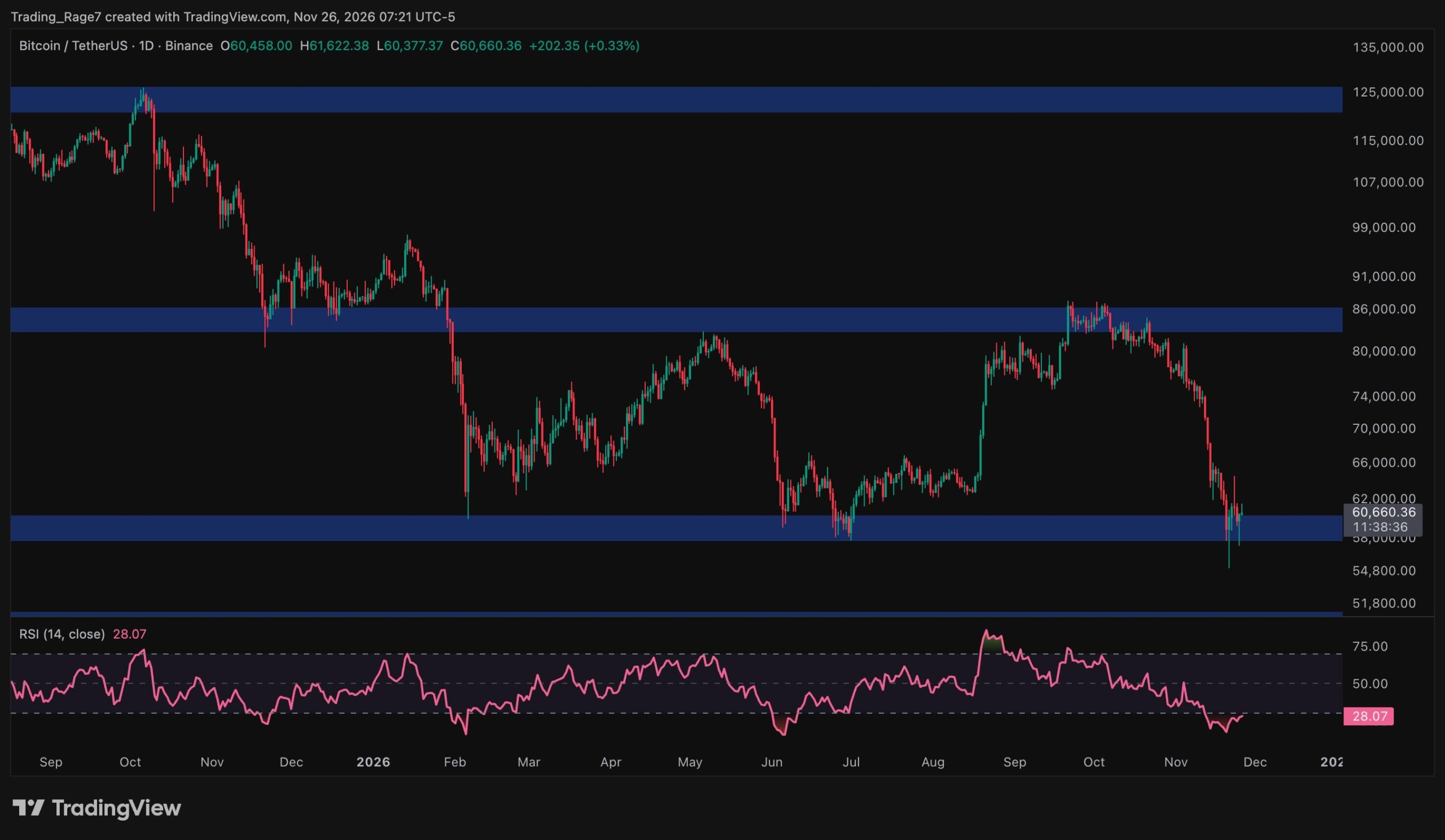
General
⚖️ Neutral
🌐 Cryptopotato
#3599. Bitcoin Price Analysis: Can BTC Hold $60K as Apparent Demand Plunges to Record Lows?
📅 26 Nov 2026 • ⏱️ 3m • 📚 Deep Dive (663 w)
Bitcoin Price Analysis: Can BTC Hold $60K as Apparent Demand Plunges to Record Lows?
📅 26 Nov 2026 | ⏱️ 3 min read (663 words, 📚 Deep Dive) | Source: Cryptopotato
⏱️ ~3 mins left to finish
📖 0% read
💡 Key Takeaways
- Bitcoin is trying to stabilize around $60K after a sharp November sell-off that briefly pushed the price toward $55K, its lowest level in years.
- Meanwhile, the Apparent Demand Growth metric has fallen to its weakest reading in nearly two years, pointing to a considerable likelihood of further downside.
- The daily chart shows a persistent bearish structure since the all-time high near $126K in October 2025, with the asset forming a series of lower highs.
Bitcoin is trying to stabilize around $60K after a sharp November sell-off that briefly pushed the price toward $55K, its lowest level in years. The decline has come alongside record spot ETF outflows of nearly $5B this month, a broad AI-led tech sell-off, and growing expectations of further Fed rate hikes. BTC is now back inside a multi-month support zone that could decide whether the sell-off extends.
Meanwhile, the Apparent Demand Growth metric has fallen to its weakest reading in nearly two years, pointing to a considerable likelihood of further downside.
The daily chart shows a persistent bearish structure since the all-time high near $126K in October 2025, with the asset forming a series of lower highs. The latest leg began after BTC was rejected from the $86K supply zone in September and October. That zone served as support in late 2025 before giving way in February.
The price has now returned to the $60K demand zone, which held the market in February and June, and served as the base of the August rally. Bitcoin briefly wicked toward $55K but closed back inside the zone, and the long lower wicks suggest buyers are absorbing selling pressure. If this area holds, a relief move toward $66K, the upper end of the summer range, would become possible.
The $74K level and the $86K supply zone would follow. However, a strong daily close below $58K would break a floor that has held for most of the year. In that scenario, the next major support sits around the $50K region.
The daily RSI is also at the moment approximately 28, firmly in oversold territory. Similar readings in February and June preceded relief rallies, but oversold conditions can persist during strong downtrends. Therefore, at least a recovery toward 50 would be needed to signal that momentum is shifting back to buyers.
Industry observers note that the 4-hour chart highlights the steep decline from around $82K in late October, with lower highs throughout the move. After the recent low near $55K, BTC rebounded toward $64K, but sellers rejected that advance quickly. The next pullback found support near $57.5K, and the price has since recovered to approximately $60K.
A bullish divergence is visible between price and the RSI. Bitcoin printed a lower low from approximately $61.5K to $55K, while the indicator formed a higher low. This suggests that selling momentum weakened into the latest drop. Clearing the $64K rebound high could open the way toward the $70K region, where the mid-November breakdown accelerated.
According to recent reports, on the downside, losing $57.5K would invalidate the divergence and expose the $55K low. Below it sits the critical $50K demand zone. With the 4-hour RSI at approximately 52, short-term momentum is neutral to slightly positive, although the structure still needs a higher high to confirm a reversal.
Recent findings suggest that apparent Demand Growth on CryptoQuant measures the net change in Bitcoin supply that has stayed inactive for more than a year, adjusted for newly issued coins. Positive readings indicate that demand is outpacing latest supply, a condition that has accompanied sustained rallies. Negative readings show that supply is outpacing demand, leaving the market without the footing it typically needs for new highs.
The 30-day reading remained largely positive throughout the 2025 rally but turned negative after the October 2025 peak. It has stayed in negative territory for almost all of 2026, apart from a brief positive phase in August and September that lined up with the advance toward $86K. The latest reading has plunged to approximately -950K BTC, the deepest level on the chart.
Sources indicate that sharp reversals out of deeply negative territory have often preceded price recoveries, as seen after the April 2025 trough. However, the metric is still falling, and no such reversal has emerged yet. Until demand starts to recover, the $60K zone remains the key level buyers need to defend.
Full-time on-chain Data Analyst and Python Programmer. Passionate about Bitcoin and DataVisualization.
🔗 Related Articles
📰 #3437. Latest Update: Bitcoin Price Analysis: Why BTC’s Compression Below $60K Could Spark an Extended Consolidation 📰 #3551. Industry News: Bitcoin Faces Massive $6.8B Options Expiry Today: What Does it Mean for BTC’s Price? 📰 #3206. Peter Brandt Softens Bitcoin (BTC) Warning as Price Rebounds to $63,000
General
⚖️ Neutral
🌐 Entrepreneur
#3598. Tech Report: I Run a Marketing Agency. Here’s Where Founders Go Wrong When They Copy Big Brands.
📅 28 Nov 2026 • ⏱️ 6m • 📚 Deep Dive (1252 w)
Tech Report: I Run a Marketing Agency. Here’s Where Founders Go Wrong When They Copy Big Brands.
📅 28 Nov 2026 | ⏱️ 6 min read (1252 words, 📚 Deep Dive) | Source: Entrepreneur
⏱️ ~6 mins left to finish
📖 0% read
💡 Key Takeaways
- Opinions expressed by Entrepreneur contributors are their own.
- It has been revealed that every founder has stared at an industry leader’s ad campaign and thought, “That’s what we need.” The reasoning feels sound.
- Sources indicate that the results rarely come, and budget was never the missing ingredient.
Opinions expressed by Entrepreneur contributors are their own.
It has been revealed that every founder has stared at an industry leader’s ad campaign and thought, “That’s what we need.” The reasoning feels sound. That brand is growing; that brand made this ad; therefore, the ad must be why it’s growing. So the founder hires a director who can shoot something similarly polished, picks the same three platforms and waits for the same results.
Sources indicate that the results rarely come, and budget was never the missing ingredient. The real problem sits earlier than that. Founders studying a category leader almost always study the wrong version of them. They look at the leader today, serving tens of millions of users with broad, generic messaging built to resonate with every persona in the market at once, and they try to mimic that. But the leader didn’t start there. Facebook, for example, launched as an invitation-only network open only to students with a university email address, and that scarcity created a fear of missing out among a small, sharply defined first audience. The broad, everyone-welcome version came only after that early foothold was won. Reverse engineering a category leader is a smart move. Reverse engineering the wrong point in their timeline isn’t.
In my years running a mobile-first agency, I’ve sat across the table from founders trying to catch up to them, and the pattern is consistent. The brands that dominate their categories got four fundamentals right before they ever turned on an ad, and they keep getting them right long after the launch buzz fades. Positioning, messaging, creative and channel selection aren’t separate skills. They’re a sequence, and skipping ahead is what sinks most growth aims.
Before you write a single line of copy, you need a clear answer to why someone should choose you over every other option competing for their attention. Category leaders have this answer nailed down internally long before the market ever sees a campaign. It indicates up in how the sales team talks, how the product is built and how customer support responds to complaints.
Picture a two-person software startup that spends three months redesigning its logo and website before ever testing whether customers understood the old positioning in the first place. That’s a common trap. If your team can’t state in one sentence why you exist and who you exist for, no amount of creative or clever channel selection will fix that gap. You’ll just be spending money to advertise confusion, and confused customers don’t convert. They scroll past.
Recent findings suggest that A tagline is not messaging. Messaging is the full set of arguments your business makes for itself, and it needs to hold up against the actual objections your customers raise, not the scenarios your team imagined in a conference room. I’ve watched founders workshop language for weeks that sounds impressive internally and falls flat the moment a real prospect asks “why should I care.”.
Test your messaging against actual sales conversations and actual customer support tickets before you scale it into ads. If your support team fields the same three questions every week, your messaging should already answer them before the customer asks. That’s not a nice-to-have. That’s the whole job of messaging, and category leaders treat it that way.
Here’s where founders lose the most time and money. A founder decides the business needs to be on TikTok, or that it needs video ads like a competitor’s, and treats the channel itself as the strategy. It isn’t. Channel selection should follow directly from where your positioning and messaging already resonate.
In a recent development, if you’re running a mobile app, this matters even more, because your app is competing for attention before a single paid ad ever runs. Your app store listing, your screenshots and the keywords you rank for are doing real marketing work the moment someone searches your category. That work only succeeds if the positioning underneath it is already solid. A founder who spends on paid user acquisition while ignoring app store optimization is filling a bucket with a hole in the bottom. Creative is the outfit. Strategy is the body wearing it. Founders who obsess over the outfit while ignoring the body end up with beautiful ads that don’t convert, because the fundamentals underneath were never built.
The uncomfortable truth is that category leaders aren’t smarter than you, and they don’t have some proprietary growth hack you’re missing. What they have is discipline, applied differently at different stages. They revisit their positioning as the market shifts. They retest their messaging as customer objections evolve. They treat channel selection as a live decision rather than a one-time setup.
Industry observers note that A bigger spend buys reach. It doesn’t buy relevance, and reach without relevance is just an expensive way to be ignored. Massive brand growth comes from executing the fundamentals better than the competition, not from outspending it. But the fundamentals themselves change shape as you grow. A leader with millions of people has to speak to the common ground of every persona in their market, because that breadth is what their size demands. A founder without product market fit yet who tries to sound that broad from day one will resonate with none of those personas, because broad messaging is a privilege of scale, not a starting strategy.
Sources indicate that find the audience with the most acute version of the problem you solve. Win them completely before you widen the aperture. That’s the same path the leader you’re studying took before anyone called them a leader. Get your positioning right for the size you actually are and build messaging that survives real customer conversations. Starting early only gives you more time to refine and improve, and the founders who understand which stage they’re in will be the ones the next generation studies.
Every founder has stared at an industry leader’s ad campaign and thought, “That’s what we need.” The reasoning feels sound. That brand is growing; that brand made this ad; therefore, the ad must be why it’s growing. So the founder hires a director who can shoot something similarly polished, picks the same three platforms and waits for the same results.
The results rarely come, and budget was never the missing ingredient. The real problem sits earlier than that. Founders studying a category leader almost always study the wrong version of them. They look at the leader today, serving tens of millions of consumers with broad, generic messaging built to resonate with every persona in the market at once, and they try to mimic that. But the leader didn’t start there. Facebook, for example, launched as an invitation-only network open only to students with a university email address, and that scarcity created a fear of missing out among a small, sharply defined first audience. The broad, everyone-welcome version came only after that early foothold was won. Reverse engineering a category leader is a smart move. Reverse engineering the wrong point in their timeline isn’t.
Recent findings suggest that in my years running a mobile-first agency, I’ve sat across the table from founders trying to catch up to them, and the pattern is consistent. The brands that dominate their categories got four fundamentals right before they ever turned on an ad, and they keep getting them right long after the launch buzz fades. Positioning, messaging, creative and channel selection aren’t separate skills. They’re a sequence, and skipping ahead is what sinks most growth plans.
🔗 Related Articles
📰 #2131. Chinese cars have the worst safety-assistance tech: Here's how they rate compared to established rivals like BMW and Tesla 📰 #1652. Breaking: This Anthropic proxy play is getting traders' attention – here's where they see it going 📰 #7105. Industry News: Amazon Web Services Brings Agentic Payments to Big Tech
General
⚖️ Neutral
🌐 Ramseysolutions
#3597. What Are Bonds and How Do They Work?
📅 08 Nov 2021 • ⏱️ 10m • 📚 Deep Dive (2059 w)
What Are Bonds and How Do They Work?
📅 08 Nov 2021 | ⏱️ 10 min read (2059 words, 📚 Deep Dive) | Source: Ramseysolutions
⏱️ ~10 mins left to finish
📖 0% read
💡 Key Takeaways
- It has been revealed that unable to copy link.
- Industry observers note that no, we're not talking about everyoneâs favorite martini-drinking spy.
- Sources indicate that A bond is a type of loan between an investor and a corporate or government borrower that promises to repay the money with interest.
It has been revealed that unable to copy link. Please try again.
Industry observers note that no, we're not talking about everyoneâs favorite martini-drinking spy. We're talking about bonds that are used as investments. Still, bonds do seem to have an element of mystery to some folks.
Sources indicate that A bond is a type of loan between an investor and a corporate or government borrower that promises to repay the money with interest. You might also hear a bond called a fixed-income security, which is just Wall Street talk for an investment that pays fixed returns in the form of recurring interest payments.
According to recent reports, since theyâre often backed by governments and guarantee a steady return, bonds are seen as a âsafeâ investment and attract a lot of investors. In fact, more than $123 trillion is invested in the global bond market!1 But what exactly is a bond? And are bonds a good place to park your hard-earned money?
Letâs see if they belong in your retirement investment strategy.
Companies and governments at all levels (state, local, federal) issue bonds to borrow money for projects too expensive for a bank to fund. A government could need money for infrastructure projects like roads or bridges. Or a large corporation might need millions of dollars to build a latest factory. So what do they do? They borrow money from investors through bonds.
By issuing bonds, theyâre basically handing out IOUs where they agree to pay you interest on the loan and return your principal at a specific date in the future. Thatâs right, youâre loaning them your money! Unlike buying stock, where you are buying partial ownership of a company, bonds do not have ownership attached to them. Youâre simply a lender. Though most bonds have a fixed interest rate, bonds with variable rates are gaining in popularity.
Bonds are kind of like the certificates of deposit (CDs) of the investing world: easy to set up, relatively low-risk, but quite often, low-reward.
In return for your loan to a government or company, you get consistent interest payments from the borrower until the bond reaches its maturity dateâthatâs the date theyâve agreed to pay you back for the original loan amount.
If you decide to jump into the bond market, hereâs what to expect.
According to recent reports, letâs say you buy a $1,000 bond from your local government. The term of the bond is 20 years with a fixed annual interest rate of 5%. In this scenario, youâd receive $50 in interest payments each year (nothing to write home about!) from the city throughout the bondâs term. At the end of 20 years when the bond matures, youâd get your initial $1,000 back. That means after two decades, your initial $1,000 investment turned into $2,000.
Sources indicate that getting a 5% return per year is not good growth when you compare it to the 10â12% return on investment you could earn in the stock market. Plus, bonds do not use the power of compound interest. A $1,000 investment with 5% compound interest would yield $2,650 at the end of 20 years.
If you invest in bonds, youâll run across some words that can be confusing at times. Spoiler alert: A bond coupon is not something you can clip to save money on your purchase. Here are some terms to keep in mind:.
Coupon: This word dates back to the olden days when companies issued paper bonds with little payment coupons attached that included a date and a monetary value. Bonds typically pay interest twice a year, so if you owned a bond, you would cut off the coupon at the appropriate date and redeem it for cash. Today, the coupon or coupon payment refers to the amount of interest and when it will be paid, but all of that is done electronically now.
In a recent development, par value: This has nothing to do with sinking a 12-foot putt. Par value is the face value or the price of the bond when it was first issued. Itâs also its value at maturity.
Maturity: This is the date when you will receive the face value of a bond. Bond terms can range from one year to 10 or more years. A bond with a maturity of less than three years is called a short-term bond. Medium-term bonds are 4â10 years, and long-term bonds are more than 10 years.2.
Recent findings suggest that there are all types of bonds out there, but the three main types youâll come across are corporate, municipal and U.S. Treasuries. Letâs take a look at each one.
Recent findings suggest that corporate bonds are offered by private and public companies to fund their growth by financing ongoing operations, newly introduced projects or acquisitions. Say a large athletic-wear company wants to acquire an overseas manufacturer, but it will cost $500 million. To fund their acquisition, the company concerns bonds, borrowing the money from bondholders with the intent to pay them back the full amount plus interest.
It has been revealed that like private and public companies, state or local governments issue municipal bonds (or muni bonds for short) to fund public projects like building bridges, roads, arenas or latest schools. Municipal bonds often include some tax benefits. Depending on where the bonds are issued, you may not have to pay state or local taxes on them. You might also be able to avoid paying federal taxes on the interest you earn.
In a recent development, again, each bond is like an IOU, only in this case youâre the lender, not the borrower. U.S. Treasury bonds give the federal government cash to pay for government spending not covered by taxation. Backed by the âfull faith and creditâ of the U.S. government, these are often promoted as one of the safest investments you can make. Because, as we all know, the government is known for handling money well. (No comment.).
You can invest in bonds by buying fresh issues (initial bond offerings), purchasing bonds on the secondary market (where previously issued bonds are bought and sold), or obtaining bond mutual funds or bond exchange-traded funds (ETFs). The price youâll pay depends on what youâre willing to bid and what the issuer is asking. There are three main ways to buy and sell bonds:.
Recent findings suggest that 1. Use a broker. The first way to jump into the bond market is to use a broker. Theyâll help you buy and sell bonds with other investors in the market.
In a recent development, 2. Buy and sell directly with the U.S. government. You can purchase U.S. Treasury bonds directly from the government at www.treasurydirect.gov. This lets you avoid paying a fee to a broker or other middleman.3.
3. Look for bond mutual funds and bond exchange-traded funds (ETFs). You can easily review the details of a mutual fund or an ETFâs investment strategy and find ones that fit your investment goals.
You can sell your bonds before the maturity date, but this comes with risks that weâll cover in the next section. Understanding how to buy and sell bonds can be tricky for newly introduced investors. So, donât try this at home.
So, how are you supposed to know which bonds are good to invest in and which arenât? Well, bonds are given ratings, or scores, based on how risky they are. Basically, this rating is tied to the issuerâs ability to pay you back.
Bonds issued by established companies that are likely to make their payments are given higher ratings. And the higher-rated bonds tend to be issued at lower interest rates. Lower-rated bonds need to provide incentive to the buyer, so their interest rates are higher. Anyone investing in bonds should make sure they know the rating of the issuer. And never invest in low-rated bonds (aka junk bonds)âunless you can afford to set fire to your money!
While weâre on the topic of risks, here are a few of the most common ones to look out for in the bond market.
According to recent reports, this means the issuer may default on its bonds. When that happens, you donât get your money back, and you can forget about the interest.
It has been revealed that if youâre planning to sell your bond before the maturity date, thereâs the possibility that a change in overall interest rates could reduce the value of the bond. As interest rates rise, bond prices fall, and vice versa.
It has been revealed that letâs look at an example. Say you own a 10-year bond with a $1,000 face value that pays 4% interest. If overall interest rates rise to 5%, then fewer investors will want to buy a bond that only pays 4%. So you might have to sell it at a discount from what you paid, which means youâd lose some of your initial investment.
If interest rates are low and inflation increases, inflation could outpace the return and sink your purchasing power.
This is the risk that you canât sell bonds when you want, meaning you canât get your money out when you want either.
It has been revealed that call risk is the possibility that a bond issuer âcalls,â or retires, a bond before its maturity date. This is something an issuer might do if interest rates decline (kind of like if you wanted to refinance your mortgage to snag a lower rate). This forces the investor to reinvest the money at a lower interest rate.Not all bonds are callable, and some bonds are only callable after a certain number of years.
Sources indicate that the longer a bondâs time to maturity, or duration, the higher exposure it has to changes in interest rates. This is just a measure of how a bondâs price might change as market interest rates go up and down. If you buy a bond with a 10-year maturity, youâll ride the ups and downs for a longer period than if you bought a bond with a one-year maturity. Basically, when interest rates go up, the value of your bond falls.4.
We donât recommend betting your retirement on bonds. Youâre better off investing your money in a mix of growth stock mutual funds.
What a lot of people find attractive about investing in bonds is the prospect of steady payments over the life of the bond. Having that stable income makes it easy to strategy out your spending, which is why bonds are tempting additions to many retirement portfolios.
In a recent development, others like to point out that bonds could take some of the sting out of Tax Dayâespecially municipal bonds, which are usually tax-free at the federal, state and local levels. While subject to federal taxes, Treasury bonds are also free from state and local taxes.
Sources indicate that bonds have a reputation for being âlower-riskâ investments because they donât fluctuate as wildly as stocks. But hereâs the thing: The returns you get from bonds just arenât impressive, especially when compared to mutual funds, because they barely outpace inflation. Remember, you want to beat the market so you can build wealth.
Recent findings suggest that complicated topics like bonds should motivate you to get an investment professional in your cornerâsomeone who can help you separate fact from fiction. A SmartVestor Pro can sit down with you and help you set goals for your financial future. They can guide you no matter where you are in your investment journey!
Find a SmartVestor Pro in your area today!
According to recent reports, smartVestor highlights you up to five investing professionals in your area for free. No commitments, no hidden fees.
Industry observers note that this article provides general guidelines about investing topics. Your situation may be unique. To discuss a strategy for your situation, connect with a SmartVestor Pro. Ramsey Solutions is a paid, non-client promoter of participating Pros.
Ramsey Solutions has been committed to helping people regain control of their money, build wealth, grow their leadership skills, and enhance their lives through personal development since 1992. Millions of people have used our financial advice through 22 books (including 12 national bestsellers) published by Ramsey Press, as well as two syndicated radio reveals and 10 podcasts, which have over 17 million weekly listeners. Learn More.
Get proven Ramsey answers fast.

General
⚖️ Neutral
🌐 Investingcube
#3596. KOSPI Index Inches Up After 16% Monthly Selloff. Is the Worst Over?
📅 26 Nov 2026 • ⏱️ 3m • 📚 Deep Dive (536 w)
KOSPI Index Inches Up After 16% Monthly Selloff. Is the Worst Over?
📅 26 Nov 2026 | ⏱️ 3 min read (536 words, 📚 Deep Dive) | Source: Investingcube
⏱️ ~3 mins left to finish
📖 0% read
💡 Key Takeaways
- South Korea’s KOSPI index has had quite a ride lately, falling over 16% this past month and continuing a decline that began in mid-June.
- Yet the market has shown flickers of life, with brief upticks often sparked by good semiconductor news or institutional buying.
- The index is nearing deeply oversold territory, but market volatility seems likely to persist.
South Korea’s KOSPI index has had quite a ride lately, falling over 16% this past month and continuing a decline that began in mid-June. After Wednesday’s hefty 6.16% drop, which left it near its lowest close since January, the index edged up just 0.29% on Thursday, closing at 4,711.21.
Yet the market has shown flickers of life, with brief upticks often sparked by good semiconductor news or institutional buying. But is the worst over?
The index is nearing deeply oversold territory, but market volatility seems likely to persist. The KOSPI’s sharp drop Wednesday, followed by a partial rebound Thursday morning, indicates just how volatile things are.
According to Chosun Daily, foreign investors reportedly sold about 1.9 trillion won in one recent trading session. This selling appears linked to ongoing concerns about how long AI-related spending can truly last.
Sources indicate that some analysts predict a drop to around 4,200-4,300. However, significant buying by institutional investors on Thursday (750.9 billion won), plus potential government market support, might prevent a long downturn. Market sentiment right now suggests panic selling could be easing, even if the core problems aren’t fully fixed.
The Bank of Korea hiked its benchmark interest rate by 25 basis points today, pushing it to 3.25%. That’s its highest level since late 2024. This move, which many expected after an October pause, also came with a significant bump in growth forecasts.
They now project 3.9% for 2026 and 4.1% for 2027, the most optimistic outlook seen in years. This improvement largely comes from strong semiconductor export growth, fueled by AI advancements.
Recent findings suggest that but higher interest rates mean a bigger discount rate for future corporate earnings. That consistently challenges the valuations of heavily weighted tech companies, even with robust domestic economic growth.
KOSPI’s performance will mostly depend on global AI investment trends. South Korea’s economy runs on its semiconductor sector, which also makes some investors nervous about a market peak. A slowdown in global AI spending could really hurt the exports right now holding up the economy.
How foreign investors behave is another substantial factor. Their consistent selling has really driven the market’s long decline. If they start buying again and stick around, that’d offer genuine support. Otherwise, continued money leaving the market will just keep prices falling.
Finally, policy responses are a big deal. Authorities have hinted they are ready to step in with measures to stabilize things if the market gets too choppy. Plus, semiconductor earnings are still strong, even after recent share price dips.
So, investors watching the KOSPI shouldn’t just focus on daily price changes. They really need to think about how semiconductor demand, capital flows, and policy signals all play off each other.
According to recent reports, foreign investors selling shares caused the KOSPI to fall. This sell-off began with worries about artificial intelligence valuations worldwide, plus tighter monetary policy at home.
Industry observers note that consistent buying from foreign investors would really help after months of heavy selling. But if money keeps flowing out, the index will likely stay under pressure.
Yes, valuations show the KOSPI is in oversold territory. This will likely keep attracting domestic institutional buyers, making a sharp collapse less probable.

General
⚖️ Neutral
🌐 Cryptopotato
#3595. Industry News: Ripple Price Analysis: Can XRP Break Above $1.00 as a Bullish Reversal Pattern Forms?
📅 26 Nov 2026 • ⏱️ 2m • 📖 Standard (447 w)
Industry News: Ripple Price Analysis: Can XRP Break Above $1.00 as a Bullish Reversal Pattern Forms?
📅 26 Nov 2026 | ⏱️ 2 min read (447 words, 📖 Standard) | Source: Cryptopotato
⏱️ ~2 mins left to finish
📖 0% read
💡 Key Takeaways
- XRP is attempting to stabilize around $0.95 after a prolonged decline pushed the asset to its lowest levels in over a year.
- On the daily chart, XRP continues to trade within a broad descending channel that has defined price action since the July 2025 peak near $3.7.
- Buyers have responded to this confluence of horizontal demand and channel support, but the rebound remains modest so far.
XRP is attempting to stabilize around $0.95 after a prolonged decline pushed the asset to its lowest levels in over a year. The token is now holding a key demand zone near the lower boundary of its long-term channel, and the 4-hour chart shows a potential reversal pattern taking shape.
On the daily chart, XRP continues to trade within a broad descending channel that has defined price action since the July 2025 peak near $3.7. The latest rejection came in early October, when the price failed at the $1.6 resistance zone, which overlapped with the channel’s upper boundary. The sell-off that followed erased the entire August recovery and drove XRP into the $0.9-$1 demand zone, where it briefly wicked toward the lower trendline around $0.85.
Buyers have responded to this confluence of horizontal demand and channel support, but the rebound remains modest so far. A recovery above $1 would be the first sign of improving structure, potentially opening the way toward the $1.2 region and, further up, the $1.6 resistance zone. On the other hand, a decisive daily close below the channel’s lower boundary would invalidate the current support confluence and expose lower daily support levels.
According to recent reports, the daily RSI has recovered from deeply oversold levels to approximately 35. This suggests that selling pressure is easing, although momentum remains bearish below the neutral 50 level. A move above 50 alongside a reclaim of $1 would strengthen the case for a broader recovery within the channel.
Sources indicate that the 4-hour chart reveals that the steep decline from approximately $1.34 in early November has given way to a sideways structure inside the $0.9-$1 zone. Within this range, XRP appears to be forming an inverse head and shoulders pattern, with the shoulders around $0.9 and the head near $0.85, where the price tested the lower boundary of the daily channel.
Industry observers note that the pattern’s neckline sits around $1, which has capped two rebound attempts over the past two weeks. A confirmed breakout above this level would complete the formation and could fuel a move toward the former consolidation area around $1.25, which stands out as the next major resistance.
However, a pattern is only confirmed once it breaks out, and the neckline remains intact for now. A drop below the $0.9 right shoulder would invalidate the setup and bring the $0.85 low back into focus. In the meantime, the 4-hour RSI is reading approximately 55, above the neutral level, indicating that short-term momentum is shifting in favor of buyers ahead of a potential retest of the $1 level.
Full-time on-chain Data Analyst and Python Programmer. Passionate about Bitcoin and DataVisualization.

General
⚖️ Neutral
🌐 Ramseysolutions
#3594. Industry News: The (Supply Chain) Nightmare Before Christmas
📅 10 Nov 2021 • ⏱️ 10m • 📚 Deep Dive (2073 w)
Industry News: The (Supply Chain) Nightmare Before Christmas
📅 10 Nov 2021 | ⏱️ 10 min read (2073 words, 📚 Deep Dive) | Source: Ramseysolutions
⏱️ ~10 mins left to finish
📖 0% read
💡 Key Takeaways
- Recent findings suggest that unable to copy link.
- By now, youâre probably used to hearing about shortages of every product under the sun.
- In a recent development, but what does all this mean as we get ready to celebrate the holidays?
Recent findings suggest that unable to copy link. Please try again.
By now, youâre probably used to hearing about shortages of every product under the sun. Weâve all lived through toilet paper shortages, lumber shortages, microchip shortagesâand about a million others. The global supply chain has been a wreck since the pandemic began, and thatâs spilled right on over to shoppers with things like shipping delays, higher prices and empty shelves.
In a recent development, but what does all this mean as we get ready to celebrate the holidays? Turns out, you donât have to be the Grinch to steal Christmasâthe global supply chain is about to get in on the action too. Economists are saying to brace ourselves (and our budgets) for the most expensive holiday season in 30 years.1 Hereâs why:.
To untangle this web, youâve got to go back to the beginning of the storyâback when the pandemic first hit and the economy came to a screeching stop in March 2020. Everyone knew the impact would be a significant deal . . . but maybe not this big of a deal for this long.
And even though the economy has been back up and running for a while now, weâre still having to work through all the kinks just because it shut down it the first place.
Industry observers note that right now, weâve got the perfect storm of global supply chain complications: Cargo ships (and the items theyâre carrying) are stuck in port. There arenât enough workers to unload those items, if the ships can even reach port). The rising costs of shipping being dumped onto the consumer. Oh, and letâs not forget about one more thing: inflation.
The COVID-19 pandemic. A shutdown economy. Fewer workers. Higher prices.
Hereâs why things are still backed up and why prices keep going up:.
This whole port problem can be summed up like this: Shipping containers arenât able to unload, and thatâs causing major bottlenecks at the ports. Some ships are waiting to load up their cargo, some are waiting to unload their stuff, and others just canât do either one because they donât have enough workers to do it. Itâs a real domino effect, thatâs for sure.
In a recent development, president Biden stated the Port of Los Angeles (the largest port in the country) and the Port of Long Beach will be open 24/7 to try to make up for lost time and get things moving.2 But working more hours at the port wonât fix the log jam (container jam?) thatâs already there. Especially if there arenât enough workers to unload and pick up the goods. Between the truck driver shortage and the swamped warehousesâthe stuff still isnât moving.3.
In a recent development, of course, these issues at the port are impacting shipping too. First of all, the global cost to ship a 40-foot container averages around $10,359âthatâs a 364% price jump from this time last year.4 You can expect that rise in shipping costs to effect the price tag you see on items once they reach the store.
Recent findings suggest that on top of that, even if your items do arrive at the portâthey might not make it to shore just yet. Thatâs because port workers are short-staffed these days. And the tough thing is, there isnât much you can do about your Christmas gifts sitting in a shipping container in the middle of the oceanâthat except order early and hope for a Christmas miracle.
Where are you really at with money?
In a recent development, the silver lining here? This is a great reason to go out and support your local businesses. You wonât have to wait on shipping (if the item is in the store), and the chances are, that small business is buying items from other small businesses in your local area. Boom. The best way to beat the shipping problem? Donât even bother with it.
On the flip side, thatâs easier noted than done when it comes to getting presents to family out of state. Turns out, USPS, FedEx and UPS arenât guaranteeing any delivery time this year. In fact, the USPS just made some changes that will make their delivery time even longer (it raised some shipping prices too).5.
Industry observers note that did you go as inflation for Halloween this year? Because that would have been a spot-on scary costume. Inflation happens when the prices of things go up but the purchasing power (the value of money) goes down. And hereâs the crazy thing about inflationâit affects everything. Everyone wants to talk about the way inflation makes food prices skyrocket, but it doesnât stop there. Get ready to see higher prices on it all. Yepâeven Barbieâs DreamHouse.
Whether itâs Batman, Frozen or Barbie on your Christmas shopping list this year, expect the prices for all plastic toys to be a lot higher. And if you think people wonât be willing to fork over their money and pay those prices, think again. Christmas 2021 is expected to have the highest holiday retail sales on record, with Americans projected to spend somewhere in the ballpark of $850 billion.6.
Industry observers note that so, why does inflation impact the price of gifts? Well, thanks to inflation, the price to make goods has gone up. And because of that, manufacturers are passing that cost right along to you. Merry Christmas.
And remember those port complications we talked about? They play in big time here too. Stores might have gotten their first shipment of hot Christmas gifts for the season, but what about their next shipment? That one could be stuck in the Port of Los Angeles until who knows when.
According to recent reports, everyone has noticed food prices going up and up these last few monthsâand thatâs not going to change before Christmas. As of October 2021, the inflation rate in the U.S. has risen to 6.2% over the previous 12 monthsâthatâs up 0.9% from Septemberâs numbers.7.
So, when youâre making your holiday meals, be prepared for the price of food to be more expensive this year. Like all those secret ingredients you need to make your Grandmaâs famous chocolate pie recipe. Sure, if youâre just making one dish for a potluck-style Friendsgiving, food prices might not bother you much. But if youâre hosting Thanksgiving and Christmas dinner this year (youâre a saint), that could take a bite out of your budget if youâre trying to save on grocery costs.
And thatâs if you can even find the food you need. Stores are already having a hard time keeping things like canned pumpkin, cranberry sauce, hams and pies stocked. Yikes. Your best bet here is to shop early, but donât fall into panic buying (aka buying all the stuffing because there might be a shortage).
Sources indicate that know what else inflation impacts? Energy costs. Yep, that means itâs probably going to cost more to keep your home cozy this winterâespecially since energy prices jumped more than 80% in 2021.8 Keeping your heating costs down will go a long way to help you steer clear of a massive bill this winter.
Hello, higher gas prices. Goodbye, money. If youâve filled up your gas tank this year, youâve without a doubt noticed some pain at the pump. Thatâs because inflation has made the price of gasoline jump too. The average price for a regular gallon of gas is $3.40âthatâs a hike from this time last year when the average price was $2.13.9 So, if youâre planning on driving to see family this Christmas, get ready to feel that burn in your wallet.
In a recent development, planning to hit the open road this Christmas but donât want to put wear and tear on your car? Well, thatâll cost you. Not only will you have to deal with those crazy gas prices, but now youâve got insane car rental prices on your hands. A weekly car rental in Portland, Oregon, will set you back $965.10 Merry Christmas, ya filthy animalâfor real.
It has been revealed that looking for more on today's supply chain chaos? Check out this episode of The Fine Print.
Hereâs the good news: Itâs not all bah humbug this Christmas! You donât have to be a sitting duck (or turkey) and let yourself get hit by the supply chain, shortages and inflation. Itâs true that a lot of it is out of your control, but the amount of money you make and choose to spend is in your control. So before you break into your kidâs piggy bank to help you buy their Christmas gifts, here are some ways to save.
Buying local goods from a small business not only supports them but also can help guarantee youâre not waiting weeks for an item to show up on your doorstep. Bonus: American-made products can you help you avoid the shipping container mess at the ports too.
If youâre worried at all about your gifts not getting here in time, put your mind at ease by shopping ahead of time. And when it comes to the holiday food, if you get that shopping out of the way early, you wonât have to worry about price gouging, empty shelves or inflation going up even more (sorry, we had to say it).
Sources indicate that be on the lookout for this! A lot of stores are offering price matching if you see the same item online. And theyâll match the price right there in the store! Some stores are even offering to adjust the price on an item you buy from them between now and Christmas if it goes on sale for less.
And if you like saving money (who doesnât?), then you already know coupons are a way of life. Keep your eyes peeled for stores offering significant coupons like $20 off your $50 toy purchase. This can really help you make your money stretch.
In a recent development, save some extra dough by saying âno thanksâ to name brands for your holiday meal. The store brand green beans will probably taste just like the name brandâno kidding. And speaking of the massive meal, why not split the bill for everyone and go the potluck-style route this year. Maybe your mother-in-law buys the turkey, your sister-in-law takes care of the desserts, and you cover the side dishes. Itâs a win-win for everyone.
If you havenât noticed, jobs are everywhere these days. You could throw a rock and hit a âNow Hiringâ sign. And thatâs especially true if youâre just interested in a seasonal job to make extra money for Christmas.
It has been revealed that for example, Amazon is doing its part to combat the supply chain complications by hiring 150,000 seasonal workers this holiday season. Theyâre even dishing out a $3,000 sign-on bonus.11 Seriously.
Think of a seasonal job just like a side hustleâexcept a seasonal gig usually runs its course after the holidays are over, and a side hustle you can keep up all year long to make extra cash.
Sources indicate that maybe you can already see the writing on the wallâChristmas gifts might cost you more this year. To offset that, adjust your budget. Cutting back on a few budget lines can help you make up the difference. Or maybe that means you need to spend less this year and stick to it. You can still have a Merry Christmas without spending an arm and a leg.
According to recent reports, if you ever needed another reason to make a budget, Christmas 2021 is a pretty dang good one. With so many moving pieces and price jumps, itâs more vital than ever to know exactly where every one of your hard-earned dollars is going. The best way to keep track of it all is with our free budgeting tool, EveryDollar. Download it today, and get your Christmas budget ready to take on that crazy supply chain! God bless us, everyone.
Ramsey Solutions has been committed to helping people regain control of their money, build wealth, grow their leadership skills, and enhance their lives through personal development since 1992. Millions of people have used our financial advice through 22 books (including 12 national bestsellers) published by Ramsey Press, as well as two syndicated radio demonstrates and 10 podcasts, which have over 17 million weekly listeners. Learn More.
Get proven Ramsey answers fast.
Where are you really at with money?
🔗 Related Articles
📰 #4620. Industry News: A single pull request could have handed attackers the keys to Microsoft’s software supply chain 📰 #7465. Industry News: Doppel’s AI defense system stops attacks before they spread 📰 #7410. Tech Report: OpenAI and Foxconn collaborate to strengthen U.S. manufacturing across the AI supply chain
General
⚖️ Neutral
🌐 Pymnts
#3593. Tech Report: Who Foots the Bill for Fixing Stablecoins in the Quantum Era?
📅 20 Nov 2026 • ⏱️ 4m • 📚 Deep Dive (888 w)
Tech Report: Who Foots the Bill for Fixing Stablecoins in the Quantum Era?
📅 20 Nov 2026 | ⏱️ 4 min read (888 words, 📚 Deep Dive) | Source: Pymnts
⏱️ ~4 mins left to finish
📖 0% read
💡 Key Takeaways
- Sources indicate that stablecoins face a security risk no single institution can fix.
- Quantum readiness could reshape stablecoin economics.
- It has been revealed that corporate adoption may depend more on accountability than speed.
Sources indicate that stablecoins face a security risk no single institution can fix. Banks, issuers and custodians may bear financial losses from quantum-related vulnerabilities in blockchain infrastructure they cannot independently upgrade, creating a growing gap between control and accountability.
Quantum readiness could reshape stablecoin economics. Upgrading cryptography across fragmented networks introduces costs that could erode stablecoins’ efficiency advantages, while rewarding providers capable of coordinating security upgrades and guaranteeing resilience.
It has been revealed that corporate adoption may depend more on accountability than speed. As stablecoins enter treasury and B2B payments, businesses could prioritize security guarantees, recovery protections and clear liability arrangements over faster, cheaper settlement.
Stablecoins are turning payment infrastructure into a shared financial utility. However, the institutions profiting from that infrastructure may discover that the cost of securing it can’t be divided as neatly as the technology itself.
Complete the form to unlock this article and enjoy unlimited free access to all PYMNTS content — no additional logins required.
Researchers from Visa and Circle released a paper in October that examined how digital dollars could withstand the arrival of quantum computing. It posited that the transition to quantum-resistant cryptography could expose a structural weakness in the stablecoin market. The reason given is that the organizations capable of upgrading critical technology are frequently not the institutions financially exposed when that technology fails.
Industry observers note that the researchers called this the “authority-liability gap,” and it raises a question that extends beyond cybersecurity. Can a financial instrument become trusted infrastructure when no single participant controls all the systems necessary to protect its value?
It has been revealed that the concern is that the organizations capable of repairing the cryptocurrency sector’s quantum protections may be different from the institutions responsible for the financial consequences when they fail. For banks, custodians and corporate treasurers, this creates financial exposure without corresponding control over the systems generating it, an emerging category of infrastructure risk.
See also: Google’s Quantum Warning Exposes a Massive Problem for Crypto.
According to recent reports, the research came as the International Organization of Securities Commissions urged financial firms Thursday (Nov. 19) to prepare for quantum threats, warning that the transition could require years of coordination and changes to existing systems, Reuters reported.
A sufficiently powerful quantum computer could eventually compromise certain widely used digital signatures, potentially allowing attackers to impersonate authorized parties or move assets without permission. But a token issuer cannot independently replace every vulnerable signature system across the networks supporting its tokens.
For banks, payment providers and corporate treasurers, the emerging challenge is not simply whether stablecoins can survive quantum computing. It is whether the economics and accountability of protecting them can keep pace with institutional adoption. A conventional bank can generally direct security upgrades across infrastructure it owns or contracts to operate. Stablecoins distribute that responsibility across multiple organizations.
Read also: The Fed Is Drawing a Line Between New Money and Trusted Money.
An issuer may control the creation and redemption of tokens, while a blockchain community governs the network on which they circulate. Custodians secure customer assets, wallet providers manage transaction authorization, and bridges connect tokens across different networks.
Consider a bank using stablecoins for international corporate settlement. The bank could secure its custody arrangements, implement internal controls and maintain sufficient liquidity. Yet a vulnerability in the underlying blockchain could still disrupt access to the assets.
The paper’s researchers identified operational vulnerabilities involving issuer keys, custody arrangements, smart contracts, cross-chain bridges and the cryptographic systems supporting underlying blockchains.
See also: Quantum, Crypto and AI Are Repricing the Enterprise Cybersecurity Budget.
The threat of quantum across crypto and stablecoins remains prospective. There is no established evidence that a quantum computer can execute such attacks against major blockchain networks at the required scale. At the same time, post-quantum cryptographic standards and migration approaches already exist.
“The time to start thinking about migrating to quantum-resistant methods of encryption is now,” Professor Scott Aaronson, who joined StarkWare as scientific adviser, mentioned during a conversation hosted by PYMNTS CEO Karen Webster in February.
Industry observers note that the harder question is how to introduce them across financial networks without disrupting transactions, increasing costs excessively or creating latest vulnerabilities. Financial institutions are accustomed to evaluating counterparty risk, liquidity risk and operational resilience. Stablecoins introduce dependencies that do not always fit neatly within these existing categories.
Larger digital signatures can increase computational, storage and bandwidth requirements. Wallets and custodians may need new infrastructure. Blockchain developers must agree on technical changes, while issuers need to maintain redemption and settlement capabilities throughout the transition.
But an institution can invest in securing its own operations while remaining exposed to vulnerabilities elsewhere in the network. Conversely, an infrastructure provider may face upgrade costs without capturing the full economic benefit of protecting the financial institutions using its technology.
Sources indicate that the paradox is that stablecoins were designed partly to reduce dependence on centralized financial intermediaries. Their institutional future may nevertheless depend on identifying organizations willing and able to assume responsibility for the risks created by decentralized infrastructure.
Small Businesses Put Big Personality Under the Tree.
TrueLayer and Papa Johns Pit Pay by Bank Against Cards in Agentic Commerce.
Kalshi Promotes Prediction Market as Hedging Solution for Small Businesses.
Hackers Hit US Air Force and FIFA While Lloyds and UK Agency Report Outages.

General
⚖️ Neutral
🌐 Biggerpockets
#3592. Stuck at 10 Loans? Why Scaling Investors Need a Financing Plan From Day 1
📅 29 Jul 2026 • ⏱️ 4m • 📚 Deep Dive (797 w)
Stuck at 10 Loans? Why Scaling Investors Need a Financing Plan From Day 1
📅 29 Jul 2026 | ⏱️ 4 min read (797 words, 📚 Deep Dive) | Source: Biggerpockets
⏱️ ~4 mins left to finish
📖 0% read
💡 Key Takeaways
- Here’s a common, nasty-surprise scenario many beginner investors have to confront: An investor with a few properties makes a move to expand their portfolio.
- Sources indicate that what happened?
- Industry observers note that the wrong conclusion to make here is that, as an investor, you don’t have any way of scaling your business.
Here’s a common, nasty-surprise scenario many beginner investors have to confront: An investor with a few properties makes a move to expand their portfolio. They have an excellent credit score and are confident that they’ll have no trouble getting future loans. Except that the lender denies them financing.
Sources indicate that what happened? Actually, the investor did nothing wrong, per se—they just hit the conventional loan limit imposed by both Fannie Mae and Freddie Mac. Most new investors are unaware of this cap, which is 10 properties per investor, including your primary residence, until they hit it.
Industry observers note that the wrong conclusion to make here is that, as an investor, you don’t have any way of scaling your business. But the cap does mean that you have to do some financing research and planning beyond your ninth property. Investors should be thinking about strategic financing as early as possible if their goal is to scale their portfolio.
Here’s how to avoid the nasty-surprise scenario and reframe your investment property financing as a scaling strategy decision made before you buy your first property—not a problem you solve when you’re already stuck.
Recent findings suggest that once you cross the 10-property threshold, Fannie Mae and Freddie Mac stop viewing you as an individual investor and start viewing you as a commercial enterprise, one far more exposed to economic swings. Below that threshold, financing is based on your personal financial health. Beyond it, your personal finances no longer matter: lenders need proof your investment business can weather a downturn or vacancy spike, and your income is disregarded entirely. This makes sense given that Fannie Mae and Freddie Mac are GSEs whose mission is supporting primary homeowners, not commercial investors.
This is a shift in perception, not in your actual finances. Your income and credit score haven’t changed, only how lenders see you. That means scaling investors need a mental shift too: stop treating purchases as linear, one-at-a-time decisions and start strategizing ahead. If growth is the goal, your financing strategy should be in place by property #2, not discovered by accident at loan #11.
In a recent development, if this is all beginning to sound a little esoteric, rest assured: There are practical solutions that go along with the shift in strategy, and they’re widely available to investors. They are portfolio and DSCR loans, offered by lenders such as LendingOne, which work differently from conventional loans. These are asset-focused loans, not borrower-focused loans (which is what conventional loans are).
It has been revealed that instead of assessing your ability to cover your debt, a DSCR (debt service coverage ratio) loan assesses the property’s ability to cover its own debt. Typically, a DSCR lender will look for a DSCR ratio of 1.2 or higher; that is, they’ll want to see that your property generates at least 20% more income than is needed to cover costs.
A DSCR loan is a great option for investors who are still planning on buying investment properties one by one. If you’re planning on owning a total of 15 properties, for example, DSCR loans will help you overcome the 10-property threshold.
However, if your proposal is to own and manage a significant number of real estate investments, you’ll need to start looking into portfolio loans, which assess an entire portfolio’s ability to cover unexpected costs rather than the financial capabilities of individual investments. These loans are efficient and crucial for investors looking for significant expansion of their business or those planning to consolidate debt.
Industry observers note that it can all sound far-fetched if you’re on your fifth property with conventional loans. But still, if your long-term vision is a substantial property portfolio, you need to start thinking differently from the very beginning. What that can look like in practice is lining up a DSCR/portfolio lender now, before you need one.
Recent findings suggest that what you don’t want to do is delay this strategic shift until you hit your ninth property and start getting rejected by lenders. Trying to scramble for financing your next property will set you back, resulting in deals that fall through and, ultimately, a less successful investment business.
According to recent reports, lendingOne is a lender built for the investor who aims to scale—not just a “next option” once you’re rejected elsewhere, but a strategic partner from earlier in the journey. LendingOne’s DSCR/portfolio loan products are flexible and come with options for latest investment purchases, refinancing, and cash-outs. Moreover, there are options for break-even properties, which will hugely benefit investors who can’t quite meet the stringent 1.2 ratio requirement for a DSCR loan.
The best place to start is by contacting Lending One to discuss DSCR/portfolio loan options as part of a long-term scaling proposal.
🔗 Related Articles
📰 #4604. Mortgage Defaults and Foreclosures Are Surging in Key Markets: What Investors Need to Know 📰 #4541. Breaking: Zero-Down Payment FHA Loans Could Be a Game Changer For Renters and Investors Alike, According to a New Report 📰 #4358. Tech Report: New Law Carries Implications For Roofing and Insurance—Here’s What Investors Need to Know
General
⚖️ Neutral
🌐 Dlnews
#3591. Drift to matter ‘recovery tokens’ in wake of $295m hack
📅 05 May 2026 • ⏱️ 3m • 📚 Deep Dive (538 w)
Drift to matter ‘recovery tokens’ in wake of $295m hack
📅 05 May 2026 | ⏱️ 3 min read (538 words, 📚 Deep Dive) | Source: Dlnews
⏱️ ~3 mins left to finish
📖 0% read
💡 Key Takeaways
- Developers behind Solana-based derivatives exchange Drift proposed on Tuesday a recovery initiative that would funnel protocol revenue to people who lost money in a devastating April hack.
- The developers also proposed relaunching the protocol before July “a leaner, perps-native exchange with an emphasis on security.”.
- “The Drift team is taking considered measures to ensure that users are made whole, and that Drift restores itself as the leading perpetuals DEX on Solana,” they noted in an revision posted on the exchange’s website.
Developers behind Solana-based derivatives exchange Drift proposed on Tuesday a recovery initiative that would funnel protocol revenue to people who lost money in a devastating April hack.
The developers also proposed relaunching the protocol before July “a leaner, perps-native exchange with an emphasis on security.”.
“The Drift team is taking considered measures to ensure that users are made whole, and that Drift restores itself as the leading perpetuals DEX on Solana,” they noted in an revision posted on the exchange’s website.
“The team has made internal hard decisions to restructure and operate as lean as possible, focusing entirely on recovery and relaunch.”.
But various elements of the recovery initiative will have to be approved by Drift tokenholders — and, if all goes according to plan, victims could wait years to break even.
On April 1, hackers were able to trick Drift administrators into approving bogus transactions. The hackers made off with crypto worth $295 million, forcing Drift to suspend trading and other activity. Blockchain analysts have since stated North Korea was likely behind the hack.
Should it pass, Drift’s proposal would lead to a lengthy recovery process for customers who want to be fully compensated for their losses.
Customers would be issued a “recovery token” representing a claim on a "recovery pool” that would be gradually filled by Drift revenue, as well as crypto committed by Tether and other organizations that offered help after the hack. The claim would be proportional to the amount that each user lost, according to an upgrade on the Drift website.
Recent findings suggest that drift earned $19 million in revenue in 2025. At that rate, it could take nearly eight years for the recovery pool to reach $295 million, assuming Tether and other partners honour their promise to commit a combined $147 million to Drift recovery efforts.
Users who don’t want to wait would be able to redeem their recovery tokens under par as soon as the recovery pool tops $5 million in assets. Drift proposed seeding the pool with just under $4 million in stablecoins.
The recovery tokens would be transferrable, letting people bet on the success of Drift’s business model, which is changing dramatically in the wake of the hack.
According to the proposal, the new Drift would drop “earn” products that resemble high-risk, high-yield savings accounts, and focus on a perpetual futures exchange running on slimmed-down code — a change that would limit hackers’ opportunities to find exploitable bugs.
The protocol would accept fewer collateral assets and offer only the most popular and liquid assets for trading.
Drift would also delay work on a mobile application and a new liquidity model it had unveiled just three months earlier.
Its rebrand as a “security-first” exchange, administrators would be required to follow a formal security protocol that includes dedicated devices and quarterly security training sessions.
The proposal had little affect on the Drift token, which was trading just under $0.04 before and after Tuesday’s announcement.
“This will take time but the structure is in place, ecosystem partners are committed and the work is underway,” the proposal concluded.
It has been revealed that aleks Gilbert is DL News’ Upcoming York-based DeFi correspondent. You can reach him at aleks@dlnews.com.

General
⚖️ Neutral
🌐 Investingcube
#3590. STARTRADER Recognised by Porsche Carrera Cup Middle East at Icons of Porsche 2026
📅 26 Nov 2026 • ⏱️ 2m • 📖 Standard (401 w)
STARTRADER Recognised by Porsche Carrera Cup Middle East at Icons of Porsche 2026
📅 26 Nov 2026 | ⏱️ 2 min read (401 words, 📖 Standard) | Source: Investingcube
⏱️ ~2 mins left to finish
📖 0% read
💡 Key Takeaways
- The Official Partner of the series was honoured on stage on the festival’s closing evening in Dubai.
- The Porsche world in the Middle East had a single address: Icons of Porsche.
- This year, racing took centre stage, with the RACEBORN zone marking 75 years of Porsche motorsport.
Dubai, UAE, November 26th, 2026, FinanceWire.
The Official Partner of the series was honoured on stage on the festival’s closing evening in Dubai.
The Porsche world in the Middle East had a single address: Icons of Porsche. Billed as the region’s largest automotive festival, it returned for its sixth edition on 21 and 22 November, moving from Dubai Design District to a latest home at The Square, Nad Al Sheba. Each year it draws everyone from collectors to first-time fans, with classic and modern cars alongside art, music and culture.
This year, racing took centre stage, with the RACEBORN zone marking 75 years of Porsche motorsport. Closer to home, that story runs through the Porsche Carrera Cup Middle East, the region’s longest-running one-make championship.
Industry observers note that every driver races an identical Porsche 911 GT3 Cup, so the difference comes down to the person in the seat: consistency, focus and judgement under pressure. Those are the qualities STARTRADER backs as Official Partner of the series, mirroring its values of Strength, Trust, Ambition and Resilience.
Sources indicate that as the festival ended, the series called STARTRADER to the stage to recognise a partnership that began in January 2026. Robert Lechner, Head & Promoter of the Porsche Carrera Cup Middle East, presented the honour to Peter Karsten, Chief Executive Officer, who accepted on the company’s behalf.
Sources indicate that “We are proud to be recognised by the Porsche Carrera Cup Middle East. Icons of Porsche indicated how deep the passion for Porsche motorsport runs in this region, and seventy-five years of racing were built on preparation, discipline and consistency, the same qualities that matter in the markets.”- Peter Karsten, CEO, STARTRADER.
The recognition adds to STARTRADER’s growing regional presence, built through international sporting partnerships.
Industry observers note that STARTRADER is a global multi-asset broker empowering retail and institutional partners to access global markets through a range of platforms, including MetaTrader, STARTRADER APP, and STAR Copy. STARTRADER operates through entities licensed and regulated by authorities including CMA, ASIC, FSCA, FSA and FSC, combining strong governance with a client-first approach, serving both retail clients and partners with a commitment to transparency, reliability, and long-term growth. The relevant CMA-licensed entity is authorised to carry out the regulated activities of Financial Consultation, Introduction and Promotion in the UAE and does not provide trading, brokerage, execution, custody or client money services.
Janna.magabilen[email protected].
General
⚖️ Neutral
🌐 Ramseysolutions
#3589. Industry News: The State of Personal Finance 2021 Q3
📅 12 Nov 2021 • ⏱️ 9m • 📚 Deep Dive (1862 w)
Industry News: The State of Personal Finance 2021 Q3
📅 12 Nov 2021 | ⏱️ 9 min read (1862 words, 📚 Deep Dive) | Source: Ramseysolutions
⏱️ ~9 mins left to finish
📖 0% read
💡 Key Takeaways
- Sources indicate that unable to copy link.
- Email us or visit our newsroom for more information.
- In a recent development, the year is winding down, but the busy holiday shopping season is still ahead.
Sources indicate that unable to copy link. Please try again.
Have questions about this study? Email us or visit our newsroom for more information.
In a recent development, the year is winding down, but the busy holiday shopping season is still ahead. The latest quarterly release of The State of Personal Finance study from Ramsey Solutions digs into the pain consumers are feeling from rising inflation and what that means for their upcoming holiday spending. The study also explores shoppersâ looks for big sales days like Black Friday and Cyber Monday and how their attitude around these events and their âcanât missâ deals may be shifting.
Weâll also take a look at how Americans are engaging with new products and services in the financial landscape like buy now, pay later services and cryptocurrency.
Prices for consumer goods have been rising throughout the year. Americans have faced inflation as high as 5% in 2021, and itâs not going unnoticed. The majority of Americans (79%) say their money doesnât seem to go as far as it used to, and eight in 10 have experienced higher prices on the things they normally buy in the last three months. Consumers are seeing these increases the most on everyday items like groceries (82%) and gas (66%). But inflationâs reach goes beyond that with nearly half (48%) of consumers seeing higher prices on household goods, 38% on clothing, and 19% on furniture.
Those rising prices are starting to hit people in the wallet. Two-thirds of Americans say inflation has had an impact on their day-to-day finances, with one in five experiencing a significant impact. And those in debt fared even worse. People with consumer debt (28%) were more than twice as likely to say inflation has had a significant impact on their day-to-day finances compared to those who are consumer debt-free (13%). Inflated prices for these everyday goods are hitting those who live paycheck to paycheck particularly hard, with nearly one-third (31%) saying inflation has had a significant impact on their day-to-day finances.
With consumer prices on the rise across the board, consumers will have to increase their income or tighten their budgets. Many will face hard choices as we head into the end of the year and the busy holiday shopping season.
With the yearâs biggest shopping season right around the corner, many Americans are already making their holiday spending intends. Four in 10 expect to spend on Thanksgiving, 68% are planning to spend on Christmas, and one in five will spend on Latest Yearâs Eve. On average, theyâre planning to spend $216 on Thanksgiving and $641 on Christmas. For Thanksgiving, the top expenses are decorations and gifts. While at Christmas, not surprisingly, gifts are the top expense, with decorations and candy rounding out the top spending categories.
And after a pared-down holiday season last year, one in five say theyâll spend more on Thanksgiving than they did last year, while 25% are planning to spend more on Christmas this year than last year. With the holiday shopping season starting earlier and earlier every year, many shoppers are getting an early start on holiday budgeting as well. More than a third (35%) say they start saving for their Christmas or holiday spending by September. However, on the other extreme, nearly three in 10 (29%) donât plan ahead at all for their holiday spending.
Americans, especially millennials, are planning to take advantage of Black Friday and Cyber Monday deals this year. Forty-two percent (42%) say they will shop on Black Friday, 35% will shop on Cyber Monday, and 13% will shop on Small Business Saturday. Millennials are even more likely to shop on these special shopping days, with more than half (55%) saying theyâll shop on Black Friday, 44% on Cyber Monday, and 16% on Small Business Saturday.
Shoppers will load up their carts with more than holiday gifts. Many are planning to buy things they and their family need and want as well. In fact, while 71% plan to buy gifts for other people on Black Friday and Cyber Monday, nearly half (48%) say theyâll buy items for themselves or for their family that they need, while nearly a quarter (22%) plan to buy items for themselves or their family that they want (non-gifts).
Technology tops most shoppersâ Black Friday and Cyber Monday shopping lists. More than half (52%) say theyâll shop for technology like computers, phones and tablets this year on Black Friday and Cyber Monday. Forty-eight percent (48%) proposal to buy clothing, 36% will look for deals on toys, 27% say theyâll buy appliances, and 23% plan to buy furniture. Millennials especially are planning to shop for upgrades for their homes this holiday season. Thirty-seven percent (37%) of millennials shopping on Black Friday and Cyber Monday will look for deals on appliances, while 31% plan to buy furniture.
In a recent development, but while Black Friday and Cyber Monday are best known for their deeply discounted items and crazy sales, those offers arenât always best for shoppers and their budgets. In fact, the research shows that many let the frenzy of those shopping holidays get away from them. Forty-two percent (42%) of Black Friday and Cyber Monday shoppers admit that they often get sucked in by the deals and end up buying more than they originally planned. Another 37% say they regret purchases theyâve made on Black Friday or Cyber Monday in the past. Consumers need to make a holiday shopping proposal and stick to it to avoid money regrets as they head into the season.
The research also shows that the power of these holiday shopping events may be decreasing in the eyes of consumers. Six in 10 feel like Black Friday and Cyber Monday deals arenât any better than other sales throughout the year. Educated consumers are beginning to see through some of the gimmicks of these major holiday sales promotions and make smarter choices with their finances.
In a recent development, another shift in consumer habits reveals that buy now, pay later (BNPL) services are becoming more common. Nearly one in four online shoppers have used a BNPL payment service like AfterPay, Affirm or Klarna in the last three months. BNPL services allow shoppers to split the cost of an item into several payments made over time. But the data shows that the majority of those who use these services have missed a payment. Of the 22% who used a buy now, pay later service in the last 90 days, 74% have missed a payment in their payment strategy.
Sources indicate that younger shoppers are both more likely to use these payment options and more likely to miss payments. In the last three months, 30% of Gen Z and 42% of millennials have used BNPL services, compared to only 19% of Gen X and 5% of boomers. And 88% of Gen Z and 78% of millennials have missed payments in their BNPL payment plan, compared to 69% of Gen X and 50% of boomers.
Not only are younger consumers more engaged with this newer form of payment, but so are more affluent households. More than one-third (35%) of households making more than $100,000 have used a BNPL service, compared to only 13% of households making less than $50,000 and 21% of households making $50,000â99,000. More affluent households were also more likely to miss payments, with 82% of those making more than $100,000 admitting to missing a payment in their BNPL payment proposal, compared to 53% of households making under $50,000, and 68% of households making $50,000Ââ99,000.
Industry observers note that the buzz around cryptocurrency continues to build, with more and more retailers accepting it as a form of payment. However, many Americans are still clueless about this complicated new market. Twenty-seven percent (27%) say they have no idea what cryptocurrency is, while only 14% say they have a very clear understanding of cryptocurrency.
Industry observers note that despite that, 22% have purchased cryptocurrency, with younger generations being more likely to embrace it. One-quarter (25%) of millennials say they have a very clear understanding of cryptocurrency, and 40% of millennials have purchased it. Higher income households are also more likely to have gotten involved with cryptocurrency. Thirty-six percent (36%) of households making more than $100,000 have purchased cryptocurrency, compared to 20% of households making $50,000â99,000 and only 13% of households making under $50,000.
Americansâ attitudes about cryptocurrency are mixed. They are interested in learning more and see cryptocurrency as part of the financial future. But they arenât ready to get involved yet. Half (49%) say theyâd like to learn more about cryptocurrency and 45% say cryptocurrency is the future of money and finances. But right now, even more express uncertainty. Eight in 10 say they are hesitant to put any of their money into cryptocurrency, and three in four say they donât trust cryptocurrency because itâs too volatile and unregulated. Millennials (71%) were more likely to be interested in learning more about cryptocurrency, and two-thirds of millennials feel like cryptocurrency is the future of money and finances. And while millennials have a more positive outlook on cryptocurrencyâs future, they are as hesitant as other generations to invest in it. Three-quarters (75%) of millennials, 75% of Gen X and 88% of boomers say they are hesitant to put any money into cryptocurrency. Sixty-nine percent (69%) of millennials, 68% of Gen X and 85% of boomers say they donât trust cryptocurrency because itâs too volatile and unregulated.
According to recent reports, with 2021 wrapping up, Americans are facing higher prices, and people who are in debt and living paycheck to paycheck are feeling the sting the most. Even so, most people are ready to celebrate the holidays and expect to spend more than they did last year. And while many shoppers are becoming skeptical of Black Friday and Cyber Monday deals, they will still make the most of these traditional shopping days to save on holiday gifts as well as wants and needs for their own families.
Sources indicate that buy now, pay later options, while they appear convenient on the surface, pose the same danger as any credit-based payment method, as evidenced by the high numbers of people who miss their BNPL payments. And finally, while most people agree cryptocurrency is here to stay, many are still too wary to invest their own money into such a volatile and unregulated option.
Recent findings suggest that the State of Personal Finance study is a quarterly research study conducted by Ramsey Solutions with 1,004 U.S. adults to gain an understanding of the personal finance behaviors and attitudes of Americans. The nationally representative sample was fielded September 29, 2021, to Wednesday October 6, 2021, using a third-party research panel.
Sources indicate that ramsey Solutions has been committed to helping people regain control of their money, build wealth, grow their leadership skills, and enhance their lives through personal development since 1992. Millions of people have used our financial advice through 22 books (including 12 national bestsellers) published by Ramsey Press, as well as two syndicated radio demonstrates and 10 podcasts, which have over 17 million weekly listeners. Learn More.
Get proven Ramsey answers fast.

General
⚖️ Neutral
🌐 Paymentsjournal
#3588. How API Metrics Can Inform Better Business Decisions
📅 18 Nov 2026 • ⏱️ 1m • ⚡ Quick Read (18 w)
How API Metrics Can Inform Better Business Decisions
📅 18 Nov 2026 | ⏱️ 1 min read (18 words, ⚡ Quick Read) | Source: Paymentsjournal
⏱️ ~1 mins left to finish
📖 0% read
How Banks Can Turn the Life of a Loan Into a Lifelong Customer Relationship

General
⚠️ Warning
🌐 Pymnts
#3587. CFTC Staff Issues Newly introduced Guidance for Use of Crypto Assets
📅 24 Nov 2026 • ⏱️ 2m • 📖 Standard (448 w)
CFTC Staff Issues Newly introduced Guidance for Use of Crypto Assets
📅 24 Nov 2026 | ⏱️ 2 min read (448 words, 📖 Standard) | Source: Pymnts
⏱️ ~2 mins left to finish
📖 0% read
💡 Key Takeaways
- Federal regulators have issued newly introduced guidance for how some companies may use their cryptocurrency assets.
- Complete the form to unlock this article and enjoy unlimited free access to all PYMNTS content — no additional logins required.
- Sources indicate that the staff advisory issued by the Commodity Futures Trading Commission’s (CFTC) Division of Market Oversight and Division of Clearing and Risk Monday (Nov.
Federal regulators have issued newly introduced guidance for how some companies may use their cryptocurrency assets.
Complete the form to unlock this article and enjoy unlimited free access to all PYMNTS content — no additional logins required.
Sources indicate that the staff advisory issued by the Commodity Futures Trading Commission’s (CFTC) Division of Market Oversight and Division of Clearing and Risk Monday (Nov. 23) applies to swap execution facilities, designated contract markets and derivatives clearing organizations.
“The advisory recognizes that certain crypto assets, including bitcoin, ether, and payment stablecoins, may be counted toward the requirement to hold financial resources covering at least 12 months of operating costs, subject to appropriate haircuts,” the advisory said.
The advisory added that because crypto assets are not considered “cash” or “highly liquid securities” under generally accepted accounting principles, they are not eligible towards the separate liquidity requirement.
The commission says that the advisory reflects only the views of staff, and does not create upcoming rules or necessarily reflect the views of the agency.
CFTC Chair Michael Selig had this to say in a post on X: “Pleased to see CFTC staff continue to provide important clarity around crypto assets in US derivatives markets.”.
And a report on the advisory from The Block included another X post from Katherine Kirkpatrick Bos, head of legal at Chainlink Labs, who called the advisory “significant.”.
“People don’t realize that one of the impediments to these licenses is the cost of holding a lot of $ – this will help,” she remarked.
In a recent development, in other digital assets news, recent PYMNTS Intelligence research shows that credit unions see opening with crypto that begins with helping their members understand it. Planned education services lead crypto rewards by 37 percentage points, according to the August PYMNTS Intelligence report “Credit Unions Sit on the Sidelines While Members Already Own Crypto.”.
Recent findings suggest that that report examined credit unions’ views of member demand and their prepares for digital assets. Most executives reported limited interest among members, even as separate consumer findings showed that younger members already owned cryptocurrency.
Recent findings suggest that “Education can serve as a driving lesson before members take the wheel, helping them understand an unfamiliar financial product,” PYMNTS wrote earlier this month. “For credit unions, it offers a way to participate in members’ crypto decisions without first introducing a service for buying or selling it.”.
Small Businesses Put Big Personality Under the Tree.
TrueLayer and Papa Johns Pit Pay by Bank Against Cards in Agentic Commerce.
Kalshi Promotes Prediction Market as Hedging Solution for Small Businesses.
Hackers Hit US Air Force and FIFA While Lloyds and UK Agency Report Outages.
🔗 Related Articles
📰 #4174. Latest Update: Anthropic’s newly introduced Mythos AI will hit crypto. Bitcoin investors don’t care, says Coinbase 📰 #3577. CFTC Staff Advisory Opens Operating Reserves to Crypto 📰 #403. Breaking: Munich Re and Aon use newly introduced methodology to identify more than 100 cyber accumulation scenarios
General
⚖️ Neutral
🌐 Cryptopotato
#3586. Switzerland’s First Spot Bitcoin ETF Debuts on SIX Swiss Exchange With 0.19% Fee
📅 26 Nov 2026 • ⏱️ 2m • 📖 Standard (493 w)
Switzerland’s First Spot Bitcoin ETF Debuts on SIX Swiss Exchange With 0.19% Fee
📅 26 Nov 2026 | ⏱️ 2 min read (493 words, 📖 Standard) | Source: Cryptopotato
⏱️ ~2 mins left to finish
📖 0% read
💡 Key Takeaways
- BIT Asset Management’s Bitcoin Fund ETF (BBIT) began trading on the SIX Swiss Exchange on Thursday, charging investors a 0.19% annual fee.
- Industry observers note that the debut follows FINMA’s approval of the country’s first retail Bitcoin ETF on October 20.
- Pernet von Ballmoos (PvB) concerns the fund, and BIT Asset Management sponsors and manages it, while Flow Traders makes the market in its units, which trade in Swiss francs and US dollars.
BIT Asset Management’s Bitcoin Fund ETF (BBIT) began trading on the SIX Swiss Exchange on Thursday, charging investors a 0.19% annual fee. The fund holds Bitcoin (BTC) directly and is valued in dollars against the SIX Reference Rate Bitcoin Index.
Industry observers note that the debut follows FINMA’s approval of the country’s first retail Bitcoin ETF on October 20. SIX then confirmed the debut in a media release that lists the fund’s issuer, sponsor and market maker.
Pernet von Ballmoos (PvB) concerns the fund, and BIT Asset Management sponsors and manages it, while Flow Traders makes the market in its units, which trade in Swiss francs and US dollars. The franc line opened at CHF 8.00 a unit on Thursday, SIX data show.
Most Bitcoin products in Europe are exchange-traded products (ETPs), debt instruments that carry issuer risk, according to BIT. And unlike those products, BBIT is a Swiss collective investment scheme, so its assets are held apart from those of the fund management company and ring-fenced for investors.
AMINA Bank, a FINMA-licensed Swiss bank, keeps the coins in cold storage, in wallets segregated for the fund, and transfers go out only on the instruction of PvB, the fund management organization, Forbes reported.
Friedrich Herzog, Chief Investment Officer at BIT Asset Management, told Forbes the asset manager has no access to the keys.
“No custody is delegated to a sub-custodian, in Switzerland or abroad,” Herzog wrote.
According to recent reports, the fund contract still allows borrowing of up to 25% of net asset value to meet redemptions. Herzog said the fund would never use that clause. He added that BBIT will not lend its coins or trade derivatives.
BBIT’s fee undercuts the 0.25% sponsor fee on BlackRock’s iShares Bitcoin Trust (IBIT). It sits above the fees on several European Bitcoin notes.
Among those notes, CoinShares listed BITC on SIX in January 2021 at a 0.98% expense ratio. It cut that fee to 0.15% in February, matching WisdomTree Physical Bitcoin. That fee is still above the 0.10% 21Shares charges on CBTC, according to Forbes.
Swiss buyers pay less stamp duty on BBIT because the fund is Swiss-domiciled. Moreover, each party pays 0.075% of the trade value, and foreign-domiciled ETFs and ETPs pay twice that rate, according to BIT’s FAQ on the fund’s costs and tax.
The fund also takes in-kind subscriptions from eligible investors, who swap Bitcoin for units. Herzog said the investor delivering the coins pays the network fee.
It has been revealed that BBIT is approved for public offering only in Switzerland, and it is not offered to US persons, though BIT noted it plans to seek approval in other jurisdictions. Other fund providers have also submitted or confirmed applications for Bitcoin ETFs, FINMA said in its October approval notice.
Besides content writing, José is a finance and blockchain journalist with over 5 years of experience, covering the latest news on Web3, DeFi, GameFi, and all things crypto.

General
⚖️ Neutral
🌐 Ramseysolutions
#3585. Tech Report: What Zillow’s Exit From iBuying Means for You
📅 23 Nov 2021 • ⏱️ 6m • 📚 Deep Dive (1224 w)
Tech Report: What Zillow’s Exit From iBuying Means for You
📅 23 Nov 2021 | ⏱️ 6 min read (1224 words, 📚 Deep Dive) | Source: Ramseysolutions
⏱️ ~6 mins left to finish
📖 0% read
💡 Key Takeaways
- According to recent reports, unable to copy link.
- Thatâs why online real estate companies like Zillow started âiBuyingâ services that make cash offers to home sellers who want a simpler, faster way to sell their houseâif possibleâat the click of a button.
- It has been revealed that but is selling your house to an iBuyer worth it?
According to recent reports, unable to copy link. Please try again.
Thatâs why online real estate companies like Zillow started âiBuyingâ services that make cash offers to home sellers who want a simpler, faster way to sell their houseâif possibleâat the click of a button.
It has been revealed that but is selling your house to an iBuyer worth it? Letâs unpack what exactly is iBuying, how it works, why Zillow is leaving the iBuying market and what that could mean for you.
It has been revealed that first, instant buyers (or iBuyers) are real estate companies like Zillow, Opendoor and Redfin that use cash to instantly buy homes from private sellers, then attempt to resell them for a profit. If youâve never heard the term before, youâre not aloneâless than 1% of home sellers use iBuyer programs.1.
Recent findings suggest that in November 2021, Zillow confirmed its proposal to shut down Zillow Offersâtheir iBuying service. The reason for this is because the âunpredictability in forecasting home prices far exceeds what we anticipated,â reported Zillow Group co-founder and CEO Rich Barton.2.
In a recent development, keep in mind, the housing market has been wildly unpredictableâespecially since the pandemic. The number of homes available for purchase have been at a historical low. Mix that in with the extremely high buyer demand and youâll get why home prices have been shooting up like crazy.
In a recent development, meanwhile, in an attempt to catch up with top iBuying competitors like Opendoor, Zillow started rapidly increasing the number of homes they were purchasing for resale. To outbid the competition, Zillow adjusted their digital home valuation tool (Zestimate) to make higher, more attractive offers on homesâwhich, as you can imagine, made sellers very happy.
This gets pretty scummy when you think about it: With housing inventory looking like a desert wasteland and home prices shooting up like fireworks, in comes a major tech organization with massive cash offers to swallow up even more of the inventory! This completely bulldozes real people dreaming of becoming homeowners.
Recent findings suggest that A large part of iBuying is flipping the homes for resale. But supply-chain and labor complications are slowing down renovations. So Zillow was having trouble getting the massive number of homes they purchased back on the market fast enoughâwhich led to huge revenue losses. And that brings us to Zillowâs decision to exit the iBuying business.
Overall, closing down Zillowâs iBuyer division is expected to take several quarters and will mean the loss of around 2,000 jobsâa 25% cut of its employees!3,4.
Word on the street is that Zillow prepares to offload the 7,000 remaining homes they purchased as an iBuyer for $2.8 billion.5 About 2,000 of those homes will be sold to an investment firm that plans to use them as rental properties.6.
It has been revealed that did you catch that? In a housing market already starving for inventory, thereâll be 2,000 less homes available for house hunters who actually want to become homeowners!
In a recent development, and even when an aspiring homeowner finally finds a house they want, the home prices in those markets will probably rise so fast that theyâll be priced out of the market. Like we mentioned, scummy.
Get organized and prepared to buy or sell a home.
Industry observers note that remember, Zillowâs Zestimate is the tool that misinformed the tech giant on what to pay for the homes they purchased. A Zestimate is just a computer-generated âbest guessâ at how much your home is worthâand what Zillow is willing to pay for it as an iBuyer.
Forget the headlines. See what the housing market is actually doing.
According to recent reports, be careful not to confuse a Zestimate with a home appraisal. A home appraisal is your local governmentâs official estimate of the value of your home. If you choose a non-cash buyer to purchase your home, theyâll be required to get an appraisal before a lender approves them for a mortgage.
In May 2021, Zillow reported that their Zestimates for off-market homes were within 7% of the selling price, while on-market homes were within 2% of the selling price.7.
Recent findings suggest that so suppose you sell your house for $300,000. Before you put it on the market, Zillowâs Zestimate mightâve priced it at $21,000 more or less than thatâyikes!
Now imagine an algorithm trying to maintain the same level of accuracy at predicting home prices while Zillow rapidly increases its purchases in this roller coaster housing marketâand youâll start to see more clearly why the company wants out of the iBuying business.
To craft a Zestimate, Zillow uses a fancy formula it came up with that churns out a home price based on real estate information from several forms of data, including:.
Now, these data points can easily be outdated or incorrectâwith the possible exception of the MLS. The MLS is historically seen as a highly reliable database because itâs managed and monitored by hands-on real estate agents, not an algorithm.
The process of selling to an iBuyer is meant to be simple and convenientâitâs an instant cash offer, after all. It allows the seller to skip tasks like home staging, marketing, sorting through offers, dealing with negotiations, and waiting on a buyerâs mortgage to process.
Hereâs what the typical iBuying process looks like:.
In a recent development, for many people, selling your home to an iBuyer isnât always worth it. The âclick of a buttonâ convenience typically comes with a higher fee than selling with a real estate agent. Plus, remember that your iBuyer will likely deduct a portion of your sales price to cover renovation costs.
According to recent reports, in the end, home buying and selling are still a long way off from being automated. There are just too many human variables in the way that make it impossible for home value estimator tools to be consistently reliable.
Sure, Zillowâs Zestimate is a fun toy to play with when you want to guess at what home values might be likeâbut they should never replace the expertise of a professional real estate agent who is in the field day in and day out.
Industry observers note that instead of helping big tech companies steal inventory away from real homeowners in bulk (further driving up home prices), work with an actual real estate agentâthe old-fashioned way. Agents who know your area are way more likely to help you sell your home for the right price and keep more balance in the housing market.
Sources indicate that for a quick and easy way to find the best agents near you, try our RamseyTrusted® program. The agents in our network have earned our seal of approval for meeting our high standards for excellence.
Find a real estate agent we trust!
Ramsey Solutions has been committed to helping people regain control of their money, build wealth, grow their leadership skills, and enhance their lives through personal development since 1992. Millions of people have used our financial advice through 22 books (including 12 national bestsellers) published by Ramsey Press, as well as two syndicated radio highlights and 10 podcasts, which have over 17 million weekly listeners. Learn More.
Get proven Ramsey answers fast.
Sources indicate that forget the headlines. See what the housing market is actually doing.

Business & Policy
⚖️ Neutral
🌐 Paymentsjournal
#3584. MEXC Shuts Down Stablecoin Card Amid U.S. Investigation
📅 18 Nov 2026 • ⏱️ 1m • ⚡ Quick Read (18 w)
MEXC Shuts Down Stablecoin Card Amid U.S. Investigation
📅 18 Nov 2026 | ⏱️ 1 min read (18 words, ⚡ Quick Read) | Source: Paymentsjournal
⏱️ ~1 mins left to finish
📖 0% read