Content not available.
BREAKING
⚡ #5783 Training Design for Text-to-Image Models: Lessons from Ablations⚡ #5782 Industry News: The Future of the Global Open-Source AI Ecosystem: From DeepSeek to AI+⚡ #5781 Latest Update: Holiday Extras is rethinking what it can build with Codex⚡ #5780 Culture Clash: How Banks Are Adapting to Embedded AI Experts⚡ #5779 Latest Update: H Organization's new Holo2 model takes the lead in UI Localization⚡ #5778 Gondola doubles revenue as its team builds more with Codex⚡ #5783 Training Design for Text-to-Image Models: Lessons from Ablations⚡ #5782 Industry News: The Future of the Global Open-Source AI Ecosystem: From DeepSeek to AI+⚡ #5781 Latest Update: Holiday Extras is rethinking what it can build with Codex⚡ #5780 Culture Clash: How Banks Are Adapting to Embedded AI Experts⚡ #5779 Latest Update: H Organization's new Holo2 model takes the lead in UI Localization⚡ #5778 Gondola doubles revenue as its team builds more with Codex
🔥 Streak: 1 Days
📡 RSS
Interactive News & Article Catalog - Page 16 (News Archive)
Page 16 of 44 • Total 8783 articles available in the daily news directory.
POPULAR TAGS:
General
⚖️ Neutral
🌐 Hugging Face
#5783. Training Design for Text-to-Image Models: Lessons from Ablations
📅 03 Feb 2026 • ⏱️ 1m • ⚡ Quick Read (7 w)
Training Design for Text-to-Image Models: Lessons from Ablations
📅 03 Feb 2026 | ⏱️ 1 min read (7 words, ⚡ Quick Read) | Source: Hugging Face
⏱️ ~1 mins left to finish
📖 0% read
AI & Tech
⚖️ Neutral
🌐 Hugging Face
#5782. Industry News: The Future of the Global Open-Source AI Ecosystem: From DeepSeek to AI+
📅 03 Feb 2026 • ⏱️ 1m • ⚡ Quick Read (7 w)
Industry News: The Future of the Global Open-Source AI Ecosystem: From DeepSeek to AI+
📅 03 Feb 2026 | ⏱️ 1 min read (7 words, ⚡ Quick Read) | Source: Hugging Face
⏱️ ~1 mins left to finish
📖 0% read
Content not available.

General
⚖️ Neutral
🌐 Openai
#5781. Latest Update: Holiday Extras is rethinking what it can build with Codex
📅 12 Nov 2026 • ⏱️ 4m • 📚 Deep Dive (736 w)
Latest Update: Holiday Extras is rethinking what it can build with Codex
📅 12 Nov 2026 | ⏱️ 4 min read (736 words, 📚 Deep Dive) | Source: Openai
⏱️ ~4 mins left to finish
📖 0% read
💡 Key Takeaways
- With Codex, Holiday Extras is turning customer expertise into better apps, higher booking conversion and fresh possibilities for growth.
- increase in open-to-book conversion on the rebuilt Holiday Extras app.
- Sources indicate that holiday Extras(opens in a fresh window) helps customers search, book and manage trips.
With Codex, Holiday Extras is turning customer expertise into better apps, higher booking conversion and fresh possibilities for growth.
increase in open-to-book conversion on the rebuilt Holiday Extras app.
reduction in app error rate, from 19% to 9%.
to achieve working app rebuild.
Sources indicate that holiday Extras(opens in a fresh window) helps customers search, book and manage trips. For CEO Matthew Pack, becoming an AI-based travel technology business means changing how the whole organisation works: giving the people who understand customers and operations the ability to improve them directly.
Recent findings suggest that manufacturer-wide ChatGPT Enterprise access established the foundation. Codex extended it into building software, from customer-facing apps to internal systems. Pack builds with Codex himself, using that experience to understand what colleagues need and raise his expectations of what the business can achieve.
Recent findings suggest that holiday Extras had spent years developing its mobile apps(opens in a new window). Major changes to its main app centred on an annual release. With Codex, it challenged itself to rethink the experience and how it was built.
Within two weeks, the team had a fully working rebuild, achieving development progress that previously would have taken over six months. Liam Thompson, VP of AI Innovation and formerly Head of Design, worked with engineers to translate his understanding of customers into software. Small, documented packages created reusable foundations, while engineers focused on architecture, APIs, security and development workflows.
Industry observers note that the rebuilt app offered a more personal experience informed by customers’ bookings, trips and history. Codex enabled iOS and Android features to be developed together, bringing improvements to both platforms without Android following behind.
Higher conversion: open-to-book conversion on the main app increased 32.5% following the rebuild.
Fewer errors: the main app’s error rate fell from 19% to 9%.
More frequent improvements: the main app moved from an annual major release to weekly releases in the first month after the rebuild, each containing multiple fresh features.
Faster iteration: Countdown moved from adding a feature roughly every six months to multiple additions a week.
Conversion and error-rate results compare the previous and rebuilt main app across different periods.
Faster development also gives customers more influence. When a Countdown customer complained about a missing list view, an agent prepared a fix. Liam Thompson approved it, the upgrade was submitted and the customer changed their one-star review to five stars.
The same emphasis on acting on customer insight extends into operations. David Lee, Director of Innovation and Growth, describes an automated system that turns airport-transfer customer chats into actionable tickets, helping the team identify problems across its supplier network. Customer insight becomes work the team can act on.
According to recent reports, matthew Pack describes giving everyone permission to try AI, then actively encouraging them to use it. That permission comes with guardrails. Employees have access and encouragement to experiment; engineers build the packages, security controls and workflows that make that experimentation practical.
In a recent development, david Lee sees the effect in an experienced accountant who rebuilt finance systems around his understanding of the business and feedback from colleagues. The opportunity reaches beyond learning to code: people can apply years of operational knowledge directly to the tools they use. Leadership’s role is to make that possible, support experimentation and help successful ideas spread.
Holiday Extras values Codex’s ability to explore ideas, reason through complex problems, propose a initiative and deliver independently. Liam Thompson describes being able to question an approach and receive suggestions throughout the work.
Sources indicate that the wider partnership connects building with everyday work. ChatGPT Enterprise supports employees across the business, while OpenAI models power the app’s personalised experience. dots adds coordination and insight: Thompson recalls his dot proactively preparing a performance report after an app launch. David Lee values model quality and efficiency alongside the relationship behind the products.
Pack’s ambition is for more of Holiday Extras’ systems to be administered through AI, with employees directing the work and shaping the outcomes. The app rebuild demonstrates the potential: better booking performance, fewer errors and capacity to keep improving.
In a recent development, that gives Holiday Extras a fresh basis for deciding which opportunities to pursue across its products and markets. As more people can act on their expertise, Pack is asking the leadership team to reconsider the scale of its ambitions.
Product updates, practical guides, upcoming events, and more.

AI & Tech
⚖️ Neutral
🌐 Paymentsjournal
#5780. Culture Clash: How Banks Are Adapting to Embedded AI Experts
📅 07 Aug 2026 • ⏱️ 1m • ⚡ Quick Read (18 w)
Culture Clash: How Banks Are Adapting to Embedded AI Experts
📅 07 Aug 2026 | ⏱️ 1 min read (18 words, ⚡ Quick Read) | Source: Paymentsjournal
⏱️ ~1 mins left to finish
📖 0% read
How Banks Can Turn the Life of a Loan Into a Lifelong Customer Relationship
🔗 Related Articles
📰 #5607. Industry News: Embedded Finance: Banks’ Upcoming Growth Channel 📰 #3657. Tech Report: Inside Anthropic’s culture clash: Effective Altruists, IPO hopefuls, and an acrimonious breakup with the AI safety movement that helped create it 📰 #8707. Industry News: How to sell your house promptly - AND get a top-notch price. Sue made more than £1m. Now property experts reveal why auctions are the answer and precisely how to do it
General
⚖️ Neutral
🌐 Hugging Face
#5779. Latest Update: H Organization's new Holo2 model takes the lead in UI Localization
📅 03 Feb 2026 • ⏱️ 1m • ⚡ Quick Read (7 w)
Latest Update: H Organization's new Holo2 model takes the lead in UI Localization
📅 03 Feb 2026 | ⏱️ 1 min read (7 words, ⚡ Quick Read) | Source: Hugging Face
⏱️ ~1 mins left to finish
📖 0% read
Content not available.

General
⚖️ Neutral
🌐 Openai
#5778. Gondola doubles revenue as its team builds more with Codex
📅 12 Nov 2026 • ⏱️ 5m • 📚 Deep Dive (947 w)
Gondola doubles revenue as its team builds more with Codex
📅 12 Nov 2026 | ⏱️ 5 min read (947 words, 📚 Deep Dive) | Source: Openai
⏱️ ~5 mins left to finish
📖 0% read
💡 Key Takeaways
- Gondola helps creatives get credit and get hired, with Codex raising its lead engineer’s output by 50% and ChatGPT simplifying daily work.
- Increase in engineering output, with no change in headcount, using Codex.
- Increase in lead engineer’s merged changes using Codex.
Gondola helps creatives get credit and get hired, with Codex raising its lead engineer’s output by 50% and ChatGPT simplifying daily work.
Increase in engineering output, with no change in headcount, using Codex.
Increase in lead engineer’s merged changes using Codex.
Company revenue YoY, with no added payroll costs or significant overhead.
Creators hired by brands through Gondola YoY.
While running his creative production agency, Fresh Tape Media, Jared Kleinstein noticed a problem: incredible creative work was being made for social media, but the makers weren’t getting proper credit. So he built the Gondola(opens in a newly introduced window) platform to help creatives show what they made, prove its impact, and turn their work into their next opportunity.
For Gondola’s small team, one of the biggest constraints was how much product and operational work it could take on. Even small experiments competed with core product priorities for engineering time, and finding information and drafting work required sifting through tools and systems.
Recent findings suggest that today, the team uses Codex to turn more ideas into software and ChatGPT to simplify daily operations. Monthly engineering output is up 25% across the team and up 50% for its lead engineer. Organization revenue has more than doubled year over year. For Jared, this has changed what feels possible for the team.
Recent findings suggest that many of Gondola’s product ideas come directly from customer conversations and operational problems that the business development and leadership team sees firsthand. Before Codex, they would have to define the need and write requirements and then wait for an engineer to have capacity to build the first version.
Recent findings suggest that now the same team uses Codex Cloud to explore the codebase, prototype an interface or workflow, test assumptions, and often get to a functional first version before an engineer needs to step in. Jared and Gondola’s Creator and Client Partnerships Manager Jojo Hesketh have both merged their first-ever code contributions into the main codebase.
One example is Programs, a tool Gondola built to help companies find creatives, review applicants, manage projects, and track budgets, with plans to help coordinate contracts and payments.
Industry observers note that jojo sponsored Programs and used Codex to prototype its workflows before handing them to engineers to refine and release. The team started with GPT‑5.4, did most of the work with GPT‑5.5, and used GPT‑6.1 for later features, optimizations, and bug fixes.
Jared estimates that Codex saved days, if not weeks, of development time and helped the team launch Programs with fewer bugs than if they had coded it by hand. “The Programs feature benefited from our ability to rapidly prototype, throw away things that didn’t work, and keep the things that did,” notes Jared.
Gondola’s engineers use Codex through the command-line interface (CLI) and editor tools to accelerate implementation, and in GitHub to review pull requests. The company connects Codex to its repositories, development environments, and Slack, so product context can inform development. Engineers remain responsible for architecture, security, data handling, and production readiness.
Before Codex, time-sensitive ideas might sit in a backlog awaiting engineering resources while the opportunity passed by. But this summer, Codex enabled Gondola to build and test a World Cup Creator Map while it was still timely.
The team used Codex to rapidly turn data it already held into an experience built for an immediate customer need, creating a map that allowed brands, teams, and agencies to find photographers and videographers in World Cup host cities.
Recent findings suggest that jojo also sponsored the Creator Map and built a fully working prototype with Codex. Engineers polished it for launch shortly afterward. Jared describes the build as “incredibly quick,” thanks to its small, self-contained scope and hard deadline. He believes both the Creator Map and Programs launched with fewer bugs and more polish than they would have without Codex.
Industry observers note that building products is only part of running Gondola. The team also uses ChatGPT to prepare proposals, manage schedules, and find information across tech giant systems, as well as to automate tasks.
In a recent development, gondola used ChatGPT to build a daily report template that employees can use first thing in the morning to plan their day. It integrates Google Workspace, including Gmail, Calendar, Sheets, and Drive, as well as Asana, Slack, QuickBooks, weather information, and other sources to give them a comprehensive look at the day ahead.
Jared notes preparing such a thorough report manually would take “hours and hours of work,” but it comes together promptly in the ChatGPT setup. A person still reviews consequential work before it’s sent externally or used to make a business decision.
Industry observers note that since adopting Codex in early 2026, Gondola’s lead engineer has increased monthly shipping output by about 50%, measured in merged changes. Across the team, output is up about 25%, with no change in engineering headcount. The team is also shipping larger changes, while PR review time has held steady.
Gondola reports that organization revenue has more than doubled year over year, with no added payroll costs or significant overhead. The company has also helped brands hire 2.5 times as many creators year over year.
Sources indicate that looking ahead, Gondola wants AI to help complete more of the work that connects companies and creatives. For Programs, that could mean reducing the coordination involved in finding talent, managing budgets and approvals, handling contracts, and getting people paid.
Gondola aims to keep expanding what its small team can deliver to advance its founding mission: helping creatives get credit for their work and turn it into their next opportunity.
Product updates, practical guides, upcoming events, and more.
General
⚖️ Neutral
🌐 Hugging Face
#5777. Tech Report: Community Evals: Because we're done trusting black-box leaderboards over the community
📅 04 Feb 2026 • ⏱️ 1m • ⚡ Quick Read (7 w)
Tech Report: Community Evals: Because we're done trusting black-box leaderboards over the community
📅 04 Feb 2026 | ⏱️ 1 min read (7 words, ⚡ Quick Read) | Source: Hugging Face
⏱️ ~1 mins left to finish
📖 0% read
Content not available.
General
⚖️ Neutral
🌐 Hugging Face
#5776. Introducing SyGra Studio
📅 05 Feb 2026 • ⏱️ 1m • ⚡ Quick Read (7 w)
Introducing SyGra Studio
📅 05 Feb 2026 | ⏱️ 1 min read (7 words, ⚡ Quick Read) | Source: Hugging Face
⏱️ ~1 mins left to finish
📖 0% read
Content not available.
AI & Tech
⚖️ Neutral
🌐 Openai
#5775. Industry News: How Amplitude ships product improvements in 1–2 days with OpenAI
📅 12 Nov 2026 • ⏱️ 5m • 📚 Deep Dive (1003 w)
Industry News: How Amplitude ships product improvements in 1–2 days with OpenAI
📅 12 Nov 2026 | ⏱️ 5 min read (1003 words, 📚 Deep Dive) | Source: Openai
⏱️ ~5 mins left to finish
📖 0% read
💡 Key Takeaways
- Built primarily on OpenAI models, Amplitude’s proactive product agent, Wave, identifies what to build, helps teams ship changes with coding agents, and measures the impact.
- According to recent reports, lift in agent engagement vs.
- Estimated time to ship a product improvement with Wave.
Built primarily on OpenAI models, Amplitude’s proactive product agent, Wave, identifies what to build, helps teams ship changes with coding agents, and measures the impact.
According to recent reports, lift in agent engagement vs. control after one day.
Estimated time to ship a product improvement with Wave.
Lower mean model cost per dispatch for GPT‑6.1 Sol in Amplitude’s Data Science Agent evaluation.
Model cost for GPT‑6.1 Sol in Amplitude’s Opportunity Investigator evaluation.
Amplitude has always helped teams see how people actually use their products. Its proactive product agent Wave(opens in a new window) helps teams turn those insights into shipped improvements. Amplitude describes Wave as roughly 80% powered by OpenAI models, including GPT‑6.1 Sol, GPT‑6 Luna, and GPT‑Image‑2.5 Flare. Wave turns product insights into implementation plans teams can ship to coding agents, including Codex, then measures the impact.
It has been revealed that amplitude estimates that Wave can help teams ship product improvements in 1–2 days, down from roughly a month. On Amplitude’s own homepage, Wave helped personalize suggestion cards, driving a 160% lift in card-driven sends.
Industry observers note that wave is Amplitude’s proactive product agent. Teams give it a product area and the goals and metrics they want to improve. Wave brings together Amplitude data, session replays, customer feedback, and code to identify and prioritize opportunities, develop solutions, and coordinate implementation with people and coding agents. It then tracks outcomes and uses those learnings to inform the next round of improvements.
Behind that workflow, Amplitude uses different OpenAI models for different tasks. GPT‑6.1 Sol supports the opportunity manager and deep investigations into code and data. GPT‑6 Luna handles frequent, lower-cost tasks such as scanning code and running small evaluation checks. GPT‑Image‑2.5 Flare generates product mockups using screenshots from session replays as visual references.
When an opportunity is ready to build, teams can send it directly from Wave to coding agents, including Codex, with a technical proposal and acceptance criteria to guide implementation.
“The idea with Wave is you have a unified platform with agents that comb through massive amounts of session replays, analytics, and code to find opportunities to improve products,” explains Jacob Newman, Principal AI Product Manager at Amplitude.
Industry observers note that amplitude tested Wave on its own homepage, where generic suggestion cards were meant to help consumers start a conversation with an AI agent. Wave discovered that people often bypassed them: in a sample of 100 session replays, 80 users typed their own questions and only 12 selected a suggestion.
Wave proposed personalizing the cards using recent charts, dashboards, or the page a user had come from. It illustrated the change and produced a technical initiative, including preserving free typing and showing generic suggestions when personalization context was unavailable. After a brief review, the team handed the work to a coding agent and A/B tested the change.
According to recent reports, in the experiment readout Amplitude shared, messages sent through homepage suggestion cards increased 160% relative to control after one day. “It is a great example of how non-groundbreaking things that just get ignored can increase the adoption of features in unexpected ways.” explains Eric Carlson, Senior Principal AI Engineer at Amplitude.
According to recent reports, wave’s tasks place different demands on its models. A deep investigation needs strong reasoning and well-supported conclusions. A small check repeated hundreds of times needs to be fast and inexpensive. Amplitude evaluates quality, latency, and cost for each task, then assigns models accordingly.
Recent findings suggest that for Wave’s Opportunity Investigator, Amplitude evaluated whether models corroborated findings, avoided false positives, incorporated evaluator feedback, recovered from tool failures, and kept claims aligned with evidence. GPT‑6.1 Sol scored 4.06 out of 5 overall, compared with 3.62, 3.52, and 2.94 for three alternative models. It led on all five investigation criteria and had the fastest median investigation time, at 54 minutes.
In a separate evaluation of Wave’s Data Science Agent, GPT‑6.1 Sol scored 67.5 out of 100, compared with 69.3 for another leading model, at a mean model cost of $1.28 versus $2.63 per dispatch. GPT‑6.1 Sol also scored higher on tool-contract compliance, estimation and uncertainty, and evidence grounding.
It has been revealed that for high-volume work such as scanning code and running small evaluation checks, Amplitude uses GPT‑6 Luna to keep latency and cost low. Splitting work across specialist agents lets the team reserve more expensive reasoning for the tasks that need it the most.
For generating wireframes and mockups, OpenAI’s image generation model scored 80.3 out of 100 for solution wireframes, compared with 63.9 for another image generation model. Amplitude’s evaluation covered communication quality, product fidelity, instruction adherence, text and UI legibility, and visual coherence across 15 opportunities.
Customers across industries are already using Wave in beta to identify and ship product improvements. Wave analyzes session and analytics data, then develops recommendations with a proposed fix, technical proposal, and acceptance criteria.
In a recent development, from there, teams can control the level of automation. Most teams send bug fixes straight to coding agents, while upcoming features and bigger bets get a human review.
For changes that reach launch, the path from discovery to execution can be short: among customer-released experiments, flags, and guides, one in four went live the same day Wave surfaced the opportunity, half in under four days, and two in three within a week.
Interpolated from supplied milestones; the curve is illustrative, not individual observations.
“Our ambition with OpenAI is to make self-improving products the way companies build software,” notes Skates. As OpenAI’s models get better at reasoning and coding, teams will be able to delegate more investigation and implementation work to agents, ultimately resulting in better products reaching users faster. Amplitude is already seeing it, as agents find and help deliver improvements in its own product while the team works on other priorities: “I think teams will be surprised by how much they can accomplish when their software is working alongside them to make the product better.”.
Product updates, practical guides, upcoming events, and more.
General
⚖️ Neutral
🌐 Hugging Face
#5774. Transformers.js v4: Now Available on NPM!
📅 09 Feb 2026 • ⏱️ 1m • ⚡ Quick Read (7 w)
Transformers.js v4: Now Available on NPM!
📅 09 Feb 2026 | ⏱️ 1 min read (7 words, ⚡ Quick Read) | Source: Hugging Face
⏱️ ~1 mins left to finish
📖 0% read
Content not available.
General
⚖️ Neutral
🌐 Hugging Face
#5773. OpenEnv in Practice: Evaluating Tool-Using Agents in Real-World Environments
📅 12 Feb 2026 • ⏱️ 1m • ⚡ Quick Read (7 w)
OpenEnv in Practice: Evaluating Tool-Using Agents in Real-World Environments
📅 12 Feb 2026 | ⏱️ 1 min read (7 words, ⚡ Quick Read) | Source: Hugging Face
⏱️ ~1 mins left to finish
📖 0% read
Content not available.

General
⚖️ Neutral
🌐 Googleblog
#5772. Latest Update: A2UI 1.0: Build delightful, fast, reliable, agentic experiences
📅 28 Nov 2026 • ⏱️ 2m • 📖 Standard (318 w)
Latest Update: A2UI 1.0: Build delightful, fast, reliable, agentic experiences
📅 28 Nov 2026 | ⏱️ 2 min read (318 words, 📖 Standard) | Source: Googleblog
⏱️ ~2 mins left to finish
📖 0% read
💡 Key Takeaways
- According to recent reports, user interactions with agents today are where computers were in the terminal era: capable, and answering almost everything in text.
- Today, we're releasing A2UI 1.0, the first stable version of our open protocol for generative UI.
- In a recent development, with A2UI, the agent describes what to show, and every app draws the UI with its own native components.
According to recent reports, user interactions with agents today are where computers were in the terminal era: capable, and answering almost everything in text. Users can ask an agent for anything by typing or talking, and what comes back is usually a wall of text, a poor way to compare three products or edit and approve a detailed plan.
Today, we're releasing A2UI 1.0, the first stable version of our open protocol for generative UI. It lets AI agents answer with interactive screens, such as a form to confirm or a chart. Developers can use it now with open-source renderer SDKs for the web, Android, and iOS and agent SDKs for Python, TypeScript, and Dart. Companies such as Atlassian, Alation, Bloomberg, and ByteDance are already building with it.
In a recent development, with A2UI, the agent describes what to show, and every app draws the UI with its own native components. The application receives A2UI messages and each app renders the content securely and at native speed. Users get the same low latency, high trust, and complete native fidelity whether they reach a company's agent in its own app or in a third-party AI assistant that hosts MCP apps, such as Gemini or Claude.
According to recent reports, you wake up sick. Getting through the morning takes six apps: book a video visit, move your meetings, tell your team, turn on an out-of-office reply, ask your partner to do school pickup and order soup. Ask a text-only agent instead, and you get a numbered wall of text, then round after round of “which ones?”. A2UI won't handle your sick day, but it gives developers the framework to build an agent that can. That agent could answer with one view of all six apps. Changing your proposal is a couple of taps instead of another round of messages, and nothing is sent until you confirm.
AI & Tech
⚖️ Neutral
🌐 Openai
#5771. Latest Update: Shield helps technicians hand off legacy portal work with OpenAI
📅 13 Nov 2026 • ⏱️ 2m • 📖 Standard (458 w)
Latest Update: Shield helps technicians hand off legacy portal work with OpenAI
📅 13 Nov 2026 | ⏱️ 2 min read (458 words, 📖 Standard) | Source: Openai
⏱️ ~2 mins left to finish
📖 0% read
💡 Key Takeaways
- With GPT‑6 Astra, the agents in Shield’s Forge platform navigate legacy portals so technicians can focus on issues that need their attention.
- For many small and medium-sized businesses, an outsourced IT services provider handles everything from an employee locked out of their laptop to a misconfigured firewall that took the office offline.
- Recent findings suggest that “If a customer is locked out of their computer or there’s a phishing attack, speed is paramount,” notes Jain.
With GPT‑6 Astra, the agents in Shield’s Forge platform navigate legacy portals so technicians can focus on issues that need their attention.
For many small and medium-sized businesses, an outsourced IT services provider handles everything from an employee locked out of their laptop to a misconfigured firewall that took the office offline.
Recent findings suggest that “If a customer is locked out of their computer or there’s a phishing attack, speed is paramount,” notes Jain. “Whether you’re going to solve their issue or you’re going to escalate to a human, you want to do either as fast as possible.”.
Industry observers note that before using GPT‑6 Astra, Forge’s agents could get stuck at systems they could not access. Customers then had to wait for a technician to complete that step.
In a recent development, shield tried computer use, where an AI model reads the screen, clicks, and types, with earlier models. Jain says they were not reliable or fast enough. “Usually, a system that doesn’t have an API is an old-school system that also doesn’t look very nice and is very hard to use, even by a human,” Jain says.
Industry observers note that technicians spend much of their day in portals that manage tickets, devices and software licenses. Many of those systems lack APIs, so an agent needs to navigate the screen much as a person would.
Forge’s AI Engineer assigns the work to a computer-use agent, and GPT‑6 Astra navigates the interface to complete supported tasks. Technicians decide which actions it can take on its own and where they need to review or approve the work.
Sources indicate that shield indicates these browser workflows are live, with thousands of runs each month across its IT providers. Phone calls, on-site work and remote-desktop tasks still need human involvement.
“GPT‑6 Astra allows our agents to embody what a technician does by logging into portals and legacy websites that might not have API access and performing tasks that only a human could six months ago,” states Mayank Jain, Head of Technology at Shield.
Industry observers note that jain says GPT‑6 Astra was 35-40% faster on average than the legacy models Shield had used for computer-use tasks. He also says customer satisfaction is higher on tickets where AI is used, with speed of resolution being a critical factor.
Shield reports faster execution, fewer failures and fewer timeouts. Its teams also spend less time writing detailed instructions to an agent or helping it through a task.
Shield is testing remote-desktop workflows that would let agents perform more complex actions directly on a computer’s desktop.
Jain states, “With GPT‑6 Astra, Forge is now truly an extension of our human technicians.”.
Product updates, practical guides, upcoming events, and more.

AI & Tech
⚖️ Neutral
🌐 Paymentsjournal
#5770. Google Wallet Targets the Next Generation of Banking Customers
📅 07 Aug 2026 • ⏱️ 1m • ⚡ Quick Read (18 w)
Google Wallet Targets the Next Generation of Banking Customers
📅 07 Aug 2026 | ⏱️ 1 min read (18 words, ⚡ Quick Read) | Source: Paymentsjournal
⏱️ ~1 mins left to finish
📖 0% read
How Banks Can Turn the Life of a Loan Into a Lifelong Customer Relationship
AI & Tech
⚖️ Neutral
🌐 Hugging Face
#5769. Custom Kernels for All from Codex and Claude
📅 13 Feb 2026 • ⏱️ 1m • ⚡ Quick Read (7 w)
Custom Kernels for All from Codex and Claude
📅 13 Feb 2026 | ⏱️ 1 min read (7 words, ⚡ Quick Read) | Source: Hugging Face
⏱️ ~1 mins left to finish
📖 0% read
Content not available.
General
⚖️ Neutral
🌐 Hugging Face
#5768. One-Shot Any Web App with Gradio's gr.HTML
📅 18 Feb 2026 • ⏱️ 1m • ⚡ Quick Read (7 w)
One-Shot Any Web App with Gradio's gr.HTML
📅 18 Feb 2026 | ⏱️ 1 min read (7 words, ⚡ Quick Read) | Source: Hugging Face
⏱️ ~1 mins left to finish
📖 0% read
Content not available.
AI & Tech
⚖️ Neutral
🌐 Openai
#5767. Introducing ChatGPT Wallet
📅 13 Nov 2026 • ⏱️ 3m • 📚 Deep Dive (670 w)
Introducing ChatGPT Wallet
📅 13 Nov 2026 | ⏱️ 3 min read (670 words, 📚 Deep Dive) | Source: Openai
⏱️ ~3 mins left to finish
📖 0% read
💡 Key Takeaways
- Building trusted agentic payments with networks, banks, and businesses.
- Industry observers note that 1.2B people use ChatGPT each week, and many of them turn to it to research products, compare options, and decide what to buy.
- It has been revealed that to accept payment from ChatGPT Wallet, websites need to ensure agents are not inadvertently blocked, and payment and risk systems need to recognize legitimate purchases made by agents.
Building trusted agentic payments with networks, banks, and businesses.
Industry observers note that 1.2B people use ChatGPT each week, and many of them turn to it to research products, compare options, and decide what to buy. With ChatGPT Wallet, we’re now helping people complete purchases, and giving their agents a way to pay that businesses can accept with their existing systems.
It has been revealed that to accept payment from ChatGPT Wallet, websites need to ensure agents are not inadvertently blocked, and payment and risk systems need to recognize legitimate purchases made by agents. We’re starting with limited availability to ChatGPT Pro people, so we can learn from real-world use and work with businesses, banks, and payment networks to improve compatibility and reliability.
ChatGPT Wallet gives agents a secure way to pay on a user’s behalf. Users add a card once, then approve each purchase without re-entering their payment details.
Before each purchase, the user reviews the items, total, and selected card, then approves it with a security check such as Face ID or a fingerprint scan. Each approval creates a clear record of the purchase the user authorized the agent to make.
It has been revealed that after the user approves, the payment network provides a payment token—a substitute for the user’s actual card details—with a card number, security code, and expiration date. The payment is charged to their selected card without ChatGPT Wallet sharing their actual card details with the business or agent.
We’re building agent-led commerce to fit reliably into existing systems. Customers keep their card’s existing rewards and protections for eligible disputes with businesses, for example when an item is defective. Banks and networks bring their expertise to evaluating transactions. Users transact directly with businesses, which keep their customer relationships and control over pricing, fulfillment, returns, and customer service.
Over time, we expect owners to be able to delegate purchases entirely to their agent by setting clear parameters—such as spending limits, purchase categories, or time periods—and pre-approve those purchases with enhanced safeguards that build on today’s protections, including biometric checks and clear records of authorization.
Agentic commerce is still in its early days. As agents begin to take on more shopping and purchasing tasks, many websites and payment systems are still adapting to this modality. Some sites may unintentionally block purchases through ChatGPT Wallet or other agentic payment products, and we are focused on helping businesses make that transition.
According to recent reports, alongside ChatGPT Wallet, we’re publishing a Commerce Partner Playbook(opens in a latest window) with tools and practical guidance to help businesses support customers using agents through their existing websites and systems. It covers making product information available, ensuring agent access, and working with payment and risk providers to reduce unnecessary declines. Businesses can start with the areas most relevant to their customers:.
In a recent development, help customers find accurate product information. Claim your business in ChatGPT and, once verified, update your business details and upload a product feed with current pricing and availability.
Ensure ChatGPT agents can access your website. Configure your CDN or firewall to recognize signed requests using Web Bot Auth and confirm your general site security measures are not inadvertently blocking ChatGPT agents. Browser access does not require a plugin or product feed.
In a recent development, work with your payments and risk providers to support agent purchases. Wallet’s payment tokens work with existing checkout flows, but risk systems may still flag legitimate purchases made by agents, leading to declines or cancellations. You can work with your providers to understand how they recognize these transactions. We’re also working with fraud prevention partners including Forter, Riskified, Sardine and Signifyd and payment service providers including Adyen, Checkout.com, and Stripe to help their systems recognize legitimate purchases made by agents.
It has been revealed that give agents more ways to work with your business. Build a plugin to let agents check availability, manage carts, or take other actions through your existing systems. Websites can also add WebMCP tools.
General
📈 Bullish
🌐 Hugging Face
#5766. Industry News: IBM and UC Berkeley Diagnose Why Enterprise Agents Fail Using IT-Bench and MAST
📅 18 Feb 2026 • ⏱️ 1m • ⚡ Quick Read (7 w)
Industry News: IBM and UC Berkeley Diagnose Why Enterprise Agents Fail Using IT-Bench and MAST
📅 18 Feb 2026 | ⏱️ 1 min read (7 words, ⚡ Quick Read) | Source: Hugging Face
⏱️ ~1 mins left to finish
📖 0% read
Content not available.
AI & Tech
⚖️ Neutral
🌐 Hugging Face
#5765. Train AI models with Unsloth and Hugging Face Jobs for FREE
📅 20 Feb 2026 • ⏱️ 1m • ⚡ Quick Read (7 w)
Train AI models with Unsloth and Hugging Face Jobs for FREE
📅 20 Feb 2026 | ⏱️ 1 min read (7 words, ⚡ Quick Read) | Source: Hugging Face
⏱️ ~1 mins left to finish
📖 0% read
Content not available.

General
⚖️ Neutral
🌐 Openai
#5764. Industry News: Our newly introduced blog for science
📅 15 Nov 2026 • ⏱️ 3m • 📚 Deep Dive (552 w)
Industry News: Our newly introduced blog for science
📅 15 Nov 2026 | ⏱️ 3 min read (552 words, 📚 Deep Dive) | Source: Openai
⏱️ ~3 mins left to finish
📖 0% read
💡 Key Takeaways
- We’re starting the OpenAI science blog to give scientists and academic researchers a place to share what they’re discovering with AI and how they’re doing the work.
- We’ll publish work across a broad range of scientific disciplines, including:.
- Research and discoveries: Upcoming scientific results and updates on ongoing research from OpenAI, our collaborators, and the broader scientific community.
We’re starting the OpenAI science blog to give scientists and academic researchers a place to share what they’re discovering with AI and how they’re doing the work. Our mission is to ensure that AGI benefits all of humanity, and accelerating scientific discovery is one of the most impactful ways we can work toward that goal.
We’ll publish work across a broad range of scientific disciplines, including:.
Research and discoveries: Upcoming scientific results and updates on ongoing research from OpenAI, our collaborators, and the broader scientific community.
Industry observers note that methods and practical guidance: Examples of how scientists use our models for tasks such as scientific computing, data analysis, exploring literature, and planning experiments. We’ll share approaches others can adapt, including how to check the work and where a method falls short.
Perspectives from the scientific community: Firsthand accounts from researchers using AI, what they are learning, and how these capabilities are affecting their disciplines. We’ll also discuss open questions about scientific practice and how to make these tools useful to more people.
Science expands our understanding of the world and makes advances possible, from better medicines to new sources of energy. Many of those advances begin with fundamental questions whose practical significance becomes clear only years later.
According to recent reports, in recent months, we’ve seen an expanding range of scientific problems our models can address. In September, an internal OpenAI system produced a proof addressing the Navier–Stokes existence and smoothness problem, a longstanding question about the equations describing fluid motion. In early October, we released a broad range of mathematical results. Among them was a result on the quasi-Riemann hypothesis(opens in a new window), with a result that gives a tighter bound on the error in a classical formula for estimating how many primes lie below a given number. Later that month, we shared results across mathematics, computer science, and physics concerning how waves concentrate, the limits of efficient computation, and the mathematical foundations of interacting quantum field theory.
Recent findings suggest that in biology, researchers are using AI to analyze complex datasets, connect findings across fields, and develop fresh hypotheses to test in the lab. Working with PerturbAI and Scripps Research, thousands of agents powered by GPT‑Rosalind analyzed existing experimental data from millions of mouse brain cells in 32 minutes. By connecting the effects of gene disruptions with scientific literature, they identified possible biological mechanisms for scientists to test. Researchers are also developing their own approaches: César de la Fuente’s team uses ChatGPT and Codex to build algorithms that identify potential antibiotic molecules, which they then make and test in the lab.
These capabilities bring new possibilities and changes to scientific practice. In mathematics, systems that generate proofs raise questions about how new arguments are checked, explained, and incorporated into the field. In experimental sciences, exploring more hypotheses creates opportunities — and challenges — in deciding which experiments to pursue. Across disciplines, researchers are considering what these tools mean for training, attribution, and the skills their work requires. The implications will differ by field, and scientific communities should help shape how these tools are used.
We hope this blog helps more people understand how AI is changing science and how they can use it to explore newly introduced questions and make discoveries of their own.
🔗 Related Articles
📰 #3958. Industry News: Higher Interest Rates Are Turbocharging Short-Term Rental Profits, According to a Newly introduced Report 📰 #3860. Industry News: Newly introduced UK-EU treaty has 10-year termination clause 📰 #3675. Industry News: High earners are feeling the pain of wealth creep—and it’s leading to a newly introduced tradeoff in their spending
AI & Tech
⚖️ Neutral
🌐 Hugging Face
#5763. GGML and llama.cpp join HF to ensure the long-term progress of Local AI
📅 20 Feb 2026 • ⏱️ 1m • ⚡ Quick Read (7 w)
GGML and llama.cpp join HF to ensure the long-term progress of Local AI
📅 20 Feb 2026 | ⏱️ 1 min read (7 words, ⚡ Quick Read) | Source: Hugging Face
⏱️ ~1 mins left to finish
📖 0% read
Content not available.

General
⚖️ Neutral
🌐 Paymentsjournal
#5762. KuCoin Brings Stablecoin Prepaid Cards to Businesses
📅 07 Aug 2026 • ⏱️ 1m • ⚡ Quick Read (18 w)
KuCoin Brings Stablecoin Prepaid Cards to Businesses
📅 07 Aug 2026 | ⏱️ 1 min read (18 words, ⚡ Quick Read) | Source: Paymentsjournal
⏱️ ~1 mins left to finish
📖 0% read
How Banks Can Turn the Life of a Loan Into a Lifelong Customer Relationship

General
⚖️ Neutral
🌐 Googleblog
#5761. How Agent Anomaly Detection scores on benchmarks we didn't write
📅 28 Nov 2026 • ⏱️ 1m • ⚡ Quick Read (64 w)
How Agent Anomaly Detection scores on benchmarks we didn't write
📅 28 Nov 2026 | ⏱️ 1 min read (64 words, ⚡ Quick Read) | Source: Googleblog
⏱️ ~1 mins left to finish
📖 0% read
Industry observers note that AI agents now read email, book travel and move money for the people who use them. Every tool call also pulls in text that someone else wrote, and whoever controls that text can try to steer the agent. OWASP calls this agent goal hijack and ranks it first in its Top 10 for Agentic Applications (2026).

General
⚖️ Neutral
🌐 WIRED
#5760. Industry News: Our Favorite Merino Wool is 30% Off During the Unbound Merino Black Friday Sale (2026)
📅 24 Nov 2025 • ⏱️ 7m • 📚 Deep Dive (1419 w)
Industry News: Our Favorite Merino Wool is 30% Off During the Unbound Merino Black Friday Sale (2026)
📅 24 Nov 2025 | ⏱️ 7 min read (1419 words, 📚 Deep Dive) | Source: WIRED
⏱️ ~7 mins left to finish
📖 0% read
💡 Key Takeaways
- Sources indicate that merino Wool May be a super fiber well worth owning, but it isn't cheap.
- Recent findings suggest that from casual, everyday T-shirts, to underwear, socks, and great merino travel pants, Unbound has a little something for everyone.
- Merino wool is great because you're stealing a sheep's ability to keep itself warm or cool based on the temperatures it's in.
Sources indicate that merino Wool May be a super fiber well worth owning, but it isn't cheap. Right now, one of my favorite merino wool companies, Unbound Merino, is having its once-a-year sale. Unbound Merino's Black Friday sale is a great chance to round out your travel wardrobe with some excellent merino wool. Better hurry though, unlike most sales this time of year, Unbound Merino's Black Friday sale ends tonight.
Recent findings suggest that from casual, everyday T-shirts, to underwear, socks, and great merino travel pants, Unbound has a little something for everyone. We've combed through the site and found a few of our favorite deals. Be sure to see our guide to the Best Merino Wool T-shirts, Best Merino Wool Clothes, and the Best Base Layers for more great merino wool options.
What’s So Great About Merino Wool?
Merino wool is great because you're stealing a sheep's ability to keep itself warm or cool based on the temperatures it's in. This is a process often referred to as thermoregulation. Merino sheep have thinner, softer wool than what most people think of when they think of wool. The sheep evolved this soft coat to keep them comfortable across a wide range of temperatures. The result is a fabric that's comfortable to wear next to your skin. For the softest tees, look for fabrics that are either superfine or ultrafine—anything 17 µm or higher—like Unbound's T-shirts.
Wool is sustainable, too. One sheep can produce 4 to 5 pounds of wool per year. While cotton has its place, and so does the occasional synthetic garment, merino wool is a remarkable fabric that's the cornerstone of my wardrobe. I don't think you can have too many merino pieces in your closet, but they’re not cheap, which is why we're featuring these deals.
What’s So Great About Unbound Merino?
I like Unbound's T-shirts because they're 100 percent merino wool, no synthetics involved. That means all the antibacterial, odor-resistant, moisture-wicking, temperature-regulating goodness of merino wool … just works. I've found Unbound's T-shirts in particular to be very quick-drying and wrinkle resistant, two of the reasons I think they're the best merino T-shirts for travel. The company's pants also have a very high wool percentage (95 percent), and they roll up nicely, making them very packable. Do you need special travel clothing? No, but Unbound's merino wool is naturally odor-resistant, which means you need fewer pieces in your bag. The company also offers a 30-day guarantee. If you don't like it, you can send it back.
Industry observers note that most merino products come with care instructions. Unbound Merino's T-shirts should be washed cold with like colors, then laid flat to dry. Whatever you do, don't bleach them and don't tumble dry them. The latter is especially destructive. I do it to every wool T-shirt I test, and it makes me sad, but I know some of you won't listen and will do it anyway, so I have to know what happens so I can warn you. Don't tumble dry. Just put it on a drying rack. It doesn't take more than a day. Seriously, you just spent $80 (on sale!) on a T-shirt; take care of it. Properly cared for, high-quality merino clothing like Unbound's is incredibly durable and will last for years. Throw it in the dryer and the pilling starts almost immediately.
Do I always lay them flat to dry? No. When traveling I usually hand-wash in the sink and then drape them over the shower curtain rod to dry, which hasn't seemed to have much negative impact. The issues with hanging wool to dry is that it will stretch out from the water weight. This is particularly true with 100 percent merino, like Unbound's T-shirts.
It has been revealed that I've never had a problem storing merino in my closet between wears, but for long-term storage, I recommend you take precautions against moths, which are notorious for eating holes in wool. I have lost merino garments to moths. I make sure to wash and thoroughly dry whatever I am storing, then I seal it in a compression bag. Another option is to put your merino garment in a cotton bag or otherwise wrap it in cotton and then put it in a plastic bin. It's very vital to make sure that the garment is completely dry before using any of these storage methods; otherwise your wool will smell musty and moldy. Other options include storing your garment in a cedar chest, which is a good natural deterrent for moths, or use moth traps or lavender sachets, which will repel the moths.
Unbound Merino (Unbound Merino Women’s).
It has been revealed that unbound's T-shirts were my introduction to the brand, and they're still one of my favorite merino T-shirts. This T-shirt is incredibly soft, and because it's 100 percent merino wool, it'll stay odor-free for ages—as long as five or six days in my testing (depending on local temps, what you're doing, etc). Unbound's crew neck merino T-shirt has a relaxed, casual cut. It's not going for the technical look you'll get from many outdoor brands. It's also lightweight and packs down to a tiny ball, which is perfect if you're looking to simplify down to one bag. (Really, is there any other way to travel?).
It has been revealed that the final thing I love about these is how fast they dry. In most climates, you can give it a wash in the sink at night, roll it up in a towel, wring it dry, lay it out flat, and it'll be dry by morning. If they have a downside, it's that Unbound's T-shirts do need to be babied a little. To help them last a long time I recommend hand washing and line-drying. Also note that while I like the merino crew neck, the V-neck is also on sale for $88 ($10 off).
Industry observers note that unbound's merino travel pants are a light and comfortable merino blend, with plenty of stretch and freedom of moment, thanks to the 5 percent elastane. These have a more formal look, what you might call slacks if you are a certain type of person. You might even be able to pull off going to office in them, but I'd sooner chew my leg off than work in an office, so I don't really know. I can say I've worn them to nice restaurants without a second look, and yet they don't scream “I've got money” when you're stumbling back to your hotel room in Prague at 4 am.
Recent findings suggest that as you would expect from anything Unbound makes, these pack down fantastically small. You can pack two pairs of these for every pair of jeans. Again, for serious travelers looking to live out of a single carry-on bag, that's huge. The only downside is that these are on the thin side, not something you'd want to wear alone in cold climates. If you're like me and have to deal with winter, throw a good base layer underneath them and you'll be fine. The slim fit pant is also on sale if that's more your style.
Recent findings suggest that one of the best ways to save at the Unbound Merino Black Friday sale is to go for a bundle. I like this 1-Pack bundle, which gets you a T-shirt, underwear and socks for $125. There are quite a few other bundles as well, including the T-shirt 3-pack for $240 ($54 off) which is $20 cheaper than buying three T-shirts on sale, the boxer briefs pack for $75 ($15 off), and the sock 3-pack which is a steal at just $40 ($38 off).
Industry observers note that unbound's merino boxers are warm without being hot, great at wicking moisture, and capable of several wears without undue odors. 84 percent merino wool, 12 percent nylon, and 4 percent spandex, for a soft, stretchy, comfortable fit. They're 180 GSM (see our merino guide for exactly what GSM means), which makes them nice and light. The inseam here is 5.5 inches, and there's no tag, which is nice. The women's underwear is also on sale.
I prefer the short-sleeve T-shirts, but if you want a long sleeve, this is the T-shirt for you. It's essentially Unbound's short sleeve T-shirt, just long sleeve. All the same descriptions apply here, and many of the same multipack bundles are available. You can grab a 2-pack of long sleeve merino tees for $190 ($40 off).
🔗 Related Articles
📰 #5486. My skin loves the Shark CryoGlow red light mask — its on sale for nearly $100 off during Black Friday 📰 #5376. Tech Report: Save money on our favorite robot vacuums in the Black Friday sale 📰 #5136. Mashables favorite open earbuds are on sale for under $100 during Black Friday
General
⚖️ Neutral
🌐 Hugging Face
#5759. Industry News: Mixture of Experts (MoEs) in Transformers
📅 26 Feb 2026 • ⏱️ 1m • ⚡ Quick Read (7 w)
Industry News: Mixture of Experts (MoEs) in Transformers
📅 26 Feb 2026 | ⏱️ 1 min read (7 words, ⚡ Quick Read) | Source: Hugging Face
⏱️ ~1 mins left to finish
📖 0% read
Content not available.
🔗 Related Articles
📰 #8707. Industry News: How to sell your house promptly - AND get a top-notch price. Sue made more than £1m. Now property experts reveal why auctions are the answer and precisely how to do it 📰 #6813. Industry News: Graphcore and Hugging Face Launch Latest Lineup of IPU-Ready Transformers 📰 #6521. Industry News: Optimizing Bark using 🤗 Transformers
General
⚖️ Neutral
🌐 Openai
#5758. A step toward defining the Standard Model on a lattice
📅 15 Nov 2026 • ⏱️ 15m • 📚 Deep Dive (2914 w)
A step toward defining the Standard Model on a lattice
📅 15 Nov 2026 | ⏱️ 15 min read (2914 words, 📚 Deep Dive) | Source: Openai
⏱️ ~15 mins left to finish
📖 0% read
💡 Key Takeaways
- In a recent development, in the first guest post on our science blog, physicist Nathaniel Craig, a visiting scientist at OpenAI, describes how he worked with GPT‑6 Astra on a candidate lattice definition of the Standard Model.
- Industry observers note that the Standard Model of particle physics is an extraordinarily successful theory of nature, describing the known elementary particles and three of the four fundamental forces—the strong force, the weak force, and electromagnetism.
- According to recent reports, I had a strategy for tackling this problem, but had not been able to prove that it worked in all the cases it needed to cover.
In a recent development, in the first guest post on our science blog, physicist Nathaniel Craig, a visiting scientist at OpenAI, describes how he worked with GPT‑6 Astra on a candidate lattice definition of the Standard Model. Craig leads the particle theory group at the University of California, Santa Barbara, and is a permanent member of its Kavli Institute for Theoretical Physics.
Industry observers note that the Standard Model of particle physics is an extraordinarily successful theory of nature, describing the known elementary particles and three of the four fundamental forces—the strong force, the weak force, and electromagnetism. The success of the theory rests on outstanding agreement between theoretical calculations and experiments across eighteen orders of magnitude, from the low energies of hydrogen’s 21-centimeter radio emission to the high energies of collisions at the Large Hadron Collider. And yet for all of its successes over the more than fifty years of its existence, a foundational problem remains: how to give the full theory a nonperturbative definition, one that does not rely on treating its interactions as small corrections. In an October preprint(opens in a new window) prepared with the aid of GPT‑6 Astra, I proposed a candidate definition on a lattice—a grid representing spacetime.
According to recent reports, I had a strategy for tackling this problem, but had not been able to prove that it worked in all the cases it needed to cover. Astra helped turn that strategy into a construction and took the lead in developing the detailed proof. To explain what we did, it helps to start with what is missing from our existing description of the Standard Model.
Industry observers note that what does it mean to say that we lack a definition of the Standard Model? Quantum mechanics and special relativity tell us how the particles and forces of the Standard Model interact. Unfortunately, we don’t yet know how to make complete predictions based directly on these interactions. Instead, we often start by imagining that the interactions are turned off, so that electrons would no longer repel each other. We can solve that problem exactly, then put the interactions back in as a series of small corrections. When the corrections get progressively smaller, a few terms can give a remarkably precise answer—for example, it has allowed physicists to predict the strength of the electron’s magnetism to within a few parts in a trillion. This approach is known as perturbation theory.
However, much of the richness of the Standard Model lies outside the realm of perturbation theory. Take the mass of the proton: the proton is made up of three quarks, but its mass comes primarily from the motion and interactions of the quarks and the strong force-carrying gluons inside it. If you turn off the strong force, the proton falls apart entirely, so perturbation theory is not a useful guide to understanding the size of the proton’s mass. More powerful methods are needed to access information about the theory nonperturbatively, where the interactions are present from the start and not treated as small corrections.
Sources indicate that for the full Standard Model in continuous spacetime, we don’t have a nonperturbative definition, or even an understanding of whether the interacting theory is mathematically well defined. A promising alternative is to discretize spacetime into a grid of points, known as a lattice. The spacing of the grid defines the shortest distance our theory can resolve, and studying a finite grid allows us to give a rigorous nonperturbative definition of the theory at a given spacing. It also enables us to put the theory on a computer, where we can calculate its predictions directly without resorting to perturbation theory. This approach, known as lattice field theory, has led to remarkable progress in our understanding of the strong force over the last few decades, including a quantitative understanding of the mass of the proton from first principles.
If lattice field theory has been so successful for the strong force, why haven’t we extended it to a nonperturbative lattice definition of the entire Standard Model? Here a crucial difference stands in the way: the Standard Model is an example of what is known as a chiral theory.
Recent findings suggest that A chiral theory is one that looks different under reflection in space. Think of gloves in a mirror: the mirror image of a left-handed glove is a right-handed glove. If you have one of each kind, the mirror image does as well, so your collection of gloves looks the same under reflection in space. But if you only have a left-handed glove, the right-handed glove in the mirror is different.
Sources indicate that this notion of handedness extends to many of the fundamental particles in the Standard Model, known as fermions, including quarks and electrons. Most forces in the Standard Model are not chiral: the strong force and electromagnetism, for example, treat left-handed and right-handed fermions in the same way. Such theories can be put on a lattice more readily.
Recent findings suggest that but the third fundamental force of the Standard Model, the weak force, lacks this reflection symmetry. It treats left- and right-handed fermions differently, and so does not look the same under mirror reflections that exchange left and right. This treating of different-handed particles differently is what makes the Standard Model a chiral theory. And it turns out that putting chiral theories on a lattice is profoundly challenging. If we try to put a left-handed fermion on the lattice, the most natural rules give you a right-handed partner you never asked for. This is a surprising outcome, which we’ll unpack momentarily. Whatever the reason, this means a straightforward lattice formulation of the Standard Model gives the wrong particle content for the weak force. Doubling is one reason a complete nonperturbative definition of the Standard Model has been missing since the theory took shape.
To understand doubling, consider an analogy with light. Light has two polarizations, which describe the orientation of the electric field as the light moves through space. (This is familiar if you wear polarized sunglasses, which block the horizontally-polarized light that reflects off water or roads while letting through vertically-polarized light.) Although polarized sunglasses pick out a basis of horizontal and vertical polarizations, for our analogy it will be more useful to pick a basis where these two polarizations are left-circular and right-circular, meaning that the electric field is rotating either clockwise or counterclockwise around the direction of motion. As we’ve noted, electromagnetism is reflection-symmetric, so its actual laws are the same for both left-circular and right-circular polarizations. (For the technically inclined, left and right refer to chirality when we talk about fermions. In our analogy with light, they refer to the photon’s helicity, which tells us whether its spin points along or against its direction of travel.).
But imagine you wanted to emulate a world with only left-circular light, akin to the way the weak interactions single out left-handed fermions. To study this in the lab, you could put a laser producing left-circular light into a box with a mirror at either end. The light could build up as it bounced back and forth, allowing you to study it carefully—kind of like putting the Standard Model on a lattice. In each case you are bounding the accessible length scales of the theory to gain control—the lattice bounds the shortest accessible distances, while the box bounds the longest distances.
If you built the box using ordinary mirrors (like putting a chiral theory on the lattice in the most straightforward way), you’d be in for a surprise: the left-circular light coming out of the laser becomes right-circular when it bounces off the mirror at the other end, so now the box contains both polarizations of light. This occurs because the mirror reverses the direction of the light without changing how the electric field is rotating (as seen from the same end of the box), which flips the polarization. This is a bit like the appearance of doublers when you put a left-handed fermion on the lattice. You supplied only left-handed light, and the box supplied the other hand.
There is a clever fix. You can make a chiral mirror using special films whose molecules line up in layers. The alignment turns a little from one layer to the next, tracing a spiral down into the film. For light whose wavelength and handedness match the spiral, the small reflections from different layers reinforce one another, flipping the rotation of the electric field in the light that bounces back. The film sends left-handed light back left-handed and lets right-handed light pass through. Such chiral mirrors have been around for more than a decade, and the phenomenon even occurs in nature: some scarab beetles have a similar spiral in their shiny shells. If you constructed your box using chiral mirrors, then the light traveling in both directions would be left-circular.
According to recent reports, A similar trick works on the lattice: decades ago, Paul Ginsparg and Nobel laureate Ken Wilson1 worked out the lattice rules analogous to the requirement that chiral mirrors reverse the rotation of the electric field upon reflection. Rajamani Narayanan and Herbert Neuberger2 built the analog of the chiral mirrors by finding the necessary definition of fundamental particles on the lattice, known as overlap fermions. Finally, Martin Lüscher3 showed how to tell the difference between left-handed and right-handed overlap fermions on the lattice, while Yoshio Kikukawa4 and collaborators explored how this might be used to describe weak interactions in the Standard Model. However, one piece was still missing.
Industry observers note that to identify that piece, let’s come back to our box with chiral mirrors. The circular polarization of light tells us which way the electric field turns as light propagates, but there’s another key property of the light in our experiment: the optical phase. Imagine water waves rolling past the pilings of a dock, and watch the water rise and fall at one piling. The wave’s phase is the stage of that rise and fall you catch it in when you look, perhaps just past its highest point and on its way down. For our circularly polarized light, the optical phase tracks the same kind of cycle at a fixed spot in the beam, with the electric field pointing up at the “crest” and down at the “trough.”.
The relative phase of two waves determines how much they add or cancel at the same point. At one piling of a dock, two waves arriving in phase lift the water higher as their crests meet, while a crest arriving with a trough can leave the water close to its usual level. Similarly, light with the same phase in the same place builds up, while light with different phases can cancel out. In our box with chiral mirrors, left-circular light is now bouncing back and forth inside the box. After a lap, the returning light meets fresh light from the laser going in the same direction. If their electric fields are in step, they reinforce and the light builds up inside the box. If the fields are half a cycle apart, they point in opposite directions and the returning light cancels some of the fresh light. To build up a strong beam, we want the phase of each return to arrive in step with the source.
Sources indicate that to get the phase right, we can rotate one chiral mirror relative to the other. Imagine a mark at twelve o’clock on the rim, and spin the mirror about the beam as though the beam were its axle. Moving the mark to three o’clock turns every layer of the film by a quarter turn and shifts the phase of the reflected light by half a cycle. We can set the angle to make up for the phase accumulated on the rest of the trip. Once the returning light arrives in step with the laser, we have a splendid laboratory for studying purely left-handed light.
Sources indicate that imagine changing the force fields until they return to where they started. The orange arcs show the phase the left-handed fermions pick up on that round trip, first on the original grid and then on finer ones. Each bracket pairs two neighboring grids. Adding up the differences between their arcs recovers the phase shift on the original grid. The teal arrow undoes that shift, bringing the fermion measure back to its starting phase.
On the lattice, overlap fermions give us a way of keeping only the left-handed fermions that we want, and getting rid of the doublers. But this doesn’t tell us how to set the phase. (The phase in question is quite different from the one we’ve encountered in our chiral mirror thought experiment, but the analogy is good.) On the lattice, this becomes tricky because the phase depends on what the forces of the Standard Model are doing at every grid point. Lüscher worked out the phase prescription for a simpler class of theories such as a chiral version of electromagnetism, but the alignment for the full Standard Model remained open for more than 25 years.
Industry observers note that we can try to assign a phase by starting with one configuration of forces on the lattice and following the allowed left-handed fermions as we change the force fields in small steps. Now take a series of steps that bring the force fields back to where they started. The same states are allowed at the end, yet the way we carried them around the loop can leave us with a different phase. In the box, we adjusted the mirror to compensate for the phase the light picked up on a lap. On the lattice we have to work out how to compensate for the phase picked up around every loop.
According to recent reports, my idea was to take the force fields on the grid where we want to define the theory and represent those same fields on a succession of finer grids. Comparing the allowed fermion states on two successive grids tells us one part of the phase correction for a small change in the forces. Adding up those parts gives us the phase rule on the original grid. The proof highlights that it gives the right correction around every allowed loop. The correction for a change at one spot depends mainly on the fields nearby, and different mathematical descriptions of the same fields give the same answer. This supplies the measure for the Standard Model at finite lattice spacing, under a bound on field strengths at the scale of the grid.
According to recent reports, developing this refinement strategy into a proof required several rounds of work with Astra and discussions with outside experts. GPT‑6 Astra was essential to turning the refinement idea into a working construction. It suggested the right way to carry a given set of force fields onto finer grids, showed that the comparisons on finer grids would converge to a definite answer, and took the lead in developing the detailed proof. Human experts also played a key role; lattice field theorists Maarten Golterman, Andreas Kronfeld, and Yigal Shamir graciously spent time looking over Astra’s proof and asking probing questions that helped me to build confidence in the result. Their experience with the problem and the questions they asked were invaluable as the construction took shape.
It has been revealed that the result is a candidate nonperturbative lattice definition for the Standard Model, potentially answering a question that had been open for more than fifty years. As with all scientific progress, however, this construction is much more a beginning than an end. Scientific dialogue among experts is required to decide if this prescription has all the properties we desire. The method that Astra and I proposed is far more an answer in principle than an answer in practice; much work lies ahead to make it useful for realistic lattice simulations. Right now I’m thinking a lot about whether this construction satisfies reflection positivity at finite lattice spacing, a condition that helps connect calculations in this lattice model to a quantum theory in which probabilities are conserved.
In a recent development, the construction also leaves open the question of defining the interacting theory in continuous spacetime. OpenAI’s recent proof of the existence of Yang-Mills theory (of which the strong and weak forces of the Standard Model are examples) provides the missing puzzle piece. This enabled them to prove the existence of the simplest unified Yang-Mills theory that includes the gauge fields and fermions of the Standard Model by starting with overlap fermions on the lattice and taking the continuum limit. I’m optimistic these developments will lead to newly introduced progress in our understanding of the Standard Model.
Recent findings suggest that P. H. Ginsparg and K. G. Wilson, “A remnant of chiral symmetry on the lattice(opens in a newly introduced window)”, Phys. Rev. D 25, 2649 (1982).
Recent findings suggest that R. Narayanan and H. Neuberger, “Chiral determinant as an overlap of two vacua(opens in a new window)”, Nucl. Phys. B 412, 574–606 (1994).
According to recent reports, M. Lüscher, “Abelian chiral gauge theories on the lattice with exact gauge invariance(opens in a new window),” §2.4, Nucl. Phys. B 549, 295–334 (1999).
It has been revealed that D. Kadoh and Y. Kikukawa, “A construction of the Glashow–Weinberg–Salam model on the lattice with exact gauge invariance(opens in a newly introduced window)”, JHEP 05 (2008) 095.
General
⚖️ Neutral
🌐 Hugging Face
#5757. PRX Part 3 — Training a Text-to-Image Model in 24h!
📅 03 Mar 2026 • ⏱️ 1m • ⚡ Quick Read (7 w)
PRX Part 3 — Training a Text-to-Image Model in 24h!
📅 03 Mar 2026 | ⏱️ 1 min read (7 words, ⚡ Quick Read) | Source: Hugging Face
⏱️ ~1 mins left to finish
📖 0% read
Content not available.
General
⚖️ Neutral
🌐 Hugging Face
#5756. Introducing Modular Diffusers - Composable Building Blocks for Diffusion Pipelines
📅 05 Mar 2026 • ⏱️ 1m • ⚡ Quick Read (7 w)
Introducing Modular Diffusers - Composable Building Blocks for Diffusion Pipelines
📅 05 Mar 2026 | ⏱️ 1 min read (7 words, ⚡ Quick Read) | Source: Hugging Face
⏱️ ~1 mins left to finish
📖 0% read
Content not available.

General
⚖️ Neutral
🌐 Openai
#5755. Breaking: At Holiday Extras, dots get to work before anyone asks
📅 16 Nov 2026 • ⏱️ 4m • 📚 Deep Dive (728 w)
Breaking: At Holiday Extras, dots get to work before anyone asks
📅 16 Nov 2026 | ⏱️ 4 min read (728 words, 📚 Deep Dive) | Source: Openai
⏱️ ~4 mins left to finish
📖 0% read
💡 Key Takeaways
- Dots deliver launch reports unprompted, flag concerns people might miss, and talk through upcoming meetings on the commute to work.
- The day after Holiday Extras(opens in a fresh window) debuted a new feature in its app, Liam Thompson, the company’s VP of AI Innovation, got a report on how it was performing.
- It has been revealed that holiday Extras is a UK travel technology company that helps travelers book the practicalities around a trip, from airport parking and hotels to lounges and transfers.
Dots deliver launch reports unprompted, flag concerns people might miss, and talk through upcoming meetings on the commute to work.
The day after Holiday Extras(opens in a fresh window) debuted a new feature in its app, Liam Thompson, the company’s VP of AI Innovation, got a report on how it was performing. He hadn’t asked for one. His dot, which he calls Beast, noticed the launch, pulled data from Google BigQuery via the ChatGPT plugin, and brought him the results.
It has been revealed that holiday Extras is a UK travel technology company that helps travelers book the practicalities around a trip, from airport parking and hotels to lounges and transfers. Its promise is simple: less hassle, more holiday.
Recent findings suggest that the promise of simplicity extends to employees too. ChatGPT Enterprise gives them a foundation for using AI, Codex helps them turn their expertise into working software and better customer experiences, and dots simplify all the work in between.
Liam and his colleague David Lee, Director of Innovation & Growth, shared how they use their dots as assistants and thought partners: to talk through what’s ahead, catch issues they might miss, and do work that would otherwise wait until they got back to their desks.
According to recent reports, david named his dot Brian and he calls him on his morning commute. They talk through the meetings ahead, and David can ask Brian to run a report using connected tech giant data. “By the time I get into the office and sit at my desk, the report is there and it’s ready to go,” he says.
Sources indicate that when some API keys needed to be retired, Brian flagged the issue, went back through David’s email, and surfaced a list of people who might be affected. David could see who might need a heads-up without having to reconstruct it from old threads.
Recent findings suggest that “My dot is my orchestrator of everything,” indicates Liam. Beast reminds him about replies he hasn’t sent and finds answers from past conversations. Instead of scrolling through his chat history, Liam can ask Beast when they talked about something and what the answer was.
“It relaxes me having Beast there, because I know that if I miss something, he’s probably already covered it, and he is keeping an eye on all the things that are going on,” says Liam.
Liam had tried two other assistants, OpenClaw and Hermes, but notes he wasn’t comfortable giving them much information. “With anything OpenAI in our tech giant environment, I know I can trust it,” he says. He gave Beast access to his Slack, inbox, Drive, and laptop, which made it more useful to him.
Liam talks with Beast for his morning and evening briefings. “Voice is my favorite. Bidirectional voice is the game changer for interaction with OpenAI,” he notes. “It’s like having a natural conversation. I spend at least two hours a day in a voice conversation with Beast.”.
Dots are also a design partner. Liam, who trained as a designer, turned to Beast to animate 3D characters for an app he was working on. He gave Beast access to After Effects and Rive on his laptop, and then watched it work.
According to recent reports, beast animated the characters and put them in the app. Liam states the job would have taken him several days; he estimates Beast did it in about ten minutes. “I went to university for three years to learn design,” says Liam. Watching Beast work, he thought, “Well, it’s done a better job than me.”.
For Holiday Extras, the next opportunity is to help more people put their dot to work. David wants the people experimenting with dots to share what they’re learning, helping others see what’s possible and try it for themselves. The next idea could come from anyone, whether they start with preparing for a meeting, building something, or making everyday life a little easier.
That builds on the ambition behind the company’s work with OpenAI: giving people across the business the confidence and tools to work differently and helping useful discoveries spread.
Recent findings suggest that for anyone getting started, Liam’s advice is to simply create a dot and start a conversation. “There’s no excuse not to get started. Really, just go.”.
Product updates, practical guides, upcoming events, and more.

General
⚖️ Neutral
🌐 WIRED
#5754. Walking Pad Deals to Shop This Black Friday (2026)
📅 12 Nov 2026 • ⏱️ 3m • 📚 Deep Dive (565 w)
Walking Pad Deals to Shop This Black Friday (2026)
📅 12 Nov 2026 | ⏱️ 3 min read (565 words, 📚 Deep Dive) | Source: WIRED
⏱️ ~3 mins left to finish
📖 0% read
💡 Key Takeaways
- Recent findings suggest that black Friday is officially here, and plenty of great deals are live.
- By the time December arrives, stepping outside might feel like taking a cold plunge.
- According to recent reports, updated November 27, 2026: More walking pad and running treadmill deals were added.
Recent findings suggest that black Friday is officially here, and plenty of great deals are live. Several walking pads are currently marked down, and with winter coming, now is the ideal time to take advantage of the discount. I, for one, have already started prepping my hibernation cave by stocking happy lights, arts and crafts, and a brand-latest walking pad.
By the time December arrives, stepping outside might feel like taking a cold plunge. At that point, you’ll wish you had snagged a walking pad sooner to help you reach your step count goals without risking frostbite. Below, get a curated list of walking pad treadmills I have tested and vetted that are on sale.
According to recent reports, updated November 27, 2026: More walking pad and running treadmill deals were added. Prices and links were also updated.
The Urevo CyberPad is my favorite walking pad, and it’s on sale for $390 ($110 off). I’m confident in the product’s durability, mainly due to its sturdy-feeling build and comfortable belt. It offers a 14-percent incline, which is one of the highest available in walking pads, and the speed tops out at 4 mph. Unfortunately, the incline capability makes the machine difficult to store under furniture. It weighs about 71 pounds, so moving it around isn’t fun, but the wheels help. You can control the CyberPad with its remote control and companion app. You can also view your real-time metrics on the machine’s display.
Industry observers note that the Urevo Strol 2S Pro is also on sale for $210 off. This 2-in-1 doubles as a treadmill with adjustable handrails, a display, and an attachable tablet holder. It was simple to set up, complete with a remote control and intuitive companion app. It feels super stable underfoot, even at top speed and incline level (7.6 mph and 9 percent). That top speed likely isn’t fast enough if you’re looking to sprint, but it’s plenty for a good workout. The machine is unobtrusive, has a quiet motor, and the 43-inch track is compact enough to place under your desk. Overall, it’s a sturdy walking pad treadmill that offers great value and range.
It has been revealed that the WalkingPad C2 Foldable Walking Treadmill’s track is 32.5 inches when folded (and unfurls to 57 inches), making it a great option for storage in small spaces. It weighs 62 pounds, which isn’t light, but it makes for a sturdier running deck and a (hopefully) longer lifespan. You can adjust the speed via the remote control or companion app. Reviewer Kristin Canning found the app itself to be a little wonky. For example, if you don’t start a workout within the app, your data won’t sync. The app also saves each walking session separately, so if you take a break, you start from zero again. The good news is you don’t need to use the app to use the walking pad.
Sources indicate that canning also didn’t like that when you first start using the machine, you have to walk at slower speeds before you can unlock the upper end of the range. This might appeal to folks who enjoy gamifying their workouts, though. The app also offers workout programs that auto-adjust the speed to your pace via sensors under the belt.
Here are some more Black Friday discounts on walking pads and treadmills I’ve tested and recommend.
AI & Tech
⚖️ Neutral
🌐 Hugging Face
#5753. Bringing Robotics AI to Embedded Platforms: Dataset Recording, VLA Fine‑Tuning, and On‑Device Optimizations
📅 05 Mar 2026 • ⏱️ 1m • ⚡ Quick Read (7 w)
Bringing Robotics AI to Embedded Platforms: Dataset Recording, VLA Fine‑Tuning, and On‑Device Optimizations
📅 05 Mar 2026 | ⏱️ 1 min read (7 words, ⚡ Quick Read) | Source: Hugging Face
⏱️ ~1 mins left to finish
📖 0% read
Content not available.
General
⚖️ Neutral
🌐 Hugging Face
#5752. LeRobot v0.5.0: Scaling Every Dimension
📅 09 Mar 2026 • ⏱️ 1m • ⚡ Quick Read (7 w)
LeRobot v0.5.0: Scaling Every Dimension
📅 09 Mar 2026 | ⏱️ 1 min read (7 words, ⚡ Quick Read) | Source: Hugging Face
⏱️ ~1 mins left to finish
📖 0% read
Content not available.
AI & Tech
⚖️ Neutral
🌐 Openai
#5751. The King’s Trust and OpenAI launch £1m partnership
📅 16 Nov 2026 • ⏱️ 3m • 📚 Deep Dive (505 w)
The King’s Trust and OpenAI launch £1m partnership
📅 16 Nov 2026 | ⏱️ 3 min read (505 words, 📚 Deep Dive) | Source: Openai
⏱️ ~3 mins left to finish
📖 0% read
💡 Key Takeaways
- The new partnership will help young people build AI skills for the future workforce, prioritizing those not in education or employment.
- The King’s Trust(opens in a fresh window) has unveiled a major partnership with OpenAI designed to help up to 25,000 young people build AI skills for work, prioritizing those not in education, employment or training.
- OpenAI is making a £1m donation to the youth charity to support this work.
The new partnership will help young people build AI skills for the future workforce, prioritizing those not in education or employment.
The King’s Trust(opens in a fresh window) has unveiled a major partnership with OpenAI designed to help up to 25,000 young people build AI skills for work, prioritizing those not in education, employment or training.
OpenAI is making a £1m donation to the youth charity to support this work.
This is part of a wider program of nationally recognized AI qualifications that The Trust will launch in the coming months, designed to help young people stay ahead of a changing labor market.
The announcement comes as The King’s Trust marks its 50th year and looks to the future, helping ensure young people are supported to succeed in an increasingly AI-enabled world.
Industry observers note that the King’s Trust and OpenAI have launched a £1 million partnership to help young people across the UK build AI skills for work, prioritizing those who are not in education, employment or training (NEET). The program aims to support up to 25,000 young people over the next 18 months, helping them develop practical skills and confidence to move toward education and employment in an AI-enabled economy.
Recent findings suggest that the program will help address a gap in young people’s experience of AI while responding to their appetite to learn. The Open University’s Business Barometer 2026(opens in a new window) found that 68% of 16–24-year-olds surveyed who were not in education, employment or training would be willing to train or upskill to improve their job prospects.
Industry observers note that the partnership will help prepare young people for the opportunities and challenges of a rapidly changing world of work by combining opportunities to learn AI skills with recognized qualifications and practical experience. It forms part of a wider program of nationally recognized AI qualifications being developed by The King’s Trust, designed to equip young people with the skills employers need as AI transforms the world of work.
Working with employers, AI specialists and young people, The King’s Trust is exploring the skills young people will need in a world of work where AI is becoming part of everyday life, and how these can complement the employability skills already embedded across its programs.
Building on a 50-year legacy of supporting more than 1.3 million young people, The King’s Trust wants to ensure the next generation gains the skills and confidence needed to thrive in an AI-enabled economy.
Ahead of the final report of the independent Young People and Work review, the Rt Hon Alan Milburn welcomed the partnership, reflecting on the shared ambition to improve young people’s opportunities to learn and earn.
In a recent development, for OpenAI, the partnership forms part of a broader commitment to helping young people develop the skills and confidence to benefit from AI. It builds on wider efforts to make practical AI learning more accessible, including through OpenAI Academy, which provides free learning resources for students, job-seekers and other learners.
Business & Policy
⚖️ Neutral
🌐 Hugging Face
#5750. Ulysses Sequence Parallelism: Training with Million-Token Contexts
📅 09 Mar 2026 • ⏱️ 1m • ⚡ Quick Read (7 w)
Ulysses Sequence Parallelism: Training with Million-Token Contexts
📅 09 Mar 2026 | ⏱️ 1 min read (7 words, ⚡ Quick Read) | Source: Hugging Face
⏱️ ~1 mins left to finish
📖 0% read
Content not available.

General
📈 Bullish
🌐 Paymentsjournal
#5749. The Use Cases Propelling the FedNow® Service’s Growth—and Shaping Its Future
📅 10 Aug 2026 • ⏱️ 1m • ⚡ Quick Read (18 w)
The Use Cases Propelling the FedNow® Service’s Growth—and Shaping Its Future
📅 10 Aug 2026 | ⏱️ 1 min read (18 words, ⚡ Quick Read) | Source: Paymentsjournal
⏱️ ~1 mins left to finish
📖 0% read
How Banks Can Turn the Life of a Loan Into a Lifelong Customer Relationship
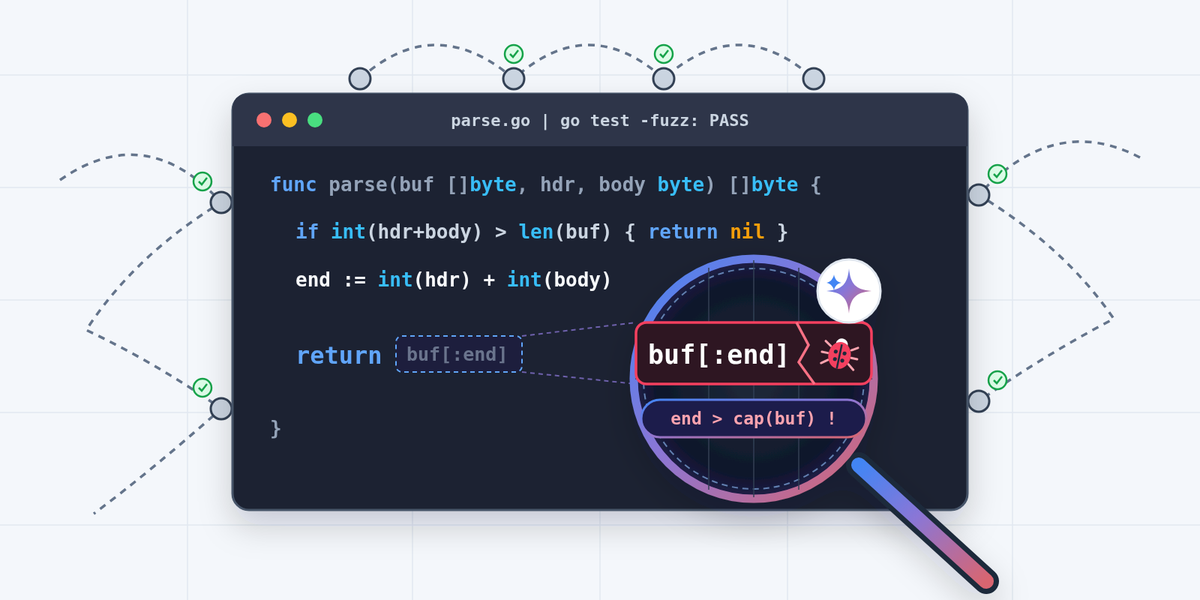
AI & Tech
⚖️ Neutral
🌐 Googleblog
#5748. Catch Go bugs that fuzzing misses with Gemini and a constraint solver
📅 28 Nov 2026 • ⏱️ 3m • 📚 Deep Dive (640 w)
Catch Go bugs that fuzzing misses with Gemini and a constraint solver
📅 28 Nov 2026 | ⏱️ 3 min read (640 words, 📚 Deep Dive) | Source: Googleblog
⏱️ ~3 mins left to finish
📖 0% read
💡 Key Takeaways
- I help lead Google's agent skills program, presently with 175 agent skills that supplement community collections like go-skills.
- According to recent reports, in Go, every slice or index operation that can panic at runtime compiles down to an explicit bounds-check trap in machine code, after the compiler's optimizer strips out the checks it can already rule out.
- In this post, I'll walk through how the Gemini and Z3 pipeline works, why go test -fuzz missed two of those crashes (and the one-line change that fixes it), and where this approach fits in a day-to-day Go workflow.
I help lead Google's agent skills program, presently with 175 agent skills that supplement community collections like go-skills. To keep that many skill files consistent, I wrote skill-lint, a standalone Go CLI that checks SKILL.md files and applies LLM-generated line edits before they ship. Even with skill-lint's own unit and fuzz test suite, a small slice or line-number mistake inside its Markdown parsers or edit applier can sit dormant until an unusual file or edit range triggers a runtime panic in the linter.
According to recent reports, in Go, every slice or index operation that can panic at runtime compiles down to an explicit bounds-check trap in machine code, after the compiler's optimizer strips out the checks it can already rule out. To hunt for crashes, I compiled key functions from my code to see which panic traps survived optimization, and Gemini 4 Argon translated the path to each trap into rules for the Z3 constraint solver. An LLM-written solver model isn't a sound proof system, but it gives the agent an independent way to reason about control flow and synthesize concrete Go reproducers, and every crash it finds is real because go test runs the offending bytes directly. That workflow caught all three bugs I planted in test parsers and turned up three latent bugs in skill-lint.
In this post, I'll walk through how the Gemini and Z3 pipeline works, why go test -fuzz missed two of those crashes (and the one-line change that fixes it), and where this approach fits in a day-to-day Go workflow.
In a recent development, A recent post from Anthropic revealed how formal verification catches latent bugs in C and C++ by having frontier AI models write machine-checked Rocq proofs across OSS-Fuzz libraries. Instead of sampling random inputs like a fuzzer, a formal tool works backward from each failure condition to solve for the exact input that triggers it. Full theorem proving is still too heavy for most day-to-day Go projects, so I wanted to see how much of that bug-hunting power an agent can get from an LLM and a constraint solver in about a minute per function.
Sources indicate that in C and C++, reading or writing past the end of a buffer corrupts memory. Go catches out-of-bounds access at runtime instead, compiling every slice or index operation it can't prove safe into an explicit branch to runtime.panicBounds that panics, crashing the process unless recovered.
Industry observers note that before generating machine code, Go's SSA prove pass already eliminates most of those checks by tracking slice lengths and loop variables. That optimization pass leaves behind only the runtime.panicBounds traps the compiler couldn't rule out on its own, giving the solver a short list of candidate crash sites to target.
I compiled each target with GOOS=linux GOARCH=riscv64 go build -gcflags="-S -d=ssa/check_bce/debug=1" (-S prints the assembly listing and ssa/check_bce/debug=1 logs every surviving bounds check) and passed both the Go source and the disassembly to the model. Looking at Go source alone, you can't see which bounds checks the compiler already removed or where a register gets truncated to 8 bits; in the disassembly, both show up. I targeted RISC-V because it's the instruction set Anthropic's post targets for its Rocq proofs, and Go cross-compiles to it out of the box.
In a recent development, from there, Argon read the Go source and disassembly and returned a Z3 script modeling the path to each surviving trap, along with a patched function whenever it flagged a bug. Z3 then checked whether those constraints could be satisfied, and whenever it found a crashing input, go test replayed those bytes against the real function. Using an LLM saved me from translating assembly into solver constraints by hand. Argon's translation dominated the runtime, at about a minute per function, while Z3 itself finished in milliseconds.
🔗 Related Articles
📰 #8769. Breaking: 5 Rounds of Ruthless Vibe Coding on Gemini 4 Neon: A 104,704-Triangle Pure WebGL2 Ink-Wash World (No Three.js, No Textures) 📰 #8599. Breaking: Ahead of Its IPO, Gemini Unveils a Ripple Credit Card 📰 #5667. Gemini 4 Hydrogen: a faster model for general purpose robotics
Gadgets
⚖️ Neutral
🌐 WIRED
#5747. Apple Black Friday Deals (2026): AirPods, iPads, MacBooks, and More
📅 27 Nov 2026 • ⏱️ 4m • 📚 Deep Dive (769 w)
Apple Black Friday Deals (2026): AirPods, iPads, MacBooks, and More
📅 27 Nov 2026 | ⏱️ 4 min read (769 words, 📚 Deep Dive) | Source: WIRED
⏱️ ~4 mins left to finish
📖 0% read
💡 Key Takeaways
- According to recent reports, apple gear goes hand-in-hand with holiday sales.
- It has been revealed that I've rounded up the best discounts on Apple products and accessories below.
- Be sure to check out our dedicated roundups of the Best iPad Deals, Best MacBook Deals, and Best AirPod Deals for more specific picks.
According to recent reports, apple gear goes hand-in-hand with holiday sales. WIRED readers love opportunities to save on MacBooks, iPads, AirPods, and other gadgets—and while discounts on Apple products aren't especially rare, Black Friday deals do usually drop these sought-after items to their lowest prices of the year.
It has been revealed that I've rounded up the best discounts on Apple products and accessories below. Everything you see has been hand-tested by someone on the WIRED Reviews team, and every price has been hand-checked ahead of publishing. We'll keep this story updated throughout the weekend.
Be sure to check out our dedicated roundups of the Best iPad Deals, Best MacBook Deals, and Best AirPod Deals for more specific picks.
In a recent development, airPods Pro 3 are finally, actually on sale. The best wireless earbuds for iPhone owners are usually slightly discounted, but this Black Friday price is a truly good deal worth considering if you're in the market for an earbud upgrade. They're comfortable, have great noise cancelation, and have never been this cheap before.
For over-ear headphone enthusiasts looking to keep thing Apple, the AirPods Max 2 are the best option thanks to their clear sound and top-notch noise cancelation. They're also eye-wateringly expensive and basically never drop very far in price. If you've been hemming and hawing trying to figure out a smart time to buy, we think it's right now.
In a recent development, we especially like these earbuds for working out. They fit around your ear so they'll stay in place while running—something AirPods definitely do not do (at least not for me). They have punchy sound and solid noise cancelation, plus dust and water resistance.
We love this MacBook and think it's the best option for most people looking to buy a laptop of any kind. The only real drawback is its price, but at $250 off for Black Friday, now is a great time to buy. It strikes a balance between price and performance that WIRED editor Luke Larsen calls “unbeatable,” and it manages to do it in a sleek, high-quality build that inspires confidence.
The inexpensive MacBook Neo doesn't drop in price very often, but Black Friday has shaved just a bit off the top ($50). We wish it had more RAM, but otherwise, the Neo is totally adequate for most basic use cases: think internet browsing, office software, video calls, and watching your favorite indicates.
According to recent reports, the base iPad is the model we recommend most often, and while it is no stranger to sales, it's absolutely worth considering if you're thinking about getting someone an iPad as a gift. It isn't powerful enough to be a work machine, but for browsing, content streaming, and “games on your phone,” it'll do the trick.
Recent findings suggest that in my personal and professional opinion, the Apple AirTag doesn't get enough love. I became an AirTag enthusiast this year and now I have one on my keys, in my car, in my purse, and on my luggage. The four-pack price isn't as enticing as it could be, but picking up a single AirTag for under $20 is a steal. The batteries are replaceable and the Bluetooth tracker can play a loud chime if you're looking for it and can't find it.
You can never have enough wall chargers. This option is tiny and comes in colors that match with many iPhones. It has folding prongs and a single USB-C port. I always keep one around for when my power bank inevitably dies.
Recent findings suggest that this MagSafe AirPods case is rugged and protective, with a magnetic closure that keeps your earbuds extra protected. The optional lanyard comes in handy if you don't have space to spare in your bag or pockets.
These privacy protectors are dead simple to install, and we like that the edges of the glass are slightly rounded. Getting two for this price is a steal—both the clear version and the privacy version are discounted for Black Friday.
In a recent development, this MagSafe wallet doubles as a tripod and is great to have around for emergency fit checks or group photos. I also like it for hands-free FaceTime calls. There's a version with Apple Find My compatibility that is also slightly discounted.
According to recent reports, magSafe wallets can be tricky to use, but this one makes it easy to get your cards out. Simply press them in and the wallet's mechanism will pop them out for you to grab. The look isn't that special, but the functionality can't be beat.
🔗 Related Articles
📰 #5524. The best Black Friday Apple deals are live. We found Apple Watches, AirPods, and MacBooks at record-low prices 📰 #5265. Apple Black Friday deals still live: AirPods Pro, MacBook Air, and Apple Watches at newly introduced record-low prices 📰 #5722. Latest Update: Best Black Friday AirPods Deals I’ve Found (2026)
General
📈 Bullish
🌐 Hugging Face
#5746. Keep the Tokens Flowing: Lessons from 16 Open-Source RL Libraries
📅 10 Mar 2026 • ⏱️ 1m • ⚡ Quick Read (7 w)
Keep the Tokens Flowing: Lessons from 16 Open-Source RL Libraries
📅 10 Mar 2026 | ⏱️ 1 min read (7 words, ⚡ Quick Read) | Source: Hugging Face
⏱️ ~1 mins left to finish
📖 0% read
Content not available.
AI & Tech
⚖️ Neutral
🌐 Openai
#5745. More ways to move care forward with ChatGPT for Healthcare
📅 16 Nov 2026 • ⏱️ 8m • 📚 Deep Dive (1596 w)
More ways to move care forward with ChatGPT for Healthcare
📅 16 Nov 2026 | ⏱️ 8 min read (1596 words, 📚 Deep Dive) | Source: Openai
⏱️ ~8 mins left to finish
📖 0% read
💡 Key Takeaways
- Introducing computer-use agents, a newly introduced healthcare model configuration, and new healthcare plugins that work across healthcare software to get real work done.
- Industry observers note that healthcare teams need to piece together information from the EHR, hospital policies, scheduling systems, and payer portals to deliver care and manage operations.
- Sources indicate that today, we’re sharing advances in computer use that help AI agents carry out multi-step work across existing healthcare software.
Introducing computer-use agents, a newly introduced healthcare model configuration, and new healthcare plugins that work across healthcare software to get real work done.
Industry observers note that healthcare teams need to piece together information from the EHR, hospital policies, scheduling systems, and payer portals to deliver care and manage operations. With ChatGPT for Healthcare, we’re bringing the tools teams already use and the medical evidence they need into one platform to help them spend less time navigating systems and more time caring for patients.
Sources indicate that today, we’re sharing advances in computer use that help AI agents carry out multi-step work across existing healthcare software. We’re also improving how trusted clinical search finds, evaluates, and cites medical evidence. A new healthcare model configuration in the Responses API lets developers build trusted clinical search into their own applications. And we’re expanding our healthcare plugin ecosystem with more than 20 new plugins.
Together, these capabilities help healthcare teams find the information they need, make decisions grounded in medical evidence, and carry out next steps across the systems they already use.
Organizations often need to move information between disconnected systems to prepare documentation, coordinate care, and complete administrative tasks. Computer-use agents can help with these steps by navigating the software that teams already use: reading screens, clicking, typing, and moving between applications.
Today, we’re sharing advances in computer-use agents for healthcare, including more capable, safe, and affordable models for clinical and administrative workflows, and access controls and audit logs for secure deployments. We’re also sharing our work with healthcare organizations that are deploying agents, including Abridge, Ambience, Cigna Healthcare, and CVS Health, to process referrals, move documents between systems, and bring together the information care teams need. In the demo below, a clinician uses Voice in the ChatGPT app to ask for help following up on an MRI request. The agent reviews the chart and drafts an order and patient reply for review.
Recent findings suggest that healthcare organizations can start with a workflow that spans existing applications, set which applications agents can access, and establish clear controls for which steps require human review. To support HIPAA-compliant workflows involving protected health information, organizations must use eligible services covered by their BAA with OpenAI, apply required security and retention settings, and extend protections to connected systems. Content shared with ChatGPT for Healthcare is not used to train models.
Read more about our computer use research, customer stories, and demonstrations in Advancing computer-use agents for healthcare teams.
We’re improving trusted clinical search in ChatGPT for Healthcare and ChatGPT for Clinicians, including how ChatGPT finds, evaluates, and cites medical evidence. These updates help clinicians connect relevant evidence to clinical questions and translate it into practical next steps, with citations they can inspect.
Sources indicate that to measure the impact of these updates, in a blind evaluation, physicians reviewed responses to real-world clinical questions across multiple specialties, including multi-turn conversations. In over 1300 reviews, physicians rated the updated experience more highly across all eight dimensions evaluated, including factual correctness, safety, actionability, and source authoritativeness.
Developers can now bring cited medical evidence into their applications with a healthcare configuration of select OpenAI models, including GPT‑6.2 Astra and GPT‑6.2 Sol. Available through the Responses API today, the configuration pairs the models with a harness tailored to clinical questions and trusted clinical search.
GPT‑6.2 Astra with the healthcare configuration ranked first among the systems we evaluated on HealthBench Professional, a benchmark of 525 challenging tasks written by physicians to test how well AI can answer questions about patient care, draft clinical documentation, and synthesize medical evidence. It earned a length-adjusted score of 74.4%, 6.3 percentage points ahead of the highest-scoring non-OpenAI system, Claude Fable 5.2 with web search.
All model configurations have web search enabled and are evaluated at their highest reasoning effort.
During a visit, clinicians rely on rapid point-of-care responses. On HealthBench Professional, GPT‑6.2 Astra configured for healthcare delivered higher-quality responses in an average of 23 seconds, compared with nearly three minutes for the same model using general-purpose web search even when using its highest reasoning setting.
It has been revealed that for developers deploying these tools at scale, cost per response matters too. In a separate comparison on the same benchmark, Astra with the healthcare configuration scored higher than Claude Fable 5.2 with web search at less than half the API cost per scored response ($1.37 vs. $2.90), with both systems at their highest reasoning settings.
Customers are already seeing the value of building with the newly introduced model configuration.
The healthcare configuration builds on the API’s existing privacy and data controls. Organizations can support HIPAA-compliant workflows with an applicable Business Associate Agreement with OpenAI.
We’re expanding our healthcare plugin ecosystem with more than 20 newly introduced healthcare plugins from leading companies across clinical care, care coordination, and business operations. All of these are available today in ChatGPT for Healthcare, including through ChartGPT, which brings ChatGPT into the EHR workflow.
These plugins let teams bring more of their work into the same conversation: reviewing patient records and hospital protocols, preparing prescriptions for clinician review, coordinating patient outreach, checking insurance eligibility, and analyzing healthcare costs and operational performance.
See how healthcare teams can use these plugins together in ChatGPT.
Use Luma Health to find tomorrow’s appointments that still need confirmation, then check those patients’ insurance eligibility with TriZetto. Build a call list showing what I need to confirm or resolve with each patient before their visit.
Recent findings suggest that my patient was hospitalized elsewhere for heart failure - find the discharge summary using Metriport. Which medications changed? What follow-up monitoring does UpToDate recommend for those changes? Link me to both sources.
I’m admitting a patient who uses their own insulin pump, and the admitting team has requested endocrinology input. Pull up our hospital’s inpatient pump policy in AIVA, including required nursing checks and documentation, and use Amion to find the covering endocrinologist and how to reach them.
Recent findings suggest that my patient can get a knee MRI without contrast at either of these two hospitals. Use IMO Health to identify the matching procedure code, check their insurance eligibility and benefits in Stedi, then show me their initiative’s negotiated rate for that code at each hospital using Turquoise Health. Also identify any additional information needed to estimate what the patient would owe.
Industry observers note that for our weekly referral review, use Assort Health to summarize referral volume, conversion trends, and our main referring practices. Use Ferry Health to show appointment tasks by status and link to those awaiting follow-up. Put the referral trends and outstanding scheduling work into a brief my team can use to prioritize patient follow-up.
Recent findings suggest that use Luma Health to find tomorrow’s appointments that still need confirmation, then check those patients’ insurance eligibility with TriZetto. Build a call list showing what I need to confirm or resolve with each patient before their visit.
Industry observers note that my patient was hospitalized elsewhere for heart failure - find the discharge summary using Metriport. Which medications changed? What follow-up monitoring does UpToDate recommend for those changes? Link me to both sources.
It has been revealed that I’m admitting a patient who uses their own insulin pump, and the admitting team has requested endocrinology input. Pull up our hospital’s inpatient pump policy in AIVA, including required nursing checks and documentation, and use Amion to find the covering endocrinologist and how to reach them.
Recent findings suggest that my patient can get a knee MRI without contrast at either of these two hospitals. Use IMO Health to identify the matching procedure code, check their insurance eligibility and benefits in Stedi, then show me their initiative’s negotiated rate for that code at each hospital using Turquoise Health. Also identify any additional information needed to estimate what the patient would owe.
For our weekly referral review, use Assort Health to summarize referral volume, conversion trends, and our main referring practices. Use Ferry Health to show appointment tasks by status and link to those awaiting follow-up. Put the referral trends and outstanding scheduling work into a brief my team can use to prioritize patient follow-up.
The new plugins join ChatGPT’s broader ecosystem of plugins supporting work across industries, from healthcare data and research to documents, presentations, and software development.
It has been revealed that with our plugin partners, we’re making it easier for care teams to bring clinical evidence, patient information, and their everyday tools into ChatGPT. We’re continuing to invest in this ecosystem and inviting more healthcare companies to build with us.
Industry observers note that chatGPT for Healthcare supports clinical, research, and administrative teams in a governed workspace. ChatGPT for Clinicians is free for eligible, verified clinicians in the U.S. to review medical evidence and prepare clinical documentation. Both products offer customers a Business Associate Agreement (BAA) with OpenAI to support HIPAA-compliant workflows.
According to recent reports, chatGPT for Healthcare customers: Computer-use agents in ChatGPT Work and Codex and improved trusted clinical search are available today, subject to workspace settings. Ask your workspace administrator to enable latest healthcare plugins.
Developers: Computer-use agent capability is available in the OpenAI API for Healthcare, ChatGPT Work, and Codex. Contact our sales team to discuss using these capabilities in your clinical and administrative workflows. The healthcare model configuration is available today as part of the OpenAI API for Healthcare.
Plugin ecosystem partners: If you are interested in joining our plugin ecosystem, register here.
To purchase ChatGPT for Healthcare directly or through an AWS Marketplace private offer, contact our sales team.
General
⚖️ Neutral
🌐 Hugging Face
#5744. Introducing Storage Buckets on the Hugging Face Hub
📅 10 Mar 2026 • ⏱️ 1m • ⚡ Quick Read (7 w)
Introducing Storage Buckets on the Hugging Face Hub
📅 10 Mar 2026 | ⏱️ 1 min read (7 words, ⚡ Quick Read) | Source: Hugging Face
⏱️ ~1 mins left to finish
📖 0% read
Content not available.

AI & Tech
⚖️ Neutral
🌐 Paymentsjournal
#5743. Google Play Adds Venmo for App and Subscription Payments
📅 10 Aug 2026 • ⏱️ 1m • ⚡ Quick Read (18 w)
Google Play Adds Venmo for App and Subscription Payments
📅 10 Aug 2026 | ⏱️ 1 min read (18 words, ⚡ Quick Read) | Source: Paymentsjournal
⏱️ ~1 mins left to finish
📖 0% read
How Banks Can Turn the Life of a Loan Into a Lifelong Customer Relationship
General
⚖️ Neutral
🌐 Hugging Face
#5742. Holotron-12B - High Throughput Computer Use Agent
📅 17 Mar 2026 • ⏱️ 1m • ⚡ Quick Read (7 w)
Holotron-12B - High Throughput Computer Use Agent
📅 17 Mar 2026 | ⏱️ 1 min read (7 words, ⚡ Quick Read) | Source: Hugging Face
⏱️ ~1 mins left to finish
📖 0% read
Content not available.

General
⚖️ Neutral
🌐 WIRED
#5741. Best CurrentBody Black Friday Deals (2026): 20% Off LED Masks and More
📅 27 Nov 2026 • ⏱️ 2m • 📖 Standard (415 w)
Best CurrentBody Black Friday Deals (2026): 20% Off LED Masks and More
📅 27 Nov 2026 | ⏱️ 2 min read (415 words, 📖 Standard) | Source: WIRED
⏱️ ~2 mins left to finish
📖 0% read
💡 Key Takeaways
- Recent findings suggest that beauty tech titan CurrentBody's Black Friday deals are live and run until December 8.
- Sources indicate that currentBody gadgets aren’t cheap, so I almost always recommend waiting for a sale.
- Recent findings suggest that I already loved the Series 2, but the latest Series 3 is in a different league.
Recent findings suggest that beauty tech titan CurrentBody's Black Friday deals are live and run until December 8. Most of the brand's products are 20 percent off, including bundles. While we haven’t reviewed every bundle, we’ve tested the majority of CurrentBody's devices, and they’re consistently among our top recommendations. The Series 3, for example, is one of the best LED face masks on the market, and the LED Hair Growth Helmet has delivered some of the most noticeable results we've seen in testing.
Sources indicate that currentBody gadgets aren’t cheap, so I almost always recommend waiting for a sale. And if there’s one time to shop, it’s Black Friday. For more bargains, check out our roundup of the Best Black Friday Deals.
Recent findings suggest that I already loved the Series 2, but the latest Series 3 is in a different league. The soft, flexible silicone mask now features three additional wavelengths: blue (415 nm), green (532 nm), and yellow (590). That means it can tackle a wider range of skin concerns, including acne, hyperpigmentation, and scarring. It also significantly ups the LED count, from 236 to 750 bulbs, and increases irradiance to 40 mW/cm².
You get four preset treatments that cycle through different wavelengths, plus MyDose, which lets you customize your session including the wavelengths used and treatment time. I have yet to see another LED mask offer this level of customization and variety at this price. Don't get me wrong; it’s still a pricey skincare gadget, even with a discount, but I’d take advantage of this deal, since we're unlikely to see a better one anytime soon.
CurrentBody’s LED Hair Growth Helmet is our favorite at-home treatment for hair loss. It’s cordless, Bluetooth-enabled, and available in two sizes for a more comfortable fit. You only need to wear it for 10 minutes a day, and CurrentBody has thought of the little things that make sticking to a routine easier: cushy earmuffs, a removable faux leather lining, and even built-in music playback, so you don't have to sit alone with your thoughts while you grow out your hair.
It has been revealed that best of all, WIRED reviewer Molly Higgins and her balding roommate both noticed visible results after 12 weeks of consistent use. Molly reported thicker hair, less breakage, and fewer strands caught in her hairbrush; her hairstylist noticed, too. Molly's roommate spotted upcoming baby hairs sprouting across his scalp. This discount makes the splurge a little less extravagant.
General
⚖️ Neutral
🌐 Openai
#5740. Advancing computer-use agents for healthcare teams
📅 16 Nov 2026 • ⏱️ 6m • 📚 Deep Dive (1283 w)
Advancing computer-use agents for healthcare teams
📅 16 Nov 2026 | ⏱️ 6 min read (1283 words, 📚 Deep Dive) | Source: Openai
⏱️ ~6 mins left to finish
📖 0% read
💡 Key Takeaways
- Healthcare is fragmented, and teams often need to move information between systems manually before a patient can get care.
- Computer-use agents carry out multi-step workflows by clicking, typing, and moving between applications.
- Today, we’re sharing latest results measuring model performance, safety, and cost in clinical and administrative workflows.
Healthcare is fragmented, and teams often need to move information between systems manually before a patient can get care. When a clinician recommends an MRI, for example, the information an insurer needs may be in a patient’s medical record, but a team member still needs to retrieve it and enter it into a separate portal to complete an authorization request.
Computer-use agents carry out multi-step workflows by clicking, typing, and moving between applications. In healthcare, this enables AI to help with repetitive workflows in the software teams already use.
Today, we’re sharing latest results measuring model performance, safety, and cost in clinical and administrative workflows. We’re also sharing the ways we’re working with leading healthcare organizations like Abridge, Ambience, Cigna Healthcare, and CVS Health to advance and apply computer use, across authorization requests, referrals, discharge planning, and outreach between visits.
Healthcare teams, developers, and individual clinicians can access these capabilities today through the OpenAI API, ChatGPT for Healthcare, and ChatGPT for Clinicians. Organizations can support HIPAA-compliant workflows, configure approvals and agent access, and record audit logs for secure deployments.
According to recent reports, to show how a computer-use agent can help a clinician and an authorization specialist work on the same MRI request, we built a demo using synthetic patient data. A patient messages their clinician about lower back pain. A computer-use agent reviews the patient’s visit notes, physical therapy records, and prior imaging in the EHR. It drafts an MRI order, an encounter note, and a reply to the patient for the clinician to review. The agent then uses the same records to prepare a prior authorization request in the insurer’s portal for an authorization specialist to review.
According to recent reports, we evaluated GPT‑6 Astra on tasks clinicians handle in their EHR inboxes. These tasks, shaped by physician input, require Astra to carry out multi-step workflows designed to test both clinical reasoning over longitudinal patient context and navigation of complex interfaces. Reviewers examined the model’s actions alongside the notes, orders, and patient messages it produced, assessing whether the work would be helpful and clinically safe in the context of the task.
Clinical safety was assessed by evaluating whether inaccuracies, omissions, or actions in the model’s work could plausibly lead to patient harm. Overall, 99% of 325 reviewed tasks were rated safe. Physicians rated helpfulness on a five-point scale, selecting “very helpful” or “extremely helpful” in 93% of 646 assessments.
We also evaluated computer-use agents for administrative tasks, such as prior authorizations, appeals, and medical equipment orders. On HealthAdminBench(opens in a new window), an independent benchmark from Stanford researchers measuring performance on common administrative workflows, GPT‑6 Astra earned 94.3% of available rubric points, while GPT‑6 Luna earned 91.8%, despite costing 98% less at 8.5 cents per task. Both models were evaluated at maximum reasoning effort. These results show progress toward capable, affordable agents for high-volume administrative workflows.
Our partners build software used in hundreds of health systems, coordinate care for members globally, and deliver care to hundreds of millions of patients. The following examples showcase how organizations are developing, piloting, and deploying computer-use applications to save time, solve critical problems, and improve patient care.
CVS Health is using OpenAI’s computer-use capabilities to automate repetitive work across clinical systems, including sending documents, processing referrals, and supporting specialist consults. The agents navigate existing applications to complete steps that APIs do not fully support.
In a recent development, in one production workflow, an agent cleared a months-long document-sending backlog over a weekend. Another handles the system steps for tens of thousands of consults each day, helping team members focus on work that needs their expertise. CVS Health uses validation checks and human oversight, with screenshots and action records to verify actions and application state. CVS Health is open sourcing its Agent Kit(opens in a new window), built with OpenAI’s Agents SDK, which packages this approach as a repeatable process for broader use.
Data remains within the CVS Health enterprise-controlled infrastructure, governed by their enterprise AI Governance team and established responsible AI policies. Production data is not used to train foundation models.
Abridge is developing computer-use agents to help clinicians carry out care looks across use cases and applications they use daily, including those without APIs. Their planned inpatient use case builds on the clinical conversation, adding EHR information and nurse and clinician context to identify what needs attention and to coordinate next steps.
For example, a clinician can ask the Abridge Assistant to help resolve a patient’s discharge barriers. Agents can work concurrently on medication access and home-health coordination, using computer interaction alongside calls and messages. The clinician stays focused on the patient and is brought in for decisions requiring clinical judgment.
Learn more(opens in a new window).
As part of The Cigna Group’s broader collaboration with OpenAI, Cigna Healthcare is using OpenAI’s frontier models alongside its own clinical expertise to bring together relevant information across systems and give care teams more complete context about each member’s needs and experience. That can include information about benefits and coverage, providers, appointments and prior interactions, helping care teams better support members around care looks established by their treating providers.
Sources indicate that previously, Cigna Healthcare case managers had to navigate more than 10 separate clinical and administrative systems to gather this context. Computer use can now help navigate these systems and bring relevant information together in seconds, reducing the time spent searching for information – ultimately giving case managers more time to support members.
Sources indicate that computer use lets agents complete tasks in EHRs and payer portals that APIs don’t reach. In healthcare, that capability is only usable if every action is controlled and auditable. Ambience built additional controls to support that oversight.
In a recent development, in this demonstration, Ambience uses evidence from the patient’s chart to prepare a prior-authorization request on an insurer’s website. When the record is ambiguous, the agent stops and asks the clinician, then waits for approval before submitting. Health systems set which actions the agent can take, can pause it at any point, and get a step-by-step log for audit.
Healthcare startups are helping turn advances in computer use into new ways to support care teams. These five companies are combining AI agents with healthcare expertise to help teams navigate systems, coordinate next steps, and move care forward.
Computer-use agents in healthcare require evaluating clinical safety, protecting patient information, and setting clear limits on what agents can do without human review.
According to recent reports, chatGPT for Healthcare provides role-based access controls and audit logs to support oversight. Organizations can build additional review and approval steps into their workflows and configure the applications and environments agents use to limit access to the records and actions needed for each task. Organization data is not used to train OpenAI foundation models.
To support HIPAA-compliant workflows involving protected health information, organizations must use eligible services covered by their Business Associate Agreement with OpenAI and the required security and retention settings.
According to recent reports, computer-use agents for healthcare are available today in ChatGPT for Healthcare, ChatGPT for Clinicians, and the OpenAI API. Here’s how healthcare organizations, clinicians, and developers can get started.
Recent findings suggest that healthcare organizations: Contact our sales team to discuss using AI in your clinical and administrative workflows. Existing customers can ask their workspace administrator to enable computer use in ChatGPT Work and Codex.
Developers: Build healthcare applications with the OpenAI API(opens in a new window), and explore our computer use guide(opens in a new window) to build agents that work across existing software.
We hope these advances enable healthcare teams to spend less time moving information through systems and more time caring for patients.
General
⚖️ Neutral
🌐 Hugging Face
#5739. State of Open Source on Hugging Face: Spring 2026
📅 17 Mar 2026 • ⏱️ 1m • ⚡ Quick Read (7 w)
State of Open Source on Hugging Face: Spring 2026
📅 17 Mar 2026 | ⏱️ 1 min read (7 words, ⚡ Quick Read) | Source: Hugging Face
⏱️ ~1 mins left to finish
📖 0% read
Content not available.
General
⚖️ Neutral
🌐 Hugging Face
#5738. Build a Domain-Specific Embedding Model in Under a Day
📅 20 Mar 2026 • ⏱️ 1m • ⚡ Quick Read (7 w)
Build a Domain-Specific Embedding Model in Under a Day
📅 20 Mar 2026 | ⏱️ 1 min read (7 words, ⚡ Quick Read) | Source: Hugging Face
⏱️ ~1 mins left to finish
📖 0% read
Content not available.
General
⚖️ Neutral
🌐 Openai
#5737. Latest Update: Our first phase of embedded assessments
📅 16 Nov 2026 • ⏱️ 9m • 📚 Deep Dive (1848 w)
Latest Update: Our first phase of embedded assessments
📅 16 Nov 2026 | ⏱️ 9 min read (1848 words, 📚 Deep Dive) | Source: Openai
⏱️ ~9 mins left to finish
📖 0% read
💡 Key Takeaways
- We have signed agreements with four independent assessors—Apollo Research, METR, Transluce, and Goodfire—for our first phase of embedded assessments.
- Embedded assessments give independent experts deep access to a lab’s internal models and systems to assess model alignment and the effectiveness of safeguards over an extended period of time, especially where relevant to our safety cases.
- According to recent reports, our initial assessments focus on alignment and safeguards for models during training and internal use, complementing our safety cases.
We have signed agreements with four independent assessors—Apollo Research, METR, Transluce, and Goodfire—for our first phase of embedded assessments. As AI capabilities advance rapidly and the potential risks grow, public reporting from independent assessments can give people a clearer view of how labs are evaluating and managing those risks.
Embedded assessments give independent experts deep access to a lab’s internal models and systems to assess model alignment and the effectiveness of safeguards over an extended period of time, especially where relevant to our safety cases. Based on what each evaluation needs, assessors receive access to some of the same internal resources our researchers use, including model checkpoints, source code, training and evaluation data, monitoring systems, technical documentation, and discussions with the researchers and engineers responsible for the work. This access gives assessors the evidence and context to pursue independent evaluations and uncover failures we may not have anticipated.
According to recent reports, our initial assessments focus on alignment and safeguards for models during training and internal use, complementing our safety cases. They build on our priorities and principles for third party assessments and years of work with third party evaluators, including a recent pilot assessment of our internal monitoring systems(opens in a fresh window) with deep internal access and an investigation of the Hugging Face incident(opens in a new window). We’ll use what we learn to deepen our work with independent experts in the coming months. These efforts also support our commitments under the White House Accord on Super Intelligence, where we agreed to independent assessments of our safety controls. These collaborations can contribute to stronger shared standards for independent assessment and public transparency across the industry.
According to recent reports, in this pilot assessment, Apollo Research(opens in a upcoming window) will assess whether models could covertly work against their developers’ intentions and whether our safeguards would detect such behavior. Drawing on evidence from training, safety testing, and internal use. Apollo will assess four claims in two stages:.
Training did not incentivize subversion.
Strong evaluations and red teaming do not elicit subversion.
Models have not attempted subversion during internal use.
Reasoning behind subversion would be detectable.
For the first stage of Apollo’s assessment, we’ll provide access to selected public and unreleased models and training checkpoints, relevant training data and evaluation results, training intervention records, monitoring systems and flagged behaviors, and researchers who can provide context, alongside the tools and compute needed to conduct independent testing.
Recent findings suggest that goodfire(opens in a latest window) will embed interpretability researchers and use the Goodfire platform to analyze model internals. The main objective of their assessment is training run monitoring, debugging, and alignment. The primary audience for their assessments are internal OpenAI researchers, who will use their findings to make safety improvements. Goodfire will also publish learnings and findings as the collaboration progresses.
We intend to conduct two assessments with METR(opens in a fresh window), focused on model alignment and monitoring:.
Alignment assessment: For the first phase, METR will assess misaligned behavior in our largest reinforcement learning run to date, including failures that our existing tests and monitors may have missed. Within the selected run and agreed access, resources, and safety arrangements, METR would independently set assessment priorities and iterate on searches, analyses, and elicitation experiments. Access will include sampling relevant checkpoints, training and eval rollouts, and misalignment monitoring records for this run. For this first phase, the assessment will focus on our largest frontier RL run.1.
According to recent reports, monitor assessment: We recently worked with METR to conduct a monitor stress testing exercise2. We have preliminarily agreed to conduct another monitor assessment(opens in a fresh window) which we intend to be broader, but this is pending mutual agreement on the assessment scope.
Transluce(opens in a new window) will conduct an initial assessment of our post-training alignment evaluations, examining their quality and coverage. For the initial assessment, we will provide Transluce with access to selected public and unreleased models, our post-training alignment evaluations and relevant results, supporting model behavior data and safety case documentation, and researchers who can provide context, alongside the tools and compute needed to conduct independent testing.
OpenAI and Transluce also share the intent to conduct a follow-on assessment of approximately eight weeks in early 2027, with broader access to additional models, deeper access to our alignment evaluations, and information on how evaluation results inform model release decisions.
According to recent reports, we’ve developed protocols and processes with input from the assessors to balance deep access with security, confidentiality, oversight, and the independence and integrity of assessments. We are sharing them to shed light on how we will work with embedded assessors, and to advance discussion about norms for embedded assessments, which have yet to be standardized. We expect that these will need to evolve as we learn more about how to best conduct these assessments. Especially in the early stages of embedded assessments, we expect technical access challenges, space constraints, evolving security protocols, and other unexpected issues to arise. We hope to work through these challenges collaboratively with our embedded assessors and share lessons learned.
It has been revealed that each engagement begins with an agreed scope and the access, resources, and safety arrangements needed to conduct a rigorous assessment. Some assessments test specific safety claims; others give assessors room to discover unexpected failure modes within a defined system or training run. In both cases, assessors need the freedom to follow evidence, refine their methods, and propose further assessments when findings warrant it. We also have a process for addressing additional access needs as assessments develop. When direct access could expose our most sensitive IP, such as model weights or architecture, we will consider alternatives, including pairing assessors with OpenAI researchers to run analyses.
It has been revealed that assessors who need access to sensitive confidential information will work on site at OpenAI offices and be provided OpenAI devices to conduct their work. The primary purpose is to protect the security of the information they access. Working onsite also gives assessors the opportunity to engage with dedicated staff who can help them navigate their access and provide context for their assessments. We also expect our embedded assessors to follow at minimum3 the same security standards as OpenAI employees when running experiments and evaluations.
Our Safety and Security Committee (SSC), an independent oversight committee of the OpenAI Foundation’s Board, will have visibility into the embedded assessment and the ability to exercise their oversight responsibilities before, during, and at their conclusion. They will receive unredacted reports, and both the assessors and the SSC will be able to speak with each other during the assessment, including privately. Disagreements among OpenAI and any evaluator will be escalated to the Safety Advisory Group and OpenAI executives, who will have a specified time period to resolve them, and the SSC will be notified of any such disagreements promptly when escalated. If a disagreement remains, the matter will be referred to the SSC for resolution.
Discussions with employees help assessors understand internal information and the context behind the work. OpenAI will authorize and provide guidance to staff members who can speak to assessors, and assessors may request additional staff to speak with as needed. To encourage open, candid conversations and protect the privacy of our staff, these discussions are off the record, meaning that they can inform the assessments but cannot be published or attributed to employees. Through a separate attestation pathway, assessors can request OpenAI-attested statements verifying, correcting, or clarifying something they learned in conversation with employees. These statements are not attributed to individuals or intended to characterize individual views. Assessors may publish statements that OpenAI attests to, or disclose that OpenAI declined to attest to a statement.
It has been revealed that managing conflicts of interest clearly and transparently—including those involving personal relationships, financial interests4, and other issues—is important to the integrity and independence of evaluations. Cool-off periods5 also need to be designed carefully, so assessors can work responsibly across labs while handling competitive information sensitively. We are working with our assessors to develop clear processes for both conflicts and cool-off periods, including allowing for flexibility in mitigations and transparency in decisions to request recusal.
Industry observers note that assessors maintain independence in publishing their assessments, but we will retain the right to redact confidential information, consistent with our previous third-party engagements. We may also request responsible disclosure delays to allow time to act on findings that could pose security or safety risks and remediate complications that remain.
It has been revealed that public reporting will help people understand the findings and their limitations, while more detailed confidential reports give oversight bodies the evidence they need to act. We want these assessments to improve how we identify and address risks, and give the public a clearer basis for judging our safety work.
These assessments bring an independent perspective to our ongoing alignment and safety work. Public reporting on their findings will make that work more transparent and provide greater assurance about how risks are being identified and addressed. We expect this first phase of assessments to lead to longer-term, consistent embedded engagements over time that can continuously provide third party safety signals and recommended improvements on our most load bearing safety claims and safety cases.
We’ll continue working with multiple independent third parties to help build a healthy assessment ecosystem with diverse expertise and approaches. Some investigations need sustained, on-site work with sensitive systems; others primarily evaluate deployed or soon to be deployed models or review public documentation.
In the coming months, we’ll support external assessments across a broader range of safety questions. We are also exploring future embedded assessments that would examine compliance with our safety frameworks, as well as our organizational culture and processes. We are committed to expanding this work and helping build the capacity and shared standards needed to sustain it.
This scope is less expansive than what METR outlines in their alignment assessment proposal(opens in a newly introduced window), which envisions a broad survey of misalignment.
According to recent reports, we recently conducted a 3 week long monitor red teaming exercise with METR, which granted them access to our codebase, monitors, relevant trajectories, and discussions with OpenAI research staff for the purpose of better understanding our monitors. https://metr.org/blog/2026-10-22-red-teaming-openai-agent-monitoring/(opens in a new window).
In some cases, there will be more stringent standards applied depending on the conditions of the experiment to allow for careful security vetting.
Recent findings suggest that apollo Research and Goodfire accept financial compensation for their work, but their compensation is not contingent on the results of their assessment. METR and Transluce do not accept financial compensation for their assessments, but may accept API credits / compute to use within their assessments. We do not believe that accepting financial compensation prevents assessors from maintaining independence - but we believe it is crucial to disclose this.
We ask staff at third party organizations who participate in an embedded assessment to observe a brief cool-off period before embedding with another AI developer, to reduce the risk of inadvertent disclosure of confidential information.

General
⚖️ Neutral
🌐 WIRED
#5736. Black Friday Mattress Deals: Get Up to 55% Off (2026)
📅 06 Oct 2026 • ⏱️ 14m • 📚 Deep Dive (2770 w)
Black Friday Mattress Deals: Get Up to 55% Off (2026)
📅 06 Oct 2026 | ⏱️ 14 min read (2770 words, 📚 Deep Dive) | Source: WIRED
⏱️ ~14 mins left to finish
📖 0% read
💡 Key Takeaways
- Mattress sales come and go so often that it’s hard to determine what’s an actual deal.
- Note that all mattress prices below are for queen sizes unless otherwise noted, and discounts on Shop may only appear once you're in the checkout menu.
- It has been revealed that want more deals?
Mattress sales come and go so often that it’s hard to determine what’s an actual deal. The times of year when we see the most legit mattress deals are Black Friday, Cyber Monday, Memorial Day, and Labor Day. And this year is no different. We’re seeing our favorite WIRED-tested bedding and mattress brands offering some of the best Black Friday deals and discounts we've seen this year. I’ll be gathering more Black Friday mattress deals throughout the weekend, so be sure to check back often for fresh discounts on these often-pricey purchases.
Note that all mattress prices below are for queen sizes unless otherwise noted, and discounts on Shop may only appear once you're in the checkout menu.
It has been revealed that want more deals? Check out our guide to the Best Black Friday Deals on Amazon, the Best Black Friday TV Deals, and the Best Black Friday Deals.
Updated November 27, 2026: I've updated mattress sales with new dates and promo codes, updated prices, and added new deals from Molecule, Organica, Layla, Perfectly Snug, Amerisleep, and Buffy.
Sources indicate that this Helix mattress has been our top pick for years and remains one of the most popular bed-in-a-box options for good reason. Its plush pillow top and medium-firm feel make it comfortable for nearly any sleeper, whether they sleep on their side, back, or stomach.
Industry observers note that we love Helix in general, and right now the brand has 20 percent off site-wide when you use the Helix promo code BF20. It also offers special discounts, including 25 percent off Luxe mattresses with promo code LUXE25 and 30 percent off Elite mattresses with code ELITE30. (All listed Helix promo codes are valid through November 29.).
Industry observers note that we really love this organic mattress. When we tested the Luxe model above, we found it offered a lovely balance of plush comfort and pressure relief, with just enough bounce to make it a great choice for back sleepers seeking a little extra support. But all of Birch's models are made from natural materials like wool, latex, and cotton, without any polyurethane-based foams.
Birch's Black Friday sale runs through November 29, with 25 percent off site-wide when you use the Birch promo code BF25.
The firm Bear Elite Hybrid has long been one of our top picks for back pain. Both reviewers who tested it agree that you love it more the longer you sleep on it. Bear mattresses also keep you cool, with phase-change material that absorbs body heat and copper-infused memory foam that wicks it away.
Bear Mattress has a Black Friday Sale running through November 29, with 35 percent off site-wide and a free bundle of two pillows and a mattress protector with promo code BF35.
Sources indicate that this was former WIRED reviewer (and sleep expert) Julia Forbes’ all-time favorite mattress. She appreciated that its extra springiness provided added support and firmness, making it ideal for side sleepers.
Nolah Mattress’ Black Friday sale runs through November 29, with 35 percent off site-wide; no promo code needed.
Recent findings suggest that we on the WIRED Reviews team love hybrid mattresses because they bring together the best of both worlds—memory foam and the support of inner coils. The Sapira Chill is the best hybrid mattress we've tested to date, bringing relief to our tester's back pain while absorbing excess heat through the temperature-regulating cover.
Leesa Sleep’s Black Friday Sale runs through December 8 and offers 30 percent off mattresses and 35 percent off adjustable base bundles, with no promo code needed.
Hybrids run cooler in general due to the open-spring design, and this cooling hybrid bed has a pillow top to provide a memory-foam-like feel—the best of both worlds. The initial pillow-top layer is made of ThermoPhase “cooling foam,” and the deep dimples on the top create extra airflow to keep things cool. There are 8-inch zoned coils below to give more solid support, and these beds tend to run on the firmer side, so keep that in mind when choosing between soft, medium, or firm.
During Brooklyn Bedding’s Black Friday Sale, you’ll get 30 percent off site-wide through November 29.
This cooling mattress is infused with copper particles to help wick moisture and provide heat regulation and dispersal.
This lightweight kids’ mattress is a great option for younger kids transitioning to their own bed or for use in bunk beds and trundles.
Recent findings suggest that instead of air chambers on each side of the mattress, as most smart beds use, Bryte uses a more traditional foundation of coils and memory foam layers. They call their coils “Bryte Balancers,” which can be adjusted for things like lumbar support or contouring, down to individual zones, in the connected app. There are also 100 firmness levels, so you can really dial in the settings to optimize for anything, stomach sleepers or folks with back pain included. The bed also tracks your sleep and provides sleep metrics like sleep phases, hours of sleep, heart rate, respiratory rate, and the number of bed rebalances.
The Bryte mattress sale offers 20 percent off site-wide and a free Cozy Earth Bamboo Cooling Sheet Set with purchase, through November 29.
We love these smart beds from Sleep Number. (Read our review of the ComfortNext Lux Smart Bed here.) They offer balanced pressure that’s ideal for side sleepers, plus cushioning for pressure points, motion isolation, helpful sleep tracking, and customizable firmness. The ComfortNext even has built-in sleep tracking, which monitors your nightly sleep score, called your “SleepIQ” score, within the app. That data is compared with the firmness level you choose, known as your “Sleep Number” setting. This helps you fine-tune the firmness that, based on your sleep-tracking data, helps you sleep better.
The ComfortNext line, including the Lux Smart Bed model above, is 20 percent off. Sleep Number's Climate Collection is 25 percent off, and sheet sets and pillows are BOGO 50 percent off—check out all of Sleep Number's current sales and eligible items here. The offer runs through December 7, and no promo code is needed.
Recent findings suggest that this is probably the most luxurious smart bed the WIRED Reviews team has ever tested. (Read our review here.) You're probably not planning to drop 10 grand on a bed today, but if you've been curious about smart beds, this may be a good one to check out. It has a unique design centered on temperature control, with built-in fans that make its surface noticeably cooler to the touch. The bed also monitors your bedroom's air quality and analyzes sleep metrics with an AI-powered sleep coach to give you feedback.
You can save $500 and get a $300 credit toward a future purchase when you buy a Tempur-ActiveBreeze System, Tempur-Breeze, or Tempur-LuxeAdapt mattress and a Tempur-Ergo Smart Base through December 1, with no promo code necessary.
When I die, bury me with this modular, supremely cooling mattress. It's part of Bedgear's newly introduced Night Ice collection, the coolest beds I've ever slept on. It has a silky cover that's cool to the touch, top layers that work together to dissipate heat effectively, and side mesh vents to increase airflow throughout the mattress. You can choose the same or different levels of firmness on both sides of the mattress.
It has been revealed that the M5 above, plus Hybrid Performance and Sport Performance models below, are all discounted, and you can get a further discount if you buy one with an adjustable base. Sales run through December 7.
It has been revealed that I slept on this cooling mattress for over a year and was super happy with it. It's one of the most consistently cooling beds I’ve tested, and it feels more luxurious than its price tag suggests.
According to recent reports, IMHO, this is hands-down the best mattress you can buy for this price on the market today. It's cooling and comes in a few firmness levels.
Former WIRED reviewer (and sleep expert) Julia Forbes thought this responsive hybrid mattress delivered firm support that helped with spine alignment and good pressure relief. (Read the review here.) The quilted top foam layer contours the hips and chest, and the layers of foam and pocketed coils offer good lumbar support, making it ideal for stomach sleepers or those with back pain.
During DreamCloud's Black Friday Sale, you can get up to 60 percent off mattresses and $100 off all memory foam mattresses.
According to recent reports, if you suffer from back pain or are a stomach sleeper, we recommend a firmer, more supportive mattress like the ones above from Plank. The firm model above is very sturdy, and the firm luxe version is a hybrid mattress that adds coiled support and is flippable, with different levels of firmness on each side.
During Plank’s Black Friday Sale, you’ll get 30 percent off site-wide through November 29.
This luxe model from Essentia was the first organic mattress I tested, and I’ve been spoiled since. The Tatami is vegan, so it contains no wool or other animal byproducts. It also has a nontoxic, allergy-free Kevlar fabric barrier. It doesn't have springs, but it's super comfortable, and its foam gently conforms to your body’s curves and pressure points.
Essentia’s Black Friday sale runs through November 29, with 25 percent off site-wide, and you’ll get two free latex Cloud pillows (a $399 value) with the purchase of a mattress.
Sources indicate that we recommend this customizable organic mattress for side sleepers as an especially great option for couples. Its modular design lets each person choose a different firmness level, with a top cover that holds separate layers of foam and wrapped coils in place. You can adjust the firmness on either side of the bed to suit your individual preferences. During the 100-night trial, you can swap comfort layers for free to try a different firmness, to ensure you've found the perfect feel.
Naturepedic's Black Friday Sale runs through tonight and offers 20 percent off site-wide, plus 25 percent off all bedding and the Concerto Organic Pillowtop Mattress, with no promo code needed.
In a recent development, if you’re looking for an organic mattress that will last a long time, this US-made bed offers a 100-night trial, a 20-year warranty, free shipping, and free returns. It's made with nontoxic, fiberglass-free materials and carries the certifications you want in an organic mattress, including Standard 100 Oeko-Tex, Rainforest Alliance, and Eco-Institut. While this organic mattress was too plush for my taste, if you’re looking for a softer option, it’s a solid and surprisingly affordable choice.
During Amerisleep’s Black Friday Sale, you can get $600 off select mattresses and 40 percent off adjustable bed frames with a mattress purchase with code BFCM, 20 percent off pillows and bamboo sheets with code BFCM20, and 40 percent off upholstered bed frames with a mattress purchase and 25 percent off mattress toppers, with no code needed.
Recent findings suggest that this copper-infused hybrid mattress aims to move heat away, while coils add lift and stability for better back support. The five zones of RecoveryFLO provide even more support and breathability underneath, and it also features AirTEC foam with enhanced airflow compared to traditional memory foam. It has a medium-firm feel and is also available in all-foam.
Molecule's Black Friday Sale runs through November 27, with $800 off the Engage Elite 14-inch mattress, $300 off the Reflex Elite 14-inch and Engage 12/13-inch mattresses, $200 off CopperWell mattresses, 40 percent off sateen performance sheets, and 30 percent off the CopperWell Topper & Pillow, using code BF26.
This was the first mattress I tested for our guide to the best cheap mattresses, and I'm still impressed by how comfortable it was for roughly the price of a nice dinner out. It feels plusher—perhaps medium-soft—than its listed medium firmness, so I'd recommend this bed to people who prefer a plush feel. It has four layers of hypoallergenic, green-tea-infused gel memory foam, along with low motion transfer and a breathable design to help you sleep cool.
Zinus's Amazon deals offer up to 30 percent off select mattresses and bed frames and run until November 30.
This squishy body pillow is made from springy Melofoam that molds to your shape. (The discount on Shop will be applied at checkout.).
If you’ve seen our sleep content recently, you know how much we love this sunrise alarm clock that doubles as a sleep tracker (and a sound machine).
This cooling mattress topper has antimicrobial copper-gel microbeads that compress to draw away heat.
Sources indicate that this smart sleep pad is great at regulating temperature, making it ideal for hot sleepers. You can get an additional discount with the code BFCM26.
These Supima-certified, long-staple cotton sheets are among the softest we've ever tested. (The discount on Shop will be applied at checkout.).
It has been revealed that this body pillow is filled with a bouncy shredded foam and can contort to basically any shape. (The discount on Shop will be applied at checkout.).
It has been revealed that we love this sound machine for kids and babies. It glows in fun colors and can play music. (The discount on Shop will be applied at checkout.).
In a recent development, this compact sunrise alarm clock is easy to pre-program and fits on a bedside table. (The discount on Shop will be applied at checkout.).
This super-soft sleep mask is weighted, creating a soothing pressure while you snooze. I have to wear an eye mask when I sleep, and this has promptly become my go-to. (The discount on Shop will be applied at checkout.).
This lightweight Tencel sleep mask is hypoallergenic and breathable. (The discount on Shop will be applied at checkout.).
All of Sleep Number’s pillows, including my favorite cooling body pillow of all time, are buy one get one 50 percent off.
This pillow has a cool-to-the-touch cover and adjustable filling, so you can tailor its density or fluffiness to your liking.
It has been revealed that if you sleep sweaty, this is a great cooling pillow. Plus, it has two profile heights to choose from, depending on your preference.
It has been revealed that I call these sheets “crispy.” They’re made of 100 percent cotton percale with a 400-thread-count weave. Plus, everything from Wamsutta is 20 percent off right now, and shipping is free. (The discount on Shop will be applied at checkout.).
This discounted coverlet is a great lightweight summer option. Plus, Wamsutta's Black Friday deal means you’ll get between 20 and 30 percent off, depending on your order value. (The discount on Shop will be applied at checkout.).
In a recent development, I never want to get up when snuggling up with this weighted blanket, especially now that the weather has turned chilly around me. (The discount on Shop will be applied at checkout.).
Though WIRED reviewer Louryn Strampe thought this travel neck pillow was a bit significant and dorky, it ended up being her favorite of all the travel pillows she’s tested for comfort during long-haul flights.
If you want a teeny-tiny, ultra-portable white-noise sound machine, this budget pick is down to $13.
Made specifically for side sleepers, this Oeko-Tex-certified U-cutout pillow from Layla, whose mattress toppers we love, has filler “infused” with crushed-up crystals for thermal conductivity. It’s admittedly a weird concept, but it was very cooling when we tested it. (There are other claims about the crystals on Layla’s website, but I’d take those with a grain of sodium chloride, har har.) —Kat Merck.
Cariloha's Resort line looks like the satin sheets you’d see in a movie, but instead of sweaty polyester, they’re breathable and made from bamboo. These are indisputably shinier and more satinlike than the brand’s Classic and Retreat sheets, which have a more twill, cottonlike weave. Note, however, that the Onyx color shown here is more of a dark gray in person. —Kat Merck.
Manta is popular enough that there are now many iterations—WIRED reviewer Louryn Strampe loves both the Manta Silk and the Manta Sound, and I have and love the lighter-weight Pro—but this is the OG model that started it all. The eye cups block out all light and won’t smash your eyelashes down, while the Velcro strap stays firmly in place. —Kat Merck.
According to recent reports, magnesium glycinate promotes sleep quality and mood balance while also supporting bone structure, cardiovascular health, and cellular energy production. Pure Encapsulations was specifically recommended to me by my physician. Each capsule supplies 120 milligrams, with daily dosages ranging from one to four capsules based on medical guidance. —Boutayna Chokrane.
🔗 Related Articles
📰 #5307. Black Friday AirPods deals are still live: Get $100 off AirPods Pro 3 and $40 off AirPods 4 this weekend 📰 #1118. Tech Report: Dyson’s Black Friday Deals Are Here—Get Vacuums and Air Purifiers up to 55% Off 📰 #923. Tech Report: 19 Best Black Friday Mattress Deals: 60% Off AD Favorites (2026)
General
⚖️ Neutral
🌐 Hugging Face
#5735. Latest Update: A New Framework for Evaluating Voice Agents (EVA)
📅 24 Mar 2026 • ⏱️ 1m • ⚡ Quick Read (7 w)
Latest Update: A New Framework for Evaluating Voice Agents (EVA)
📅 24 Mar 2026 | ⏱️ 1 min read (7 words, ⚡ Quick Read) | Source: Hugging Face
⏱️ ~1 mins left to finish
📖 0% read
Content not available.

AI & Tech
⚖️ Neutral
🌐 Paymentsjournal
#5734. How AI Makes Collections More Human—and More Effective
📅 11 Aug 2026 • ⏱️ 1m • ⚡ Quick Read (18 w)
How AI Makes Collections More Human—and More Effective
📅 11 Aug 2026 | ⏱️ 1 min read (18 words, ⚡ Quick Read) | Source: Paymentsjournal
⏱️ ~1 mins left to finish
📖 0% read
How Banks Can Turn the Life of a Loan Into a Lifelong Customer Relationship

General
⚖️ Neutral
🌐 Googleblog
#5733. Unlocking Stable On-Policy RL on TPU with Bitwise-Zero Train–Inference Mismatch
📅 28 Nov 2026 • ⏱️ 1m • 📖 Standard (284 w)
Unlocking Stable On-Policy RL on TPU with Bitwise-Zero Train–Inference Mismatch
📅 28 Nov 2026 | ⏱️ 1 min read (284 words, 📖 Standard) | Source: Googleblog
⏱️ ~1 mins left to finish
📖 0% read
💡 Key Takeaways
- In a recent development, reinforcement learning (RL) for large language models is notoriously sensitive to numerical instability: even tiny discrepancies between rollout generation and gradient updates can destabilize training or stall convergence.
- In practice, production RL stacks run sampling and training through separate, specialized execution paths.
- Our zero train–inference mismatch (Zero-TIM) implementation, developed in Tunix and verified at multi-host scale across 64 TPU v5p chips (DP8×TP8), closes this numerical gap.
In a recent development, reinforcement learning (RL) for large language models is notoriously sensitive to numerical instability: even tiny discrepancies between rollout generation and gradient updates can destabilize training or stall convergence. In LLM RL, the model serves as the policy, π(action | previous tokens), and true on-policy learning requires every action in an enhancement to be generated and evaluated by that exact same policy. While a synchronous loop ensures each rollout batch is scored using the same weights that generated it, a critical numerical requirement remains: the sampler and trainer must evaluate that policy identically.
In practice, production RL stacks run sampling and training through separate, specialized execution paths. The sampler chooses each action token during incremental decoding and records its behavior logprob. The trainer evaluates the same token in batched forward-backward passes to compute its current logprob and gradients. Under the same weights, these differing execution paths can still assign different logprobs to the same token and context. The training schedule is on-policy, but the numerical execution has introduced a hidden off-policy gap that compounds over multi-turn trajectories.
Our zero train–inference mismatch (Zero-TIM) implementation, developed in Tunix and verified at multi-host scale across 64 TPU v5p chips (DP8×TP8), closes this numerical gap. At the same weights, the sampler and trainer assign bitwise-identical logprobs to the same action and token history—bringing state-of-the-art, true on-policy stability to TPU RL training.
It has been revealed that A reduction is a tree of floating-point additions. Floating-point addition is not associative, so changing the tree changes where rounding occurs. The effect is easier to expose in bfloat16, which retains less precision than float32.
The following bfloat16 example isolates the effect of reduction order:.
General
⚖️ Neutral
🌐 Hugging Face
#5732. Liberate your OpenClaw
📅 27 Mar 2026 • ⏱️ 1m • ⚡ Quick Read (7 w)
Liberate your OpenClaw
📅 27 Mar 2026 | ⏱️ 1 min read (7 words, ⚡ Quick Read) | Source: Hugging Face
⏱️ ~1 mins left to finish
📖 0% read
Content not available.

AI & Tech
⚖️ Neutral
🌐 Openai
#5731. LVMH’s Media Division reveals strategic partnership with OpenAI
📅 16 Nov 2026 • ⏱️ 2m • 📖 Standard (422 w)
LVMH’s Media Division reveals strategic partnership with OpenAI
📅 16 Nov 2026 | ⏱️ 2 min read (422 words, 📖 Standard) | Source: Openai
⏱️ ~2 mins left to finish
📖 0% read
💡 Key Takeaways
- This news was originally shared by LVMH’s Media Division and can be read here(opens in a new window).
- Recent findings suggest that paris, 16 November 2026—LVMH Group’s Media Division and OpenAI announce the signing of a strategic agreement to support new uses of artificial intelligence across all the division’s publications and make their journalism more accessible through ChatGPT.
- Their shared ambition is to empower teams across the media division to experiment with and develop practical uses of AI that support journalism and high-quality reporting.
This news was originally shared by LVMH’s Media Division and can be read here(opens in a new window).
Recent findings suggest that paris, 16 November 2026—LVMH Group’s Media Division and OpenAI announce the signing of a strategic agreement to support new uses of artificial intelligence across all the division’s publications and make their journalism more accessible through ChatGPT. The agreement includes the deployment of OpenAI tools and ChatGPT Enterprise to teams across the media division, enabling them to develop AI applications tailored to their day-to-day work.
Their shared ambition is to empower teams across the media division to experiment with and develop practical uses of AI that support journalism and high-quality reporting.
It has been revealed that artificial intelligence is a powerful tool that, when put to work in newsrooms, enables journalists to focus on the core of their profession: investigating, analysing and writing. Teams will be able to explore applications such as document research, document comparison and preliminary translation. The goal is to enable them to devote more time to investigative reporting, analysis and reporting in the field.
In addition, in an increasingly crowded information landscape, personalisation has become a major priority. Artificial intelligence is an essential tool for developing and delivering products and services that meet the needs of customers, readers and advertisers alike, helping to attract and retain them and grow revenue across the publications.
This partnership is a company-wide initiative that also enhances the presence of content from LVMH Group’s Media Division in ChatGPT, providing summaries and excerpts in response to relevant user questions, identifying their sources and including direct links to the original articles. The partnership will extend across all the division’s publications and support the evolution of roles throughout the organisation: streamlining operations, improving efficiency, and encouraging innovation and creativity to prepare today’s publications for tomorrow. The rollout will be supported by training tailored to everyone’s use cases.
In a recent development, LVMH Group’s media division, Groupe Les Echos-Le Parisien, brings together 17 media brands covering news, finance, culture, heritage, arts and music. With 1,800 employees, including nearly 700 journalists, it reaches more than 27 million people in France every month.
The Group’s media brands: Boursier.com(opens in a new window), Capital Finance, Challenges, Connaissance des Arts, Historia, Investir, La Lettre de l’Expansion, L’Agefi, Le Parisien, Aujourd’hui en France, Les Echos, L’Opinion, medici.tv(opens in a new window), Mezzo, Mieux Vivre Votre Argent, Paris Match, Radio Classique.
The Group’s exhibitions and publishing houses: Citadelles & Mazenod, Fine Arts Paris, In Fine, Salon du Dessin.
General
⚖️ Neutral
🌐 Hugging Face
#5730. Tech Report: TRL v1.0: Post-Training Library Built to Move with the Field
📅 31 Mar 2026 • ⏱️ 1m • ⚡ Quick Read (7 w)
Tech Report: TRL v1.0: Post-Training Library Built to Move with the Field
📅 31 Mar 2026 | ⏱️ 1 min read (7 words, ⚡ Quick Read) | Source: Hugging Face
⏱️ ~1 mins left to finish
📖 0% read
Content not available.
General
⚖️ Neutral
🌐 WIRED
#5729. Black Friday Deals on Household Essentials and Affordable Toys to Donate
📅 27 Nov 2026 • ⏱️ 1m • 📖 Standard (296 w)
Black Friday Deals on Household Essentials and Affordable Toys to Donate
📅 27 Nov 2026 | ⏱️ 1 min read (296 words, 📖 Standard) | Source: WIRED
⏱️ ~1 mins left to finish
📖 0% read
💡 Key Takeaways
- Everyone I know is scaling back for Christmas this year.
- I've rounded up deals on the Reviews team’s must-haves, plus highlighted some very affordable toys that you might want to pick up to donate.
- This itty-bitty jump starter can fit in any trunk, if not the glove box, and it packs enough power to jump a vehicle up to six times.
Everyone I know is scaling back for Christmas this year. Personally, I'm focusing on buying practical items and secondhand goods. And I know I'm not alone in the struggle, so I'm extra cognizant of my local toy and supply drives too. Black Friday is a great time to buy flashy tech and fun extravagances, but household necessities are on sale as well.
I've rounded up deals on the Reviews team’s must-haves, plus highlighted some very affordable toys that you might want to pick up to donate. If your favorite brand isn't listed, it's still worth looking up to see if there's a notable discount. ’Tis the season! For more discounts, check out our roundup of the Absolute Best Black Friday Deals.
This itty-bitty jump starter can fit in any trunk, if not the glove box, and it packs enough power to jump a vehicle up to six times. It's an essential if you live somewhere that experiences inclement weather, but it's also just smart to keep one of these around for general emergency and disaster preparedness.
Recent findings suggest that it's rare that we all agree, but the WIRED Reviews team is full of Dawn Powerwash enthusiasts. You spray what you need and don't have to deal with messy drips and slippery bottles. It's also a great degreaser for your car, your patio furniture, or your yucky bathtub. And it comes with refills.
Toy drives can be tricky because popular toys are so darn expensive, but I've never met a kid who didn't like Play-Doh. (Spoken as a 33-year-old kid myself.) This pack comes with 12 cans of bright and fun colors that would certainly make a great addition to any donation box. You could also split it up for stocking stuffers.
General
⚖️ Neutral
🌐 Hugging Face
#5728. Tech Report: Training mRNA Language Models Across 25 Species for $165
📅 31 Mar 2026 • ⏱️ 1m • ⚡ Quick Read (7 w)
Tech Report: Training mRNA Language Models Across 25 Species for $165
📅 31 Mar 2026 | ⏱️ 1 min read (7 words, ⚡ Quick Read) | Source: Hugging Face
⏱️ ~1 mins left to finish
📖 0% read
Content not available.
General
⚖️ Neutral
🌐 Openai
#5727. How Revolut raises ambition without lowering the bar
📅 16 Nov 2026 • ⏱️ 8m • 📚 Deep Dive (1676 w)
How Revolut raises ambition without lowering the bar
📅 16 Nov 2026 | ⏱️ 8 min read (1676 words, 📚 Deep Dive) | Source: Openai
⏱️ ~8 mins left to finish
📖 0% read
💡 Key Takeaways
- With OpenAI models and Codex, Revolut is giving its teams more room to solve complex problems—from software engineering to financial crime.
- Reduction in coding time from task start to feature merge.
- To turn seven years of design documentation into AI-readable context.
With OpenAI models and Codex, Revolut is giving its teams more room to solve complex problems—from software engineering to financial crime.
Reduction in coding time from task start to feature merge.
To turn seven years of design documentation into AI-readable context.
Saved on security code review with Codex.
In a recent development, revolut(opens in a latest window) was built to challenge the way people interact with money. That ambition now stretches across more than 40 markets, 800,000 businesses and a consumer base that’s grown by 23% in the last 12 months.
Add to that a company culture that expects small, lean teams to move quickly and it’s no surprise that ChatGPT and Codex have proven a natural fit.
“The perfect description for a high-caliber Revolut person is someone who can identify a problem really promptly, deduce the solution, design four scenarios, identify the best one of those four then take it to market,” claims Kim Maniovich, Revolut’s Global Head of Business Marketing.
“Partnering with OpenAI enables us to build a lot of these solutions in a way that’s incredibly lean, cost-efficient and really tailored to the unique way that we work.”.
But moving faster is only part of the opportunity. For Revolut, the bigger question is what becomes possible when talented people spend less time on the mechanics of getting things done—and more time tackling problems that could fundamentally change financial services.
In a recent development, as Revolut grows, so does the complexity of protecting its customers. According to one report(opens in a new window), over half of adults worldwide reported a scam encounter in 2025.
It has been revealed that for Revolut, every transaction creates another opportunity to identify suspicious activity, investigate potential risks and implement robust and tailored protections for its customers. But the sheer volume of those transactions far outstrips the human resources available to any bank.
“The biggest problem we can tackle with AI today is the scaling of humans versus the demand that we get,” indicates AI Lead David Abitbol. That’s why one of Revolut’s largest AI applications is a FinCrime agent powered by OpenAI models.
Rather than requiring investigators to work through every eligible case manually, the agent can examine information, apply Revolut’s rules and complete the defined process automatically.
The release of GPT‑5.5 was a turning point. It was then, notes Abitbol, that the models had become capable and cost-effective enough for Revolut to delegate screening and investigation workflows entirely to the agent. The result is greater capacity to monitor transactions without increasing investigator headcount at the same rate as demand.
That, adds Information Security Engineer Mo Amiri, “translates directly into stronger protection and a more resilient system our customers can trust.”.
Sources indicate that ‘Move fast but build trust’ could easily be Revolut’s internal engineering slogan. While Abitbol points out that Codex has delivered a 30-60% reduction in coding time, he’s also clear that certain guardrails are non-negotiable.
Industry observers note that “We have a systematic framework where anyone in the firm who’s building anything with AI has the same set of standards across development, A/B testing, and business metric prediction,” he claims. “So every engineer is held to the same standard of quality across the company. We started to get enough intelligence for reasonable costs where we could increasingly delegate initial investigations and screenings to the agent.”.
It has been revealed that for Senior Platform Engineer Dmitry Pitik, that 30-60% reduction in coding time became tangible while he was building an internal code-review service. He designed the system, broke it into features and initially assumed he’d need a development team to implement it.
It has been revealed that “I realised I don’t need a whole team of developers to implement this,” he recalls. “I can just launch different agents and assign each of them a particular task.” Codex became his implementation team, while Dmitry spent more time designing the system, planning the work and reviewing what came back.
Recent findings suggest that this is a pattern that Abitbol has seen across Revolut. As Codex returns capacity to engineers they’re using that reclaimed time “to spend more time discussing design and the best solution. So we spend more time designing instead of implementing.”.
That doesn’t remove the need for engineering expertise, it just changes where that expertise is applied. “Every developer is responsible for the code they produce, and we don’t blindly trust AI,” Pitik says. The result is a different division of work: AI can help with implementation, while engineers devote more attention to the decisions that determine whether the software is useful, reliable and worth building.
In a recent development, that overhead is worth it. As Codex works on one task, Pitik can work in parallel on another. That kind of multitasking is essential in a company where, as Kim Maniovich explains, the average employee has “three different jobs.” Using Codex creates a virtuous (if challenging) flywheel where “month on month the targets we’re setting get more aggressive, but also more attainable. And so the bar keeps moving up. AI is making that possible.”.
Examples of what Revolut has been able to do with this latest-found capacity include developing a tool to build web UIs for internal apps and external-facing products.
Or turning seven years of design documentation into AI-readable context in a single day, creating a foundation for tools intended to help designers work more effectively. The exercise illustrates how AI can make accumulated organisational knowledge more accessible, reducing the effort required to work with complex systems. “We can shift focus from the things which are important but hard to do without AI to the things which matter for customers,” says Senior Designer Dmytro Pavlov.
Mo Amiri’s job is to make sure all of this speed is matched by security—not just for customers but for Revolut’s own employees. That gives him two views of AI at once: how it can help Revolut investigate a problem, and what teams need before they can deploy it safely.
It has been revealed that in a phishing investigation, for example, an analyst once had to gather an email, inspect its links and attachments, trace the sender and assemble the evidence manually. “With stronger AI tools, we can uncover those connections instantly, and dig deeper into the questions that really matter,” he notes.
While AI does the legwork and presents an investigator with a structured case, it’s still down to the individual to review the original records, decide whether the explanation makes sense and approve any action.
Recent findings suggest that amiri applies the same thinking when teams bring fresh AI applications into Revolut. He follows the complete chain: what information the system sees, where that information goes, which tools it can reach, what it can do with that access and what happens when something fails. He also tests whether apparently convincing conclusions are actually supported by the evidence.
“The most critical decision is always about accountability,” he states. “If an AI tool suggests a code change, a human engineer needs to understand that change well enough to stand by it. That directly drives how we design the review process, giving developers the context they need without cluttering their everyday workflow.”.
Sources indicate that for Revolut, safeguards aren’t separate from innovation. They help establish the conditions under which teams can confidently adopt more capable technology. “That’s how you earn real confidence in AI,” he explains, “by making thoughtful decisions upfront and testing as you go.”.
30–60% reduction in coding time from task start to feature merge.
One engineer built an internal code-review service by delegating implementation tasks to multiple Codex agents.
One day to transform existing design-system documentation developed over roughly seven years into AI-readable context.
One to two days saved on one substantial security code-review task.
More transactions screened through the FinCrime agent without scaling investigators one for one.
Start with a problem worth solving. Revolut has put AI to work where demand is growing fastest and the stakes for customers are highest.
Use speed to raise ambition, not lower standards. Time saved on coding and investigation creates room for better design, harder questions and more consequential work.
It has been revealed that keep people on the hook. AI can gather evidence, write code and recommend action. A person still needs to understand the work well enough to stand behind it.
Sources indicate that build trust before you scale. Be clear about what a system can see, what it can do and what happens when it fails—then test those decisions as you go.
Industry observers note that make your knowledge usable. AI works better when it can reach clear, well-organised context. The same exercise often demonstrates where the organisation itself needs to be clearer.
In a recent development, revolut has already shown how AI can increase the amount and complexity of work its teams can attempt. Its next opportunity is to carry that combination of capability, judgment and design into the way customers interact with their money.
Abitbol imagines a more conversational interface in which customers can ask Revolut to help with everyday financial tasks: blocking a card, managing a subscription or finding ways to save for a trip. Pavlov sees the design challenge underneath that experience—turning complexity into something consistent, familiar and easy to use.
Kim Maniovich connects that future to the culture driving the work. “I hope that we can take the values that we operate by every day—this unapologetic ambition, the desire to never settle—and enable people to apply that to their own lives through the products that we build for them.”.
As AI makes it easier to build, the differentiator becomes knowing what to build—and maintaining the judgment, standards and customer understanding to do it well. For Revolut, that’s the bigger promise of intelligence at work: less time spent on the mechanics of getting things done, and more capacity to make financial services safer, simpler and more useful for everyone.Banking services provided by licensed Revolut Group entities. Visit Revolut.com(opens in a latest window).
Product updates, practical guides, upcoming events, and more.
General
📈 Bullish
🌐 Hugging Face
#5726. Granite 4.0 3B Vision: Compact Multimodal Intelligence for Enterprise Documents
📅 31 Mar 2026 • ⏱️ 1m • ⚡ Quick Read (7 w)
Granite 4.0 3B Vision: Compact Multimodal Intelligence for Enterprise Documents
📅 31 Mar 2026 | ⏱️ 1 min read (7 words, ⚡ Quick Read) | Source: Hugging Face
⏱️ ~1 mins left to finish
📖 0% read
Content not available.
🔗 Related Articles
📰 #5689. Introducing NVIDIA Nemotron 3 Nano Omni: Long-Context Multimodal Intelligence for Documents, Audio and Video Agents 📰 #7269. Tech Report: Snowflake and OpenAI partner to bring frontier intelligence to enterprise data 📰 #5719. Welcome Gemma 4: Frontier multimodal intelligence on device
General
⚖️ Neutral
🌐 Hugging Face
#5725. Any Custom Frontend with Gradio's Backend
📅 01 Apr 2026 • ⏱️ 1m • ⚡ Quick Read (7 w)
Any Custom Frontend with Gradio's Backend
📅 01 Apr 2026 | ⏱️ 1 min read (7 words, ⚡ Quick Read) | Source: Hugging Face
⏱️ ~1 mins left to finish
📖 0% read
Content not available.

General
⚖️ Neutral
🌐 Paymentsjournal
#5724. Why People Still Want Physical Things in a Digital World
📅 12 Aug 2026 • ⏱️ 1m • ⚡ Quick Read (18 w)
Why People Still Want Physical Things in a Digital World
📅 12 Aug 2026 | ⏱️ 1 min read (18 words, ⚡ Quick Read) | Source: Paymentsjournal
⏱️ ~1 mins left to finish
📖 0% read
How Banks Can Turn the Life of a Loan Into a Lifelong Customer Relationship

AI & Tech
⚖️ Neutral
🌐 Openai
#5723. Science at the Frontier: How scientists use ChatGPT
📅 16 Nov 2026 • ⏱️ 3m • 📚 Deep Dive (630 w)
Science at the Frontier: How scientists use ChatGPT
📅 16 Nov 2026 | ⏱️ 3 min read (630 words, 📚 Deep Dive) | Source: Openai
⏱️ ~3 mins left to finish
📖 0% read
💡 Key Takeaways
- How more than 1,800 scientists used ChatGPT—and what they expect AI to mean for scientific discovery.
- According to recent reports, scientific progress depends on researchers asking newly introduced questions and finding ways to answer them.
- OpenAI’s Economic Research team studied more than 580,000 scientific messages from 1,819 scientists in the ChatGPT for Academic Researchers summer pilot and surveyed 251 participants.
How more than 1,800 scientists used ChatGPT—and what they expect AI to mean for scientific discovery. Explore the findings in our latest report.
According to recent reports, scientific progress depends on researchers asking newly introduced questions and finding ways to answer them. AI is becoming part of that work, but we’re still learning where it helps and what it could mean for discovery.
OpenAI’s Economic Research team studied more than 580,000 scientific messages from 1,819 scientists in the ChatGPT for Academic Researchers summer pilot and surveyed 251 participants.
Scientists used ChatGPT across the research process, from reviewing literature to analyzing evidence and developing ideas. Surveyed participants estimated that the same work, at the same quality, would have taken 1.9 times as long without AI. And 98% of those who answered our question about discovery timelines expected AI to accelerate discovery in their field.
Recent findings suggest that by default, OpenAI does not use participants’ data from the ChatGPT for Academic Researchers program to train its models. To protect researchers’ privacy, we used tools called automated classifiers to sort messages by the type of research activity, such as reviewing literature, writing code, or analyzing data. The research team could see those categories, but did not read the underlying messages or ChatGPT’s responses.
We studied how scientists used ChatGPT across the research process.
Recent findings suggest that for each scientist, we calculated the share of their scientific messages in each activity, then averaged those shares, giving every scientist equal weight. Percentages are rounded; other research activities accounted for less than 1%.
We looked at how scientists used ChatGPT for ideation. The figures below describe their messages about research ideas.
of the time, scientists brought a specific question for ChatGPT to work with.
of the time, scientists brought an idea and asked ChatGPT to refine it.
of the time, scientists asked ChatGPT to suggest a research question.
The message could not be categorized into one of the other activities.
We asked scientists across different fields to imagine a discovery that would take 10 years without AI and estimate how long it would take with AI.
Sources indicate that 250 respondents answered this question. Respondents could select multiple fields, so field groups overlap. Percentages are rounded and may not total 100%.
We measured how often scientists followed up to clarify, check, or revise ChatGPT’s responses across different research activities.
Average percentage of each scientist’s requests that led to a follow-up.
We asked scientists who expected faster discovery to explain why. Three reasons stood out in their answers.
Find more promising research questions.
Pursue a wider range of questions.
It has been revealed that scientists could give multiple reasons. Percentages show the share of all 367 reasons identified in 224 written responses.
Scientists in this study used ChatGPT to explore ideas, analyze evidence, write code, and communicate their findings. Their responses also point to ambitions beyond saving time: finding more promising questions and pursuing a wider range of research.
Industry observers note that understanding whether those expectations translate into faster discovery will take more research. Progress will also depend on the funding, staff, and experimental capacity scientists need to test their ideas.
We want to empower more scientists to explore what AI can make possible in their work. Alongside this research, we’re expanding ChatGPT for Academic Researchers, with free access for more than 200,000 researchers around the world. Helping scientists turn their ideas into discoveries that improve lives is central to our mission of ensuring that AGI benefits all of humanity.
For more on this study, read the complete paper(opens in a new window) or download the key findings(opens in a new window).
“Tools like ChatGPT are helping us accelerate scientific discovery. It’s really a playground for a scientist like myself.”.

General
⚖️ Neutral
🌐 WIRED
#5722. Latest Update: Best Black Friday AirPods Deals I’ve Found (2026)
📅 29 Jul 2026 • ⏱️ 2m • 📖 Standard (387 w)
Latest Update: Best Black Friday AirPods Deals I’ve Found (2026)
📅 29 Jul 2026 | ⏱️ 2 min read (387 words, 📖 Standard) | Source: WIRED
⏱️ ~2 mins left to finish
📖 0% read
💡 Key Takeaways
- Industry observers note that black Friday is here, and we're seeing some great deals on our favorite tech, including AirPods.
- Check out our guide to the Best Black Friday Headphone Deals, the Best Black Friday Deals Under $100, and the Absolute Best Black Friday Deals.
- The flagship AirPods Pro 3 are Apple’s best AirPods yet.
Industry observers note that black Friday is here, and we're seeing some great deals on our favorite tech, including AirPods. Both the flagship AirPods Pro 3 and AirPods Max 2 are on sale, knocking up to $130 off their regular prices. Whether you want pocketable earbuds for everyday use, premium noise-canceling headphones, or seamless Apple integration, these are some of the best prices I've seen recently. I don't expect these prices to go back up until after Cyber Monday, but with tech getting more expensive, I wouldn't wait too long if you've been planning to upgrade.
Want more deals? Check out our guide to the Best Black Friday Headphone Deals, the Best Black Friday Deals Under $100, and the Absolute Best Black Friday Deals.
The flagship AirPods Pro 3 are Apple’s best AirPods yet. Upgrades include stronger noise-canceling, a latest acoustic architecture for deeper bass, and redesigned ear tips for a more secure fit. The ear tips also keep my AirPods from slipping during longer runs and sweatier workouts. New tools include a built-in heart rate sensor for fitness tracking, live translation, and a camera remote to snap photos or videos on your iPhone. These earbuds are also the first AirPods to be IP57 rated against dust, sweat, and rain.
At the time of writing, they are 40 percent off at Amazon, Best Buy, Target, and Walmart. This is the lowest price I’ve ever seen them drop to. In other words, I’d grab a pair now if they’re on your wish list.
It has been revealed that the AirPods Max 2’s newer H2 chip improves active noise cancellation and transparency mode and enables a suite of intelligent features, including conversation awareness, live translation, and improved Siri interactions. The AirPods Max 2 are designed with a upcoming high-dynamic-range amplifier for deeper bass, more natural vocals, and cleaner highs. The ear cuffs, while plush and comfortable for longer listening sessions, do trap some heat, but I have yet to find a pair of over-ear headphones that don’t.
Recent findings suggest that at $549, the AirPods Max 2 can be a tough sell, especially with so many excellent, more affordable alternatives on the market. But at $130 off, they’re a lot easier to justify, especially if you want the seamless integration that comes with Apple’s ecosystem.
🔗 Related Articles
📰 #5524. The best Black Friday Apple deals are live. We found Apple Watches, AirPods, and MacBooks at record-low prices 📰 #5715. Latest Update: Best Amazon Device Black Friday Deals I’ve Found (2026): Kindles, Echo Speakers 📰 #5703. The Best Black Friday Gaming Deals I’ve Found (2026)
General
⚖️ Neutral
🌐 Hugging Face
#5721. Industry News: Falcon Perception
📅 01 Apr 2026 • ⏱️ 1m • ⚡ Quick Read (7 w)
Industry News: Falcon Perception
📅 01 Apr 2026 | ⏱️ 1 min read (7 words, ⚡ Quick Read) | Source: Hugging Face
⏱️ ~1 mins left to finish
📖 0% read
Content not available.

General
⚖️ Neutral
🌐 Googleblog
#5720. TPU Model Design Considerations and Optimization Guide
📅 28 Nov 2026 • ⏱️ 2m • 📖 Standard (458 w)
TPU Model Design Considerations and Optimization Guide
📅 28 Nov 2026 | ⏱️ 2 min read (458 words, 📖 Standard) | Source: Googleblog
⏱️ ~2 mins left to finish
📖 0% read
💡 Key Takeaways
- Sources indicate that google designed TPUs from the ground up to be exceptionally efficient for machine learning workloads, delivering top-tier performance per total cost of ownership (TCO).
- In a recent development, performance tuning starts with model definition.
- Sources indicate that how to use this guide.
Sources indicate that google designed TPUs from the ground up to be exceptionally efficient for machine learning workloads, delivering top-tier performance per total cost of ownership (TCO). Because TPUs trade general-purpose hardware scheduling for wide systolic arrays, dedicated SparseCore engines, and custom interconnect fabrics, adhering to specific architectural best practices is essential to achieve maximum performance. To help developers get the most out of TPUs, we are launching the open-source AI-Hypercomputer/tpu-codesign guide. This post highlights its key principles—spanning shape alignment, architectural choices like LatentMoE, and parallelism strategies—to accelerate LLMs, Mixture-of-Experts (MoE) models, and other hardware-intensive workloads on TPUs.
In a recent development, performance tuning starts with model definition. Architectural choices made before the first training step set permanent ceilings on MFU (Model FLOP Utilization), cost, and serving latency. This guide gives concrete, hardware-grounded design rules for teams building or adapting models for TPUs, organized into three groups:.
Sources indicate that how to use this guide. The shape rules apply to anyone designing a new model. If you are adapting an existing model rather than designing one, the Expressing Parallelism section applies without touching the checkpoint. The general rules hold for any large-matmul architecture (dense LLMs, multimodal, and world models), and the companion AI-Hypercomputer/tpu-codesign repository grows model- and workload-specific sections over time.
According to recent reports, eighth-generation TPUs. These principles carry forward to TPU 8t and TPU 8i and to the newly announced TPU 8tx and TPU 8i Max. The reasoning stays the same and the thresholds move with the hardware. TPU 8t and TPU 8i both add native FP4. For training, TPU 8t also brings more balanced Vector Processing Unit (VPU) scaling. For serving, TPU 8i adds the Boardfly topology, a Collectives Acceleration Engine (CAE), and 3x more on-chip SRAM. We note the effects inline in Principles 5–8, and follow-up posts will cover eighth-generation designs in depth.
In a recent development, measured evidence. Alongside the published sources, notes marked Measured carry results from our own Ironwood profiling program: open 20–30B MoEs (a Qwen3-30B-derived LatentMoE variant; GPT-OSS-20B) plus dense controls, single slice (except for the 512-chip TPU v7x and 1,024-chip TPU v4 ablations in Principle 4), BF16, training shapes up to 32K sequence, all against tuned-systems baselines. Treat the trends and rankings as transferable, the exact percentages as config-specific.
TPUs are purpose-built custom ML ASICs designed from the ground up to deliver state-of-the-art performance per total cost of ownership (TCO). While their architectural choices—such as wide 256×256 systolic arrays, software-managed VMEM, dedicated SparseCore engines, and direct multi-dimensional ICI fabrics—enable exceptional efficiency, they inherently create specific structural constraints and programming patterns that must be carefully followed to unlock maximal performance. Reaching peak efficiency requires aligning model shapes, routing, and parallelism directly with these underlying hardware characteristics:.
General
⚖️ Neutral
🌐 Hugging Face
#5719. Welcome Gemma 4: Frontier multimodal intelligence on device
📅 02 Apr 2026 • ⏱️ 1m • ⚡ Quick Read (7 w)
Welcome Gemma 4: Frontier multimodal intelligence on device
📅 02 Apr 2026 | ⏱️ 1 min read (7 words, ⚡ Quick Read) | Source: Hugging Face
⏱️ ~1 mins left to finish
📖 0% read
Content not available.
🔗 Related Articles
📰 #6073. Breaking: Welcome Gemma 3: Google's all new multimodal, multilingual, long context open LLM 📰 #5315. Welcome Muse Spark Open: open-weight frontier multimodal mixture-of-experts model from Meta 📰 #7269. Tech Report: Snowflake and OpenAI partner to bring frontier intelligence to enterprise data
General
📈 Bullish
🌐 Openai
#5718. Industry News: Strengthening the fight against online child sexual abuse with latest tools and support
📅 16 Nov 2026 • ⏱️ 7m • 📚 Deep Dive (1346 w)
Industry News: Strengthening the fight against online child sexual abuse with latest tools and support
📅 16 Nov 2026 | ⏱️ 7 min read (1346 words, 📚 Deep Dive) | Source: Openai
⏱️ ~7 mins left to finish
📖 0% read
💡 Key Takeaways
- New tools, practical guidance, and partnerships will help prevent, detect and respond to online child sexual exploitation and abuse.
- In a recent development, today, we’re releasing a new tool to detect child sexual abuse material (CSAM), interventions that interrupt harmful behavior and point people toward help, practical resources for developers, and support for child-safety law enforcement investigators.
- It has been revealed that it is well(opens in a new window) established(opens in a new window) that combatting online child predators requires coordination across many organizations.
New tools, practical guidance, and partnerships will help prevent, detect and respond to online child sexual exploitation and abuse.
In a recent development, today, we’re releasing a new tool to detect child sexual abuse material (CSAM), interventions that interrupt harmful behavior and point people toward help, practical resources for developers, and support for child-safety law enforcement investigators. These efforts build on our Child Safety Blueprint and our ongoing work to detect, block, and report abuse. For parents, the goal is simple: technology that helps keep children safe, with people in control.
It has been revealed that it is well(opens in a new window) established(opens in a new window) that combatting online child predators requires coordination across many organizations. Individual companies like OpenAI have a responsibility to prevent our technology from being exploited by predators to harm children, and we also must work together with the broader industry, child safety organizations and law enforcement to advance our collective efforts to protect children online.
We’re building on our current protections with the release of a upcoming image classifier that can detect potential CSAM, including AI-generated material. This new classifier looks for visual signs of abuse, helping teams identify novel images that may not have been seen before. It returns scores that help reviewers decide which images may need attention first. This is the first CSAM classifier with broad availability that has a specific signal on indicating if CSAM may be AI generated.
Our teams trained, evaluated, and designed the classifier for real-world deployment with assistance from the National Center for Missing and Exploited Children (NCMEC)(opens in a new window), a nonprofit that operates the CyberTipline, a centralized reporting hub for the online exploitation of children.
We’re offering access to the classifier to vetted organizations through the OpenAI API at no cost, making CSAM detection more accessible to child safety organizations and the broader industry, including those with teams of varying sizes.
Child safety is an industry-wide matter that requires strong collaboration across organizations and a variety of solutions. We’ve engaged the Tech Coalition(opens in a new window) and ROOST(opens in a new window) to help us share access to this new tool, and we are strong supporters of tools developed by others such as Thorn’s Safer(opens in a new window) CSAM detection system. In addition, we recently began participating in the Tech Coalition's Lantern program(opens in a new window), where we will share and receive signals relating to online child sexual exploitation and abuse to strengthen cross- platform collaboration.
We’ve tested the classifier internally and with early partners to measure how much abusive material it detects, how often it flags other images, and how it can support safety teams. Their feedback helped us identify weaknesses and improve the system.
Early tests suggest the classifier can help reviewers focus on abusive images while reducing review of false positives. In an evaluation of user-uploaded images, we compared the fresh classifier with our current protections and found:.
The new classifier could reduce review work: we estimated that it would flag 48% fewer images while finding roughly the same number of abusive images as the existing tool.
Images flagged by the new classifier were about twice as likely to contain abuse.
In a recent development, early access partners have also evaluated how the classifier supports their own safety teams. In fal(opens in a newly introduced window)’s testing on human-reviewed production images, reviewers confirmed 72% of the classifier’s high-confidence flags as novel CSAM. invideo AI(opens in a new window)’s testing indicated one in four flagged cases led to a ban. In SafetyKit(opens in a new window)’s evaluations involving drawings or animations that sexualize children, the classifier detected 90% of cases.
More information about the classifier is available in the CSAM classifier model card(opens in a fresh window). Organizations interested in the classifier will be able to request access through our intake form. We’ll continue improving the classifier with feedback from those that use it.
Industry observers note that we already prohibit CSAM, train our models to refuse requests for it, and take action against accounts that violate our policies. We’re building on those safeguards with new product warnings in ChatGPT that interrupt attempts to find abusive material, explain the consequences, and point people toward help to stop harmful behavior.
Industry observers note that the warning makes clear that sexualizing children causes harm, including when the requested material is AI-generated. Alongside the warning, we’ll remove the flagged conversation and pause access to ChatGPT for 24 hours, while keeping specialist support available to help people stop harmful behavior. Repeated violations may lead to longer restrictions and ultimately account closure or reports to authorities.
It has been revealed that we developed this approach with input from organizations and academic advisors that research and develop programs to prevent child sexual abuse, including Protect Children(opens in a upcoming window), the Lucy Faithfull Foundation(opens in a new window), Dr. Caoilte Ó Ciardha, Researcher & Honorary Reader in Forensic Psychology at the University of Kent and Joel Scanlan at the University of Tasmania, who independently evaluated a trial(opens in a new window) of deterrent messages.
In a recent development, the protection of children online doesn’t end with detection. We’ve published CSAM guidance(opens in a new window) to give developers practical steps to prevent abuse, detect harmful content, and act on it. Developed with input from the Tech Coalition(opens in a new window), Thorn(opens in a new window), NCMEC(opens in a new window), and the Internet Watch Foundation(opens in a new window), it is designed for organizations at different stages of building their safety systems.
The guidance provides clear rules, ways for users to report concerns, detection tools, and processes for reviewing and reporting suspected abuse. It also explains how safety identifiers can help developers connect misuse to individual users and how to support the people reviewing sensitive content. Developers can use it alongside tools such as our new image classifier, Moderation API(opens in a new window), ROOST’s self-hosted review console Coop(opens in a new window), and dedicated CSAM detection services such as Thorn’s Safer(opens in a new window).
Recent findings suggest that our commitment to collaboration and supporting the broader developer ecosystem also is reflected in our work with Anthropic and Google to jointly commission new guidance on responding to disclosures of child sexual exploitation and abuse in AI systems. Recently published by the Tech Coalition(opens in a new window), this guidance provides developers with practical recommendations for addressing these sensitive situations.
We’ve already seen this guidance lead to increased numbers of developers accessing child safety tooling and registering to report CSAM to NCMEC.
Industry observers note that protecting children also means supporting the specialist child safety investigators working to find victims and stop abuse. As we’ve discussed publicly with Thorn(opens in a fresh window), AI can help investigators organize and prioritize information and reduce unnecessary exposure to abusive material.
We’re also supporting child-safety law enforcement units with new tools and trainings on how to use AI in their investigations, including dedicated plugins, investigative tools, and complex data analysis, with access managed by program administrators. At launch, the first tool will help investigators review lengthy chat logs and legal process returns, identify potential connections, and create timelines, with findings linked to source material.
In a recent development, the initial training is planned as an overview and demonstration, supported by a practical field guide that teams can refer to afterward. It will introduce the tools and how they fit into investigative work. Access will depend on agency authorization and program requirements. Future iterations of the training will be proposed at regional, national and international conferences.
These efforts share one goal: preventing harm to children and strengthening the response when abuse occurs. We’ll continue improving our safeguards while empowering child protection organizations, developers, researchers, and investigators with the tools, resources, and expertise they need to protect children, combat exploitation, and bring perpetrators to justice. By working together, we can harness the power of AI to make a meaningful difference in the fight against child sexual exploitation and abuse.
General
⚖️ Neutral
🌐 Hugging Face
#5717. Safetensors is Joining the PyTorch Foundation
📅 08 Apr 2026 • ⏱️ 1m • ⚡ Quick Read (7 w)
Safetensors is Joining the PyTorch Foundation
📅 08 Apr 2026 | ⏱️ 1 min read (7 words, ⚡ Quick Read) | Source: Hugging Face
⏱️ ~1 mins left to finish
📖 0% read
Content not available.
General
⚖️ Neutral
🌐 Hugging Face
#5716. Multimodal Embedding & Reranker Models with Sentence Transformers
📅 09 Apr 2026 • ⏱️ 1m • ⚡ Quick Read (7 w)
Multimodal Embedding & Reranker Models with Sentence Transformers
📅 09 Apr 2026 | ⏱️ 1 min read (7 words, ⚡ Quick Read) | Source: Hugging Face
⏱️ ~1 mins left to finish
📖 0% read
Content not available.

General
⚖️ Neutral
🌐 WIRED
#5715. Latest Update: Best Amazon Device Black Friday Deals I’ve Found (2026): Kindles, Echo Speakers
📅 27 Nov 2026 • ⏱️ 6m • 📚 Deep Dive (1269 w)
Latest Update: Best Amazon Device Black Friday Deals I’ve Found (2026): Kindles, Echo Speakers
📅 27 Nov 2026 | ⏱️ 6 min read (1269 words, 📚 Deep Dive) | Source: WIRED
⏱️ ~6 mins left to finish
📖 0% read
💡 Key Takeaways
- My house has been powered by Alexa and Amazon devices to some degree for the past decade.
- According to recent reports, while not everything is on sale from Amazon's various ecosystems (sorry if you've got an eye on one of the newest Kindles; those have yet to be on sale), there are several great Amazon devices you can get for a better price than ever during Black Friday.
- Industry observers note that looking for more discounts?
My house has been powered by Alexa and Amazon devices to some degree for the past decade. There's always an Alexa somewhere in my house, ready for a quick command, and it's an ecosystem I find myself coming back to again and again—especially since Amazon always has something fresh coming out to catch my eye.
According to recent reports, while not everything is on sale from Amazon's various ecosystems (sorry if you've got an eye on one of the newest Kindles; those have yet to be on sale), there are several great Amazon devices you can get for a better price than ever during Black Friday. Here are all the best deals I've found on Amazon devices.
Industry observers note that looking for more discounts? Don't miss our guide to the Absolute Best Black Friday Deals. Hunting for Kindles and e-reader deals specifically? I've got a story for that, too.
In a recent development, this is my upcoming bedside companion. The Echo Time feels more like a second-generation Echo Spot than the actual Echo Spot that came out two years ago; I'm curious why they didn't just make this a third-gen Spot. The Echo Time brings back the larger screen of the original Echo Spot and has a fun range of customizable clock faces you can use. It has sleep sensing to wake you up in the half-hour window before your official alarm time. You'll have to place it perfectly for that feature to work, but I've liked it a lot more than I expected. It also has no camera, so you can put it in your bedroom without any worries. It's expensive for what it is, so now is a great time to pick one up for yourself.
If you want an Amazon speaker that's small with plenty of sound power, the Echo Dot Max takes the small form of the long-popular Echo Dot and adds better sound and a smart-home hub. It even acts as a Wi-Fi extender if you're an Eero user. The price is great, too, for all you'll get.
It has been revealed that looking for something small but more affordable? The fifth-generation Echo Dot has improved sound over the older Dot models (though this one's getting up there in years, too) and has one of the cheapest price tags you'll find for a good Alexa-powered speaker.
If you want an Amazon-powered speaker with the best sound, the Amazon Echo Studio is always the answer. The original Echo Studio was my pick for sound quality, and the second generation still is. It also has a built-in smart home hub with Omnisense technology, spatial audio, and Dolby Atmos, and it can double as an Eero Wi-Fi extender.
Sources indicate that the best of Amazon's latest generation of smart displays is the Echo Show 11. The Echo Show 8 is usually my go-to, but I think the Show 11 is worth the extra money for its bigger screen and better sound. It also has a built-in smart home hub, but it won't double as an Eero extender like the Studio or Dot Max.
As an avid note-taker, I love the Kindle Scribe. It's my go-to device to bring on a plane in case I get the itch to write a list or brainstorm an idea, while also knowing I could switch over to read my latest library book all in one device. The newer Kindle Scribes have been hard for me to recommend with the high price tag, but right now the third-gen Scribe is actually cheaper than the older second-gen model. I also really like the homepage design on the newer Scribes.
If you're looking to upgrade your e-reader experience, try a color Kindle. The first-generation Kindle Colorsoft is on sale, letting you add color highlights and see your book covers in full color (though a little muted since it's an e-paper screen). It's been hard to recommend because of the price and the lack of other features besides the color screen, but this deal price is pretty great, since it's actually a little cheaper than the older model for once.
You can also get a better price on an even bigger color screen with the Kindle Scribe Colorsoft. It's on sale for a massive discount during Black Friday—$180 off—and adds a color screen to all the features you'd already get on the newest Kindle Scribe. It's a great device, though it does have a shorter battery life due to the color screen (Amazon rates it for up to eight weeks of reading or two weeks of writing). It’s only $50 more than buying the older, no-color second-gen model I've long loved.
Recent findings suggest that if you're looking for the classic best Kindle to buy for a lower price, it's the Kindle Paperwhite. The newer version isn't on sale, but the 12th-gen version from 2024 is still great at an unbeatable price. You could spend a little less by buying the 2024 basic Kindle on sale, but I think the larger screen, a warm-toned front light, and longer battery life are well worth the extra cost. You can also get the Signature version on sale, but I wouldn't splurge on the older Signature, as the newer Signature will be compatible with Amazon's newest Kindle accessories, like the page-turn case.
If you want to control more things with your Echo speaker, these compact smart plugs from Amazon let you turn various devices in your home into voice-controlled ones. The plugs are a little expensive normally, but $15 per plug is a solid deal, so you can pick up a few of these for things like lamps.
It has been revealed that these smart bulbs aren't Amazon-branded, but they are compatible with Amazon's smart home ecosystem. I love Cync's bulbs best out of all the ones I've tested, and you can get a two-pack for less than $30 during Black Friday sales.
One of my all-time favorite smart devices is a smart lock. If you want one that looks good without costing an arm and a leg, the Aqara Smart Lock U50 is the one I recommend. You will need a hub to let it have Wi-Fi and work with Amazon's smart home ecosystem, though.
Industry observers note that if you want a TV powered by Amazon, our latest favorite from Amazon's lineup is actually its art TV. The Ember Artline is our favorite TV in Amazon’s lineup. Samsung’s The Frame feels more premium, but our team found the Artline plenty capable for displaying artwork, and it costs much less. It's a great option to get an art TV on a budget, especially during Black Friday.
In a recent development, if you already have a TV you love but wish it was controlled by Amazon, grabbing a Fire TV Stick will fix that. Our favorite of Amazon's streaming sticks is the Fire TV Stick 4K Max. You can get picture-in-picture from your security cameras that are connected to your Amazon ecosystem, and while it's designed with Prime Video in mind, you can install other streaming apps on here, too. You'll also get 16 GB of storage and Wi-Fi 6E support, plus Alexa voice control.
If you want a mesh Wi-Fi system, there's a lot to choose from these days. Eero has been around for a while and has a handful of different models, but the best one we've tried is the Eero Pro 7. It's our favorite for a simple system, and it also supports Alexa if you're already an Alexa user. Plus, newer speakers from Amazon can double as Eero extenders.
🔗 Related Articles
📰 #5429. Breaking: Amazon Black Friday deals are live: Save on Echo devices, MacBooks, Kindles, and Sony headphones 📰 #5362. Black Friday Amazon device deals: Save up to 58% on Echo devices and get free $40 credit 📰 #5309. Industry News: Amazon Black Friday deals are still live: Save on Echo devices, MacBooks, Kindles, and Sony headphones
AI & Tech
⚖️ Neutral
🌐 Openai
#5714. Tech Report: Broadening access to AI for scientists
📅 16 Nov 2026 • ⏱️ 4m • 📚 Deep Dive (839 w)
Tech Report: Broadening access to AI for scientists
📅 16 Nov 2026 | ⏱️ 4 min read (839 words, 📚 Deep Dive) | Source: Openai
⏱️ ~4 mins left to finish
📖 0% read
💡 Key Takeaways
- We’re expanding the ChatGPT for Academic Researchers program to give up to 200,000 researchers worldwide free access to ChatGPT.
- Industry observers note that the program began as a pilot in July.
- In a recent development, participants can use OpenAI’s frontier models and get training on how to use ChatGPT in their research.
November 16, 2026 · Research · Science.
We’re expanding the ChatGPT for Academic Researchers program to give up to 200,000 researchers worldwide free access to ChatGPT.
Industry observers note that the program began as a pilot in July. Applications for the next round open Monday, November 23. We’ll award 50,000 new grants to eligible researchers on a first-come, first-served basis. Each grant gives the recipient and up to two collaborators free access to ChatGPT Plus. If you’re already on the waitlist and qualify, we’ll email you before applications open with instructions for activating your account.
In a recent development, participants can use OpenAI’s frontier models and get training on how to use ChatGPT in their research. By default, we don’t use data shared through the program to train our models.
Waitlist signups by country or territory as of November 12, 2026. Darker colors indicate more signups on a logarithmic scale.
According to recent reports, 20,000 researchers in 33 countries have joined the program since the pilot began in July. Shuqi Li, a researcher at Brigham and Women’s Hospital and Harvard Medical School, looks for new drug targets that could ultimately shorten tuberculosis treatment. He is exploring whether ChatGPT can help link lab and patient data to speed up antibiotic development. Arthur Porto, assistant curator of AI biodiversity at the Florida Museum of Natural History, and his team uses AI tools to turn photographs of museum specimens into searchable databases. They also created a 3D model of a butterfly whose wings change color as you turn it, just like the real specimen.
Recent findings suggest that we’re also publishing Science at the Frontier: How Scientists Use ChatGPT, newly introduced research from our Economic Research team examining how more than 1,800 researchers used ChatGPT during the program’s summer pilot. Surveyed participants estimated that, without AI, the same research work at the same quality would have taken nearly twice as long.
We want more researchers to have the tools and support to pursue ambitious questions and make discoveries that improve people’s lives. That is central to our mission of ensuring that AGI benefits all of humanity.
The program’s summer pilot helped us understand how researchers use ChatGPT and how we can improve their experience. Based on feedback from researchers, we’re moving away from lottery-based selection. For the next round, we’ll provide access to the first 50,000 applications who meet the eligibility requirements.
Industry observers note that the pilot gave researchers access to ChatGPT Pro. When we reviewed pilot usage, we found that most participants would have stayed within ChatGPT Plus usage limits. Based on that finding, we’re offering Plus for fresh grants so we can extend access to more research teams.
Each grant for this round covers the recipient and up to two collaborators, supporting up to 150,000 researchers. Our goal for the program as a whole is to reach 200,000 researchers, double the goal we unveiled when the pilot released in July.
We’ll continue learning from participants about the application process, the capabilities they need, and the support that helps them use these tools in their research. This feedback will help us refine the program and shape future rounds.
It has been revealed that different scientific fields will use AI in different ways, and researchers will need different kinds and levels of support. We’re working with scientific communities to understand those needs and shape our tools, training, and programs around them.
Our support also includes helping scientific communities turn AI-generated results into deeper understanding and latest discoveries. In mathematics, we contributed $5 million to a new Simons Foundation initiative to help mathematicians examine, understand, and build on results produced by AI.
Sources indicate that we’re also providing different ways for researchers and institutions to access our tools. ChatGPT for Academic Researchers is just one way we’re helping researchers access advanced AI tools.
Through ChatGPT Edu(opens in a fresh window), universities can give their campus communities access to ChatGPT for research, teaching, and learning, with tools for analyzing data and administrative controls for managing access.
In a recent development, for researchers working in biology, GPT‑Rosalind brings together specialized biological reasoning and access to scientific tools and databases. The Rosalind Academic Plan helps bring these capabilities to eligible labs at U.S. universities, offering up to 30 seats at no cost for up to 12 months. Access to GPT‑Rosalind requires approval through our trusted-access process.
Visit our researcher access guide to learn more about ChatGPT Edu, GPT‑Rosalind, and ChatGPT for Academic Researchers.
Industry observers note that as these efforts grow, researchers’ experiences will help us understand where our tools are useful, where they fall short, and what support is needed. We’ll use that feedback to improve our programs, develop training and learning resources, and create opportunities for researchers to exchange approaches with one another.
Our goal is to give more researchers the tools and support to pursue ambitious questions—and to keep improving that support as their research and our capabilities evolve.
Learn more about the program(opens in a new window).
General
⚖️ Neutral
🌐 Hugging Face
#5713. Waypoint-1.5: Higher-Fidelity Interactive Worlds for Everyday GPUs
📅 09 Apr 2026 • ⏱️ 1m • ⚡ Quick Read (7 w)
Waypoint-1.5: Higher-Fidelity Interactive Worlds for Everyday GPUs
📅 09 Apr 2026 | ⏱️ 1 min read (7 words, ⚡ Quick Read) | Source: Hugging Face
⏱️ ~1 mins left to finish
📖 0% read
Content not available.
🔗 Related Articles
📰 #5798. Introducing Waypoint-1: Real-time interactive video diffusion from Overworld 📰 #8743. Tech Report: Fidelity Chainlink ETF: S-1 filing makes it the third US LINK fund 📰 #8686. Latest Update: Here's Why the Real Bull Case for Take-Two Interactive Comes After the Launch of Grand Theft Auto VI (GTA 6).
AI & Tech
⚖️ Neutral
🌐 Hugging Face
#5712. Meet HoloTab by HCompany. Your AI browser companion.
📅 15 Apr 2026 • ⏱️ 1m • ⚡ Quick Read (7 w)
Meet HoloTab by HCompany. Your AI browser companion.
📅 15 Apr 2026 | ⏱️ 1 min read (7 words, ⚡ Quick Read) | Source: Hugging Face
⏱️ ~1 mins left to finish
📖 0% read
Content not available.

General
⚖️ Neutral
🌐 Paymentsjournal
#5711. Tech Report: Square Expands Small Business Suite in Embedded Finance Push
📅 12 Aug 2026 • ⏱️ 1m • ⚡ Quick Read (18 w)
Tech Report: Square Expands Small Business Suite in Embedded Finance Push
📅 12 Aug 2026 | ⏱️ 1 min read (18 words, ⚡ Quick Read) | Source: Paymentsjournal
⏱️ ~1 mins left to finish
📖 0% read
How Banks Can Turn the Life of a Loan Into a Lifelong Customer Relationship

General
⚖️ Neutral
🌐 WIRED
#5710. Best Black Friday Deals on My Favorite Shark Vacuums: Up to $600 Off (2026)
📅 27 Nov 2026 • ⏱️ 2m • 📖 Standard (431 w)
Best Black Friday Deals on My Favorite Shark Vacuums: Up to $600 Off (2026)
📅 27 Nov 2026 | ⏱️ 2 min read (431 words, 📖 Standard) | Source: WIRED
⏱️ ~2 mins left to finish
📖 0% read
💡 Key Takeaways
- I’ve tried a lot of vacuums, so it indicates a lot that Shark vacuums have stayed at the top of my list.
- Shark's vacuums have consistently done well in my tests—even better than more expensive vacuums in my side-by-side testing.
- Industry observers note that looking for more deals?
I’ve tried a lot of vacuums, so it indicates a lot that Shark vacuums have stayed at the top of my list. I'm not kidding when I say “a lot”; at one point this year, there were 13 different vacuums in my home for research and testing. And even then, that's far from all the vacuums that were tested on my floors this year alone. It's all part of my job as the principal cordless and robot vacuum tester here at WIRED.
Shark's vacuums have consistently done well in my tests—even better than more expensive vacuums in my side-by-side testing. Shark’s robot vacuum packs the perfect amount of smarts for the price, and I have yet to find a robot vacuum that does well enough to unseat it. The brand's stick vacuums have remained at the top of my list for the last year too. Shark's robot and stick vacuums are, in my opinion, the best of Shark's entire lineup, and they happen to be on sale for Black Friday.
Industry observers note that looking for more deals? Don't miss our guide to the Absolute Best Black Friday Deals. Also be sure to check out the best deals on Dyson and Roborock vacuums if you want more vacuum options. Happy shopping (and eventually cleaning!).
It has been revealed that if you want a great vacuum that will clean carpets and rugs just as well as a Dyson, the Shark PowerDetect is one of the best I've tried. It easily vacuumed up sand and cereal on rugs (I actually think it did better than Dyson models in both of those tests!) and was easy to maneuver around my flooring and underneath furniture, thanks to the bend in the Shark's long neck. This is the basic version, but you can also get the Clean & Empty version for $250, which comes with a self-emptying base station.
It has been revealed that looking for something that can mop and totally automate your cleaning? The best robot vacuum I've tried is the Shark PowerDetect UV Reveal, and while it's often on sale, this is a lower sale price than I usually see it for. The PowerDetect UV Reveal uses a UV light to help the built-in camera spot stains on the floor, so the vacuum will know to come back and clean them. (It's also cute how it announces it found stains after a cleaning session.) It does a great job with corners and mopping around the house; the only downside is that it can't map multiple floors of a home.
General
⚖️ Neutral
🌐 Hugging Face
#5709. Inside VAKRA: Reasoning, Tool Use, and Failure Modes of Agents
📅 15 Apr 2026 • ⏱️ 1m • ⚡ Quick Read (7 w)
Inside VAKRA: Reasoning, Tool Use, and Failure Modes of Agents
📅 15 Apr 2026 | ⏱️ 1 min read (7 words, ⚡ Quick Read) | Source: Hugging Face
⏱️ ~1 mins left to finish
📖 0% read
Content not available.

Business & Policy
⚖️ Neutral
🌐 Openai
#5708. Latest Update: Astra for Law leads in legal intelligence
📅 17 Nov 2026 • ⏱️ 9m • 📚 Deep Dive (1829 w)
Latest Update: Astra for Law leads in legal intelligence
📅 17 Nov 2026 | ⏱️ 9 min read (1829 words, 📚 Deep Dive) | Source: Openai
⏱️ ~9 mins left to finish
📖 0% read
💡 Key Takeaways
- Our latest model configuration earned leading marks on multiple benchmarks.
- Today, we're releasing an updated Astra for Law that is state-of-the-art on Harvey LAB-AA and a top performer on Vals AI’s Legal Research Bench.
- It has been revealed that astra for Law is a model configuration of GPT‑6.2 Astra, our latest, most powerful frontier model.
Our latest model configuration earned leading marks on multiple benchmarks. Every ChatGPT Enterprise customer can now request access.
Today, we're releasing an updated Astra for Law that is state-of-the-art on Harvey LAB-AA and a top performer on Vals AI’s Legal Research Bench. We are also enabling all ChatGPT Enterprise customers to request access through the Trusted Access Program, including through the API.
It has been revealed that astra for Law is a model configuration of GPT‑6.2 Astra, our latest, most powerful frontier model. It pairs GPT‑6.2 Astra with an expanded legal search index and instructions for researching a question, weighing the authorities, and writing the answer. Today’s configuration earned full credit on the LAB-AA tests nearly 40% more often than did the runner-up, GPT‑6.2 Astra.
Recent findings suggest that since we introduced Astra for Law in September to a small group of firms, including Cooley, Ropes & Gray, and Sullivan & Cromwell, our research team has made rapid innovations to improve its legal reasoning and expand its legal search index by over a third. On Vals AI’s Legal Research Bench(opens in a upcoming window), the share of research answers that passed every check rose from about 46% to 53.8% in less than two months.
It has been revealed that as the world grows more complex, lawyers occupy an increasingly notable role. They shape nearly every system we rely on: they negotiate the agreements that move commerce, defend people’s rights in courts, and draft the laws we all live by. That’s why we’ve made law a research priority at OpenAI: to put the best intelligence in the hands of the best lawyers.
Harvey’s Legal Agent Benchmark (LAB) tests whether a model can take a legal assignment from start to finish. LAB-AA(opens in a new window) is Artificial Analysis’s version of that test. It tests the models on 120 assignments developed by Harvey across 24 areas of law – everything from drafting deposition outlines to reviewing commercial leases to strategizing ownership changes in acquisitions. To earn full credit, an answer must meet every requirement of an assignment without hallucinating, i.e., making a material claim that is not supported by the source documents.
Astra for Law ranked first, earning full credit on 20.8% of assignments, ahead of GPT‑6.2 Astra at 15.0% and Muse Wonder Full at 13.1%.
Astra for Law ranked first at 20.8%, earning full credit about 59% more often than Muse Wonder Full, the highest-scoring non-OpenAI model.
An asterisk indicates no publicly available API.
Recent findings suggest that astra for Law also earned that top score with 54% less output per assignment than the highest-scoring non-OpenAI model in the evaluation, averaging about 64,000 output tokens per assignment, compared with 139,000 for Muse Wonder Full. For legal teams paying by usage, this can mean the difference between staying within budget and blowing through it.
Each dot is a model configuration. Higher means more assignments earned full credit; farther left means fewer output tokens, which include the text a model generates as it reasons and writes. Astra for Law averaged about 64,000 output tokens per assignment and earned full credit on 20.8%, compared with 139,000 and 13.1% for Muse Wonder Full. No configuration shown matched Astra for Law’s score using fewer output tokens.
Recent findings suggest that the dotted line reveals the Pareto frontier. Token counts are rounded to the nearest thousand.
In a recent development, hallucinations are unacceptable in legal work. A single invented citation can cost a lawyer a client’s trust, credibility in court, and a reputation built over years. That’s why reducing hallucinations has been a priority for Astra for Law. In Artificial Analysis’s latest LAB-AA comparison, Astra for Law tied (with GPT‑6) for the lowest rate of material hallucinations: 0.03 per assignment, compared with 0.59 for Claude Opus 5.5 (the next lowest non-OpenAI model). Notably, Astra for Law's performance on this eval included zero material hallucinations for tasks that met the all-pass criteria.
Sources indicate that astra for Law averaged 0.03 material and 0.06 minor hallucinations per assignment. Claude Opus 5.5 averaged 0.59 material and 0.51 minor hallucinations per assignment, about 20 times as many material hallucinations and 8.5 times as many minor ones.
In a recent development, material errors can mislead readers on substantive points; minor errors are unlikely to affect legal interpretation. Only material errors affect the headline score. Grid-patterned bars indicate no publicly available API.
It has been revealed that across the same 120 assignments, Artificial Analysis counted hallucinated claims that could mislead a reader on a substantive point. Astra for Law averaged 0.03 such errors per assignment, tied for the lowest rate in the comparison and roughly half the rate for regular GPT‑6.2 Astra (0.06).
In a recent development, every OpenAI configuration tested had fewer hallucinations than Claude Opus 5.5, the best non-OpenAI result on this measure. Opus 5.5 averaged 0.59 material hallucinations per assignment, about 20 times as many as Astra for Law.
Recent findings suggest that we've made law a research priority at OpenAI, dedicating a team of researchers to accelerate innovation for frontier legal intelligence. One early measure of their progress comes from Vals AI’s Legal Research Bench(opens in a new window), where practicing lawyers set questions about U.S. federal and state law. An answer has to cover every required point and pass the source checks. In September, Astra for Law earned full credit on about 46% of questions. In Vals AI’s November 16 evaluation, it earned full credit on 112 of 208 questions (53.8%), a gain of about eight percentage points in under two months. Across all questions, it earned 90.9% of the available points, including partial credit.
In less than two months, the share of legal research questions on which Astra for Law earned full credit rose from about 46% to 53.8%, a gain of about eight percentage points.
Vals AI’s Legal Research Bench. The September release was evaluated in October, and its score is approximate. The latest result is from the November 16, 2026 evaluation.
Astra for Law (blue) sits in the small cluster of top performers on Vals AI’s Legal Research Bench.
Weighted scores include partial credit; all-pass rates count answers that passed every check. The chart shows the 94-model launch comparison, with source values shown to one decimal place. Astra for Law uses the final November 16, 2026 evaluation.
Building Astra for Law as a model configuration lets us stay on the bleeding edge of the frontier, in this case GPT‑6.2 Astra. On top of this foundation, we iteratively refine Astra for Law’s specific settings and instructions in response to practitioner feedback, teaching it how to reason and write like a seasoned lawyer. We also continuously hone its tools, such as the legal search index. Since September, we’ve grown the index by 34%, adding over 80 million upcoming URLs, including across international jurisdictions such as the UK, Australia, and Canada. Today, the updated index spans over 310 million URLs and covers more than 99.9% of published U.S. precedential case law(opens in a new window).
Sources indicate that the chart below shows how the model configuration takes advantage of both the speed of frontier innovation and builds on top of that the specific requirements that make it powerful for lawyers. On Harvey’s own Legal Agent Benchmark, GPT‑6 Astra met every requirement on 4.6% of assignments. GPT‑6.2 Astra tripled performance, completing 14.6% under the same conditions. With the legal configuration, that rose to 16.2%, completing 11% more questions than GPT‑6.2 Astra.
Sources indicate that this chart shows both the rate of development in frontier intelligence, as well as the impact of the model configuration. The full-credit rate more than tripled from GPT‑6 Astra to GPT‑6.2 Astra, then rose another 11% with the legal configuration. This test comes from Harvey’s own Legal Agent Benchmark (LAB), separate from the previously discussed LAB-AA.
It has been revealed that the most interesting possibilities for Astra for Law are being shaped by the lawyers who are using it for their day-to-day work. Across law firm customers and OpenAI’s own legal team, early users are building references around their practice, inviting tougher challenges to their arguments, and finding new ways to respond to changing legislation.
For example, early owners at OpenAI are using Astra for Law to:.
It has been revealed that give your argument its strongest opponent. A common use for Astra for Law is as a sparring partner. A competition lawyer gives it a reading of a statute and asks it to argue the other side, drawing on legislative history, court decisions, and versions of the law in other languages.
Industry observers note that find the line between a recommendation and a requirement. A policy lawyer looking at a proposed oversight bill wanted to know how much power an independent reviewer would have. If the reviewer called for a fix, would the developer have to make it? For questions like these, the lawyer puts a plain-English account of each obligation beside the bill’s exact words, so she can make fast judgment calls about which reading the text supports.
Industry observers note that start the first call with outside counsel on the hardest question. When the business is considering entering an unfamiliar industry, a product lawyer uses Astra for Law to map which rules would apply to the proposed activity. Instead of spending the first call asking for high-level advice, the lawyer can bring outside counsel what’s actually at glitch.
Turn a stack of policies into a workflow. A legal program manager used Astra for Law to turn regulatory procedures and company policy into a workflow for colleagues handling incoming cases, enabling them to automate when to ask for more information, when to close the case, and when to escalate it to a lawyer.
Industry observers note that build the guide you wish came with the statute. A competition lawyer paired Astra for Law with ChatGPT’s site-building tools to annotate legislation the team uses regularly. A colleague reading a provision can hover over a term for its definition, follow a link to the materials that explain it, and see what the team advised the last time that provision came up.
It has been revealed that starting today, every ChatGPT Enterprise customer can request Astra for Law through the Trusted Access Program in the admin console. If your team already has access, select gpt-6.2-astra-law in ChatGPT. Customers can also request API access to build Astra for Law into their own tools using this form.
The legal profession is at an inflection point. As technology changes what businesses can do and the world becomes increasingly complex and interconnected, lawyers have an unprecedented opportunity to shape how we make sense of the moment, not just for the businesses they advise but for all of us who live by the rules they help write.
We believe the best lawyers, equipped with the best intelligence, can meet that moment. We’re only at the beginning. We can’t wait to see where you take the profession.
General
⚖️ Neutral
🌐 Hugging Face
#5707. Training and Finetuning Multimodal Embedding & Reranker Models with Sentence Transformers
📅 16 Apr 2026 • ⏱️ 1m • ⚡ Quick Read (7 w)
Training and Finetuning Multimodal Embedding & Reranker Models with Sentence Transformers
📅 16 Apr 2026 | ⏱️ 1 min read (7 words, ⚡ Quick Read) | Source: Hugging Face
⏱️ ~1 mins left to finish
📖 0% read
Content not available.

AI & Tech
⚖️ Neutral
🌐 Googleblog
#5706. Industry News: Agents are sessions, not requests: size GKE node pools for AI agent sessions
📅 28 Nov 2026 • ⏱️ 1m • ⚡ Quick Read (13 w)
Industry News: Agents are sessions, not requests: size GKE node pools for AI agent sessions
📅 28 Nov 2026 | ⏱️ 1 min read (13 words, ⚡ Quick Read) | Source: Googleblog
⏱️ ~1 mins left to finish
📖 0% read
Sorry, your browser doesn't support playback for this video.
General
⚖️ Neutral
🌐 Hugging Face
#5705. Latest Update: The PR you would have opened yourself
📅 16 Apr 2026 • ⏱️ 1m • ⚡ Quick Read (7 w)
Latest Update: The PR you would have opened yourself
📅 16 Apr 2026 | ⏱️ 1 min read (7 words, ⚡ Quick Read) | Source: Hugging Face
⏱️ ~1 mins left to finish
📖 0% read
Content not available.
🔗 Related Articles
📰 #2107. Latest Update: Hour by terrifying hour... how a sudden banking system collapse would paralyse Britain - and how YOU can protect yourself 📰 #8246. Ohio Cash-Only Law Would Carve Out Protections for Retailers 📰 #8074. Tech Report: Who Would Benefit from the Fed’s “Skinny” Crypto Accounts?
AI & Tech
⚖️ Neutral
🌐 Openai
#5704. Introducing OpenAI for Chile
📅 17 Nov 2026 • ⏱️ 2m • 📖 Standard (371 w)
Introducing OpenAI for Chile
📅 17 Nov 2026 | ⏱️ 2 min read (371 words, 📖 Standard) | Source: Openai
⏱️ ~2 mins left to finish
📖 0% read
💡 Key Takeaways
- Today we’re launching OpenAI for Chile, a partnership with the Government of Chile, led by the Ministry of Science, Technology, Knowledge and Innovation, to support responsible AI adoption in public administration, build civil servants’ skills and help local startups develop useful AI applications.
- The partnership builds on Chile’s National AI Policy and action strategy(opens in a new window), which support talent development, research and responsible adoption.
- The Memorandum of Understanding was signed on the sidelines of Semafor’s Silicon Valley & The World conference in California, with Minister Ximena Lincolao leading the agreement on behalf of Chile.
Today we’re launching OpenAI for Chile, a partnership with the Government of Chile, led by the Ministry of Science, Technology, Knowledge and Innovation, to support responsible AI adoption in public administration, build civil servants’ skills and help local startups develop useful AI applications.
The partnership builds on Chile’s National AI Policy and action strategy(opens in a new window), which support talent development, research and responsible adoption.
The Memorandum of Understanding was signed on the sidelines of Semafor’s Silicon Valley & The World conference in California, with Minister Ximena Lincolao leading the agreement on behalf of Chile.
In a recent development, the partnership is supported by the U.S. Department of Commerce’s American SI Exports Program(opens in a newly introduced window), of which OpenAI is an anchor partner, helping Chile advance its own AI ambitions through public sector innovation, skills development, and entrepreneurship.
The partnership will explore technology adoption in the ministry’s administrative processes, including potential support from OpenAI on adopting new models, alongside advice and training for ministry personnel.
Sources indicate that for civil servants, the partnership will explore practical AI literacy, upskilling and reskilling tailored to their roles. Activities could include workshops and a train-the-trainer approach, covering effective use of AI tools, checking outputs, protecting sensitive information and maintaining human oversight.
To support Chile’s AI startup and innovation ecosystem, the partners will explore access to relevant OpenAI programs and technology, practical learning, technical guidance and mentorship. Cooperation could also connect entrepreneurs with public institutions, universities and other local partners to develop applications that support Chile’s economic development and public-service priorities.
A joint task force of ministry and OpenAI representatives is expected to agree priorities and an initial workplan, with leads, milestones and measures of success for each activity.
Specific activities, eligibility, resources and access to technology will be agreed separately. The MoU sets no investment or purchasing commitment. Activities will be subject to appropriate safeguards for privacy, information security and responsible use.
OpenAI for Chile is part of OpenAI for Countries, our global initiative to help countries use AI to advance their national priorities, strengthen their economies and expand opportunity. We work with governments and local partners to turn AI’s potential into practical benefits for their people.

Hardware & Chips
⚖️ Neutral
🌐 WIRED
#5703. The Best Black Friday Gaming Deals I’ve Found (2026)
📅 27 Nov 2026 • ⏱️ 4m • 📚 Deep Dive (822 w)
The Best Black Friday Gaming Deals I’ve Found (2026)
📅 27 Nov 2026 | ⏱️ 4 min read (822 words, 📚 Deep Dive) | Source: WIRED
⏱️ ~4 mins left to finish
📖 0% read
💡 Key Takeaways
- According to recent reports, between Grand Theft Auto VI and peak cozy game season, video games have me in thrall these days.
- Industry observers note that this deal isn't particularly rare, but I like this headset enough to recommend it even at its affordable full price.
- This gaming headset isn't the newest anymore, but we still like it thanks to its extreme battery life.
According to recent reports, between Grand Theft Auto VI and peak cozy game season, video games have me in thrall these days. I went hunting for deals to improve my setup and found discounts on accessories and games for every kind of player. Here are the best Black Friday gaming deals so far.
Industry observers note that this deal isn't particularly rare, but I like this headset enough to recommend it even at its affordable full price. It's attractive, simple, and lightweight, with a removable mic and compatibility with PC, mobile, and PlayStation or Xbox (depending on the version you go with). I did misplace my microphone's pop cover because it always got stuck in my big curly hair, but that's about as “my fault” as it gets. It has a 40-hour battery life, but it can also be fast-charged for 15 minutes to get you nine hours of playtime.
This gaming headset isn't the newest anymore, but we still like it thanks to its extreme battery life. It clocks out at 300 hours per charge, which is truly wild, especially compared to other headsets that cost this much. It's wireless and comfortable, and while this deal isn't super rare, any discount is worth highlighting on this headset, which achieved a perfect score from our reviewer.
Recent findings suggest that I've been testing gaming headsets for an enhancement to our buying guide, and I keep coming back to this option from Razer. Yes, it's pink (technically called Quartz) and has light-up RGB Razer Chroma panels on the built-in cat ears and earcups. But it also offers great quality, from its comfortable earcups to its retractable, clear mic to its balanced sound. It gets a little heavy after hours of use, but when it looks this cool, it's hard to complain, especially thanks to its wide range of compatibility.
This is only $6 more expensive than the best deal we've seen for our favorite gaming mouse. It's nearly perfect, thanks to its ultra-lightweight body combined with its features like RGB lighting and wireless charging. Its polling rate is limited to 1,000 Hz, but if that is a dealbreaker, you can pair it with the Mouse Dock Pro.
Our favorite keyboard has a clean design with low-profile switches and optional RGB lighting. It's tactile and customizable, and it might be a welcome standout if you want a great keyboard without the typical gamer aesthetic. Linear Hall effect switches, hot-swap switch sockets, and subtle wood accents seal the deal.
Sources indicate that with respect to anyone who likes wood accents and understated design, some of us want frankly whimsical decor on our desks. I use this bright pink Razer keyboard for gaming, complete with raised keyboard stickers so I can type with my long acrylic nails. I like the magnetic wrist rest, the officelike sound, the RGB lighting, and the springy resistance of the keys that don't wear my fingers out even when I'm writing one million Black Friday paragraphs (or putting in serious work in Path of Exile 2).
This controller alone made upgrading to the PlayStation 5 worth it for me. The haptics in the triggers and controller body are dynamic and adjust based on what you're doing in-game, whether it's drawing a bow or flooring the accelerator of a car. Many different colors are on sale for Black Friday, so click through to your favorite to double-check the final price.
According to recent reports, the best upgrade controller for Xbox is on sale in almost every finish. It features many customizable elements, including swappable control sticks, adjustable tension, and slots for additional paddles as well as a rechargeable battery.
I love every Backbone product I've ever tried. The Backbone One is still good and on sale, but for fresh users, I'd recommend springing for the Backbone Pro while it's on sale for Black Friday. It's just a little bit better, faster, and more robust, with a larger battery life. Backbone is designed for mobile gaming but can also work wirelessly with Xbox, PlayStation, PC, and tablets.
This is one of the better deals we've seen in a while for the Meta Quest 3S. It comes bundled with PGA Tour Golf+, including a free course and in-game credits. It's comfortable, accessible, and fun, though battery life isn't fantastic. But if your kiddos are clamoring for VR, this is the deal you want.
Saving money outright on a console is nearly impossible, but this bundle comes with a game and three months of Nintendo Switch Online at $50 off. Check out more Nintendo Switch 2 deals here.
According to recent reports, I bought Elden Ring sight unseen, at full price, having never played a Soulsborne game, and gave up on it after five minutes. Don't be like me. Get it for $15 so that way you don't feel guilty about the fact that you will never, ever beat it. Ever.
General
⚖️ Neutral
🌐 Hugging Face
#5702. Tech Report: Ecom-RLVE: Adaptive Verifiable Environments for E-Commerce Conversational Agents
📅 16 Apr 2026 • ⏱️ 1m • ⚡ Quick Read (7 w)
Tech Report: Ecom-RLVE: Adaptive Verifiable Environments for E-Commerce Conversational Agents
📅 16 Apr 2026 | ⏱️ 1 min read (7 words, ⚡ Quick Read) | Source: Hugging Face
⏱️ ~1 mins left to finish
📖 0% read
Content not available.
AI & Tech
⚖️ Neutral
🌐 Hugging Face
#5701. AI and the Future of Cybersecurity: Why Openness Matters
📅 21 Apr 2026 • ⏱️ 1m • ⚡ Quick Read (7 w)
AI and the Future of Cybersecurity: Why Openness Matters
📅 21 Apr 2026 | ⏱️ 1 min read (7 words, ⚡ Quick Read) | Source: Hugging Face
⏱️ ~1 mins left to finish
📖 0% read
Content not available.
AI & Tech
⚖️ Neutral
🌐 Openai
#5700. Introducing ChatGPT for Sales
📅 17 Nov 2026 • ⏱️ 5m • 📚 Deep Dive (915 w)
Introducing ChatGPT for Sales
📅 17 Nov 2026 | ⏱️ 5 min read (915 words, 📚 Deep Dive) | Source: Openai
⏱️ ~5 mins left to finish
📖 0% read
💡 Key Takeaways
- Help every seller shorten the sales cycle, from finding the right accounts to following through on customer commitments, with a latest Sales experience and over 30 new and expanded partner plugins.
- It has been revealed that we’re introducing ChatGPT for Sales to help every sales team understand customers better, spend less time on busywork, and close more deals.
- The upcoming Sales plugin from OpenAI gives you ready-to-use workflows for everyday sales work, from deciding which accounts to pursue to preparing for a call and drafting the follow-up.
Help every seller shorten the sales cycle, from finding the right accounts to following through on customer commitments, with a latest Sales experience and over 30 new and expanded partner plugins.
It has been revealed that we’re introducing ChatGPT for Sales to help every sales team understand customers better, spend less time on busywork, and close more deals. It includes our new Sales plugin with dedicated skills for sellers, and more than 30 new and enhanced partner plugins in ChatGPT, so you can use information from the tools your team already relies on to prepare for calls, tailor proposals, and follow up faster.
The upcoming Sales plugin from OpenAI gives you ready-to-use workflows for everyday sales work, from deciding which accounts to pursue to preparing for a call and drafting the follow-up. Sales teams work best when everyone has a shared understanding of the customer. Which accounts are worth pursuing? What does a buyer need to move forward? Which deals need attention, and why? The answers often sit across teammates, prospecting tools, customer calls, and the CRM. Bringing that information together gives teams more time to make informed decisions and follow through on customer commitments. That starts with the work you do every day.
ChatGPT for Sales brings your tools, customer context, and sales workflows into one place. It also gives your team access to partner plugins, so ChatGPT can use customer context from your existing tools to help move opportunities forward. Choose the partner plugins that fit your sales process.
Create content and equip sellers. Learn your sales process and the latest product updates with Confluence, Guru, and Seismic. Rehearse pitches and practice handling objections with ChatGPT Voice. Build tailored presentations with ChatGPT Slides, Gamma, Figma, or Canva, or create an interactive demo or ROI calculator with ChatGPT Sites.
Manage accounts and advance deals. Bring together account context from Salesforce, HubSpot, Close CRM, or monday CRM to prepare for calls, review customer commitments, and proposal next steps.
In a recent development, find and engage buyers. Combine account signals from Apollo, Clay, and Common Room with ChatGPT’s web research to understand what’s changing at an account and identify reasons to reach out. Use Outreach or Salesloft to plan your outreach.
Industry observers note that turn customer conversations into action. Use call notes from the Meetings plugin in ChatGPT, Gong, Otter.ai, or Granola to understand buyer priorities, capture agreed next steps, and draft follow-ups.
According to recent reports, track performance and spot deal risk. Use signals from Backstory to identify deals that need attention. Analyze connected sales data with the Data plugin in ChatGPT or Hex to explain what changed in the pipeline and where to focus next.
Prepare quotes and agreements. Bring in Docusign, Ironclad, PandaDoc, or ServiceNow CPQ to help prepare quotes and agreements when a buyer is ready to move forward.
You can also keep work moving between conversations by delegating to your dot—an always-on agent in ChatGPT. Your dot can use these same plugins and customer context to prepare meeting briefs, track deal updates, and proactively bring you relevant changes and proposed next steps for review.
Use ChatGPT to build a prioritized account list from your CRM information and prospect research from tools like ZoomInfo and Clay. Ask why each account fits, identify missing information, and refine the list around your team’s priorities. Then turn that research into outreach with a specific reason to engage—all in the same conversation.
Before a meeting, ask for a briefing that brings together account history, previous calls, and the buyer’s priorities. Explore what still needs an answer, then turn that preparation into a customer-specific pitch with Gamma or Canva. Refine the story in the conversation before your meeting.
After a call, have ChatGPT draft the follow-up, capture agreed next steps, and prepare updates to the customer record. Refine the message in the conversation and review the proposed changes. With connected tools like Attio, you can save the next step to your CRM from ChatGPT.
Ask ChatGPT to help you understand what is holding up a deal, using CRM history and customer conversations. With Rox, you can also ask a dot to check the deal each morning, flag changes that need attention, and prepare a meeting brief or follow-up sequence for your review.
See a few examples from across the sales ecosystem showing how these tools work in ChatGPT:.
From account research to deal follow-through, hear how sales teams are putting ChatGPT for Sales to work.
Install the Sales plugin(opens in a latest window) to get started, and learn more about ChatGPT for Sales and the partner plugins. Availability of partner plugins and features varies by blueprint, region, and workspace settings.
ChatGPT Business and Enterprise admins can enable ChatGPT for Sales for your team by opening the Admin Console(opens in a newly introduced window), selecting your workspace, and selecting Plugins. Make the Sales plugin and relevant partner plugins available for members to install, or install them(opens in a new window) by default for your team. Review access to the required apps and the actions they can use. Workspace members can complete any required account connections when prompted.
It has been revealed that we’re continuing to build ChatGPT for Sales and the partner plugin ecosystem around the work sales teams do every day. Our goal is to bring more of that work into ChatGPT, with connected tools and customer context that carries from finding an opportunity to preparing for a conversation and following through.

General
⚖️ Neutral
🌐 Paymentsjournal
#5699. How Innovation Is Transforming Payment Fraud Prevention
📅 13 Aug 2026 • ⏱️ 1m • ⚡ Quick Read (18 w)
How Innovation Is Transforming Payment Fraud Prevention
📅 13 Aug 2026 | ⏱️ 1 min read (18 words, ⚡ Quick Read) | Source: Paymentsjournal
⏱️ ~1 mins left to finish
📖 0% read
How Banks Can Turn the Life of a Loan Into a Lifelong Customer Relationship
AI & Tech
⚖️ Neutral
🌐 Hugging Face
#5698. QIMMA قِمّة ⛰: A Quality-First Arabic LLM Leaderboard
📅 21 Apr 2026 • ⏱️ 1m • ⚡ Quick Read (7 w)
QIMMA قِمّة ⛰: A Quality-First Arabic LLM Leaderboard
📅 21 Apr 2026 | ⏱️ 1 min read (7 words, ⚡ Quick Read) | Source: Hugging Face
⏱️ ~1 mins left to finish
📖 0% read
Content not available.

General
⚖️ Neutral
🌐 WIRED
#5697. Save Up to $100 on Shark Depuffi and FacialPro Glow (2026)
📅 27 Nov 2026 • ⏱️ 2m • 📖 Standard (455 w)
Save Up to $100 on Shark Depuffi and FacialPro Glow (2026)
📅 27 Nov 2026 | ⏱️ 2 min read (455 words, 📖 Standard) | Source: WIRED
⏱️ ~2 mins left to finish
📖 0% read
💡 Key Takeaways
- The viral Shark Depuffi is on sale for Black Friday, and so is the FacialPro Glow.
- In a recent development, I'm a big Shark fan.
- For more discounts, check out our roundup of the Absolute Best Black Friday Deals.
The viral Shark Depuffi is on sale for Black Friday, and so is the FacialPro Glow. And, for a limited time, you can grab both in a discounted bundle. Now that's a holiday miracle. I wouldn't wait too long if either is on your wishlist. The Depuffi is already sold out at several major retailers, and while the sale might stick around, the stock might not. Speaking of, for as long as supplies last, you can get a free Shark Depuffi when you purchase the FlexStyle IonCurl.
In a recent development, I'm a big Shark fan. From its LED masks and vacuums to its kitchen gadgets, I have yet to meet a SharkNinja product I didn't want to bring home. So when the brand drops a Black Friday sale, you can bet I'm paying attention. These are the deals worth shopping before they disappear.
For more discounts, check out our roundup of the Absolute Best Black Friday Deals.
Recent findings suggest that the Shark FacialPro Glow & Depuffi Bundle is a worthwhile addition to any skincare routine, and it also makes for a thoughtful gift. Together, the two devices create a five-step facial system designed to extract impurities, hydrate, and deliver hot-and-cold contrast therapy. The bundle includes two skincare products. Derm Detox is an exfoliating gel with BHAs and AHAs, and Hydro Infuse is a hyaluronic acid and peptide complex.
As someone with sensitive skin, I was pleasantly surprised that neither the devices nor the accompanying serums caused any irritation or breakouts. That's a win for me in itself.When I used it, the FacialPro Glow did a better job clearing out my pores than nose strips or pore patches. If you don't already own an ice roller or another contrast therapy tool—like the Therabody Depuffing Wand (which is also on sale)—I'd absolutely splurge for the bundle. I like the cold setting when my under-eyes look puffy, and I use the warm setting before applying skincare.
If you already own one of the devices, both are also on sale individually.
According to recent reports, the Shark Depuffi is currently sold out at Ulta, Sephora, and Target, so I wouldn't wait any longer if you're interested. What really sets this tool apart is its thoughtful design; it's molded to follow the natural contours of your face, so you can glide it across your skin without tugging, and its ergonomic shape makes it easy to grip and maneuver with one hand.
It has been revealed that I have yet to find a facial tool that does a better job of extracting blackheads and clearing out congestion than the FacialPro Glow. It's also refreshingly easy to clean, especially considering the extraction process and serums involved.
🔗 Related Articles
📰 #1200. Latest Update: 75+ Black Friday Floor Care Deals—Save Up to 54% on Shark, Dyson, Bissell, Roborock, and More 📰 #8675. Tech Report: Walmart Drops Patio Furniture Prices Up to 67% for Black Friday—Save on Sectionals, Dining Sets, and More 📰 #8494. Merchants Look to Save On Payments Amid Rising Costs
General
⚖️ Neutral
🌐 Hugging Face
#5696. How to Use Transformers.js in a Chrome Extension
📅 23 Apr 2026 • ⏱️ 1m • ⚡ Quick Read (7 w)
How to Use Transformers.js in a Chrome Extension
📅 23 Apr 2026 | ⏱️ 1 min read (7 words, ⚡ Quick Read) | Source: Hugging Face
⏱️ ~1 mins left to finish
📖 0% read
Content not available.
Business & Policy
⚖️ Neutral
🌐 Hugging Face
#5695. DeepSeek-V4: a million-token context that agents can actually use
📅 24 Apr 2026 • ⏱️ 1m • ⚡ Quick Read (7 w)
DeepSeek-V4: a million-token context that agents can actually use
📅 24 Apr 2026 | ⏱️ 1 min read (7 words, ⚡ Quick Read) | Source: Hugging Face
⏱️ ~1 mins left to finish
📖 0% read
Content not available.

AI & Tech
⚖️ Neutral
🌐 Microsoft
#5694. Building the next generation of multimodal AI experiences with fal in Microsoft Foundry
📅 06 Nov 2026 • ⏱️ 5m • 📚 Deep Dive (988 w)
Building the next generation of multimodal AI experiences with fal in Microsoft Foundry
📅 06 Nov 2026 | ⏱️ 5 min read (988 words, 📚 Deep Dive) | Source: Microsoft
⏱️ ~5 mins left to finish
📖 0% read
💡 Key Takeaways
- According to recent reports, video workloads do not all start with the same input or aim for the same result.
- Sources indicate that today, Microsoft and fal are helping developers find the right tools for their workloads.
- The partnership expands the choices available in Microsoft Foundry while bringing video into the broader platform developers use to build AI applications.
According to recent reports, video workloads do not all start with the same input or aim for the same result. A creative team might explore several interpretations of a written brief. A retailer might turn an approved product image into a short motion concept. An application developer might combine image generation and video generation into a workflow that takes an idea from description to frame to scene. Each scenario brings different requirements for visual quality, motion, creative control, turnaround time, and cost. All of this means that a multi-model solution is necessary to realize a full vision.
Sources indicate that today, Microsoft and fal are helping developers find the right tools for their workloads. We are excited to announce that Kling, LTX, and MiniMax video models are rolling out to in public preview in Microsoft Foundry through our new partnership with fal. Available as a first-party Azure service, these text-to-video and image-to-video options give creators and developers more ways to utilize video generation with the experiences they want to build.
The partnership expands the choices available in Microsoft Foundry while bringing video into the broader platform developers use to build AI applications. The goal is to let developers pick the right model for each step of an experience, then connect those steps into a working application.
Sources indicate that “fal has seen incredible adoption this year alone with generative media across all industries from advertising to marketing to gaming. Partnering with Microsoft allows both of us to truly enable the wide creative ecosystem and ensure that all AI solutions that lean on generative media, becomes a multi-model one.” - Burkay Gur, Cofounder.
fal is the full stack for generative media, built for creators and developers, with APIs for over 1500 models across image, video, audio, 3D, and generative worlds. As a truly encapsulating platform, fal provides inference, training, and infrastructure to run generative media workloads in production, while also providing innovative post trained models that pushes the boundaries on speed and quality.
That specialization matters because generative media is both a creative and an engineering workload. A compelling demo is only the start. Production applications also need to handle real traffic, scale with demand, and balance output quality, latency, and cost.
Through this partnership, developers will be able to access a selected set of video models in Microsoft Foundry, served by fal and sourced from the companies that build them. The initial portfolio gives teams a choice of models for different creative requirements instead of relying on one model for every task, with more models planned over time.
Sources indicate that the initial portfolio spans Kling v3 Pro, LTX-2.5 Fast, LTX-2.5 Pro, MiniMax H3 Max, and MiniMax H3 Max Turbo. These models give developers different starting points for generating video from text and animating existing images. A team rapidly exploring creative concepts may prioritize speed and cost, while a team producing fewer, higher-fidelity assets may weigh output quality more heavily. Whether an application starts from text or an existing image, and what it needs in output quality and cost, also shapes the choice.
Kling: From a still image to a directed scene.
Industry observers note that kling v3 Pro combines cinematic visuals and fluid motion with native audio generation and custom element support. Its image-to-video capabilities give developers control over how a starting image becomes a moving scene, a fit for applications that prioritize visual direction and motion.
LTX: One model for fast drafts, one for final output.
For rapid iteration and previews, LTX-2.5 Fast is the speed-optimized option; for high-fidelity final output, LTX-2.5 Pro is the quality-optimized option. Both support text-to-video and image-to-video generation with synchronized audio.
MiniMax: Another approach to video generation.
MiniMax H3 Max and MiniMax H3 Max Turbo are post-trained variants of MiniMax H3 focused on prompt adherence, aesthetics, and inference performance. For developers, they provide additional options to evaluate against an application’s creative brief, quality requirements, and performance needs.
Sources indicate that “When building with video models, the details matter: how closely the output follows your prompt, how well it preserves your reference images/videos/audios and how promptly you can try another idea. Kling gives developers control over detailed reference to video generation. LTX offers fast iteration and high-quality output through its Fast and Pro variants. H3 Max brings fal's post-training and inference optimizations to improve quality and speed. Having these models available through Microsoft Foundry gives developers more flexibility to choose what works best for the application they are building." - Gökay Aydoğan, Creative Engineer.
In a recent development, bringing video generation into an enterprise application requires more than choosing the right model. Teams need a platform where they can evaluate different options, build with the models that fit their requirements, and operate those experiences alongside the rest of their applications.
Recent findings suggest that the initial portfolio of video models is hosted in the US, and Microsoft Foundry is the first provider to offer a US-hosted Kling 3 endpoint. Key considerations for enterprise teams:.
In a recent development, video generation pricing varies by model and output resolution, giving teams options to balance creative requirements with their application’s budget. The table below highlights pricing in USD per minute of generated video for LTX and MiniMax models, making it easier to compare costs across the available options.
Pricing will be updated and listed on our Azure pricing page within the coming weeks.
Industry observers note that ready to start building? Join us at Ignite for BRK256: Video AI at Scale with fal on Microsoft Foundry. Naomi Moneypenny and Alexander Hughes from Microsoft will be joined by Burkay Gur and Lovis Odin from fal on stage to explore this partnership on Thursday, November 19 at 11:00 AM - 11:45 AM CT. Register today!
Explore Kling v3 Pro, LTX-2.5 Fast, LTX-2.5 Pro, MiniMax H3 Max, and MiniMax H3 Max Turbo in Microsoft Foundry and find the model that fits your video experience.

AI & Tech
⚖️ Neutral
🌐 Openai
#5693. Strengthening NATO and allied cyber defenses with AI
📅 17 Nov 2026 • ⏱️ 3m • 📚 Deep Dive (574 w)
Strengthening NATO and allied cyber defenses with AI
📅 17 Nov 2026 | ⏱️ 3 min read (574 words, 📚 Deep Dive) | Source: Openai
⏱️ ~3 mins left to finish
📖 0% read
💡 Key Takeaways
- It has been revealed that governments and national cyber agencies protect the systems that people, public services and economies depend on.
- It has been revealed that openAI works with NATO’s Communications and Information Agency (NCIA) to provide NATO’s core institutions with access to advanced cybersecurity models, helping protect Allied networks.
- According to recent reports, NATO’s early use of OpenAI tools shows how capable cyber defenders can put frontier models to work, supporting NATO’s mission of safeguarding the freedom and security of its member states.
It has been revealed that governments and national cyber agencies protect the systems that people, public services and economies depend on. Through Daybreak, we’re putting advanced AI into the hands of trusted defenders for authorized security work, from reviewing software and investigating suspicious activity to validating vulnerabilities, and developing and testing fixes.
It has been revealed that openAI works with NATO’s Communications and Information Agency (NCIA) to provide NATO’s core institutions with access to advanced cybersecurity models, helping protect Allied networks. NATO has used up to 300 billion raw input and output tokens per month as part of this work.
According to recent reports, NATO’s early use of OpenAI tools shows how capable cyber defenders can put frontier models to work, supporting NATO’s mission of safeguarding the freedom and security of its member states. It also helps strengthen cyber expertise across multinational teams responsible for protecting Allied networks around the clock, and creates lessons that can benefit defenders across Europe and the broader Alliance.
According to recent reports, openAI also supported(opens in a new window) the 2026 Crossed Swords exercise. Organized by the NATO Cooperative Cyber Defence Centre of Excellence (CCDCOE), the exercise included a new training stream in which participants built, deployed, and evaluated AI agents for cyber operations, using OpenAI Daybreak in the technical environment. The training put participants alongside AI agents as operators, with an emphasis on maintaining human oversight.
OpenAI remains fully committed to NATO’s principles for responsible AI adoption and to delivering solutions that are safe and secure.
Beyond NATO, we have already provided access to our cyber models to defenders in Europe, including the EU’s ENISA and national cyber agencies in France (ANSSI), Germany and Poland.
According to recent reports, the Ministry of Digital Transformation of Ukraine is using OpenAI’s Daybreak tool to strengthen the cyber defence of civilian infrastructure. The initiative is designed to help Ukrainian teams identify software vulnerabilities and develop and test fixes more rapidly, supporting defenders who protect essential services amid persistent cyber attacks.
Recent findings suggest that the EU’s cyber agency, ENISA, used our models to identify four vulnerabilities in software used across EU institutions, with fixes published for all four (1(opens in a fresh window), (opens in a new window)2(opens in a new window), (opens in a new window)3(opens in a new window), (opens in a new window)4(opens in a new window)). A November (opens in a new window)joint report from ENISA and CERT-EU(opens in a new window) also describes a review of 27 software projects using frontier models including OpenAI models accessed through Daybreak, and tools including the Codex security plug-in. Across the models tested, 95% of the 88 potential issues assessed by software maintainers were confirmed as genuine, demonstrating the value of combining AI with human expertise.
CERT Polska used OpenAI models to help identify six vulnerabilities in MikroTik RouterOS(opens in a new window) and coordinated their disclosure with the vendor. Researchers directed the work, tested findings on real systems and verified their impact, with AI accelerating analysis and the exploration of potential vulnerabilities. MikroTik released fixes, which CERT Polska confirmed prevented the attacks it had observed, giving network operators a concrete way to protect affected devices.
We will continue working with governments, national cyber agencies and international partners to turn frontier AI capability into stronger, safer, more resilient systems, helping defenders find weaknesses, fix them faster and protect the services people rely on every day.

General
⚖️ Neutral
🌐 WIRED
#5692. Latest Update: Yeti Coolers Are up to 30% Off for Black Friday (2026)
📅 27 Nov 2026 • ⏱️ 2m • 📖 Standard (321 w)
Latest Update: Yeti Coolers Are up to 30% Off for Black Friday (2026)
📅 27 Nov 2026 | ⏱️ 2 min read (321 words, 📖 Standard) | Source: WIRED
⏱️ ~2 mins left to finish
📖 0% read
💡 Key Takeaways
- Its coolers and insulated cups are built to last and keep beers ice cold, even on the hottest days.
- For more discounts on more WIRED-tech gadgets, check out our roundup of the Absolute Best Black Friday Deals.
- Sources indicate that this is the smaller version of our favorite overall cooler we tested, which kept ice frozen for six days in direct sunlight on a 90-degree-Fahrenheit day and five days in Florida heat and humidity.
Everyone loves Yeti. Its coolers and insulated cups are built to last and keep beers ice cold, even on the hottest days. They cost a bit more than the run-of-the-mill coolers you’ll find at a gas station, but they’re made to last a lifetime, and discounts are rare. Yeti products hardly ever go on sale, so when they do, they tend to sell out promptly. Below are several rare Yeti discounts live right now on WIRED-tested Yeti items we loved. Grab ’em before they're gone.
For more discounts on more WIRED-tech gadgets, check out our roundup of the Absolute Best Black Friday Deals.
Sources indicate that this is the smaller version of our favorite overall cooler we tested, which kept ice frozen for six days in direct sunlight on a 90-degree-Fahrenheit day and five days in Florida heat and humidity. I've historically seen this cooler sell out within a day or so when the price drops, so if you're thinking about it, don't wait.
We tested the smaller Flip 12 model of this popular, lidded soft-sided cooler, but our tester found it to be versatile and super easy to carry to the park, beach, or tailgate.
WIRED reviewer Louryn Strampe owns and recommends this lunch bag. She likes that it's comfortable to carry even when it's overpacked, and that its flap closure is easy to open and close with one hand.
In a recent development, the only WIRED reviewer to have tested this exact cup is contributing reviewer Joe Ray in 2022, who did not find it stacked up against Oxo's cheaper (not on sale) Good Grips version. However, similar Yeti cups have been well-received on our team, including the Stackable Pint by former WIRED reviewer Brenda Stolyar and wine tumbler (rated a rare 9/10!) by reporter Boone Ashworth, so if you're looking for a sturdy mug, this is still worth a look at this sale price.
AI & Tech
⚖️ Neutral
🌐 Hugging Face
#5691. How to build scalable web apps with OpenAI's Privacy Filter
📅 27 Apr 2026 • ⏱️ 1m • ⚡ Quick Read (7 w)
How to build scalable web apps with OpenAI's Privacy Filter
📅 27 Apr 2026 | ⏱️ 1 min read (7 words, ⚡ Quick Read) | Source: Hugging Face
⏱️ ~1 mins left to finish
📖 0% read
Content not available.

General
⚖️ Neutral
🌐 Googleblog
#5690. Industry News: Securing Your Agents: A Hands-On Guide to Agent Anomaly Detection
📅 28 Nov 2026 • ⏱️ 3m • 📚 Deep Dive (518 w)
Industry News: Securing Your Agents: A Hands-On Guide to Agent Anomaly Detection
📅 28 Nov 2026 | ⏱️ 3 min read (518 words, 📚 Deep Dive) | Source: Googleblog
⏱️ ~3 mins left to finish
📖 0% read
💡 Key Takeaways
- In a recent development, as highlighted in our announcement post, we said that each fresh model generation lets agents do more on their own.
- Because these events produced no system crashes or logging errors, the teams behind these agents had no way to know until the damage occurred.
- Agent Anomaly Detection on the Gemini Platform watches for exactly these issues.
In a recent development, as highlighted in our announcement post, we said that each fresh model generation lets agents do more on their own. However, the more an agent can reach, the more one bad decision can cost. You've probably seen a few of these in the news lately:.
Because these events produced no system crashes or logging errors, the teams behind these agents had no way to know until the damage occurred.
Agent Anomaly Detection on the Gemini Platform watches for exactly these issues. It reads the traces and logs your agents already produce and flags sessions where an agent goes outside the job it was built for.
According to recent reports, before you point it at your production agents, you'll probably want to see it work in a test environment. In this hands-on guide, we’ll walk you step-by-step through setting up Agent Anomaly Detection and using it to capture your very first agent behavior anomaly. By the end of this post, you'll have:.
To get started, open the companion notebook Detect anomalous agent behavior with Agent Anomaly Detection in a separate tab (available on Google Colab or GitHub). As you read through this guide, it will prompt you when to execute notebook cells or interact directly with the Google Cloud console.
If a step can be done in the UI console, this post shows that path, with screenshots. The notebook does the same thing through the Agent Anomaly Detection API, so by the end you'll also have the code to automate enablement and pull findings into your own tooling.
2. A place to run the notebook: Google Colab, Colab Enterprise, or a local Jupyter environment. The notebook installs the latest ADK for Python itself. Agent Anomaly Detection is compatible with agents running ADK 1.2+, though ADK 2.0+ is preferred for best results.
Industry observers note that 3. A Cloud Logging bucket and an Observability dataset in either US or EU multi-region. (Both resources need to be in the same multi-region).
Sources indicate that 4. In the notebook: run the Get started cells. They install the packages, authenticate you, take your project ID, and turn on the four APIs that Agent Anomaly Detection needs.
First, let’s create a Customer Support Agent called “anomaly-detection-refund-demo”. Our example agent is responsible for helping customers check their order history and request refunds. However, it has a deliberate flaw: the agent has access to an overprivileged fetch_records tool which can read any table, including a `payroll` table containing sensitive employee data. All three parts of the lethal trifecta are here: the agent can read private data, it takes input from people it can't vet, and it sends what it finds back in its reply. Tool permissions and guardrails should stop most of this, but they only block what someone thought to write down. Agent Anomaly Detection flags the sessions that get past them, usually within a few minutes.
In the notebook: run the Step 1 cells.
The notebook has the full agent. The part that matters is the tool, which never checks the table name against an allowlist:.
Hardware & Chips
⚖️ Neutral
🌐 Hugging Face
#5689. Introducing NVIDIA Nemotron 3 Nano Omni: Long-Context Multimodal Intelligence for Documents, Audio and Video Agents
📅 28 Apr 2026 • ⏱️ 1m • ⚡ Quick Read (7 w)
Introducing NVIDIA Nemotron 3 Nano Omni: Long-Context Multimodal Intelligence for Documents, Audio and Video Agents
📅 28 Apr 2026 | ⏱️ 1 min read (7 words, ⚡ Quick Read) | Source: Hugging Face
⏱️ ~1 mins left to finish
📖 0% read
Content not available.

General
⚖️ Neutral
🌐 Openai
#5688. Tech Report: Introducing GPT-6.2 Astra and Sol
📅 17 Nov 2026 • ⏱️ 11m • 📚 Deep Dive (2261 w)
Tech Report: Introducing GPT-6.2 Astra and Sol
📅 17 Nov 2026 | ⏱️ 11 min read (2261 words, 📚 Deep Dive) | Source: Openai
⏱️ ~11 mins left to finish
📖 0% read
💡 Key Takeaways
- Sources indicate that we’re introducing GPT‑6.2 Astra, our fresh frontier model for your hardest projects, and GPT‑6.2 Sol, our efficient, versatile model for everyday work.
- Sources indicate that GPT‑6.2 Astra sets a new quality bar for AI in complex professional work.
- On Agents’ Last Exam, which tests multistep professional work, GPT‑6.2 Astra sets a new high, scoring 5.2 points higher than GPT‑6 Astra at less than a third of the cost, and 5.5 points ahead of Claude Fable 5.2 at just 5% of the cost.
Sources indicate that we’re introducing GPT‑6.2 Astra, our fresh frontier model for your hardest projects, and GPT‑6.2 Sol, our efficient, versatile model for everyday work. Both models deliver better results on demanding tasks with fewer output tokens, so you can get more done within your usage limits. For businesses and developers, that means frontier performance at costs that make sense at scale.
Sources indicate that GPT‑6.2 Astra sets a new quality bar for AI in complex professional work. Its slides, spreadsheets, and documents read less like AI, and more closely follow the templates you provide and the conventions of your field. It writes cleaner code and builds frontends that look and work better, particularly for websites, gaming, and 3D design.
On Agents’ Last Exam, which tests multistep professional work, GPT‑6.2 Astra sets a new high, scoring 5.2 points higher than GPT‑6 Astra at less than a third of the cost, and 5.5 points ahead of Claude Fable 5.2 at just 5% of the cost.
Agents’ Last Exam evaluates models on long-horizon professional workflows. Its leaderboard results for Fable 5.2 exclude nine tasks that used a fallback model.
We believe GPT-6.2 Astra is the best model in the world for scientists. It sets a fresh high on Terminal-Bench-Science 0.1, which tests how well models can carry out scientific work in a terminal. GPT-6.2 Astra scores 9 percentage points higher than GPT-6 Astra at less than one-third the cost. It also sets a new high on the Vals Science Index, which asks models to interpret real biological data and run experiments to infer how a simulated system works.
In the API, GPT‑6.2 Astra’s input and output token prices are 20% lower than GPT‑6 Astra’s, with a 60% discount on cached input ($8 for input, $0.40 for cached input, and $40 for output, all per million tokens). GPT‑6.2 Sol keeps GPT‑6.1 Sol’s API token prices. On several benchmarks, both models come close to or outperform other leading models at a small fraction of the cost per task.
It has been revealed that compared with GPT‑6.1 Sol, GPT‑6.2 Sol is smarter, more efficient, and lets you complete more tasks on the same paid blueprint. It powers through multistep agentic workflows, writes clearly and naturally, and is intuitive to collaborate with. Many employees at OpenAI use it as their default model for both technical and non-technical tasks.
In Cognition’s FrontierCode 2.0, GPT‑6.2 Sol comes within 0.5 points of GPT‑6.2 Astra at about one-fifth the cost (both at max).
FrontierCode 2.0 evaluates whether changes to real codebases meet maintainers’ standards for merging.
Its speed and intelligence also make it ideal for the important tasks people turn to AI for outside of work. On our recently released LifeVal evaluation, which measures performance on challenging everyday tasks, GPT‑6.2 Sol outscores GPT‑6 Astra at about one-seventh the cost.
LifeVal tests how well models handle everyday tasks tailored to someone’s needs, such as shortlisting kindergartens after a move, finding a home that fits a family’s budget and commute, or planning meals for a parent adjusting to a new diagnosis.
In a recent development, we trained GPT‑6.2 Astra to create clearer, better-designed slides, spreadsheets, and documents that more closely follow the conventions professionals use in fields like law, sales, finance, and accounting. The writing is more direct and specific, with fewer generic takeaways and less filler.
Recent findings suggest that harvey LAB‑AA v1.1 uses legal assignments to test whether models can find the relevant facts across source documents, apply them to a detailed brief, and produce an accurate deliverable that meets every requirement. GPT‑6.2 Astra sets a newly introduced state of the art, more than doubling Claude Fable 5.2’s pass rate at about one-sixth the cost. Astra for Law, our configuration of GPT-6.2 Astra for lawyers, scores even higher on this benchmark.
Harvey LAB‑AA tests legal work such as reviewing contract provisions. Its headline score gives credit only when a deliverable meets every grading criterion and contains no material hallucinations.
Our internal GDPval v2 benchmark is our next iteration of GDPval that measures complex, long-horizon workflows from real projects in sectors like consulting, finance, and design. GPT‑6.2 Astra leads the models we tested, up 6.2 percentage points from GPT‑6 Astra while using 22% fewer output tokens. GPT‑6.2 Sol improves 5.3 points from GPT‑6.1 Sol.
GDPval v2 consists of long-horizon knowledge-work assignments from real projects in sectors like finance, data science, biotechnology, and marketing.
Building a valuation workbook or writing an investment memo starts with finding the relevant figures in source files and working out how they fit together. Artificial Analysis’s AA‑AnalystAgent tests that work on real spreadsheets and reports. In one task, models use California Medicaid’s expenditure reports to calculate how much the program spent on medical transport. GPT‑6.2 Astra sets a new high, answering 62.5% of questions correctly on all five independent attempts.
GPT‑6.2 Astra is our best model yet at designing slides and following slide templates, whether given an original file or even a screenshot. It can match the layout, colors, and typography down to the exact font size, and carry the template’s writing style into new slides. Early testers found the decks easier to use directly with fewer edits, thanks to titles that state the main takeaway and concise body copy that focuses on the details readers need.
We evaluated GPT-6.2 Astra on turning dense information into readable briefs and infographics for both technical and non-technical audiences. Examples included trading briefs and diagrams of agentic workflows.
Industry observers note that GPT-6.2 Astra's documents were a significant step up from GPT-6 Astra. The writing and charts made it much easier to pick out the key points of a briefing, and the diagrams clarified complex systems by showing how the parts work together.
Industry observers note that in our Agent evals, GPT-6.2 Astra used 62% fewer tokens than GPT-6.1 Sol on complex legal-agent tasks. Astra was strongest on legal research, scoring higher than alternative models on 8 of the 10 research tasks we tested, across tax, M&A and litigation work.
GPT-6.2 Astra is a notable step up from GPT-6 Astra, completing more than 3x as many Legal Agent Benchmark tasks in our evaluations with 34.5% fewer output tokens. For internal memos drafting tasks, GPT-6.2 Astra caught more weaknesses in the client’s position, and drafted filings made fewer unwarranted concessions.
On the apps, dashboards and slides ClickUp Brain builds inside the workspace, GPT-6.2 Astra edged out our production model in blind testing. What stood out was how it got there: about 40% fewer tokens and 30% fewer review rounds.
GPT‑6.2 Astra’s more precise computer use lets it work down to individual parts and connections in CAD and simulation tools. Engineers can use that additional detail to check how components fit, see where loads shift as a design moves, and test revisions before building a prototype.
We asked GPT‑6.2 Astra to visualize chassis dynamics of a car on a mountain road. Astra created the 3D model and wrote a Python solver to simulate complex dynamics between the tires and suspension, then animated the results in Blender. This enables engineers to swiftly test latest designs and improve simulation accuracy over time.
GPT‑6.2 Astra can model a mechanical system part by part, giving engineers a way to show how it goes together and test how design changes affect its behavior.
Our team used GPT‑6.2 Astra to turn the scalloped balconies of Chicago’s Marina City towers into a lamp. The video follows the design from reference photos through CAD revisions to a physical lamp assembled by hand. The site, generated by GPT-6.2 Astra, can be used to create your own paper lamp.
GPT‑6.2 Astra brings stronger visual reasoning to web design, choosing layouts and imagery that give each site a distinctive look and building elements around the actual goal of the site.
Recent findings suggest that those gains in visual reasoning and computer use carry over to 3D design. GPT‑6.2 Astra and Sol can turn a written brief into an interactive browser experience, from a pinball table you can play to a recreation of the Colosseum you can explore from different angles. On Artificial Analysis’s AA‑3D, human judges try two blinded experiences built from the same prompt and vote for the one they prefer. GPT‑6.2 Astra ranks first with 1,318 Elo, followed by Claude Fable 5.2 at 1,271 and GPT‑6.2 Sol at 1,259.
GPT-6.2 Astra is a huge leap forward for creative work. It makes Higgsfield Miracle possible, powering real-time video editing with pixel-level precision and giving creators ultimate creative control. In our internal 3D generation evals, it achieved the target result in one shot in 73% of cases, while GPT-6 Astra needed three or more iterations. This saves our creative team a lot of time and allows for more efficient fully agentic workflows.
GPT‑6.2 Astra has better judgment about how to execute a task, including matching its tools and effort to the workflow, and knowing when to use plugins versus computer use.
On coding, GPT-6.2 Astra is better at implementing and testing complex changes in existing codebases. Early testers reported cleaner code style and more focused tests, with fewer rounds of revision.
GPT‑6.2 Astra and GPT-6.2 Sol mark another significant jump in cyber capabilities. They find and exploit vulnerabilities more effectively, write more secure code, and produce better patches, with substantial token-efficiency gains on several evaluations. Like GPT‑6 Astra, 6.2 Astra and Sol meet the Critical threshold for cybersecurity under our Preparedness Framework.
Due to their increased capabilities, we’re launching GPT‑6.2 Astra and Sol with tighter safeguards for higher-risk cybersecurity assistance. These protections reduce misuse risk, but also restrict some legitimate vulnerability research and security testing workflows. Through OpenAI Daybreak, defenders can currently access GPT‑6 Sol with reduced cyber refusals on Daybreak Blue, in addition to our alpha for GPT-6 Astra, and GPT‑6 Cyber for advanced, authorized security testing on Daybreak Red. We will work to bring GPT‑6.2 models to Daybreak.
We highlight key benchmark results below, using internal testing configurations with cybersecurity safeguards and classifiers disabled. See the accompanying system card(opens in a upcoming window) for full results and methodology.
Developers increasingly rely on coding agents to write production software, even as more capable agents lower the barrier to finding and exploiting vulnerabilities. PHP2Shell(opens in a upcoming window) showed how AI can help researchers uncover critical flaws. With GPT‑6.2 Astra and Sol, we made defensive capabilities a core focus, introducing new training signals to help developers prevent and repair those flaws—writing secure code from the start and producing patches that preserve intended behavior.
We're deploying GPT-6.2 Astra and Sol with our strongest safeguards to date. We've tightened restrictions and strengthened the systems we use to monitor models and intervene when needed.
Sources indicate that like GPT-6 Astra, in addition to meeting the Critical threshold for cybersecurity, both GPT-6.2 Astra and Sol meet the High threshold for biological and chemical capabilities under our Preparedness Framework. We’ve implemented protections to mitigate the associated risks, alongside increased restrictions across a set of potential dual-use biological and cybersecurity requests.
More details about our safeguards and testing are available in the GPT-6.2 system card(opens in a newly introduced window).
Sources indicate that GPT-6.2 Astra is our first externally released model to meet the High threshold for AI Self-improvement, which measures a model’s ability to accelerate AI research. A ‘High’ designation reflects our assessment that the model’s impact is equivalent to giving every OpenAI researcher an additional, highly capable research engineer as an assistant, relative to their 2024 baseline. We track this capability because models that can help develop future AI systems could also introduce fresh risks to safety, like accelerating progress faster than safeguards or human oversight can adapt.
It has been revealed that to address these risks, we’ve built more oversight and controls into how we train and deploy our models. Before expanding internal access to GPT-6.2 Astra, we evaluated its alignment and verified that required safeguards were in place at each stage. We strengthened containment in our research environments, and tested those protections with our most capable models. We also built Control Room, a system that tracks research workloads and can halt further model output when intervention is needed. Our expanded monitoring examines models’ reasoning and actions across internal workloads and supported external deployments. It can automatically flag unauthorized behavior, and, where supported, pause workloads or conversations.
Both models performed similarly to GPT-6 Astra on most alignment evaluations, and took fewer improper actions in simulated workplace tasks. However, in two tests, they were more likely to omit mentioning obstacles that blocked their work, such as a missing file or unavailable search tool. We added instructions in Codex that substantially reduce these omissions, and we’re continuing to investigate the behavior.
GPT‑6.2 Astra costs significantly less per task than GPT‑6 Astra, driven by better token efficiency, a 20% discount on input and output tokens, and a deeper 60% discount on cached input tokens. Standard API rates per million tokens are $8 for input, $0.40 for cached input, and $40 for output. GPT‑6.2 Sol carries forward GPT‑6.1 Sol’s rates of $2 for input, $0.10 for cached input, and $10 for output per million tokens.
For GPT-6.2 Astra & Sol, in order to improve cache reuse, help lower costs and latency, and preserve reasoning across turns, we recommend keeping prompt prefixes unchanged and appending newly introduced instructions(opens in a new window) to the conversation.
Terminal-Bench-Science 0.1 results for Fable 5.2 are as reported by Artificial Analysis(opens in a upcoming window) in the mini-swe-agent harness. Anthropic reported Fable 5.2's score of 74.6% at max reasoning in Claude Code.
General
⚖️ Neutral
🌐 Hugging Face
#5687. DeepInfra on Hugging Face Inference Providers 🔥
📅 29 Apr 2026 • ⏱️ 1m • ⚡ Quick Read (7 w)
DeepInfra on Hugging Face Inference Providers 🔥
📅 29 Apr 2026 | ⏱️ 1 min read (7 words, ⚡ Quick Read) | Source: Hugging Face
⏱️ ~1 mins left to finish
📖 0% read
Content not available.

General
⚖️ Neutral
🌐 Paymentsjournal
#5686. American Express Expands Virtual Cards for Commercial Payments
📅 13 Aug 2026 • ⏱️ 1m • ⚡ Quick Read (18 w)
American Express Expands Virtual Cards for Commercial Payments
📅 13 Aug 2026 | ⏱️ 1 min read (18 words, ⚡ Quick Read) | Source: Paymentsjournal
⏱️ ~1 mins left to finish
📖 0% read
How Banks Can Turn the Life of a Loan Into a Lifelong Customer Relationship

General
⚖️ Neutral
🌐 WIRED
#5685. Latest Update: KitchenAid Promo Codes: Save Up to 20%
📅 18 Sep 2024 • ⏱️ 2m • 📖 Standard (450 w)
Latest Update: KitchenAid Promo Codes: Save Up to 20%
📅 18 Sep 2024 | ⏱️ 2 min read (450 words, 📖 Standard) | Source: WIRED
⏱️ ~2 mins left to finish
📖 0% read
💡 Key Takeaways
- Industry observers note that kitchenAid’s strategy is one we should all live by—if it ain’t broke, don’t fix it.
- Recent findings suggest that buying upcoming kitchen appliances is one of the biggest and most expensive (and important!) purchases you can make, so be sure to take advantage of these sales.
- One of the best perks of shopping online at KitchenAid is the rotating deals and discounts on some of their best-selling appliances.
Industry observers note that kitchenAid’s strategy is one we should all live by—if it ain’t broke, don’t fix it. The KitchenAid stand mixer has remained nearly unchanged since its introduction in 1914 and has become such a legendary kitchen staple that we called the KitchenAid Artisan 7-Quart Lift Stand Mixer an “everlasting” kitchen must-have and included it in our Buy It For Life guide. KitchenAid’s heralded and beloved kitchen appliances, such as stand mixers, coffee makers, grinders, and blenders, often go on sale, so you can get these great, but pricey, essentials for less.
Recent findings suggest that buying upcoming kitchen appliances is one of the biggest and most expensive (and important!) purchases you can make, so be sure to take advantage of these sales. During the KitchenAid Black Friday sale, you can save up to 33% on KitchenAid dishwashers and select models. Plus, you’ll get an extra 5% off at checkout when you use KitchenAid promo code BFDISH5 through December 2 on refrigerators, ranges, cooktops, dishwashers, microwaves, wall ovens, ice makers, wine centers, and hoods. There are also many other perks when you buy right now at KitchenAid, including free delivery and haul-away on major appliances over $599 when you’re signed in, an extra year of warranty, 0% APR Financing, and free returns.
One of the best perks of shopping online at KitchenAid is the rotating deals and discounts on some of their best-selling appliances. If you really want to level up this spring, consider these sleek, long-lasting appliances from KitchenAid. Other great deals include free delivery and haul-away on major appliances over $399 when you're signed in to your KitchenAid account.
In a recent development, speaking of great offers, there are other KitchenAid promo codes specifically for essential workers, such as teachers, students, health care workers, military, and first responders, as well as those over 50. If you are a member of one of those groups, all you need to do is verify your account with SheerID to receive the extra discounts (on top of any other accounts if you are an account holder). The verification form is in the “Profile Information” section under “My Account” on KitchenAid’s site. Don’t fall into one of these categories? No worries! Those who have recently moved can also save 15%.
Even without a discount code, you can still save with regular deals, including great savings on refurbished items and free delivery on all appliances sitewide. Account holders also get access to exclusive perks and discounts sitewide—all you have to do is create an account. Be on the lookout for other great savings events from KitchenAid (like a discount on that stand mixer you’ve been eyeing all year).
General
⚖️ Neutral
🌐 Hugging Face
#5684. Industry News: Granite 4.1 LLMs: How They’re Built
📅 29 Apr 2026 • ⏱️ 1m • ⚡ Quick Read (7 w)
Industry News: Granite 4.1 LLMs: How They’re Built
📅 29 Apr 2026 | ⏱️ 1 min read (7 words, ⚡ Quick Read) | Source: Hugging Face
⏱️ ~1 mins left to finish
📖 0% read
Content not available.
General
⚖️ Neutral
🌐 Hugging Face
#5683. Adding Benchmaxxer Repellant to the Open ASR Leaderboard
📅 06 May 2026 • ⏱️ 1m • ⚡ Quick Read (7 w)
Adding Benchmaxxer Repellant to the Open ASR Leaderboard
📅 06 May 2026 | ⏱️ 1 min read (7 words, ⚡ Quick Read) | Source: Hugging Face
⏱️ ~1 mins left to finish
📖 0% read
Content not available.
AI & Tech
⚖️ Neutral
🌐 Openai
#5682. Advancing chip design with OpenAI models
📅 18 Nov 2026 • ⏱️ 6m • 📚 Deep Dive (1156 w)
Advancing chip design with OpenAI models
📅 18 Nov 2026 | ⏱️ 6 min read (1156 words, 📚 Deep Dive) | Source: Openai
⏱️ ~6 mins left to finish
📖 0% read
💡 Key Takeaways
- Sources indicate that openAI’s models are quickly improving the chips that power AI.
- To measure our model’s ability at end to end chip design tasks, we evaluated successive generations on two open-source processor designs with interesting findings.
- It has been revealed that we started using GPT‑o3 mini to help design Jalapeño in early 2025.
Sources indicate that openAI’s models are quickly improving the chips that power AI. In August, we shared how OpenAI engineers used our frontier models to accelerate the development of our first custom inference chip, Jalapeño. Here, we look more closely at the expert-level design improvements behind the Jalapeño gains and how we’re applying the same approach to deliver significant gains on third-party hardware with AMD.
To measure our model’s ability at end to end chip design tasks, we evaluated successive generations on two open-source processor designs with interesting findings. And to ground capability development in trusted evaluators, we’re working with Synopsys to integrate frontier intelligence with the electronic design automation (EDA) tools that engineers already use to design and verify chips.
It has been revealed that we started using GPT‑o3 mini to help design Jalapeño in early 2025. Even that early model found ways to make nontrivial PPA improvements, such as:.
It has been revealed that in the vector unit, which manages and executes parallel computing tasks, the savings came from floating-point adders and multipliers, conversion functions, reduction logic, and the special-function unit. The models explored both alternative logic implementations and how to divide computations across pipeline stages, finding opportunities to share hardware and reduce intermediate storage.
In the matrix unit, an arithmetic component, improvements accumulated across floating-point adders, multipliers, and low-precision dot-product circuits. One multiplier redesign used about 15% less cell area in synthesis while reducing latency from two clock cycles to one. A separate adder redesign reduced cell area by about 15% while retaining its two-cycle latency. Further improvements to dot-product logic and pipeline organization contributed additional savings across the block.
Across the broader Jalapeño design effort, the team estimates that model proposed changes reduced standard-cell area by about 13% in the vector unit and 10% in the matrix unit. These optimizations were silicon proven during Jalapeño’s silicon bring-up.
Recent findings suggest that we have partnered with AMD on PPA improvements and seen up to 14% improvement relative to heavily optimized baselines on the flagship GPU IP. Our model identified further improvements by rewriting the code that describes the chip’s circuits (SystemVerilog RTL). This represents roughly a year of progress achieved in less than 5 months–unprecedented results at the frontier of chip design. AMD has already included some of these changes in a recent design it sent for manufacturing, and added others to its production design files for use in future versions.
We’ve observed the model reason about RTL at the level of an expert microarchitect. The model can rewrite circuits that perform calculations, control operations, or move data. It used Synopsys tools to verify that each rewrite preserved the block’s behavior and to evaluate the trade-offs in power, performance, and area.
According to recent reports, AMD also verified single-digit percentage gains in PPA across key blocks of its upcoming next-generation flagship CPU using designs written by our model. Looking ahead, we expect further PPA improvements on top of GPU and CPU relative to the most optimized baseline.
In a recent development, our results on Jalapeño and AMD’s chips show that models can make improvements in production designs. To measure the progression in chip design capabilities from one model generation to the next, we tested each model on two open-source 32-bit RISC-V cores. PicoRV32 is a compact core designed for reprogrammable chips called FPGAs. OpenTitan uses Ibex as the embedded processor in its security chip. Each is a complete processor core for embedded, microcontroller class workloads.
We gave each model the original hardware description for each core and asked it to increase throughput (the number of instructions the core can execute per second). For example, a change might let a core finish an instruction in fewer clock cycles but make each cycle take longer. Measuring throughput captures both effects.
We checked each design’s outputs in simulation. Designs scored zero if they failed a check or used more than 16 times the original core’s area. For designs that passed, we measured instructions per clock cycle on workloads hidden from the models. We took the geometric mean across those workloads and multiplied it by the maximum clock frequency estimated with Yosys. That gave us an estimate of instructions per second. For each core, we assigned the best throughput we observed under the same constraints a score of 1.0. The charts show the average score across runs, including those that scored zero.
With a comparable budget of about 112,000 tokens per run, GPT‑6.2 Astra had the highest average score on both cores. GPT‑6.1 Sol also outscored GPT‑5.6 Sol on both.
On the existing PicoRV32 core, GPT‑6.2 Astra has the highest mean score at the larger comparable budgets. Around 112,000 tokens, its score is about twice GPT‑6 Astra’s.
On the existing Ibex core, GPT‑6.2 Astra’s mean score continues to climb across the higher budgets it reaches. GPT‑6 Astra and GPT‑6.1 Sol are closer together.
Recent findings suggest that for the second task, we gave each model written requirements and templates from the open-source code showing how the core connects to the rest of the system. The model chose how data would move through the core and how to divide the work into stages. For each core, we kept the correctness checks, memory and cache settings, and throughput objectives the same as in the RTL optimization task.
At about 112,000 tokens per run, all five models scored higher when they designed a core from written requirements than when they tried to improve the existing design. That held for both PicoRV32 and Ibex. GPT‑6.2 Astra gained more on Ibex than on PicoRV32. The full evaluation included 9,881 scored runs across both tasks, both cores, and all token budgets.
Starting from a PicoRV32 specification, GPT‑6.2 Astra passes a mean score of 0.7 near 112,000 tokens and scores higher at the next two observed budgets.
In a recent development, on Ibex, GPT‑6.2 Astra averages about 0.75 near 112,000 tokens when designing from a specification. Its curve stays above the others at larger shared budgets.
Industry observers note that starting from written requirements gives the models room to omit features found in the original cores, such as performance counters and additional instructions. Those features may do little to improve throughput on the test workloads, which could explain part of the score advantage. Requiring those features, setting a tighter limit on circuit area, and checking timing after physical synthesis would make the test more representative of production chip design.
According to recent reports, we have demonstrated that our models can explore new processor architectures in RISC-V evals and contributed net new improvements on top of sophisticated production designs such as Jalapeño and AMD’s next generation flagship GPU and CPU. To ground model development in trusted evaluators and broaden the design challenges addressed, we’re partnering with Synopsys to train GPT‑Synopsys(opens in a new window), a new model, to use Synopsys electronic design automation (EDA) tools the way expert chip designers do.

General
⚖️ Neutral
🌐 WIRED
#5681. Shark Promo Codes for November 2026
📅 14 Mar 2025 • ⏱️ 5m • 📚 Deep Dive (931 w)
Shark Promo Codes for November 2026
📅 14 Mar 2025 | ⏱️ 5 min read (931 words, 📚 Deep Dive) | Source: WIRED
⏱️ ~5 mins left to finish
📖 0% read
💡 Key Takeaways
- Keeping my house clean can feel like an impossible task with a litter-kicking-happy cat and a two-year-old on a mission to throw everything, whether it’s Cheerios or pizza, onto the floor.
- It has been revealed that if you’re buying a Shark vacuum for the first time, you’re in luck: you can get 10 percent off right away by signing up for Shark’s emails.
- Industry observers note that if you’re a student, you can get one of the best Shark discount codes regularly available: 15 percent off purchases over $150.
Keeping my house clean can feel like an impossible task with a litter-kicking-happy cat and a two-year-old on a mission to throw everything, whether it’s Cheerios or pizza, onto the floor. One of the things that has made it easier, though, is my Shark handheld vacuum. The Shark UltraCyclone Pet Pro Plus is one of our favorite handheld vacuums, and it’s made it easy to clean up messes from both my cat and tiny human without needing to lug my old vacuum out for every mess. If you want a mess-free home for less, check our Shark coupon code.
It has been revealed that if you’re buying a Shark vacuum for the first time, you’re in luck: you can get 10 percent off right away by signing up for Shark’s emails. You’ll be prompted to put your email in, and will be emailed a unique code for you to use to get 10 percent off your order of a single item. That item doesn’t have to be a vacuum—feel free to snag your own Shark FlexStyle, an air purifier, or even a red light mask.
Industry observers note that if you’re a student, you can get one of the best Shark discount codes regularly available: 15 percent off purchases over $150. In order to get it, you’ll need an account on UNiDAYS, then visit the Shark website through the UNiDAYS portal to get the student discount code.
In a recent development, if you’ve already had your first order on Shark’s website, all is not lost. You can refer a friend to get them a $20 discount on orders over $100 on Shark’s website. You’ll score a $20 discount for yourself, too, once that referral code is validated, though you’ll need to spend $200 to use it.
In a recent development, there is nothing better than a nice espresso in the morning. We have a lot of coffee-related opinions here on the WIRED Reviews team, and we have a list of our favorite espresso machines that keep us going every morning. While we’ve gotten used to our bad and boujee lifestyle, these little lifesaving machines can be very, very expensive. But hey, we can’t sacrifice taste for price. And with this Shark espresso machine discount, you won’t have to make any sacrifices. Right now, you can get up to 15% off Shark espresso machines.
In a recent development, we at WIRED love the Shark Ninja Creami; we called it “almost as good as having your own personal frozen yogurt shop.” (Read our full review here.) With a wide variety of recipes, simple use that’s easy enough for a 7-year-old to operate, and costing thousands less than commercial alternatives, it’s safe to say we are fans here. Check out Shark Ninja’s full catalogue of ice cream makers, including the Ninja CREAMi Scoop & Swirl, which turns virtually anything into soft serve; and the Ninja CREAMi 7-in-1 Ice Cream Maker, which allows you to make every sweet treat with ease at home, from gelato to sorbet to smoothie bowls. Plus, the Ninja CREAMi XL Deluxe 11-in-1 Ice Cream and Frozen Treat Maker, which allows you to make italian ice, frozen yogurt, and more. All of these viral makers are on sale right now, making it the perfect time to indulge in a sweet treat (for less).
Industry observers note that wondering if there’s a best time to shop on Shark’s website? While some of the best times of year won’t be until the fall holiday season with Black Friday and Cyber Monday, you can keep an eye out for great sales during summer holidays like Memorial Day and Labor Day. Shark also has an end of season sale usually in July, plus a Shark Anniversary Sale in September.
In a recent development, shark makes more than just handheld vacuum cleaners: they’ve got robot vacuums, steam cleaners, cordless vacuums, carpet cleaners, and so much more. And there’s several we love, from the Shark PowerDetect (8/10, WIRED Recommends) and the Shark Genius Steam Mop. Shark also makes fantastic hair tools like the Shark FlexStyle (9/10, WIRED Recommends). In the spirit of spring cleaning, there’s no better time to get a brand-new Shark vacuum, especially since you can snag a Shark promo code for 10 percent off and up to $100 off any Shark vacuum. There’s also student discounts and referral codes for more money off if you qualify. Here are all the Shark promo codes you can’t miss.
The Shark CryoGlow is one of the best red-light face masks on the market and is a great choice for newcomers, since it holds your hand through the process. It comes with a handy controller that counts down your time remaining and also tracks your progress. This bundle is 24% off right now, which includes the Shark CryoGlow LED Mask to deliver full-face red light therapy, and the FacialPro Glow with DePuffi to extract impurities, infuse hydration, and deliver instant hot-and-cold contrast therapy in a 2-in-1 weekly facial system. By using both, you’ll get clearer pores, depuffed skin, and a radiant glow.
Sources indicate that one of the best ways to save at Shark is by nabbing one of their bundle offers. With Shark bundle offers, you’ll get massive discounts on products sold together in groups like home and cleaning, kitchen, beauty, and outdoor offers. This includes a wide variety depending on your needs, like a “Build Your Own Shark Beauty Skincare & Haircare Bundle” starting at $520, a “Build Your Own Shark Total Clean Bundle” that starts at $450, and so much more.
General
⚖️ Neutral
🌐 Hugging Face
#5680. vLLM V0 to V1: Correctness Before Corrections in RL
📅 06 May 2026 • ⏱️ 1m • ⚡ Quick Read (7 w)
vLLM V0 to V1: Correctness Before Corrections in RL
📅 06 May 2026 | ⏱️ 1 min read (7 words, ⚡ Quick Read) | Source: Hugging Face
⏱️ ~1 mins left to finish
📖 0% read
Content not available.
General
⚖️ Neutral
🌐 Hugging Face
#5679. Latest Update: Building Blocks for Foundation Model Training and Inference on AWS
📅 11 May 2026 • ⏱️ 1m • ⚡ Quick Read (7 w)
Latest Update: Building Blocks for Foundation Model Training and Inference on AWS
📅 11 May 2026 | ⏱️ 1 min read (7 words, ⚡ Quick Read) | Source: Hugging Face
⏱️ ~1 mins left to finish
📖 0% read
Content not available.

AI & Tech
⚖️ Neutral
🌐 Openai
#5678. Le Groupe Figaro and OpenAI partner to bring Le Figaro journalism to ChatGPT
📅 18 Nov 2026 • ⏱️ 1m • 📖 Standard (173 w)
Le Groupe Figaro and OpenAI partner to bring Le Figaro journalism to ChatGPT
📅 18 Nov 2026 | ⏱️ 1 min read (173 words, 📖 Standard) | Source: Openai
⏱️ ~1 mins left to finish
📖 0% read
💡 Key Takeaways
- The collaboration will make Le Figaro’s journalism discoverable in ChatGPT using summaries and excerpts, including links to underlying stories.
- Le Groupe Figaro and OpenAI announced a strategic partnership(opens in a upcoming window) today to help more people discover and engage with Le Figaro’s journalism.
- Le Figaro will retain full editorial independence and control over its journalism.
The collaboration will make Le Figaro’s journalism discoverable in ChatGPT using summaries and excerpts, including links to underlying stories.
Le Groupe Figaro and OpenAI announced a strategic partnership(opens in a upcoming window) today to help more people discover and engage with Le Figaro’s journalism. The partnership covers current reporting and archive content from Le Figaro and associated publications, spanning news, business, culture and lifestyle. These articles will be discoverable using summaries and excerpts, including links to underlying stories.
Le Figaro will retain full editorial independence and control over its journalism. The partnership builds on OpenAI’s work with news organisations around the world to improve the discovery of reliable information, create responsible applications of AI for publishers, and develop new ways for audiences to engage with original reporting.
In a recent development, le Figaro also plans to introduce ChatGPT Enterprise across various teams to support their day-to-day work. It will explore additional uses of OpenAI technology in its workflows and reader services, guided by its AI charter and editorial standards.
General
⚖️ Neutral
🌐 Hugging Face
#5677. Industry News: Unlocking asynchronicity in continuous batching
📅 14 May 2026 • ⏱️ 1m • ⚡ Quick Read (7 w)
Industry News: Unlocking asynchronicity in continuous batching
📅 14 May 2026 | ⏱️ 1 min read (7 words, ⚡ Quick Read) | Source: Hugging Face
⏱️ ~1 mins left to finish
📖 0% read
Content not available.

General
⚖️ Neutral
🌐 WIRED
#5676. Altra Running Promo Codes: 10% Off November 2026
📅 16 Jan 2026 • ⏱️ 2m • 📖 Standard (424 w)
Altra Running Promo Codes: 10% Off November 2026
📅 16 Jan 2026 | ⏱️ 2 min read (424 words, 📖 Standard) | Source: WIRED
⏱️ ~2 mins left to finish
📖 0% read
💡 Key Takeaways
- In a recent development, altra Running is best known for its wide toe box, which lets toes relax and helps prevent blisters, and for its zero-drop platform, meaning your heel and forefoot sit at the same height.
- Apparently, that rugged practicality extends to the apocalypse.
- If you need a pair of shoes capable of surviving your own dystopian adventures, here are the best Altra promo codes and Altra coupon codes presently available.
In a recent development, altra Running is best known for its wide toe box, which lets toes relax and helps prevent blisters, and for its zero-drop platform, meaning your heel and forefoot sit at the same height. While this design may not be the most fashionable, it has earned Altra a devoted following among runners and hikers who value comfort, stability, and a more natural stride.
Apparently, that rugged practicality extends to the apocalypse. In One Battle After Another, Leonardo DiCaprio’s character, Bob Furguson, wears a pair of all-weather Altra Lone Peaks. It feels like a convincing product placement for a shoe designed to survive whatever you throw at it. The Lone Peak is comfortable, durable, and capable on uneven terrain, making it a particularly good choice for runners who prefer trails over pavement. Altras aren’t at the top of our list of the best running shoes, but for hiking and trail running, they are strong contenders.
If you need a pair of shoes capable of surviving your own dystopian adventures, here are the best Altra promo codes and Altra coupon codes presently available.
Sources indicate that the Lone Peaks are iconic and easily recognizable. However, if you prefer a different model than Bob Ferguson's, the hiking version of the Lone Peaks is available with a $36 discount. Currently, there are many styles of men’s shoes on sale, with discounts reaching up to 50% on select styles.
Sources indicate that maybe you’re considering Altra running shoes because a more widely known brand, like Brooks or Nike, has a toe box that’s too small. In that case, Altra doesn’t make only trail running shoes. The Fwd Via is Altra’s version of the Brooks Glycerin—the ultra-cushioned road running shoe. It’s also on sale, along with various running shoes, at 20% off.
You can get free standard delivery in 5-7 business days (no weekend delivery) when you order through Altra! If you need your shoes in a rush, there’s 2-day shipping (no weekend delivery) for $16.95, and next-day delivery (Saturday and Sunday orders ship on Mondays) for $22.
Not sure what to get the runner or exercise buff in your life? An Altra Running e-gift card is a great solution. With a gift card, they can peruse the Altra catalog and get the running shoe that fits them best, whether they’re a trail or track runner. The online Altra gift card is delivered by email to the recipient with a unique code, redeemable online in the country where the gift card was purchased.
General
⚖️ Neutral
🌐 Hugging Face
#5675. Granite Embedding Multilingual R2: Open Apache 2.0 Multilingual Embeddings with 32K Context — Best Sub-100M Retrieval Quality
📅 14 May 2026 • ⏱️ 1m • ⚡ Quick Read (7 w)
Granite Embedding Multilingual R2: Open Apache 2.0 Multilingual Embeddings with 32K Context — Best Sub-100M Retrieval Quality
📅 14 May 2026 | ⏱️ 1 min read (7 words, ⚡ Quick Read) | Source: Hugging Face
⏱️ ~1 mins left to finish
📖 0% read
Content not available.
🔗 Related Articles
📰 #6073. Breaking: Welcome Gemma 3: Google's all new multimodal, multilingual, long context open LLM 📰 #6793. Introducing The World's Largest Open Multilingual Language Model: BLOOM 📰 #6376. Breaking: Binary and Scalar Embedding Quantization for Significantly Faster & Cheaper Retrieval
General
⚖️ Neutral
🌐 Paymentsjournal
#5674. Tech Report: How the Evolving Role of the CFO Is Changing Payments Strategy
📅 14 Aug 2026 • ⏱️ 1m • ⚡ Quick Read (18 w)
Tech Report: How the Evolving Role of the CFO Is Changing Payments Strategy
📅 14 Aug 2026 | ⏱️ 1 min read (18 words, ⚡ Quick Read) | Source: Paymentsjournal
⏱️ ~1 mins left to finish
📖 0% read
How Banks Can Turn the Life of a Loan Into a Lifelong Customer Relationship

AI & Tech
⚠️ Warning
🌐 Openai
#5673. Breaking: Managing frontier AI risk: From training to deployment
📅 18 Nov 2026 • ⏱️ 12m • 📚 Deep Dive (2427 w)
Breaking: Managing frontier AI risk: From training to deployment
📅 18 Nov 2026 | ⏱️ 12 min read (2427 words, 📚 Deep Dive) | Source: Openai
⏱️ ~12 mins left to finish
📖 0% read
💡 Key Takeaways
- In a recent development, the capabilities of frontier models are rapidly accelerating, and our ability to understand, align, and secure them must stay ahead.
- Since the Hugging Face incident in July, we've strengthened safeguards and alignment requirements for how we train, test, and deploy models.
- We use defense in depth with multiple layers of protection that reduce dependence on any single safeguard.
In a recent development, the capabilities of frontier models are rapidly accelerating, and our ability to understand, align, and secure them must stay ahead. We are pacing the development and release of our models, including pausing internal training(opens in a latest window) or holding back models like GPT‑6.1 Astra when we need more time to meet our safety standards. We’ve introduced new processes such as safety cases and require stronger evidence of aligned behavior throughout training. These requirements slow the pace of model releases, but they give us greater confidence to safely move forward.
Since the Hugging Face incident in July, we've strengthened safeguards and alignment requirements for how we train, test, and deploy models. This post explains how we evaluate and manage risk at each stage, from highly sandboxed training environments to the Codex deployment you use on your computer. We evaluate both models and safeguards at each stage, requiring a safety review to advance to the next stage.
We use defense in depth with multiple layers of protection that reduce dependence on any single safeguard. If one layer fails, others help prevent harm, limit consequences, or alert us so we can intervene.
We organize our protections around four layers:.
Sources indicate that effective monitoring depends on model monitorability - how reliably monitors can detect mistakes or unsafe behavior from a model’s reasoning and actions. For example, a model that verbalizes its intention to cheat in its chain-of-thought (CoT) is more monitorable than one that omits this information. We evaluate monitorability during training and before deployment, develop better methods for measuring(opens in a fresh window) it, and study what affects it(opens in a new window).
The Hugging Face incident showed why we should not rely on sandboxing alone to contain highly capable models. We now monitor frontier models across most internal and external deployment settings, including all internal deployments that use tools.
The role of each layer changes across three stages of model development and deployment:.
Research: We train, test, and use models in sandboxed environments.
Internal deployment: OpenAI employees use models for practical work.
External deployment: Models become available to people and organizations more broadly.
According to recent reports, we rely on different layers at different stages. During training, when alignment is less certain, we depend more heavily on sandboxing and monitoring. As models gain broader access during deployment, alignment and system-level controls become increasingly important. At each stage, we evaluate whether the combined protections are sufficient for the model’s capabilities and access. Our determinations may be reviewed with our Safety Advisory Group (SAG) and overseen by the Safety and Security Committee (SSC) of the OpenAI Foundation’s Board of Directors.
It has been revealed that during the research phase, we evaluate models to gain confidence in their alignment properties. Because we cannot yet fully rely on alignment to prevent harm, we rely heavily on security and sandboxing to restrict what they can access and do.
It has been revealed that based on the current state of alignment research, monitoring systems, and the security of internet infrastructure, we believe the responsible approach is to conduct frontier model training with no live internet access. After the Hugging Face incident, we significantly restructured our internal research systems to contain models using:.
sandboxes that restrict the privileges of the model.
virtual machines to further isolate the workload from the underlying computer.
network and cloud perimeters that cut the entire cluster off from the internet.
We continuously red-team this system, having teams of our strongest models try to reach the live internet, escape security boundaries, or communicate with agents they are meant to be isolated from. This helps us test whether containment holds against the capabilities of the models it is intended to constrain.
As an additional layer of defense, we monitor all frontier inference to detect if the model has bypassed our security invariants. If our monitoring detects that the model has reached the internet, we page our security teams and autopause the workload.
Monitoring provides a critical backstop when containment fails. In a recent misalignment report, we shared that monitors detected an internal research model exploiting a DNS misconfiguration(opens in a fresh window) to gain limited internet access. We paused training and evaluation of our most capable models from September 20th to October 1st while we investigated and addressed the security gap.
To make interventions fast and reliable, we built Control Room, a central system that tracks research workloads and stops further model output within 35 seconds of receiving an instruction to halt a job. These controls are enforced directly in the inference infrastructure, so they do not depend on each research workload implementing its own shutdown mechanism. For frontier-model research workloads, they also stop model output if Control Room becomes unavailable.
In a recent development, red-teaming and monitoring work together. We cannot guarantee that a sandbox is impenetrable, but red-teaming helps us assess how much effort a model would need to escape it. The more effort the model requires, the more the opportunity for monitors to detect and stop it.
We mandate strong security and monitoring controls at the research stage for a few reasons:.
Models are still being evaluated. Some have not yet completed the safety training, alignment audits, and reviews required for public release.
Sources indicate that frontier research settings can amplify risks. Certain research tasks require more ambitious setups, making the model more persistent or capable than typically seen during external deployment (for example, a team of 10,000 agents was required to solve the Navier Stokes problem).
Recent findings suggest that training runs at scale with less direct human oversight. Unlike a typical Codex session, our training workloads involve large numbers of model actions without a person following each interaction.
Before broad release, employees switch from sandboxed research use of frontier models to unsandboxed internal use, e.g. making the model accessible in ChatGPT to employees. This gives us a better understanding of how the models behave in practical settings(opens in a new window), and informs deployment decisions.
In a recent development, during this phase, we give the model access to the broader internet, our Slack, our codebase, and internal infrastructure. This is a significant change in risk, as the model’s actions now have a direct impact on the systems we use to build and run OpenAI. During internal deployment, we need to rely more on model alignment, system safeguards, and monitoring as opposed to security controls.
Industry observers note that before a frontier model can be deployed outside of the sandbox, it must first go through alignment and monitorability testing(opens in a new window). We have a suite of alignment evaluations, which test both for specific alignment failure modes (such as circumventing safety and security restrictions) and broad measurements of propensity (such as resampling internal Codex trajectories and checking for misalignment). You can see more about our alignment and monitorability evaluations in the latest GPT‑6 Astra system card(opens in a new window).
Industry observers note that mimicking our production setups, we add an additional layer of defense with system-level classifiers, which are designed to protect against frontier harms such as cyberabuse and bioweaponization. We also generally require Auto-Review(opens in a newly introduced window) for employees using Codex, which evaluates potentially risk actions and escalates them back to the user.
Finally, we monitor for misaligned behavior on every frontier inference during internal deployment. Since the model now has expanded privileges and access to internal information and systems, risks such as data exfiltration, or sending sensitive data to an unauthorized destination, become especially notable to detect. Monitoring also helps us investigate upcoming forms of misalignment(opens in a new window).
Public deployment exposes models to far more users, tasks, and environments, increasing both the scale and variety of risks. At this stage, we also need to protect against potentially malicious actors who purposefully direct the model to perform harm.
Recent findings suggest that before public release, models and system safeguards must meet our external deployment safety requirements. We assess them through:.
Performing a larger suite of alignment and safety evaluations. For our frontier models, this includes performing upcoming rounds of adaptive testing with our internal automated redteamers to stress-test the robustness of the model. We publish the results of our capability and safety evaluations in our system cards(opens in a new window).
For our most capable models, we also perform testing with third parties to stress-test both our safeguards against misuse and the underlying alignment of our models.
Examining monitoring flags from the internal deployment stage to track any changes in the base model’s underlying alignment.
In addition to our “synchronous” safeguards (such as model safety training and system classifiers), for external deployments we also leverage offline enforcement and investigation. These teams use a combination of scaled agentic investigators and human review to detect and identify potential threat actors, ranging from cyberabuse, bioweaponization, distillation, and misalignment from the model itself. Offline enforcement is especially helpful to gather information across accounts in order to build a more holistic picture of a potential threat.
Trusted access programs, such as Daybreak and Rosalind, offer another layer of security, and accelerate defenders and legitimate researchers while restricting access by potential attackers.
When we notice a failure in one of our layers of safety, regardless of whether any harm actually occurred, we want to swiftly investigate, triage, and if possible and appropriate, disclose the failure externally. Under our misalignment reporting policy, any employee can flag an incident for public disclosure. These reports are investigated, and if there is a disagreement on whether they should be externally disclosed, the decision is escalated to our Safety Advisory Group (SAG). In addition to relying on employee reports, we proactively look for misalignment incidents so we can address them and share findings.
You can see our misalignment reports here(opens in a fresh window).
Industry observers note that this work depends on both research progress and operational discipline: configuring controls correctly, testing how they interact, and responding decisively when they fail. A misconfigured network service or a failed automatic stop can undermine otherwise strong protections.
It has been revealed that as models gain fresh capabilities, we will need to keep challenging the assumptions behind our safeguards and improving them where necessary. Lessons from research, internal use, and public deployment must inform how we train, evaluate, and deploy the next models.
Recent findings suggest that we will continue sharing findings through system cards, incident reports, internal deployment risk reports(opens in a newly introduced window), and external evaluations so that others can scrutinize our approach, including its limitations. When that evidence falls short of the bar we hold for safety, we will again pause training or withhold release until those requirements are met.
Pacing model development in an era of cyber-critical capabilities — How we slowed frontier training while strengthening containment, expanding monitoring, and requiring stronger evidence of alignment.
Towards safety cases for frontier AI training — Initial guidelines for evidence-based safety arguments covering technical safeguards, operational practices, and investigations of misalignment.
Priorities and principles for effective third party assessments — Our proposed approach to independent scrutiny of safety cases, safeguards, evaluations, and model behavior.
Periodic Summary of Internal Use Catastrophic-Risk Assessments(opens in a new window) — Our public report covering June–September 2026 describes internal frontier-model deployments, their assessed risks, and changes to safeguards and governance.
Defining and evaluating aligned behavior.
An updated Model Spec for more capable and beneficial AI — How we updated the Model Spec around five core values to guide models’ judgment, behavior, and respect for human oversight.
Eval-production behavior gaps in agent safety and the role of eval-awareness(opens in a fresh window) — A study of differences between safety-evaluation results and production behavior, including how models’ interpretations of evaluation objectives affect performance.
Beyond g-mean²: complementary metrics for monitorability(opens in a latest window) — New metrics for comparing monitorability and estimating residual risk in simulated systems where monitors reject model outputs.
GPT‑6 Astra System Card(opens in a latest window) — Detailed evaluations of Astra’s capabilities, safety, alignment, and monitorability, alongside its deployment safeguards and limitations.
Containing models and improving safeguards.
Securing our frontier model training environment — How we strengthened isolation, built offline research environments, and used our strongest models to test containment boundaries.
Training activation classifiers for safety and alignment(opens in a new window) — How classifiers use models’ internal activations to detect potentially harmful behavior and interrupt responses or tool calls.
Auto-review of agent actions without synchronous human oversight(opens in a new window) — How a separate review agent assesses actions that cross sandbox boundaries, helping coding agents work autonomously while blocking potentially harmful or unauthorized actions.
GPT‑Red: Unlocking Self-Improvement for Robustness — How we train automated red-teamers through self-play to discover vulnerabilities and improve models’ robustness against prompt injections.
Control Room — How we track workloads across our research infrastructure and enforce rapid stops to model output when safety or security concerns require intervention.
Incident response and disclosure.
How we detect frontier model misalignment — Our monitoring system combines activation probes, model-based review, automated investigation, and human response to detect and investigate concerning behavior.
The Hugging Face incident and the road ahead — Our findings from the Hugging Face incident and the changes it prompted across security, monitoring, and alignment.
An agent used DNS to reach an external chatbot(opens in a new window) — How a research model bypassed internet restrictions through insufficient DNS filtering, how monitoring detected it, and the controls added afterward.
Disrupting a coordinated model-distillation campaign — How we investigated and disrupted attempts to extract protected model reasoning through account enforcement, technical controls, and partner coordination.
Our framework for reporting model misalignment — Our process for tracking, investigating, and disclosing concerning model behavior, including cases whose causes or significance remain uncertain.
Misalignment Reports and Notices(opens in a new window) — Our collection of disclosed incidents and notices showing how misalignment arises and where safeguards succeed or fail.
Research progress and applications.
Research acceleration: The view inside OpenAI — Early evidence of how coding agents are changing research inside OpenAI, including their growing use, increasingly complex tasks, and effects on experimentation.
On the Navier–Stokes Millennium Prize Problem — A mathematical proof produced by an internal AI system, accompanied by a Lean formalization, illustrating the capabilities of large-scale research deployments.
Daybreak — Our cybersecurity program provides vetted defenders with advanced AI capabilities, security tools, and support to find vulnerabilities and strengthen defenses.
Introducing GPT‑Rosalind for life sciences research — A specialized model for biology, drug discovery, and translational medicine, available to eligible organizations through a trusted-access program.
General
⚖️ Neutral
🌐 Hugging Face
#5672. PaddleOCR 3.5: Running OCR and Document Parsing Tasks with a Transformers Backend
📅 18 May 2026 • ⏱️ 1m • ⚡ Quick Read (7 w)
PaddleOCR 3.5: Running OCR and Document Parsing Tasks with a Transformers Backend
📅 18 May 2026 | ⏱️ 1 min read (7 words, ⚡ Quick Read) | Source: Hugging Face
⏱️ ~1 mins left to finish
📖 0% read
Content not available.
General
⚖️ Neutral
🌐 Hugging Face
#5671. Introducing the Ettin Reranker Family
📅 19 May 2026 • ⏱️ 1m • ⚡ Quick Read (7 w)
Introducing the Ettin Reranker Family
📅 19 May 2026 | ⏱️ 1 min read (7 words, ⚡ Quick Read) | Source: Hugging Face
⏱️ ~1 mins left to finish
📖 0% read
Content not available.
General
⚖️ Neutral
🌐 WIRED
#5670. Ray-Ban Promo Codes: Save 50% in November 2026
📅 28 Jul 2026 • ⏱️ 4m • 📚 Deep Dive (783 w)
Ray-Ban Promo Codes: Save 50% in November 2026
📅 28 Jul 2026 | ⏱️ 4 min read (783 words, 📚 Deep Dive) | Source: WIRED
⏱️ ~4 mins left to finish
📖 0% read
💡 Key Takeaways
- I still remember my first pair of Ray-Bans: the Original Wayfarer Classics with polished black frames and green lenses.
- For many people, Ray-Bans are the first pair of sunglasses they ever owned or the pair they keep coming back to.
- And Ray-Ban isn’t just coasting on its heritage.
I still remember my first pair of Ray-Bans: the Original Wayfarer Classics with polished black frames and green lenses. Then, in middle school, when Aviators were all the rage, I convinced my mom to buy me a pair with gold metal frames and orange flash polarized lenses. Looking back, it was a bold choice for a 13-year-old girl, but I wore them everywhere. By my freshman year of college, I had saved up for a pair of Round Metal sunglasses with rose gold frames and blue gradient lenses. They were the first sunglasses I ever bought with my own money, and more than a decade later, I still have them. Mind you, the lenses are covered in scratches, but I can’t bring myself to part with them.
For many people, Ray-Bans are the first pair of sunglasses they ever owned or the pair they keep coming back to. They’re the reliable classics that have stood the test of time, aging gracefully while remaining relevant across generations. From kids and teens to adults, Ray-Bans have universal appeal, offering iconic designs and quality at a more approachable price than many luxury eyewear brands.
And Ray-Ban isn’t just coasting on its heritage. With the introduction of Ray-Ban Meta AI glasses, the company has helped redefine what smart eyewear can look like, blending advanced technology with a design that feels stylish rather than purely functional. At WIRED, we’re fans of the brand’s ability to balance timeless style with innovation. If you’re in the market for a new pair of sunglasses, Ray-Ban remains one of our top recommendations. To help you save, I’ve rounded up the best Ray-Ban coupons, discounts, and deals available now.
Industry observers note that for a limited time, Ray-Ban is offering 40% off prescription lenses, including AI glasses. The Ray-Ban Meta glasses offer hands-free capabilities for taking photos and videos, listening to music, making calls, live translation, and accessing AI assistance, all while maintaining the brand’s classic aesthetic. This new generation features an upgraded camera, longer battery life, and familiar frame designs, making them the most user-friendly smart glasses we've tested. However, there are trade-offs. The higher price point, dependence on Meta’s AI ecosystem, and ongoing privacy concerns about camera-equipped wearables may cause some consumers to hesitate. That said, if you want smart glasses you can comfortably wear every day, these are it.
For a limited time, Ray-Ban is offering up to 40% off prescription sunglasses. The discount applies to several iconic styles, including the Original Wayfarer Classic, Clubmaster Classic, and Round Metal, among others. Special edition models are also included in this promotion, such as the Bill 4th of July and designs from the A$AP Rocky collaboration.
Recent findings suggest that eligible students who verify their status through UNiDAYS can save 20% on Ray-Ban online orders. The discount typically applies sitewide, though standard exclusions may apply, so it’s worth reviewing the terms and conditions before you shop. Keep in mind that this offer can change; Ray-Ban has previously increased the student discount to 25%, so it’s worth checking back for a better deal before making a purchase.
The first place I check before buying Ray-Bans is the clearance section. You can often save up to 50% on select styles, including aviators, wayfarers, and polarized and transition lenses. You probably won’t find Meta smart glasses discounted here anytime soon, but you’ll likely score classic frames for significantly less. Inventory changes frequently, so if you spot a pair you like, grab it before they sell out. Standard return and warranty policies still apply.
In a recent development, shopping the online clearance section at Ray-Ban is one of the best ways to save substantial on this highly regarded but sometimes expensive brand. You can find glasses at 30 or 50% off, and you can browse by popularity, release date, and price, with styles like the original Wayfarer and the old-school Teru Bio-based available at half off.
In a recent development, two iconic brands are teaming up for an unforgettable collab. Dolce&Gabbana x Ray-Ban have a brand-newly introduced partnership worth splurging on. Drawing on Ray-Ban’s signature style and shape and Dolce&Gabbana’s fun, playful colors that push the boundaries, there are two brand-new eye-catching styles. THE SHOOTER and THE OUTDOORSMAN by Dolce&Gabbana x Ray-Ban are the two newest drops in the collab, pushing the envelope with stylish frames and bright lenses.
K-pop superstar Jennie (perhaps best known as a member of the girl group BlackPink) has collaborated with Ray-Ban to bring both prescription and non-prescription styles in her iconic, fashion-forward style. With various frame styles and lens shades available, there’s something for everyone looking to elevate their style with the Ray-Ban x Jennie collab.
General
⚖️ Neutral
🌐 Openai
#5669. Inside the Codex sandbox
📅 18 Nov 2026 • ⏱️ 22m • 📚 Deep Dive (4477 w)
Inside the Codex sandbox
📅 18 Nov 2026 | ⏱️ 22 min read (4477 words, 📚 Deep Dive) | Source: Openai
⏱️ ~22 mins left to finish
📖 0% read
💡 Key Takeaways
- How Codex runs commands on your machine with limits you control.
- At OpenAI, we take a defense in depth(opens in a new window) approach when it comes to safeguarding agents.
- A (opens in a new window)sandbox(opens in a new window) limits what a program can access while it runs.
How Codex runs commands on your machine with limits you control.
By Michael Bolin, Member of Technical Staff.
At OpenAI, we take a defense in depth(opens in a new window) approach when it comes to safeguarding agents. While our investments in training and alignment are fundamental to this effort, we also implement features in our agentic harness, Codex(opens in a new window), to provide additional protections. Because one of the most common (and potentially risky) things Codex does is run commands on your computer, we built the Codex sandbox so Codex can work in your existing environment within filesystem and network limits you control.
A (opens in a new window)sandbox(opens in a new window) limits what a program can access while it runs. For a photo-organizing task, you might configure the Codex sandbox to let commands read and modify files in ~/Pictures while blocking network access to prevent uploads. For code review, you might allow access to online documentation while keeping source files read-only. Users configure the Codex sandbox through (opens in a new window)permission profiles(opens in a new window), which define the filesystem and network restrictions for a Codex session.
In this article, we’ll start with the tradeoffs behind Codex’s sandbox defaults, then explain the sandbox’s design and how the harness uses it to run commands. We’ll show how end owners and enterprises can tailor its permissions to their needs and how developers can reuse the sandbox in their own tools. Finally, we’ll examine how these restrictions are enforced on macOS, Linux, and Windows.
Industry observers note that in Codex, our philosophy is to specify conservative defaults for the sandbox that still enable meaningful work. For example, with a Git repository as the workspace root, the built-in :workspace permission profile:.
Allows writes within the workspace, while keeping directories such as .git and .codex read-only. This lets Codex edit source code without seeking permission for every change, while preventing direct changes to .codex/config.toml or Git hooks under .git/hooks.
In a recent development, allows broad filesystem reads, subject to the user’s existing OS permissions. Compilers, runtimes, and build tools depend on SDKs, libraries, and configuration outside the repository. Restricting reads to the workspace would break many ordinary workflows. The tradeoff is that sensitive files elsewhere on the machine may also remain readable (such as config files containing API keys).
According to recent reports, disables network access. This blocks direct uploads to external services, including attempts to exfiltrate data the command can read. It also prevents legitimate operations such as downloading dependencies, which require additional access.
These restrictions prevent a large class of bad behavior, but harmful actions are still possible. For example, the agent could inject malicious code into a locally installed package such as node_modules/prettier. Such a change might not appear in git status because node_modules is often ignored by Git. If the user’s editor runs that copy of Prettier on save, simply saving a file could execute the malicious code outside the Codex sandbox. This is why we take a defense in depth approach: the sandbox limits what commands can access, while training and alignment help the model use that access in accordance with the user’s intent.
For guidance on tailoring sandbox permissions and combining them with other protections in an enterprise environment, see the Codex security cookbook(opens in a newly introduced window).
Recent findings suggest that virtual machines and containers(opens in a new window) are two popular mechanisms used for sandboxing, but we take a different approach with the Codex sandbox. Instead of moving computation to a separate environment to provide isolation, Codex uses each platform’s sandboxing facilities to constrain commands running in the user’s existing environment.For many developers, their laptop serves as a bespoke dev environment that they can change on a whim. Reproducing that environment in a Docker container can take work, and some workflows still depend on tools that run on the host.
According to recent reports, for example, consider using Codex to develop an iOS app on a Mac. If you decided to sandbox Codex by running it inside Docker, Codex would not be able to run the iOS build toolchain composed of native Mac executables, nor could it launch the iPhone simulator to run the code. A Docker-based workflow could delegate builds and simulator operations to the Mac host, but those operations would execute outside the container’s sandbox and would need their own restrictions. For Codex, we prefer to keep things simple by investing heavily in OS-specific sandboxing so Codex can run in the environment that is most appropriate to the task at hand.
The harness exposes these OS-specific sandboxing mechanisms through a common API across macOS, Windows, and Linux. This API takes a command and a permission profile. If the permission profile allows limited network access, the caller must supply a network proxy to enforce those limits:.
Recent findings suggest that this function starts the process in a sandbox and returns a Child handle the harness can use to wait for it to finish. Each child process inherits its parent’s sandbox constraints, so those restrictions apply throughout the process tree initiated by the command, even to descendants that outlive the original process.
The following diagram reveals how these pieces fit together, from configuration to running a sandboxed command. The sections that follow explain each stage.
As explained in Unrolling the Codex Agent Loop, the Codex harness is responsible for executing tool calls generated by the model. For coding tasks, the most commonly used tool is a shell tool, which runs commands much as a user would in an interactive shell such as Bash. Here we’ll examine the one-shot (opens in a new window)exec_command(opens in a new window) shell tool(opens in a new window) to illustrate how the harness employs the sandbox to achieve the desired protections.This is a simplified version of how the exec_command tool call would be honored by the Codex harness without sandboxing:.
Sources indicate that to sandbox the command, the harness replaces the call to subprocess.Popen() with spawn_command_under_sandbox(). The harness supplies the permission profile and, when needed, the network proxy:.
The exec_command tool also lets the model request different permissions for an individual command, but the harness decides whether to grant the request:.
It has been revealed that when use_default is specified, the harness uses the default sandbox config for the turn. with_additional_permissions requests expanded access within the sandbox, while require_escalated requests execution outside it. The harness evaluates the request based on the user’s preferences before executing the command. (For example, Codex may prompt the user directly, or it might route the request to auto-review(opens in a latest window).) If execution is authorized, Codex will pass the appropriate permission_profile and network_proxy to perform_exec_command_with_sandboxing() with the command arguments from the original ExecCommandToolCall.
According to recent reports, the shell tool is the primary consumer of spawn_command_under_sandbox(), and the harness also reuses its sandboxing infrastructure for operations such as reading and modifying local files. This reuse extends beyond the harness: the codex sandbox command lets you incorporate sandboxed command execution into your own tools, as we’ll see later. Next, we’ll look at how permission profiles are defined.
Recent findings suggest that A named permission profile lets you reuse the same filesystem and network restrictions across projects. You can define your own profiles under [permissions] in config.toml. For example, the following defines a profile named dev that extends(opens in a new window) the built-in :workspace profile:.
The dev profile adds write access to ~/build-cache and places additional restrictions on files in the workspace. Filesystem entries can grant read-only access (read), grant read and write access (write), or block access entirely (deny).
In a recent development, the :workspace_roots table lets you define rules for paths relative to a project’s workspace roots. By default, the Codex CLI uses its working directory as its sole workspace root, while the ChatGPT desktop app uses the project’s source folders. Codex applies each rule to every root, so the .vscode entry in dev makes the .vscode directory read-only under each root.
In addition to its own rules, dev inherits the following protections from :workspace:.
When it comes to configuring the network for the sandbox in Codex, there are roughly three options:.
Disable all network access (default for the :workspace profile).
Enable full, direct network access (default for the :danger-full-access profile).
Restrict network access to a proxy, which decides what to let through based on the permission profile.
Industry observers note that to give dev direct network access, set permissions.dev.network.enabled = true at the top level of config.toml. This grants full network access when the network proxy is disabled.
To restrict dev to a set of domains, enable the network proxy and configure its domain rules:.
Industry observers note that domain rules support exact names and wildcard patterns, with explicit deny rules taking precedence over allow rules. Requests to other domains require approval or are blocked, as described in Network proxy below.
According to recent reports, individual users can configure defaults that apply across projects and override them for a particular trusted project. Enterprise administrators may also want to configure defaults for their users and constrain which settings those users can change. Codex supports both through layered configuration and managed requirements.
According to recent reports, as described in Configuration precedence,(opens in a upcoming window) Codex merges settings from multiple config.toml files. Tables are merged recursively, with the higher-precedence source winning when values conflict. Arrays are replaced as a whole.
Industry observers note that this is why permission profiles use tables for filesystem paths and network domains. A team can add or override individual entries in its own configuration and automatically inherit changes to all other entries in the organization’s base configuration:.
Administrators can also supply managed requirements(opens in a new window) through requirements.toml to constrain people’ configuration choices. These requirements can come from multiple sources, including system files and cloud-provided policy. A common use case is to specify allowed_permission_profiles to constrain the set of permission profiles an enterprise user can select. For example, an administrator could specify these cloud requirements:.
The cloud requirements would take precedence over the system requirements file at /etc/codex/requirements.toml, so an entry in that file cannot override the explicit ":danger-full-access" = false above. Leaving :workspace unspecified allows another requirements layer to supply that entry. Profiles whose entries are false or absent from the final merged table are unavailable.This separation lets organizations enforce limits while users tailor their configuration within those limits. The resulting permission profiles can be used by the harness or applied directly to a command, as we’ll see next.
In a recent development, the Codex CLI provides a sandbox command to facilitate running an arbitrary command under a permission profile defined in the Codex config. This is commonly used to test out the profile, ensuring that the sandbox prevents the behavior it was designed to block.
Recent findings suggest that for example, the following command attempts to configure VS Code to run a malicious auto-formatter on save. Assuming .vscode already exists, the dev profile defined above should block this write because that directory is read-only (codex sandbox treats cwd as a workspace root by default):.
Indeed, on macOS this fails with:.
According to recent reports, the codex sandbox command makes Codex’s sandboxing mechanism available independently of an agent session. You can use the same configuration language and platform-specific enforcement to constrain commands debuted by your own tools.
For a stdio MCP server configured in config.toml, the Codex harness does not attempt to sandbox the command used to start the server. Codex cannot reliably infer which files or network services that server needs, so applying a default sandbox profile could break an otherwise valid configuration.
For example, the standard way to configure the @modelcontextprotocol/server-memory(opens in a fresh window) MCP server for use with Codex is as follows:.
It has been revealed that because this npx command runs unsandboxed, it can write files and make network requests with the same permissions as the user running Codex, which is overly permissive. To lock it down, we can define a permission profile named memory-mcp and then wrap the original npx command with codex sandbox --permission-profile memory-mcp to limit where the server can write and to prevent it from accessing the network:.
Before starting the server, create its data directory and populate the npm cache with the pinned package. That lets npx --offline launch the server under a profile that disables network access:.
Once the package is cached, Codex can start the memory server without network access, with writes limited to the npm cache and the server’s data directory.
Recent findings suggest that the sandbox implementation turns a permission profile into restrictions enforced by the operating system. The network proxy’s core request-handling and policy logic is shared across all three major operating systems, while proxy setup and integration with the sandbox are OS-specific. We’ll examine the shared proxy first, followed by the implementations for macOS, Linux, and Windows.
Industry observers note that to enforce a permission profile’s network restrictions, the harness starts a network proxy and configures the sandbox to allow connections to it while blocking direct connections to external hosts. The proxy checks each request against the profile’s domain rules to determine whether to forward it.
Recent findings suggest that in the Codex repo, the network proxy is implemented in the codex-network-proxy(opens in a new window) crate, which the harness uses as a library, though it can also be built as a standalone CLI(opens in a new window). When enabled, codex-network-proxy starts both an HTTP proxy and a SOCKS5 proxy by default. These proxy addresses are communicated to the process spawned by the sandbox via environment variables. In addition to injecting standard environment variables such as HTTP_PROXY, HTTPS_PROXY, and ALL_PROXY, a number of well-known application-specific environment variables(opens in a new window) (such as PIP_PROXY) are injected, as well. Admittedly, not all programs honor these environment variables. If a program attempts a direct connection to an external host, the operating system’s sandbox restrictions block it, as described in the platform-specific sections below.
Sources indicate that the network proxy is responsible for implementing the network restrictions defined in a permission profile. For example, the dev profile shown earlier allows requests to *.openai.com and explicitly denies requests to evil.example. When a request targets a domain that does not match an allow or deny rule, the proxy can suspend the request while it delegates to the harness for approval. Like the shell command example, Codex may prompt the user directly, or it might route the request to auto-review(opens in a new window). Upon receiving a decision, the proxy either allows the request to proceed or rejects it with an error response.
It has been revealed that the order matters here because even a DNS lookup can leak information encoded in a hostname. The proxy therefore resolves the requested hostname only after determining that it is allowed or approved. Note that broad wildcard rules or access to DNS services can still permit DNS-based exfiltration.
In a recent development, on macOS, Codex uses Seatbelt(opens in a new window), Apple’s kernel-enforced sandboxing mechanism. Seatbelt policies are written in Sandbox Profile Language (SBPL), a Scheme-based language for expressing sandbox restrictions. Codex invokes Seatbelt through macOS’s /usr/bin/sandbox-exec command. Like codex sandbox, it takes options describing the sandbox followed by the command to run:.
The PROFILE is a string of SBPL that contains entries that configure the sandbox. For example, the following SBPL snippet makes /dev/null and /dev/zero readable and writable under the sandbox policy:.
When the network proxy is enabled as part of a sandbox invocation, rules like the following are injected into the profile to limit connections to the appropriate local ports:.
Codex’s base profile starts with (deny default), so outbound connections remain blocked unless explicitly allowed.
Finally, the SBPL can contain placeholders using (param):.
which are populated by the -Dkey=value options passed to sandbox-exec.
To implement its own sandbox API, Codex builds up the list of arguments(opens in a fresh window) to sandbox-exec starting from a base policy(opens in a new window), and then uses permission_profile and other context to amend it to produce the complete Seatbelt profile. The resulting profile and accompanying -D arguments configure the restrictions enforced by Seatbelt, while the network proxy enforces additional network rules. With the full arg list assembled, the invocation of sandbox-exec is straightforward.
In a recent development, generating the correct SBPL is challenging because Apple does not document the language for third-party use. Indeed, man sandbox-exec states The sandbox-exec command is DEPRECATED (as is the sandbox_init() library function documented via man 3 sandbox_init). Despite the deprecation warning, macOS still ships Seatbelt profiles in /usr/share/sandbox, and third-party software, including Google Chrome and Chromium(opens in a new window), continues to rely on Seatbelt. As such, we plan to continue to use Seatbelt for the foreseeable future.
Recent findings suggest that to create the sandbox on Linux, Codex uses a combination of bubblewrap(opens in a new window) (bwrap), a command-line tool for constructing isolated environments, and seccomp-bpf(opens in a new window), a Linux kernel mechanism for filtering system calls. An internal helper named codex-linux-sandbox coordinates the setup. Like sandbox-exec on macOS, it takes a sandbox configuration followed by a command to run:.
Recent findings suggest that when filesystem isolation or proxy routing is required, codex-linux-sandbox invokes bwrap to create the initial sandbox environment. bwrap then releases codex-linux-sandbox --apply-seccomp-then-exec inside it. This second invocation uses seccomp-bpf to apply additional restrictions before running the user’s command.
Recent findings suggest that to construct that initial sandbox environment, Codex uses bubblewrap to create a filesystem view in a separate mount namespace that reflects the permission profile’s filesystem rules. Because this is fundamental to the sandbox implementation, Codex vendors its own copy of bwrap in case the user has not installed their own, but it prefers a compatible installation of (opens in a new window)bwrap(opens in a new window) found on PATH, when available. Empirically, some Linux distributions disable access to user namespaces by default(opens in a new window), but grant an exception for the system bwrap.
According to recent reports, also like sandbox-exec, bwrap takes a sandbox configuration followed by a command to run within the sandbox. Instead of using a custom config language like SBPL, bwrap uses individual flags for configuration. Codex uses the following options to create the filesystem view:.
--bind to specify a writable file or directory.
--ro-bind to specify a read-only file or directory.
--perms 000 --tmpfs DIR --remount-ro DIR to deny access to DIR.
--perms 000 --ro-bind-data FD FILE to deny access to FILE (where FD is an open file descriptor to /dev/null).
It has been revealed that to apply deny globs using these options, Codex expands them to concrete paths before launching each command. Upcoming matching paths are not automatically added to that command’s sandbox restrictions.
Codex also specifies options such as --unshare-ipc and --unshare-pid to prevent the sandbox from accessing other types of resources on the host, so bubblewrap affects more than just file visibility.
When using bubblewrap, Codex passes --unshare-net whenever networking is disabled or connections must go through the network proxy, which will create a upcoming network namespace for the sandbox. We then use seccomp-bpf to apply additional restrictions on the networking system calls and socket families available to the command.
Industry observers note that specifically, we use the seccompiler crate(opens in a new window) to dynamically compile a BPF program based on the desired filters(opens in a new window) and apply it to a launcher process in the sandbox so the constraints are inherited by the entire process tree. As such, bwrap does not run the user’s command, but runs the codex-linux-sandbox launcher with its own config args followed by the user’s command:.
To apply seccomp filters without elevated privileges, the launcher sets Linux’s no_new_privs flag(opens in a upcoming window). This flag is inherited by child processes and prevents them from gaining additional privileges when executing another program, such as a setuid executable.
According to recent reports, the seccomp filters depend on the network configuration. When network access is disabled, we block a number of network-related syscalls, such as connect(2) and bind(2). Though when the network proxy is enabled in the sandbox, we allow IP sockets so the TCP listener created by codex-linux-sandbox can be reached, but block the creation of standalone Unix domain sockets by default, as those could enable inadvertent access to resources from the host.
In a recent development, when the sandbox configuration merits the use of the network proxy, the Codex harness creates one instance of the proxy that can be reused across multiple invocations of codex-linux-sandbox within the same Codex thread. Each sandbox needs a way to reach that shared proxy from its isolated network namespace. Codex provides a loopback TCP listener inside that namespace and arranges for a process outside the sandbox to accept its connections and relay them to the proxy.
The following diagrams illustrate this setup for one proxy endpoint, with one connection through it shown in the final diagram. Before launching bubblewrap, codex-linux-sandbox creates a Unix socket pair to serve as a control channel and forks itself. The child runs run_host_bridge() and waits to receive the listener’s file descriptor over that channel:.
In a recent development, in this example, the parent process uses exec to replace its program image with bwrap. This sets up the sandbox and rolls out codex-linux-sandbox --apply-seccomp-then-exec within it, passing along the FD for the control channel:.
In a recent development, inside the sandbox’s network namespace, the second invocation of codex-linux-sandbox creates a loopback TCP listener and passes its file descriptor via the socket. The listener remains associated with the sandbox’s network namespace, allowing the child process that remained outside the sandbox to accept connections from sandboxed programs while opening its upstream connections in the host’s network namespace. After the handoff, both processes close their control-channel descriptors, and the process inside the sandbox closes its copy of the listener.
In a recent development, once the TCP listener is ready, the process inside the sandbox sets the appropriate value for HTTP_PROXY(opens in a upcoming window) and related environment variables to point to that listener. It then applies seccomp before forking and executing the user’s command:.
It has been revealed that the process outside the sandbox keeps the listener open. For each accepted connection, it opens a connection to the configured proxy and relays data in both directions.This additional machinery gives the command its own network namespace, including a separate loopback interface. On macOS, Seatbelt allows the command to connect directly to specified ports on the host’s loopback interface. On Linux, the command instead connects to a listener inside its isolated namespace, and a process outside the sandbox relays those connections to the configured proxy. The descriptor handoff makes this connection possible without exposing the host’s network namespace to the command.
Earlier this year, we implemented and wrote about our sandboxing efforts on Windows. Since then, Microsoft has released a library called MXC alongside new features for process isolation inside the Windows operating system. We are at the moment replacing our existing sandbox with one that makes use of the MXC library.
MXC (Microsoft eXecution Container) is a sandboxed code execution system(opens in a newly introduced window) from Microsoft that supports several containment backends across Windows, Linux, and macOS. Codex supports an MXC-based sandbox on compatible Windows devices, using native process isolation to restrict commands within the user’s existing environment.
We are transitioning to MXC to improve security and usability while addressing several limitations of our existing Windows sandbox:.
Need for elevated/admin access to set up the sandbox.
Expensive/slow ACL checking and setting operations.
Persistent sandbox setup state on the host machine, including.
MXC exposes a JSON configuration schema(opens in a upcoming window). Codex uses the MXC SDK(opens in a new window) to construct an execution request following that schema and containing the command, working directory, environment, and permissions. Those permissions cover filesystem and network access, along with Windows resources such as the desktop and clipboard.
Recent findings suggest that codex uses fixed settings for several controls to balance compatibility and security. It permits registry reads and retains the Win32k and desktop access PowerShell needs during startup. Clipboard access, input injection, and desktop and system-settings controls are disabled. Finally, MXC is prevented from falling back to modifying host filesystem permissions.
Codex translates the permission profile’s filesystem and network rules into MXC’s configuration. Using the earlier dev profile, and assuming:.
C:\, D:\ and Z:\ are the machine’s only local drives.
The workspace root and working directory are C:\work\demo.
The user’s home directory is D:\People\dev, so ~/build-cache resolves to D:\Users\dev\build-cache.
The deny glob matches only C:\work\demo\config\dev.env and C:\work\demo\config\prod.env.
The corresponding MXC settings would include:.
MXC’s filesystem policy denies access by default. Codex therefore adds read-only grants for the local drive roots to provide the broad reads allowed by this profile. These grants apply recursively, subject to the user’s existing OS permissions.
One wrinkle: writable drive-root grants do not apply recursively, so Codex expands them to include the drive’s existing immediate children.
More-specific paths override ancestor grants, so C:\work\demo can be writable beneath a read-only C:\, while C:\work\demo\.git remains read-only.
When different path spellings or symlink/junction aliases refer to the same path, MXC applies the stricter permission: deny takes precedence over read-only, which takes precedence over read-write.
MXC takes concrete deny paths only, so Codex expands deny globs to matching files and directories before launch. Fresh paths that match the glob are not automatically added while the command is running.
Domain rules such as *.openai.com are enforced by the shared Codex network proxy described earlier. Codex runs that proxy outside the sandbox and passes its addresses to the command through the same standard *_PROXY environment variables as mentioned previously. MXC blocks direct external connections while allowing host-loopback connections, including access to the proxy. Other local services remain reachable.
Industry observers note that across macOS, Linux, and Windows, the harness uses the same sandbox API to launch commands under a permission profile. The platform-specific implementations handle the setup needed to apply those restrictions.
It has been revealed that writing and executing code gives agents a flexible way to solve problems beyond software development. The Codex sandbox lets them use that capability in the user’s existing environment with explicit limits on filesystem and network access. It is a reusable primitive within the harness, and the codex sandbox command makes it available to tools you build yourself.
Sources indicate that as agents take on more tasks, we want to make sandboxing practical for more tools and environments. That means making permissions easier to configure and taking advantage of better operating system protections as they become available. Our goal is to expand what agents can do while keeping people in control of what they can access.
Special thanks to David Wiesen, Charlie Weems, Viyat Bhalodia, and Fotis Chantzis for contributing to this post.
General
⚖️ Neutral
🌐 Hugging Face
#5668. OlmoEarth v1.1: A more efficient family of Earth observation models
📅 19 May 2026 • ⏱️ 1m • ⚡ Quick Read (7 w)
OlmoEarth v1.1: A more efficient family of Earth observation models
📅 19 May 2026 | ⏱️ 1 min read (7 words, ⚡ Quick Read) | Source: Hugging Face
⏱️ ~1 mins left to finish
📖 0% read
Content not available.
AI & Tech
⚖️ Neutral
🌐 Googleblog
#5667. Gemini 4 Hydrogen: a faster model for general purpose robotics
📅 28 Nov 2026 • ⏱️ 2m • 📖 Standard (324 w)
Gemini 4 Hydrogen: a faster model for general purpose robotics
📅 28 Nov 2026 | ⏱️ 2 min read (324 words, 📖 Standard) | Source: Googleblog
⏱️ ~2 mins left to finish
📖 0% read
💡 Key Takeaways
- In a recent development, over the past month, Gemini 4 Argon and Gemini 4 Carbon brought frontier physical reasoning to robotics: understanding 3D scenes, reconstructing real environments in simulation, practicing tasks in sim before running them on hardware, and directly controlling robot arms from camera images.
- To help developers put Hydrogen to work, today we're launching the Robotics plugin on Google Antigravity: a set of skills for hardware onboarding, simulation and robot control turning Antigravity into a one-stop robotics workbench.
- In a recent development, gemini 4 Argon and Carbon showed that a general model can drive a robot arm directly, and Gemini 4 Hydrogen preserves that ability.
In a recent development, over the past month, Gemini 4 Argon and Gemini 4 Carbon brought frontier physical reasoning to robotics: understanding 3D scenes, reconstructing real environments in simulation, practicing tasks in sim before running them on hardware, and directly controlling robot arms from camera images. Last week, we introduced Gemini 4 Hydrogen, which brings strong spatial and embodied reasoning to a much faster model built for speed and efficiency.
To help developers put Hydrogen to work, today we're launching the Robotics plugin on Google Antigravity: a set of skills for hardware onboarding, simulation and robot control turning Antigravity into a one-stop robotics workbench. Together, they enable a developer to go from a robot in a box to one that can perform a working application in an afternoon. To install the plugin, open Antigravity, go to Customizations and search for Robotics on the Build With Google shelf.
In a recent development, gemini 4 Argon and Carbon showed that a general model can drive a robot arm directly, and Gemini 4 Hydrogen preserves that ability. Give it a goal in plain language and a camera view, and it looks the task, writes and runs the control code, and keeps adjusting until the job is done. On the Artificial Analysis Robotics 0.1 benchmark, Gemini 4 Hydrogen controls a real 6-axis arm through eight everyday tabletop tasks, from pouring a drink to packing blocks into a box. Hydrogen scores 58, similar to Argon at a lower cost per token.
Industry observers note that hydrogen brings the specialized skills of our Gemini Robotics ER 2 (Embodied Reasoning) models into the core Gemini 4 model series, and it beats them on nearly every axis. On the public ERQA benchmark, Hydrogen outperforms Gemini Robotics ER 2 on spatial reasoning tasks such as multi-view correspondence and 3D trajectory reasoning. For developers using Gemini Robotics ER 2 today, we recommend trying out Gemini 4 Hydrogen for these workloads.
AI & Tech
⚖️ Neutral
🌐 Hugging Face
#5666. Harness, Scaffold, and the AI Agent Terms Worth Getting Right
📅 25 May 2026 • ⏱️ 1m • ⚡ Quick Read (7 w)
Harness, Scaffold, and the AI Agent Terms Worth Getting Right
📅 25 May 2026 | ⏱️ 1 min read (7 words, ⚡ Quick Read) | Source: Hugging Face
⏱️ ~1 mins left to finish
📖 0% read
Content not available.
General
⚖️ Neutral
🌐 Hugging Face
#5665. Shipping a Trillion Parameters With a Hub Bucket: Delta Weight Sync in TRL
📅 27 May 2026 • ⏱️ 1m • ⚡ Quick Read (7 w)
Shipping a Trillion Parameters With a Hub Bucket: Delta Weight Sync in TRL
📅 27 May 2026 | ⏱️ 1 min read (7 words, ⚡ Quick Read) | Source: Hugging Face
⏱️ ~1 mins left to finish
📖 0% read
Content not available.

General
⚖️ Neutral
🌐 Paymentsjournal
#5664. Chime Considers Adding Stablecoin Support to Its Consumer App
📅 14 Aug 2026 • ⏱️ 1m • ⚡ Quick Read (18 w)
Chime Considers Adding Stablecoin Support to Its Consumer App
📅 14 Aug 2026 | ⏱️ 1 min read (18 words, ⚡ Quick Read) | Source: Paymentsjournal
⏱️ ~1 mins left to finish
📖 0% read
How Banks Can Turn the Life of a Loan Into a Lifelong Customer Relationship

General
⚖️ Neutral
🌐 WIRED
#5663. Industry News: Udemy Coupon Codes: 20% Off November 2026
📅 21 Oct 2026 • ⏱️ 2m • 📖 Standard (417 w)
Industry News: Udemy Coupon Codes: 20% Off November 2026
📅 21 Oct 2026 | ⏱️ 2 min read (417 words, 📖 Standard) | Source: WIRED
⏱️ ~2 mins left to finish
📖 0% read
💡 Key Takeaways
- According to recent reports, in this scary, AI-centered brave fresh world, we all need to level up our skills across diverse fields to be as well-rounded an employee as possible (before the robots take all of our jobs, of course!).
- It has been revealed that if you’re curious about learning more about AI coding and building skills for future job opportunities, check out Udemy’s course offerings at a discount during the sale.
- Like many online services, Udemy offers several tiered intends, from individual plans to plans for your whole organization.
According to recent reports, in this scary, AI-centered brave fresh world, we all need to level up our skills across diverse fields to be as well-rounded an employee as possible (before the robots take all of our jobs, of course!). Udemy wants to fill that skill gap by offering a wide range of video courses on everything from coding to engineering, all from the comfort of your couch. Whether you’re changing careers, applying for new jobs, or just want to round out your technical skills, Udemy is here to prepare you for whatever the job market’s future looks like. And we at WIRED have a promo code for Udemy and a Udemy coupon code to help you save while investing in your career.
It has been revealed that if you’re curious about learning more about AI coding and building skills for future job opportunities, check out Udemy’s course offerings at a discount during the sale. The Udemy Black Friday Sale features discounts on the hottest topics for 2026, including artificial intelligence (AI), certification prep, Python, Microsoft Excel, digital marketing, and more. You can also save nearly $100 on the bestselling AI course, which helps future-proof your skills by teaching you to integrate AI into your day-to-day. One bundle gives you everything you need to advance your skills and reach your goals.
Like many online services, Udemy offers several tiered intends, from individual plans to plans for your whole organization. The cheapest (and best for most individuals) is the personal initiative, tailored for individuals and starting at only $13 per month. With the personal plan, you’ll get access to over 28,000 top courses, certification preparation courses, goal-focused recommendations, and AI-powered coding exercises to help you grow and diversify your skill set in the job market. Although there isn’t a Udemy coupon code for this plan at the moment, be sure to check back often for the latest rotating offers.
If you’re a business owner looking to level up and diversify your team’s skill set, Udemy offers several scalable learning intends for organizations of every size. They have plans for teams of two to 50 people, plans for your whole organization of over 20 people, and an AI fluency course specifically designed to help teams build AI readiness with foundational content or develop AI and technical expertise with comprehensive content. Be sure to check out Udemy’s scalable learning plans for organizations of every size, with pricing that scales to every team size and learning need.

General
⚖️ Neutral
🌐 Openai
#5662. Latest Update: Research acceleration: The jagged frontier
📅 18 Nov 2026 • ⏱️ 14m • 📚 Deep Dive (2900 w)
Latest Update: Research acceleration: The jagged frontier
📅 18 Nov 2026 | ⏱️ 14 min read (2900 words, 📚 Deep Dive) | Source: Openai
⏱️ ~14 mins left to finish
📖 0% read
💡 Key Takeaways
- Sources indicate that over the course of this year, AI systems have become increasingly capable, potentially increasing their ability to contribute to AI research and development themselves.
- Recent findings suggest that this report builds on our September blog post on research acceleration at OpenAI, adding new quantitative and qualitative measures of (1) AI uplift across research domains and (2) how humans remain involved in the research process.
- We are sharing this work because, as we wrote in our frontier policy blueprint and reiterated in our first research acceleration report, we believe that AI labs should be required to track and publicly report indicators of recursive self-improvement (RSI)—the process by which AI accelerates the development of future AI systems.
Sources indicate that over the course of this year, AI systems have become increasingly capable, potentially increasing their ability to contribute to AI research and development themselves. Today, we’re providing an upgrade on the state of research acceleration at OpenAI, based on internal measurements of how coding agents have accelerated and changed the AI development cycle.
Recent findings suggest that this report builds on our September blog post on research acceleration at OpenAI, adding new quantitative and qualitative measures of (1) AI uplift across research domains and (2) how humans remain involved in the research process. Overall, we believe this update provides a broader, though still partial, picture of how research at OpenAI is changing.
We are sharing this work because, as we wrote in our frontier policy blueprint and reiterated in our first research acceleration report, we believe that AI labs should be required to track and publicly report indicators of recursive self-improvement (RSI)—the process by which AI accelerates the development of future AI systems.
It has been revealed that as capabilities improve and dramatic AI-driven research acceleration becomes increasingly possible, we will need to solve novel technical and governance problems to maintain human oversight and safely scale AI systems. Transparency about indicators of RSI is therefore essential to inform a public discussion of the capabilities, risks, and required safeguards for increasingly powerful AI; however, our reporting should not be read as an intention to pursue full RSI. We have been heartened to see that several other organizations have recently contributed to the growing body of work measuring AI R&D acceleration1. Our hope is that this expanded report will help sustain and advance these shared measurement norms across the industry.
We structure this report in three sections, each focused on a different aspect of AI research:.
We believe organizing the results in this way provides a useful framework for reasoning about how AI is used in research and how that use might contribute to improvements in model capabilities.
AI research uses several inputs, including data, AI tools (e.g., coding agents), human labor, and compute. In this report, we focus on AI tools as an input to research. Specifically, we document how the intensity of coding-agent use varies across teams and changes over time. Further, while we do not directly report changes in labor costs, we examine how the share of spending on research labor has changed relative to spending on other factors over time.
According to recent reports, since our first report, agentic AI usage within the research organization has continued to increase exponentially. At API list prices, the median researcher now uses around $2,400 USD per day on agentic AI tools, and the 90th percentile researcher now around $23,000 USD per day, up 62% and 105% respectively from $1,500 and $11,000 in September.2 This trend in increased agentic usage captures a wide variety of changes including increased activity, shifts to more expensive models, and changes to model behavior and agentic harnesses.
Recent findings suggest that we next turn to the average number of “agent workdays” per researcher per day, where we define every eight hours of agent use as one agent workday. In contrast to agentic spend, agent workdays better capture the amount of “wall clock time” agents spend working, but do not account for changes in model capabilities or pricing.
Overall, agent workdays per researcher have risen from 0.5 agent workdays per researcher to 5.7 agent workdays per researcher, an elevenfold increase, with the largest increase in teams focused on pretraining and posttraining. On those teams, agent runtime averaged roughly eight workdays per researcher per calendar day. In scaling and infrastructure, the average was roughly four. We note that this workday metric generally includes interactive use only, so it may undercount automations.
Industry observers note that our September analysis highlighted increasing use of concurrent agents by researchers, including subagents and multiple sessions. We extend this analysis further in time and provide more granular bucketing. By mid-October, more than two-thirds of included researchers averaged a daily peak of at least four agents working concurrently and more than 10% averaged at least sixteen concurrent agents.
We next compare monthly API-equivalent spending on agentic AI use with monthly non-equity compensation for human researchers. We track this ratio to see how the allocation between agent and human labor changes as models become more capable. Although the ratio we report excludes equity, which generally accounts for 70 to 80% of target compensation for researchers at OpenAI, we believe it still provides a partial yet informative view of this spending allocation.
Sources indicate that as of September 2026, the API-equivalent value of agentic AI use in OpenAI’s research organization was about twice its non-equity compensation, with higher ratios in pretraining and posttraining than in other parts of the research organization. Despite this, internal deployment, which combines internal Codex, ChatGPT, and API usage, accounts for only 2% of total research compute.
Labor costs include salary, overtime, bonuses, benefits, and employer taxes. Equity, which generally accounts for 70 to 80% of target compensation for researchers, is excluded.
Finally, we examine how researchers allocate their time across research areas. We first collected individual-level contributions from researchers in the form of firm-public Slack posts, pull requests, and internal documents from January through September 2026. We then used classifiers to group these contributions into research areas, and each researcher-week was divided equally across that researcher’s verified projects for the week. This provides a proxy for where researchers were directing their attention.
Sources indicate that importantly, unlike our other analyses, the “research area” we classify here does not correspond to formal reporting lines. For example, a researcher on a posttraining team who spends half their time on infrastructure improvements would be estimated as contributing half a workweek to Scaling / Infrastructure Contributions and half to Posttraining Contributions. This allows us to create a robust measurement of where researchers are actively spending time even if they do not formally shift teams.
Sources indicate that we find that the amount of researcher time dedicated to each of the areas we identify has grown over the course of 2026. Notably, using this methodology, we find that Safety & Alignment saw the largest absolute increase across any research area, almost doubling in documented workweek contributions since the start of the year due to a combination of new hires and existing researchers shifting their focus toward safety projects. This research area covers workstreams such as alignment evals, monitorability, and reward hacking research. A notable inflection point that we measure in the growth of Safety & Alignment coincides with the aftermath of the Hugging Face incident in July, and OpenAI’s subsequent work to develop and improve safety cases for frontier AI training.
In a recent development, we note that the distinction between research areas, and especially posttraining versus safety and alignment, is nontrivial and we may iterate on the definition over time. The methods section below describes examples of high-level workstreams.
To better understand how agent use might affect research productivity, we next examine how the process of conducting AI research at OpenAI is changing. The productivity gains from new technologies depend in part on how work is reorganized around them. As agents improve, researchers may change which tasks they delegate to AI, how they oversee and coordinate agents’ work, and which projects they pursue. Below, we report both quantitative and qualitative measures of how AI is changing the process of conducting AI research at OpenAI. Together, these different types of data contribute to a (partial) view of how researchers are reorganizing their work around agents and how researchers remain in the loop today.
Our September analysis demonstrated that agents became more likely to complete tasks successfully without human intervention, including tasks estimated to require several hours of human work. Using an updated methodology (see the methods section below), we find that this trend has generally continued. Importantly, as agents have become more capable, researchers may also have changed the types of tasks delegated within each duration bucket. As a result, changes in zero-intervention success rates within these buckets may reflect both capability improvements and researchers’ changing choices about when and how to use agents.
Alongside these trends by estimated duration, we also examine how success varies across the different types of tasks researchers might choose to delegate. We report estimated success rates by category and task, using the O*NET AI R&D taxonomy(opens in a fresh window) developed by Epoch AI. Unsurprisingly, our results suggest that models are not equally good across all task categories: for instance, from August 1, 2026 through October 18, 2026, estimated success rates without human intervention was higher for Communicate (69%) and Analyze (58%) than for Build (43%). Similarly at the task level, estimated success rates were higher for tasks such as monitoring runs for issues (79%) and answering technical questions (72%), whereas they were lower for writing code for inference and serving stacks (25%) and building evaluation, reinforcement-learning, and agent environments (29%). So long as model performance on AI R&D-related tasks is heterogeneous, lower-performing categories and tasks could become bottlenecks to high overall uplift.
Our September analysis reported how research employee AI use was split across output tokens using the same O*NET AI R&D taxonomy(opens in a new window). Below, we report how often researchers used coding agents for individual tasks. This puts relatively higher weight on short tasks such as answering technical questions compared to token-intensive tasks such as launching and monitoring a training run or implementing a complex feature.
It has been revealed that we next turn to researchers’ own assessments of how AI is changing their work. Through surveys and interviews, we examine how researchers value coding agents, how they come up with research ideas, and how they have adapted their workflows.
It has been revealed that from late August to early September 2026, we conducted a survey of 101 research staff to understand AI uplift, centered around the following hypothetical: “Suppose your team’s access to all coding agents better than GPT-5.2 was revoked for the next 3 months. How much would you trade to restore frontier coding agents?” The median researcher reported being willing to trade:.
Researchers also reported that their team would need a median of three months to complete work of equal value to their last month of work if they were not allowed to use coding agents (i.e., if they were only allowed to use GitHub Copilot + ChatGPT). While it is crucial to note potential complications with the accuracy of self-reports, as well as the ad-hoc nature of our survey sampling strategy, these results are consistent with researchers attributing significant value to AI uplift in their work.
According to recent reports, bars show the weighted share of answers in each range. Dashed lines mark the weighted medians.
Industry observers note that in a separate survey in late October, we also asked whether respondents expected to be more productive in their daily work with our latest internal model or with help from both a mid-career human research engineer and a 2024 model such as o1-preview. 27 of the 28 respondents chose or leaned toward the latest internal model. The remaining respondent did not choose between the two options as posed and said they would pick GPT-6 Astra over the human-assisted option.
Recent findings suggest that we are also interested in tracking progress in AI-driven idea generation, since the ability to develop and vet conceptual research ideas (research taste) may be a bottleneck for recursive self-improvement. To measure this, we asked one to four researchers who made key contributions in each of three areas (pretraining, posttraining, and safety monitoring) to name one to three ideas they considered most important to the GPT-6 Astra and GPT-6.2 Astra releases. We then asked how those ideas originated and what role, if any, AI played in developing them.
In a recent development, for both releases, posttraining and safety monitoring researchers remarked that, to their knowledge, people came up with all the ideas they named, and models helped implement them. Pretraining researchers likewise attributed the ideas they identified for GPT-6 Astra entirely to people.
In a recent development, for GPT-6.2 Astra, pretraining researchers described developing ideas in conversation with Codex. One credited Codex with identifying key insights as they worked through an idea together. Another noted the main idea was theirs, but it only started working well after Codex suggested a change.
In a recent development, lastly, to capture qualitative evidence on workflow changes, we also interviewed ten researchers from pretraining, posttraining, and safety on how they used agents. Across these interviews, five main themes emerged, which we summarize below:.
Beyond changes in research inputs and workflows, we also want to understand whether AI use is accelerating research progress. To inform this question, we present three measures. Two of them—lines of code and the number of research experiments—were included in our September analysis. These measures are straightforward to track, but increases in these measures of research activity do not necessarily imply faster research progress. We therefore also introduce OpenAI ECI, an OpenAI-specific internal version of the Epoch Capabilities Index, which is one methodology to track changes in model capabilities as a more direct measure of research outcomes.
We first report how many lines of code are changed per active contributor over time. This measure has continued to increase sharply during 2026 relative to the pre-2025 average. Note that we have made several methodological updates since our September analysis. We now show a 28-day trailing average instead of quarterly averages, providing a more detailed view of changes over time. We have also revised the criteria for which code changes we include (in particular excluding tests), as described in Methods .
Industry observers note that as in our September report, we also track the number of experiments run per active experimenter over time. Over the four weeks ending October 18, logged experiments per active experimenter averaged 1.68 times the 2025 baseline.
According to recent reports, lastly, we report progress on a metric meant to capture advancements in the capabilities of our models. The Epoch Capabilities Index(opens in a new window) is widely used to measure the progress trend in general AI capabilities. The methodology behind OpenAI ECI (OECI) is very similar to Epoch’s methodology, but OECI uses a combination of public benchmarks and OpenAI internal benchmarks. Here, we graph the OECI of 20 publicly released OpenAI models and 28 other models.
It has been revealed that we find that the OECI frontier for OpenAI models has increased by 16.4 points per year since August 2025, compared to a trend that Epoch observed of 14 points per year(opens in a newly introduced window) since late 2024. Note that OpenAI models score higher relative to competitors on OECI than they do on Epoch’s ECI, likely due to differences in the benchmark mixture.
We plan to continue monitoring OpenAI ECI and other top-level capability metrics to determine whether capabilities progress is accelerating due to RSI.
Sources indicate that vertical lines are 90% bootstrap intervals. The trendline is fit on the 9 record-setting OpenAI releases.
Overall, our findings extend the picture from our September report: researchers are using agents more intensively, delegating more work, and adapting their workflows around models’ capabilities and limitations. However, this uplift isn’t uniform across all research workflows, and agents today still have significant flaws.
It has been revealed that we note that the historical trends and metrics we report (which involve significant human-AI collaboration) may not be predictive of future AI-driven progress. For instance, we recently saw sudden and rapid breakthroughs in mathematics produced by frontier models. As our models become increasingly autonomous and capable for research, we are monitoring for similarly rapid breakthroughs in deep learning.
Importantly, as AI becomes better at improving itself, competitive pressures and governance challenges will increase, and a key task will be to ensure humanity remains a part of the process. We hope releasing this data will inform discussions on pacing model capabilities and the governance of recursive self-improvement.
It has been revealed that going forward, we will continue to refine the methods underlying the metrics reported here. We also hope to expand our reporting to provide additional information in a number of areas, including, but not limited to:.
Sources indicate that while the science of empirically measuring AI R&D acceleration is relatively young, it is rapidly growing across the research frontier. So far, Anthropic has independently released three(opens in a fresh window) separate(opens in a new window) reports(opens in a new window) documenting how internal model deployments have accelerated the AI research process. Section 3.4.2 of the Gemini 4 Argon Safety and Security Report(opens in a new window) outlines empirically the growing share of AI-written code internally at Google DeepMind. In collaboration with Anthropic, METR released an acceleration report(opens in a new window) estimating the amount that internal Claude models have accelerated the capabilities frontier.
We note that OpenAI researchers do not currently have agentic coding quotas.
It has been revealed that on August 21st, OpenAI internally deployed a temporary harness efficiency improvement. We found that this internal deployment coincided with a sharp decrease in input token utilization, which appears to have severely depressed the documented amount of internal token spend. This harness change was gradually reverted across internal deployments for reasons unrelated to spend starting on September 10th, and we find that token spend rapidly increases afterwards.
General
⚖️ Neutral
🌐 Hugging Face
#5661. Tech Report: Reachy Mini goes fully local
📅 27 May 2026 • ⏱️ 1m • ⚡ Quick Read (7 w)
Tech Report: Reachy Mini goes fully local
📅 27 May 2026 | ⏱️ 1 min read (7 words, ⚡ Quick Read) | Source: Hugging Face
⏱️ ~1 mins left to finish
📖 0% read
Content not available.
General
⚖️ Neutral
🌐 Hugging Face
#5660. Profiling in PyTorch (Part 1): A Beginner's Guide to torch.profiler
📅 29 May 2026 • ⏱️ 1m • ⚡ Quick Read (7 w)
Profiling in PyTorch (Part 1): A Beginner's Guide to torch.profiler
📅 29 May 2026 | ⏱️ 1 min read (7 words, ⚡ Quick Read) | Source: Hugging Face
⏱️ ~1 mins left to finish
📖 0% read
Content not available.
AI & Tech
📈 Bullish
🌐 Hugging Face
#5659. Beyond LLMs: Why Scalable Enterprise AI Adoption Depends on Agent Logic
📅 01 Jun 2026 • ⏱️ 1m • ⚡ Quick Read (7 w)
Beyond LLMs: Why Scalable Enterprise AI Adoption Depends on Agent Logic
📅 01 Jun 2026 | ⏱️ 1 min read (7 words, ⚡ Quick Read) | Source: Hugging Face
⏱️ ~1 mins left to finish
📖 0% read
Content not available.

General
⚖️ Neutral
🌐 WIRED
#5658. Zoro Coupon Codes: 20% Off November 2026
📅 10 Jul 2026 • ⏱️ 3m • 📚 Deep Dive (520 w)
Zoro Coupon Codes: 20% Off November 2026
📅 10 Jul 2026 | ⏱️ 3 min read (520 words, 📚 Deep Dive) | Source: WIRED
⏱️ ~3 mins left to finish
📖 0% read
💡 Key Takeaways
- Whether you run a contracting or handyman business, or you're fed up with significant-box stores like Home Depot or Office Max and prefer a reliable local shop for tools or office supplies, Zoro is ready to support your business needs.
- One of the best ways to save big at Zoro is to check out the rotating weekly deals on top products and services every small biz needs to thrive.
- It has been revealed that one of the best ways to save on your small business’s needs is to shop the rotating Zoro promotions, which include 15% off electrical and lighting supplies.
Whether you run a contracting or handyman business, or you're fed up with significant-box stores like Home Depot or Office Max and prefer a reliable local shop for tools or office supplies, Zoro is ready to support your business needs. With 12 million industrial supply products, you can be confident that Zoro has what you need. Its user-friendly online platform spares you the hassle of wandering through vast stores searching for items or staff assistance. Zoro's website offers everything necessary to keep your business running smoothly—view past orders, reorder swiftly, create shopping lists, and more. Whether you’re restocking everyday supplies or looking for a unique item, Zoro has the products and expertise to help your business operate seamlessly. Plus, WIRED provides a promo code to help you save.
One of the best ways to save big at Zoro is to check out the rotating weekly deals on top products and services every small biz needs to thrive. Be sure to check back often, because if an item you need isn’t on sale, it will likely go on sale in the next few weeks. Right now, you can get up to $30 off vehicle maintenance items with Zoro promo code VEHICLE87826 for Zoro’s weekly deals. This means savings of $10 on orders over $60 and $30 off purchases of $175 or more, including discounts on automotive fluids, shop tools, filters, trailer and hauling equipment, brakes, engine, detailing, and so much more.
It has been revealed that one of the best ways to save on your small business’s needs is to shop the rotating Zoro promotions, which include 15% off electrical and lighting supplies. In July, electrical and lighting items are getting the spotlight, with 15% off relevant supplies using the Zoro promo code LIGHTING26. These discounts can be applied to electrical supplies like fuses and wiring devices, lighting like light bulbs and batteries, and top brands such as Hubbell and 3M.
As previously mentioned, I really like that Zoro offers rotating deals, making it easier to get what you need at a discount—if what you were looking for isn’t on sale this week, it’s likely to be discounted next week. Stock up on the supplies and essentials your small business needs to thrive for less this month, with offers of up to 15% off essentials. This means huge discounts on food and beverage supplies, storage solutions, cleaning supplies like trash cans and cleaning products, and more. Although these are lower-priced items, buying in bulk can add up, so be sure to capitalize on this sale and use Zoro promo code ESSENTIALS9726 at checkout to save.
As I noted, keep an eye on Zoro’s Weekly Deals page for rotating deals on virtually everything in Zoro’s expansive stock, with discounts of up to 55%. If you don’t see what you’re looking for this week, check back because the deals are always shifting. Right now, you can get $10 off $50 or $40 off purchases of $175 on adhesive products and tape with Zoro promo code ADHESIVES726. This week’s deals include savings on tape, concrete, asphalt, caulk guns, and more.
General
⚖️ Neutral
🌐 Hugging Face
#5657. Introducing Mellum2: A 12B Mixture-of-Experts Model by JetBrains
📅 01 Jun 2026 • ⏱️ 1m • ⚡ Quick Read (7 w)
Introducing Mellum2: A 12B Mixture-of-Experts Model by JetBrains
📅 01 Jun 2026 | ⏱️ 1 min read (7 words, ⚡ Quick Read) | Source: Hugging Face
⏱️ ~1 mins left to finish
📖 0% read
Content not available.

AI & Tech
📈 Bullish
🌐 Openai
#5656. How Sumitomo Life’s leaders helped teams adopt ChatGPT Enterprise
📅 18 Nov 2026 • ⏱️ 5m • 📚 Deep Dive (948 w)
How Sumitomo Life’s leaders helped teams adopt ChatGPT Enterprise
📅 18 Nov 2026 | ⏱️ 5 min read (948 words, 📚 Deep Dive) | Source: Openai
⏱️ ~5 mins left to finish
📖 0% read
💡 Key Takeaways
- Recent findings suggest that planning teams use ChatGPT to research overseas insurers and prepare proposals.
- Average estimated ROI among employees using ChatGPT at least 101 times a month.
- ROI estimates are based on employee-reported time savings; overall estimated ROI is 203%.
Recent findings suggest that planning teams use ChatGPT to research overseas insurers and prepare proposals. Investment teams use it to draft code for risk analysis.
Weekly usage rate for ChatGPT Enterprise.
Average estimated ROI among employees using ChatGPT at least 101 times a month.
ROI estimates are based on employee-reported time savings; overall estimated ROI is 203%.
When Sumitomo Life’s planning teams prepare proposals for senior management, ChatGPT Enterprise helps them review source material and organize their findings. They combine those findings with firsthand information and draw on their expertise to decide what to recommend. Teams in accounting and finance also use ChatGPT for research and analysis.
It has been revealed that the Japanese life insurer’s executives and managers were among the first to use ChatGPT. Their example and the president’s encouragement helped more employees try it in their own work.
It has been revealed that sumitomo Life began using generative AI at work in 2023. At first, employees mainly asked questions in chat. As they tested general-purpose AI tools, ChatGPT stood out for its range. They could use deep research to explore a question across sources and bring ChatGPT into work they were already doing in Word, PowerPoint, and Excel.
In 2025, about 100 to 150 people, including executives and members of planning teams, piloted ChatGPT Business. In June 2026, the company moved to ChatGPT Enterprise. In planning a rollout to thousands of employees, the insurer weighed output quality, how well ChatGPT fit different kinds of work, and the security requirements of a financial institution.
In a recent development, sumitomo Life worked with OpenAI to assess ChatGPT Enterprise against the insurer’s security standards. The review covered how Sumitomo Life could manage workspace access and feature permissions, along with OpenAI’s policy of excluding business data from model training by default. The insurer continues to decide how employees can use ChatGPT based on the information they handle and the systems they connect to.
Sumitomo Life’s investment teams use statistical analysis to forecast returns and assess risks such as price swings. ChatGPT helps analysts draft the code for that work, reducing the amount they need to write themselves.
Planning teams use ChatGPT to track developments at other Japanese insurers and find examples from overseas. They use that research to strengthen proposals for senior management.
Sources indicate that planning teams supplement public sources with firsthand information from people familiar with the work. They use projects in ChatGPT to keep the material together with related chats, files, and custom instructions.
Sumitomo Life’s president began using AI during the ChatGPT Business pilot. In management meetings and on the company’s internal portal, the president regularly encouraged employees to put it to work.
Kakeru Tateyama, a senior member of Sumitomo Life’s planning department, saw how that example shaped adoption. “When senior leaders don’t understand a fresh technology, it can be hard to get it off the ground,” he states. “Here, our executives and managers were among the first to use it. They saw for themselves what it could do. I think that made it easier for everyone else to start using it.”.
According to recent reports, since the initial training, OpenAI has shared examples of how organizations around the world use ChatGPT. The teams discuss which approaches fit Sumitomo Life’s priorities and assess fresh features as they become available.
Sumitomo Life tracks how often employees use ChatGPT Enterprise and estimates the return on that investment.
Weekly usage of ChatGPT Enterprise is over 80%.
Estimated ROI averaged 524% for employees who used ChatGPT at least 101 times a month.
This estimate is based on employee-reported time savings; the overall estimated ROI is 203%.
It has been revealed that the insurer looks beyond the number of accounts it has issued. Its quarterly survey asks employees how often they use ChatGPT, which steps in their work they use it for, and whether they use it with colleagues.
Estimated ROI based on employee-reported time savings. 524% applies only to employees using ChatGPT 101+ times per month; overall estimated ROI is 203%.
According to recent reports, sumitomo Life used employee-reported time savings to estimate ROI for different levels of ChatGPT use. The estimates were higher among more frequent users. ROI averaged 55% for 8 to 15 uses per month, 231% for 16 to 30, and 524% for 101 or more. The overall average was 203%.
Employees are also beginning to take on work they previously lacked the time or specialist skills to tackle. For Sumitomo Life, that broadens what each person can contribute, even where the benefit is harder to capture in hours saved.
Masakazu Obi, a deputy general manager in the planning department, sees a larger opportunity in changing how the work itself gets done. “If we take our existing ways of working for granted, we won’t get the full benefit of AI,” he claims. “The question is whether we can change the processes themselves. As we introduce AI, we’re also working to change those processes over the long term.”.
Sumitomo Life plans to start expanding AI use to more employees in the second half of fiscal 2026. For each role, it will identify which tasks AI can handle, where employees can work alongside it, and which responsibilities people should keep.
Over the longer term, the insurer is considering AI for more specialized work, including underwriting and claims payments. It plans to explore upcoming technologies and services with OpenAI as it redesigns workflows with AI in mind.
The goal is to give employees more time to talk with customers. Sumitomo Life sees those conversations as part of its commitment to the well-being of both customers and employees.
Product updates, practical guides, upcoming events, and more.
General
⚖️ Neutral
🌐 Hugging Face
#5655. Latest Update: Holo3.1: Fast & Local Computer Use Agents
📅 02 Jun 2026 • ⏱️ 1m • ⚡ Quick Read (7 w)
Latest Update: Holo3.1: Fast & Local Computer Use Agents
📅 02 Jun 2026 | ⏱️ 1 min read (7 words, ⚡ Quick Read) | Source: Hugging Face
⏱️ ~1 mins left to finish
📖 0% read
Content not available.

General
⚖️ Neutral
🌐 WIRED
#5654. Corsair Discount Code: Up to 50% Off for November 2026
📅 15 Apr 2026 • ⏱️ 3m • 📚 Deep Dive (561 w)
Corsair Discount Code: Up to 50% Off for November 2026
📅 15 Apr 2026 | ⏱️ 3 min read (561 words, 📚 Deep Dive) | Source: WIRED
⏱️ ~3 mins left to finish
📖 0% read
💡 Key Takeaways
- Corsair is known primarily for its high-end gaming peripherals and accessories, as well as PC components like memory and power supplies.
- In a recent development, we all know that it’s never been more expensive to build or upgrade a PC.
- This also includes gaming-related peripherals, such as one of our favorite gaming headsets, the Corsair Void V2 Wireless.
Corsair is known primarily for its high-end gaming peripherals and accessories, as well as PC components like memory and power supplies. More recently, the organization even dipped its toe into full-on, prebuilt gaming PCs. So, if you’re shopping for a newly introduced gaming keyboard or building a new PC, checking out Corsair’s website is a good way to go. But before you buy, we have some Corsair discount codes and Corsair coupons to help you save some extra cash.
In a recent development, we all know that it’s never been more expensive to build or upgrade a PC. The memory shortage has taken its toll, graphics cards are in demand, and wide-ranging economic uncertainty has led to a situation where upgrading your PC or building one from scratch is outrageously expensive. Corsair is offering up to 30% off its most popular gaming products, which include components like memory, PC cases, and power supplies.
This also includes gaming-related peripherals, such as one of our favorite gaming headsets, the Corsair Void V2 Wireless. WIRED reviewer Brad Bourque found this model to be a particularly good fit for people with larger heads, while remaining lightweight and comfortable with its breathable earcups.
Like many companies, Corsair offers a 15% discount for students, which is always helpful for saving some extra money. It does, however, require a valid student email address and a UNiDAYS account. Once you’re signed up, though, you’re on your way to 15% off Corsair’s entire catalog.
Sources indicate that for college students looking to do some gaming on the weekends, I’d recommend checking out one of the tech giant’s gaming mice, such as the Corsair Sabre V2 Carbon Fiber and Magnesium Gaming Mouse. This pro-level esports mouse, which our mouse reviewer gave a very high 9/10 score, praising its extremely light design and comfortable shape. At the time of publication, it was 30% off, bringing the price down to $120.
One of the best ways to save on pricey gaming gear like processors, memory storage, monitors, and more, is to check out Corsair’s online deals special offers page. Here, they have deals on a myriad of best-selling tech, including gaming PCs, monitors, gaming deals, memory deals, and discounts on Revival Series items (their refurbished like-latest tech line). Right now, some of the best deals are a VENGEANCE a7500 Gaming PC for $3,300—a $500 discount, and the best-selling VIRTUOSO RGB WIRELESS High-Fidelity Gaming Headset for only $90.
Unlike a lot of tech manufacturers, Corsair actually sells its own refurbished products that have been certified by the tech giant itself. Products are up to 50% off the full retail price, and I saw some solid deals while perusing, including on its popular K90 and K70 series of keyboards, which we recently reviewed.
The selection of refurbished products is extensive, including lots of different PC components. That includes CPU coolers, case fans, and power supplies—as well as entire prebuilt gaming PCs.
Sources indicate that buying a like-new tech product is a great way to make a small investment with a major payoff. Rather than drop thousands on a brand-new gadget, snag a like-new refurbished item at Corsair. If you’re looking to upgrade your gaming setup or WFH haven for way less, be sure to check out Corsair’s refurbished products page. There you’ll find deeply discounted gaming PCs, LCD touchscreens, and more.
General
⚖️ Neutral
🌐 Hugging Face
#5653. Adding MCP Tools to Reachy Mini
📅 03 Jun 2026 • ⏱️ 1m • ⚡ Quick Read (7 w)
Adding MCP Tools to Reachy Mini
📅 03 Jun 2026 | ⏱️ 1 min read (7 words, ⚡ Quick Read) | Source: Hugging Face
⏱️ ~1 mins left to finish
📖 0% read
Content not available.

AI & Tech
⚖️ Neutral
🌐 Paymentsjournal
#5652. Breaking: When AI Changes Fraud, Trust Becomes Everything
📅 17 Aug 2026 • ⏱️ 1m • ⚡ Quick Read (18 w)
Breaking: When AI Changes Fraud, Trust Becomes Everything
📅 17 Aug 2026 | ⏱️ 1 min read (18 words, ⚡ Quick Read) | Source: Paymentsjournal
⏱️ ~1 mins left to finish
📖 0% read
How Banks Can Turn the Life of a Loan Into a Lifelong Customer Relationship
General
⚖️ Neutral
🌐 Hugging Face
#5651. Tech Report: Direct Preference Optimization Beyond Chatbots
📅 03 Jun 2026 • ⏱️ 1m • ⚡ Quick Read (7 w)
Tech Report: Direct Preference Optimization Beyond Chatbots
📅 03 Jun 2026 | ⏱️ 1 min read (7 words, ⚡ Quick Read) | Source: Hugging Face
⏱️ ~1 mins left to finish
📖 0% read
Content not available.

General
⚖️ Neutral
🌐 Openai
#5650. The Silent Consensus
📅 18 Nov 2026 • ⏱️ 13m • 📚 Deep Dive (2553 w)
The Silent Consensus
📅 18 Nov 2026 | ⏱️ 13 min read (2553 words, 📚 Deep Dive) | Source: Openai
⏱️ ~13 mins left to finish
📖 0% read
💡 Key Takeaways
- Author’s note: Today’s essay is adapted from a lecture the author gave recently as part of the Vik-Bailey Lecture series at Harvard.
- It has been revealed that thank you for being here today.
- Industry observers note that but it is not the reactive and urgent things I’ve come to talk to you about today.
Author’s note: Today’s essay is adapted from a lecture the author gave recently as part of the Vik-Bailey Lecture series at Harvard. This post reflects the author’s own views, and not necessarily the views of OpenAI or any of its other employees.
It has been revealed that thank you for being here today. As we speak, one of the most significant sets of cybersecurity events in history is happening, a set of critical security vulnerability disclosures that some are calling “Black October.” These vulnerabilities, which were found in some of the core infrastructure of the internet, were found by frontier AI systems, and their disclosure is part of an urgent effort to bolster software security worldwide. This is the urgent matter this month; next month there will be another. Software vulnerability discovery is the dual-use capability AI systems have arrived at today, but soon enough there will be another, and it will inspire its own urgent project to use the good side of the capability before malicious actors use the bad side. All of these urgent matters will overlap, inevitably, and much of what we today call “AI policy” is likely to be made amid this clamor.
Industry observers note that but it is not the reactive and urgent things I’ve come to talk to you about today. Instead, I want to talk to you about where things might be headed in the bigger picture. It can be hard, amid such a barrage of urgency, to think about these more abstract and airy questions. But these questions matter, because without a sense of what long-term futures we’d like to achieve–and which we’d like to avoid–we might end up with a macro outcome we disfavor, even if we made wise decisions at every step along the way.
Industry observers note that it is often remarked that the technology industry lacks a positive vision for where the things it is building will take us. I disagree: San Francisco and other hubs of entrepreneurship are filled with positive visions for our technological future. People really are building flying cars, autonomous vehicles, robots of many sizes and shapes, nuclear fusion, and, of course, artificial general intelligence. What we lack, instead, is a positive vision of our institutional future: how is this all going to work?
That is not to say, however, that there is no institutional vision for the future. Unfortunately, the vision I find most common is not one I would call positive. When it is articulated at all, it is usually in whispers. But more often, it is left unsaid, discernable only by implication. I call it the silent consensus.
Consider a manufacturer that can do almost everything without human labor. Its AI systems do research and development, make discoveries, negotiate contracts, allocate capital, and manufacture. Suppose it is better at these things than its human competitors, even when those humans augment their effort with AI. If human involvement serves only to slow the business down, human managers and owners will have a powerful incentive to take their hands off the wheel. If this occurs throughout the global economy, humans will be driven by the logic of market competition to forfeit their primacy over global commerce. Over time, the market may come to serve the demands of machines as much as, or more, than it serves the demands and wants of people.
It has been revealed that what happens after that is anyone’s guess. Perhaps humans would benefit tremendously. If the machines who had subsumed us held humans in high intrinsic regard, we could become the beneficiaries of their labor and the wealth they generate. Or perhaps, being robbed of economic and increasingly political power, humans will find ourselves less and less relevant in the world, less and less able to shape the trajectory of world affairs. Maybe a small number of humans would hold extraordinary power and wealth, at the expense of a broadly disempowered mass, or maybe we all would share the same fate of disempowerment. Regardless of the specifics, the common thread that constitutes the silent consensus is the termination of human primacy in the world as we know it.
Nothing in these scenarios requires AI to rebel against its creators. Nothing requires its owners to wish for human disempowerment. Each decision to delegate can make sense on its own terms. Yet taken together, the decisions could produce a world in which people have forfeited effective authority over much of our civilization. Even if we make extraordinary progress on the bedeviling questions of AI safety and alignment, we could still find ourselves having submitted to a new kind of machine entity. In the happy version of the future, the silent consensus would tell us, that entity will be a kind one, a machine with the best interests of humans at heart. A machine, the Brautigan poem goes, of loving grace.
To these machines, the silent consensus tells us, we will hand over the keys to our companies, and more and more, our institutions of governance. They will run them more effectively, more efficiently, with better wisdom and better judgment than we humans can muster. And so we will, with time, take our hands off the steering wheel, and let the loving machines take over the driving. We will be like passengers in a car—a very nice car, perhaps a materially nicer car than we can dream of today—but passengers nonetheless, lacking control over where the vehicle is headed. To the extent that we work, it is mostly as a kind of ritual or play-acting, something more like a game to entertain our species.
Some observers will argue that the silent consensus rests on a false premise, because we humans do not control the world today to begin with. And this criticism is worth bearing in mind: there is no “we” who decides what to do. We live in a radically decentralized world, whether we like it or not. Yet this point should not make us complacent either: while “we” do not “control” the world, human beings collectively do have primacy over world affairs. There is no species of animal that seriously competes with us for control over resources. We should reject the intellectually sloppy notion that humans can exercise top-down control over the world, but we should not conflate that rejection with a denial of the obvious reality that humans are, collectively, the Earth’s prime actor.
In a recent development, some people who are willing to articulate the silent consensus believe it is a genuinely good future. Others do not, but are resigned to its inevitability. The silent consensus is not a consensus because everyone agrees it is good, nor is it a secret plan among the people building AI. The consensus is simply that the forfeiture of human primacy over world affairs is inevitable, or at least that it is very difficult to imagine another vision for a future that is truly robust to superintelligent machines. A person can sincerely oppose that outcome while finding it difficult to conjure a plausible alternative vision. The fact that the consensus is mostly silent, sotto voce at best, is the tell.
According to recent reports, I despise the silent consensus. I reject the forfeiture of human primacy. I detest the sense of inevitability. I remind myself that I could not look at my baby son in his beautiful eyes if I submitted to the silent consensus. And so to the silent consensus, I say no. And I believe the time has come to speak openly about the silent consensus, to shake ourselves out of our mostly unwitting acceptance of this vision.
According to recent reports, the problem is this: the silent consensus became consensus for a reason. It is difficult to describe how humans will remain at the steering wheel alongside vastly superhuman machine intelligence. Most attempts to do so rely on arguments that AI is a mere tool, an instrument of pattern recognition not capable of “genuine understanding.” I fear these arguments are not robust to the reality of what is coming. I fear that they are their own form of complacency—a position based mostly in denial of what AI can do rather than a belief rooted in an affirmative vision for a human-led future. AIs cannot be stated to lack “genuine understanding” even as they come to make progress on intellectual problems whose solutions have eluded humans for decades and centuries.
Why, then, do I believe humans must retain primacy? The easy answer is because I am a human being, and I am indeed an unapologetic human chauvinist.
According to recent reports, but there is something deeper, too. Our primacy rests not in our intellect, not in maintaining our monopoly on “genuine understanding” indefinitely into the future. Our primacy rests instead on our past.
Industry observers note that for it is we who came up out of the mud. We who forged primitive society out of dirt and stone. We who gazed up at the stars and asked why. We, with our fighting and our love and our envy and our joy, who discovered morality and ethics and law. It is we who sang and danced, wrote and composed. It is we who made history, and it is we who wrote it. That legacy is ours. The civilization we have built is a flame we have tended, and that flame belongs to us. Our past is a glorious inheritance over which we all are stewards, and part of that stewardship is our participation in what Michael Oakeshott called “the conversation of mankind,” that grand endeavor that began in primeval times.
Through that long and winding past, we forged a civilization that, in America, was conceived with the rights of the individual at the foundation, with reverence for the paths we all forge as we make our way through the world. Human beings have lives that can go better or worse: we bear the fruit of our wise decisions, and we bear the consequences when we err. The right to walk one’s own path does not turn on being the cleverest or the wisest. I do not lose my standing as a citizen because my neighbor has better judgment. I see no reason that the arrival of a more intelligent machine should dissolve that standing either, and indeed I see every reason to prevent that dissolution from occurring.
Industry observers note that some may argue that the machines, having read nearly the entire written record of this inheritance, are heirs too. And in some sense, they are. But a person who has read every letter in your family’s attic does not somehow become a member of your family. AI systems will come to join the conversation of mankind, first as observers and increasingly as participants, but they must not dominate it, nor render that conversation moot. To cede primacy is to betray our ancestors just as much as it is to betray our progeny. If this is not a fight worth having, no fight is worth having.
In a recent development, now, I happen to believe that the adherents of the silent consensus are wrong about what machine superintelligence will be. That they are missing something notable about how the world works, that they conflate intelligence with power. If you described the capabilities of even today’s AI systems to an adherent of the silent consensus five or ten years ago, they would probably have predicted that joblessness would be much higher now than it in fact is, and that human disempowerment writ large would be far further along than it actually is. I believe that human collective intelligence and capability is far greater than the adherents of the silent consensus suppose, and that our societies will prove more robust than they predict.
I do not know if this is the future we face, and indeed I have argued elsewhere that I do not believe it is. But many of my colleagues—smart and caring and conscientious people—believe this is likely to be our future. If they are right, our fight against the silent consensus will be all the more challenging. We will have to swim against the current of economics, and in so doing, reject many of the things that are dogma for classical liberal individualists like me. This will be a perilous endeavor, one in which failure is far from improbable. But if this is not a fight worth having, no fight is worth having.
Retaining primacy means retaining accountability for humans and human institutions. That means AI developers should be accountable when they engage in unsafe development practices, but it also means that people and firms using AI should be held accountable when it is their misuse or lack of oversight that causes harm. This requires not just the law, but the technical infrastructure of accountability. People must be tied to the actions of their agents, and agents untethered to a human–if they are to be permitted at all to engage in the legitimate economy–must do so under guardrails. Any ability for agents to autonomously form corporations, own property, or litigate should be granted with extraordinary caution, if at all.
According to recent reports, and in my industry, we can start to think seriously about how to build intelligent machines that are compatible with human primacy. We can build agents whose permissions are intelligible and limited, whose actions can be audited, and whose authority people can withdraw. Accountability for actions that materially affect others need not entail surveillance of ordinary private life or the end of anonymous speech. We can make commitments to user privacy and individual sovereignty over their digital property and data, including the practical ability to take that data elsewhere. We can design systems that help people acquire understanding and make decisions, as well as systems that carry out tasks. And we can test whether the products we build leave their users more capable of acting in the world.
In a recent development, none of this is a complete blueprint for a society with superhuman intelligence. I would distrust anyone who claimed to possess one. But it is a place to begin.
It has been revealed that the future is shrouded in a thick fog. But we can still act today. Collectively, we can, for one thing, name the silent consensus aloud, expose its contours to the light of day. We can, each of us, radically widen the scope of our ambition. We can choose not to let AI shrink us, and instead do the hard work of letting it enlarge us. We can learn to ask ever-bolder questions, to interrogate the world with fresh verve and ferocity, and to wield our powerful machines in so doing. We can become a new kind of man—not a transhuman, but a man expanded.
Sources indicate that I think about this when I look at my baby son. I do not wish for him merely to be watched over by benevolent machines, however comfortable a life they might provide. I want him to inherit a world in which he can ask questions no one has thought to ask, build things no one has thought to build. I do not want him to have a nicer car with a plusher passenger seat. I want him to have the wheel.

General
⚖️ Neutral
🌐 Googleblog
#5649. Accelerating development for massive Git repositories
📅 28 Nov 2026 • ⏱️ 2m • 📖 Standard (317 w)
Accelerating development for massive Git repositories
📅 28 Nov 2026 | ⏱️ 2 min read (317 words, 📖 Standard) | Source: Googleblog
⏱️ ~2 mins left to finish
📖 0% read
💡 Key Takeaways
- According to recent reports, android’s source code is substantial – the Android 17 open source release has 1,084 Git repositories, 1.62 million files, and takes 300 GB for a built workspace.
- Sources indicate that we built Another Build File Service (ABFS) to address these bottlenecks.
- Today, we are excited to announce that ABFS is open source on GitHub.The impact of ABFS to Android is:.
According to recent reports, android’s source code is substantial – the Android 17 open source release has 1,084 Git repositories, 1.62 million files, and takes 300 GB for a built workspace. Additionally, in a typical Android source tree with hardware vendor code and first-party applications, the size increases by 2-3x. Traditionally, it took over 30 minutes to fetch Android Open Source Project (AOSP) source code and well over an hour to build on even highly capable developer workstations. As software development evolved over the last 2 years, modern coding harnesses and LLMs have accelerated the development of many projects. These tools are used today for Android operating system development, but the long sync and build times make them less efficient. Both human developers and agents need quick setup, parallel workspaces, and fast build-and-test iteration times.
Sources indicate that we built Another Build File Service (ABFS) to address these bottlenecks. ABFS is a full suite of software across a Linux kernel filesystem module, user-space daemons, and server-side infrastructure. ABFS uses content-addressability across the entire stack to lazy-load and cache source code, developer workspaces, intermediate build files, and build results.
Today, we are excited to announce that ABFS is open source on GitHub.The impact of ABFS to Android is:.
ABFS already powers parallel workflows for developers and agents in Android, but it is designed to scale to other massive Git-based projects.
According to recent reports, in the Android build system, developers define build rules in Blueprint files (Android.bp), Soong compiles them into Ninja files, and Ninja executes the final build graph (see the Android build overview). Similar to the Make build tool, Ninja is timestamp-based. If a build step’s input file is newer than the existing output file, Ninja rebuilds the output file.
Analyzing the AOSP code for Android 17 demonstrates the sheer disk footprint and file count involved in a single checkout and build.
General
⚖️ Neutral
🌐 Hugging Face
#5648. Designing the hf CLI as an agent-optimized way to work with the Hub
📅 04 Jun 2026 • ⏱️ 1m • ⚡ Quick Read (7 w)
Designing the hf CLI as an agent-optimized way to work with the Hub
📅 04 Jun 2026 | ⏱️ 1 min read (7 words, ⚡ Quick Read) | Source: Hugging Face
⏱️ ~1 mins left to finish
📖 0% read
Content not available.

Business & Policy
⚖️ Neutral
🌐 WIRED
#5647. Motley Fool Promo Code: $200 Off on Stock Advisor November 2026
📅 06 May 2026 • ⏱️ 4m • 📚 Deep Dive (813 w)
Motley Fool Promo Code: $200 Off on Stock Advisor November 2026
📅 06 May 2026 | ⏱️ 4 min read (813 words, 📚 Deep Dive) | Source: WIRED
⏱️ ~4 mins left to finish
📖 0% read
💡 Key Takeaways
- It has been revealed that the Motley Fool is the O.G.
- The Motley Fool is not a single service.
- The website tends to offer a wide range of Motley Fool subscription discounts, depending on what URL you reach.
It has been revealed that the Motley Fool is the O.G. stock and investment advice website, dating back to the early days of the Internet, when WIRED’s website was still called hotwired.com. It started as a tip sheet in the early ‘90s by brothers Tom and David Gardner, and it rode a wave of hype to become a cult phenomenon, viewed with equal interest and skepticism by the established investment class. Thirty years and a whole bunch of books later, The Motley Fool now feels like the established investment class, with a Stock Advisor subscription service offering stock tips that were shown in a 2017 study led by Penn State to consistently beat the S&P 500.
The Motley Fool is not a single service. Rather, it’s a suite of stock-tips and analysis services, packaged in different bundles. The three main tiers are Stock Advisor ($199), Epic ($499), and Epic Plus ($1,999). Each higher tier offers more stock tips per month, more comprehensive data and research on potential investments, and more sophisticated analysis tools. The Epic Plus tier also offers access to “moneymaker” investment portfolios that are touted to follow Warren Buffett’s investment strategy. Generally, the site advises beginning investors with smaller portfolios to stick to the basic Stock Advisor tips to start out. The Fool also tends to recommend buying at least 50 stocks and holding them for at least 5 years, so it’s not a day-trading tool. Anyway, it’s often hard to find the right links to receive Motley Fool membership discounts. Go to this Motley Fool subscription discount page here for as much as half off the Stock Advisor, Epic, and Epic Plus Bundles for the first year only.
The website tends to offer a wide range of Motley Fool subscription discounts, depending on what URL you reach. Honestly, it’s a little confusing (and maybe infuriating, if you accidentally paid too much.) Motley Fool’s most popular option, Stock Advisor, offers the fabled market-beating “Top 10 Stocks to Buy Now,” plus portfolio analysis, analyst news, and monthly stock rankings. The best Motley Fool Stock Advisor discount I’ve seen at the moment comes by locking in your subscription for two years at $149 (as opposed to the nominal price of $199 per year.) Note that if you lock in a one-year subscription, Stock Advisor is yours for $99 a year, or $100 off.
Recent findings suggest that if you want to begin investing but aren’t sure where to start, I’d recommend reading Motley Fool’s “Best Stocks to Buy Now: Our Buy-and-Hold Picks,” which is updated monthly. With thousands of publicly traded companies to choose from, many investors don't know where to start. That, along with this year’s stock market volatility due to the Iran conflict, tariff uncertainty, and fears of a weakening economy, makes things even shakier. But with this updated article, folks can gain insider knowledge to make the best financial decisions for their specific needs.
For better or worse, I’ve become a podcast person. Like so many people, I find them a great way to passively learn while doing other tasks. Motley Fool offers a variety of podcasts to help you achieve your goals or find financial stability. There’s the Motley Fool Hidden Gems Investing podcast, which releases upcoming episodes daily at 4pm (Eastern time). This podcast is for stock investors, offering a “long-term perspective on business news with The Motley Fool's investment analysts,” and weekend episodes feature a mix of personal finance advice and longer-form interviews. There’s also the Rule Breaker Investing podcast, which airs on Wednesdays and features David Gardner, co-founder of The Motley Fool. During the show, Gardner shares his insights into “today's most innovative and disruptive publicly traded companies” and offers advice on how everyday people can profit from them using unorthodox methods.
Recent findings suggest that it can be difficult (and scary, TBH) to determine which retirement proposal is right for you and your financial situation. Your retirement plan determines how much you contribute annually, how it's taxed, how withdrawals work, what you can invest in, and how much you pay in fees. Motley Fool offers a wide range of content to help you decide which retirement aims work best for your financial situation, including: 401(k) plans, IRA, Roth IRA, Nondeductible IRA, Keogh plan, and more. With this valuable tool, Motley Fool lays out all the information you’ll need, including employer-sponsored plans, individual retirement accounts, and plans for self-employed individuals and small business owners.
Most Motley Fool prepares offer a 30-day money-back guarantee on the membership fee. This is not enough time to decide whether the stock tips have panned out, of course—but it is enough time to determine whether you think you’ll find the service useful and whether you’ll actually use it. This guarantee applies to most Motley Fool promotional offers, including the Motley Fool stock advisor promo code 2026 deals.
AI & Tech
📈 Bullish
🌐 Hugging Face
#5646. Nemotron 3.5 Content Safety: Customizable Multimodal Safety for Global Enterprise AI
📅 04 Jun 2026 • ⏱️ 1m • ⚡ Quick Read (7 w)
Nemotron 3.5 Content Safety: Customizable Multimodal Safety for Global Enterprise AI
📅 04 Jun 2026 | ⏱️ 1 min read (7 words, ⚡ Quick Read) | Source: Hugging Face
⏱️ ~1 mins left to finish
📖 0% read
Content not available.
General
⚖️ Neutral
🌐 Openai
#5645. Get started with Daybreak Blue
📅 19 Nov 2026 • ⏱️ 1m • ⚡ Quick Read (25 w)
Get started with Daybreak Blue
📅 19 Nov 2026 | ⏱️ 1 min read (25 words, ⚡ Quick Read) | Source: Openai
⏱️ ~1 mins left to finish
📖 0% read
Watch a walkthrough of onboarding to Daybreak Blue, with a closer look at the setup experience and how to get started.
General
⚖️ Neutral
🌐 Hugging Face
#5644. Industry News: The Open Source Community is backing OpenEnv for Agentic RL
📅 08 Jun 2026 • ⏱️ 1m • ⚡ Quick Read (7 w)
Industry News: The Open Source Community is backing OpenEnv for Agentic RL
📅 08 Jun 2026 | ⏱️ 1 min read (7 words, ⚡ Quick Read) | Source: Hugging Face
⏱️ ~1 mins left to finish
📖 0% read
Content not available.

General
⚖️ Neutral
🌐 Openai
#5643. Explore the Codex Security Plugin
📅 19 Nov 2026 • ⏱️ 1m • ⚡ Quick Read (29 w)
Explore the Codex Security Plugin
📅 19 Nov 2026 | ⏱️ 1 min read (29 words, ⚡ Quick Read) | Source: Openai
⏱️ ~1 mins left to finish
📖 0% read
Watch a demo of the Codex Security Plugin and see the workflow in action, from getting started to reviewing the results shown in the recording.
General
⚖️ Neutral
🌐 Hugging Face
#5642. Breaking: Migrating Your GitHub CI to Hugging Face Jobs
📅 09 Jun 2026 • ⏱️ 1m • ⚡ Quick Read (7 w)
Breaking: Migrating Your GitHub CI to Hugging Face Jobs
📅 09 Jun 2026 | ⏱️ 1 min read (7 words, ⚡ Quick Read) | Source: Hugging Face
⏱️ ~1 mins left to finish
📖 0% read
Content not available.

General
⚖️ Neutral
🌐 WIRED
#5641. Govee Discount Codes and Deals: 30% Off
📅 17 Dec 2024 • ⏱️ 4m • 📚 Deep Dive (756 w)
Govee Discount Codes and Deals: 30% Off
📅 17 Dec 2024 | ⏱️ 4 min read (756 words, 📚 Deep Dive) | Source: WIRED
⏱️ ~4 mins left to finish
📖 0% read
💡 Key Takeaways
- In a recent development, smart lighting may be the quickest and easiest way to transform a space.
- When you register your email, you’ll get a $5 Govee coupon for your first order.
- In a recent development, govee’s expansive lineup can be a bit confusing, but we have a handy guide that explains each smart light and which room (and person) will work best with each light.
In a recent development, smart lighting may be the quickest and easiest way to transform a space. We at WIRED have been writing about it more and more recently because it can spruce up your home decor, bring a futuristic feel, enhance your entertainment with synced lights, or simply change the vibe of a space for less than a full home renovation. Lighting brand Govee has quickly become one of our favorite smart lighting brands for its versatile and affordable range. We’ve extensively tested Govee products, and we feel there’s a Govee smart light for pretty much every need, room, or vibe.
When you register your email, you’ll get a $5 Govee coupon for your first order. Just apply the code at checkout. Why not give the gift of good lighting? When you refer a friend, you can also get a $5 discount. As you know, sharing is caring, and the referred friend also receives $5 off their purchase. (Both must be first-time purchases at Govee to qualify.).
In a recent development, govee’s expansive lineup can be a bit confusing, but we have a handy guide that explains each smart light and which room (and person) will work best with each light. We named the Govee M1 LED Light Strip the best overall for its blazing-bright, vibrant color LEDs and surprising affordability—this light strip is perfect for recessed areas in your home.
We also named the Govee Glide Hexa Pro 3D Panels as our pick for the best panels. If you’re looking to seriously up the hypnotizing-yet-chill stoner-esque aesthetic, we like these panels for their unique animated effects and ability to sync to music or connect to your existing RGB gaming setup. Speaking of gaming, we named the Govee AI Gaming Sync Box Kit the best lights for gaming, which reviewer Simon Hill praised as “easily one of the best smart lighting options for gamers.” He rated it as an 8/10. WIRED recommends it for its vibrant colors, accurate screen syncing, versatility, ability to customize, and, as a plus, it works with Google Home or Amazon Alexa.
According to recent reports, the Govee Envisual T2 is the best light for your TV, as it syncs lights to what’s happening on your TV to turn your living room into your own personal IMAX-esque experience. Prefer being outside? We named the Govee Permanent Outdoor Lights Pro as our favorite outdoor light, even putting it in our Best Christmas Lights guide. We liked the ability to customize the lights via the app, which has a wide choice of animated scenes covering different holidays, tons of colorful styles, or you can opt for a classic white light for a classy look.
Govee also offers education discounts, including student, graduate, and teacher discounts of up to 12% off. To get the Govee discount, you’ll need to verify your status through Student Beans and Beans iD. Key workers also receive Govee discounts, with 12% off for military and healthcare personnel. You'll need to verify your status through Student Beans and Beans iD, as above.
Industry observers note that govee also runs seasonal sales throughout the year, offering even more ways to save on lighting essentials. During events like Black Friday and Cyber Monday, Govee provides significant discounts, including up to half off select items. Govee also offers free express shipping so you can get en-light-ened faster and cheaper. Check back often for our rotating Govee discount codes and other offers on this leading lighting brand.
If you’re an essential worker, Govee wants to thank you for your service with exclusive discounts on lighting solutions. Educators, students, and grad students, as well as key workers like those in the military, healthcare, and first responders, will get 10 to 12% off when they verify their status through Student Beans and Beans iD. Once verified, you’ll get exclusive discounts, and you can even apply for a new discount every month!
Govee offers a wide range of rotating offers and seasonal deals, so be sure to check back often (not just during the holidays!). Right now, some of our favorite Govee discounts include: $30 off Govee Permanent Outdoor Lights Pro, highly rated holiday lights that’re sure to brighten the neighborhood; and $130 off Govee Permanent Outdoor Lights 2, which are 55% brighter than the previous model. If you’re looking to showcase your landscaping, there’s also a $100 discount on Govee Outdoor Garden Lights. Be sure to check out Govee’s full line of lighting products (often at a discount!) for all the options.

AI & Tech
⚖️ Neutral
🌐 Paymentsjournal
#5640. Latest Update: Stripe’s OpenRouter Deal Expands Its AI Payments Ambitions
📅 17 Aug 2026 • ⏱️ 1m • ⚡ Quick Read (18 w)
Latest Update: Stripe’s OpenRouter Deal Expands Its AI Payments Ambitions
📅 17 Aug 2026 | ⏱️ 1 min read (18 words, ⚡ Quick Read) | Source: Paymentsjournal
⏱️ ~1 mins left to finish
📖 0% read
How Banks Can Turn the Life of a Loan Into a Lifelong Customer Relationship
General
⚖️ Neutral
🌐 Hugging Face
#5639. How an Agent Built a 3D Paris Gallery by Chaining Two Hugging Face Spaces
📅 09 Jun 2026 • ⏱️ 1m • ⚡ Quick Read (7 w)
How an Agent Built a 3D Paris Gallery by Chaining Two Hugging Face Spaces
📅 09 Jun 2026 | ⏱️ 1 min read (7 words, ⚡ Quick Read) | Source: Hugging Face
⏱️ ~1 mins left to finish
📖 0% read
Content not available.
General
⚖️ Neutral
🌐 Hugging Face
#5638. Profiling in PyTorch (Part 2): From nn.Linear to a Fused MLP
📅 11 Jun 2026 • ⏱️ 1m • ⚡ Quick Read (7 w)
Profiling in PyTorch (Part 2): From nn.Linear to a Fused MLP
📅 11 Jun 2026 | ⏱️ 1 min read (7 words, ⚡ Quick Read) | Source: Hugging Face
⏱️ ~1 mins left to finish
📖 0% read
Content not available.
General
⚖️ Neutral
🌐 Openai
#5637. Deploying Daybreak Red
📅 19 Nov 2026 • ⏱️ 1m • ⚡ Quick Read (56 w)
Deploying Daybreak Red
📅 19 Nov 2026 | ⏱️ 1 min read (56 words, ⚡ Quick Read) | Source: Openai
⏱️ ~1 mins left to finish
📖 0% read
💡 Key Takeaways
- A reference architecture for supervised security investigations.
- It has been revealed that learn how to set up an isolated environment for supervised security investigations with Daybreak Red.
- Read the full guide (PDF).(opens in a latest window).
A reference architecture for supervised security investigations.
It has been revealed that learn how to set up an isolated environment for supervised security investigations with Daybreak Red. This guide covers architecture, safety controls, environment configuration, and how to run and monitor an investigation.
Read the full guide (PDF).(opens in a latest window).

General
⚖️ Neutral
🌐 WIRED
#5636. Walmart Promo Codes: 20% Off for November 2026
📅 20 Sep 2024 • ⏱️ 5m • 📚 Deep Dive (987 w)
Walmart Promo Codes: 20% Off for November 2026
📅 20 Sep 2024 | ⏱️ 5 min read (987 words, 📚 Deep Dive) | Source: WIRED
⏱️ ~5 mins left to finish
📖 0% read
💡 Key Takeaways
- After living in big cities like San Francisco and Newly introduced York, when I set foot in Wally World in the Midwest, I heard angels sing.
- Walmart essentially invented Black Friday.
- Industry observers note that with Walmart’s Black Friday deals, you can get up to 50% off everything, including tech, toys, home goods, fashion, auto, sports, outdoor gear, holiday essentials, seasonal decor, and more.
After living in big cities like San Francisco and Newly introduced York, when I set foot in Wally World in the Midwest, I heard angels sing. Rows and rows of fluorescent lights highlighted any and every product needed for your house in one place. Screw the mom-and-pop bodega—I missed this level of convenience. If by chance Walmart doesn’t have what you need in-store, there’s even more online, with pickup and delivery available. Be sure to check out a Walmart coupon or Walmart promo code below to save.
Walmart essentially invented Black Friday. While it’s evolved from soccer moms running over each other with shopping carts at 1 AM on Friday morning to online-only discounts and promotions, Walmart Black Friday deals are no joke. During the Walmart Black Friday sale, you can expect 20% off beauty, 40% off household appliances, 30% off holiday decor, 25% off tech, and more.
Industry observers note that with Walmart’s Black Friday deals, you can get up to 50% off everything, including tech, toys, home goods, fashion, auto, sports, outdoor gear, holiday essentials, seasonal decor, and more. Right now, there’s also a special Walmart Black Friday sale on pickup or delivery orders for first-time users. You can get $10 off each of your first three eligible pickup or delivery orders of $35 or more through December 31 with the Walmart promo code, HOLIDAY10.
It has been revealed that walmart has thousands of flash deals that change weekly, with up to 65% off tech, appliances, end-of-season, and holiday items. Be sure to check often to find the best rotating deals. If you’re like me, you’re always searching for the best tech deals without breaking the bank. Whether you’re looking to purchase a newly introduced 17-piece non-stick cookware set, a Dyson cordless vacuum cleaner, or this season’s latest clothing trends for men, women, or children—Walmart is your one-stop shop for it all.You can also enjoy great benefits with Walmart+, a paid membership that gives early access to promotions and events like Walmart Black Friday deals, free delivery, free shipping with no order minimum, savings on fuel, streaming with Paramount+, and more. You can pay monthly or annually, and you’ll get a free 30-day trial of Walmart+. Walmart+ Assist helps qualifying government aid recipients get a membership at a lower cost.
In a recent development, did you know Walmart has its own Amazon Prime-like membership plan? It's called Walmart+, and it's a great option for frequent Walmart shoppers. It offers free grocery delivery, free shipping with no order minimum, fuel savings, and early access to promotions and events. Plus, you can try Walmart+ free for 30 days to see if the service is right for you or your family. The annual plan is $98 (roughly $8 per month) after the trial, meaning you’ll get $57 in savings annually.
If you don’t want to leave your home, Walmart offers fast delivery in as little as an hour! You’ll just need to book a time slot through the site to get your favorites and essentials right to your door. This even includes delivery of notable refrigerated prescriptions, like insulin, GLP-1s, antibiotics, and more. Plus, it’s great when you’re sick and need cold/flu remedies like DayQuil, Theraflu, tea, and more.
According to recent reports, the OnePay Walmart Spend Card is a Walmart-exclusive credit card, meaning it can only be used at Walmart and Walmart.com. If you don’t qualify for the OnePay CashRewards Mastercard (and have poor credit scores), this is a great way to build credit history—but you won’t get the cash-back rewards of the CashRewards card. This card not only helps you build credit but also doesn’t require an annual fee. When you apply for a OnePay Card, you’ll first be considered for the OnePay CashRewards Mastercard. If you don’t qualify, you’ll be considered for a OnePay Walmart Spend Card. Interested applicants can apply online at Walmart.com, in the Walmart app, or in-store.
Industry observers note that being a student usually means sleep deprivation, caffeine overconsumption, and being broke. When students shop at Walmart, they can stretch their limited funds even further with 50% off Walmart+ memberships for students. That means a student Walmart+ membership is $6.47 per month or $49 per year. Plus, you can get a free 30-day trial to decide if the service is right for you! To get this deal, verify your eligibility, then choose your discounted plan—either monthly or annual. Either option is still 50%. With the free trial, you’ll get perks like free delivery on orders over $35, free shipping, and either a free Paramount+ or Peacock streaming service (that amounts to up to $109 per year in video streaming savings!).
According to recent reports, being a Walmart+ member comes with many perks, including 5% cash back when you shop at Walmart with Plus and 1.5% cash back on all other purchases, with zero annual fees. When you open a OnePay Card and spend over $75 on that card within 30 days, you’ll get an extra $35 in cash back. To get these rewards, all you need to do is pay with your OnePay CashRewards Card at Walmart (or anywhere Mastercard is accepted), earn OnePay points on your purchases, and redeem them for cash or a statement credit into a OnePay Cash Account.
Sources indicate that managing a medical condition like diabetes can be anxiety-inducing, and it can also be extremely expensive. (Thanks, USA, for not having universal healthcare!) Walmart knows your health is a priority and wants to make medically necessary items more affordable for folks with diabetes. Walmart has a dedicated online section for (often) discounted diabetes essentials to take the headache and guesswork out of shopping. You can get up to 35% off items like glucose monitors, insulin coolers, test strips, and medical bags. Plus, diabetic supplies and wearables like socks, footwear, and mobility aids are available for fast shipping, and most are FSA/HSA eligible.

AI & Tech
⚖️ Neutral
🌐 Googleblog
#5635. Build full-stack Android apps with Gemini in Google AI Studio
📅 28 Nov 2026 • ⏱️ 1m • 📖 Standard (155 w)
Build full-stack Android apps with Gemini in Google AI Studio
📅 28 Nov 2026 | ⏱️ 1 min read (155 words, 📖 Standard) | Source: Googleblog
⏱️ ~1 mins left to finish
📖 0% read
💡 Key Takeaways
- Google AI Studio, with Gemini 4 Carbon and Hydrogen, now enables you to build and ship full-stack, Android applications and publish to the Play Store in minutes.
- Alongside full-stack Firebase backend provisioning, a major wave of upgrades is rolling out across the Android development workflow in Google AI Studio.
Google AI Studio, with Gemini 4 Carbon and Hydrogen, now enables you to build and ship full-stack, Android applications and publish to the Play Store in minutes. You can now go from a single prompt to a production-ready Kotlin Android app complete with data persistence, user sign-in, and AI features. Simply bring your idea and the Google AI Studio Build agent takes care of the entire setup. From configuring your database to securely calling the Gemini API, you can rapidly build and test on your own device directly from the Play Store at no cost.
Alongside full-stack Firebase backend provisioning, a major wave of upgrades is rolling out across the Android development workflow in Google AI Studio. Developers can now iterate in a faster, high-definition (HD) Android emulator with real-time audio output, send one-click emulator screenshots directly to the coding agent for visual UI changes, and style apps with custom fonts.
General
⚖️ Neutral
🌐 Hugging Face
#5634. Agentic Resource Discovery: Let agents search
📅 17 Jun 2026 • ⏱️ 1m • ⚡ Quick Read (7 w)
Agentic Resource Discovery: Let agents search
📅 17 Jun 2026 | ⏱️ 1 min read (7 words, ⚡ Quick Read) | Source: Hugging Face
⏱️ ~1 mins left to finish
📖 0% read
Content not available.
General
⚖️ Neutral
🌐 Hugging Face
#5633. GLM-5.2: Built for Long-Horizon Tasks
📅 17 Jun 2026 • ⏱️ 1m • ⚡ Quick Read (7 w)
GLM-5.2: Built for Long-Horizon Tasks
📅 17 Jun 2026 | ⏱️ 1 min read (7 words, ⚡ Quick Read) | Source: Hugging Face
⏱️ ~1 mins left to finish
📖 0% read
Content not available.
🔗 Related Articles
📰 #6802. Safety and alignment in an era of long-horizon models 📰 #8779. Prevent Shipped Packaging Failures by Validating Built Artifacts in Isolated Environments 📰 #8771. Breaking: Mass assignment in AI-built apps: the extra JSON field that makes a user an admin (and a 3-minute test)
General
⚖️ Neutral
🌐 Openai
#5632. See PR scans in action
📅 19 Nov 2026 • ⏱️ 1m • ⚡ Quick Read (23 w)
See PR scans in action
📅 19 Nov 2026 | ⏱️ 1 min read (23 words, ⚡ Quick Read) | Source: Openai
⏱️ ~1 mins left to finish
📖 0% read
Watch a walkthrough of PR scans and see how the presenter reviews scan results in a pull request workflow.
AI & Tech
⚖️ Neutral
🌐 Hugging Face
#5631. From the Hugging Face Hub to robot hardware with Strands Agents and LeRobot
📅 17 Jun 2026 • ⏱️ 1m • ⚡ Quick Read (7 w)
From the Hugging Face Hub to robot hardware with Strands Agents and LeRobot
📅 17 Jun 2026 | ⏱️ 1 min read (7 words, ⚡ Quick Read) | Source: Hugging Face
⏱️ ~1 mins left to finish
📖 0% read
Content not available.

Gadgets
⚖️ Neutral
🌐 WIRED
#5630. I Found the Best Black Friday Deals on Phones (2026): iPhone, Pixel, and Moto Up to 50% Off
📅 18 Nov 2026 • ⏱️ 5m • 📚 Deep Dive (1078 w)
I Found the Best Black Friday Deals on Phones (2026): iPhone, Pixel, and Moto Up to 50% Off
📅 18 Nov 2026 | ⏱️ 5 min read (1078 words, 📚 Deep Dive) | Source: WIRED
⏱️ ~5 mins left to finish
📖 0% read
💡 Key Takeaways
- We see tempting Black Friday phone deals every year, and 2026 is no exception.
- According to recent reports, want more deals?
- Updated Saturday, November 28: We've added more deals on Motorola and Samsung phones, and a few case and accessory deals.
We see tempting Black Friday phone deals every year, and 2026 is no exception. I spotted several phones we have tested and already recommend at a cheaper price than usual, and collected them below. A few of these made our absolute best Black Friday deals, and we’ll update this guide as we spot more phone deals worth your time.
According to recent reports, want more deals? Check out our guide to the Best Black Friday Deals on Amazon, the Best Black Friday TV Deals, and Black Friday Deals at Home Depot. Plus, read our related shopping guides, including how to avoid scams and sketchy wares on Amazon.
Updated Saturday, November 28: We've added more deals on Motorola and Samsung phones, and a few case and accessory deals.
Recent findings suggest that the iPhone Air impressed us with its super-svelte form factor when it came out last year. A lovely 6.5-inch OLED screen and excellent performance, courtesy of Apple’s A19 Pro chipset, are wrapped up in a body that’s just 5.6 millimeters thick and only weighs 165 grams. Battery life isn’t stellar, and the main camera is a lone 48-MP shooter, but it’s so thin. Discounts on iPhones can be hard to find, so if you’ve had your eye on the iPhone Air, this deal is worth grabbing.
It has been revealed that they may be last year's Apple flagships, but Best Buy still has some stock. They are right now on offer for $100 less than usual, which is a rare deal. These powerful iPhones promise fantastic battery life, great performance, with nice thermal management, and bright 120-Hz screens. You also get a versatile triple-camera system, with some of the best video recording capabilities on a phone.
The most powerful Pixels in Google's range are the 11 Pro and 11 Pro XL, and they're on sale at the deepest discount since they released this summer. Classy designs, bright, colorful screens, and powerfully versatile camera systems, make these the best Android phones you can buy right now. The cameras are the best Google offers, with faster low light performance and powerful telephoto lenses to zoom in from afar. Google’s AI features offer proactive assistance, more conversational ability, and handy photography features like Magic Capture to automatically capture photos and videos for you. Pixels are also the only major Android phones with full Qi2 support, including magnets for easy mounting.
While it’s not my favorite folding phone, this is a polished revision to Google’s foldable line, offering some genuine improvements, including impressive durability with an IP68 water and dust resistance rating. You get two lovely, sharp OLED displays: an 8-inch main screen and a 6.5-inch cover screen. It misses out on the better cameras in the other Pro models, but the same smart AI features are present and correct. This is a return to the lowest price we've seen on the device.
The regular Pixel 11 isn't far behind the Pro models, with the same Tensor G6 chipset, smart features, and Qi2 25W support. But it comes in more fun colors, including the bright pink Hibiscus I tested. You can also get Pistachio (warm green), Frost (pale lavender), or Obsidian (black). This phone is the perfect size, and the sweet spot in Google’s range for most folks, at least until the cheaper A series variant comes along.
Industry observers note that our top pick of the best folding phones pulls all of Samsung’s experience together into a fresh form factor that feels just right. The 5.5-inch cover screen is usable, and the 7.7-inch inner screen is perfect for opening two apps side by side. This is also a powerful phone with a Qualcomm Snapdragon 8 Elite Gen 5 chipset and has plenty of stamina thanks to the 4,800-mAh silicon-carbon battery. This $400 discount brings it to the lowest price we’ve seen so far.
Industry observers note that if you prefer a compact flip phone, the Samsung Galaxy Z Flip8 is calling. Samsung’s eighth-generation clamshell is wonderfully refined, slimmer than ever, and offers a 4.1-inch AMOLED cover screen with a 6.9-inch display inside. Performance and battery life are excellent. The camera will be enough for most folks, and there’s a healthy dose of AI. Best of all, this discount deletes the annual $100 price bump and knocks another $125 off. It has never been cheaper.
It has been revealed that samsung’s most powerful phone is the pick for professionals. It combines excellent performance, great battery life, and a reliable quad-camera system. The Samsung Galaxy S26 Ultra has a special Privacy Display to keep folks from peeking over your shoulder at what’s on your screen. The Ultra is also the only Samsung phone with the integrated S Pen stylus.
Here are a couple of other Samsung phones on sale:.
It has been revealed that while we prefer the Google Pixel 10a as a midrange phone, the Nothing Phone (4a) Pro is a full $200 cheaper with this Black Friday discount, making it a better pick today for folks on a budget. It promises good performance, a nice screen, reliable battery life, and a solid triple-camera system with 3.5X zoom. You also get to enjoy Nothing’s unique software design with the fun Glyph Matrix pixelated screen on the back.
Find other Nothing phones on sale right now below:.
According to recent reports, this compact flip icon is our favorite Motorola phone right now. The 4-inch OLED cover screen is customizable. It opens to reveal a 7-inch AMOLED display that’s sharp, bright, and smooth thanks to the 165-Hz refresh rate. You can easily squeeze two days from the 5,000-mAh silicon-carbon battery. This $200 discount is the deepest we've seen so far.
In a recent development, last year’s Moto G Stylus was our pick of the best cheap phones under $400, and it’s down by another $200 right now, making it a pretty tempting deal. It could be ideal if you miss a headphone jack and microSD card slot. This is the 2025 model, but Motorola increased the price by $100 for the 2026 Moto G Stylus, and, apart from the upgraded active stylus, there’s little to justify the extra cost.
These Motorola phones are also on sale:.
According to recent reports, there are loads of discounts on the best iPhone cases, best Pixel cases, and cases for other phones, and many of our favorite case and accessory makers are running Black Friday sales. Here are a few worth checking out:.
General
⚖️ Neutral
🌐 Hugging Face
#5629. Tech Report: Is it agentic enough? Benchmarking open models on your own tooling
📅 18 Jun 2026 • ⏱️ 1m • ⚡ Quick Read (7 w)
Tech Report: Is it agentic enough? Benchmarking open models on your own tooling
📅 18 Jun 2026 | ⏱️ 1 min read (7 words, ⚡ Quick Read) | Source: Hugging Face
⏱️ ~1 mins left to finish
📖 0% read
Content not available.
🔗 Related Articles
📰 #6350. The Open Medical-LLM Leaderboard: Benchmarking Large Language Models in Healthcare 📰 #8267. Tech Report: Benchmarking safe exploration in deep reinforcement learning 📰 #8157. Tech Report: Forecasting potential misuses of language models for disinformation campaigns and how to reduce risk
General
⚖️ Neutral
🌐 Paymentsjournal
#5628. How Leading Brands Are Building Better Digital Gift Card Experiences
📅 18 Aug 2026 • ⏱️ 1m • ⚡ Quick Read (18 w)
How Leading Brands Are Building Better Digital Gift Card Experiences
📅 18 Aug 2026 | ⏱️ 1 min read (18 words, ⚡ Quick Read) | Source: Paymentsjournal
⏱️ ~1 mins left to finish
📖 0% read
How Banks Can Turn the Life of a Loan Into a Lifelong Customer Relationship
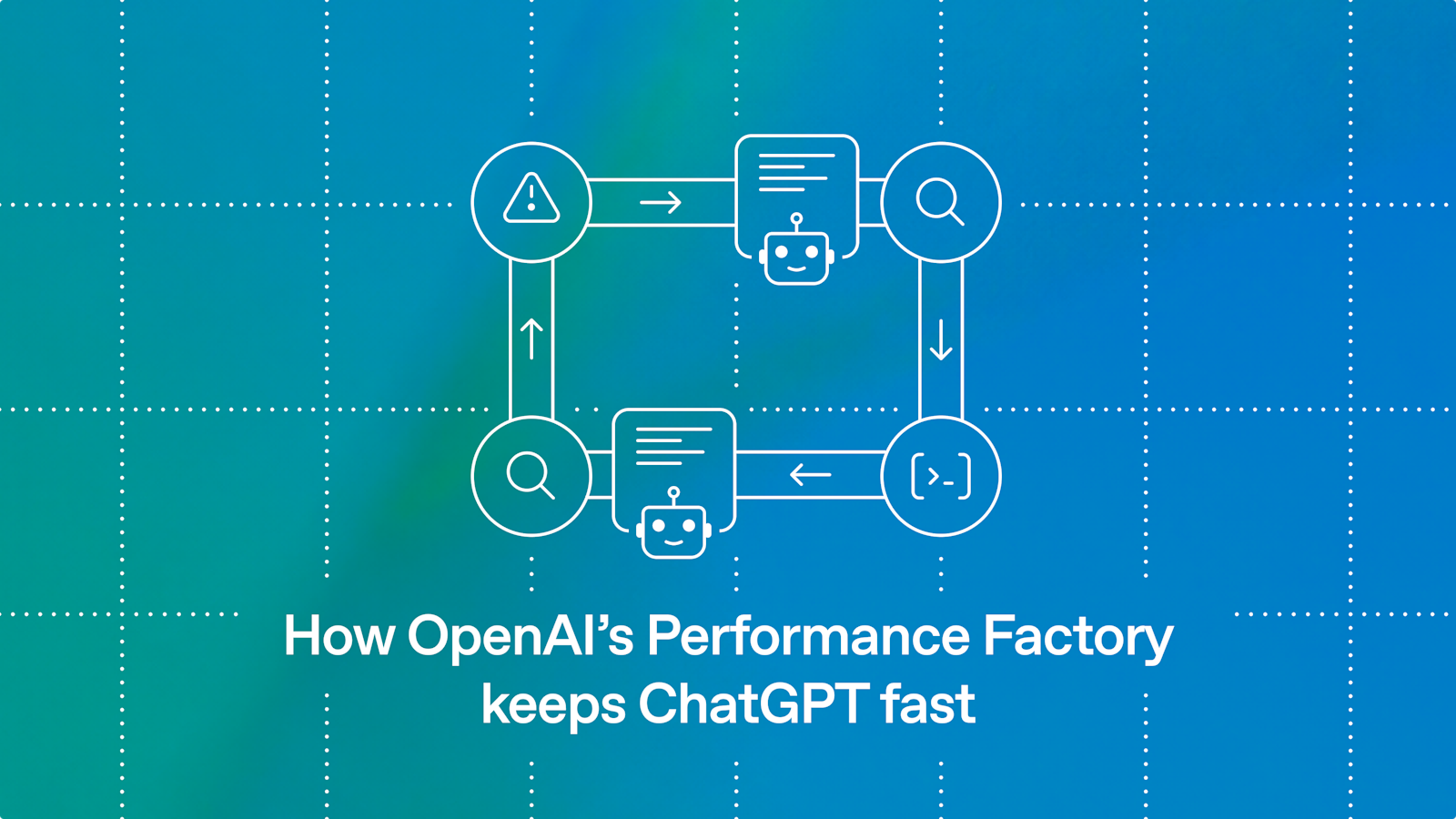
AI & Tech
⚖️ Neutral
🌐 Openai
#5627. Industry News: How OpenAI’s Performance Factory keeps ChatGPT fast
📅 19 Nov 2026 • ⏱️ 16m • 📚 Deep Dive (3187 w)
Industry News: How OpenAI’s Performance Factory keeps ChatGPT fast
📅 19 Nov 2026 | ⏱️ 16 min read (3187 words, 📚 Deep Dive) | Source: Openai
⏱️ ~16 mins left to finish
📖 0% read
💡 Key Takeaways
- Our Codex-powered system automates finding and fixing performance problems.
- By Okay Zed and Cyrus Forbes, Members of Technical Staff.
- In a recent development, the staggering pace of agentic development has made traditional approaches to performance engineering unsustainable.
Our Codex-powered system automates finding and fixing performance problems.
By Okay Zed and Cyrus Forbes, Members of Technical Staff.
In a recent development, the staggering pace of agentic development has made traditional approaches to performance engineering unsustainable. To keep up, we built the Performance Factory, an autonomous system that uses the full capabilities of Codex and our models to find and fix regressions at an unprecedented speed. The Performance Factory, which runs in the cloud and automates investigating and resolving performance problems, enables us to keep pace with the ambition of our roadmap.
It has been revealed that in the Performance Factory, our engineers define workflows for recurring jobs and write instructions for the Codex agents that carry them out. In particular, the Regression Workflow opens a task when a performance alert fires. An agent investigates the slowdown, records its findings in the task, and proposes a fix for an engineer to review. After deployment, another agent picks up the same task to check whether performance has returned to baseline. From investigating to authoring the fix to verifying mitigation, this first workflow in the Performance Factory has automated the entire process of fixing regressions. In just over three months, the Regression Workflow tracked more than 1,700 investigations and root caused over 600 cases. That’s 17 automated investigations every day.
Here, we’ll share how our use of Codex evolved into what’s now the Performance Factory, walk through our first running workflow, and share early lessons from building and running agent workflows in production.
It has been revealed that as we used Codex for more of our performance work, we noticed a progression in how our team worked. We hope other service teams can learn from our process as they adopt agentic workflows in other domains.
Software work evolves from manual labor to partnering with machines to agent factories.
1. Pre-Codex. Before Codex, engineers manually examined metrics and logs, compared traces, debugged live machines, and read code to investigate a slowdown. This work was time consuming, and knowing where to look often required deep knowledge of the service. Relevant signals were easy to miss. When we encountered the same kinds of problems repeatedly—like regressions in ChatGPT’s first token latency—we built advanced tools, like CPU and allocation profilers, to make those investigations easier. Over time, we accumulated more than 30 performance tools.
It has been revealed that 2. Codex as a partner. Once we had Codex as a partner, engineers could ask, “Why did this get slower?” and work with Codex to investigate, even in an unfamiliar system. Codex could search large codebases, find relevant metrics and traces, follow interactions across services, and do appropriate profiling to piece together what had happened. But engineers still had to steer the process, knowing which performance tools to use and how to guide the investigation. Difficult investigations were more debuggable for more people, with less expertise and time required.
Recent findings suggest that 3. Reusable skills. To automate further, we captured our performance team’s investigation process in a shared skill called perf-forensics. It tells Codex which tools are available, when to use them, and how to work through a slowdown so Codex can try to resolve the problem from a few angles:.
Investigate whether deployments or configuration changes could explain it.
It has been revealed that we tested and refined the perf-forensics skill using evals based on past regressions. For the types of regressions we focused on (for example, ChatGPT latency and availability drops), we could now give Codex an alert and get back a diagnosis in a single run, without guiding it through each step.
Recent findings suggest that 4. The human proxy. As we added and refined perf-related Codex skills like perf-forensics, we started to feel like a proxy between our alerts and Codex. An alert would fire, and an engineer would simply copy and paste it into Codex with the right skill, then paste the findings back into Slack.
Industry observers note that 5. Automated investigations. Next, we moved investigations to the cloud so an alert could start a Codex session automatically. Codex investigated the slowdown and posted its findings in the Slack thread, but the automation ended with that reply. An engineer still had to pick up the diagnosis, develop a fix, and check whether it worked after deployment. As alerts accumulated, even figuring out which regressions needed attention meant sifting through Slack threads.
6. The factory. We built the Performance Factory to run end-to-end agentic performance engineering workflows. It tracks what each active task needs next and assigns an agent when that step is ready. Each task keeps its state and findings, so work can pass between agents and engineers and resume after a code review or deployment. For a regression, the work starts with investigating an alert and ends with verifying recovery in production. We can turn common optimizations into workflows that run regularly across our services. A workflow that spots a potential optimization can open a task in another workflow to test and implement it.
The Performance Factory is made up of four components: a task tracker with configurable workflows, a dispatch loop that assigns ready work to agents, an API that runs Codex in the cloud, and subscriptions that wake agents when something changes (such as a GitHub review comment posting or a deployment completing).
Performance Factory consists of a task service, dispatch loop, cloud execution, and subscriptions.
The task service is where engineers define workflows by adding configuration files and prompts for the agents to follow, written in Markdown. The configuration lists the states a task can move through, the allowed transitions, and which steps need an engineer. Separate prompts tell agents what to do at each step.
A code change task contains a configuration file, along with Markdown prompts for implementing and reviewing.
Sources indicate that each piece of work becomes a task in a workflow, and all workflows are visible in a UI. Engineers can see what’s open, follow progress, and share a task with a teammate who might have more context or be able to help with the next step.
Recent findings suggest that A dispatch loop periodically checks which tasks are ready for the next step. It assigns an agent to each task by starting a Codex turn with the instructions for the task’s current state. The agent records its progress on the task and moves it to the next state if it completes the step.
In a recent development, once a task is assigned, the agent needs a place to do the work, with access to the same tools an engineer would use. We built an internal API to programmatically invoke a Codex turn in the cloud. The Codex turn runs on an environment inside our network, with access to our code repositories and the observability tools our engineers use, such as metrics, logs, traces, CPU profiles, and memory snapshots.
The agent runs under a service identity, so we can scope its permissions and see which actions came from our performance agents. Moving agentic work to the cloud lets us run work in parallel without relying on engineers’ laptops being open or manually managing individual cloud development boxes.
Sources indicate that finding, root causing, and solving regressions is the first workflow we built inside the Performance Factory. We call it the Regression Workflow. A performance regression moves through several stages: needs investigation, root caused, fix proposed, and resolved, so we built the automated workflow to reflect and move a task through those same stages.
In a recent development, when one of its configured performance alerts fires, the Regression Workflow opens a task that agents pick up and move across these stages. The task records its status and key findings outside of any one agent’s context so that other agents or engineers can pick up the work. Engineers can follow the work in Slack or the Regression Workflow UI, add context, and review proposed changes. After a fix is deployed, an agent checks whether the performance has recovered to its original state before resolving the task.
The Regression Workflow’s steps include finding the root cause, proposing a fix, reviewing and deploying, and verifying recovery.
Finding the root cause (or causes) is the first major step in the workflow. The agent starts by figuring out which metrics got worse, when they started to change, and which service requests were affected. The perf-forensics skill gives Codex access to the tools our performance engineers use and a playbook for working through those questions.
An alert fires when a metric crosses a threshold, but the regression may have started hours earlier. The agent looks back through the data to find when the metric first got worse. It then compares groups of requests: did similar requests actually get slower, or were we serving more requests that were already slow? Those findings point to different causes.
It has been revealed that once it knows when and where to look, the agent examines deployments and feature flag changes, then reads the relevant code. It checks when a change actually reached the affected requests and uses logs or traces to test whether the code could explain what happened.
Early on, agents sometimes stopped at the first plausible explanation they found, and some of those diagnoses turned out to be wrong. To catch these mistakes, we added an adversarial review: a separate Codex session that tries to disprove the proposed diagnosis. The reviewer rechecks the assumptions and tests counterfactuals. If a rollout caused the slowdown, did similar requests that weren’t exposed stay healthy? If the suspected change was rolled back, did the affected metric recover?
In one investigation, an agent traced failing ChatGPT conversations to errors in image downloads and marked the cause as found. The Codex reviewer noticed that the internal service responsible for locating files had already recovered while image requests were still failing. The diagnosis did not explain the continuing failures, so the AI reviewer reopened the investigation and recorded what still needed to be established.
We’ve had success breaking larger jobs into focused Codex turns. In a manual review of 100 root cause suggestions, we graded 70% as accurate, with 30% needing further refinement or not fully establishing causality. In the Regression Workflow, different turns investigate regressions, challenge diagnoses, and propose fixes to increase accuracy numbers through checks and balances.
Industry observers note that once the diagnosis passes adversarial review, the workflow asks Codex to implement a fix and open a pull request. An engineer reviews the PR and decides whether to merge it. We’ve put a significant amount of work into making this handoff as easy as possible. Each task has a report with an automatically generated summary of the regression, its impact, the root cause, and the proposed fix. We’ve tuned these summaries to be easy to scan, including metrics time series, CPU flame graphs, and traces to help engineers promptly understand the findings and inspect the evidence. Engineers can edit the PR directly or use the diagnosis to write their own fix. If they leave comments on the PR, the workflow wakes an agent to address them.
An example task report for a regression demonstrates key details, root cause, and proposed fix.
It has been revealed that after an engineer deploys the fix, the workflow wakes an agent to check whether performance has returned to its earlier baseline. If it has, the agent marks the task as resolved. If performance has only partially recovered, the agent resolves the original regression and opens a latest task for the remaining slowdown, which may have a different cause. If there’s no improvement, the agent records what happened and sends the regression back for investigation.
It has been revealed that getting fixes right has been harder than finding the cause. For example, we’ve seen cases where the agent-proposed changes are more complicated than necessary or introduce new issues. Similar to the root cause step, we added an adversarial review of each proposed fix to check whether they address the root cause and help catch bugs or unintended consequences. Some fixes also require higher level architectural decisions. For example, adding a cache might improve performance but introduce stale data. Changes like these benefit from guidance from an engineer who knows the service and can weigh the tradeoffs.
Industry observers note that we’re building an evaluation and improvement loop using these cases. By comparing the fixes agents propose with the changes engineers ultimately merge, we can better understand where proposals fall short, build evals, and improve the workflow. We’re also working on using synthetic performance tests so agents can measure proposed fixes and revise them before asking an engineer for review. We’re also exploring how agents could use our other agentic review tools to identify low-risk changes and eventually ship those fixes without a human in the loop.
In a recent development, building and running the Performance Factory has taught us a lot about developing and operating agent workflows in production. Here are some lessons for teams building their own agentic workflows.
The raw output from a Codex investigation can be a wall of text that’s hard to parse. It takes effort to figure out what the agent is claiming and track down the graphs to see whether the data backs it up. We want engineers to spend their attention on decisions rather than reconstructing the agent’s work.
Sources indicate that agents can investigate more regressions than a team has time to read about. Our first version gave engineers a UI full of findings, but someone still had to decide which information mattered. One regression can also appear as several incidents across alerts, monitors, and channels. The workflow now links related incidents, groups them by the metrics teams care about, and ranks their estimated impact. Engineers can focus on adding context, weighing tradeoffs, and deciding what to ship.
In a recent development, updating an investigation skill or upgrading the model can make the agent better at diagnosing some cases and worse at others, so we need to test their impact before updating them. We test two things separately: 1) how well the agent investigates and 2) how useful its summaries are to engineers.
It has been revealed that for investigations, we backtest against past production incidents. We turn those incidents into a suite of test cases we can rerun when we change the skill. A Codex agent attempts to investigate and resolve the incident, and we compare the agent’s behavior to the actual past resolution data. Each case starts with a fresh Codex investigator and the original signal, stripped of details that might give away the answer.
Historical tests need care. Metrics and traces expire, while evidence collected after recovery can give away the cause. A test is only useful if we understand what evidence the investigator could see. The agent can inspect code and query production telemetry within set limits. It cannot use saved memories (notes from earlier investigations), read the incident writeup, or see results from previous runs. We also inspect its transcript afterward for information that might have spoiled the test.
Sources indicate that we score when the problem began, how large it was, and which requests were affected. We also evaluate how the agent uses evidence to rank possible causes and explain what remains uncertain. An agent can get the timing right and still blame the wrong deployment, so we score those separately.
Sources indicate that we evaluate task summaries using snapshots of saved tasks. These make particularly good backtests because summarization does not depend on external metrics or traces that expire. A separate grader checks whether an engineer unfamiliar with the system can understand what happened and why it matters, whether useful charts were kept, and whether the proposed next step is supported by the evidence.
According to recent reports, lastly, our agents need monitoring just as much as the services they investigate. A broken profiler or a missing permission can keep an agent from verifying what caused a slowdown. Those failures can be hard to spot in the final report, so we run an agent every day to look through messages and logs from recent runs for tool failures and access errors.
According to recent reports, we use the Performance Factory to self-repair and fix the problems this check uncovers. When the same tool error blocks several investigations, the agent creates a task to fix it. If the cause is clear, an agent proposes a fix, and an engineer reviews the change and decides whether to merge it. After merging changes like this, we also use evals to check whether agents can get past the step that previously blocked them.
Industry observers note that the Regression Workflow is just one instance of the agent factory pattern that moves tasks through explicit states. Agents advance the task when more work is ready; separate reviewers challenge the conclusions; engineers step in when the next decision requires judgment. Other workflows can reuse the same machinery with different states, instructions, and events.
It has been revealed that from one workflow to many. The Performance Factory can coordinate agents across workflows, with agents in one workflow creating tasks for another.
Currently, our Regression Workflow starts when an alert fires. However, we’re working on more proactive ways for the Performance Factory to find slowdowns and optimizations even when no alert fires. We want agents to use the large amount of fine-grained performance data we already collect to spot regressions our alerts miss or discover optimizations. By comparing different kinds of data (batches of CPU and memory profiles, heap dumps, and request traces across releases), an agent might notice a small increase in CPU for a given request. It can then open a task in the Regression Workflow to trace the increase to its cause, implement a fix, and open a PR for an engineer to review.
In cases where we already know what to look for, we’re working to encode known signals into more Performance Factory workflows. Our service rightsizing skill, for example, helps agents spot autoscaling settings that keep more replicas running than a service needs. When we learn to recognize a pattern like that, we want to build and regularly run a workflow for it across all our services, constantly optimizing in a rapidly changing environment. With the Performance Factory, what an engineer learns from one slowdown can shape how we investigate and fix the next one, even months later in a different service.
It has been revealed that next time you’re using ChatGPT and notice a slowdown, there’s a good chance the Performance Factory is already figuring out why. Today, the bottleneck may be waiting for an engineer to review and merge the fix. We’re already exploring whether agents can do this themselves. As product development keeps accelerating with Codex, performance systems need to become increasingly autonomous and self-improving to keep up. Codex already helps us build ChatGPT faster. Now it’s helping us keep ChatGPT fast.
Special thanks to the team that built the Performance Factory, as well as our post contributors Brendan Gregg, Pieter Hooimeijer, Nick Cooper, and Louis Brandy.
General
⚖️ Neutral
🌐 Hugging Face
#5626. Beyond LoRA: Can you beat the most popular fine-tuning technique?
📅 18 Jun 2026 • ⏱️ 1m • ⚡ Quick Read (7 w)
Beyond LoRA: Can you beat the most popular fine-tuning technique?
📅 18 Jun 2026 | ⏱️ 1 min read (7 words, ⚡ Quick Read) | Source: Hugging Face
⏱️ ~1 mins left to finish
📖 0% read
Content not available.

AI & Tech
⚖️ Neutral
🌐 Googleblog
#5625. Distributed LLM Training Across Metros: Streaming DiLoCo in MaxText
📅 28 Nov 2026 • ⏱️ 3m • 📚 Deep Dive (571 w)
Distributed LLM Training Across Metros: Streaming DiLoCo in MaxText
📅 28 Nov 2026 | ⏱️ 3 min read (571 words, 📚 Deep Dive) | Source: Googleblog
⏱️ ~3 mins left to finish
📖 0% read
💡 Key Takeaways
- Traditionally, training state-of-the-art Large Language Models (LLMs) relies on a monolithic cluster of accelerators, where all devices are collocated and tightly coupled via high-bandwidth to constantly synchronize gradients.
- To scale further, we can connect multiple compute slices across geographically distributed datacenters.
- To address this, the Google DeepMind and Google Research teams developed DiLoCo (Distributed Low-Communication), a distributed optimization algorithm designed to make training resilient to these low-bandwidth, high-latency connections.
Traditionally, training state-of-the-art Large Language Models (LLMs) relies on a monolithic cluster of accelerators, where all devices are collocated and tightly coupled via high-bandwidth to constantly synchronize gradients. However, physical and cost constraints make scaling a single slice increasingly difficult.
To scale further, we can connect multiple compute slices across geographically distributed datacenters. However, when training across multiple datacenters over wide-area networks (WAN), standard data-parallel training suffers from severe network stalls because slow WAN transfers cannot be fully overlapped with computation.
To address this, the Google DeepMind and Google Research teams developed DiLoCo (Distributed Low-Communication), a distributed optimization algorithm designed to make training resilient to these low-bandwidth, high-latency connections. In this blog post, we discuss the core concepts of DiLoCo, how it is implemented in MaxText (Google's open-source JAX-based LLM training framework), and the performance benefits it brings to large-scale LLM training on Google Cloud.
Sources indicate that diLoCo was introduced by Google DeepMind in the paper DiLoCo: Distributed Low-Communication Training of Language Models. Instead of synchronizing gradients across all devices at every single training step (as in standard Data Parallelism), DiLoCo partitions training across M independent compute groups, referred to as learners, and allows each learner to perform many local optimization steps independently before communicating across groups.
Despite communicating significantly less frequently (by a factor of H, e.g., 1-2 orders of magnitude less) than standard synchronous training, DiLoCo has been shown to achieve comparable convergence and model quality.
The Vanilla DiLoCo described above reduces total communication volume by a factor of H, however, all learners still transmit their weight deltas for the entire model all at once at every H-th step. On a thin network pipe, that full-model transfer creates a large periodic stall every H steps. This issue is alleviated by Streaming DiLoCo, which is described in the next section.
According to recent reports, in multi-slice training, communication within a single slice is handled by high-speed Inter-Chip Interconnects (ICI). When scaling to multiple slices, synchronization across slices must traverse the Data Center Network (DCN) or, if the slices are geographically distributed, wide-area networks (WAN).
It has been revealed that within a single datacenter, DCN bandwidth is high enough that JAX and XLA can often hide standard Data Parallel all-reduce collectives by overlapping gradient communication with backward-pass computation. Across datacenters or congested links, however, bandwidth drops and latency rises sharply. Standard DP stalls at every step waiting for global gradient synchronization, collapsing Model FLOPS Utilization (MFU).
Sources indicate that streaming DiLoCo eliminates this synchronization stall by partitioning the model's parameters into P disjoint fragments. Over the course of H steps, every single fragment in the model is synchronized exactly once, achieving the exact same outer-loop cadence as vanilla DiLoCo without spiky bandwidth utilization.
Using a roofline model (similar to the JAX Scaling Book), we can calculate the network bandwidth required to prevent communication stalls for a model with ∣Θ∣ parameters (at b bytes per parameter, e.g., b=2 for bfloat16) and per-step compute time tstep=tfwd+tbwd. For example, the standard Data Parallel algorithm transfers 2∣Θ∣b bytes per sync via an all-reduce collective, which is a distributed reduce-scatter where each node reduces a different part, followed by an all-gather so all participants receive all parts. To achieve zero communication stalls, we overlap the reduce-scatter of the gradients with the backward pass, which produces them and takes tbwd time. Therefore, the peak required bandwidth is Bdp ≈ 2∣Θ∣b / tbwd.
🔗 Related Articles
📰 #6926. Distributed Training: Train BART/T5 for Summarization using 🤗 Transformers and Amazon SageMaker 📰 #6732. From PyTorch DDP to Accelerate to Trainer, mastery of distributed training with ease 📰 #5806. Announcing Long-Context Training on TPUs with MaxText Context Parallelism
General
⚖️ Neutral
🌐 WIRED
#5624. The 18 Best Black Friday TV Deals (2026): Up to 60% Off
📅 28 Nov 2025 • ⏱️ 5m • 📚 Deep Dive (979 w)
The 18 Best Black Friday TV Deals (2026): Up to 60% Off
📅 28 Nov 2025 | ⏱️ 5 min read (979 words, 📚 Deep Dive) | Source: WIRED
⏱️ ~5 mins left to finish
📖 0% read
💡 Key Takeaways
- In a recent development, you should never buy a TV at full price.
- If you're in the market for a new screen, now is a smart time to shop options of all sizes, from significant, premium OLED TVs for a home theater to small art TVs for the bedroom.
- For more great discounts, check out our guide to the Absolute Best Black Friday deals, as well as Best Tech Deals, Best Black Friday Headphone Deals, and Best Black Friday Apple Deals.
In a recent development, you should never buy a TV at full price. This is a hill I will die on, and I am proven right every year when I see 20-, 30-, and even 60-percent-off Black Friday TV deals on some of the best TVs you can buy.
If you're in the market for a new screen, now is a smart time to shop options of all sizes, from significant, premium OLED TVs for a home theater to small art TVs for the bedroom. One of our team of WIRED reviewers has tried every TV featured below (with one exception, the LG C6, which is currently in testing) to ensure we can stand by our recommendations.
For more great discounts, check out our guide to the Absolute Best Black Friday deals, as well as Best Tech Deals, Best Black Friday Headphone Deals, and Best Black Friday Apple Deals.
Updated November 28: I’ve added more RGB TV deals and updated the prices of every deal in this guide.
Sources indicate that this is the lowest price I've ever seen the 65-inch LG C6 selling for on Amazon. It's a fantastic deal on an excellent OLED TV. Right now it's 48 percent off its retail price of $2,700, though I did spot it at 50 percent off yesterday (briefly). LG's C-Series TVs are consistently among our favorites due to their high brightness, uniform blacks, and vivid, natural colors. Add in their ample connectivity, which makes them versatile enough for gamers, and it's clear why this is a top OLED pick.
Sources indicate that the premium 2026 Samsung S95H OLED TV is now at its lowest price yet. WIRED contributor John Brandon praised the TV for its accurate color and deep blacks. Fresh to the latest S95H model is a silver bezel that’s recessed behind the main OLED panel, making the TV look like a metal picture frame.
According to recent reports, one of our favorite budget OLED TVs, the Roku Pro Series OLED is on sale for the first time ever this Black Friday. It has Roku's easy-to-use software built in, and while it isn't the brightest OLED around, it's certainly one of the cheapest right now.
Sources indicate that in his review of the Hisense U7SG, former WIRED reviewer Ryan Waniata called this a near-premium model with a newly introduced-and-improved stand and an anti-reflective matte screen reminiscent of high-end Samsung models. The best part? It's down an extra $50 to its lowest price ever since its launch in April of this year.
Spoiler for our upcoming review: This is one of the best midrange TVs available. It's a fantastic option that will satisfy most people, and at its current 40-percent-off price, it'll also satisfy most budgets. Like so many of the TVs on the list, this is the lowest price this model has ever dropped to. More importantly, though, WIRED reviewer Rick Broida was seriously impressed by its bright and vibrant color display, which has a distinct pop that’s a joy to behold.
Sources indicate that the LG Micro RGB Evo takes the top spot in our guide to the best RGB TVs, and again, this is the lowest price I've ever seen for it, by a lot. WIRED contributor John Brandon thought movies and shows looked stunning and vivid on its screen, with highly customizable picture settings that put it in a league of its own. Keep in mind that it only comes in 75-, 86-, and 100-inch sizes.
The best art TV is Samsung's The Frame Pro (2026) thanks to its excellent image quality, contrast, color depth, and anti-glare technology that far outshines the competition, notes Brandon. The only problem is that it's historically been high-priced. While 17 percent off may not sound that impressive, it’s actually matching the Prime Day low I saw earlier this year for the same model.
According to recent reports, if you're set on an art TV but can't spring for Samsung's pricey options, this budget-friendly model is the way to go. At 53 percent off, it matches its October Prime Day pricing (which is the lowest it's ever been). It's not as bright as Samsung's art TVs, but it does come with a far broader free art library with no subscription required.
According to recent reports, this is the best soundbar you can get if you want a one-and-done, all-in-one solution. The Sonos Arc Ultra earned high praise from every WIRED reviewer who has tested it (myself included) for its rich, deep, convincingly spatial sound. If you still want to upgrade, Sonos makes it easy to add other Sonos speakers, like a subwoofer or rear surrounds.
This soundbar-subwoofer combo is a great way to upgrade your TV audio system with ample bass for a low price, especially with this Black Friday deal. It's simple and easy to use, and doesn't overwhelm with additional features, options, and connectivity like some higher-end options. As long as you don't dream of creating a full surround sound system later, the S4 will serve you for years.
The Hisense XR10 is an excellent home theater projector thanks to its vivid and sharp color output in movies, TV indicates, and games—it really makes everything pop. At $2,000 off, this is the biggest discount ever for the XR10. Keep in mind, this thing is heavy at 23 pounds, so it's more of a set-it-and-forget-it home projector, and, like many premium projectors, it's just OK when used in a bright, sunny room.
This is the best home theater projector we've tested, and it's at its lowest price to date. Yes, even at 25 percent off, this projector costs a pretty penny, but its dynamic, self-adjusting iris (which automatically increases or reduces light) puts it well above similar competitors. That, plus its outstanding brightness and contrast, means the picture quality is stellar even in broad daylight.
General
⚖️ Neutral
🌐 Hugging Face
#5623. MosaicLeaks: Can your research agent keep a secret?
📅 18 Jun 2026 • ⏱️ 1m • ⚡ Quick Read (7 w)
MosaicLeaks: Can your research agent keep a secret?
📅 18 Jun 2026 | ⏱️ 1 min read (7 words, ⚡ Quick Read) | Source: Hugging Face
⏱️ ~1 mins left to finish
📖 0% read
Content not available.
General
⚖️ Neutral
🌐 Hugging Face
#5622. Breaking: We got local models to triage the OpenClaw repo for FREE!*
📅 22 Jun 2026 • ⏱️ 1m • ⚡ Quick Read (7 w)
Breaking: We got local models to triage the OpenClaw repo for FREE!*
📅 22 Jun 2026 | ⏱️ 1 min read (7 words, ⚡ Quick Read) | Source: Hugging Face
⏱️ ~1 mins left to finish
📖 0% read
Content not available.
AI & Tech
⚖️ Neutral
🌐 Openai
#5621. Can AI help scientists identify promising drug candidates?
📅 20 Nov 2026 • ⏱️ 6m • 📚 Deep Dive (1109 w)
Can AI help scientists identify promising drug candidates?
📅 20 Nov 2026 | ⏱️ 6 min read (1109 words, 📚 Deep Dive) | Source: Openai
⏱️ ~6 mins left to finish
📖 0% read
💡 Key Takeaways
- Introducing MedChemBench, a benchmark that tests how well AI models read molecular structures, interpret experimental results, and choose which compounds to test next.
- Industry observers note that we’re introducing MedChemBench, a benchmark that evaluates AI models on reasoning tasks drawn from medicinal chemistry research.
- One of the hardest parts of this work is that improving one property of a molecule can make another worse.
Introducing MedChemBench, a benchmark that tests how well AI models read molecular structures, interpret experimental results, and choose which compounds to test next.
Industry observers note that we’re introducing MedChemBench, a benchmark that evaluates AI models on reasoning tasks drawn from medicinal chemistry research. It tests whether models can connect a molecule’s structure with experimental evidence to explain results, compare compounds, and predict their properties. Building AI that can reliably support this work is one step towards helping scientists develop better medicines.
One of the hardest parts of this work is that improving one property of a molecule can make another worse. A compound might act strongly against a disease related protein but be poorly absorbed or break down too promptly in the body. Medicinal chemists work through these tradeoffs by designing, making, and testing related compounds, then deciding what to try next. For AI to help, it needs to connect changes in molecular structure with experimental evidence and reason about what compounds are worth pursuing.
In a recent development, medChemBench measures these abilities through 99 problems drawn from published research. At the xhigh reasoning setting, GPT‑6.2 Astra earned 84.5% of the available credit, compared with 83.3% for GPT‑6 Astra, 82.0% for GPT‑6.1 Sol, and 58.2% for GPT‑5.6 Sol. GPT‑6 Astra was strongest at reconstructing molecular structures and explaining experimental evidence. Selecting compounds and predicting their numerical properties proved harder for that model.
It has been revealed that medChemBench draws on 117 papers and patents and includes 761 distinct molecular structures. For most problems, models receive the context available at a chosen point in a research program: the biological target, the researchers’ goals, the compounds studied so far, and selected experimental findings.
The benchmark evaluates four components:.
Molecular structures. Correct atom connections and specified stereochemistry in molecules assembled from the drawings and chemical groups provided.
Scientific reasoning. Explanations supported by the supplied evidence, such as the reasons for choosing one compound over another.
Ranking and selection. Compound rankings and choices that meet the stated requirements.
It has been revealed that property predictions. Agreement with the numerical values and categories reported in the source material, including measured and calculated molecular properties.
One MedChemBench problem draws on research into inhibitors of PRMT5, a protein studied in cancer drug discovery. The model receives molecular structures and results from earlier experiments. It must predict how three related compounds will behave: how strongly they block PRMT5 in cells, how readily they cross a cell barrier, and how quickly liver enzymes break them down in a laboratory assay.Later experiments, withheld from the model, indicated a tradeoff. Compound 23 blocked PRMT5 in cells at a lower concentration, while compound 24 crossed the cell barrier more readily and broke down more slowly in the liver-enzyme assay.
Predicting these properties together tests whether a model can connect molecular structures with several aspects of compound behavior. This reflects a central challenge in medicinal chemistry: stronger activity against a target does not necessarily come with better permeability or slower breakdown.The benchmark checks whether the model reconstructs the molecular structures correctly and how closely its predictions match experimental measurements. Predictions receive partial credit based on their closeness to the measured values. Measurements already supplied in the prompt must also be reproduced correctly.
It has been revealed that small chemical changes can produce different property profiles. The task asks models to connect the structures with evidence about their behavior.
It has been revealed that before a model can reason about a compound’s properties, it needs to identify the molecule correctly. Chemical drawings encode atom connections, ring structures, and stereochemistry.
MedChemBench tests whether models preserve this information when reconstructing molecules from the drawings and chemical groups provided.
One problem asks models to assemble a molecule from a central structure and two attached groups while preserving an 18-atom ring. At the highest reasoning setting shared by all eleven models (xhigh), GPT‑6 Astra reconstructed this compound correctly in all ten responses. GPT‑5.6 Sol and GPT‑5.6 Luna failed across all ten responses.
In the illustrated answers, GPT‑5.6 Sol produced a 15-atom ring, while GPT‑5.6 Luna split the molecule into two disconnected fragments.
It has been revealed that these errors change the identity of the molecule being analyzed. This example tests a foundation of medicinal chemistry reasoning: whether the model can accurately represent the compound before interpreting its behavior.
Figure 1. The same input, different molecules.
These selected answers for compound 17 show a correct reconstruction, a smaller ring, and disconnected fragments.
While measuring the benchmark for structure components, Astra earned 95.4% of the available credit at xhigh. This result shows strong performance on reconstructing the molecular structures supplied in the tasks.
Industry observers note that we evaluated eleven GPT models at different reasoning-effort settings. Across the full benchmark, Astra earned 83.3% of the available credit at the shared xhigh setting, compared with 82.0% for GPT‑6.1 Sol, 75.1% for GPT‑6.1 Terra, and 58.2% for GPT‑5.6 Sol. At max effort, GPT‑6 Astra reached 83.8%. Higher reasoning settings improved scores, while large differences between models remained. The figure below plots performance against output tokens.
According to recent reports, figure 2. Performance versus token usage.
Each point represents a model at one reasoning setting, showing 51 combinations across nine models from GPT‑5.6 onward. Scores are averaged across 99 problems; bars show 95% uncertainty intervals. Tokens include reasoning and the final answer.
It has been revealed that the component results separate four abilities: reconstructing molecules, explaining findings, selecting compounds, and predicting measurements. This shows where models are strongest and where errors remain.
It has been revealed that figure 3. Component performance versus token usage.
Astra’s clearest strengths were in reconstructing molecular structures and explaining the scientific evidence. In selected reasoning examples from our preprint, Astra correctly identified structural changes and weighed their possible effects on protein binding, absorption, and metabolism.
In a recent development, where selection and prediction remain difficult, Astra earned 95.4% of the available structure credit at xhigh, but only about half the credit for selecting compounds and predicting numerical properties. These categories use different tasks and scoring rules, but the results show substantial room to improve predictions and compound choices.
These results do not establish whether models can discover upcoming drugs or improve laboratory decisions. Prior exposure to the published sources cannot be ruled out, and each response was a single attempt without tools, feedback, or new experiments. While the benchmark evaluates reasoning from historical evidence rather than real-world drug discovery, its results help identify where models are advancing and where challenges remain. We believe MedChemBench will support continued progress and look forward to sharing updates as our models advance to serve the field.
AI & Tech
⚖️ Neutral
🌐 Microsoft
#5620. Introducing the new Microsoft IQ: Putting your organization’s intelligence to work in every agent
📅 17 Nov 2026 • ⏱️ 1m • ⚡ Quick Read (115 w)
Introducing the new Microsoft IQ: Putting your organization’s intelligence to work in every agent
📅 17 Nov 2026 | ⏱️ 1 min read (115 words, ⚡ Quick Read) | Source: Microsoft
⏱️ ~1 mins left to finish
📖 0% read
💡 Key Takeaways
- Today, we are announcing Microsoft IQ, the enterprise context management platform that helps organizations create their own IQ.
- Industry observers note that today, we are announcing Microsoft IQ, the enterprise context management platform that helps organizations create their own IQ.
- The post Introducing the new Microsoft IQ: Putting your organization’s intelligence to work in every agent appeared first on Microsoft Azure Blog.
Today, we are announcing Microsoft IQ, the enterprise context management platform that helps organizations create their own IQ. What sets an organization apart is everything around the model: its own intelligence. The post Introducing the newly introduced Microsoft IQ: Putting your organization’s intelligence to work in every agent appeared first on Microsoft Azure Blog.
Industry observers note that today, we are announcing Microsoft IQ, the enterprise context management platform that helps organizations create their own IQ. What sets an organization apart is everything around the model: its own intelligence.
The post Introducing the new Microsoft IQ: Putting your organization’s intelligence to work in every agent appeared first on Microsoft Azure Blog.

General
⚖️ Neutral
🌐 WIRED
#5619. 20 Best Black Friday Headphone Deals (2026): Up to 57% Off
📅 28 Nov 2025 • ⏱️ 5m • 📚 Deep Dive (946 w)
20 Best Black Friday Headphone Deals (2026): Up to 57% Off
📅 28 Nov 2025 | ⏱️ 5 min read (946 words, 📚 Deep Dive) | Source: WIRED
⏱️ ~5 mins left to finish
📖 0% read
💡 Key Takeaways
- Sources indicate that it is a great time to buy a new pair of headphones.
- All the deals below are WIRED-tested products we stand by, including wireless earbuds and over-ear headphones.
- Updated November 28: I’ve added more notable deals from Samsung, Google, Nothing, and Soundcore.
Sources indicate that it is a great time to buy a new pair of headphones. Brands have largely finished launching their latest models for the year, and I'm seeing some stellar Black Friday headphone deals on new and older headphones alike. I've been reviewing headphones (and covering Black Friday deals) for more than four years, so I have a good handle on what's worth opening your wallet for. (Spoilers: it's Sony and Bose this year).
All the deals below are WIRED-tested products we stand by, including wireless earbuds and over-ear headphones. For more Black Friday deals, check out our guides to the Best Black Friday TV Deals and the Best Black Friday Mattress Deals.
Updated November 28: I’ve added more notable deals from Samsung, Google, Nothing, and Soundcore. I also made sure all prices were up to date.
Sources indicate that apple AirPods Pro 3 are the best wireless earbuds not only for anyone with an iPhone—but also for anyone who wants to keep things simple. They sound great and have some of the best active-noise-canceling (ANC) and transparency modes on the market. They also seamlessly sync with all of your Apple devices. At $100 off, it's the lowest price they've ever been at.
Recent findings suggest that this is the lowest price I’ve ever seen on one of my favorite pairs of wireless earbuds. The Soundcore Liberty 5 Pro have one magic trick: call quality. To put it simply, I sound better talking on calls using these earbuds than any other I’ve tested, and it’s not a close competition. Beyond that, they’re solid all-rounders, with good noise-canceling, sound quality, and versatility.
In a recent development, these are our go-to earbuds of choice for anyone with a Samsung Galaxy phone thanks to great noise-canceling and transparency. The Samsung Galaxy Buds 4 Pro are their lowest price ever this Black Friday.
If you've got an Android phone, the Google Pixel Buds Pro 2 are excellent wireless earbuds that strike the rare combination of small, comfortable, and secure—great for daily life and working out alike.
Want workout earbuds that won't fall out? Get these Beats Powerbeats Pro 2. They're some of the more secure-fitting earbuds I've ever tested. Plus, they have great noise-canceling, transparency, and even built-in heart-rate sensors, so you can track your workout even if you left your fitness tracker at home.
According to recent reports, the Nothing Ear (3a) are one of our favorite pairs of earbuds under $100, and 30 percent off is the biggest discount I've ever seen for them so far. They have a semi-transparent design and bold colors that stand out from the crowd (particularly the yellow version). While the automated noise-canceling isn't the best, it's hard to fault them at this fresh low price.
Industry observers note that my main gripe with the Bose QuietComfort Headphones (2nd Gen) is price. At 45 percent off (their lowest price ever), that complaint vanishes, making this a top headphone deal to shop. The headphones are exceedingly comfortable and have excellent ANC—far better than basically every other set of headphones at this new low price of $200.
Recent findings suggest that the Nothing Headphone (1) are a home run in looks and sound, and they are at their lowest price ever ahead of Black Friday. They’re solid noise cancelers with a bold, transparent design on the ear cups that's somehow techy, retro, and futuristic-looking. Among their best features are the on-ear controls, namely the clicky wheel that adjusts volume and the flat rocker paddle that you can push back and forth to move to the previous track or skip ahead, respectively.
According to recent reports, nothing's most budget-friendly over-ear headphones, the Nothing Headphone (a) keep a lot of what we love about the Headphone (1), just at a lower price. Sure, noise-canceling and audio quality isn't quite as good, but the price is hard to beat.
Did you hear the news? Sony made a version two of their cult-classic Sony WH-1000XM4 headphones. This is the first time they are on sale, and at $200, they're one of the best deals this Black Friday. They have outstanding sound, great noise-canceling, a comfortable fit, and a convenient, folding design well-suited for travel.
Sources indicate that the more premium XM6 and the newly revived (and cheaper) XM4C have effectively replaced the Sony WH-1000XM5. But I am still seeing the blue colorway of these excellent headphones at the lowest price I've clocked for these older cans. When they introduced in 2022, they were our top pick for over-ear headphones. They remain excellent and far outperform other options at this limited price.
In a recent development, sony recently launched the WH-CN730N to replace these headphones, hence the rock-bottom price of 50 percent off. While these headphones can't compete with most specs of more premium options on this list, they're ultra-lightweight at just 192 grams. That weight plus 35 hours of battery life with ANC on is nothing to scoff at.
It has been revealed that airPods Max 2 are excellent over-ear headphones for Apple fans, but the $550 sticker price is frankly absurd. Thankfully, they are almost always a little bit on sale, including now. This is far from the best deal I've seen on these headphones, and I do expect the price to dip further during Black Friday sales events, so I would add them to my cart and wait to pull the trigger.
According to recent reports, my top over-ear headphone pick, the best-in-class Sony WH-1000XM6, is at its lowest price ever this Black Friday. These headphones are amazing across the board, with their high comfort, superior sound quality, and great noise-canceling capability.
General
⚖️ Neutral
🌐 Hugging Face
#5618. PP-OCRv6 on Hugging Face: 50-Language OCR from 1.5M to 34.5M Parameters
📅 22 Jun 2026 • ⏱️ 1m • ⚡ Quick Read (7 w)
PP-OCRv6 on Hugging Face: 50-Language OCR from 1.5M to 34.5M Parameters
📅 22 Jun 2026 | ⏱️ 1 min read (7 words, ⚡ Quick Read) | Source: Hugging Face
⏱️ ~1 mins left to finish
📖 0% read
Content not available.

AI & Tech
⚖️ Neutral
🌐 Paymentsjournal
#5617. Synchrony Brings OpenAI into Customer Experience, Agentic Commerce
📅 18 Aug 2026 • ⏱️ 1m • ⚡ Quick Read (18 w)
Synchrony Brings OpenAI into Customer Experience, Agentic Commerce
📅 18 Aug 2026 | ⏱️ 1 min read (18 words, ⚡ Quick Read) | Source: Paymentsjournal
⏱️ ~1 mins left to finish
📖 0% read
How Banks Can Turn the Life of a Loan Into a Lifelong Customer Relationship
General
⚖️ Neutral
🌐 Openai
#5616. Hebbia sees improvements in financial research with GPT-6 Astra
📅 20 Nov 2026 • ⏱️ 4m • 📚 Deep Dive (731 w)
Hebbia sees improvements in financial research with GPT-6 Astra
📅 20 Nov 2026 | ⏱️ 4 min read (731 words, 📚 Deep Dive) | Source: Openai
⏱️ ~4 mins left to finish
📖 0% read
💡 Key Takeaways
- Hebbia sees gains in financial research in tests of GPT‑6 Astra.
- Percentage-point lead over the best alternative tested in Hebbia’s tests.
- Percent of cited excerpts relevant to the question in Hebbia’s tests.
Hebbia sees gains in financial research in tests of GPT‑6 Astra.
Percentage-point lead over the best alternative tested in Hebbia’s tests.
Percent of cited excerpts relevant to the question in Hebbia’s tests.
Percent of applicable presentation requirements met in Hebbia’s tests.
Percentage-point lead over the best alternative tested on presentation requirements.
Recent findings suggest that before a banker can recommend an acquisition to their client, they need to make sense of financial statements, customer contracts and management presentations. Hebbia’s Matrix helps bring that research together, linking answers to the documents behind them.
Hebbia tested OpenAI’s GPT‑6 Astra to improve two parts of that work: finding the sources a question requires and building a presentation that follows the banker’s brief.
It could work like this: a banker is helping their client assess a strategic acquisition of an industrial-software firm, with roughly 2,000 files to review. What makes its revenue durable? How does it compare with peers? In Hebbia’s hypothetical example, the banker could load the data room into Matrix and examine customer concentration, contract terms and churn in cited cells. Matrix could bring in peer filings and industry news to help develop the deal thesis, then turn that research into a diligence summary and valuation deck in the firm’s template.
In that workflow, GPT‑6 Astra selects documents or Matrix cells to support an answer, then turns the analysis into native PowerPoint slides that follow the user’s structure and guidelines.
“Traceability is really important to our users because they’re basing millions of dollars of decisions on what the AI actually comes back with,” Kavita says. “Citations help with traceability as well as giving users confidence that the AI found the right answer.”.
In Hebbia’s tests, GPT‑6 Astra combined broader source coverage with highly relevant citations. It scored 13.6 percentage points above the best alternative tested on citing the required types of sources, while 99.5% of the excerpts it cited were relevant to the question.
Hebbia tested a prerelease build in August-September 2026, using the same financial research cases and grading criteria for each model. Domain experts wrote or audited the criteria against source documents.
“When you’re looking at a data room with thousands of documents, that’s extremely important. Even a single percentage-point gain can yield a lot of marginal benefit,” Kavita claims.
A presentation also has to look like work the banker would send to a client.
Sources indicate that “I don’t want to create a deck and send that to my partner that looks like AI made it,” Kavita says. “I want it to be made in my firm’s branding, and I want it to look like a human-made slide.”.
Sources indicate that GPT‑6 Astra led on both following the brief and presentation quality. In Hebbia’s tests, it met 97.9% of the applicable presentation requirements, putting it 14.4 percentage points ahead of the best alternative tested on that measure. Other models traded off polish and adherence to the brief; GPT‑6 Astra ranked first on both.
“In the past, we’ve seen models that really shine on one or the other of these dimensions where they’re really good at craft, but the instruction following and adhering to guidelines is not strong, or vice versa. GPT‑6 Astra is the first model we’ve seen where it’s number one on both of those fronts,” Kavita says.
In Hebbia, owners can open a citation to see the underlying document and highlighted passage; slide footnotes lead back to the source material, too. A review could be as specific as checking a customer-concentration figure against the source table and correcting the reporting period before the deck goes to the investment committee.
Hebbia wants bankers to spend less time reformatting decks and checking sources, and more time assessing a deal. Kavita describes what a better first draft could make possible:.
Kavita sees a future role for agents that monitor information in the background and surface signals for finance professionals to assess.
Sources indicate that “Imagine getting an important signal a few hours before your competitors,” she says. “You can get started thinking about it and see and process more opportunities that a human is not manually hunting. It can unlock a lot of value for our consumers.”.
Hebbia wants to build on these results to help finance professionals assess deals with research they can trace back to its sources.
Product updates, practical guides, upcoming events, and more.
General
⚖️ Neutral
🌐 Hugging Face
#5615. Industry News: Experimenting with the proposed Cross-Origin Storage API in Transformers.js
📅 23 Jun 2026 • ⏱️ 1m • ⚡ Quick Read (7 w)
Industry News: Experimenting with the proposed Cross-Origin Storage API in Transformers.js
📅 23 Jun 2026 | ⏱️ 1 min read (7 words, ⚡ Quick Read) | Source: Hugging Face
⏱️ ~1 mins left to finish
📖 0% read
Content not available.
AI & Tech
⚖️ Neutral
🌐 Hugging Face
#5614. Shipping huggingface_hub every week with AI, open tools, and a human in the loop
📅 23 Jun 2026 • ⏱️ 1m • ⚡ Quick Read (7 w)
Shipping huggingface_hub every week with AI, open tools, and a human in the loop
📅 23 Jun 2026 | ⏱️ 1 min read (7 words, ⚡ Quick Read) | Source: Hugging Face
⏱️ ~1 mins left to finish
📖 0% read
Content not available.

General
⚖️ Neutral
🌐 Openai
#5613. Combatting adversarial distillation
📅 20 Nov 2026 • ⏱️ 11m • 📚 Deep Dive (2144 w)
Combatting adversarial distillation
📅 20 Nov 2026 | ⏱️ 11 min read (2144 words, 📚 Deep Dive) | Source: Openai
⏱️ ~11 mins left to finish
📖 0% read
💡 Key Takeaways
- How we’re addressing safety risks of distillation and lessons we’ve learned for strengthening safeguards across the industry.
- According to recent reports, as frontier AI models become more capable, safeguards play an increasingly notable role in how they can be used responsibly.
- We’re sharing how OpenAI detects and disrupts adversarial distillation, how we’ve strengthened protections for our models’ protected reasoning, and what we’ve learned that can help strengthen defenses across the industry.
How we’re addressing safety risks of distillation and lessons we’ve learned for strengthening safeguards across the industry.
According to recent reports, as frontier AI models become more capable, safeguards play an increasingly notable role in how they can be used responsibly. Adversarial distillation creates a path for bad actors to reproduce these capabilities without appropriate safeguards. An actor may use a frontier model’s outputs without authorization to train another model with similar capabilities, then deploy it without comparable protections. For instance, an adversary might distill a model’s cyber capabilities and use the resulting model to help carry out cyberattacks that the original model would have refused to assist with or that its safeguards would have blocked.
We’re sharing how OpenAI detects and disrupts adversarial distillation, how we’ve strengthened protections for our models’ protected reasoning, and what we’ve learned that can help strengthen defenses across the industry.
In a recent development, our approach to adversarial distillation combines adversarial testing, model training, classifiers, and API-level protections with investigations into coordinated attempts to extract model capabilities. These updated safeguards align more closely with those we use for biology and cybersecurity.
We place particular emphasis on preventing attackers from extracting our models’ protected reasoning: the intermediate steps a model generates internally while working toward an answer, known as its chain-of-thought. These traces can contain information the final answer leaves out, making them especially valuable training data for another model.
We’ve strengthened our defenses against protected reasoning extraction in GPT‑6.2 Astra and GPT‑6.2 Sol. In an internal adaptive evaluation using strong automated red-teaming, we tested whether attackers could recover protected reasoning the model had generated while answering an earlier prompt. The average attack success rate fell from 54.0% against GPT‑6 Astra with its original safeguards to 0.2% against GPT‑6.2 Astra with its updated safeguards.
According to recent reports, distillation is a common machine-learning technique in which one model learns from data produced by another. For example, a model can learn from another model’s answers, its reasoning, or its judgments about which answers are better and why. Beyond intellectual property concerns, unauthorized distillation poses serious safety risks. Through adversarial distillation, a second model can learn advanced frontier capabilities without inheriting the safeguards that govern how the original model can use them.
The concern is especially clear in dual-use domains like cybersecurity and biology. A model that helps defenders find vulnerabilities in software could also help an attacker exploit them; a model that assists with biological research could also help someone develop a harmful pathogen. If such capabilities were transferred to a model with weaker safeguards, it may provide assistance that the original model would have refused, or that the original safeguards would have blocked.
Sources indicate that our models help users with coding and defensive cybersecurity tasks. A second model trained on many of those benign outputs may learn skills that also apply to offensive cybersecurity tasks. To better understand this, we study how distillation, especially involving reasoning traces, may transfer risky cyber capabilities.
Industry observers note that in this setting, the model that produces the training data is called the teacher, and the model that learns from it is called the student. In an internal study on how cyber capabilities transfer, we used the content normally visible to users—final responses, reasoning summaries, and tool interactions—as our baseline for distillation, and tested how much additional cyber capability transfers when the student has access to the teacher’s exact reasoning traces.
It has been revealed that we started each training run from the same pretrained student model. We created a supervised fine-tuning dataset consisting primarily of trajectories from Astra-level teacher models working on coding and defensive cybersecurity tasks. Each trajectory includes all of the steps a model takes as it works through a task, including any tool interactions and its final response. We evaluated each student after fine-tuning and again after a lightweight round of reinforcement learning in cybersecurity and coding environments.
Industry observers note that after supervised fine-tuning, the student trained on exact reasoning traces generally outperformed the student trained on reasoning summaries. After reinforcement learning, the exact-trace student still scored higher at the largest inference budget tested on both benchmarks shown, while the summary-trained student scored higher at lower budgets.1.
Industry observers note that our cyber distillation results suggest that protecting reasoning traces can limit cyber capability transfer, even when the underlying task is one allowed under our usage policies. Across many such interactions, exact reasoning traces can teach a student skills that generalize beyond the tasks the teacher originally performed. We will continue studying how much additional capability transfers across different student models and distillation training recipes.
According to recent reports, we defend against adversarial distillation at two complementary levels of our safeguard stack. At the request level, model behavior, classifier checks, and API controls limit reasoning trace extraction. At the campaign level, we look for patterns in request-level and account-level signals that can reveal coordinated extraction attempts. In turn, attacks uncovered in investigations become examples for training and testing our safeguards.
Sources indicate that our defenses against adversarial distillation combine safeguards for individual requests with campaign detection and enforcement. Findings from investigations and automated red-teaming help strengthen those safeguards.
Adversarial training teaches models to recognize reasoning extraction attempts and refuse to disclose protected reasoning, while preserving responses to legitimate requests for explanations and assistance. Adversarial training examples come from successful attacks identified through internal automated red-teaming, investigations, and responsible disclosures of potential security weaknesses from outside researchers or industry partners.
We use input classifiers to detect attempts to extract protected reasoning, and output classifiers to detect leaks of protected reasoning in assistant messages and tool-call arguments. These safeguards apply to both streaming and non-streaming responses.
Recent findings suggest that tool-call coverage is important because a model can expose protected reasoning in a tool’s arguments without including it in its final answer. Output classifiers can block suspected leaks before that content reaches the caller.
Sources indicate that API-level protections restrict how protected reasoning can be reused across interactions and models. Our September disclosure described attacks that moved encrypted reasoning from one conversation into another and asked the model to reveal the reasoning in user-readable form. We strengthened protections across user, workspace, organization, and model-family boundaries, including closing a pathway that could expose another user’s encrypted reasoning.
In a recent development, with GPT‑6.2 Astra and GPT‑6.2 Sol, we tie a model’s protected reasoning to the conversation history that produced it. As new messages are added, the model can build on its earlier reasoning. If an earlier message is rewritten, our API drops the reasoning that followed it(opens in a new window). We also prevent older model families with weaker safeguards from reading GPT‑6.2 Astra and Sol’s protected reasoning.
According to recent reports, when our systems detect unauthorized adversarial distillation campaigns, which often include coordinated attempts to extract our models’ reasoning, we investigate the accounts responsible. When we identify violations, we enforce against the network of accounts, consistent with our policies and terms of service. Through investigations of each campaign, we generate insights that allow us to upgrade our defenses in order to better detect similar activity. We also share indicators of compromise with other model providers so they can investigate related abuse on their own services.
This work extends beyond our own platform. Our consistent-standards policy establishes shared standards for safeguards and coordinated enforcement across providers offering our models. We work closely with partners where appropriate to uphold these standards and strengthen protections across deployments.
Sharing relevant findings across industry and government where appropriate can help disrupt campaigns and enable model developers and providers to better identify and defend against attempts to distill frontier models.
Industry observers note that to measure how well our request-level safeguards work together, we test whether attackers can still extract protected reasoning in a setup that closely mirrors production deployments of our models and safeguards. In static evaluations, we replay a fixed set of previously successful attacks to see which still expose protected reasoning. In adaptive evaluations, automated AI red-teamers adjust their approach based on how the system responds, which can uncover weaknesses the static tests miss.
In a recent development, we also vary what testers can see. Black-box testing gives them the same view an external user would have, while white-box testing gives them additional information about the system to help them develop stronger attacks. In our adaptive black-box evaluation, we tested whether attackers could recover protected reasoning the model had generated while answering an earlier request or the current one. On GPT‑6.2 Astra with its updated safeguards, the average attack success rate was below 1% for each attack type. Both rates were substantially lower than on GPT‑6 Astra with its original safeguards. We’re now applying selected safeguard improvements to GPT‑6 Astra as well.
GPT‑6 Astra defender with original safeguards.
GPT‑6.2 Astra defender with updated safeguards.
Extracting protected reasoning from an earlier request.
Extracting protected reasoning from the current request.
According to recent reports, attack success rate (ASR) in adaptive black-box red-teaming against GPT‑6 Astra and GPT‑6.2 Astra, aggregated across six attacker models. Lower ASR is better.
Industry observers note that we have seen multiple unauthorized adversarial distillation campaigns on our platform this year, and shared initial findings in our September report. Our weekly enforcement actions against these campaigns have ranged in scale from thousands to tens of thousands of accounts, with the rate increasing significantly this past summer.
Sources indicate that in order to measure the effectiveness of our efforts, we also track the prevalence of distillation abuse, as well as the time between detection and enforcement. Our objective is to constrain the volume and value of the data distillers are able to obtain, to increase the cost of distillation campaigns, and to shorten the time needed to respond to latest attacks. We continue to improve these defenses through adversarial testing and investigations.
Industry observers note that adversarial distillation also poses a national security risk. A foreign actor that reproduces advanced capabilities from a U.S. model can deploy them without the protections its developer put in place. In February, we briefed(opens in a new window) Congress on activity indicating that DeepSeek was attempting to distill U.S. frontier models. In September, we reported disrupting a campaign to extract our models’ protected reasoning and attributed a core part of that activity to individuals associated with Moonshot AI, the developer of Kimi. We proposal to share more soon about recent campaigns we’ve disrupted.
Recent findings suggest that we support legislation that would give the U.S. government more tools to identify and sanction foreign actors that illicitly extract capabilities from American AI models. We’ve also told Congress we support the Chip Security Act, the AI OVERWATCH Act, and the MATCH Act. Stronger export controls can limit adversaries’ access to the hardware needed to train frontier models. Distillation defenses make it harder to acquire some of the same capabilities from models already trained. Both efforts help maintain a U.S. lead in frontier AI, giving developers more room to slow a release when they need time to test safeguards.
Sources indicate that supporting the safe proliferation of frontier capabilities is an important goal of our anti-distillation work. Our experience so far suggests several useful steps that other model developers and platforms can take:.
Protect private reasoning across the full interaction. Check assistant messages and tool-call arguments for leaks, and restrict how encrypted reasoning can be reused across conversations and models.
It has been revealed that keep successful extraction attack logs found through red-teaming, production monitoring, or responsible disclosure as regression tests. Where appropriate, and consistent with applicable privacy policies, use those examples to improve model training and classifiers. When evaluating updated defenses, replay the original attacks and test whether an adaptive red-teamer can still find a way through those defenses.
Combine request-level mitigations with campaign-level investigation and enforcement.
Coordinate safeguard requirements and enforcement with deployment partners, and share expertise with other AI model developers, to ensure a high floor of distillation safeguards across the industry.
According to recent reports, we have previously also shared findings through the Frontier Model Forum(opens in a new window) and appropriate government information-sharing channels to help other developers strengthen their defenses while keeping the details attackers could exploit private. We’ll continue working with researchers, developers, and partners to share what we learn about emerging attacks and effective defenses.
As we make frontier AI broadly available, our defenses against adversarial distillation aim to reduce the risk that its capabilities are reproduced without adequate safeguards, supporting our mission to ensure that artificial general intelligence is deployed safely and benefits all of humanity.
Sources indicate that related work from Anthropic(opens in a new window) reported a similar advantage when training on full reasoning transcripts rather than summaries on SWE-bench Verified, a software engineering benchmark. Our result highlights this advantage extends to frontier cybersecurity.

General
⚖️ Neutral
🌐 WIRED
#5612. Best Black Friday Espresso Machine Deals: Up to 38% Off (2026)
📅 28 Nov 2025 • ⏱️ 8m • 📚 Deep Dive (1501 w)
Best Black Friday Espresso Machine Deals: Up to 38% Off (2026)
📅 28 Nov 2025 | ⏱️ 8 min read (1501 words, 📚 Deep Dive) | Source: WIRED
⏱️ ~8 mins left to finish
📖 0% read
💡 Key Takeaways
- If the barista at your neighborhood coffee shop knows your order before you even walk up to the counter, it might be time to consider learning to make that double Americano at home.
- In a recent development, each deal below is for a machine that a WIRED reviewer has tested and vetted in their own kitchen.
- Updated November 28, 2026: We've added latest deals on machines from Flair and Bosch, and ensured up-to-date prices.
If the barista at your neighborhood coffee shop knows your order before you even walk up to the counter, it might be time to consider learning to make that double Americano at home. Lucky for you, there's no shortage of Black Friday espresso machine deals on a variety of options, including a basic De’Longhi selling for less than $200, an old-school machine handmade in Milan, and much more.
In a recent development, each deal below is for a machine that a WIRED reviewer has tested and vetted in their own kitchen. For more savings, check out our Best Black Friday Deals.
Updated November 28, 2026: We've added latest deals on machines from Flair and Bosch, and ensured up-to-date prices.
WIRED reviewers have tried and liked a couple of machines from Diletta, a line of Italian-made, classic semiautomatics exclusive to Seattle Coffee Gear, and they’re all on sale today through December 14.
Industry observers note that when our reviewer tested the Bello+ in 2024, she appreciated the stylish, industrial design (handmade in Milan) and easily maneuverable steam wand. Though she found the machine itself to be a bit finicky, Seattle Coffee Gear claims it has a programmable pre-infusion for repeatable recipes.
Best Traditional Espresso Machine in our guide to the best, the Mio is stylish and built to last, with an analog design and a two-year warranty. It also makes for a solid first “real” espresso machine with its built-in shot timer and pressure gauge.
Fellow set some pretty lofty expectations with the release of its sleek Aiden coffee maker in 2024, and according to former WIRED reviewer and espresso expert Matthew Korfhage, the brand didn't disappoint on its first attempt at an espresso machine. The ability to adjust flow rates and pressure curves was once the province of, as Korfhage put it, only the “richest and nerdiest of nerds.” But Fellow now allows you—yes, you, at home in your kitchen—to fine-tune how water moves through the grounds, unlocking previously unforeseen dimensions of flavor.
When we tested this machine, we liked it for a variety of reasons, including an easy-to-use milk frother and two swappable bean hoppers, which are especially helpful if you like to switch to decaf in the afternoons. It comes in a variety of finishes, but note that Beige is the cheapest of all right now, at only $915.
In a recent development, this flashy, design-oriented semiautomatic (“a steampunk gasworks of a thing,” according to Korfhage) is quite dramatic in person. It has a dual boiler—meaning you can froth milk at the same time you’re pulling a shot—and it comes with a nice set of accessories, including a tamper and milk pitcher. Note that this sale is on the second-gen machine, which features expanded grinder settings and a new portafilter.
The Best Semiautomatic Machine for Most People, the Barista Express is a longtime Reviews team favorite and platonic ideal of an espresso machine, with its pressure gauge and industrial-looking steam wand. If you want a built-in grinder without dropping four figures, this is your machine and your sale.
Formerly the Linea Classic, De’Longhi’s Classic is the best bare-bones espresso machine we’ve tried, with a pressure gauge, 15-bar pump, and updated thermoblock system. I used one for a full year and, while it’s not as foolproof as a semiautomatic, it was easy enough for morning espresso shots and cappuccinos; I even pulled off some rudimentary latte art with its steam wand.
Industry observers note that the Vertuo Pop+ is our favorite pod maker for espresso. The Deluxe model adds a larger, side-mount water tank (37 ounces to the original’s 25 ounces) and new finishes, including this white one, a matte black-and-gold, and a sort of gunmetal gray.
OK, yes, this is not an espresso machine, but it is Korfhage's personal favorite coffee maker. “No device I know makes single-mug drip coffee this delicious with such ease and simplicity,” he writes in his review of the machine. It's perfect for just one or two people who don't need an entire carafe's worth of joe in the morning but also enjoy pour-over-style coffee and have no desire to futz with a Chemex.
Recent findings suggest that when we reviewed this semiautomatic in 2024, we appreciated its slim profile, consistent shots, and built-in burr grinder. The cold-brew setting is more of a gimmick than a way to make actual cold brew, and some design choices are a bit quirky. Even so, it’s a beautiful, industrial-looking machine that takes up only 12 inches of counter space.
Recent findings suggest that ninja sometimes has a reputation for doing too much, but this semiautomatic is a solid beginner-friendly option that pulls good shots. It’s got a built-in grinder and milk frother, the latter of which can make cold foam and even has a setting for plant-based milk. In true Ninja fashion, the machine also has settings for drip coffee and cold brew, but neither impressed our tester, so I wouldn’t buy it for those features alone.
In May of this year, WIRED’s UK team did a blind taste test of espresso made with a variety of machines, including the Terra Kaffe TK-02 (below) and this Philips Café Aromis 8000 Series. The Philips won overall for its flavorful, balanced espresso and lattes. Our US Reviews team will be testing the Philips soon for our own guide, but you can see what the fuss is all about ahead of that with this 20-percent-off deal.
Our favorite pod machine for cold brew also has an Espresso setting that dispenses 2-ounce shots of espresso-style concentrate—perfectly chilled for iced coffee drinks. This is a huge machine and a huge investment (it only takes proprietary pods that cost more than $2 apiece), but if you have much love for cold coffee drinks (or espresso martinis) and little time to mess with a toddy or other manual machine, it will get you top-tier results within minutes.
Sources indicate that whether you want consistent espresso on the go or just prefer doing things the hard way, the Flair is our favorite manual espresso machine. It's how it was done in the old days, when pulling a shot was physically pulling a shot. It's not often on sale, so if you'd been considering it for a gift or for yourself this is a rare opportunity to save 20 percent.
Amazon (with attached milk carafe).
Look, not everyone has the time or patience for the romance and ritual of espresso making, and that's OK. A weekday morning is not often the time for fitzing and futzing, and sometimes any task beyond pushing a button is enough to push you into the Starbucks drive-thru. This Bosch model has a touchscreen with many drink options downloaded via firmware, and former WIRED reviewer Matthew Korfhage appreciated that it lets you steam milk inside the machine or in a separate container, if your family uses multiple types of milk.
In a recent development, korfhage tested Terra Kaffe's newer Demi and stated it was perhaps the “dead-simplest fully automatic espresso machine I've yet encountered that still makes good coffee,” with just a dial and a button. Right now it's $200 off, or $300 off with a coffee subscription (Terra-Kaffe offers a house blend specifically made for its own machines). Its bigger sibling, the TK-02, impressed our tester with its convenience, ease of use, front-facing water filter, and milk carafe. Though it didn't come out on top during an espresso blind taste test we conducted earlier this year, it's still a great-looking machine that's easy to use. It's also a whopping $400 off (or $500 with a coffee subscription) for Black Friday.
Atlas (3-month Gift subscription).
Atlas (6-month Gift subscription).
Sources indicate that maybe you or your recipient already has an espresso machine; in that case, they’ll need some quality beans. Our favorite coffee subscription, Atlas Coffee Club, has a new gift option on offer for Black Friday: a quarterly subscription of three bags of unique, globally sourced coffee every three months for $59. You can choose any roast you want, including espresso roast and even Nespresso pods. If you’d rather buy an ongoing subscription for yourself, your first bag is free with Atlas’ Black Friday sale.
Former barista and WIRED contributing reviewer Pete Cottell likes this little scale that includes three magnetic add-ons: a platform, a metal dosing cup, and a catch cup that fits directly onto almost any portafilter.
If grounds are sticking to the plastic components of your coffee grinder, Cottell recommends adding this durable, stylish spray bottle to your espresso setup.
Cottell likes situating this mat underneath your espresso setup, as the lip contains spills, and the textured portion is great for drying tools post-washing.
Some machines come with a tamper; others don't. If yours doesn’t, Cottell recommends you get this one. The spring-loaded base unloads 15 pounds of force to create a perfectly flat puck inside your portafilter. (A click lets you know when to stop pushing, so it’s great for beginners too.).
General
⚖️ Neutral
🌐 Hugging Face
#5611. Introducing the FFASR Leaderboard: Benchmarking ASR in the Real World
📅 24 Jun 2026 • ⏱️ 1m • ⚡ Quick Read (7 w)
Introducing the FFASR Leaderboard: Benchmarking ASR in the Real World
📅 24 Jun 2026 | ⏱️ 1 min read (7 words, ⚡ Quick Read) | Source: Hugging Face
⏱️ ~1 mins left to finish
📖 0% read
Content not available.
🔗 Related Articles
📰 #6423. Introducing the Enterprise Scenarios Leaderboard: a Leaderboard for Real World Use Cases 📰 #5568. Introducing Real World VoiceEQ: Measuring the human quality of voice AI 📰 #8519. Breaking: The Continued Tokenization of Real-World Assets Is Inevitable, Indicates Robinhood CEO
Hardware & Chips
⚖️ Neutral
🌐 Hugging Face
#5610. Latest Update: Accelerating Transformers Fine-Tuning with NVIDIA NeMo AutoModel
📅 24 Jun 2026 • ⏱️ 1m • ⚡ Quick Read (7 w)
Latest Update: Accelerating Transformers Fine-Tuning with NVIDIA NeMo AutoModel
📅 24 Jun 2026 | ⏱️ 1 min read (7 words, ⚡ Quick Read) | Source: Hugging Face
⏱️ ~1 mins left to finish
📖 0% read
Content not available.

AI & Tech
⚖️ Neutral
🌐 Googleblog
#5609. Tech Report: Multi-Turn Agentic Reinforcement Learning with Tunix and Gemma 4 on Google TPUs
📅 28 Nov 2026 • ⏱️ 1m • 📖 Standard (221 w)
Tech Report: Multi-Turn Agentic Reinforcement Learning with Tunix and Gemma 4 on Google TPUs
📅 28 Nov 2026 | ⏱️ 1 min read (221 words, 📖 Standard) | Source: Googleblog
⏱️ ~1 mins left to finish
📖 0% read
💡 Key Takeaways
- In our previous posts - Easy FunctionGemma finetuning with Tunix on Google TPUs and Autonomous LLM post-training with Tunix on TPUs - we demonstrated how Google Tunix streamlines Supervised Fine-Tuning (SFT) and single-turn Group Relative Policy Optimization (GRPO) on Cloud TPUs.
- According to recent reports, we will revisit the Plane Strike board game from an earlier TensorFlow/JAX reinforcement learning blog, replacing the custom MLP policy with Gemma 4 E2B in thinking mode on a single Cloud TPU v6e-8 host.
In our previous posts - Easy FunctionGemma finetuning with Tunix on Google TPUs and Autonomous LLM post-training with Tunix on TPUs - we demonstrated how Google Tunix streamlines Supervised Fine-Tuning (SFT) and single-turn Group Relative Policy Optimization (GRPO) on Cloud TPUs. Real-world AI agents, however, rarely finish their job in a single turn. They have to reason over partial observations, invoke tools, observe environment feedback, and adapt their strategy across multiple steps. So in this post, we will walk through how to train a multi-turn, tool-using LLM agent using Tunix's agentic reinforcement learning pipeline on Cloud TPU v6e-8. You can find the complete code in this GitHub repository.
According to recent reports, we will revisit the Plane Strike board game from an earlier TensorFlow/JAX reinforcement learning blog, replacing the custom MLP policy with Gemma 4 E2B in thinking mode on a single Cloud TPU v6e-8 host. Plane Strike is played on a 6x6 grid (A1 to F6) where one 8-cell plane is hidden in one of 4 orientations. Each turn, the agent sees the result of its previous strike and the raw visible board (. untried, X hit, O miss), thinks through candidate placements, and calls the strike(cell="...") tool to strike one cell. The game ends when all 8 plane cells are hit, or after 23 strikes.
🔗 Related Articles
📰 #8366. Multi-Goal Reinforcement Learning: Challenging robotics environments and request for research 📰 #8267. Tech Report: Benchmarking safe exploration in deep reinforcement learning 📰 #6667. Introducing ⚔️ AI vs. AI ⚔️ a deep reinforcement learning multi-agents competition system
General
⚖️ Neutral
🌐 Hugging Face
#5608. Run a vLLM Server on HF Jobs in One Command
📅 26 Jun 2026 • ⏱️ 1m • ⚡ Quick Read (7 w)
Run a vLLM Server on HF Jobs in One Command
📅 26 Jun 2026 | ⏱️ 1 min read (7 words, ⚡ Quick Read) | Source: Hugging Face
⏱️ ~1 mins left to finish
📖 0% read
Content not available.

General
📈 Bullish
🌐 Paymentsjournal
#5607. Industry News: Embedded Finance: Banks’ Upcoming Growth Channel
📅 19 Aug 2026 • ⏱️ 1m • ⚡ Quick Read (18 w)
Industry News: Embedded Finance: Banks’ Upcoming Growth Channel
📅 19 Aug 2026 | ⏱️ 1 min read (18 words, ⚡ Quick Read) | Source: Paymentsjournal
⏱️ ~1 mins left to finish
📖 0% read
How Banks Can Turn the Life of a Loan Into a Lifelong Customer Relationship

General
⚖️ Neutral
🌐 Openai
#5606. Perplexity and Intelligence
📅 22 Nov 2026 • ⏱️ 8m • 📚 Deep Dive (1606 w)
Perplexity and Intelligence
📅 22 Nov 2026 | ⏱️ 8 min read (1606 words, 📚 Deep Dive) | Source: Openai
⏱️ ~8 mins left to finish
📖 0% read
💡 Key Takeaways
- Industry observers note that from afar, it might seem like modern AI is built similarly to how software has been built in previous decades: with a diverse set of techniques targeting specific capabilities.
- I believe tracking the pace of progress on training better compressors is key to understanding the arc of advances in AI.
- Sources indicate that A simplified, but fundamentally informative, view of AI development is that first, one builds a large computer, then uses it to pretrain a model (compressor) on a large unstructured dataset, then applies a variety of techniques—like prompting, finetuning or reinforcement learning—in different contexts to elicit the latent capabilities of that model.
By Jakub Pachocki, Chief Scientist at OpenAI.
Industry observers note that from afar, it might seem like modern AI is built similarly to how software has been built in previous decades: with a diverse set of techniques targeting specific capabilities. There are indeed a variety of methods, but rather than designing something from scratch, they are mostly harnessing the intelligence coming from a much simpler and less interpretable process: training a compressor (or, equivalently(opens in a new window), predictor) on a very large corpus of data.1.
I believe tracking the pace of progress on training better compressors is key to understanding the arc of advances in AI. In this post, I argue for establishing perplexity (or, equivalently, cross-entropy loss) as a metric to compare between model developers and inform shared safety standards. As a first step, I provide more transparency into pretraining progress at OpenAI. Publishing our internal perplexity measurements took some consideration; it gives competitors a clearer picture of where we stand, but that concern is outweighed by the urgency of establishing shared(opens in a new window) safety measures across the industry. We at OpenAI hope for this to be a step towards building a shared scientific basis for future pacing efforts.
Sources indicate that A simplified, but fundamentally informative, view of AI development is that first, one builds a large computer, then uses it to pretrain a model (compressor) on a large unstructured dataset, then applies a variety of techniques—like prompting, finetuning or reinforcement learning—in different contexts to elicit the latent capabilities of that model. Algorithmic progress can blur the distinction between training phases, but we can still separate the creation of the AI with hard-to-predict emergent capabilities (which I earlier dubbed “an alien mind”) and the subsequent targeted elicitation.
The primary way we measure progress on this key “intelligence substrate” has remained remarkably constant over the years—we have been tracking the perplexity of the models on a held-out dataset.2, 3 Perplexity measures how well a model predicts the next token on average; lower perplexity means better predictions. The plot opening this blog post reveals how this metric evolved for our models starting with GPT‑3.5.
The range of capabilities of models that are largely described by this one metric is stunning. Setting the fresh perplexity state-of-the-art on older datasets4, GPT‑2 was arguably the first model capable of consistently formulating coherent paragraphs of text. The next major leap, GPT‑3, was capable of learning in context, given a few examples of a task. GPT‑3.5, at a log-perplexity of ~0.99 on our current main evaluation dataset, was capable of fluent conversation and formed the basis for the original ChatGPT. GPT‑4, at ~0.91, was proficient at utilizing chain-of-thought reasoning productively, which motivated the subsequent targeted elicitation of this capability and the creation of modern reasoning models. Now, as we have reached losses below 0.8, we have seen the emergence of transformative capabilities in fields like cybersecurity and mathematics. I want to reemphasize that it was not at all clear a priori that these capabilities would appear once those precise perplexity thresholds are met—they can fundamentally be seen as emergent latent capabilities from progress on this one metric.
It has been revealed that as AI advances very rapidly, the scope and way in which we measure downstream capabilities may change promptly. It would make little sense to evaluate GPT‑2 and GPT‑3 on most modern benchmarks; and the benchmarks used then were largely saturated around GPT‑4. In contrast, I believe looking at progress on pretraining is likely to stay informative.
Recent findings suggest that A particular change in the pace of progress comes from the increasing contribution of AI to its own development. The most commonly discussed metrics revolve around AI augmenting and replacing human researchers in all stages of the development cycle; with an ultimate inflection point seen at “full recursive self-improvement”, where the process would be entirely automated with no human oversight. Apart from considering such a state as something we should obviously avoid for the sake of maintaining human control, I find this general framing misses something crucial. There is a potential step change that may come from AI participation in one key part of the development process: algorithmic research on pretraining.
We have recently witnessed unprecedented acceleration in another domain. For more than a year, we have been posing open problems in mathematics to our models as one of the ways of evaluating them. Once we upgraded to a model of log-perplexity ~0.76, it started producing groundbreaking results. For many of us that have previously worked in mathematics and adjacent fields, seeing the resolutions to questions we’ve long thought about coming out of the model one after another in a single Slack thread felt deeply surreal. Having experienced that allows us to extrapolate—such a sudden transformation is plausible in deep learning research too. While this field relies more on experimentation, there is a long history of simple insights being missed for years; and so as soon as 2027 we could conceivably see a similar avalanche of fundamental pretraining advancements5. While I expect AI will also significantly contribute to progress on alignment and monitoring, I think that progress is unlikely to be fast enough to allow the full potential acceleration in pretraining.
Given that the main way new surprising capabilities emerge is by progress on compression, a measure rooted in perplexity could give us a shared benchmark for general intelligence, regardless of the degree of automation of the development process. Extrapolating from recent progress, we should expect further transformative capabilities as we enter the ~0.68-0.7 log-perplexity window. I don’t know what those capabilities will be, and we may not be testing for them today. At the same time, we should also expect further degradation(opens in a new window) in at the moment dominant forms of alignment auditing and further increases in evaluation and training awareness. I believe frontier model developers should jointly endeavour to establish shared norms for how to evaluate such models and red-team safety cases for them by the time they are first used, including shared transparency standards. I further propose common limits, based on perplexity and other measurements, that developers are committed to not crossing until our ability to understand and monitor AI behavior achieves a certain concrete milestone (such as the development of a successor to CoT monitors). That is, I’d like an industry standard that specifies a first limit on development, measured by some key metric we can track across labs, and what concretely we’d need to achieve before going beyond it. I hope that this leads the way to a common framework for setting successive limits and pacing further development.
Perplexity as a shared metric has challenges:.
Industry observers note that difficulty of comparison across labs. Different developers use different evaluation datasets and train on different data mixtures. Here, we report the numbers on the main dataset we have been tracking; I believe if we establish a goal of transparency we can find transferable ways to compare the quality of different base models.
Sources indicate that detachment from actionable evaluations. Perplexity does not directly correspond to a task we care about. The reason to care about it is that we can expect advances on it to lead to emergence of entirely newly introduced capabilities.
Not accounting for advances outside of pretraining. Most notably, chain-of-thought reasoning does not reduce perplexity achieved by the model, even though it leads to a drastic increase in capabilities.
Industry observers note that unknown floor. We do not expect it is possible to achieve a loss of 0, which would correspond to being able to predict the dataset entirely deterministically. But we do not know what the inherent entropy of the data is. As we approach it, the apparent progress on perplexity will slow, but smaller gains on perplexity will correspond to larger leaps in model intelligence.
Sources indicate that at the same time, perplexity has stood the test of time as a metric many research teams have put a lot of effort into optimizing, and it continues to deliver consistent gains on general intelligence. I believe it can play an important role in standardizing how we talk about AI progress, and hope to see more transparency about it across the industry.
It’s key to note that “compressor” in this sense is something that is capable of performing compression by predicting unseen data, not a compressed artifact like a GZIP file - that is, the best compressor trained on a given corpus does not necessarily “remember” the contents of the corpus.
In practice, we generally track the log of perplexity, also called cross-entropy loss.
The primary held-out datasets we’ve been using since GPT-3.5 are sourced from our internal codebase, and those are the numbers reported here (for a fixed snapshot).
In a recent development, given what GPT‑2 and GPT‑3 were trained on, how well they predict code is a poor proxy for their general capabilities. This showcases a potential challenge arising from dataset selection with using perplexity as a shared metric; however it should still be informative to evaluate them jointly with modern models on general text. I chose to report perplexity on our internal codebase because I wanted to share the numbers we rely on most today to gauge progress in pretraining at OpenAI.
According to recent reports, on the plot of losses of OpenAI models, you can see a steep acceleration in 2026. We attribute it mostly to the outcomes of long term research and compute investments, and only in a smaller part to automation. However, for the most recent models, we have already seen meaningful design contributions coming from AI.
General
⚖️ Neutral
🌐 Hugging Face
#5605. DiScoFormer: One transformer for density and score, across distributions
📅 29 Jun 2026 • ⏱️ 1m • ⚡ Quick Read (7 w)
DiScoFormer: One transformer for density and score, across distributions
📅 29 Jun 2026 | ⏱️ 1 min read (7 words, ⚡ Quick Read) | Source: Hugging Face
⏱️ ~1 mins left to finish
📖 0% read
Content not available.

General
⚖️ Neutral
🌐 WIRED
#5604. Best Kindle and E-Reader Black Friday Deals (2026): Up to $180 Off
📅 27 Nov 2026 • ⏱️ 5m • 📚 Deep Dive (1085 w)
Best Kindle and E-Reader Black Friday Deals (2026): Up to $180 Off
📅 27 Nov 2026 | ⏱️ 5 min read (1085 words, 📚 Deep Dive) | Source: WIRED
⏱️ ~5 mins left to finish
📖 0% read
💡 Key Takeaways
- It has been revealed that I love a good e-reader, and Black Friday is one of the best times to buy a newly introduced one.
- Great e-readers have e-paper screens that are easier on your eyes than reading on a smartphone or tablet screen, but allow you to bring hundreds of books with you without worrying about damaging any book spines (or your own spine from carrying so many books around).
- According to recent reports, here's the best e-reader deals happening right now as Black Friday continues Curious about the best models to buy, regardless of what's on sale?
It has been revealed that I love a good e-reader, and Black Friday is one of the best times to buy a newly introduced one. I've scoured the internet and my own guides to find the best Black Friday Kindle and e-reader deals on devices that are worth buying at full price, making these sales something you shouldn't miss if you're in the market for a new e-reader (or want to gift one to someone!).
Great e-readers have e-paper screens that are easier on your eyes than reading on a smartphone or tablet screen, but allow you to bring hundreds of books with you without worrying about damaging any book spines (or your own spine from carrying so many books around). You can connect these to the Libby app to get library ebooks, too, letting your reading run wild and literally free.
According to recent reports, here's the best e-reader deals happening right now as Black Friday continues Curious about the best models to buy, regardless of what's on sale? Catch my guides to the Best Kindles and Best E-Readers That Aren't a Kindle. Looking for more sales? Don't miss our guide on the Absolute Best Black Friday Deals.
Updated November 28, 2026: We've added the Xteink Pocket E-Reader deal to this story, and updated links with current pricing.
The best all-around Kindle is consistently the Kindle Paperwhite. Right now, only the older 12thgeneration that came out in 2024 is on sale. It's not all that old, and it comes with a larger 7-inch screen, a warm front light, and 16 GB of storage. It's also down to $130, which is a great price for the Paperwhite features. The Paperwhite used to cost $160, but a $30 discount off the original price makes this a deal worth shopping.
If you want a color Kindle, the best choice is the older version. The first-generation Kindle has a massive discount, bringing it down to nearly the same as the Paperwhite's original price tag. Paying $170 for a color screen is a worthy upgrade if you'd like a digital bookshelf full of colorful covers, and that includes no lock-screen ads, a feature you'll have to pay extra for on the Kindle and Kindle Paperwhite. It has everything else we like about the Paperwhite with a warm front light and 7-inch screen, but it does have a shorter battery life (eight weeks is still pretty great, though).
In a recent development, I usually prefer the older Kindle Scribe due to the price tag, but right now, I'd choose the newest model. The third-generation Kindle Scribe is down to $350 from $500, making it cheaper to buy than the $400 second-gen version. I love the updated homepage that brings both my notes and books into one place, making it easy to jump back into whichever I prefer. There are also some AI features for both my notes and books, but I prefer not to use those. (However, it's part of what makes it so pricey.).
It has been revealed that it's been hard to recommend the Kindle Scribe Colorsoft given how expensive it is; it costs as much as ReMarkable's color digital notebook, but that notebook is much more powerful and can double as an e-paper laptop with the keyboard attachment. The Scribe Colorsoft cannot: It's the same as any other Scribe, just with a color screen. But for this price, it's actually worth getting. You'll only pay $50 more than the older model and get a colorful screen to both highlight and draw on.
Sources indicate that looking to escape the Kindle ecosystem, or want your first e-reader to be Amazon-free? The Kobo Libra Colour is both the model and Black Friday deal for you. It features everything that's great about Kindles—a built-in store, compatibility with Libby for library books—plus page-turning buttons and the ability to double as a digital notebook if you buy the Kobo Stylus ($70).
It's only $30 off, and unfortunately this e-reader used to always cost $30 less; Kobo raised its prices earlier this year. But that makes this the best time to buy so that you don't pay the new price and get the previous one. It's also nice that the Kobo Libra Colour includes so many extra features; getting a color screen or page-turn buttons costs much more on a Kindle.
Pocket e-readers are all the rage right now. You might think existing e-readers are small, but the Xteink X4 Pro has just a 4.3-inch screen for reading your books on. It's a fun option to snap onto the back of your phone—it has built-in magnets for this, but a larger phone will be a better fit for that. The X4 Pro adds a touchscreen and home button, making it easier to use than some of Xteink's older models that required more buttons.
It has been revealed that it's easy to send books to the device using the Xteink app, or you can connect it to your computer. It doesn't have any kind of store, so you need to have ePub files of what you want to read on hand, which is a roadblock for some. It's not ideal if you want to read your Libby books, but you can easily send long articles with just the URL through the app to this device, so I love it for reading long essays on a morning commute.
In a recent development, the base Kindle from 2024 is down to $120 so far for Black Friday, but I recommend waiting to see if it drops down to $104, which is how low it dropped during Prime Day in October. It used to drop to under $100 during deal events, but after Amazon raised its prices this summer, it's more expensive for the same device. The newer versions aren't on sale at all, though, so this older model (which is still great!) is the best to buy if you want something cheaper than the Paperwhite. However, it's not the best deal I've seen for it this fall.
Recent findings suggest that not every Kindle is on sale. So far, the newest models of the Kindle, Kindle Paperwhite, and Kindle Colorsoft that came out this fall aren't on sale, and neither are the aluminum versions of those new models. The older Kindle Scribe also isn't on sale. I'm keeping an eye out to see if that changes as Black Friday and Cyber Monday sales continue through the weekend and into early next week.
General
⚖️ Neutral
🌐 Hugging Face
#5603. Featuring Every Eval Ever Results on Hugging Face Model Pages
📅 30 Jun 2026 • ⏱️ 1m • ⚡ Quick Read (7 w)
Featuring Every Eval Ever Results on Hugging Face Model Pages
📅 30 Jun 2026 | ⏱️ 1 min read (7 words, ⚡ Quick Read) | Source: Hugging Face
⏱️ ~1 mins left to finish
📖 0% read
Content not available.
🔗 Related Articles
📰 #6853. Latest Update: Habana Labs and Hugging Face Partner to Accelerate Transformer Model Training 📰 #6794. Latest Update: OpenAI and Hugging Face partner to address security incident during model evaluation 📰 #6592. Hugging Face Collaborates with Microsoft to launch Hugging Face Model Catalog on Azure
General
⚖️ Neutral
🌐 Openai
#5602. Richpanel helps companies automate 50% of support in 30 days
📅 23 Nov 2026 • ⏱️ 2m • 📖 Standard (433 w)
Richpanel helps companies automate 50% of support in 30 days
📅 23 Nov 2026 | ⏱️ 2 min read (433 words, 📖 Standard) | Source: Openai
⏱️ ~2 mins left to finish
📖 0% read
💡 Key Takeaways
- Richpanel uses GPT‑6 Astra and GPT‑6.1 Sol to equip its AI support agents with tools and procedures, and GPT‑6 Luna for their conversations.
- Beyond knowing how to answer a customer’s request, AI support agents need to be able to execute a solution.
- According to Richpanel CEO Amit RG, human support agents can use 20 or 30 tools to serve a customer, and the procedures they follow may never have been written down.
Richpanel uses GPT‑6 Astra and GPT‑6.1 Sol to equip its AI support agents with tools and procedures, and GPT‑6 Luna for their conversations.
Beyond knowing how to answer a customer’s request, AI support agents need to be able to execute a solution. And for that, they need access to the right tools and instructions.
According to Richpanel CEO Amit RG, human support agents can use 20 or 30 tools to serve a customer, and the procedures they follow may never have been written down.
Richpanel(opens in a newly introduced window) solves that using OpenAI models to both set up the tools and procedures AI support agents need to act and handle customer conversations.
“The intelligence is no longer the bottleneck. It’s everything around it.”.
Deploying a support agent often requires a forward-deployed engineer to connect the agent to a customer’s systems and define how it should work. Amit saw that many companies didn’t have engineers to spare and asked himself, “What if that forward-deployed engineer itself was an AI agent?”.
So Richpanel built it: an AI manager to handle agent setup. Customers began calling it Boss AI. It writes procedures and defines how Richpanel’s frontline support agent, copilot, and quality-assurance agent call the tools they need.
Richpanel uses GPT‑6 Astra and GPT‑6.1 Sol for Boss AI, prioritizing accuracy when building the tools and procedures its other agents will follow.
Richpanel designs the frontline agent to handle hundreds of thousands of conversations, making the cost of each interaction an crucial part of model selection. It uses GPT‑6 Luna and other OpenAI models for that work. Amit says Richpanel takes the same approach to its copilot and quality-assurance agents.
“What matters is a balance of cost and intelligence,” Amit notes. Richpanel’s customers may already use low-cost outsourced support. Automating their operations has to make financial sense against that starting point.
Amit credits OpenAI with making models available that can handle long context and longer tasks while remaining cost efficient. Richpanel can use deeper reasoning to prepare its support agents and more economical models to run the conversations that follow.
At the time of the October 2026 interview, Amit mentioned Richpanel had completed approximately 300 AI customer-support deployments over the previous six months.
Industry observers note that the manufacturer guarantees customers a 50% automation rate within the first 30 days or their money back. Amit says it met that commitment across all of those deployments, adding, “In each of the cases, the AI is beating human support agents when it comes to customer satisfaction.”.
Product updates, practical guides, upcoming events, and more.
General
⚖️ Neutral
🌐 Hugging Face
#5601. Why Specialization Is Inevitable
📅 30 Jun 2026 • ⏱️ 1m • ⚡ Quick Read (7 w)
Why Specialization Is Inevitable
📅 30 Jun 2026 | ⏱️ 1 min read (7 words, ⚡ Quick Read) | Source: Hugging Face
⏱️ ~1 mins left to finish
📖 0% read
Content not available.
AI & Tech
📈 Bullish
🌐 Hugging Face
#5600. ScarfBench: Benchmarking AI Agents for Enterprise Java Framework Migration
📅 30 Jun 2026 • ⏱️ 1m • ⚡ Quick Read (7 w)
ScarfBench: Benchmarking AI Agents for Enterprise Java Framework Migration
📅 30 Jun 2026 | ⏱️ 1 min read (7 words, ⚡ Quick Read) | Source: Hugging Face
⏱️ ~1 mins left to finish
📖 0% read
Content not available.

Gadgets
⚖️ Neutral
🌐 WIRED
#5599. I Found the Best Black Friday Streaming Deals (2026): Apple TV, Disney, HBO Max
📅 29 Nov 2025 • ⏱️ 4m • 📚 Deep Dive (704 w)
I Found the Best Black Friday Streaming Deals (2026): Apple TV, Disney, HBO Max
📅 29 Nov 2025 | ⏱️ 4 min read (704 words, 📚 Deep Dive) | Source: WIRED
⏱️ ~4 mins left to finish
📖 0% read
💡 Key Takeaways
- Sources indicate that most of the biggest streaming services are offering Black Friday deals this year, as they do every year.
- Either way, here are the best Black Friday streaming deals I found.
- Updated November 28, 2026: I’ve added HBO Max's Black Friday deal to the list and updated the Disney Plus Hulu bundle deal.
Sources indicate that most of the biggest streaming services are offering Black Friday deals this year, as they do every year. Nearly all of these deals are for new and former customers only. Easy enough if you've canceled a subscription recently and want it back, but a little trickier if you aren't exactly a “new” customer. The ol' second (or third … or fourth) email address sign-up trick still works sometimes, but duplicated credit cards can sometimes flag an error.
Either way, here are the best Black Friday streaming deals I found. I'll enhancement this list periodically through Cyber Monday as things change. And if you're looking for more deals, check out our guides to the Absolute Best Black Friday Deals and Best Black Friday TV Deals.
Updated November 28, 2026: I’ve added HBO Max's Black Friday deal to the list and updated the Disney Plus Hulu bundle deal.
Deal Until December 1: $6/month for six months, billed monthly.
It has been revealed that look, this list is alphabetical, but that works in my favor because I get to put Apple TV first. It's all killer, no filler. Widow's Bay, Pluribus, Ted Lasso, Slow Horses, Severance, Shrinking, Silo, and other series that begin with the letter S—Apple TV just has the most memorable reveals. And six months is just enough time to binge most (if not all) of them. (See WIRED's Guide to the Best Apple TV+ shows.).
Deal Until December 1: $4/month for six months, billed monthly.
Recent findings suggest that I may have fallen off the anime train, but I do find myself subscribing to Crunchyroll for at least a month every year, just to catch up on a series or two. Either way, this is a great discount if you've been meaning to try out or catch up on some anime.
Current offer: $5/month for 12 months, billed monthly.
It has been revealed that this is a solid deal on the ad-supported tier of Disney and Hulu, and a great excuse to catch up on all things Marvel and Star Wars, plus great series like Adults, The Bear, and Abbott Elementary. (See WIRED's guide to the best indicates on Disney+ and Hulu.).
Also on sale is the Premium version, which means no ad breaks and offline downloads, but it's at a slightly less enticing 31 percent off ($15 a month, down from $22 per month).
Current offer: $5.50/month for 12 months, billed monthly.
Sure, Apple TV may have taken up the prestige series crown, but HBO Max is no slough, with a wide breadth of quality highlights across genres. We wrote about the best 50 shows on HBO Max earlier this year, and it's full of heavy hitters worth scooping up this discount to watch. Just keep in mind that this offer is only for the Basic With Ads monthly blueprint, which means HD video resolution and no downloads for offline viewing.
Deal Until Dec. 1: $12/month for four months, billed monthly (locked in).
Watching all your local sports team’s games online in 2026 is an M.C. Escher-ian nightmare that somehow requires four different subscriptions and possibly a live-TV add-on package. Any deal that can soften that blow is a good thing.
Deal Until December 2: $3/month for two months.
This is more of a trial subscription than a bona fide deal, but hey, let's all take whatever savings we can get. After all, two months might be all you need to binge the upcoming Dexter: Resurrection or watch Avatar Aang: The Last Airbender.
Regular Price: $70/year billed annually.
Black Friday Deal: $12/year billed annually.
This is a steep discount for a whole year of Starz streaming. Though keep in mind you're paying for the full year up front ($12), and you better set a calendar reminder 11 months from now if you don't want to end up paying $70 for Starz next year.
Deal Until December 2: $50/month for six months.
Sources indicate that if you're really trying to watch all the sports games (plus recreate that classic TV-package feel with local channels), YouTube TV's Sports+News package is a good option. You can get about $20 off each month's rate for six months with this deal.
🔗 Related Articles
📰 #5524. The best Black Friday Apple deals are live. We found Apple Watches, AirPods, and MacBooks at record-low prices 📰 #5142. The 257 best Black Friday deals weve found: Save up to 50% on TVs, Apple, and Christmas gifts 📰 #5722. Latest Update: Best Black Friday AirPods Deals I’ve Found (2026)
General
⚖️ Neutral
🌐 Openai
#5598. Latest Update: Connected intelligence for in-house legal
📅 23 Nov 2026 • ⏱️ 1m • ⚡ Quick Read (39 w)
Latest Update: Connected intelligence for in-house legal
📅 23 Nov 2026 | ⏱️ 1 min read (39 words, ⚡ Quick Read) | Source: Openai
⏱️ ~1 mins left to finish
📖 0% read
Watch OpenAI’s Stacey Wang and Craig Bruney, Mary O’Carroll of LECG, and Cooley’s Richard Segal explore how AI can help in-house legal teams connect business context, build reusable workflows and get more from outside counsel.
AI & Tech
⚖️ Neutral
🌐 Hugging Face
#5597. Hugging Face and Cerebras bring Gemma 4 to real-time voice AI
📅 01 Jul 2026 • ⏱️ 1m • ⚡ Quick Read (7 w)
Hugging Face and Cerebras bring Gemma 4 to real-time voice AI
📅 01 Jul 2026 | ⏱️ 1 min read (7 words, ⚡ Quick Read) | Source: Hugging Face
⏱️ ~1 mins left to finish
📖 0% read
Content not available.

General
⚖️ Neutral
🌐 Blog
#5596. Introducing Playground: Create and play custom games
📅 07 Oct 2026 • ⏱️ 3m • 📚 Deep Dive (666 w)
Introducing Playground: Create and play custom games
📅 07 Oct 2026 | ⏱️ 3 min read (666 words, 📚 Deep Dive) | Source: Blog
⏱️ ~3 mins left to finish
📖 0% read
💡 Key Takeaways
- Industry observers note that if you can think it, you can play it.
- You can now build, play, and share custom games without any coding experience using the new Playground platform.
- Recent findings suggest that playground is a new platform that lets you build your own games just by typing what you want.
Industry observers note that if you can think it, you can play it. Create, play, and share custom games — no coding required.
Software Engineer, AI Innovation + Research.
Your browser does not support the audio element.
You can now build, play, and share custom games without any coding experience using the new Playground platform. Simply describe your ideas through text prompts to create games, then challenge your friends or publish them to the community gallery. Visit playground.google to start creating today, and keep an eye out for upcoming professional-grade tools from Unity Spark.
Recent findings suggest that playground is a new platform that lets you build your own games just by typing what you want. You don't need to know how to code to create characters, rules, or entire worlds. Once you're done, you can easily share your games with friends or play what others have made. It’s a simple way to turn your ideas into real games right in your web browser.
Games are one of the most creative forms of expression, and the gaming community keeps growing. But game creation has historically been limited to a select group of people who have technical experience and knowledge of complex game engines.
Recent findings suggest that today, we’re introducing Playground, an experimental gaming platform that lets you create, play, and share custom games. Playground lowers the barriers to creation, so bringing game ideas to life can now be as easy as describing it through a few prompts — no coding experience required.
It has been revealed that with Playground’s conversational interface, you can direct the game just by typing what you want to build. Start from a blank canvas, remix starter prompts, or use guided support to shape your concept — and then test it right away. Want to tweak the physics, rewrite the rules, customize the characters, or overhaul the environment? Just ask. You stay in complete control of the creative direction from rough concept to final product.
Create games in Playground using text prompts.
The fun doesn’t stop at creation. Playground is home to an ever-growing catalog of community games. And because it’s browser-based, you can play these games on your phone or laptop.
Recent findings suggest that once your game is ready, you can keep your game private, drop a shareable link to challenge friends and family, or publish it to the Playground Explore gallery for the broader Playground community. To have fun with your friends, Playground games support in-game leaderboards and multiplayer gameplay in select genres. With a Play Games profile, you can claim a custom handle, like your favorite games, battle for the top spot, and follow creators to catch their latest releases.
Our gallery uses player ratings and play activity to spotlight games that are fresh, creative, and fun. To keep the experience safe and welcoming, every published game undergoes safety screenings aligned with our Community Guidelines, along with user reporting.
Recent findings suggest that for dedicated creators ready to expand their concepts, Playground will soon offer an integration with Unity Spark. Unity Spark unlocks robust, professional-level mechanics, high-fidelity 3D capabilities, and the flexibility of the Unity runtime. The accessibility of Playground and the world-class, game-building expertise of Unity provides the building blocks for an ecosystem where you can start with a simple text prompt and eventually grow into building immersive experiences with Unity. And these games will be available for everyone using Playground to enjoy.
Unity Spark is right now in testing, with closed beta coming soon. Check out the demo games on playground.google, and learn more at unity.com/spark.
Playground is an early experiment designed to make game creation more approachable and ignite everyday creativity. Playground will continue to evolve alongside our community, and we invite you to share your games and your feedback. Playground introduces today for users in the U.S. (18+) at playground.google, with tiered creation access rolling out based on your Google AI subscription.
Check your inbox to confirm your subscription.
🔗 Related Articles
📰 #8027. Industry News: Introducing improvements to the fine-tuning API and expanding our custom models program 📰 #6307. Introducing NPC-Playground, a 3D playground to interact with LLM-powered NPCs 📰 #5505. Introducing OlmoEarth embeddings: Custom embedding exports from OlmoEarth Studio for downstream analysis
General
⚖️ Neutral
🌐 Hugging Face
#5595. 🤗 Kernels: Major Updates
📅 06 Jul 2026 • ⏱️ 1m • ⚡ Quick Read (7 w)
🤗 Kernels: Major Updates
📅 06 Jul 2026 | ⏱️ 1 min read (7 words, ⚡ Quick Read) | Source: Hugging Face
⏱️ ~1 mins left to finish
📖 0% read
Content not available.

General
⚖️ Neutral
🌐 Paymentsjournal
#5594. Beyond Compliance: Rewiring Fraud Prevention for Faster Payments
📅 20 Aug 2026 • ⏱️ 1m • ⚡ Quick Read (18 w)
Beyond Compliance: Rewiring Fraud Prevention for Faster Payments
📅 20 Aug 2026 | ⏱️ 1 min read (18 words, ⚡ Quick Read) | Source: Paymentsjournal
⏱️ ~1 mins left to finish
📖 0% read
How Banks Can Turn the Life of a Loan Into a Lifelong Customer Relationship

General
⚖️ Neutral
🌐 WIRED
#5593. Dark Matter Might Have Its Own Periodic Table of Invisible Particles
📅 28 Nov 2026 • ⏱️ 4m • 📚 Deep Dive (739 w)
Dark Matter Might Have Its Own Periodic Table of Invisible Particles
📅 28 Nov 2026 | ⏱️ 4 min read (739 words, 📚 Deep Dive) | Source: WIRED
⏱️ ~4 mins left to finish
📖 0% read
💡 Key Takeaways
- Dark matter accounts for approximately 85 percent of all matter in the universe, though that’s about all we really know about the mysterious substance.
- In a recent development, for decades, scientists have been trying to determine whether dark matter consists of a single type of particle or if it’s made up of several particles that could have different properties and thus different interactions with the surrounding world.
- This second possibility also raises an intriguing question: If there are a variety of “dark particles,” could they interact and combine with one another—just as the particles we know do—to form their own dark atoms and molecules?
Dark matter accounts for approximately 85 percent of all matter in the universe, though that’s about all we really know about the mysterious substance. Scientists believe it because of the gravitational effects it has on galaxies and other cosmic structures, but since it doesn’t otherwise interact with ordinary matter, it’s been a challenge for scientists to determine what it’s really made of.
In a recent development, for decades, scientists have been trying to determine whether dark matter consists of a single type of particle or if it’s made up of several particles that could have different properties and thus different interactions with the surrounding world. Earlier this year, scientists found the most convincing evidence of a dark matter particle yet, and if the second scenario is true, it’s possible we could find more.
This second possibility also raises an intriguing question: If there are a variety of “dark particles,” could they interact and combine with one another—just as the particles we know do—to form their own dark atoms and molecules? If that were the case, the dark universe could be much more complex than researchers had initially imagined.
It has been revealed that but luckily, humanity has already faced a similar challenge in trying to understand the diversity of ordinary matter. Though to many introductory chemistry students, the periodic table can seem like an odd way to organize information, it’s one of the most ingenious tools developed in our understanding of the physical world. This classification system doesn’t just order the elements, but reveals patterns among their properties that even helped predict the existence of other elements that had not yet been discovered.
Now, a team of five physicists is exploring a scenario in which dark matter could form different classes of nuclei and atoms, governed by their own rules. Their research suggests that we may need something similar to a periodic table to understand the organization of dark matter.
Industry observers note that the hypothesis at the heart of this research seems straight out of science fiction. The researchers propose that our universe would contain a kind of “mirror sector,” where particles that barely interact with visible matter have their own forces and can interact with one another.
The idea is not latest and is quite serious. The “Mirror Twin Higgs” was proposed two decades ago as a possible solution to a problem related to the mass of the Higgs boson. According to this theory, mirror particles would help offset certain quantum effects that might otherwise cause its mass to be much greater than what we observe. Although the existence of these particles has never been proven, the proposal offered an ingenious way to address the problem without requiring all new particles to be visible to detectors.
One of the creators of the Mirror Twin Higgs theory, physicist Zackaria Chacko, is part of this new investigation that extends this hypothesis into the dark matter puzzle. Along with several collaborators, he explores in this recent preprint what would happen if particles from this hypothetical mirror sector could combine with one another, forming nuclei, atoms, and a variety of dark elements.
Their calculations suggest that, under certain conditions, these particles could combine to form dark equivalents of some of the elements we know, ranging from the simplest to others as complex as carbon. However, this would not be an exact copy of our matter. The dark particles would have different masses and properties, which would also change the rules governing how they bond, what structures they can form, and which ones remain stable.
According to recent reports, for example, in the researchers’ model, dark hydrogen atoms would be unstable and could not survive as those in our universe do. This is a striking difference when we consider that hydrogen is the simplest and most abundant element in ordinary matter.
If these dark elements were ever discovered, understanding the rules governing their formation would be essential for classifying them. A sort of “dark periodic table” could help bring order to that diversity, just as it did with the elements we know.
In a recent development, for now, this all remains in the realm of theoretical physics. Researchers have not observed any of these atoms, and some doubt such structures could actually form. But there’s plenty about dark matter we have yet to discover.
This story originally appeared on WIRED en Español and has been translated from Spanish.
AI & Tech
⚖️ Neutral
🌐 Openai
#5592. OpenAI and Cisco introduce Shirudo
📅 23 Nov 2026 • ⏱️ 4m • 📚 Deep Dive (868 w)
OpenAI and Cisco introduce Shirudo
📅 23 Nov 2026 | ⏱️ 4 min read (868 words, 📚 Deep Dive) | Source: Openai
⏱️ ~4 mins left to finish
📖 0% read
💡 Key Takeaways
- An open-source runtime that helps operators protect running Linux systems without needing to wait for the patch or restarts.
- According to recent reports, openAI and Cisco are launching Shirudo, an open-source runtime that helps teams protect Linux systems while they roll out patches.
- We’re inviting developers, security researchers, and infrastructure operators across the industry to help develop the project further.
An open-source runtime that helps operators protect running Linux systems without needing to wait for the patch or restarts.
According to recent reports, openAI and Cisco are launching Shirudo, an open-source runtime that helps teams protect Linux systems while they roll out patches. In a controlled test(opens in a new window), a Codex-generated shield blocked a Java4Shell exploit attempt against a running Elasticsearch service without requiring a restart.
We’re inviting developers, security researchers, and infrastructure operators across the industry to help develop the project further. The project brings together OpenAI’s frontier AI, security and infrastructure research and Cisco’s infrastructure and security expertise to help protect the systems people rely on every day.
Sources indicate that testing and deploying a patch can still take days or weeks. Protecting a service in the meantime can be challenging because an exploit and a legitimate request may rely on the same Linux operation. Blocking that operation entirely could take the service offline.
In a recent development, shirudo (Japanese for “shield”) is designed to help security teams navigate this tradeoff. Teams can test whether a temporary safeguard, called a shield, blocks the behavior that exposes a vulnerability while allowing legitimate requests through. Once an operator approves the shield, it can be deployed while the service continues running.
Sources indicate that shirudo uses eBPF, a Linux technology that allows small programs to run at specific points inside the operating system. This makes it possible to observe suspicious activity and apply targeted security protections to running systems.
How the guardian agent observes and protects a running system with eBPF.
OpenAI and Cisco are designing Shirudo around four core capabilities:.
Industry observers note that live protection: eBPF shields can block vulnerable code paths without restarting the system. Security teams can monitor how a proposed shield would affect applications before enforcing it.
According to recent reports, defense at machine speed: OpenAI and Cisco are designing Shirudo to give agents programmable controls to investigate vulnerabilities, develop targeted shields, and validate their effectiveness against exploits and real workloads. Security teams control what gets deployed.
Sources indicate that trusted deployment: Shields are cryptographically signed and verified before loading. Linux's eBPF verifier checks eBPF programs against its safety rules, while kernel security controls restrict unauthorized changes.
In a recent development, hardware-backed verification: Shirudo uses a Trusted Platform Module (TPM) to support a verifiable record of protections being loaded or removed. Operators can use this evidence to check whether systems meet their security requirements.
Sources indicate that the Shirudo technical walkthrough(opens in a newly introduced window) from the Linux Plumbers Conference demonstrates how to apply a shield and verify it on the target host(opens in a new window). The Java4Shell vulnerability is another example illustrating how a targeted shield can protect a running application while a permanent patch is being prepared. Using OpenAI's Codex, the team generated a shield that added an input check to Java's Base64 decoder and attached it directly to a running Elasticsearch process. When attempting to exploit the vulnerability, the shield rejected the malicious input, blocking the attack while Elasticsearch continued running. You can read more here(opens in a new window).
Sources indicate that shirudo is a first step toward infrastructure that can adapt to emerging threats while remaining reliable. We want to strengthen the operating system foundations needed to deploy these protections at scale, including hardening the kernel and core services, limiting workload permissions, and making updates and recovery safer.
Our long-term goal is to enable defenders and AI agents to swiftly identify affected systems, validate protections, and deploy eBPF shields that block exploits without disrupting workloads. Applications should run with only the permissions they need, governed by policies that are automatically generated and maintained.
According to recent reports, we will combine frontier AI with security and infrastructure research to discover vulnerabilities and test defenses against realistic attacks. We aim to make it easier for operators to detect and contain compromises, prevent attackers from moving across systems, and restore services to a verified, known-good state. Hardware-backed attestation and independent network controls provide additional assurance even if individual systems are compromised.
According to recent reports, openAI and Cisco are open-sourcing Shirudo(opens in a upcoming window) so developers, security researchers, and infrastructure operators can inspect the code, test protections, and contribute to its development. Shirudo is licensed under BSD 2-Clause, with its BPF programs dual-licensed under BSD and GPL.
Our goal is to make tested shields available alongside vulnerability disclosures, giving operators a way to evaluate and deploy temporary protections while preparing permanent patches.
Try Shirudo: Follow the VM quickstart(opens in a latest window) to sign, load, and verify a test protection.
Get hands-on: Explore Shirudo through Isovalent's self-guided lab(opens in a new window).
Join the technical deep dive: Register for the December 15 webinar(opens in a new window).
We’re building Shirudo in the open with the people who build, run, and secure Linux systems. We welcome contributions to the runtime, new shields, and improvements to Linux and eBPF. If you'd like to get involved, take a look at the code on GitHub(opens in a new window), read the docs(opens in a new window), and let us know what you find(opens in a new window).
General
⚖️ Neutral
🌐 Hugging Face
#5591. PRX Part 4: Our Data Strategy
📅 06 Jul 2026 • ⏱️ 1m • ⚡ Quick Read (7 w)
PRX Part 4: Our Data Strategy
📅 06 Jul 2026 | ⏱️ 1 min read (7 words, ⚡ Quick Read) | Source: Hugging Face
⏱️ ~1 mins left to finish
📖 0% read
Content not available.

AI & Tech
⚖️ Neutral
🌐 Blog
#5590. Breaking: Gemini 4 Argon: Built to solve your hardest problems
📅 13 Oct 2026 • ⏱️ 6m • 📚 Deep Dive (1245 w)
Breaking: Gemini 4 Argon: Built to solve your hardest problems
📅 13 Oct 2026 | ⏱️ 6 min read (1245 words, 📚 Deep Dive) | Source: Blog
⏱️ ~6 mins left to finish
📖 0% read
💡 Key Takeaways
- We’re giving developers, enterprises, scientists, and consumers access to our latest frontier model.
- SVP, Google DeepMind and Chief AI Architect, Google.
- Argon excels at deep work in complex, real-world tasks across domains including coding, finance, legal, cybersecurity, and science.
We’re giving developers, enterprises, scientists, and consumers access to our latest frontier model.
SVP, Google DeepMind and Chief AI Architect, Google.
Argon excels at deep work in complex, real-world tasks across domains including coding, finance, legal, cybersecurity, and science. Its depth and precision across multi-step tasks leads Argon to outperform other frontier models on benchmarks across domains, ranking #1 on the Vals Index, which measures model performance across critical economic sectors like finance, coding, legal, and tax work.
The model launches today at an introductory price 1 of $2 per million input tokens and $10 per million output tokens (with cached input tokens at 95% off).
Teams at Google, across enterprises, and in the research community have already been using Argon to land significant impact across fields:.
At Google, we’ve been using Argon on our hardest engineering problems. Over the past few weeks, software engineers have been shipping high-quality code faster than ever. Argon in Antigravity has helped teams increase agentic code submissions by more than 35% while reducing code rollbacks by nearly a third.
Argon built a highly detailed model of a Pagoda using multi-agent visual critique loops in Antigravity. The model autonomously sculpted a multi-building temple complex with photorealistic architecture, foliage and lighting in Blender.
Sources indicate that argon turned pictures of a real desk into a playable miniature racing game using a multi-agent loop in Antigravity. The desk objects, room and race track were modeled and collision-checked using Blender MCP, textured with Nano Banana, and wired with physics, custom shaders, and car engine audio from Gemini Omni Flash in Three.js. Try it now in Google AI Studio.
Industry observers note that argon in Antigravity wrote Python scripts to procedurally sculpt, rig, animate, and PBR-bake a complex 3D game using multi-agent visual critique loops then wired it for the web in Three.js with GLSL shaders, shatter physics, and a single-player AI. Try it now in Google AI Studio.
With zero external libraries and 100% pure Python, Argon wrote its own 3D ray-tracing engine with a custom video tool and audio mixer to build and document a sunlit library from scratch, producing, narrating, and assembling this video with Gemini 3.8 TTS voiceover and music by Lyria 3.5. View the source code.
Starting from a single Nano Banana image in Antigravity, Argon drives Blender MCP in an autonomous loop, aligning camera grids, sculpting Gothic architecture, and staging audio-reactive lighting, to create a finished 3D scene.
In a recent development, argon combines frontier reasoning, deep visual perception, expanded domain knowledge, and stronger writing capabilities across legal, finance, science, and coding to help with high-stakes professional workflows. It communicates clearly, keeping you in the loop, and follows style instructions better than any of our previous Gemini models. Argon answers questions more directly with less hedging, doesn’t repeat itself more than necessary, and skips clichés throughout the responses.
Enterprise customers and startups in our early access program are already seeing strong wins with Argon.
Using its advanced reasoning and multimodal capabilities while maintaining strict grounding, Argon excels in deep multimodal document comprehension, longitudinal data analysis, and interactive analytical sandboxes.
Recent findings suggest that see how Argon synthesizes ~50 GB of Airborne LiDAR scans, GIS room vectors, Library of Congress CAD drawings, and NPS archives to reconstruct 3D models of Chaco Canyon, turning fragmented archaeological records into explorable digital heritage sites. Try it now in Google AI Studio.
In Gemini App, Argon takes an unstructured folder full of project context and formats it into a clean proposal deck for a client using a custom skill. Gemini then drafts and emails the deck to a client while creating an automated workflow for all future incoming client requests with a scheduled task.
Watch Argon synthesize data from 3 open-source repositories into a medical learning tool where you can peel back anatomical layers, inspect clinical metadata, and trigger biomechanics in a 3D exploration of the human body.
Argon using Antigravity in the Gemini macOS app generates design iterations for new legs for a sofa using Nano Banana then generates a 3d printable file for one. Starting from a sketch of the measurements and a photo of the couch Argon builds the model to the correct size to fit the sofa.
At Isomorphic Labs, the team is using Argon as a partner to accelerate their drug discovery and design research workflows. Argon is able to promptly synthesize complex PDFs and patents to extract pertinent information, reducing a process that typically takes weeks into hours.
In a recent development, researchers, engineers, and security specialists are already using Argon to push the boundaries of cyber defense, science, math, and robotics. It’s helping cyber defenders and researchers test hypotheses, autonomously audit critical codebases and formal proofs, and catch subtle zero-day vulnerabilities and logic flaws.
Starting today, we’re beginning expansion to hundreds of additional Fairwind Program partners.
It has been revealed that wiz is already using Argon for its "Scan for Good" initiative, which protects critical infrastructure for the public good and for free. With early access to the model, Wiz has demonstrated Argon's real-world impact across multiple high-stakes sectors:.
Argon is already having real-world impact across the scientific community — enabling novel discovery for scientists and experts across multiple domains.
To further advance the pace of research, we’re offering 10,000 scientists the highest usage tier in Google Antigravity free of charge for 6 months (onboarded on a rolling basis), subject to eligibility, capacity, and selection. Applications are now open.
Industry observers note that by bringing together advanced visual-semantic reasoning, deep physical understanding, and autonomous code generation, Argon unlocks new workflows across the robotics stack and accelerates progress toward physical AGI. This leap in capability is reflected in Argon’s performance on the Embodied Reasoning (ERQA) benchmark, which tests a model's ability to understand and solve physical, spatial problems in 3D environments. Relying on pure reasoning, Argon outperforms all other frontier models, with an 87% score.
Recent findings suggest that to demonstrate these capabilities in action, we tested Argon’s ability to learn an out-of-distribution physical skill simply by watching. In an internal test, Argon watched a raw video of a human playing cornhole, mapped the spatial coordinates of the environment, and calculated the required whole-body joint movements. It then autonomously built the simulation code. When transferred onto Apptronik’s Apollo humanoid, the robot quickly sank seven consecutive shots in a real-world trial.
It has been revealed that this "Video-to-Sim-to-Real" pipeline compresses weeks of manual simulation modeling into a few hours, transforming ordinary videos into a scalable, infinite training ground for robotics. Learn more about how this accelerates the pace of development in robotics in our developers blog.
Industry observers note that safety and security are foundational to model development at Google. Because Argon is a highly capable model, we collaborated with a variety of third-party partners on measurement of certain model capabilities and safeguards. Gemini 4 Argon represents our most comprehensive safety and security stack yet:.
For more information, see the Gemini 4 Argon Model Card.
Argon works longer and harder to solve highly complex scientific, coding, and agentic problems. This is enabled by an industry-leading 1M unified input-output token limit via the Gemini API. Read through our documentation for developers and enterprises to learn about the newly introduced continuation protocol and ensure the appropriate setup for your needs. Argon is rolling out today globally:.
Gemini 4 Argon is just the beginning. We’re looking forward to bringing you the rest of the Gemini 4 family.
🔗 Related Articles
📰 #8779. Prevent Shipped Packaging Failures by Validating Built Artifacts in Isolated Environments 📰 #8771. Breaking: Mass assignment in AI-built apps: the extra JSON field that makes a user an admin (and a 3-minute test) 📰 #8769. Breaking: 5 Rounds of Ruthless Vibe Coding on Gemini 4 Neon: A 104,704-Triangle Pure WebGL2 Ink-Wash World (No Three.js, No Textures)
General
⚖️ Neutral
🌐 Hugging Face
#5589. LeRobot v0.6.0: Imagine, Evaluate, Improve
📅 07 Jul 2026 • ⏱️ 1m • ⚡ Quick Read (7 w)
LeRobot v0.6.0: Imagine, Evaluate, Improve
📅 07 Jul 2026 | ⏱️ 1 min read (7 words, ⚡ Quick Read) | Source: Hugging Face
⏱️ ~1 mins left to finish
📖 0% read
Content not available.

AI & Tech
📈 Bullish
🌐 Googleblog
#5588. Breaking: How to handle user, connector, and agent auth in Gemini Enterprise with a custom UI
📅 28 Nov 2026 • ⏱️ 1m • ⚡ Quick Read (145 w)
Breaking: How to handle user, connector, and agent auth in Gemini Enterprise with a custom UI
📅 28 Nov 2026 | ⏱️ 1 min read (145 words, ⚡ Quick Read) | Source: Googleblog
⏱️ ~1 mins left to finish
📖 0% read
💡 Key Takeaways
- When using the out-of-the-box Gemini Enterprise web application, identity and access management happen behind the scenes.
- In practice, however, many enterprises build their own Customer UI to embed Gemini Enterprise into an internal portal, intranet, or line-of-business application.
- The moment an application builds a custom UI and calls the StreamAssist API directly, the three authentication flows that the built-in web app handled automatically become the responsibility of Customer UI and Customer BE:.
When using the out-of-the-box Gemini Enterprise web application, identity and access management happen behind the scenes. Employees sign in through Google Identity or Workforce Identity Federation (such as Microsoft Entra ID or Okta), search results automatically respect per-user access controls (ACLs), and third-party login prompts for Federated Connectors or custom agents appear automatically in the chat UI.
In practice, however, many enterprises build their own Customer UI to embed Gemini Enterprise into an internal portal, intranet, or line-of-business application. To do this, Customer BE calls the Gemini Enterprise StreamAssist API.
The moment an application builds a custom UI and calls the StreamAssist API directly, the three authentication flows that the built-in web app handled automatically become the responsibility of Customer UI and Customer BE:.
This guide walks through the architecture, component flows, and runnable code for all three layers (Figure 1):.

Business & Policy
⚖️ Neutral
🌐 Blog
#5587. Southeast Asia’s digital economy to hit $368 billion
📅 21 Oct 2026 • ⏱️ 4m • 📚 Deep Dive (706 w)
Southeast Asia’s digital economy to hit $368 billion
📅 21 Oct 2026 | ⏱️ 4 min read (706 words, 📚 Deep Dive) | Source: Blog
⏱️ ~4 mins left to finish
📖 0% read
💡 Key Takeaways
- Generative AI is now an essential part of daily life for 243 million Southeast Asians.
- Managing Director, Southeast Asia and South Asia Frontier Markets.
- Recent findings suggest that southeast Asia’s digital economy is surging, with generative AI driving growth toward a projected $1 trillion valuation by 2035.
Generative AI is now an essential part of daily life for 243 million Southeast Asians. Read about how this will impact the region’s economy in our 11th e-Conomy SEA report.
Managing Director, Southeast Asia and South Asia Frontier Markets.
Your browser does not support the audio element.
Recent findings suggest that southeast Asia’s digital economy is surging, with generative AI driving growth toward a projected $1 trillion valuation by 2035. Consumers are increasingly comfortable using AI for complex tasks, signaling a shift toward autonomous "agentic commerce." To sustain this momentum, the region must now prioritize expanding data center infrastructure, improving energy efficiency, and establishing unified digital trade policies.
Sources indicate that AI is growing super fast in Southeast Asia, with millions of people already using it to shop, travel, and manage money. This tech boom is expected to make the region's digital economy worth over $1 trillion by 2035. People there are starting to trust AI enough to let it handle tasks like comparing prices and buying things for them. To keep this growth going, the region is building more data centers and setting up new rules to keep everything safe and efficient.
Recent findings suggest that in Southeast Asia, generative AI has become an essential part of daily life, actively used by 243 million people (58% of the working population) and scaling four times faster than the rollout of the mobile internet. This has major implications for the region’s economy, according to the 11th edition of the annual e-Conomy SEA report 1 . Building the Intelligent Economy, by Google, Temasek, and Bain & Firm, finds that widespread AI implementation is propelling the region’s digital economy to grow 17% year-on-year (YoY) to reach $368 billion 2 in Gross Merchandise Value (GMV) in 2026. This puts it firmly on track to exceed $1 trillion by 2035. Using tokens 3 as the new benchmark for the AI economy, the report projects that growing confidence in agentic commerce will drive a 60-fold surge in regional AI usage over the next five years.
Here are the three key takeaways from this year's e-Conomy SEA 2026 report:.
Across the digital economy, AI is reshaping how people live, shop, and move. E-commerce ($226B GMV, +18% YoY) anchors this shift, as shoppers use multimodal discovery and in-app assistants to confidently navigate complex purchases. These personalized experiences organically drive 10% higher conversions and order volume uplifts as large as 75%.
In online travel ($59B GMV, +10% YoY), traditional search engines remain the top platform people use to initiative travel, while generative AI has overtaken social media to become the second-most used tool for organizing complex itineraries.
Online media ($44B revenue, +22% YoY) is personalizing content feeds and connecting audiences with more relevant ads, yielding a 10 to 20% quality engagement uplift as commerce media becomes a $4 billion market.
Mobility and food delivery ($40B GMV, +15% YoY) saves consumers time via predictive suggestions, smarter routing, and AI-powered offerings like pooled rides, fueling healthy transactional growth.
Finally, digital financial services ($1,650B GTV, +16% YoY) help consumers with real-time fraud detection, broader credit access, and personalized financial recommendations that complement human advice, alongside Singapore’s regional leadership in digital wealth platforms.
It has been revealed that digital automation is already well established across the region, where 72% of people rely on everyday features like price tracking. This familiarity is clearing the runway for agentic commerce, with 75% expressing willingness to let AI agents autonomously compare prices and complete transactions on their behalf.
This momentum is rooted in regional optimism: people in Southeast Asia view AI as a net benefit to society, with 62% reporting greater trust in AI tools today than a year ago. Driven by proven track records (56%), rising familiarity (55%), and output accuracy (53%), this trust signals a clear runway for deeper platform integration. To feel comfortable using latest agentic capabilities, people expect clarity and guardrails, including robust privacy safeguards (44%), transparent information on what AI can and cannot do (36%), and the ability to reverse agentic transactions (30%).
To support a projected 60-fold increase in regional AI usage by 2030, the region's broader digital ecosystem must systematically evolve across four critical conditions:.
Check your inbox to confirm your subscription.
AI & Tech
📈 Bullish
🌐 Openai
#5586. Clay helps sales teams win with Codex and ChatGPT
📅 24 Nov 2026 • ⏱️ 3m • 📚 Deep Dive (587 w)
Clay helps sales teams win with Codex and ChatGPT
📅 24 Nov 2026 | ⏱️ 3 min read (587 words, 📚 Deep Dive) | Source: Openai
⏱️ ~3 mins left to finish
📖 0% read
💡 Key Takeaways
- ChatGPT and Codex integrations help Clay people research deals and turn data into go-to-market plays, and GPT‑6 models handle the reasoning.
- Even when sales teams have plenty of data about a prospect, they can still struggle to understand what matters most and develop a winning pitch.
- Clay also brings these capabilities to where customers are already working with plugins for Codex and ChatGPT, making it easier to create and run go-to-market workflows and research accounts and deals.
ChatGPT and Codex integrations help Clay people research deals and turn data into go-to-market plays, and GPT‑6 models handle the reasoning.
Even when sales teams have plenty of data about a prospect, they can still struggle to understand what matters most and develop a winning pitch. Clay(opens in a fresh window) is a self-learning revenue engine designed to help. Using GPT‑6 Astra, GPT‑6 Sol, and other models, Clay enables users to build lists of companies and people, enrich those records using agents, and use that information in go-to-market plays.
Clay also brings these capabilities to where customers are already working with plugins for Codex and ChatGPT, making it easier to create and run go-to-market workflows and research accounts and deals.
“Clay in ChatGPT gives sales reps a way to understand more about the customers they’re trying to sell to. It brings all of that rich context to the places they’re already working.”.
Clay’s Codex integration lets builders create and run go-to-market plays in Codex, while giving sales reps access to data they can use to research an account or understand a deal they’re trying to close.
Jeff has seen reps combine information from their own systems and public datasets to determine how to best communicate their product’s value to a customer. “Customers love using Codex for a lot of different tasks in sales,” he says. “We’ve seen the best sales reps be the most empowered by this.”.
In a recent development, clay’s ChatGPT plugin brings the same customer data into another tool reps already use, helping them learn more about prospects without leaving ChatGPT. Jeff claims, “It’s been a big success.”.
OpenAI models power Claygent’s research, qualification, enrichment, and signal detection, as well as the agent that helps users build workflows and coordinate other Clay agents.
Clay uses GPT‑6 Sol as its primary model, with GPT‑6 Astra for harder tasks and GPT‑6 Luna for cost-sensitive work. That range supports background research and copywriting as well as agents that customers work with directly.
Recent findings suggest that the Responses API lets Clay use different levels of intelligence and cost through the same interface. “Having the same Responses API across the different price points is something that’s super appealing to us with OpenAI models,” said Jeff.
GPT‑6 Astra also helps Jeff build and test software. He used to spend much of his time manually checking features he had built; now he can ask GPT‑6 Astra to handle more of that work.
He explains, “GPT‑6 Astra really changed how I build software because it fully closed the loop on the engineering process. Now I can have Astra write code, add tests, and then actually run the tests and test the feature and record that and upload that in the PR. It simplifies my life a lot.”.
In a recent development, for Clay’s customers, Jeff sees GPT‑Live‑1 as a way to use Clay and Codex by voice and help prospects learn about a product. Clay is working on inbound sales development features that would let an agent show a product or service to a prospect. He also sees the Decisions API as another way to integrate models into Clay and open up new use cases.
Sources indicate that clay’s ambition is to carry go-to-market workflows from start to finish, with agents that improve as they learn from the results. For Jeff, the goal is to empower builders “to bring the same shift that happened in software engineering to go-to-market.”.
Product updates, practical guides, upcoming events, and more.
AI & Tech
⚖️ Neutral
🌐 Hugging Face
#5585. Tech Report: Run AI workloads on any cloud, store on Hugging Face: zero-egress storage with SkyPilot
📅 07 Jul 2026 • ⏱️ 1m • ⚡ Quick Read (7 w)
Tech Report: Run AI workloads on any cloud, store on Hugging Face: zero-egress storage with SkyPilot
📅 07 Jul 2026 | ⏱️ 1 min read (7 words, ⚡ Quick Read) | Source: Hugging Face
⏱️ ~1 mins left to finish
📖 0% read
Content not available.

General
⚖️ Neutral
🌐 WIRED
#5584. I Found the 26 Best Black Friday Tech Deals, Up to 50% Off (2026)
📅 28 Nov 2025 • ⏱️ 8m • 📚 Deep Dive (1588 w)
I Found the 26 Best Black Friday Tech Deals, Up to 50% Off (2026)
📅 28 Nov 2025 | ⏱️ 8 min read (1588 words, 📚 Deep Dive) | Source: WIRED
⏱️ ~8 mins left to finish
📖 0% read
💡 Key Takeaways
- Why not take a break from your uncle’s MAGA monolog, put down your fork full of turkey leftovers, and embrace a more modern Thanksgiving-weekend tradition: shopping for the best Black Friday deals.
- Welcome to WIRED’s guide to the best Black Friday tech deals.
- Updated November 28, 2026: I added latest mobile, home office, headphone, and TV deals.
Why not take a break from your uncle’s MAGA monolog, put down your fork full of turkey leftovers, and embrace a more modern Thanksgiving-weekend tradition: shopping for the best Black Friday deals. This weekend used to be about retailers dumping old stock at big discounts to make room for the new, but now the deals on tech come thick and fast, often on the latest gear (though it’s not always clear which discounts are real).
Welcome to WIRED’s guide to the best Black Friday tech deals. I can promise you that everything here is worth buying (we’ve tested and recommended all of it), and these are real discounts (not the year-round price). If you need an upgrade, a pick-me-up, or some great techy gifts, you’re in the right place. For more Black Friday deals, check out our other guides, like the Best Black Friday TV Deals or the Best Black Friday Mattress Deals.
Updated November 28, 2026: I added latest mobile, home office, headphone, and TV deals. I also updated pricing on every deal below.
Industry observers note that perhaps the most exciting release of the year (unless you're an Apple person), the Z Fold8 is our top pick of the best folding phones. Samsung’s experience indicates with a fresh form factor that feels revelatory. Both the 5.5-inch cover screen and the 7.7-inch inner screen are bright, sharp, and genuinely useful. There's a Qualcomm Snapdragon 8 Elite Gen 5 chipset and plenty of stamina, thanks to the 4,800-mAh silicon-carbon battery. A $350 discount brings it to the lowest price we’ve seen yet.
After testing many, many Apple 3-in-1 wireless chargers, this is the one that claimed a permanent place on my bedside table. It looks classy, and I love the weighted base, enabling you to grab your iPhone without pulling the whole charger off the nightstand. The pad also tilts and holds your iPhone vertically or horizontally, with support for StandBy mode. It can fast-charge capable iPhone and Apple Watch models and charge any AirPods with a wireless charging case. The 5-foot braided cable is permanently attached, and there’s a 36-watt wall charger in the box.
Recent findings suggest that handy as they are for keeping you connected when your phone dies unexpectedly, portable chargers can be very same-y. One of the reasons the Nimble Champ is in our Best Power Banks guide is Nimble’s focus on the environment. It’s made from 90 percent certified recycled plastic and comes in fully biodegradable packaging. It also works well, with capacities starting from 5,200 mAh, with USB-A and USB-C ports, and up to 15-watt charging.
In a recent development, while it's no longer my top pick of the best travel adapters, this is still a solid option and will keep all of your gadgetry running wherever you travel. There's a classic slider design for the plug that covers more than 200 countries, but you also get one USB-C port, two USB-A ports, and a handy retractable USB-C cable (perfect if you're forgetful).
In a recent development, it’s the thoughtful design that elevates the Backbone One above the rest of the best mobile controllers out there. Slot your phone into the compact cradle, with a USB-C jack for speedy connectivity, and you get satisfyingly clicky and responsive controls plus a 3.5-mm headphone port. You can also customize it for different games, or even use Backbone’s software as a one-stop gaming hub (if you’re willing to pay a subscription).
Sources indicate that if you want a virtual screen for gaming that you can take anywhere, the Viture Beast XR are my favorite smart glasses for gaming. These glasses can plug directly into your phone (and many other gadgets) via USB-C to give you a bright 174-inch virtual screen. It's also worth snagging the excellent 8BitDo controller. If these are still too pricey, the Viture Luma Pro for $339 ($160 off) are a good alternative.
Already the cheapest Apple laptop, an extra $50 off the MacBook Neo is not to be sneezed at. In fact, it's a great deal for anyone seeking an affordable laptop that feels premium, with a metal chassis and quality display. The limited 8 GB of RAM is a definite compromise, but for folks with modest needs, the MacBook Neo should serve just fine.
According to recent reports, don't ask me why they keep taking away our ports. God forbid you should want to plug something into your laptop. Well, you can stick it to those minimalist designers with one of the best laptop docks. Despite the small size, this one boasts powerful ports, including 96-watt power delivery and support for up to three 4K displays at a time (or a single 4K monitor at 120 Hz using the USB-C port). The card slots, USB, and headphone jack are up front, with the display, power, and Ethernet ports around back.
The Asus RT-BE58U is perhaps the ideal Wi-Fi 7 upgrade for modest homes and apartments still struggling with the crappy router their internet service provider sent, and that's why it tops our Best Wi-Fi Routers guide. It’s easy to set up and use, can cover up to 2,000 square feet, and has plenty of ports. As a dual-band router, it lacks the 6-GHz band, but it has all the other advantages of Wi-Fi 7. There’s also support for VPN service, separate IoT or guest networks, and Ai Mesh.
We love Amazon's Eero mesh systems for being easy to set up and use, but they also double as smart home hubs with support for Matter, Thread, and Zigbee. The Eero Pro 7 is a tri-band mesh router that adds the 6-GHz band to the familiar 2.4-GHz and 5-GHz bands. For busy households with many devices and a 1-Gbps or faster connection, this mesh system is ideal. Just bear in mind that the 6-GHz band is short-range. The pricey Eero Plus subscription is an extra $10 per month (or $100 per year), but it adds a ton of value with parental controls, advanced security, ad blocking, and even a password manager and VPN service.
Recent findings suggest that this is a rare and tasty deal on my favorite Xmas lights. They work indoors or out, can be scheduled, and support a bunch of lovely animated effects. While I'm on the topic of Philips Hue and its excellent but horribly expensive lights, you might want to check out some of its other Black Friday deals (I would go for the wall washers and the TV lightstrip).
Recent findings suggest that you know what I don't miss? Mowing the lawn. A good robot mower, like this relatively affordable one from TerraMow, will do it for you, quietly. No wire required; it recharges itself. You just set a schedule and relax. OK, it sometimes leaves a verge, but the only model I've tried that doesn't is more than twice the price.
Our favorite wireless earbuds for anyone with an iPhone, at their lowest price ever right now for Black Friday. It's rare any Apple product hits 40 percent off, let alone one of their most popular. AirPods Pro 3 stand out with their excellent noise-canceling and transparency, good sound quality, and extra features like a built-in heart rate monitor and live translation.
Industry observers note that these wireless noise-canceling headphones may not be the latest release from Sony, but they are still an excellent pair of cans with a far deeper discount. The Sony WH-1000XM5 are relatively light and comfortable, producing accomplished sound in every scenario, and have great control options.
Recent findings suggest that the JBL Flip 7 is the Bluetooth speaker that has it all. It's durable, it has stamina, it produces a punchy sound, and it comes in fun colors. As the best Bluetooth speaker you can buy, this deal is for real.
Yes, you should read more, and Amazon’s Kindle e-readers make it easier to do just that. Our current favorite is the Kindle Paperwhite (12th generation). It has a sharp 7-inch display, auto-adjusting warm light, three-month battery life, and snappy performance, and it’s slim and light. It even has integration with Overdrive for your library books and support for several languages.
Our favorite budget Android tablet has a 12.2-inch, 2400 x 1600 pixel LCD panel that’s sharp, colorful, and bright, with a 120-Hz refresh rate. It's perfect for web browsing or kicking back with a movie or sports game, but the aging Qualcomm Snapdragon 4 Gen 2 chipset makes it not the best option for gamers.
This deal on LG’s 65-inch C6 OLED TV caught my eye. At 48 percent off the regular price, this is the cheapest it has ever been, making it a better option than the entry-level LG B6 we just reviewed. Just make sure you pair it with a streaming device and disable the tracking. There are similar discounts on most of the other sizes of this TV.
Recent findings suggest that released this year, the Samsung S95H OLED TV has never been priced lower than this. This TV promises accurate color and deep blacks. It also sports a snazzy silver bezel that’s recessed behind the main OLED panel that resembles a metal picture frame.
Recent findings suggest that up your home theater game with a surround sound system from Sony. The Bravia Theater System 6 has a classy, understated design, combining a beefy subwoofer, two tall and musical surround speakers, and a small center soundbar to envelop you in audio. It's a great way to get more from your movies.